核心要点
1. 生活更像扑克而非国际象棋:拥抱不确定性
与国际象棋不同,我们无法简单地从结果的好坏倒推判断信念或决策的质量。
不确定性不可避免。 生活如同扑克,我们在信息不完全且结果难以预测的情况下做出决策。不同于国际象棋中所有棋子明晰且走法确定,现实世界充满隐藏信息和偶然事件。
接受概率思维。 不必追求绝对确定,而应在现有信息基础上做出最佳决策。要认识到,即使是正确的决策,也可能因超出掌控的因素而导致不理想的结果。
适应变化的环境。 随着新信息的出现,及时调整策略。灵活应变是驾驭生活和决策不确定性的关键。
2. 我们的信念塑造决策,但常常存在缺陷
我们以零散的方式形成信念,往往仅凭听闻而非亲自验证就轻信各种观点。
信念往往未经质疑。 大多数信念是被动形成的,基于接触到的信息却未加批判性审视,容易导致误解和偏见决策。
识别认知偏差。 大脑倾向捷径思考,可能导致推理错误:
- 确认偏差:只寻找支持已有信念的信息
- 可得性偏差:高估容易回忆事件的发生概率
- 锚定偏差:过度依赖最初获得的信息
主动挑战信念。 经常质疑假设,寻求多元视角。面对新证据或有力论据时,保持开放心态,勇于修正观点。
3. 由此产生的危险习惯:以结果评判决策
结果无法告诉我们哪些是自己的责任,哪些不该归功于自己。
避免结果偏差。 抵制仅凭结果好坏来评价决策质量的冲动。好决策可能因运气不佳而失败,坏决策有时也会带来意外的好结果。
关注决策过程。 根据当时掌握的信息和推理来评估决策:
- 决策是否信息充分?
- 是否考虑了备选方案?
- 风险评估是否合理?
从成功与失败中学习。 分析影响结果的因素,区分可控与不可控、可预测与不可预测的部分。
4. 重新定义“错误”,提升决策水平
重新定义错误,让我们摆脱因结果不佳而产生的痛苦。
接受结果的不确定性。 认识到很少有决策能保证结果。不要简单贴标签“对”或“错”,而应以概率和潜在结果来看待。
聚焦决策质量。 根据思考过程和可用信息评估选择,而非仅凭结果。问自己:
- 是否考虑了所有相关因素?
- 推理是否严密?
- 是否充分考虑风险和不确定性?
培养成长心态。 将“错误”视为学习机会,而非失败。此心态促进持续进步,减少因害怕犯错而导致的决策瘫痪。
5. 将决策视为下注,做出更优选择
以下注思维开始,认识到决定人生走向的只有两件事:决策质量和运气。
把决策当作下注。 以赌注的心态看待选择,促使更谨慎地权衡风险和概率。
评估赌注大小。 认真考虑每个决策的潜在后果:
- 最佳结果是什么?
- 最坏情况如何?
- 各种结果的可能性有多大?
提升成功概率。 聚焦可控因素,增加有利结果的可能:
- 收集更多信息
- 寻求专家建议
- 考虑不同视角
6. 通过客观经验学习抵抗偏见
经验是良师,但显然只有部分学生愿意倾听。
积极寻求反馈。 定期回顾决策结果,发现规律和改进空间。对正面和负面反馈都保持开放。
避免自利偏差。 不要只把成功归功于自己,把失败全怪运气。努力客观评估决策及其结果。
建立决策日志。 记录重要决策,包括:
- 背景和可用信息
- 推理过程和预期
- 实际结果及意外因素
定期复盘,识别趋势,优化决策流程。
7. 组建决策小组,提升决策效果
就像我们可以招募他人为决策伙伴,也可以让不同的自己成为自己的决策伙伴。
组建多元团队。 创建由信任且观点多样的人组成的“决策小组”,帮助克服个人偏见和盲点。
制定基本规则。 明确小组互动准则:
- 鼓励尊重的分歧
- 关注推理质量而非仅结果
- 适时保持保密
发挥集体智慧。 利用小组:
- 头脑风暴备选方案
- 识别潜在风险与机会
- 挑战假设和偏见
8. 有效沟通,内外兼顾
以这种方式表达信念,也有助于听众。我们默认会相信听到的信息,往往不加核实。
践行透明沟通。 公开表达信心程度和信念背后的理由。用“我有X%的信心……”等表述传达不确定性。
鼓励建设性异议。 营造分歧被视为宝贵意见的氛围。提出问题如:
- “我们可能忽略了哪些视角?”
- “有人愿意扮演反方角色吗?”
针对受众调整表达。 向决策小组外分享时:
- 先强调共识点
- 用“而且”替代“但是”以承接观点
- 以未来改进为导向,避免指责过去错误
9. 运用心理时间旅行,做出更明智决策
逆向规划与预先失败分析相辅相成。逆向规划想象积极未来,预先失败分析设想消极未来。
设想未来情景。 利用心理时间旅行预测可能结果,做好多种准备:
- 逆向规划:设想成功未来,倒推必要步骤
- 预先失败分析:设想失败情境,制定预防措施
考虑长期影响。 运用“10-10-10”法则评估决策:
- 10分钟后你会如何看待?
- 10个月后呢?
- 10年后呢?
召唤未来的自己。 想象未来的自己如何建议现在的自己,帮助短期行动与长期目标对齐。
10. 在决策中实施逆向规划与预先失败分析
通过准确记录可能发生的情景(而非事后编辑的版本),保存我们通过良好规划过程创建的情景计划和决策树,未来能更好地校准判断。
逆向规划以达成成功。 从期望的未来结果出发,倒推:
- 明确目标
- 确定关键里程碑和必要行动
- 预见潜在障碍及应对策略
开展预先失败分析。 设想决策失败的未来:
- 想象最坏情境
- 找出失败可能原因
- 制定预防和应急方案
记录决策过程。 保存情景规划和决策树,有助于:
- 避免事后诸葛亮偏差
- 从过往经验中提升未来决策
- 保持对多种可能结果的清晰认识,而非仅关注实际发生的结果
读者评价
《以赌注思考》评价不一。许多人赞赏其关于决策的见解,特别强调了不确定性与运气的作用。读者认可杜克以扑克为基础的视角,以及他克服认知偏差的实用建议。但也有人觉得内容重复,深度不足;另有部分读者认为该书提供了一个有价值的决策框架。批评者指出,书中观点并非完全原创,且表达上可以更简洁。总体来看,评论者建议那些希望提升决策能力的人阅读此书,尤其适合对行为经济学概念不熟悉的读者。
其他人还在读
常见问题
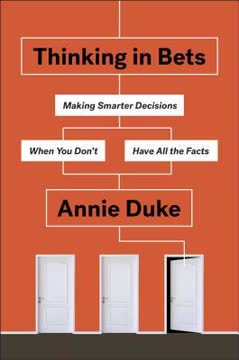
What's Thinking in Bets about?
- Decision-Making Focus: Thinking in Bets by Annie Duke explores decision-making in uncertain environments, using betting as a framework to analyze choices. It compares life to poker, where outcomes are influenced by both skill and luck.
- Learning from Outcomes: The book emphasizes understanding the difference between luck and skill to improve decision-making. By treating decisions as bets, individuals can better evaluate their choices and learn from results.
- Practical Strategies: Duke provides strategies for separating decision quality from outcome quality, encouraging readers to embrace uncertainty and think probabilistically.
Why should I read Thinking in Bets?
- Enhanced Decision-Making: The book helps improve decision-making skills by teaching readers to recognize and mitigate biases, leading to more rational choices in personal and professional contexts.
- Real-World Applications: Concepts are applicable across various fields, including business and finance, helping readers navigate uncertainty more effectively.
- Engaging Narrative: Duke's experiences as a professional poker player make the book informative and entertaining, illustrating complex concepts in an accessible way.
What are the key takeaways of Thinking in Bets?
- Life as Bets: Every decision is a bet on an uncertain future, encouraging evaluation of risks and rewards associated with choices.
- Avoiding Resulting: Duke stresses not equating decision quality with outcomes, understanding that luck plays a role, which helps in learning from experiences.
- Embracing Uncertainty: The book advocates for accepting uncertainty and encourages saying, “I’m not sure,” leading to better decision-making and belief assessment.
What are the best quotes from Thinking in Bets and what do they mean?
- “Thinking in bets will improve decision-making throughout our lives.”: This quote encapsulates the book's premise that a betting mindset enhances informed choices.
- “We can get better at separating outcome quality from decision quality.”: Highlights the importance of distinguishing between decision results and the decisions themselves for objective learning.
- “I’m not sure” is a vital step to being a better decision-maker.: Emphasizes acknowledging uncertainty, leading to more thoughtful and less reactive decision-making.
How does Annie Duke define a "bet" in Thinking in Bets?
- Broad Definition: A bet is “a choice made by thinking about what will probably happen,” applicable to everyday decisions involving risk assessment.
- Risk and Belief: Involves risking something valuable based on beliefs about future events, encouraging evaluation of outcome likelihoods.
- Decision-Making Framework: Framing decisions as bets allows for better analysis of choices and influencing factors, leading to improved outcomes.
What is the "Buddy System" in Thinking in Bets?
- Collaborative Learning: Involves forming a group committed to truth-seeking and improving decision-making together, holding each other accountable.
- Accountability and Support: Group members provide feedback and challenge beliefs, fostering open-mindedness and reducing biases.
- Diversity of Opinions: A diverse group combats confirmation bias and promotes exploratory thought, essential for accurate and informed decisions.
What is "resulting," and why is it a problem in decision-making?
- Definition of Resulting: Resulting is evaluating decision quality based solely on its outcome, a cognitive bias leading to misjudgments.
- Impact on Learning: Equating outcomes with decision quality can hinder learning from mistakes or overestimating skills, affecting future decisions.
- Example in Sports: Duke uses Pete Carroll’s Super Bowl play call to illustrate resulting, where critics judged the decision based on the negative outcome.
How can I separate luck from skill in my decision-making according to Thinking in Bets?
- Fielding Outcomes: Actively analyze decision outcomes to determine influence by skill or luck, asking critical questions about contributing factors.
- Learning Loop: Create a feedback loop to assess decisions and outcomes, identifying growth areas and refining beliefs.
- Embrace Uncertainty: Accepting luck's role in outcomes allows focus on controllable decision-making processes, fostering resilience and adaptability.
What strategies does Thinking in Bets suggest for improving decision-making?
- Think Probabilistically: Adopt a mindset assessing outcome likelihoods before decisions, clarifying risks and rewards.
- Practice Self-Reflection: Reflect on past decisions and outcomes to identify thinking patterns and biases, improving future choices.
- Engage in Truth-Seeking: Seek diverse perspectives and challenge beliefs for a more accurate world understanding, combating biases.
How does Thinking in Bets address the role of emotions in decision-making?
- Emotional Influence: Emotions significantly impact decision-making, often leading to irrational choices; recognizing this is essential for objectivity.
- Strategies for Managing Emotions: Techniques like stepping back to assess situations rationally help maintain focus on decision-making processes.
- Building Resilience: Understanding and managing emotions builds resilience, allowing better navigation of uncertainty and improved outcomes.
How does Thinking in Bets relate to personal finance and investing?
- Probabilistic Thinking: Encourages applying probabilistic thinking to financial decisions, assessing risks and potential returns for informed choices.
- Long-Term Perspective: Emphasizes maintaining a long-term perspective in investing, focusing on trends and probabilities over short-term fluctuations.
- Learning from Outcomes: Advocates analyzing past investment decisions to refine strategies and improve decision-making.
What role does mental time travel play in Thinking in Bets?
- Future Self-Awareness: Involves envisioning future outcomes and considering current decisions' impact on future selves, enhancing decision quality.
- Regret Anticipation: Anticipating potential regret helps avoid impulsive actions by considering future feelings about decisions.
- Scenario Planning: Encourages imagining possible futures based on current decisions, identifying risks and opportunities for strategic choices.