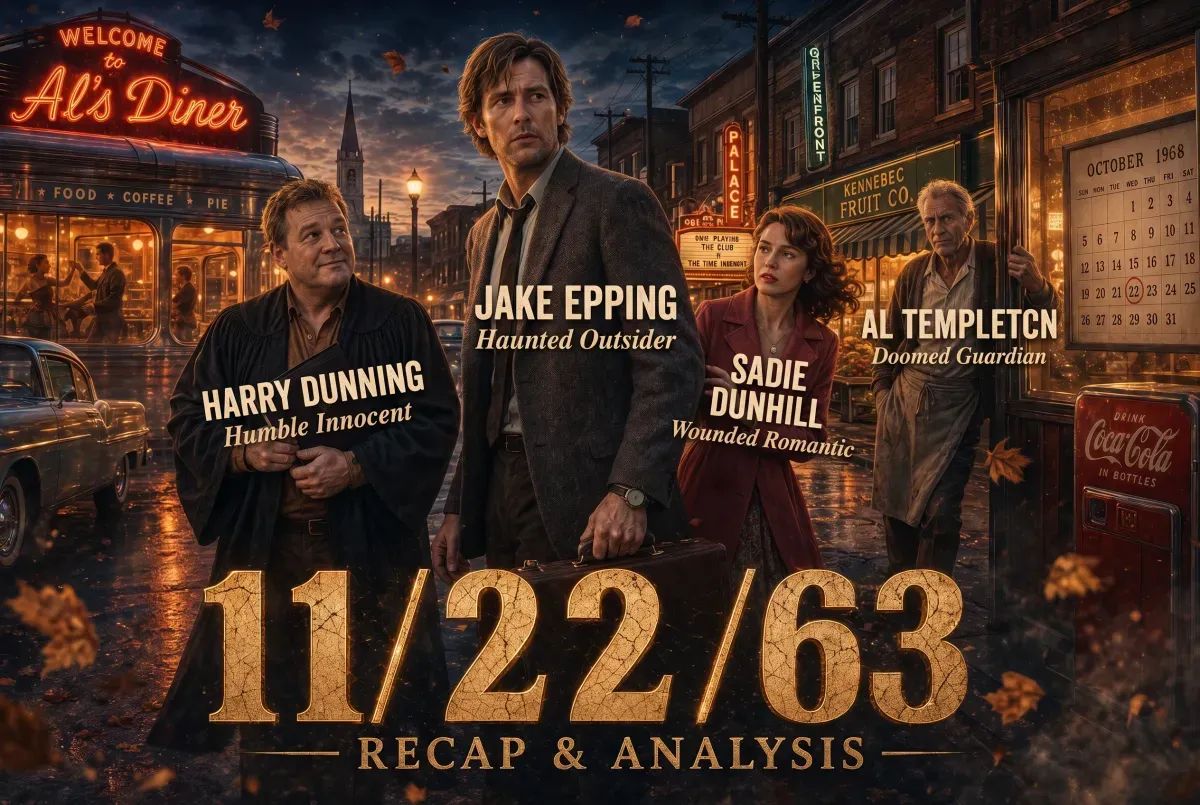


Plot Summary
The Janitor's Father
In the teachers' room at Lisbon Falls High School, English teacher Jake Epping1 grades GED essays and pulls out the one written by Harry Dunning,5 the limping, gap-toothed school janitor. In blotted, misspelled pages, Harry5 describes the Halloween night in 1958 when his drunken father6 burst in with a sledgehammer and slaughtered his mother and two brothers, left his sister dying in a coma, and crippled Harry5 himself.
Jake,1 a recently divorced man who claims he can barely cry, weeps over the pages and awards an A-plus. The story lodges deep inside him. It is the first fracture in his ordinary life, though he cannot yet know that everything terrible and wonderful to come will flow from those tears.
King opens not with spectacle but with grief, locating the novel's moral seed in an act of reading. Jake's tears over a crude essay establish empathy as both his defining trait and his vulnerability: compassion is what makes him exploitable. The janitor's primitive prose, more powerful for its flaws, argues that suffering authenticates testimony. By framing the inciting wound as domestic rather than presidential, King insists history is made of private catastrophes. The chapter introduces the book's governing irony, that a man who claims a nonexistent emotional gradient will sacrifice everything precisely because he feels too much, and that ordinary lives carry the same weight as famous deaths.
The Pantry to 1958
Al Templeton,4 whose impossibly cheap Fatburgers have fed the town for years, phones Jake1 sounding ancient. When Jake1 arrives at the diner, Al4 has lost forty pounds and gone white-haired in a single day, dying of advanced lung cancer. He leads Jake1 to the pantry, where invisible steps descend into a sunlit September afternoon in 1958.
Jake1 walks out behind the old Worumbo mill, drinks a root beer so rich it stuns him, and chats with a teenage Frank Anicetti. He returns convinced of the impossible: the past is real and reachable. Al4 has lived there across many trips, each costing only two minutes in the present. The aging is genuine, the rabbit-hole genuine, and Al4 wants Jake1 for something enormous.
The impossible aging of Al makes time travel visceral before it is ever explained, grounding fantasy in a ruined body. King's nostalgia is double-edged from the first breath: the root beer tastes fuller, but the air reeks of mill pollution. The pantry portal, mundane and domestic, refuses science fiction grandeur, suggesting miracles hide in ordinary places. Al's deterioration previews the novel's central equation, that crossing time exacts a toll on living flesh. The scene seduces both Jake and reader with wonder while planting dread, establishing the seductive danger that will define every descent and forecasting that the past is not a museum but a hungry, living thing.
A Dead Man's Mission
Al4 lays out the rules: every fresh trip resets the past completely, erasing prior changes, and always returns to the same noon in 1958. He has already tested whether history can be altered by saving a girl from a hunting accident, discovering the past resists change in proportion to its importance.
Now, with weeks to live, he reveals his true obsession: stationing himself in Texas to kill Lee Harvey Oswald3 before November 22, 1963, and prevent Kennedy's assassination. He gives Jake1 a notebook of Oswald research, identity papers for an alias named George Amberson,1 and a warning about a strange, mumbling Yellow Card Man11 near the portal. Then, unwilling to give Jake1 time to back out, Al4 takes a fatal overdose, leaving the burden behind.
Al's rules convert wonder into burden. The earlier rescue experiment introduces the obdurate past as a quasi-conscious force, turning a power fantasy into a contest of wills. Al's suicide is morally fraught: he removes himself so Jake cannot reconsider, an act of love and manipulation that models the recurring question of whether noble ends excuse coercive means. By passing the mission as a dying man's request, King binds Jake through guilt rather than conviction. The notebook and alias make the abstract concrete, while the cryptic warning about the Card Man seeds a mystery whose eventual answer will reframe the entire enterprise and its cost.
The Wrongness of Derry
As a trial run before Dallas, Jake1 travels to Derry to save Harry's family.5 The town feels poisoned, haunted by recent child murders and a buried sense of menace. He befriends two fearless kids, Beverly and Richie, who sense his strangeness yet help him locate the Dunnings. He rents rooms, shadows Frank Dunning,6 the handsome, beloved butcher whose charm masks a vicious temper, and confirms the man's hidden brutality toward his estranged wife.
The past fights Jake1 constantly with illness, mechanical failures, and small obstacles, until interfering feels like clawing out of a tightening nylon stocking. He plans to ambush Dunning6 on Halloween, the night the hammer will fall, intending to prove at last that history can be bent.
Derry, imported from King's wider fiction, becomes a moral laboratory where Jake tests both the past's resistance and his own capacity for violence. The town's pervasive wrongness externalizes the corrosion beneath mid-century Americana. Befriending children who intuit his otherness suggests innocence recognizes what adults deny. The nylon-stocking metaphor renders resistance physical and claustrophobic. Crucially, Jake's stalking of Frank Dunning blurs savior and predator: to protect, he must surveil and prepare to kill in cold blood. The chapter rehearses the larger mission in miniature, asking whether intervention is heroism or hubris, and warns that foreknowledge does not guarantee clean outcomes.
The Halloween Hammer
On Halloween night, hidden near the Dunning house, Jake1 is jumped by Bill Turcotte,13 a sickly local who has guessed his target and claims the kill for himself, revealing Dunning6 murdered his sister years before. While they struggle, Dunning6 arrives and storms inside swinging a sledgehammer. Jake1 breaks free, shoots and wounds the butcher,6 but cannot stop him from killing young Tugga.
Turcotte,13 collapsing from a heart attack, drives a bayonet through Dunning's6 back and finishes him. Jake1 saves the mother and the surviving children, including Harry,5 then escapes wounded. The family lives, minus one boy. History has been changed, but brutally and incompletely, and the gentle English teacher1 who wept over an essay has become a killer.
The Halloween climax shatters Jake's fantasy of clean intervention. Turcotte's intrusion proves the past improvises its defenses, conscripting other damaged people into the chaos. That Jake cannot save Tugga despite foreknowledge and a loaded gun enforces the novel's hard truth: changes come partial and blood-soaked. The shared kill with a dying man complicates heroism, making salvation a messy collaboration rather than triumph. King refuses catharsis; the rescue is traumatic and sickening. Jake crosses an irreversible threshold here, learning that rewriting history means absorbing its violence into his own hands, and that the universe makes you pay even when you mostly win.
Becoming George Amberson
Jake1 returns through the rabbit-hole, where only minutes have passed, and finds a photograph on Al's diner4 wall has changed, confirming the butterfly effect. He verifies Harry5 survived. Settling fully into his George Amberson1 identity, he must wait years before Oswald3 returns from Russia.
Using Al's4 almanac of future sports results, he bets to fund himself, but his suspiciously perfect winnings draw a Tampa bookie named Eduardo Gutierrez, who burns down his Florida cottage in revenge.
Wary now of organized crime and the way the past keeps biting, Jake1 keeps moving toward Texas. He is learning that meddling with both money and time attracts punishment, and that inhabiting a borrowed life in a vanished America is exhilarating and perilous in equal measure.
The altered photograph delivers the butterfly effect as evidence, validating Jake's power while hinting at unpredictability. His drift south and reliance on the almanac expose the moral compromise of weaponizing foreknowledge for profit; the burned cottage is the past collecting interest. King threads paranoia through the gambling subplot, showing that even careful meddling ripples into danger. The interval cements Jake's transformation into George Amberson, a man increasingly at home in a fabricated identity. This connective tissue argues that consequence is cumulative and inescapable, that one cannot touch history lightly, and that survival in the Land of Ago demands constant, exhausting vigilance against forces seen and unseen.
Jodie and the Librarian
Jake1 settles in the small town of Jodie, Texas, takes a substitute teaching job, and discovers he loves the classroom more than his secret errand. At a faculty lawn party he literally catches a tall, graceful, accident-prone librarian as she stumbles into his arms: Sadie Dunhill,2 newly arrived from Georgia and quietly fleeing a bizarre marriage.
Their friendship ripens into love through swing dancing and long evenings. Jake1 directs a town variety show that turns a hulking football player named Mike Coslaw15 into a stage star and later raises money to repair a scarred girl's face. For the first time, Jodie feels like home and Sadie2 like a future. But Dallas and Oswald3 still wait, a machine full of teeth he must eventually approach.
Jodie offers the pastoral counterweight, a place where Jake's vocation and capacity for love flower. The teaching subplot reveals his authentic self, the nurturer rather than the assassin, complicating the mission's claim on him. Meeting Sadie literalizes the romance of falling, yet King invests it with genuine tenderness and the recurring grace of dance, which the novel treats as life itself. The variety show and the girl's surgery show Jake reshaping lives for good on a human scale, a quieter form of time-changing. Here the book plants its essential tension: the future he came to alter against the present he has come to cherish.
Listening Through the Wall
Relocating near the Oswalds in Fort Worth and Dallas, Jake1 plants hidden microphones in their cheap apartments and listens to Lee Harvey Oswald,3 the failed defector who beats his Russian wife Marina10 and dreams of revolutionary fame. Jake1 watches Oswald's3 strange, intense friendship with George de Mohrenschildt,9 a flamboyant oil man who eggs on the younger man's resentments.
Al's notebook insists Oswald3 acted alone, but a margin of doubt gnaws at Jake:1 was de Mohrenschildt9 steering Oswald3 toward an earlier attempt on right-wing General Edwin Walker? Jake1 cannot kill Oswald3 until he is certain no conspiracy exists, because eliminating the wrong man would leave Kennedy doomed and force him to begin the whole agonizing journey over again.
Surveillance becomes the novel's moral grey zone, as Jake bugs apartments and shadows a struggling family, justifying intrusion by future stakes. King humanizes Oswald precisely to make the planned killing harder, showing tenderness alongside cruelty. De Mohrenschildt embodies seductive ambiguity, the charismatic intellectual who may be puppeteer or merely a bored provocateur. The unresolved Walker question sustains suspense and ethical paralysis: Jake will not act without certainty, dramatizing the impossibility of perfect knowledge before irreversible violence. This section interrogates the watcher's dilemma, that observation is never neutral and that prolonged proximity to a target slowly erodes the one who watches.
The Broom in the Bed
Sadie's estranged husband,2 John Clayton,7 a science teacher consumed by hygiene rituals and apocalyptic delusions, tracks her to Jodie. While Jake1 is monitoring Oswald,3 Clayton7 invades Sadie's house,2 slashes her face open, and holds her hostage, phoning Jake1 to demand he choose who lives.
Jake1 races back with the elderly retired educator Deke Simmons.8 Clayton7 has already disfigured Sadie2 when they break in; Deke8 hurls a casserole as a distraction, Jake1 disarms the husband,7 and Clayton7 cuts his own throat.
Sadie2 survives but is scarred, depressed, and ashamed. Jake1 suspends the Oswald3 mission to nurse her, paying her medical bills, sleeping on her sofa, and soothing her nightmares. The man who came to save a president1 is nearly undone by love for a wounded woman.2
Clayton's attack collapses Jake's two lives into one catastrophe, proving the past punishes through the people he loves. The broom, Clayton's grotesque emblem of repression and control, returns as literal threat, binding sexual shame to violence. The rescue, improvised and frantic, mirrors the Dunning climax: salvation arrives partial and disfiguring. Jake's choice to suspend the world-historical mission for one wounded woman is the novel's moral pivot, privileging intimate love over abstract duty. King insists the personal outweighs the political in the felt life, even as the calendar marches toward Dallas. Love here is simultaneously redemption and the mission's gravest, most disabling liability.
The Carousel Club Alibi
Determined to close his window of uncertainty, Jake1 disguises himself, poses as a CIA-style operative, and ambushes George de Mohrenschildt.9 He intimidates the oil man9 with threats and inside knowledge, dangling coveted Haitian oil leases as a reward for cooperation. De Mohrenschildt9 produces a newspaper photo proving he was at Jack Ruby's Carousel Club, celebrating his wife's birthday, on the very night someone shot at General Walker.
Terrified, he swears he merely goaded Oswald3 as a game and promises never to contact him again. Jake1 is now nearly certain Oswald3 is the lone gunman. The path to killing Oswald3 before November 22 lies clear, though doubt, like the obdurate past itself, never fully dies and never fully releases its grip.
The confrontation stages Jake at his most coldly competent, weaponizing bluff and inside knowledge like a true operative. The Carousel Club alibi, threaded with Jack Ruby's real presence, exemplifies King's harmonies, history rhyming with itself. By nearly eliminating the conspiracy, the scene clears Jake's conscience for murder while underscoring that certainty stays asymptotic, never quite total. The episode reveals how far Jake has traveled from the weepy teacher, now a man who terrifies and manipulates. King resists tidy conspiracy, advancing his thesis that the disproportion of one small man felling a giant is the unbearable, unsatisfying truth at the heart of the assassination.
Telling Sadie the Truth
As the Cuban Missile Crisis terrifies America, Jake1 finds Sadie2 half-drugged and despairing after her ex-husband7 mailed her photographs of atomic-bomb victims. Drawing on his future knowledge, Jake1 calmly predicts the standoff's peaceful resolution and describes it before it happens. To prove he is no madman, he foretells the result of a fixed prizefight: the aging Tom Case knocking out the favored Dick Tiger in the fifth round.
When it comes true exactly as promised, Sadie2 believes him. A second benefit variety show, where she bravely shows her scarred face to the whole town, deepens their bond. Jake1 finally confesses he comes from the future, and Sadie,2 frightened but resolute, chooses to stand with him whatever he is about to do.
The Missile Crisis sequence externalizes Cold War dread through Sadie's near-suicidal terror, weaponized by her ex-husband's apocalyptic propaganda. Jake's reassurance, grounded in foreknowledge, recasts prophecy as comfort, and the prizefight becomes the proof that converts faith into certainty. King stages belief as the precondition for true partnership: Sadie can fully love Jake only once she accepts his impossible origin. The benefit show, where she bares her scar to the town, dramatizes courage as public self-exposure. By revealing his secret, Jake trades the safety of concealment for the risk of intimacy, choosing connection over caution exactly as the endgame begins to close in.
Beaten and Broken
Returning to a betting parlor triggers a fatal realization: Jake1 has crossed paths with the same mobbed-up Dallas bookie14 linked to the man who burned his Florida house. Akiva Roth's14 enforcers ambush him in his apartment, beating him with a felt-wrapped pipe, shattering his knee, arm, ribs, and skull, leaving him for dead.
He nearly dies of infection at Parkland Hospital and emerges with a wrecked memory, unable to recall Oswald's3 name or location. Sadie2 nurses him through months of grueling rehabilitation, gently coaxing fragments of the truth back into the light.
The assassination date crawls steadily closer while Jake,1 crippled and amnesiac, struggles to reassemble what he knows. The obdurate past has nearly won simply by breaking his body apart.
The mob beating is the obdurate past at its most brutally literal, breaking the body that threatens to break history. Jake's amnesia weaponizes time itself, the deadline advancing while his knowledge dissolves, generating dread from absence rather than action. The long convalescence inverts the rescue motif: now Sadie nurses him, completing a circuit of mutual salvation that defines their love. King grounds the fantastical in the grim textures of 1963 medicine and pain. The chapter argues the universe need not be supernatural to resist change; sometimes obduracy wears the face of ordinary thugs, and heroism becomes nothing grander than the stubborn refusal to give up.
The Race Across Dallas
Recovering his memory only days before November 22, Jake1 flees his rehab center and hides in Oswald's old Fort Worth house,3 where a determined Sadie2 finds him and refuses to let him face the danger alone. On assassination morning the past unleashes a barrage of sabotage: their car's wheel snaps off, a packed bus crashes, a thief tries to rob them, a stolen car blows its engine, and Jake1 must buy a crutch from a roadside beggar.
Limping and bleeding precious minutes, the two improvise their way toward the Texas School Book Depository, where Oswald3 waits at a sixth-floor window. Every escalating obstacle confirms how violently history defends itself against this single, world-altering correction they are desperate to make in time.
The frantic crosstown journey renders the past's resistance as relentless, escalating catastrophe, each disaster intensifying with proximity to the world-altering act. Sadie's insistence on joining transforms her from rescued to rescuer, equalizing their partnership at the decisive hour. King mines genuine suspense from mundane obstacles, blown tires and crashed buses, proving history defends itself with banality rather than melodrama. The accumulating accidents reach a fever pitch, dramatizing chaos theory as physical assault on two ordinary bodies. Limping and improvising, Jake embodies the thesis that significant change demands disproportionate suffering, and that the universe charges an ever-steeper toll the closer one comes to rewriting it.
Six Floors Up
Jake1 and Sadie2 talk their way into the Depository and climb six flights, Jake1 hauling himself on a crutch with his ruined knee. On the sixth floor they find Oswald3 socking his rifle to his shoulder as Kennedy's motorcade turns onto Elm Street. Jake1 shouts and fires, spoiling the killing shot; Oswald's3 bullet flies wild and the president is saved.
Police marksmen below cut Oswald3 down at the window. But as Jake1 stumbles, Oswald's3 last round strikes Sadie,2 who is right behind him. She dies in his arms, asking only whether the president is safe and remembering how they danced. Kennedy lives; the woman Jake1 loves does not. The mission succeeds at the most unbearable price imaginable.
The climax delivers triumph and devastation in a single breath, refusing to let salvation come free. Saving Kennedy costs Jake the woman he loves, an exchange the novel deliberately frames as unfair, as a grieving Deke will later insist. Sadie's dying question about the president and her final memory of dancing fuse the political and the personal into intolerable cost. King structures the scene as a near-mirror of the actual assassination, with the obdurate past claiming its blood elsewhere. The lone-gunman truth holds: one small man, stopped by another small man, at incalculable private expense. Here heroism becomes indistinguishable from grief and loss.
The World He Broke
Hailed as a hero and even thanked by phone by a grateful Kennedy, Jake1 slips free of the FBI's careful management and returns through the rabbit-hole to 2011. He finds a devastated world: earthquakes tearing the planet apart, nuclear wars fought and lost, a poisoned, lawless America where Maine has fled to Canada.
A new guardian, the Green Card Man, explains that each trip and each saved life adds strings to time's instrument, multiplying eerie harmonies until reality itself begins to shatter.
Visiting an aged, wheelchair-bound Harry Dunning,5 Jake1 hears the grim alternate history his meddling unleashed. Saving the president did not heal the future; it broke it. To prevent total annihilation, he must now undo every single thing he accomplished.
The ruined 2011 detonates the novel's thesis: tampering with history purchases apocalypse, not utopia. King literalizes consequence as a planet tearing apart, recasting the saved president as a catastrophic miscalculation. The Green Card Man's exposition reframes every earlier harmony as a symptom of accumulating damage, retroactively darkening the whole enterprise. The aged Harry Dunning, surviving into a nightmare, embodies the cruel irony that even Jake's first rescue helped feed the ruin. This reversal interrogates the seductive fantasy of fixing the past, arguing that history's terrible events may be load-bearing, and that arrogance dressed as compassion holds the power to unmake everything it touches.
Letting the Past Win
Jake1 goes back one last time to September 1958, knowing a complete reset will erase every change, including Sadie's rescue2 and Kennedy's survival. He hides in a roadside motor court and writes the manuscript that becomes this book. Tormented, he considers slipping into Jodie merely to meet Sadie2 again and shield her from Clayton,7 but he realizes every life he alters spawns more catastrophic harmonies, and that even saving her could doom reality.
With anguish he tears up the warning postcard he wrote to protect her, buries his manuscript in a steel box, and walks back to the rabbit-hole. He lets the past close, sacrificing the woman he loves2 so that the world itself can go on existing.
The final reset is the novel's most painful act of moral maturity, trading personal love for cosmic survival. Jake's temptation to merely meet Sadie again, altering nothing but their two lives, exposes how even modest selfishness threatens reality once harmonies multiply. Tearing up the protective postcard is his surrender of the savior's role, an acceptance that some intervention, however loving, is forbidden. By burying the manuscript, King frames the entire book as Jake's confession and farewell. The chapter argues for humility over control, for grieving acceptance over endless revision, and for the terrible wisdom of finally letting the past remain obdurate and unchanged.
Epilogue
In a restored 2012, Jake1 discovers Sadie2 survived John Clayton7 after all, because in the untouched timeline Deke8 and the principal Ellen Dockerty still rescued her in time. She never remarried, became a beloved Texas legislator and librarian, and at eighty is being honored as Jodie's Citizen of the Century.
Jake1 travels south, asks an old DJ to play Glenn Miller's In the Mood, and invites the white-haired woman with the faintly scarred cheek2 to dance. She does not recognize him, yet she feels she somehow knows him. As they waltz beneath the party lights, she asks who he is, and he answers only that he is someone she once knew in another life. The music rolls the years away, and they dance.
The restored 2012 grants a consolation the reset seemed to foreclose: in the untouched timeline, Sadie was saved anyway by other good people, implying that ordinary kindness, not time travel, is what truly redeems lives. King resolves his thesis tenderly. The final dance fulfills the novel's central motif, dancing as improvised grace within fixed constraint, where two strangers briefly defeat time without rewriting it. Sadie's flicker of unconscious recognition suggests love leaves residue even across erased timelines. The scene offers neither reunion nor triumph but something humbler and more honest: a beautiful, transient moment of connection before the music, and the time, inevitably ends.
Analysis
11/22/63 reframes the most analyzed assassination in American history as a meditation on whether the past can or should be redeemed. King weaponizes nostalgia: the Land of Ago smells sweeter and tastes fuller, but it also hides poison ivy behind segregation signs and brutality behind small-town smiles. The novel's true subject is not Kennedy but consequence. Jake's1 discovery that history is obdurate, and that every correction generates exponential harmonies, dramatizes chaos theory as moral argument: good intentions untethered from humility are catastrophically arrogant. The book stages the same lesson at escalating scales, from a saved janitor's family5 to a saved president, asking what we owe the dead and whether love justifies playing God. The love story is the secret engine. By making readers fall for Sadie2 and for the gentle rhythms of Jodie, King raises the cost of his own thesis. The deepest cruelty is not that history bites back but that it offers Jake1 a life worth more than his mission. The recurring motif of dancing functions as a counter-argument to determinism: where the obdurate past insists on fixed outcomes, dancing improvises within constraint, a fragile harmony made by human choice rather than imposed by fate. King states plainly that dancing is life. Politically, the book refuses the comfort of conspiracy. Both Jake's1 investigation and King's afterword land on Oswald3 as a lone, grandiose failure, rejecting the consoling notion that something larger must explain something so disproportionate. The dystopian future Jake1 unleashes warns against the fantasy that removing one bullet could purchase utopia, suggesting instead that history's catastrophes may be load-bearing. Ultimately the novel argues for acceptance over control, for living forward rather than rewriting backward. Its final image, two strangers dancing while music rolls back the years, offers neither triumph nor despair but something rarer: grace, briefly, before the time is gone.
Review Summary
11/22/63 is a captivating time-travel novel that explores the consequences of altering history. King masterfully blends historical fiction, romance, and suspense as Jake Epping attempts to prevent JFK's assassination. Readers praise King's meticulous research, character development, and ability to evoke 1950s-60s America. While some found parts slow-paced, most were engrossed by the story's emotional depth and thought-provoking themes. The book's exploration of the butterfly effect and the past's resistance to change resonated with many. Overall, it's considered one of King's best works, appealing to both longtime fans and newcomers.
People Also Read








Characters
Jake Epping (George Amberson)
Time-traveling teacherA recently divorced, emotionally reserved high school English teacher in Maine who insists he is not a crying man. Intelligent, decent, and quietly lonely, he is pulled into an impossible errand that asks him to weaponize his compassion. Operating under the alias George Amberson, he proves resourceful, brave, and increasingly ruthless when love and mission collide. His core drives are a teacher's instinct to repair what is broken and a deep need to matter in the world. He learns that good intentions carry hidden costs, and that the man capable of cold-blooded violence and the man who weeps over a janitor's5 essay are the same person. He narrates with wry warmth shading steadily into dread.
Sadie Dunhill
Accident-prone librarianA tall, graceful, endearingly clumsy school librarian who arrives in Jodie, Texas, fleeing a strange marriage she rarely discusses. Warm, funny, and unexpectedly bold, she becomes the emotional center of Jake's1 Texas life. Beneath her easygoing charm runs deep shame about her sexual inexperience and her failed marriage, instilled by a cold mother and a controlling husband7. She craves honesty and cannot abide secrets, which strains her bond with the secretive Jake1. Her courage grows steadily, from a woman who hides from the world to one who confronts danger directly. She believes love can conquer most obstacles, and she repeatedly dares Jake1 to prove himself worthy of the trust she is risking everything to give him.
Lee Harvey Oswald
Grandiose lone gunmanA semi-educated, grandiose ex-Marine and failed defector who returns from Russia with a Russian wife10 and a head full of socialist ideology and self-importance. By turns a doting father splashing in the bath with his daughter and a cold, prissy wife-beater seething at a world that refuses to recognize him, he strikes Jake1 as both pitiable and monstrous. His paranoia, resentment, and craving to make the world take notice render him dangerous. King depicts him not as a cartoon villain but as a small, damaged man, a wretched waif convinced of his own destiny, poised to alter the course of history through a single act of violence.
Al Templeton
Dying diner ownerThe gruff, devoted owner of a Lisbon Falls diner whose impossibly cheap burgers have fed the town for decades. A former Marine and lifelong smoker, he is obsessive, fiercely patriotic, and willing to stake his life on a single idealistic mission. He discovered the portal and became its first true student. Dying, he transforms into Jake's1 reluctant recruiter and conscience, part mentor, part manipulator, who sets the entire enterprise in motion.
Harry Dunning
Haunted school janitorThe limping, gap-toothed janitor whose painfully written GED essay about his murdered family ignites the whole story. Gentle, humble, and unfailingly kind despite a childhood shattered by violence, he embodies the ordinary lives Jake's1 mission claims to protect, and a living reminder of how private catastrophes shape who we become.
Frank Dunning
Charming, violent butcherHarry's father5, a handsome, popular Derry butcher beloved by the town's housewives, who conceals a savage temper and a history of murder behind a movie-star grin. He represents the menace lurking beneath small-town pleasantness and becomes the first target of Jake's1 experiment in changing the past.
John Clayton
Obsessive, dangerous ex-husbandSadie's estranged husband2, a science teacher consumed by compulsive cleaning rituals, hygiene mania, and apocalyptic statistical delusions. Outwardly mild and physically cowardly, he is nonetheless capable of sudden violence, stalking Sadie2 with a knife and a head full of doom. His repression curdles quietly into obsession and threat.
Deke Simmons
Loyal retired educatorA twice-widowed, retired Jodie school official with a tender heart and an old-cowboy backbone. He becomes a surrogate father to Sadie2 and a steadfast friend to Jake1, exactly the kind of decent older man who arrives when it matters most and asks few questions.
George de Mohrenschildt
Flamboyant oil baronA worldly, theatrical Russian-emigre oil man and possible intelligence asset who befriends Oswald3. Charming, amoral, and self-dramatizing, he goads the younger man's resentments for sport, making him the central question mark in Jake's1 investigation into whether the assassination was the work of one man or many.
Marina Oswald
Isolated Russian wifeLee's3 beautiful young Russian wife, marooned by language and dependent on the kindness of emigre acquaintances, who endures her husband's beatings while trying to raise their daughters. A hostage to circumstance and to him, she is glimpsed by Jake1 as both victim and survivor.
The Yellow Card Man
Unsettling portal guardianA ragged, muttering figure stationed near the time-fracture, the card tucked in his hatband shifting color with his deteriorating mind. He guards the rabbit-hole and embodies the past's resistance and the steep mental cost of meddling with time, a warning Jake1 only gradually comes to understand.
Mimi Corcoran
Sharp-eyed school powerThe perceptive, dry-witted administrator who effectively runs Jodie's high school and coaxes Jake1 into teaching and directing, seeing through his thin cover story while choosing to keep his secret.
Bill Turcotte
Vengeful, ailing localA sickly, hard-drinking Derry man nursing a private grudge against Frank Dunning6, who unexpectedly forces his way into Jake's1 carefully laid Halloween plan and changes its outcome.
Akiva Roth
Mobbed-up Dallas bookieA vicious, crime-connected bookmaker whose grudge over Jake's1 improbable gambling winnings turns his enforcers loose, nearly ending the mission with a pipe and a pair of fists.
Mike Coslaw
Football player turned actorA massive, good-natured Jodie football lineman who discovers a surprising gift for the stage under Jake's1 direction, representing the lives Jake1 quietly reshapes for the better during his Texas years.
Plot Devices
The Rabbit-Hole
Fixed portal to 1958A fissure in time hidden in the pantry of Al's Diner4 that always deposits the traveler at the same noon on September 9, 1958. It launches and sustains the entire mission. Each return to the present costs only two minutes no matter how many years are spent in the past, and each new descent resets all prior changes. King uses it as both engine and trap, a doorway that frees Jake1 to act yet tethers him to a single historical moment. Its physical location and fragility become rising stakes, since destroying the building above it could seal it forever, stranding the traveler in whichever time he happens to occupy.
The Obdurate Past
History resists changeThe governing principle that history actively fights alteration in proportion to how much a given change matters. It is the story's true antagonist, manifesting as sudden illness, flat tires, collapsed bridges, falling signs, and freak accidents that escalate as Jake1 nears world-altering acts. King converts an abstract paradox into visceral suspense: the larger the intended change, the harder reality pushes back, sometimes with lethal force. The device transforms time travel from a power fantasy into a grueling wrestling match against an invisible opponent, and it lends the entire narrative a sense of mounting, almost conscious hostility that dogs the protagonist at every consequential step.
Al's Oswald Notebook
Roadmap and lifelineA blue notebook crammed with timelines, addresses, and future sports results that Al4 compiles before handing the mission to Jake1. It serves as Jake's1 guide and financial lifeline, telling him where Oswald3 will be and how to fund himself through guaranteed bets. But its gaps and Al's4 own lingering doubts about a possible conspiracy drive much of Jake's1 prolonged surveillance and hesitation. The notebook is also a dangerous liability, capable of exposing everything if discovered, which forces Jake1 to hide it carefully. It anchors the fantastical premise in painstaking, plausible research, lending the impossible mission the texture of real historical investigation.
The Color-Coded Cards
Sanity meters of guardiansThe figures stationed near the portal wear cards tucked in their hatbands that shift from yellow to orange to black, or from green to muddy ocher, tracking the unraveling of their minds. The colors externalize the mental cost of holding multiple, contradictory realities in a single brain, and their darkening foreshadows just how degrading and dangerous proximity to the time-fracture becomes. The cards turn an eerie background detail into a clue about the hidden machinery and toll of time travel, eventually revealing that the guardians are men, not monsters, slowly destroyed by the duty of watching over the strings of time.
The Harmonies
Echoes that warn of damageThroughout the novel, events and names rhyme uncannily: repeated diner owners named Templeton4, doubled jump-rope girls, a recurring red-and-white Plymouth Fury, identical phrasings across decades. King calls these harmonies, the past echoing itself, and at first they seem mere atmosphere. Ultimately they are revealed as added strings on time's instrument, multiplied by every change Jake1 makes, building toward a dissonance powerful enough to crack reality apart. The device functions as both poetic motif and structural payoff, transforming pleasant coincidence into existential dread and providing the mechanism by which the protagonist's well-meaning interventions threaten to destroy the very fabric of existence.
FAQ
Synopsis & Basic Details
What is 11/22/63 about?
- Time travel mission: A high school teacher, Jake Epping, travels back in time to 1958 with the goal of preventing the assassination of John F. Kennedy.
- Past's resistance: Jake faces challenges from the past itself, which seems to actively resist his attempts to alter events, creating obstacles and unexpected consequences.
- Love and sacrifice: Amidst his mission, Jake falls in love with Sadie Dunhill, forcing him to balance his historical task with his personal desires and the potential for heartbreak.
Why should I read 11/22/63?
- Intricate time travel: The novel offers a detailed and immersive exploration of time travel, focusing on the practical and emotional challenges of living in the past.
- Historical reimagining: It provides a compelling reimagining of the late 1950s and early 1960s, blending historical events with fictional characters and scenarios.
- Emotional depth: Beyond the plot, the story delves into themes of love, loss, sacrifice, and the moral implications of changing history, making it a deeply moving read.
What is the background of 11/22/63?
- Historical setting: The novel is set against the backdrop of the late 1950s and early 1960s in America, a period of significant social and political change.
- Cultural context: It explores the cultural norms, music, fashion, and societal attitudes of the era, immersing the reader in a bygone time.
- Political intrigue: The assassination of John F. Kennedy and the events surrounding it form the central historical event that drives the plot, highlighting the political tensions of the time.
What are the most memorable quotes in 11/22/63?
- "The past is obdurate.": This quote encapsulates the central theme of the novel, highlighting the resistance the past puts up against change and the challenges Jake faces.
- "Life turns on a dime.": This phrase, repeated throughout the book, emphasizes the fragility of life and the unpredictable nature of fate, especially in the context of time travel.
- "If you're going to change the past, you've got to do it right.": This quote underscores the responsibility and the potential consequences of altering history, a key concern for Jake.
What writing style, narrative choices, and literary techniques does Stephen King use?
- Detailed realism: King employs a highly detailed and realistic writing style, immersing the reader in the sights, sounds, and culture of the past.
- First-person narration: The story is told from Jake's perspective, allowing readers to experience his thoughts, emotions, and moral dilemmas firsthand.
- Foreshadowing and suspense: King masterfully uses foreshadowing and suspense to build tension, hinting at future events and keeping the reader engaged.
Hidden Details & Subtle Connections
What are some minor details that add significant meaning?
- The yellow card: The yellow card that Al gives Jake, with the date of JFK's assassination, is a constant reminder of his mission and the weight of his responsibility.
- The taste of root beer: The recurring mention of root beer, a favorite of Jake's, serves as a nostalgic link to his present and a comfort in the past.
- The "invisible broom": This seemingly minor detail about Sadie's past marriage becomes a powerful symbol of the emotional barriers and secrets that exist between people.
What are some subtle foreshadowing and callbacks?
- Harry Dunning's story: Jake's initial attempt to save Harry Dunning's family foreshadows the larger challenges he will face in trying to alter the past.
- The "obdurate past": The recurring theme of the past resisting change is foreshadowed early on, with minor inconveniences escalating into major obstacles.
- The dance with Sadie: The dance at the school is a callback to the joy and connection Jake experiences, which is later threatened by the weight of his mission.
What are some unexpected character connections?
- Bill Turcotte and Frank Dunning: Bill's personal vendetta against Frank Dunning unexpectedly intersects with Jake's mission, highlighting the interconnectedness of lives in the past.
- George de Mohrenschildt and Lee Harvey Oswald: The complex relationship between these two characters reveals the hidden influences and manipulations that shaped historical events.
- Beverly and Richie's connection to Derry: Their presence in Derry, a town with a dark history, adds a layer of unease and foreshadows the dangers Jake will face.
Who are the most significant supporting characters?
- Sadie Dunhill: Sadie is not just a love interest but a symbol of the life Jake yearns for, and her strength and courage become a driving force in his mission.
- Al Templeton: Al's belief in the power of change and his warnings about the past serve as a constant reminder of the risks involved in Jake's mission.
- George de Mohrenschildt: His shadowy connections and potential influence on Oswald make him a complex and dangerous character, crucial to the plot.
Psychological, Emotional, & Relational Analysis
What are some unspoken motivations of the characters?
- Jake's desire for purpose: Beyond preventing JFK's assassination, Jake seeks a sense of purpose and meaning in his life, which he finds in his mission and his relationship with Sadie.
- Sadie's need for stability: Sadie's past trauma makes her crave stability and love, which she initially finds with Jake, but her need for honesty clashes with his secrets.
- Oswald's search for recognition: Oswald's actions are driven by a deep-seated need for recognition and a desire to leave his mark on history, however misguided.
What psychological complexities do the characters exhibit?
- Jake's moral conflict: Jake struggles with the moral implications of altering history, torn between his mission and his desire for a normal life with Sadie.
- Sadie's vulnerability and strength: Sadie is both vulnerable due to her past trauma and incredibly strong, standing by Jake despite the uncertainty and danger.
- Oswald's instability and paranoia: Oswald's psychological instability and paranoia are evident in his actions and his interactions with others, making him a dangerous figure.
What are the major emotional turning points?
- Jake's decision to stay in the past: Jake's decision to stay in the past and pursue a relationship with Sadie marks a major emotional turning point, shifting his focus from his mission to his personal life.
- Sadie's confrontation with Jake: Sadie's confrontation with Jake about his secrets forces him to confront the consequences of his lies and the impact on their relationship.
- The final confrontation with Oswald: The final confrontation with Oswald is a culmination of Jake's emotional journey, forcing him to make a difficult choice with far-reaching consequences.
How do relationship dynamics evolve?
- Jake and Sadie's love: Their relationship evolves from a tentative connection to a deep and passionate love, tested by secrets, danger, and the weight of Jake's mission.
- Jake and Al's mentorship: Al's role as a mentor to Jake evolves into a more complex relationship, with Jake grappling with the responsibility Al entrusted to him.
- Jake and the past: Jake's relationship with the past evolves from a mission to change it to a struggle to understand and navigate its complexities and resistance.
Interpretation & Debate
Which parts of the story remain ambiguous or open-ended?
- The true nature of the past's resistance: The exact nature of the past's resistance remains ambiguous, leaving the reader to wonder if it's a conscious force or a natural consequence of time travel.
- The extent of the ripple effect: The full extent of the ripple effect caused by Jake's actions is left open-ended, raising questions about the long-term consequences of altering history.
- The possibility of other time travelers: The novel hints at the possibility of other time travelers, leaving the reader to speculate about their existence and motivations.
What are some debatable, controversial scenes or moments in 11/22/63?
- Jake's decision to prioritize Sadie: Jake's decision to prioritize his relationship with Sadie over his mission is debatable, raising questions about his responsibility and the potential consequences.
- The violence against Frank Dunning: The violence Jake uses against Frank Dunning is controversial, raising questions about the morality of his actions and the justification for violence.
- The ending and its implications: The ending, where Jake returns to a changed present, is open to interpretation, with some readers questioning the ultimate success of his mission.
11/22/63 Ending Explained: How It Ends & What It Means
- Altered timeline: Jake returns to a present where JFK was never assassinated, but the world is worse off, highlighting the unintended consequences of changing the past.
- Sacrifice and loss: Jake's decision to return to the past and prevent the assassination ultimately leads to the loss of his relationship with Sadie, emphasizing the theme of sacrifice.
- Acceptance of the past: The ending suggests that the past, with all its flaws, is perhaps best left unchanged, and that the pursuit of a perfect world can lead to unforeseen and negative outcomes.
About the Author
Other books by Stephen King



Download PDF
Download EPUB
.epub digital book format is ideal for reading ebooks on phones, tablets, and e-readers.








































