

Key Takeaways
You are the author of your reality, not its victim
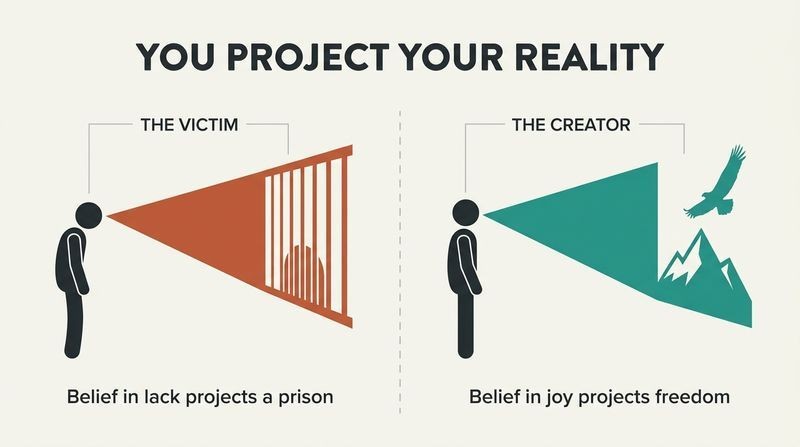
The book's foundational claim, delivered through a channeled voice. Darryl Anka presents these teachings as messages from Bashar, an entity he says represents an extraterrestrial civilization called Essassani that exists in humanity's future. Whether one accepts the framing or not, the operating thesis is blunt: your thoughts, feelings, and beliefs generate the physical experiences you have, without exception.
The universe supports you exactly as far as you believe it can. If you buy into the idea that you can only achieve so much, reality confirms that ceiling instantly. Bashar argues humans habitually cut themselves off from ecstasy, treating joy as a fairy tale and suffering as realistic. The invitation is to stop waiting for permission and reclaim the creative power you never actually lost.
The stance echoes constructivist psychology and the placebo effect, where expectation measurably shapes physiological outcomes. It also anticipates the Law of Attraction popularized decades later. What is worth flagging: taken literally, radical reality-creation can slide into victim-blaming, implying the abused or ill somehow chose their suffering. The more defensible reading treats it as a claim about interpretation and agency rather than metaphysics. The idea that belief precedes experience finds real support in cognitive behavioral therapy, where reframing thoughts reliably alters emotional states. The channeling wrapper is unfalsifiable, but the practical psychology underneath is testable and often useful.
Follow your excitement; it is a compass, not a mood
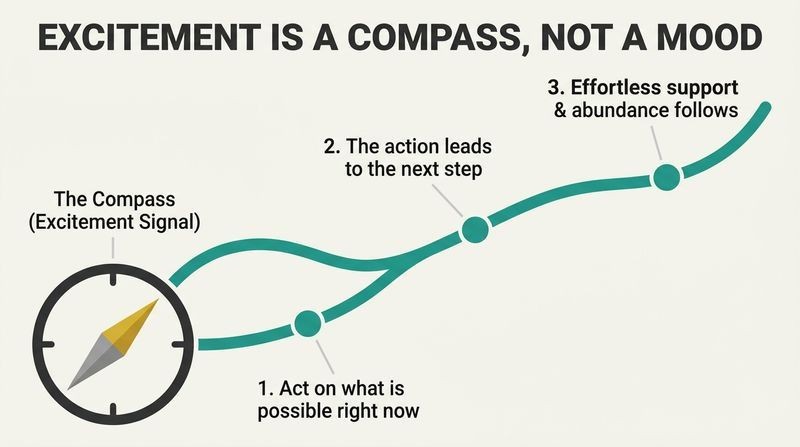
This is the book's single most practical teaching. Bashar defines excitement mechanically: it is the physical sensation that translates the vibratory energy of the path you chose. When something excites you more than anything else in a given moment, that signal is telling you three things at once:
1. This is who you are.
2. Acting on it will feel effortless because you are being yourself.
3. It will attract the support and abundance needed to keep doing it.
Act on whatever excites you most that you can actually act on right now. You do not need a grand life purpose. Follow the strongest impulse available, and it leads to the next one, like a thread. Excitement is not always jumping up and down; a calm, steady conviction counts too.
This reframes intuition as a navigational instrument, resonating with Mihaly Csikszentmihalyi's flow research, where intrinsic engagement predicts both performance and wellbeing. It also parallels Joseph Campbell's follow your bliss. The strength here is present-focus: rather than paralyzing yourself hunting for a singular calling, you act on the strongest available signal. The weakness is that excitement can be hijacked by addiction, impulsivity, or novelty-seeking, which feel identical in the body. Bashar's built-in safeguard is the phrase with integrity, but distinguishing authentic excitement from dopamine-chasing requires the very self-knowledge the practice is meant to build.
Believing is seeing, so act as the person you want to be
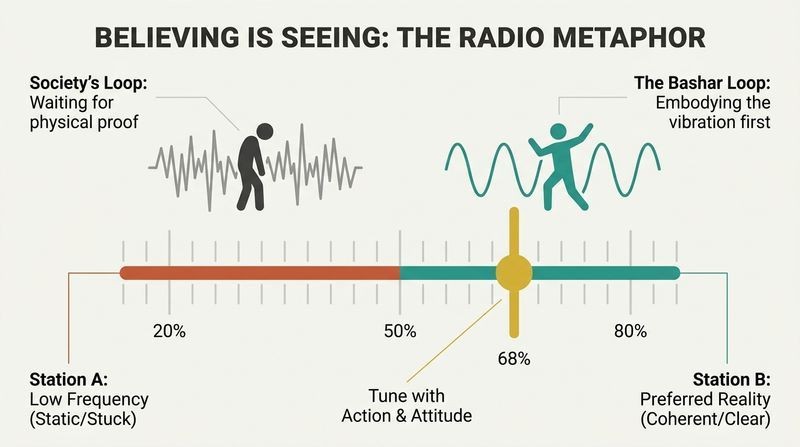
Society teaches seeing is believing; Bashar inverts it. You only perceive what you are already the vibration of. The outer world is an echo of an inner belief, so waiting for external proof before changing your self-image keeps you stuck in the old reality. The belief comes first; the manifestation follows.
The actionable move is to embody the identity now. If you can imagine being a certain kind of person, that capacity to imagine it is itself proof you are already that vibration. He uses a radio analogy: all stations broadcast simultaneously, but you only hear the one your dial is tuned to. All possible versions of your life already exist. Tune yourself, through action and attitude, to the one you prefer, and its details assemble around you.
The radio-and-frequency metaphor is a vivid, teachable model, and the identity-first prescription aligns closely with modern habit science, where James Clear argues behavior change works best when anchored to identity (I am a runner) rather than outcomes. Social psychology's self-fulfilling prophecy and Amy Cuddy's fake it till you become it research lend partial support. The overreach is the many-worlds claim that every version of your life literally exists and you switch tracks. That borrows the language of quantum physics without its math. Stripped of cosmology, the usable core is simple and sturdy: rehearsed identity reshapes perception and action.
Guilt, not hate, is the true opposite of love
Bashar reframes guilt as the master tool of self-limitation. Love, in his definition, is complete self-worthiness and creative flow. Hate is love's dynamic polarity, still containing a sense of deserving. Guilt is different: it is the total absence of deservability, a denial of your own worth and, he says, of your very existence. Humanity has become uniquely expert at it.
Guilt perpetuates the belief that good things must be earned through suffering. This is why the culture treats no pain, no gain as wisdom and happily-ever-after as childish. Bashar's counter: you do not have to earn what you already own by birthright. Remove guilt from your toolbox and the operating assumption flips. Nothing becomes too good to be true, and nothing too wondrous to be yours.
Placing guilt rather than hate opposite love is a genuinely original move, and it dovetails with clinical findings that chronic guilt and shame correlate strongly with depression and self-sabotage, while healthy self-worth predicts resilience. Brene Brown's distinction between guilt (I did something bad) and shame (I am bad) sharpens this: Bashar's guilt maps closer to toxic shame. The caution is that guilt also serves a prosocial function, signaling when we have genuinely harmed others and prompting repair. Dissolving it wholesale risks eroding accountability. The teaching is most useful against the diffuse, unearned self-condemnation that blocks joy, less so as blanket permission.
Every circumstance is neutral until your meaning charges it
Nothing in your life carries built-in meaning. Bashar insists all situations are fundamentally blank, empty, zero. You supply the interpretation, and the interpretation determines the effect. Positive meaning in, positive effect out; negative meaning in, negative effect out. It is presented as simple mechanics rather than optimism.
His illustration: you reach the train platform as the train departs. The neutral fact is only that you are standing there and the train is moving. The old self rages at the schedulers and stomps off. The new self, trusting that everything serves a positive purpose, stays calm, and in staying calm notices an old friend stepping off that very train. The angry version would have missed the encounter entirely. Meaning is not a reaction to events; meaning generates the events you experience.
This is Stoicism in New Age clothing. Epictetus wrote that people are disturbed not by things but by their judgments about things, and Viktor Frankl located ultimate freedom in choosing one's attitude toward unchangeable circumstances. Cognitive reframing, a core CBT technique, operationalizes exactly this. The missed-friend example is a clean demonstration of how emotional state narrows or widens attention, consistent with Barbara Fredrickson's broaden-and-build theory, where positive affect literally expands perceptual scope. Where Bashar goes beyond the evidence is claiming meaning creates events rather than merely reveals or reframes them. Even the conservative version, that interpretation governs outcome, is powerful daily leverage.
Treat coincidence as design, then act on it with integrity
Bashar reduces his entire philosophy to two steps. First, recognize that everything is synchronicity: no accident exists, and every person, object, and event is present for a reason, even if its relevance is not consciously obvious to you. Second, act on the opportunities that recognition brings, with integrity, meaning as a whole and self-sufficient being who does not need to dominate or force anyone.
These two steps feed each other in a loop. Acting with integrity generates more conscious awareness of synchronicity, which generates more opportunities to act, accelerating indefinitely. He warns against over-analyzing every detail; the point is not to decode each leaf on a tree but to trust that what stands out is what you need, and move on it. Negative synchronicity exists too: fearful beliefs attract their own confirmations.
Bashar borrows Jung's term synchronicity, meaningful coincidence, but universalizes it into a claim that nothing is random. Psychologically this is double-edged. Seeing pattern and significance boosts motivation and what researchers call sense of coherence, which correlates with health and longevity. But the same tendency is apophenia, the perception of meaningful connections in noise, and can fuel magical thinking or conspiracy. The integrity clause is the redemptive constraint: it rules out the manipulation and grandiosity that pure you-create-everything thinking can breed. The instruction to act rather than endlessly interpret is genuinely wise, echoing the difference between rumination (harmful) and engaged problem-solving (helpful).
Fear and excitement are one energy; judgment splits them
Bashar claims fear and excitement are physiologically the same vibration. The only difference is the judgment you layer on top. This means you never have to eliminate the energy of fear, only reinterpret it. The moment you get curious about what a fear is showing you, the fear dissolves into excitement.
Fear is reframed as a messenger, not an enemy. It taps you on the shoulder to reveal a buried belief you did not know you held, offering you the chance to integrate it. If you reject the message, the fear lingers and grows, like an unwanted houseguest you keep feeding. Accept the message and it leaves. His advice for anxiety about anything new: remember it signals you are on the threshold of more awareness, and let it become excitement.
The physiological claim has real scientific footing. Arousal states of fear and excitement share nearly identical bodily markers: elevated heart rate, adrenaline, heightened alertness. Harvard research by Alison Wood Brooks showed that reframing anxiety as excitement (saying I am excited before a performance) measurably improved outcomes versus trying to calm down, precisely because the body is already aroused and relabeling is easier than reversing. This is anxiety reappraisal, now a mainstream performance-psychology tool. Bashar's houseguest metaphor for suppressed fear also aligns with the therapeutic principle that avoided emotions intensify while acknowledged ones diminish. This may be the book's most empirically vindicated single idea.
You already trust 100%; just redirect it toward what you prefer
Bashar rejects the idea that trust is hard. What people call doubt is not an absence of trust, he says, but total, unshakable conviction aimed at a negative reality. You are always trusting fully. The only question is whether you invest that 100% in what you prefer or in what you fear.
The universe gives you exactly what you believe you are ready to handle, no more. If you believe success requires struggle, you get struggle-flavored support. If you believe you deserve effortless abundance, you get that instead, at no extra cost to the universe. He notes that even 99% commitment can fail because the withheld 1% is enough to block the result. And he warns against berating yourself for going slowly, since self-criticism only adds to the delay.
Reframing doubt as misdirected conviction is a clever cognitive judo move: it removes the excuse that one simply lacks the capacity to trust. This resonates with expectancy theory in motivation research and with the documented power of self-efficacy, Albert Bandura's finding that belief in one's ability strongly predicts actual achievement. The observation that harsh self-judgment slows progress is well supported by Kristin Neff's self-compassion research, which shows self-kindness outperforms self-criticism for behavior change. The vulnerable point is the guarantee that belief alone summons outcomes, which ignores structural constraints, luck, and the actions of others. Belief is necessary but rarely sufficient.
Abundance means doing what you want when you want, not just money
Bashar redefines abundance away from a bank balance. Abundance is simply the ability to do what you need and want to do, when you want to do it. Money is one valid tool for that, but not the only one, and often not the shortest route. Abundance flows like electricity, along the path of least resistance, arriving as gifts, trades, loans, or opportunities you did not anticipate.
He diagnoses a hidden belief that blocks it. Many people unconsciously equate wealth with moral bankruptcy, having seen rich people they consider corrupt. That buried equation makes them keep themselves poor to stay good. The remedy is to disassemble the belief consciously: separate abundance from corruption, and deliberately attach it instead to being generous and loving. Broaden your definition and you widen the channels through which support can reach you.
Decoupling abundance from money is both liberating and slippery. The strength: it targets a real psychological barrier, the wealth-guilt some people carry, which behavioral economists and financial therapists confirm can produce self-sabotaging money scripts. Redefining abundance as capability rather than accumulation also aligns with Amartya Sen's capability approach in development economics, where wellbeing is measured by what people can actually do and be, not merely what they own. The critique: the broadened definition can rationalize material precarity, telling someone struggling to pay rent that they are already abundant. Reframing beliefs is valuable, but it does not substitute for income, and conflating the two can excuse inaction.
Your present is not the result of your past
Bashar calls this the single key that unlocks what he terms fourth density. In his cosmology, densities are frequencies of existence: third density is ordinary physical reality, fourth density is the transformational state of consciously creating your reality, and fifth is nonphysical. The doorway phrase is deceptively simple: your present is not caused by your past.
You create the past from the present, not the reverse. Each moment is its own discrete now, unconnected to the last except by the continuity you impose. If you believe your present results from your history, you generate all the linear evidence to confirm it. Change your present self-definition and you stop experiencing anything that supports the old story. This is the mechanism behind living in the moment, needing less memory, and treating each experience as if for the first time.
Philosophically this challenges strict causal determinism and echoes eternalist views of time, where past, present, and future coexist, a position some physicists hold under the block universe interpretation. Therapeutically, releasing the grip of the past resonates with narrative therapy, which helps people rewrite the stories that constrain them, and with the trauma-informed insight that we are shaped less by events than by the meaning we keep assigning them. The obvious tension: causality is real, and denying that consequences flow from prior actions could encourage recklessness. The generous reading is psychological, not physical: your identity today, not your history, dictates how you interpret and act now.
Humanity are Masters of Limitation, uniquely skilled at forgetting its power
Bashar frames the whole human project as a chosen game. Long ago, he says, humanity collectively decided to focus intensely into physical materiality, and that focus brought an unexpected side effect: the ability to forget you created your own reality to begin with. Other civilizations, he claims, literally could not conceive of a being powerful enough to forget its own power. This earned humans a nickname across the cosmos: Masters of Limitation.
The pain is presented as the setup for a rapid awakening. Bashar likens it to a rubber band stretched far into negativity; released, it snaps hard toward the positive. He places humanity at the midpoint of an 80-year transformational age and predicts unusually fast change once integration replaces separation. The severity of the limitation, he argues, is the measure of how strong the positive expression can become.
As metaphysics this is unverifiable, and the book's specific forecasts have aged poorly: a transformed Middle East and world government by 2011-2013, global population falling toward 50 million, open contact with alien civilizations within decades. None occurred, which is instructive about channeled prophecy generally. Yet the underlying reframe has psychological utility. Viewing one's darkest struggles as the raw material for growth mirrors post-traumatic growth research, where many trauma survivors report increased strength and meaning. The rubber-band image captures how contrast can motivate transformation. Treat the cosmic narrative as an empowering myth rather than a prediction, and it functions as a resilience story rather than a testable forecast.
Analysis
Bashar: Blueprint for Change is a channeled New Age text: Darryl Anka presents its contents as telepathic transmissions from an extraterrestrial named Bashar, structured as spontaneous question-and-answer sessions with live audiences. It belongs to a lineage traceable to Jane Roberts's Seth Material of the 1970s and forms a direct antecedent to the Law of Attraction industry that later flourished through works like The Secret. Its intellectual DNA is eclectic: Stoic cognitive control, Jungian synchronicity, Hindu-flavored nonduality (you are All That Is), quantum-borrowed vocabulary, and mid-century human-potential optimism.
Stripped of its cosmology, the book is a surprisingly coherent manual of applied cognitive psychology. Its strongest, most defensible claims (circumstances are neutral until interpreted, fear and excitement share one physiology, identity precedes behavior, self-criticism slows change) find genuine support in CBT, arousal-reappraisal research, self-efficacy theory, and self-compassion studies. The central prescription, follow your excitement, is a usable heuristic for intrinsic motivation and flow.
The liabilities are equally clear. The literal metaphysics is unfalsifiable, and the book's datable predictions failed outright, which should temper any reader inclined to treat channeled prophecy as knowledge. The strongest ethical danger is the totalizing you-create-100%-of-your-reality doctrine, which, applied without nuance, blames the suffering for their suffering and can rationalize material precarity as spiritual abundance. It also underweights structure, luck, biology, and other people's agency.
The honest verdict: read it as transformative self-help wearing a science-fiction costume. The costume is the marketing; the working content is reframing, identity work, present-focus, and emotional acceptance. A discerning reader can extract real leverage by keeping the psychology and holding the cosmology loosely. Its enduring cultural footprint, decades of devoted followers and a vocabulary (excitement, densities, synchronicity) that spread widely, testifies less to alien contact than to how effectively it packaged perennial wisdom for a spiritually hungry, therapeutically underserved audience.
Review Summary
Bashar receives mostly positive reviews, with readers praising its insights on beliefs, manifestation, and consciousness. Many find it life-changing and enlightening, considering it a valuable resource for personal growth. Some readers appreciate the concepts but are less interested in the extraterrestrial aspects. Critics question the channeling claims, while others embrace the alien connection. Overall, readers value the book's teachings on shaping reality and following one's excitement, with some considering it a spiritual guide.
Glossary
Bashar
Channeled extraterrestrial narratorThe entity Darryl Anka claims to channel, presented as a being from the civilization Essassani who exists in humanity's future and one of Anka's past-life connections. Bashar functions as the book's teaching voice, delivering its philosophy through live question-and-answer dialogues and framing itself as reflecting humanity's own creative power back to it.
Essassani
Bashar's home civilizationThe world Bashar describes as home, meaning place of living light. Its inhabitants are portrayed as telepathic, governed by synchronicity rather than politics or economics, married collectively to one another, and transitioning from fourth to fifth density. Bashar presents Essassani as a mirror of the integrated, spontaneous society humanity is moving toward.
Follow your excitement
Act on strongest positive impulseBashar's core practical instruction. Excitement is defined as the body's translation of the vibratory energy of one's chosen life path. Acting on whatever excites you most in the present moment, with integrity, is said to reveal your true self, feel effortless, and attract the support needed to continue, chaining you toward all further excitement.
Densities
Frequency levels of existenceBashar's ladder of consciousness. Third density is ordinary physical reality experienced as separate from self. Fourth density is the transformational, still-physical state of consciously creating your reality and living in the now. Fifth density and above are nonphysical. Moving up means realizing you ARE the dimension you thought you merely lived inside.
Masters of Limitation
Humanity's cosmic nicknameBashar's term for humans, who he says uniquely funneled their creative power into forgetting they possess it, focusing so intensely into physical limitation that they lost awareness of being the creators of their own reality. Framed not as an insult but as evidence of great underlying strength now poised to reverse.
Synchronicity
Everything present for a reasonBashar redefines this Jungian term as the principle that nothing is accidental and every element of experience is one interconnected event seen from different viewpoints. His two-step method: recognize everything as synchronicity, then act on the opportunities it brings with integrity. Negative synchronicity is the same mechanism confirming fearful beliefs.
All That Is
God, infinite creation, everythingBashar's name for the totality of existence, equated with God and the Infinite Creator. Because it is defined as everything everywhere, Bashar argues no being can be outside it; therefore every individual is God expressing and experiencing itself in one of infinite ways. The recognition of this within each person is what he calls the true second coming.
Peace Clock
Daily noon peace meditationA proposed global practice: every person meditates on world peace for one minute at noon in their own time zone, creating a rolling electromagnetic wave of focused intention around the planet, which Bashar claims would accelerate humanity toward harmony and lay foundations for one world.
Limbo State
Point of power, standstillThe apparent standstill when nothing seems to be happening. Bashar reframes it not as your life slowing down but as your perception accelerating to match the speed of your own creation, achieving equilibrium in which events can be moved effortlessly, like a martial artist matching an opponent's momentum. It is living fully in the present.
Deservability
Belief you deserve goodBashar's term for the felt sense of being worthy to receive. He identifies its lack as a central human affliction, the root belief (I deserve negativity, I do not deserve positivity) that blocks people from claiming happiness. Guilt is described as the complete denial of deservability, and reclaiming it is essential to creating a preferred reality.
FAQ
What's "Bashar: Blueprint for Change" about?
- Channeling and Wisdom: The book is a collection of channelings by Darryl Anka, who communicates with an entity named Bashar. It offers insights into various aspects of life and the universe.
- Metaphysical Concepts: It explores new metaphysical ideas, including the nature of reality, consciousness, and the interconnectedness of all things.
- Guidance for Transformation: The book provides guidance on personal and societal transformation, emphasizing self-empowerment and the integration of spiritual and physical realities.
- Future and Extraterrestrial Insights: It discusses the potential future of humanity and the role of extraterrestrial consciousness in our evolution.
Why should I read "Bashar: Blueprint for Change"?
- Expand Your Perspective: The book offers a unique perspective on reality and consciousness, challenging conventional beliefs and encouraging open-mindedness.
- Personal Growth: It provides tools and insights for personal transformation, helping readers to understand and harness their own creative power.
- Spiritual Exploration: For those interested in metaphysics and spirituality, the book offers deep insights into the nature of existence and our place in the universe.
- Extraterrestrial Communication: It presents intriguing ideas about communication with extraterrestrial beings and their influence on human evolution.
What are the key takeaways of "Bashar: Blueprint for Change"?
- Self-Empowerment: The book emphasizes the importance of self-empowerment and taking responsibility for one's own reality.
- Integration of Realities: It highlights the need to integrate spiritual and physical realities for a more holistic understanding of existence.
- Consciousness and Creation: The book explores the idea that consciousness is the fundamental force behind creation and that we are all creators of our own reality.
- Extraterrestrial Influence: It suggests that extraterrestrial beings are involved in human evolution and that open communication with them can aid in our transformation.
What are the best quotes from "Bashar: Blueprint for Change" and what do they mean?
- "You are the creator": This quote emphasizes the book's central theme of self-empowerment and the idea that individuals have the power to shape their own reality.
- "All is one": This reflects the book's message of interconnectedness and the unity of all existence, encouraging readers to see beyond the illusion of separation.
- "Imagination is the bridge": This highlights the role of imagination in connecting the spiritual and physical realms, suggesting that creativity is a key to transformation.
- "Love is the foundation": This quote underscores the importance of unconditional love as the fundamental energy that sustains and connects all things.
How does Darryl Anka channel Bashar?
- Pre-life Agreement: Anka describes channeling as a pre-life agreement made before physical existence, where certain individuals agree to act as channels for higher consciousness.
- Sightings as Triggers: Anka's channeling journey began with sightings of Bashar's spacecraft, which triggered memories of his agreement to channel.
- Telepathic Connection: The connection is established telepathically, allowing Bashar's consciousness to merge with Anka's, creating a third identity that communicates the messages.
- State of Receptivity: Anka enters a receptive state, often described as a trance, to facilitate the flow of information from Bashar to the audience.
What is the "Metaphysics of the Template" in "Bashar: Blueprint for Change"?
- Foundational Structure: The "Metaphysics of the Template" refers to the foundational structure underlying physical reality, described as a double tetrahedron.
- Symbolic Representation: This structure symbolizes the balance and integration of positive and negative energies, forming the basis of all creation.
- Connection to Consciousness: It suggests that consciousness interacts with this template to manifest physical reality, highlighting the role of awareness in creation.
- Unified Field Theory: The template is presented as a unifying concept that connects various scientific and metaphysical ideas, bridging the gap between them.
How does "Bashar: Blueprint for Change" address the concept of reincarnation?
- Simultaneous Lives: The book presents reincarnation as a series of simultaneous lives rather than a linear progression, with all lives existing at once.
- Self-Imposed Karma: It describes karma as self-imposed, chosen by the higher self to achieve balance and growth, rather than a judgmental force.
- Integration of Experiences: Reincarnation is seen as a way to integrate various experiences and perspectives, contributing to the soul's evolution.
- Beyond Linear Time: The book challenges the traditional view of time, suggesting that past, present, and future lives are interconnected and influence each other.
What role do extraterrestrial beings play in "Bashar: Blueprint for Change"?
- Guides and Observers: Extraterrestrial beings are portrayed as guides and observers, assisting humanity in its transformation and evolution.
- Telepathic Communication: The book suggests that communication with extraterrestrials often occurs telepathically, as a precursor to physical interaction.
- Shared Evolutionary Path: It posits that humans and extraterrestrials share an evolutionary path, with mutual benefits from open communication and collaboration.
- Non-Interference Principle: Extraterrestrials respect the principle of non-interference, allowing humanity to evolve at its own pace while offering support when invited.
How does "Bashar: Blueprint for Change" define consciousness?
- Fundamental Force: Consciousness is described as the fundamental force behind all creation, shaping reality through intention and awareness.
- Interconnectedness: The book emphasizes the interconnectedness of all consciousness, suggesting that individual awareness is part of a larger, unified whole.
- Creative Power: It highlights the creative power of consciousness, asserting that individuals have the ability to manifest their desires through focused intention.
- Beyond Physical Limits: Consciousness is portrayed as transcending physical limits, capable of accessing higher dimensions and realities.
What is the significance of imagination in "Bashar: Blueprint for Change"?
- Bridge Between Realities: Imagination is seen as a bridge between spiritual and physical realities, facilitating the manifestation of desires and ideas.
- Tool for Transformation: The book encourages the use of imagination as a tool for personal and societal transformation, unlocking creative potential.
- Dimension of Creation: Imagination is described as a dimension of creation, where all possibilities exist and can be accessed through focused intent.
- Empowerment Through Imagination: By embracing imagination, individuals can empower themselves to create the reality they desire, aligning with their true purpose.
How does "Bashar: Blueprint for Change" approach the idea of self-empowerment?
- Taking Responsibility: The book emphasizes taking responsibility for one's own reality, recognizing that individuals are the creators of their experiences.
- Aligning with Purpose: It encourages aligning with one's true purpose and desires, using them as a guide for decision-making and action.
- Overcoming Limitations: Self-empowerment involves overcoming self-imposed limitations and beliefs, freeing oneself to explore new possibilities.
- Integration of Self: The book advocates for the integration of all aspects of the self, including spiritual and physical, to achieve a state of wholeness and empowerment.

Download PDF
Download EPUB
.epub digital book format is ideal for reading ebooks on phones, tablets, and e-readers.








































