

Key Takeaways
Pain is unavoidable, but suffering is a choice you keep making
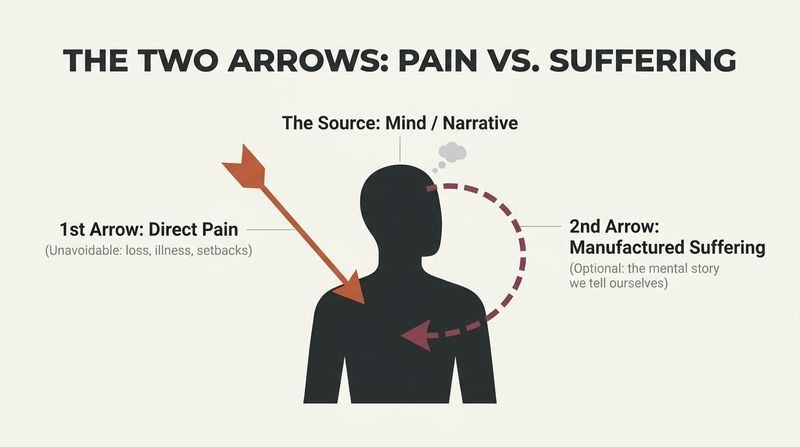
Two arrows, one optional. Nguyen draws on a Buddhist parable: when misfortune strikes, a first arrow causes real pain. But we fire a second arrow ourselves, our reaction, our story about the pain, and that is where suffering lives. Losing a job, illness, betrayal: these hurt. The prolonged anguish afterward is something we manufacture internally.
Psychological, not physical. The author is careful to specify he means emotional and mental suffering, not the bodily pain of the first arrow. He spent years chasing relief through therapy, 4am wake-ups, spiritual retreats, diets, and personality typing, growing more lost, not less. The breakthrough came not from adding techniques but from understanding where suffering originates in the first place, a shift from managing symptoms to removing the source.
The two-arrows distinction maps neatly onto modern cognitive science. Cognitive Behavioral Therapy rests on the same wedge: an activating event, a belief about it, then the emotional consequence. Viktor Frankl located human freedom in the gap between stimulus and response. Where Nguyen departs from CBT is dosage. CBT reframes the second arrow into a more accurate thought; Nguyen wants to stop firing arrows altogether. Worth noting: trauma researchers caution that some suffering is not merely interpretive but somatic, lodged in the nervous system. The clean claim that suffering is fully optional deserves nuance for those carrying genuine trauma, where the body keeps the score regardless of interpretation.
You live inside your interpretations, never inside raw reality
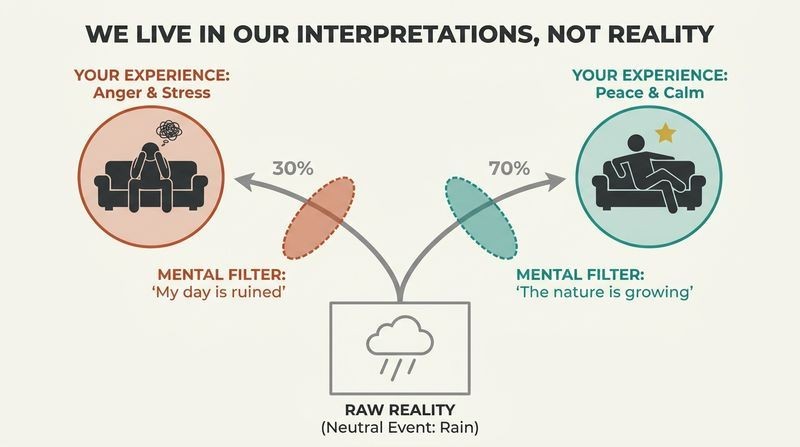
Thought builds your world. Echoing Sydney Banks, Nguyen argues we inhabit a perception of reality, not reality itself. Ask 100 people what money means and you get roughly 100 answers: freedom, security, greed, evil. The dollar is identical; the meaning is manufactured. Ask about a president and get 100 verdicts about one person.
Same event, different experience. Picture yourself fuming about your job while sitting on the couch with family during a comedy. Everyone shares the identical external scene, yet your experience is misery because your thinking imported the office into the living room. Two people can work the exact same job, one calling it a dream, the other a nightmare. The gap is interpretation. This is why someone in a poor country can outshine someone wealthy in contentment: circumstance does not dictate feeling.
This is philosophical constructivism dressed in accessible clothing, and it has deep lineage: Epictetus said men are disturbed not by things but by their opinions about things. Modern affective forecasting research (Daniel Gilbert, Timothy Wilson) confirms we badly overestimate how much external events move our lasting happiness, a phenomenon called the impact bias. Lottery winners and accident victims drift back toward baseline. The caution: constructivism can slide into denying material conditions. Interpretation shapes experience, but structural realities like poverty, discrimination, and chronic illness are not merely thought-forms. The strongest reading keeps both truths: circumstance sets a stage, interpretation writes the script.
Thoughts arrive on their own; thinking is what wrecks you
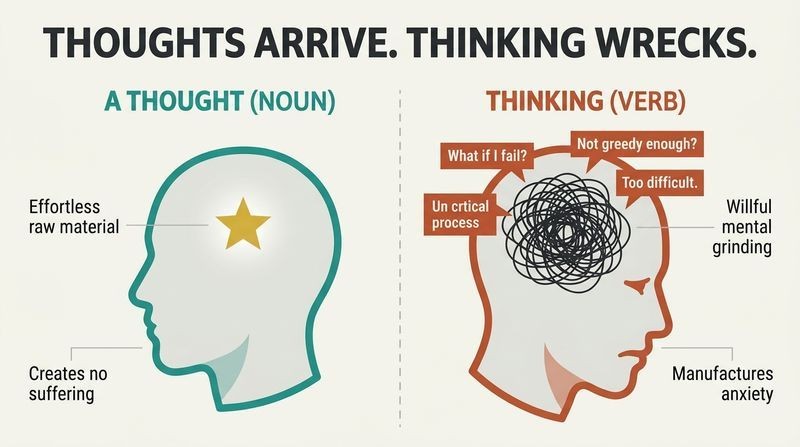
A noun versus a verb. Nguyen's central distinction: thoughts are effortless raw material that simply appear, like a sudden idea popping in. Thinking is the effortful, willful act of chewing on those thoughts, judging them, elaborating on them. Thoughts create. Thinking destroys.
The money experiment. Ask yourself your dream income. An answer surfaces instantly, neutral, maybe even exciting. That is a thought. Now multiply it by five and start deliberating. Watch the avalanche: no way, nobody in my family earns that, that is greedy, I am not capable. That churning is thinking, and it hauls in every limiting belief and criticism you own. The initial thought caused no pain. The mental commentary afterward manufactured the anxiety, unworthiness, and doubt. Nguyen treats emotions as a dashboard: heavy feelings signal you have slipped from receiving thoughts into grinding on them.
The thought/thinking split closely tracks the psychological distinction between cognition and rumination. Susan Nolen-Hoeksema's decades of research show rumination, repetitively rehearsing negativity, predicts and prolongs depression far more than the triggering thoughts themselves. Mindfulness traditions similarly teach observing thoughts as passing weather rather than engaging them. Nguyen's terminology is idiosyncratic, though: cognitive scientists would not call deliberate problem-solving inherently destructive, since analytical thinking builds bridges and cures diseases. The claim is strongest for self-referential emotional rumination and weakest as a blanket verdict on all effortful cognition. Reframing it as ruminative thinking rather than thinking-per-se sharpens an otherwise powerful and usable insight.
Joy is your factory default, revealed only when thinking quiets
Positive feeling needs no positive thought. A common objection: if we feel what we think, must we force positive thoughts? Nguyen says no. Recall your most joyful moment and inspect it. Most people find their mind was silent, or that gratitude arrived after the feeling, not before. The feeling could not have been produced by a thought that came later.
Look at a baby. Absent abuse or illness, infants default to curiosity, delight, and ease, not chronic anxiety. Peace, love, and joy are our native state, uncovered rather than generated. Nguyen offers a thought-o-meter: the more thoughts per minute, the deeper into stress and burnout you redline. Positive emotion is inversely proportional to thinking volume. The prescription is subtraction, not addition. Stop stirring, and contentment surfaces on its own.
This inverts the entire positive-thinking industry, and refreshingly so. Affirmations and forced optimism often backfire: research by Joanne Wood found that repeating I am lovable actually worsened mood in people with low self-esteem. Nguyen's subtraction model resonates with flow research and with meditation studies showing that reduced default-mode-network activity (the brain's self-referential chatter) correlates with reported bliss and ego dissolution. The baby-as-natural-state argument is rhetorically appealing but scientifically shaky; infants also experience distress, and temperament varies genetically from birth. Still, the core move, that wellbeing is an uncovering rather than a manufacturing, is a genuinely liberating reframe for anyone exhausted by the labor of trying to think themselves happy.
Don't filter muddy water; let it settle by leaving it alone
Awareness alone does the work. You cannot force thinking to stop, and trying harder backfires. The move is simpler: notice that you are thinking, recognize it as the source of the bad feeling, and stop disturbing it. Attention itself lets the churn settle.
Two images make it concrete.
1. Muddy water: hand someone a cloudy glass and ask them to clear it. Most say filter or boil. But leave it undisturbed and the sediment sinks on its own. The mind's natural state is clear; agitation keeps it murky.
2. Quicksand: thrash and you sink faster. Relax and your natural buoyancy lifts you. Fighting your thoughts tightens their grip.
Expect to oscillate between thinking and stillness. Nguyen compares it to the sun at night: peace never leaves, it is only temporarily hidden, and always returns.
The passive, allow-it-to-settle instruction aligns strikingly with acceptance-based therapies. Acceptance and Commitment Therapy (ACT) teaches that struggling against unwanted thoughts amplifies them, and lab studies on thought suppression (Daniel Wegner's white bear experiments) prove that trying not to think of something makes it more intrusive. So the quicksand metaphor has real empirical teeth. The subtle risk is that vulnerable readers hear let it settle as suppress or dissociate, which are different and unhealthy. Genuine settling requires facing the feeling without acting on it, closer to mindful acceptance than avoidance. The distinction between allowing and avoiding is the hinge on which this practice succeeds or fails.
You perform best in the wordless zone athletes call flow
Peak output is thoughtless. Nguyen asks what runs through your mind during your best work. The honest answer: almost nothing. When fully absorbed, self-conscious commentary disappears. He equates peak human performance with non-thinking. Elite athletes call it the zone; hesitation, doubt, and overanalysis only intrude when deliberate thinking creeps back in.
Mushin. Japanese martial arts name this mushin, mind without mind: free of anger, fear, and ego, the practitioner reacts instantly from trained instinct rather than calculating the next move. Years of practice get encoded, then thinking would only slow the response. Nguyen's point is that this state is not reserved for a favorite activity or for masters; it is available in any present moment, because reality only exists now, and thinking always drags you into a nonexistent past or future.
This is well-supported territory. Mihaly Csikszentmihalyi's flow research documents the quieting of self-consciousness and distorted time sense during optimal performance, and neuroscientist Arne Dietrich's transient hypofrontality hypothesis proposes that flow involves downregulation of the prefrontal cortex, the seat of deliberate analysis. Sian Beilock's work on choking under pressure shows that explicit attention to well-learned motor skills degrades them, exactly Nguyen's claim. The important caveat mushin itself encodes: flow rests on prior deliberate practice. The samurai reacts without thought precisely because he thought hard for years in training. Non-thinking is the harvest of disciplined preparation, not a shortcut around it, a nuance easy to miss.
Audit your goals: are they born of inspiration or desperation?
Same goal, opposite sources. Wanting a million dollars is neither good nor bad; what matters is where the wanting comes from. Nguyen splits goals into two origins:
1. Desperation: heavy, urgent, scarcity-driven. It feels like you HAVE to. These are usually means goals, wanted for something else (quit the job to escape stress). Achieve them and the emptiness returns within days, so you set a bigger one.
2. Inspiration: light, expansive, a calling. You create because you WANT to, for no further reason, like a painter painting for its own sake.
Children as proof. Kids dream wildly, rarely registering that something is impossible. Adults learn to strangle inspiration the instant thinking labels it unrealistic. Nguyen's unlocking question strips away fear: if you had infinite money, had already traveled everywhere, felt no fear, and got zero recognition, what would you create?
The desperation/inspiration axis rhymes with Self-Determination Theory (Deci and Ryan), which distinguishes extrinsic motivation (rewards, avoidance, external pressure) from intrinsic motivation (inherent interest and enjoyment). Decades of evidence show intrinsically motivated pursuits produce greater persistence, creativity, and wellbeing, empirical backing Nguyen does not cite but could. His infinite-money question is a clever projective tool, related to the death-bed and if-money-were-no-object prompts used by career coaches to bypass status anxiety. One honest tension: many worthwhile achievements demand grinding through unglamorous, uninspired stretches. The purist framing risks romanticizing motivation as always effortless, when even inspired creators report tedious middles. Inspiration lights the fire; discipline often tends it.
Unconditional love has no reasons, because reasons are conditions
The girlfriend who couldn't explain. Nguyen kept asking his partner why she loved him. Her answer never changed: she did not know, she just did. He could list fifty reasons for loving her; she offered none. This bothered him for years until the insight landed: her list was empty precisely because her love was unconditional. Reasons are conditions in disguise. If he loved her for her laugh, he would stop loving her on days she did not laugh.
Creation without conditions. The same logic extends to work. Conditional creation makes something for an ulterior payoff (money, fame, security), so the process feels like grinding and the reward evaporates fast. Unconditional creation is done purely because you want to, and it delivers the wholeness you were chasing while you make it, not after.
The reasons-are-conditions argument is philosophically sharp and echoes debates about the nature of love in ethics. Harry Frankfurt argued that love is not a response to the beloved's valuable properties but a source of value in itself, we do not love because, we simply love, which mirrors Nguyen exactly. There is tension worth flagging: attachment research suggests healthy bonds do involve responsiveness to who a person actually is, not a contentless devotion. Reasonless love could theoretically attach to anyone, which some find hollow rather than profound. The most charitable reading: unconditional love means the commitment does not evaporate when specific traits fluctuate, which is closer to mature, durable attachment than to indifference.
You already know what to do; fear disguises itself as confusion
Knowing masked as not-knowing. Most decision paralysis is not missing information, it is fear wearing the costume of confusion. Want to lose weight? You already know the formula: eat less, move more. The recipe is not written in hieroglyphics. For most life choices, a gut answer already exists; we just distrust it and outsource the decision to everyone around us, which floods us with conflicting opinions and manufactures anxiety.
Intuition as inner GPS. Nguyen frames intuition as a real-time navigation system that guarantees the destination while leaving the route unknown. It arrives as effortless thoughts carrying a sense of knowingness, and it usually contradicts logic, which is the point: predictable paths cannot produce novel results. He notes society rarely validates intuition until it is already mainstream, so seeking external confirmation reliably yields discouragement.
The claim that we usually know but fear blocks action finds support in research on decision-making. Antonio Damasio's somatic marker hypothesis shows that gut feelings, bodily signals from past experience, are essential to sound decisions; patients with damage to emotion-processing brain regions become paralyzed by endless deliberation, unable to choose even trivial things. Gary Klein's studies of firefighters and nurses reveal expert intuition as rapid, accurate pattern recognition. The needed caveat, from Daniel Kahneman: intuition is trustworthy only in domains with valid regularities and sufficient practice. Gut feelings in genuinely novel or rigged environments can mislead badly. Intuition is compressed expertise, reliable exactly where you have earned it.
Guard the what, surrender the how, to the universe
Your job is the destination, not the map. Nguyen argues people burn out because they believe they must engineer every step to their goal. But there are infinite possible routes, and a finite mind cannot compute them. Hold clearly what you want, then release control of how and when it arrives. The path reveals itself only as you start walking; the whole road is never lit in advance, which is why faith matters.
Space precedes creation. Insight comes from emptiness, not effort. Nguyen cites Edison, who dozed holding steel balls so that as he drifted off and they dropped, waking him, a solution surfaced. Einstein reportedly played violin when stuck, and answers arrived unbidden. Empty the cup, like the overflowing-teacup Zen scholar too full of opinions to learn anything new. New ideas need vacancy to enter.
The what-not-how principle has a practical, non-mystical translation that strengthens it. Psychologists studying incubation confirm that stepping away from a problem boosts creative insight; the unconscious keeps processing while conscious effort rests, which explains the shower-thought phenomenon and Edison's hypnagogic trick (now studied formally at MIT as targeted dream incubation). Where the framing gets contentious is surrender to the universe as a delivery mechanism. Skeptics will hear law-of-attraction magical thinking, and outcomes clearly are not guaranteed by faith alone. The defensible core: obsessive control and premature how-planning strangle both creativity and action, and clarity of intention plus tolerance of uncertainty genuinely outperforms white-knuckled micromanagement.
Engineer your environment to trigger less thinking, not more
Peace is partly logistical. Though reality is created inside-out, Nguyen concedes we are spiritual beings in a physical world and our surroundings still nudge us toward or away from mental churn. Rather than adding productivity hacks, subtract triggers. Audit what pushes you into fight-or-flight across four domains:
1. Physical health: foods, stimulants, and drinks that spike anxiety.
2. Physical environment: clutter or spaces that agitate.
3. Digital environment: apps and notifications.
4. Digital consumption: media that winds you up.
Start the day with momentum. He prescribes an activation ritual, a calm morning routine (meditation, walking, yoga) that launches you into stillness before email hijacks you into stress. An object in motion stays in motion; begin peaceful and the day inherits that momentum. For work, rate every task 1 to 10 by energy, cut the drainers, and aim to spend 80% of your time on the 9s and 10s.
This is the book's most concrete, testable advice, and it converges with behavioral design research. James Clear and BJ Fogg both argue environment beats willpower: we do not rise to our intentions, we fall to our surroundings. The trigger audit resembles clinical anxiety protocols that identify and reduce activating stimuli. The morning-routine claim aligns with findings that cortisol peaks shortly after waking, making the first hour disproportionately influential on the day's stress trajectory, so protecting it from reactive inputs like email is physiologically sound. The 80% energy-task target echoes the Pareto principle applied to job crafting. This chapter grounds an abstract, mystical book in refreshingly actionable, environment-level levers anyone can pull tomorrow.
Analysis
Joseph Nguyen's short 2022 self-help book advances one radical, repeated thesis: psychological suffering has a single root, and that root is thinking. The structure is thesis-driven and conversational, alternating Zen parables (the empty boat, heaven and hell, the overflowing teacup) with guided thought experiments and closing implementation frameworks. Its brevity (about 25,000 words) and its promise of a single master-key make it seductive and easy to read, but also make it hard to summarize faithfully, because much of its intended value lives in experiential exercises rather than transferable propositions, and because its vocabulary quietly redefines ordinary words.
The intellectual lineage is explicit: Sydney Banks and the Three Principles movement (Mind, Consciousness, Thought), filtered through Buddhist and Taoist imagery. Nguyen's genuine contribution is the thought-versus-thinking distinction, a clean and usable wedge that maps well onto rumination research and mindfulness practice. His inspiration-versus-desperation goal taxonomy echoes Self-Determination Theory, and his flow material tracks Csikszentmihalyi and transient-hypofrontality neuroscience. These convergences suggest the book intuits real psychological mechanisms even when its explanatory language turns metaphysical.
The weaknesses are the mirror image of its strengths. Monocausality (all suffering equals thinking) is elegant but overreaching; it sidelines trauma, biochemistry, grief, and material deprivation that are not merely interpretive. The frequent slide into Universal Mind, divine downloads, and manifestation will alienate empirically minded readers and risks encouraging spiritual bypassing, using pseudo-enlightenment to avoid necessary feeling or action. The insistence that the truth is always simple can function as an unfalsifiable shield against critique.
Read generously, though, the book is a practical antidote to a specific modern affliction: chronic overthinking mistaken for problem-solving. Its best moves, treating emotions as a dashboard, letting the mind settle rather than forcing it, guarding intention while releasing method, and redesigning environments to reduce triggers, are legitimately useful. The reader who extracts the psychology and holds the metaphysics loosely gains a genuinely calming reframe: you are one noticed thought away from peace.
Review Summary
Don't Believe Everything You Think received mixed reviews. Some readers found it insightful and helpful for managing overthinking, praising its simplicity and powerful message. However, many criticized its repetitive content, lack of scientific backing, and reliance on spiritual concepts. Critics felt the book oversimplified complex issues and failed to provide practical techniques. The writing style was often described as immature and poorly edited. While some appreciated the book's core ideas about mindfulness and letting go of negative thoughts, others found it potentially harmful and lacking substance.
People Also Read



Glossary
Thinking vs. Thoughts
Effortful rumination versus effortless ideasNguyen's central distinction. Thoughts are nouns: effortless, uncontrollable ideas that appear on their own, treated as creative raw material. Thinking is a verb: the willful, energy-consuming act of engaging, judging, and elaborating on those thoughts. Thoughts create and feel light; thinking destroys and feels heavy. In his framing, only thinking, not thoughts, causes psychological suffering.
The Three Principles
Mind, Consciousness, Thought create experienceA model Nguyen credits to Sydney Banks describing how human experience is generated. Universal Mind is the intelligent life force behind all things; Universal Consciousness is the awareness that makes experience perceivable; Universal Thought is the raw material from which we form our perceived reality. All three must operate together for any experience to occur.
Non-Thinking
Present-moment state of no ruminationNguyen's term for the state of allowing thoughts to pass without engaging them, synonymous with flow. In non-thinking you feel peace, love, joy, lose track of time and self, and perform at your peak. It is accessed only in the present moment and is described as the natural default state humans return to when mental churn quiets.
Second Arrow
Self-inflicted reaction to painFrom a Buddhist parable Nguyen uses to open the book. The first arrow is unavoidable pain from an external event. The second arrow is our own reaction and story about that pain, the source of prolonged suffering. Because we fire the second arrow ourselves, suffering (unlike pain) is optional.
Inspiration vs. Desperation Goals
Two opposite sources of goalsNguyen's framework for classifying goals by origin rather than content. Desperation goals feel heavy, urgent, and scarcity-driven, pursued as a means to escape something, and leave emptiness even when achieved. Inspiration goals feel light and expansive, pursued purely because one wants to, as an end in themselves, and deliver fulfillment during the process.
Activation Ritual
Calm momentum-building morning routineA morning routine Nguyen recommends to enter and sustain non-thinking early in the day, such as meditation, walking, or yoga, done before reactive inputs like email. Because an object in motion stays in motion, starting the day peacefully creates momentum that makes it easier to remain in a calm, non-thinking state throughout.
FAQ
What's "Don't Believe Everything You Think" about?
- Exploration of Suffering: The book delves into the root cause of psychological and emotional suffering, suggesting that our thinking is the primary source.
- Inside-Out Understanding: It presents an inside-out understanding of how our experiences are created, emphasizing that our perception of reality is shaped by our thoughts.
- Path to Peace: The author, Joseph Nguyen, offers insights and methods to achieve peace, joy, and fulfillment by altering our relationship with our thoughts.
Why should I read "Don't Believe Everything You Think"?
- Transformative Insights: The book promises to change your perspective on life by revealing the truth about the nature of thoughts and suffering.
- Practical Benefits: Readers have reported significant improvements in various aspects of life, such as increased income, better relationships, and overcoming addictions.
- Universal Appeal: Regardless of your background or current situation, the book claims to offer peace and fulfillment accessible to everyone.
What are the key takeaways of "Don't Believe Everything You Think"?
- Thoughts vs. Thinking: Understanding the difference between thoughts (which are neutral) and thinking (which can cause suffering) is crucial.
- Root Cause of Suffering: The book identifies thinking as the root cause of all psychological suffering.
- State of Non-Thinking: Achieving a state of non-thinking can lead to peace, joy, and a deeper connection with the universe.
How does Joseph Nguyen define the root cause of suffering?
- Thinking as the Cause: Nguyen argues that our own thinking is the root cause of psychological suffering, not external events.
- Perception of Reality: We live in a world of thought, not reality, meaning our experiences are shaped by our perceptions.
- Freedom from Suffering: By understanding and altering our thinking, we can free ourselves from suffering.
What is the difference between thoughts and thinking according to Joseph Nguyen?
- Thoughts as Raw Materials: Thoughts are neutral, energetic raw materials that come to us effortlessly.
- Thinking as Engagement: Thinking involves actively engaging with thoughts, which requires effort and can lead to suffering.
- Creation vs. Destruction: Thoughts are creative and expansive, while thinking can be destructive and limiting.
How can I stop thinking, as suggested in "Don't Believe Everything You Think"?
- Awareness of Thinking: Simply becoming aware that you are thinking can help detach from it and allow it to settle.
- Creating Space: Allow thoughts to pass without engaging with them, creating space for clarity and peace.
- Natural State of Mind: Trust that the mind's natural state is clear and peaceful, and it will return to this state when undisturbed.
What are the Three Principles mentioned in "Don't Believe Everything You Think"?
- Universal Mind: The intelligence behind all living things, connecting everything in the universe.
- Universal Consciousness: The awareness that allows us to experience life and perceive thoughts.
- Universal Thought: The raw material from which we create our experiences, allowing us to think and perceive.
How does Joseph Nguyen suggest we handle goals and ambitions without thinking?
- Inspiration vs. Desperation: Create goals out of inspiration rather than desperation to feel energized and fulfilled.
- Divine Inspiration: Allow thoughts from the universe to guide your goals, rather than relying on past experiences and analysis.
- Natural Flow: Trust that in a state of non-thinking, you will naturally be guided towards your true desires.
What role does intuition play in "Don't Believe Everything You Think"?
- Inner Wisdom: Intuition is seen as a direct connection to infinite intelligence, guiding us without the need for thinking.
- Trust and Faith: Trusting your intuition requires faith in something greater than yourself, allowing for miraculous outcomes.
- Beyond Logic: Intuition often goes against logical thinking but leads to profound insights and decisions.
How can I create a non-thinking environment as per Joseph Nguyen's advice?
- Eliminate Triggers: Identify and remove things that make you prone to thinking, such as stressors and distractions.
- Supportive Environment: Create a physical and digital environment that supports relaxation and peace.
- Morning Rituals: Establish routines that help you start the day in a state of non-thinking, setting the tone for the rest of the day.
What are some of the best quotes from "Don't Believe Everything You Think" and what do they mean?
- "Thinking is the root cause of all suffering." This quote encapsulates the book's central thesis that our own thinking is what causes emotional and psychological pain.
- "We are ever only one thought away from peace, love, and joy." It suggests that by letting go of thinking, we can immediately access our natural state of happiness.
- "The truth is always simple." This emphasizes that understanding and experiencing truth doesn't require complex thinking but rather a return to simplicity.
How does Joseph Nguyen suggest overcoming destructive habits?
- Awareness and Acknowledgment: Recognize the habit and the thinking patterns that trigger it.
- Insight and Understanding: Seek insights from your inner wisdom to understand the root cause and desire for change.
- Letting Go: Allow yourself to release the thinking and beliefs that sustain the habit, creating space for positive change.
Download PDF
Download EPUB
.epub digital book format is ideal for reading ebooks on phones, tablets, and e-readers.








































