


Key Takeaways
Your real opponent isn't the field, it's fear itself
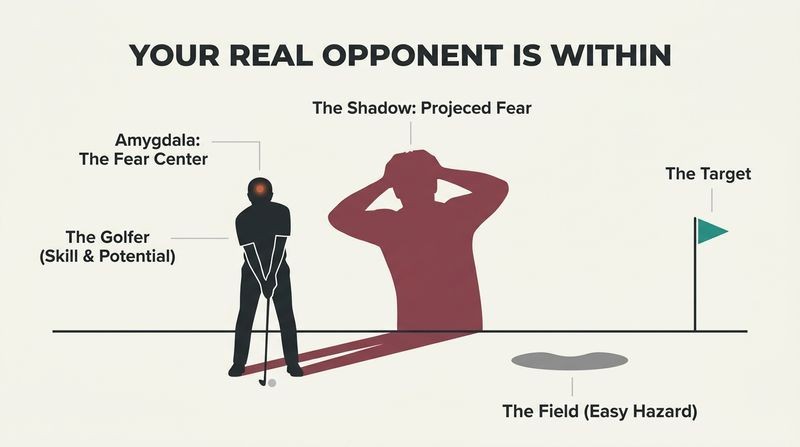
Fear sabotages skill you already have. Sports psychologist Gio Valiante studied dozens of PGA Tour champions and found that the difference between choking and thriving is not talent but fear management. Fear is not merely mental. It triggers the body's fight-or-flight response through the amygdala, the brain's ancient alarm system that overrides rational thought in a fraction of a second, faster than the cortex can process the word for what threatens you.
Even Jack Nicklaus lost the 1960 U.S. Open partly because fear froze his thinking on a short putt. Valiante uses a driving analogy: your first time behind the wheel was terrifying, but experience bred calm confidence. The same conquest of fear can transform your golf, one round at a time.
The framing echoes FDR's line about fearing fear itself, but Valiante grounds it in neuroscience that holds up. Joseph LeDoux's amygdala research confirms the fast, subcortical fear circuit Valiante describes. What's notable is his refusal to pathologize nerves. This aligns with modern performance psychology (Yerkes-Dodson) showing moderate arousal improves output. A useful caution: not all fear is irrational. In genuinely high-stakes contexts, some vigilance is adaptive. The golf setting is instructive precisely because the physical danger is near zero, isolating fear as pure self-sabotage and making it a clean laboratory for studying performance anxiety across any domain.
Play to master the course, not to impress the crowd
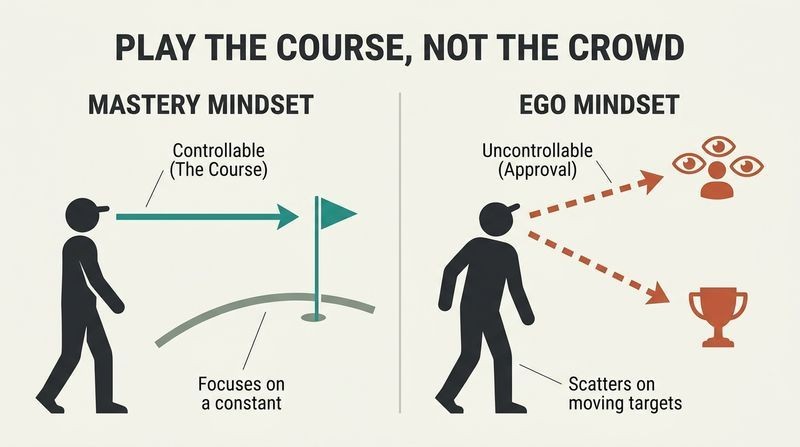
Two motivations, opposite results. Valiante splits golfers into mastery-oriented and ego-oriented. Mastery golfers play to learn, refine, and conquer the course itself, treating each shot as a puzzle. Ego golfers play to win approval, avoid embarrassment, and beat other people. Only the mastery mindset produces fearless play, because its attention stays on things within control.
He borrows the Japanese concept of kaizen, continual improvement regardless of performance. Nick Price described refining his swing yearly like sanding a wooden block toward a perfect circle. Ben Hogan claimed his true secret was concentration, not mechanics. Ego golfers, by contrast, get consumed by rankings, prize money, and who is watching, which divides the mind. When you play the course, you compete against a constant. When you play people, you chase a moving target.
This maps almost perfectly onto Carol Dweck's growth versus fixed mindset and Deci and Ryan's self-determination theory, where intrinsic motivation predicts persistence and wellbeing better than extrinsic rewards. Valiante's contribution is showing the mechanism in real time: ego questions divide attention, and divided attention wrecks fine motor execution. The counterpoint worth raising is that elite competitors are rarely pure mastery types. Michael Jordan and Tiger Woods were famously fueled by slights and rivalry. Valiante concedes orientation is a matter of degree, which is the honest position. Ego can ignite effort even as it corrodes composure under pressure.
Ask "What's my target?" to shut down the fear spiral
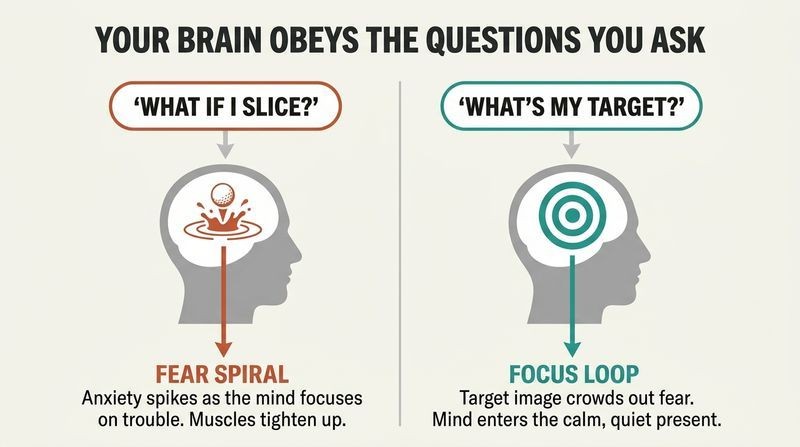
Your mind obeys the questions you ask it. Valiante's central practical tool is the guiding question. The brain automatically answers whatever you ask and often returns the answer as a vivid image. Ask "What if I slice?" and you instantly picture the ball sailing into trouble, spiking anxiety. Ask "What's my target?" and your mind locks onto a specific spot in the distance, crowding out fear.
He recommends three questions at three moments:
1. Before the round: What are my obstacles and strategy?
2. On the tee: What is the best way to play this hole?
3. Over the ball: What's my target?
Jack Nicklaus reduced his entire mental game to two: How am I going to win this tournament, and how do I want to play this shot. The target question becomes a mantra that pulls you into the present.
The insight that questions direct attention and generate imagery anticipates work in cognitive behavioral therapy and self-talk research, where interrogative self-talk ("Will I?") often outperforms declarative self-talk ("I will") in motivating action, per Senay and Ibrahim's studies. Valiante's version is subtler: he wants task-focused questions that eliminate outcome thinking entirely. There is a neat parallel to attentional control theory, which holds that anxiety consumes working memory unless attention is anchored to task-relevant cues. One limitation: novices may lack the skill to pick a good target or execute toward it, so the question presupposes competence it cannot supply.
Confidence is belief you can execute, not liking yourself
Self-efficacy is the engine of fearless play. Valiante borrows psychologist Albert Bandura's concept of self-efficacy: the specific belief that you can organize and carry out the actions a situation demands. He sharply distinguishes it from self-esteem. Self-esteem is how you feel about yourself; self-efficacy is a cognitive judgment about what you can do. A golfer can dislike himself yet believe utterly in his putting stroke.
Gary Player told Valiante that Nicklaus was not the best ball-striker of his era, but nobody matched his confidence under pressure, and that won the majors. Self-efficacy determines which goals you set, how hard you persist, and how fast you recover from failure. Crucially, belief must track reality: a confident golfer lacking skills is just a confident fool. Confidence and competence must grow together.
Grounding confidence in Bandura rather than pop-psychology self-esteem is one of the book's strongest moves. Decades of research (including Baumeister's 2003 review) found self-esteem barely predicts performance, while self-efficacy robustly does. Valiante's "confident fool" caveat matters: efficacy beliefs work only when calibrated, though Bandura also found slight overconfidence optimizes effort. The domain-specificity is key and often missed. Efficacy does not transfer wholesale; a surgeon confident in the operating room may panic giving a wedding toast. For golfers, this means confidence must be built shot-type by shot-type, not summoned as a global mood, which explains why generic pep talks so often fail.
Build confidence from four sources, above all past mastery
Confidence has traceable roots. Valiante identifies four sources of self-efficacy, in order of power:
1. Mastery experiences (past successes are the strongest)
2. Vicarious learning (watching models succeed)
3. Verbal persuasion (encouragement from trusted people)
4. Physiological states (how you read your body's signals)
Curtis Strange traced his lifelong belief to one clutch 1-iron he hit to win the NCAA as a freshman; he returned to that memory for decades. The lesson: winning breeds winning, so bank and replay your successes rather than your failures. Hogan admitted he remembered bad shots more vividly than good ones, a habit that likely eroded his putting. Because experience is always a mix of success and failure, you get to choose which memories you feed and how you frame them.
This is Bandura's four-source model applied faithfully, and the ranking (enactive mastery first) is exactly what the literature supports. The practical genius is the reframing angle, which connects to Howard Gardner's work on how high achievers narrate setbacks advantageously. There is a memory-science wrinkle Valiante intuits: negative events are encoded more strongly (the negativity bias documented by Baumeister and Rozin), so deliberately rehearsing successes is a countermeasure against the brain's default. A challenge worth noting: selectively remembering only good shots risks miscalibration, the very overconfidence he warns against elsewhere. The resolution is honest framing, not delusional editing.
Don't kill nerves, learn to swing beautifully while nervous
Arousal is neutral until you interpret it. Valiante's client Don Snider begged to be taught how to stop feeling nervous. Valiante refused, teaching him instead to hit shots while nervous, which paradoxically dulled the nerves. Every champion, including Tiger Woods and Nicklaus, feels a churning stomach and shaking hands on the first tee. Tom Kite said flatly that if you are not scared, it means you do not care.
The difference between psyched up and psyched out is interpretation. Low self-efficacy makes a golfer read a racing heart as fear, producing norepinephrine that tightens muscles, constricts the hands, and triggers a downward spiral of tight grips, quick tempo, deceleration, and blocked shots. High self-efficacy reads the same sensations as excitement and readiness, and the body stays loose. Same physiology, opposite outcome.
This is arousal reappraisal, now well supported by Alison Wood Brooks's experiments showing that saying "I am excited" beats "I am calm" before high-pressure tasks, and by Jeremy Jamieson's work reframing stress arousal as functional. Valiante was ahead of the popularization curve. The physiological chain he describes (norepinephrine, capillary constriction, grip pressure) is largely accurate, though the causal story is simplified. The deeper wisdom is acceptance over suppression, which parallels ACT (Acceptance and Commitment Therapy). Trying to suppress an emotion often amplifies it, per Wegner's ironic-process theory. Telling yourself not to be nervous reliably makes you more nervous.
Recover from a bad shot instantly by hunting the next target
Greatness lives in the misses, not the makes. Valiante points to the PGA Tour's bounce-back statistic, the rate of following a bogey with a birdie. In 2000, Tiger Woods bounced back better than one time in three. The mark of a resilient mind is speed of recovery, the same metric biologists use to gauge the health of a coral reef or a trained athlete's heart rate.
When Valiante asked Nicklaus about hitting a ball out of bounds while leading the 1984 Memorial, Jack said he had no time to dwell because he was already busy asking what he needed to do to win. His son said Jack simply does not remember his mistakes; in his mind they never happened. The psychologically weak golfer replays failure like a bad movie, feeding a self-reinforcing collapse.
Recovery speed as the true marker of mental fitness is a powerful reframe, echoing research on emotional regulation and rumination. Susan Nolen-Hoeksema's work shows rumination predicts depression and impaired problem-solving, while quick cognitive disengagement protects performance. The coral-reef and cardiovascular analogies are more than rhetorical; ecological resilience science genuinely defines health by recovery rate after disturbance. One nuance: Nicklaus "forgetting" mistakes sounds like denial, but it is better understood as strategic non-elaboration, declining to encode the event with emotional weight. The risk is failing to learn from real errors, which is why Valiante pairs in-round amnesia with rigorous post-round analysis.
Blame the right cause, because wrong diagnosis wrecks improvement
Attributions determine what you fix. Valiante uses attribution theory: the reasons we assign to success and failure shape our next actions, and they are based on perceived rather than actual causes. He classifies attributions along three axes: stable or unstable, internal or external, controllable or uncontrollable. The healthiest attributions are internal, controllable, and changeable, like effort and preparation.
A golfer who blames a putter for missed putts buys a new putter but keeps his flawed setup, then spirals into lost confidence. A student who blames a mean teacher never fixes bad study habits. When his client John played his worst round in years, he first blamed mechanics and equipment, then admitted the truth: he had skipped his practice round. Battles are won before they are fought. Blame ability or luck and you surrender; blame preparation and you gain a lever.
This is Bernard Weiner's attribution theory rendered practical, and the controllability dimension is what matters most for motivation, as Weiner's research confirms. The link to Dweck reappears: attributing outcomes to fixed ability breeds helplessness, while attributing them to effort sustains engagement. Valiante's clinical eye catches a subtle trap, the self-serving bias Freud flagged, where we credit ourselves for wins and blame externals for losses. Interestingly, elite performers like Curtis Strange invert this, blaming themselves even for uncontrollable outcomes, which preserves a sense of agency. That may be technically inaccurate but psychologically adaptive, a productive illusion of control that fuels persistence.
Practice perfectly, because sloppy reps groove permanent flaws
Practice makes permanent, not perfect. Valiante draws on William James's laws of habit: much of adult behavior runs on automatic pilot, and habits eventually override conscious choice. This cuts both ways. Ben Hogan built a repeatable swing by hitting every practice shot with full concentration and a clear purpose, treating his round as beginning the moment he pushed open the locker room door.
The average golfer who rakes 300 balls carelessly may groove several different swings and inconsistency itself, then default to those flaws under pressure. Vince Lombardi corrected the cliche: only perfect practice makes perfect. James's maxims for change: launch a new habit with maximum intensity, never allow an exception until it takes root, and act on it at every opportunity. Because habits harden with age, cultivating good ones early beats fighting bad ones later.
The neuroscience has caught up with James and Hogan. Deliberate practice, as defined by Anders Ericsson, requires focused attention on specific weaknesses with immediate feedback, precisely what mindless range-beating lacks. Myelination research shows repeated firing patterns get physically insulated, meaning you literally wire in whatever you rehearse, flaws included. The claim that pressure triggers reversion to dominant automatic patterns aligns with reinvestment theory (Masters and Maxwell), which shows anxiety makes skilled performers regress to older, more ingrained movements. The practical upshot is uncomfortable: hours logged are nearly meaningless; only attentive, purposeful reps build a swing that survives a shaking hand.
Analysis
Fearless Golf occupies an unusual niche: a sports-instruction book that is really an applied psychology monograph, built on Gio Valiante's five-year study of PGA Tour players and anchored in academic sources (Bandura, Weiner, William James, Dweck) rather than locker-room folklore. Its structure is a tight causal chain. Fear is the enemy. A mastery orientation prevents fear. Self-efficacy buffers against it. Guiding questions redirect attention away from it. Correct attributions and deliberate habit-formation sustain the whole system. Each chapter feeds the next, which is why the book reads as an argument rather than a tip list. The intellectual honesty is a strength. Valiante repeatedly hedges: orientations are matters of degree, overconfidence must be calibrated, generalizations are working hypotheses sensitive to local conditions (invoking Cronbach). This makes the science more credible even as it complicates the self-help promise. The weakness is generalizability in the other direction: nearly all evidence is anecdotal testimony from champions, a population selected for success. There is survivorship bias throughout. The players who used these mindsets and still failed do not appear, and correlation between mastery talk and winning may partly reflect that winners narrate more graciously.
Still, the core claims align remarkably well with research that matured after 2005: arousal reappraisal, attentional control theory, growth mindset, deliberate practice, and acceptance-based emotion regulation. Valiante essentially anticipated the practical convergence of these fields around one idea: performance under pressure is governed less by what you feel than by where you point your attention and how you interpret your own body. The book's most transferable lesson has nothing to do with golf. It is that fear thrives on outcome-focused questions about an uncertain future, and it starves when attention narrows to a controllable, present-moment task. That applies to public speaking, surgery, and any arena where competence exists but composure wavers. The recurring refrain, that battles are won before they are fought, reframes preparation as the true site of courage.
Review Summary
Fearless Golf receives mostly positive reviews, with readers praising its focus on the mental aspects of golf. Many find the book's principles applicable to life beyond golf. Readers appreciate the author's use of player commentary and practical advice for improving one's game. Some criticize the book for being repetitive or lacking in practical application. Overall, readers find the book helpful in developing a positive mindset, improving focus, and managing emotions on the course. The book's emphasis on mastery orientation over ego orientation resonates with many readers.
Glossary
Fearless golf
Committed swings at specific targetsValiante's ideal state of play: making decisive, committed swings at precise targets regardless of circumstances, opponents, or pressure. It does not mean the absence of fear, which is impossible, but the ability to acknowledge fear and perform well anyway by keeping attention on the task rather than the threat.
Mastery orientation
Playing to improve and learnA motivational stance in which a golfer plays to learn, refine skills, and conquer the course itself, judging progress against self-set standards. Awards and approval are incidental byproducts. This orientation frees the mind from fear because attention stays on controllable, task-relevant details.
Ego orientation
Playing to impress or avoid embarrassmentA motivational stance in which a golfer plays to win approval, demonstrate superiority, or avoid looking incompetent. Because it fixates on outcomes, other players, and audience reactions, it divides attention and breeds anxiety, tentativeness, and choking under pressure.
Self-efficacy
Belief you can execute tasksBorrowed from psychologist Albert Bandura, the specific cognitive belief that one can organize and carry out the actions a given situation requires. Distinct from self-esteem (how one feels about oneself), it is domain-specific, predicts persistence and performance, and functions best when it slightly exceeds actual ability.
Kaizen
Continual improvement regardless of resultsA Japanese concept Valiante applies to golf: the drive for constant, measured improvement independent of any given day's performance or reward. The kaizen golfer gets absorbed in perfecting the process, treating the game's details as puzzles to master rather than obstacles to fear.
Guiding questions
Task-focused questions directing attentionValiante's core technique. Because the mind automatically answers whatever it is asked, often in images, golfers should ask task-focused questions (What's my target? What is the best strategy for this hole?) rather than fear-inducing ones (What if I slice?). The questions steer attention and crowd out anxiety.
Bounce back
Following a bogey with birdieA PGA Tour statistic measuring how often a golfer follows a bogey or worse with a birdie on the next hole. Valiante uses it as a proxy for psychological resilience, arguing that recovery speed after mistakes, not the quality of good shots, best distinguishes great competitors.
Attribution
Reason assigned to success or failureFrom attribution theory, the perceived cause a person assigns to an outcome. Valiante classifies attributions as stable or unstable, internal or external, and controllable or uncontrollable. Attributing results to controllable, changeable factors like effort and preparation sustains motivation; blaming fixed ability or luck breeds helplessness.
FAQ
What's "Fearless Golf: Conquering the Mental Game" about?
- Focus on Mental Game: The book by Gio Valiante explores the psychological aspects of golf, emphasizing the importance of overcoming fear to play at one's best.
- Fear as the Main Enemy: It identifies fear as the primary obstacle golfers face, whether it's fear of failure, embarrassment, or the unknown.
- Confidence and Self-Efficacy: The book delves into building self-efficacy, which is the belief in one's ability to succeed, as a crucial component of playing fearless golf.
- Practical Strategies: It provides practical strategies and mental exercises to help golfers manage their thoughts and emotions on the course.
Why should I read "Fearless Golf: Conquering the Mental Game"?
- Improve Mental Toughness: The book offers insights into developing mental toughness, which is essential for consistent performance in golf.
- Learn from Champions: It includes anecdotes and lessons from golf legends like Jack Nicklaus and Tiger Woods, providing real-world examples of mental resilience.
- Overcome Common Fears: Readers can learn techniques to overcome common fears that hinder performance, applicable not just in golf but in other areas of life.
- Enhance Overall Game: By focusing on the mental game, the book complements physical training, leading to a more holistic improvement in golf skills.
What are the key takeaways of "Fearless Golf: Conquering the Mental Game"?
- Fear Management: Understanding and managing fear is crucial for peak performance in golf.
- Self-Efficacy Importance: Building self-efficacy is essential for confidence and success on the course.
- Mastery vs. Ego Orientation: The book distinguishes between mastery-oriented golfers, who focus on self-improvement, and ego-oriented golfers, who focus on external validation.
- Effective Practice: Emphasizes the importance of quality practice and developing habits that translate into success during competition.
How does Gio Valiante define self-efficacy in "Fearless Golf"?
- Belief in Success: Self-efficacy is defined as the belief in one's ability to succeed in specific situations.
- Foundation for Confidence: It serves as the foundation for confidence, influencing motivation, emotion, and action.
- Influence on Performance: High self-efficacy leads to better performance as it encourages perseverance and resilience.
- Developing Self-Efficacy: The book outlines ways to build self-efficacy through mastery experiences, vicarious learning, verbal persuasion, and managing physiological states.
What is the difference between mastery and ego orientation in "Fearless Golf"?
- Mastery Orientation: Focuses on personal growth, learning, and self-improvement, regardless of external validation.
- Ego Orientation: Driven by the desire to appear competent and gain approval from others, often leading to fear of failure.
- Impact on Performance: Mastery-oriented golfers tend to perform better under pressure as they are less concerned with external judgments.
- Long-Term Success: The book advocates for a mastery orientation as it leads to sustained motivation and enjoyment of the game.
What are some practical strategies from "Fearless Golf" to overcome fear?
- Guiding Questions: Use guiding questions like "What is my target?" to focus the mind on the task at hand and away from fear-inducing thoughts.
- Visualization Techniques: Visualize successful shots to build confidence and reduce anxiety.
- Routine Development: Establish a consistent pre-shot routine to create a sense of control and calmness.
- Positive Framing: Reframe negative experiences as learning opportunities to maintain a positive mindset.
How does "Fearless Golf" suggest building confidence on the course?
- Mastery Experiences: Gain confidence through repeated success in practice and competition.
- Vicarious Learning: Observe and model the behavior of successful golfers to enhance self-belief.
- Verbal Persuasion: Surround yourself with positive influences and feedback to reinforce confidence.
- Physiological Management: Learn to interpret physiological arousal as excitement rather than fear.
What are the best quotes from "Fearless Golf" and what do they mean?
- "Fear is the enemy": Highlights the central theme that fear is the primary barrier to achieving one's potential in golf.
- "Confidence does not ignore fear, it overcomes fear": Emphasizes that confidence is about managing fear, not eliminating it.
- "You play to win the game": A reminder that the focus should be on the process and the challenge, not just the outcome.
- "What is my target?": Encourages golfers to maintain focus on specific goals, reducing the influence of fear and distraction.
How does "Fearless Golf" address the concept of habit formation?
- Importance of Habits: The book stresses that habits are the foundation of consistent performance in golf.
- Developing Good Habits: Encourages golfers to practice with purpose and intention to develop positive habits.
- Breaking Bad Habits: Offers strategies for identifying and changing detrimental habits that affect performance.
- Role of Routine: Establishing a routine helps in making positive behaviors automatic and reliable under pressure.
What role do attributions play in "Fearless Golf"?
- Understanding Attributions: Attributions are the reasons golfers give for their successes and failures.
- Impact on Improvement: Accurate attributions help identify areas for improvement and prevent the reinforcement of negative patterns.
- Controllable Factors: The book advises focusing on controllable factors like effort and preparation rather than external factors like luck.
- Positive Framing: Encourages framing experiences positively to maintain motivation and confidence.
How does "Fearless Golf" suggest handling pressure situations?
- Stay Present: Use questions like "What is my target?" to stay focused on the present moment.
- Trust Your Preparation: Confidence in preparation helps manage pressure by reinforcing belief in one's abilities.
- Embrace Nervousness: Recognize that nervousness is natural and can be channeled into heightened focus and performance.
- Focus on Process: Concentrate on executing the process rather than worrying about the outcome.
What is the significance of the "bounce back" statistic mentioned in "Fearless Golf"?
- Measure of Resilience: The "bounce back" statistic measures how often a golfer follows a bogey with a birdie, indicating resilience.
- Indicator of Confidence: High bounce-back rates suggest strong self-efficacy and the ability to recover quickly from setbacks.
- Mental Toughness: Demonstrates a golfer's mental toughness and ability to maintain focus after mistakes.
- Application to Improvement: Encourages golfers to develop the mindset and skills necessary to recover quickly and maintain performance.
Download PDF
Download EPUB
.epub digital book format is ideal for reading ebooks on phones, tablets, and e-readers.








































