

Key Takeaways
Passive income is freedom, not money flowing while you nap
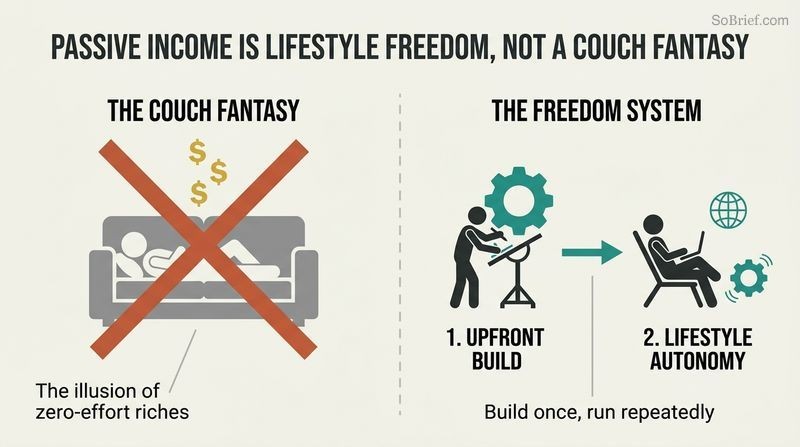
The couch fantasy is a lie. Andrews dismantles the cliche that passive income means cash falling through your windows while you eat chips. The honest definition: do something once, then collect payment repeatedly. But that upfront "once" can stretch across weeks, months, even years, and most streams still demand ongoing maintenance.
The deeper meaning is lifestyle. Few income streams are truly hands-off. What they buy is autonomy: choosing where you live, working when you want, never begging a boss for time off. Andrews opens the book describing experts he interviewed who replied to his emails from an island in the Philippines or a road trip across Central America. Twelve practitioners agreed to share their methods. The recurring theme across all fourteen strategies is escaping the trade of hours for dollars.
What's striking is the honesty buried in a hype-heavy genre. By conceding that "passive" usually means "front-loaded plus light upkeep," Andrews inoculates readers against the disappointment that sinks most side hustles. Tim Ferriss made the same move in The 4-Hour Workweek, reframing the goal as "mobility" rather than idleness. The economic literature on this is blunt: nearly all assets require either capital or sweat equity first. The reframe matters psychologically, though. People who chase freedom persist through the unglamorous setup phase, while people who chase effortless money quit the moment effort appears.
Money is the receipt for problems you solve at scale
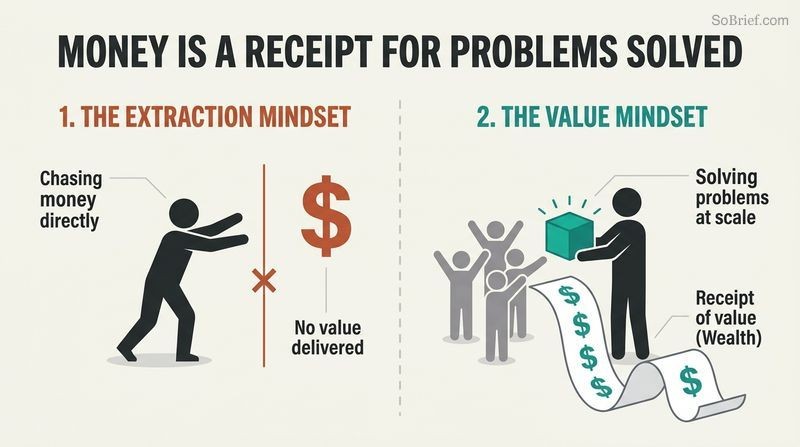
Stop asking how to make money. Andrews borrows from Mark Anastasi's The Laptop Millionaire the idea that money is simply a measure of value delivered to others. The wealthiest people, from the Microsoft founders to Amazon's and Facebook's creators, didn't chase dollars; they solved millions of problems (easier shopping, new ways to connect) and the dollars followed.
Reframe the question. Instead of "How can I make more money?" ask "How can I create more value for more people?" Every strategy in the book ties back to this: the high-protein-diet book, the knee scooter, the membership forum. They each answer a real need. Andrews argues your bank balance is an exact representation of value you've delivered, so the path to wealth runs through other people's pain points, not through clever extraction.
This is the genre's most defensible claim, and it echoes Adam Smith's insight that self-interest channeled through markets serves others. Still, it deserves a caveat the book glosses over: value captured and value created diverge constantly. Tobacco firms, payday lenders, and patent trolls earn fortunes while arguably destroying value, and many essential workers create enormous value for modest pay. Price reflects scarcity and bargaining power as much as benefit. The maxim is a useful compass for an aspiring entrepreneur, but treating net worth as a moral scoreboard confuses correlation with virtue. Solve real problems, yes, but stay skeptical of the tidy equation.
Validate demand before you build, or you'll build nothing anyone wants
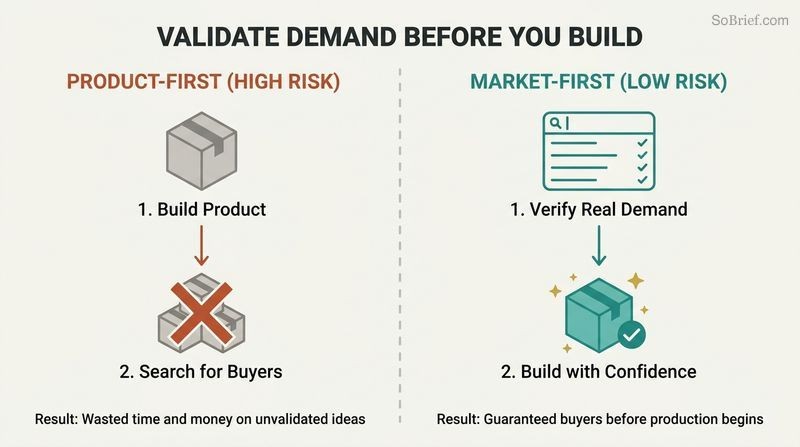
Find the market first, create the product second. The most expensive mistake new entrepreneurs make is building what they assume will sell, then discovering nobody wants it. Andrews flips the order across every strategy. For Kindle books, he searches Amazon's autocomplete to see what people actually type, then checks bestseller rankings: a book ranked under 100,000, priced at $2.99, likely earns roughly $50 to $100 per month.
Test cheaply, then commit. The Amazon FBA expert Will preaches "don't buy it first, sell it first." You can list a product, fill test orders by buying from a competitor and shipping to the customer, and confirm real demand before sinking cash into inventory. eBook sellers use squeeze pages to ask audiences what they want. The principle is constant: let evidence of demand precede production.
This is lean startup thinking translated for solo operators. Eric Ries built a movement around the "minimum viable product" and "validated learning," the idea that the riskiest assumption is whether anyone cares. Andrews's Amazon ranking heuristics are a poor person's market research, crude but directionally sound. The deeper wisdom is epistemic humility: your taste is not the market's taste. One caution worth flagging is that fulfilling "test" orders through a competitor skirts platform rules and ethics. The validated-demand principle is golden; some of the suggested tactics for achieving it are sketchier than the book admits.
Multiply one book into a dozen income streams across formats
One asset, many channels. Andrews's signature math: if reaching $100,000 a year would require 100 Kindle ebooks each earning $100 monthly, you can slash that number by repackaging. He reports earning double from paperbacks what he earns from Kindle versions of the same titles, plus a third again from audiobooks. Converting each ebook into paperback and audio drops the required catalog from 100 books to roughly 28.
Then go wider. Mark Anastasi describes a woman earning around a million dollars annually from about 120 books spread across more than 100 platforms: Kindle, iTunes, Kobo, Nook, Smashwords, Audible via ACX, video courses on Udemy, even Groupon deals. The same intellectual property, sold everywhere, becomes dozens of parallel revenue streams instead of one.
This is the content-creator's version of asset utilization, and it is genuinely smart. The marginal cost of relisting a finished ebook on a new platform approaches zero, so the return on that hour of effort can be extraordinary. Distribution-everywhere strategies powered early YouTube and Spotify creators alike. The book underplays two frictions, though. Audience attention is finite, and platforms increasingly reward depth and authenticity over thin, ghostwritten volume; Amazon has cracked down hard on low-quality content farms. The "hire ghostwriters and flood every channel" playbook that worked in 2017 collides with both algorithm changes and a saturated market today.
Recycle your investment with the Buy, Rehab, Rent, Refinance, Repeat loop
BRRRR turns one down payment into many properties. Popularized on the BiggerPockets forum, the strategy means buying a distressed property cheap, renovating it, renting to quality tenants, refinancing to pull your original cash back out, then repeating. The discipline lives in the purchase: the 70% rule says pay no more than 70% of after-repair value minus rehab costs. A home worth $100,000 needing $15,000 of work should cost no more than $55,000.
The cash recycles. Because most lenders refinance at 70% loan-to-value, you can extract nearly everything you invested and redeploy it. Andrews calculates that buying two properties yearly, then selling two starting in year five, reaches $100,000 annually. He notes around 90% of millionaires built wealth through real estate, and warns this is no get-rich-quick scheme.
BRRRR is real estate's answer to compounding, and it works beautifully in rising or stable markets. The unspoken fragility is leverage. The same recycling that accelerates gains amplifies losses when values fall, rates spike, or appraisals come in low and the refinance fails to return your capital, leaving you cash-trapped. Investors who ran this aggressively before 2008 got wiped out. The "tenant-proofing" advice (laminate over hardwood, materials built to endure) reflects hard-won operational wisdom often missing from glossier guides. BRRRR rewards conservative underwriting and punishes optimism, which is precisely why the book's emphasis on finding a "great deal, not good enough" is the load-bearing detail.
Private labeling turns a one-dollar product into thirty dollars of margin
Slap a brand on a generic good. Amazon FBA (Fulfillment by Amazon) handles warehousing, shipping, and customer service, letting a solo seller operate like a large business. The expert Will built millions in sales this way. The core trick is private labeling: buying unbranded products from Alibaba suppliers and selling them under your own brand at a premium. He found Muay Thai shorts selling for $70, sourced near-identical ones for a dollar in China, branded them, and sold them for $30.
Hunt niches of niches. When his cousin needed a knee scooter that retailed for $400, Will discovered he could manufacture one for $60, bought the domain injuredleg.com, and sold seven on day one. The rule: target needs not wants, price between $15 and $50 for impulse buying, and saturate small markets competitors ignore.
Private labeling is arbitrage dressed as entrepreneurship, exploiting the gap between manufacturing cost and brand-driven willingness to pay. The behavioral economics is sound: a name signals quality, and buyers anchor on the higher-priced incumbent, making the cheaper branded alternative feel like a steal. The knee-scooter logic (market to necessity, not curiosity) mirrors how performance marketers distinguish high-intent from browsing traffic. The dated element is competitive density. By 2017 Amazon FBA was already crowding; today tariffs, rising Alibaba costs, ad-spend inflation, and Amazon's own private-label competition have compressed these fairy-tale margins. The transferable lesson endures: find where perceived value vastly exceeds production cost, then position yourself in the gap.
The real money lives on the backend, not the first sale
Your existing customers are your business. Andrews repeatedly cites research that acquiring a new customer costs five times more than keeping one, that you have a 60 to 70% chance of selling to an existing buyer versus 5 to 20% for a stranger, and that current customers spend 31% more. The frontend sale of a $20 ebook is just the entry point; the profit lives in $200, $300, and $500 upsells.
Build the list, then monetize it. Anastasi's book The Laptop Millionaire sold over 100,000 copies and topped $1.7 million in twelve weeks, largely through seminar upsells. His Facebook-marketing ebook generated $400,000 in 30 days via upsells to 5,000 buyers. Blogger Yaro Starak needs just 100 subscribers spending $1,000 over a year to hit six figures. The email list is the asset; the book is the lead magnet.
This is the most financially significant insight in the book and the one beginners most reliably ignore. Direct-response marketers have known for a century that the back end funds the front end; Claude Hopkins wrote about it in the 1920s. The lifetime-value-over-acquisition-cost ratio is the metric every modern subscription business obsesses over. The retention statistics Andrews cites are widely circulated and roughly accurate. The subtle danger is that an upsell-maximizing mindset can curdle into manipulation, the high-pressure funnels and "$25,000 mentorship" offers the book elsewhere celebrates. The healthiest reading: serve a customer so well that selling them more is a service, not a squeeze.
A blog earns nothing until you treat it as a sales funnel
Writing posts does not pay. Andrews bluntly states you cannot make $100,000 just by blogging. Money does not spit out of your disc drive when you publish an article. Most blogs make nothing for years. The fatal error bloggers make is creating free content, sprinkling in affiliate links and ads, and hoping cash appears.
The blog is a funnel to your own products. Andrews cites a blogger earning roughly $22,000 in one month, of which only about $6,000 came from advertising; over $12,000 came from selling his own products. Yaro Starak earns $20,000 to $30,000 monthly from standard income but spikes to $50,000 to $70,000 when he launches products to his existing traffic. Build trust by giving away genuinely best-in-class content, then sell courses, coaching, memberships, or physical goods to the audience that trusts you.
The funnel insight separates hobbyist bloggers from operators. Advertising and affiliate revenue scale with raw traffic, which is brutally hard to grow, whereas product sales scale with trust and relationship, which a small audience can supply. This is why creators increasingly abandon ad-supported models for direct monetization, the shift Substack and Patreon institutionalized. Kevin Kelly's "1,000 True Fans" essay made the same arithmetic famous: a modest number of devoted buyers beats a massive indifferent crowd. The book's coaching example ($25,000 for one-on-one access) highlights an underappreciated truth: the least passive offering often pays the most, because expertise plus scarcity plus trust commands premium pricing.
Buy and improve a website rather than building one from scratch
Digital real estate flips like physical real estate. Websites currently sell for roughly 23 to 24 times monthly profit, so a site netting $5,000 a month can fetch six figures. Empire Flippers describes a buyer who purchased an ad-supported site earning $1,200 monthly, spent about 10 hours over a few months installing a plugin and rearranging ad blocks, and lifted income to roughly $2,100, nearly doubling the site's value from $28,800 to $50,400.
Buying beats building for beginners. A new content site may earn nothing for six months while it climbs Google's rankings, fighting the "sandbox effect" that suppresses young sites. An established site comes with traffic, backlinks, and search indexing already in place. The strategies range from domain parking (lowest effort, lowest return) to flipping to full development, and they can be combined.
The valuation multiple is the key literacy here. Once you understand that online businesses trade at a multiple of earnings, every optimization that lifts monthly profit gets amplified roughly two dozen times at sale, which is why small operational tweaks produce outsized capital gains. This is identical to how private equity creates value, buying cash-flowing assets and improving margins before exit. The honest admission that new sites earn nothing for months is refreshingly anti-hype. The risk the book soft-pedals is platform dependency: a site living on Google traffic or Amazon affiliate commissions can lose most of its value overnight from a single algorithm update, making these assets far more volatile than the real estate metaphor implies.
Make idle gold and silver pay rent like a property
Metals usually just sit there. The standard approach to precious metals is buying coins and bars, then waiting years or decades for prices to rise while the asset produces no income. Minesh Bhindi's method, described in the book, treats metal holdings like a rental property that generates monthly cash flow of roughly 1 to 2.2%.
Sell call options against metal ETFs. Using funds like GLD and SLV that hold physical gold and silver, you sell call options to speculators, collecting a premium for granting them the right to buy at a set price by a set date. Since the Chicago Board Options Exchange notes that 90 to 95% of options speculators lose money monthly, the option-seller usually keeps the premium when prices fail to spike. Bhindi claims a 92% verified success rate. Reaching $100,000 yearly this way requires roughly $1.2 to $2 million in capital.
This is a covered-call strategy, a legitimate and well-understood income technique, repackaged with metals as the underlying asset. The framing as "rent" is pedagogically clever and accurate in spirit: you collect premium income from an asset you already own. The crucial caveat the enthusiasm obscures is that covered calls cap your upside. If gold rockets past the strike price, you forfeit those gains while keeping only the modest premium, so the strategy quietly bets against the very price explosion many metal buyers are hoping for. The eye-watering capital requirement also undercuts the populist framing; this is a strategy for the already-wealthy, not the aspiring escapee.
Royalty companies mint precious-metal profits without touching a mine
Finance the mine, skip the shovels. A royalty company funds mining operations, in exploration or construction, in exchange for either a percentage royalty (typically 1 to 5%) on future production or a "stream," the right to buy metal at a steep discount, sometimes 75% below spot price. They are mine-financing entities whose shares trade publicly.
Astonishing efficiency and built-in diversification. Royal Gold generated over $300 million in sales with fewer than 24 employees, more than $12.5 million per employee; Silver Wheaton produced around $500 million with at most 30 people. A mature royalty firm collects from 10 to 50 mines, so one mine's failure barely dents results. They bear no exposure to capital cost overruns or rising production costs, and because tax rules favor high payouts, they often distribute around 20% of royalty income as dividends, far more than typical miners.
Royalty and streaming companies are a genuinely elegant business model, capturing commodity upside while outsourcing operational risk and capital intensity to the miners. The revenue-per-employee figures are staggering precisely because the model is closer to a financial intermediary than an industrial operator, resembling how a music-publishing catalog or a patent licensor earns. The diversification argument is sound: spreading exposure across dozens of mines smooths the notorious volatility of single-asset miners. What the section underweights is that these firms still ride the underlying metal price, so they are far from recession-proof, and their valuations (the 20-times-royalty multiples cited) can compress sharply when commodity sentiment sours. Still, for metals exposure, the structure beats owning a single miner.
Theory pays nothing; the only fatal mistake is never starting
Action is the one thing the book cannot do for you. Every expert Andrews interviewed converged on the same point: 95% of people who read the books and attend the seminars never actually begin. Options trader Sean Allison describes a student with five degrees including a PhD who studied for a year without placing a single trade; once she finally acted, she made $10,000 in her first month and said she learned more in that month than in the prior year of study.
Start small and cheap today. Will's advice: buy ten cheap items on Alibaba, list them, and accept that losing $50 buys priceless experience. Find a mentor who actually earns money doing what they teach rather than someone selling theory; Sean spent around $250,000 on programs that did not work before learning this. Pick one of the fourteen strategies and try it now.
This closing thesis is the book's emotional core and its most universally true claim. The phenomenon has a name in psychology: analysis paralysis, the documented tendency for excess information and option overload to suppress decision-making. The PhD anecdote dramatizes a real cognitive trap where expertise-seeking becomes a sophisticated form of procrastination. The mentor warning is shrewd: in the lucrative "teaching people to make money" industry, most instructors earn from tuition, not the methods they sell, a conflict of interest worth naming. The one tension is that "just start" can rationalize reckless bets. The wiser synthesis pairs bias-toward-action with small, survivable experiments, which is precisely what the cheap-test advice prescribes.
Analysis
This is a 2017 anthology-style finance guide, structured as fourteen loosely connected strategy chapters anchored by interviews with twelve practitioners. Its genre is the aspirational "escape the rat race" manual, sitting downstream of Kiyosaki's Rich Dad Poor Dad and Ferriss's The 4-Hour Workweek, both of which Andrews quotes. The difficulty in summarizing it is breadth without depth: the strategies range wildly in capital requirements (a $5 Fiverr cover versus $2 million in dividend stocks), risk profiles, and passivity, yet share a thin connective tissue of repeated mantras.
The book's intellectual spine is stronger than its presentation. Three principles genuinely unify it: value creation precedes income, demand validation precedes production, and backend monetization of trust beats frontend transactions. These are durable, defensible ideas drawn from direct-response marketing and lean-startup thinking. Where the book ages poorly is tactical specificity. The Amazon Kindle and FBA playbooks describe a 2017 arbitrage window that platform crackdowns, ad inflation, tariffs, and AI-generated content saturation have since narrowed dramatically. Much of the ghostwriter-and-outsource advice assumed a frictionless gig economy and an under-policed Amazon that no longer exist. The book's honesty is uneven. It admirably debunks the couch fantasy and repeatedly insists "passive" means front-loaded effort, yet it casually presents survivorship-biased anecdotes (seven knee scooters on day one extrapolated to $31,500 monthly) as repeatable formulas. The recurring $100,000 target functions more as motivational framing than rigorous modeling; the dividend and gold chapters quietly reveal that several "strategies" require seven-figure capital, contradicting the populist promise.
Read critically, the book is best treated as a menu and a mindset primer rather than a blueprint. Its enduring value is the cross-strategy meta-lessons: solve real problems, test before building, own the customer relationship, and above all act rather than study endlessly. A reader who internalizes those four ideas and ignores the dated tactical minutiae extracts most of the worth.
Review Summary
"How to Make $100,000 per Year in Passive Income and Travel the World" receives mixed reviews. Some readers find it practical and insightful, praising its clear advice and actionable strategies. They appreciate the focus on providing value and solving real problems. However, others criticize it for alleged plagiarism and outdated information. The book offers various passive income ideas, including e-commerce, education, and investing in precious metals. While some reviewers found multiple useful strategies, others felt certain sections were less valuable. Overall, the book's simplicity and practicality are highlighted as strengths by positive reviewers.
People Also Read


Glossary
BRRRR
Buy, rehab, rent, refinance, repeatA real estate investing strategy from the BiggerPockets community: buy a distressed property cheaply, renovate it, rent it to quality tenants, refinance the mortgage to recover your invested cash, then repeat the cycle with the same capital. It combines house-flipping mechanics with long-term rental wealth-building, letting an investor acquire multiple properties without repeatedly raising fresh money.
70% Rule
Max purchase price for flipsA real estate guideline stating the most an investor should pay for a property is 70% of its after-repair value (ARV) minus renovation costs. For a home with a $100,000 ARV needing $15,000 of work, the maximum purchase price is $55,000. It builds in a margin of safety against overpaying.
Private Labeling
Branding a generic productBuying an unbranded, generic product (often from suppliers on Alibaba) and selling it under your own brand name at a higher price. A one-dollar pair of generic athletic shorts becomes a thirty-dollar branded product. The brand name itself, plus packaging and a simple website, adds perceived value and margin without changing the underlying item.
Amazon FBA
Fulfillment by Amazon serviceFulfillment by Amazon, a program where Amazon handles warehousing, shipping, customer service, and returns for third-party sellers. It lets a solo entrepreneur operate at a scale normally requiring a large logistics operation, sending inventory to Amazon's warehouses and letting the platform manage everything after a sale.
Backend Potential
Profit from repeat customer salesThe additional, higher-priced products and services you can sell to a customer after their initial low-priced purchase, such as coaching, seminars, courses, or memberships. The first sale (the front end) is the entry point; the larger profit lives in the back end, since selling to an existing trusting customer is far cheaper and more likely than acquiring a new one.
Website Flipping
Buy, improve, sell websitesPurchasing an existing website, improving its traffic, content, or monetization, then reselling it for profit. Sites typically trade at roughly 23 to 24 times monthly profit, so small increases in monthly earnings translate into large gains in sale value. It is the digital equivalent of flipping a house.
Royalty Company
Publicly traded mine financierA publicly traded company that provides capital to mining operations in exchange for either a royalty (1 to 5% of future production) or a stream (the right to buy metal at a steep discount). It earns from many mines without bearing operational costs, cost overruns, or production-cost inflation, and typically pays high dividends due to favorable tax treatment.
Self-Generated Dividend
Covered calls on metal ETFsMinesh Bhindi's term for generating monthly income (roughly 1 to 2.2%) by selling call options against physical gold and silver ETFs like GLD and SLV. The option premiums collected from speculators function like a dividend or rent on metal holdings you own, while you still benefit from any long-term appreciation in the metal's price.
FAQ
What's "How to Make $100,000 per Year in Passive Income and Travel the World" about?
- Overview: The book by Chase Andrews is a guide to achieving financial freedom through passive income. It outlines 14 proven strategies to generate $100,000 annually.
- Purpose: It aims to help readers escape the traditional 9-to-5 job structure and live a lifestyle of their choosing, potentially traveling the world.
- Content Structure: The book is divided into chapters, each focusing on a different passive income strategy, such as real estate, blogging, and dividend investing.
- Author's Journey: Chase Andrews shares his personal journey from an unfulfilling job to financial independence, providing a relatable context for readers.
Why should I read "How to Make $100,000 per Year in Passive Income and Travel the World"?
- Financial Freedom: The book offers practical strategies to achieve financial independence, which can be appealing to those looking to escape the rat race.
- Diverse Strategies: It covers a wide range of passive income methods, allowing readers to choose what best suits their skills and interests.
- Actionable Advice: Each chapter provides step-by-step guidance, making it easier for readers to implement the strategies.
- Inspiration and Motivation: The author’s personal success story serves as motivation for readers to pursue their own passive income goals.
What are the key takeaways of "How to Make $100,000 per Year in Passive Income and Travel the World"?
- Passive Income Definition: Passive income is about doing something once and getting paid repeatedly, though it often requires ongoing work.
- Mindset Shift: Achieving passive income requires a change in mindset, focusing on solving people's problems to create value.
- Diverse Opportunities: There are numerous ways to generate passive income, from real estate to digital products, each with its own set of challenges and rewards.
- Action is Crucial: The book emphasizes the importance of taking action and not just learning the theory behind passive income.
What are the best quotes from "How to Make $100,000 per Year in Passive Income and Travel the World" and what do they mean?
- "The trouble with the rat race is that even if you win, you’re still a rat." – This quote highlights the futility of traditional employment in achieving true freedom.
- "If you do what you’ve always done, you’ll be what you’ve always been." – It emphasizes the need for change to achieve different results.
- "Your time is limited, so don’t waste it living someone else’s life." – A reminder to pursue personal goals and passions rather than conforming to societal expectations.
- "Nothing will work unless you do." – Stresses the importance of taking action to achieve passive income and financial freedom.
How does Chase Andrews define passive income in the book?
- IRS Definition: The IRS defines passive income as income generated by a rental activity or a business in which the taxpayer does not materially participate.
- Author's Definition: Andrews expands this to mean doing something once and getting paid repeatedly, though it often requires ongoing work.
- Freedom Aspect: He also views passive income as a means to achieve freedom, allowing individuals to live life on their own terms.
- Misconceptions: The book clarifies that passive income is not about making money without effort; it often involves significant upfront work.
What is the BRRRR strategy mentioned in the book?
- Acronym Meaning: BRRRR stands for Buy, Rehab, Rent, Refinance, Repeat, a strategy for real estate investment.
- Process Overview: It involves purchasing a property, renovating it, renting it out, refinancing to pull out equity, and repeating the process.
- Cash Flow Focus: The strategy aims to create a steady cash flow while building equity in multiple properties.
- Long-term Benefits: Over time, this method can lead to significant wealth accumulation and passive income through rental properties.
How does the book suggest using Amazon Kindle Direct Publishing for passive income?
- Platform Overview: Amazon Kindle Direct Publishing allows authors to self-publish eBooks and earn royalties.
- Finding a Niche: The book advises conducting market research to find profitable niches and keywords.
- Book Creation: It covers the process of creating, publishing, and marketing an eBook to generate sales.
- Scaling Income: By publishing multiple books and converting them into paperbacks and audiobooks, authors can increase their passive income streams.
What are the benefits of membership sites according to the book?
- Recurring Revenue: Membership sites provide a steady stream of income through recurring monthly payments.
- Customer Loyalty: They help build a loyal customer base by offering ongoing value and engagement.
- Low Overhead: Most membership sites deliver information, which requires minimal overhead compared to physical products.
- Scalability: Once set up, membership sites can scale easily without significant additional effort.
How does the book recommend using blogging for passive income?
- Value Creation: The book emphasizes creating valuable content that solves readers' problems to attract and retain an audience.
- Monetization Strategies: It suggests various monetization methods, including affiliate marketing, selling products, and offering services.
- Traffic Generation: Building a blog requires strategies to drive traffic, such as SEO and social media marketing.
- Long-term Growth: Successful blogs can become authority sites, leading to increased income and opportunities.
What is the role of dividend investing in achieving passive income?
- Dividend Definition: Dividends are payments made by a company to its shareholders, usually derived from profits.
- Investment Strategy: The book suggests focusing on blue-chip companies with a history of paying and increasing dividends.
- Long-term Growth: Reinvesting dividends can lead to compound growth, increasing the value of the investment over time.
- Passive Income Goal: The ultimate aim is to build a portfolio that generates enough dividend income to cover living expenses.
How does the book address the mindset needed for creating passive income?
- Problem-Solving Focus: The book stresses the importance of solving people's problems to create value and generate income.
- Action-Oriented: It encourages readers to take action rather than just learning the theory behind passive income.
- Lifestyle Change: Achieving passive income often requires a shift in lifestyle and priorities, focusing on long-term goals.
- Overcoming Fear: The book advises overcoming the fear of change and failure to pursue passive income opportunities.
What are some other passive income strategies mentioned in the book?
- Options Trading: The book covers how to analyze and implement trades to generate income from stock options.
- Digital Real Estate: It discusses buying, developing, and flipping websites for profit.
- Royalty Companies: Investing in royalty companies as a way to earn income from mining operations.
- Gold and Silver: Using precious metals as a form of investment to generate income through strategic buying and selling.
Download PDF
Download EPUB
.epub digital book format is ideal for reading ebooks on phones, tablets, and e-readers.








































