

Key Takeaways
We run on mental autopilot that con artists hijack with single triggers
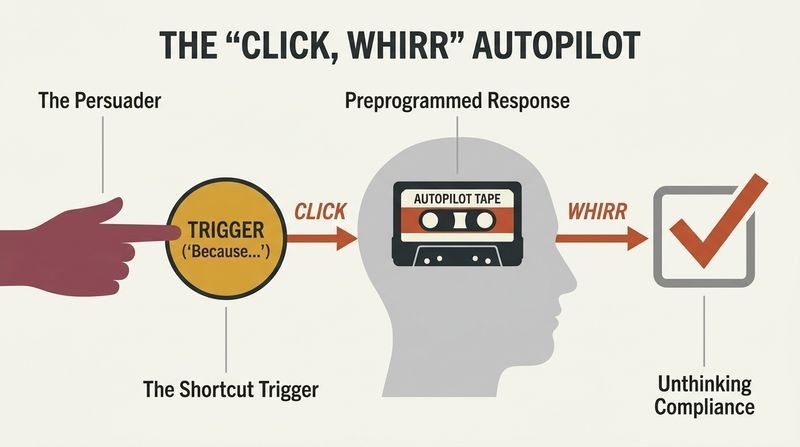
The click, whirr response. Cialdini argues humans, like animals, run preprogrammed behavior tapes triggered by a single feature. A mother turkey will mother any object that emits a "cheep-cheep" sound, even a stuffed polecat (her natural enemy) wired with a recorder. Humans behave similarly. In Ellen Langer's photocopier study, 94% of people let someone cut in line when given a real reason ("because I'm in a rush"), but 93% complied even with a meaningless reason ("because I have to make copies"). The word "because" alone triggered compliance.
Why we need shortcuts. Modern life is too complex to analyze every decision. We rely on rules of thumb like "expensive equals good," which is why a jewelry store sold dead-stock turquoise faster after the price was accidentally doubled.
What's striking is how this anticipates Daniel Kahneman's System 1 and System 2 thinking by decades. Cialdini's "click, whirr" is essentially heuristic processing under cognitive load. The turkey example is memorable but risks overstating the human-animal parallel: human shortcuts are learned and flexible, not hardwired instincts. The deeper warning holds up well against behavioral economics research: as information density rises, reliance on these shortcuts intensifies, making us more, not less, exploitable. The ethical frame matters here too. Shortcuts are usually adaptive and correct; the problem is only when someone deliberately counterfeits the trigger.
A small gift creates a debt so strong it overrides dislike
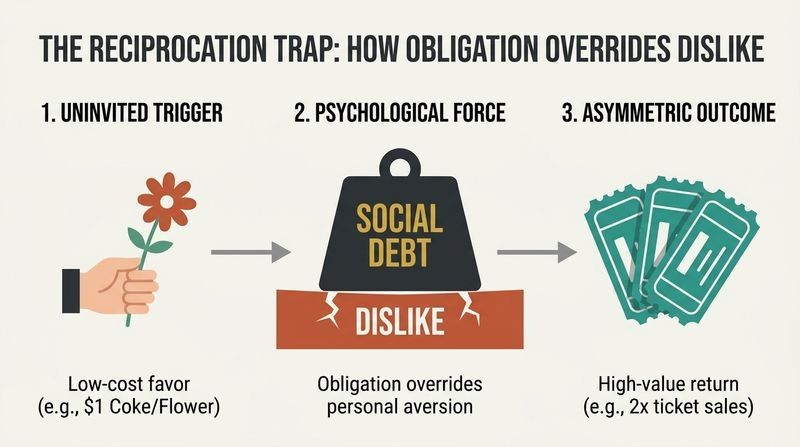
The rule of reciprocation. Every human society trains members to repay what others provide. This obligation is so powerful it overwhelms other factors. In Dennis Regan's experiment, a confederate who bought a subject an unrequested Coke later sold them twice as many raffle tickets, and crucially, whether the subject liked him made no difference. The favor alone drove compliance.
Exploiting the rule. The Hare Krishnas mastered this by pressing a flower into a stranger's hand before requesting a donation, refusing to take it back. Even gifts thrown in the trash had already extracted money. Uninvited gifts work too: mailing free address labels nearly doubled charity donation rates from 18% to 35%. The rule can trigger unfair exchanges, since a tiny favor can prompt a much larger return.
Anthropologists Marcel Mauss and Alvin Gouldner established reciprocity as a near-universal social glue, and Cialdini's contribution is showing its weaponization. The Regan finding that obligation trumps liking is the genuinely unsettling part: it means manipulators need not be charming, only generous first. A useful defense Cialdini offers is redefinition: accept genuine favors gladly, but mentally reclassify a "gift" as a sales tactic the moment it reveals itself as one, which strips it of reciprocal force. Modern "freemium" business models and free product samples run on exactly this engine, suggesting the principle scales effortlessly to digital commerce.
Open big, then retreat to make your real request feel like a concession
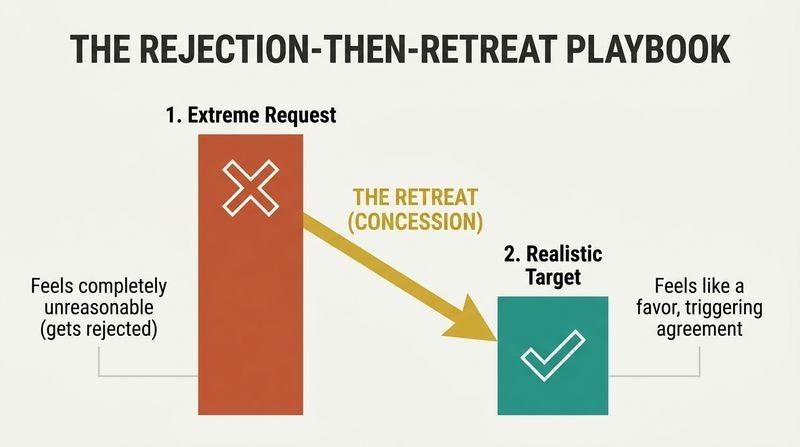
Rejection-then-retreat. A concession obligates a return concession. Cialdini bought unwanted chocolate bars from a Boy Scout who first asked him to buy five-dollar circus tickets, then "retreated" to one-dollar candy. In a formal test, asking students to chaperone delinquents on a zoo trip got 17% agreement, but first asking them to commit to two years of unpaid counseling (which all refused) tripled zoo-trip compliance to 50%.
Hidden bonus effects. Targets of this tactic feel more responsible for and more satisfied with the outcome, so they actually follow through more reliably and agree to future requests. Liddy's Watergate plan got approved partly because his absurd one-million-dollar scheme made the eventual 250,000-dollar break-in seem like "a little something." The opening demand must stay credible, though, or it backfires.
This is the door-in-the-face technique, and its power lies in stacking two forces at once: reciprocity (a concession demands a concession) plus the contrast principle (the second request looks smaller after the first). The responsibility and satisfaction findings are the underappreciated insight, distinguishing it from mere pressure tactics. It explains why skilled negotiators and even TV producers (inserting lines they expect censors to cut) thrive on inflated openers. A caveat from negotiation research: anchoring too extremely destroys trust and credibility, so the tactic has a ceiling. The Watergate application is a sobering reminder that group decisions are not immune to these levers.
Once you commit out loud or in writing, you become its prisoner
Commitment drives consistency. After placing a bet, racetrack gamblers grow instantly more confident in their horse, though nothing about the horse changed. We feel pressure to behave consistently with stands we have taken. Thomas Moriarty staged beach thefts: only 4 of 20 bystanders intervened normally, but when the victim first asked someone to "watch my things," 19 of 20 became vigilantes.
The foot-in-the-door. Small commitments reshape self-image and unlock larger ones. Homeowners who accepted a tiny "Be a Safe Driver" sign later allowed an enormous ugly billboard on their lawns at a 76% rate, versus 17% for others. Chinese POW interrogators got American captives to write mildly pro-Communist statements, then escalated. Written, public, effortful, and freely chosen commitments bind hardest.
Festinger's cognitive dissonance theory is the engine beneath this: inconsistency between action and self-concept generates discomfort we resolve by adjusting beliefs to match deeds. Cialdini's practical extension is identifying the four amplifiers (active, public, effortful, uncoerced). The "freely chosen" condition is the most profound and the most ethical: Freedman's robot study showed that mild requests without threats produced lasting behavior change in children, while strong threats produced only temporary compliance. This is why bribing or threatening kids backfires, and why minimal sufficient justification builds genuine internalized values. The lowball car-sales tactic exploits this by letting a decision grow its own supporting reasons before yanking the original incentive.
Brutal initiations exist because suffering manufactures loyalty
Effort breeds devotion. Aronson and Mills found that women who endured a severely embarrassing initiation to join a discussion group rated that group (deliberately staged to be dull) as far more valuable than women admitted easily. The more electric shock endured, the more desirable the group seemed afterward.
Why hazing survives. This explains the stubborn persistence of fraternity Hell Weeks and tribal rites, despite deaths and bans. The Thonga tribe subjects boys to beatings, cold, thirst, and threats of death. Fraternities recreate nearly identical trials and fiercely resist replacing them with community service. Groups with the harshest initiations show the greatest solidarity. People value what they suffered to obtain, so the pain is not sadism but a mechanism of group survival.
This is one of the book's most counterintuitive and well-supported claims, rooted in effort justification, a branch of dissonance theory. The logic is airtight: if I suffered greatly for something worthless, I face unbearable dissonance, so I inflate the thing's value. Military boot camps, medical residencies, and elite startup cultures all exploit it. A nuance worth raising: the effect may be weaker when the suffering is clearly attributable to external coercion rather than free choice, which is precisely why fraternities refuse to let pledges off the hook with charity work. The dark side is obvious, yet the same mechanism underlies healthy commitment to hard-won achievements.
When unsure, we copy others, sometimes straight off a cliff
Social proof. We decide what is correct by watching what others do, especially under uncertainty. This is why canned laughter works despite everyone hating it: it makes audiences laugh more and rate jokes funnier, even poor ones. Bartenders salt tip jars; preachers seed crowds with rehearsed donors.
Pluralistic ignorance. In emergencies, each bystander reads others' calm as evidence nothing is wrong, so no one acts. A faked seizure got help 85% of the time from a lone witness but only 31% with five present. The Werther effect shows the deadly extreme: publicized suicides spike copycat deaths, and disguised suicides crash cars and planes, killing similar others. Jonestown's mass suicide worked because Jones isolated 900 people where the only social proof was each other.
Latane and Darley's bystander research revolutionized how we understand the misnamed "apathy" of crowds: the failure is informational, not moral. Cialdini's actionable rescue is brilliant and life-saving: a victim should point at one specific person and assign a clear task, dissolving the diffusion of responsibility. Phillips's Werther-effect data remains debated in epidemiology (confounds are hard to rule out), but media guidelines on suicide reporting now reflect its core insight. The similarity amplifier (we copy people like us) connects to modern concerns about social media contagion, where algorithmically curated "people like you" become an unprecedented engine of social proof.
We say yes to people we like, and liking is easy to manufacture
The friendly thief. Tupperware parties outsell stores because the request comes from a friend hosting it; the social bond predicts purchase twice as strongly as product preference. Several levers reliably build liking:
1. Physical attractiveness creates a halo: handsome defendants got lighter sentences and were twice as likely to avoid jail.
2. Similarity: people helped a stranger dressed like them two-thirds of the time.
3. Compliments: praise wins us over even when transparently false and self-serving.
4. Familiarity and cooperation: working toward shared goals dissolves hostility.
5. Association: we like those linked to good things.
Cooperation as cure. Sherif's boys' camp turned warring groups into friends only when forced to cooperate on shared crises, the basis for the "jigsaw classroom" that reduced racial prejudice.
The liking factors are individually well-documented in social psychology, but Cialdini's synthesis into a compliance toolkit is the value-add. The defense he proposes is elegantly minimal: stop monitoring the dozens of causes of liking and instead watch only for the effect, an unexpectedly strong fondness for someone trying to sell you something. The jigsaw classroom deserves more attention than it gets; Aronson's cooperative-learning method shows that mere contact between groups worsens prejudice (school desegregation data confirmed this), while interdependent cooperation toward shared goals is the actual mechanism of reconciliation. Good Cop/Bad Cop weaponizes manufactured allegiance, proving liking can be conjured even in an interrogation room.
A title, a uniform, or a suit makes us obey without thinking
Directed deference. In Milgram's notorious experiment, about two-thirds of ordinary people delivered what they believed were dangerous 450-volt shocks to a screaming victim simply because a lab-coated researcher told them to. Experts predicted only 1 in 1,000 would comply. The driver was not sadism but deep-seated obedience to authority.
Symbols suffice. We respond to the appearance of authority as readily as the substance. 95% of nurses prepared to administer an obviously dangerous, unauthorized drug dose because an unknown caller claimed to be a doctor. Three times more pedestrians jaywalked behind a man in a business suit. Robert Young sold Sanka coffee for years simply because he had played a doctor on TV. Con artists exploit titles, clothes, and luxury cars precisely because the trappings, not the credentials, trigger deference.
Milgram's study, conducted to understand Holocaust obedience, remains the most cited and most ethically fraught experiment in psychology. Its replications across many countries confirm the cross-cultural reach of authority pressure. Cialdini's practical contribution is two defensive questions: Is this authority truly an expert? and How truthful can I expect them to be here? The second matters because trustworthy-seeming experts who argue slightly against their own interest (the waiter Vincent steering diners to cheaper dishes) become disproportionately persuasive. A modern extension: credentials inflation and online "expert" personas mean the gap between symbol and substance has only widened since Cialdini wrote, raising the stakes on his expert-verification test.
Scarcity makes things more desirable but never any better
The rule of the few. Opportunities feel more valuable as they become less available. Cialdini suddenly wanted to tour a Mormon temple sector only because access was about to close. Sellers exploit this with limited-number claims ("only five left") and deadlines ("sale ends soon"). Loss looms larger than gain: homeowners told what they would lose from poor insulation acted more than those told what they would save.
Reactance and competition. When freedoms shrink, we want them more (psychological reactance). Banning a speech made students agree with it more without hearing it. Newly scarce things and contested things spike desire most: in a cookie study, cookies made scarce by sudden demand were rated most desirable, though they tasted no better. ABC overpaid 3.3 million dollars for a movie in a bidding frenzy.
Scarcity fuses with Kahneman and Tversky's loss aversion, and Brehm's reactance theory gives it teeth: censorship, bans, and parental interference (the Romeo and Juliet effect) all backfire by making forbidden things more alluring. Davies's J-curve theory extends this to revolutions, which erupt not under steady oppression but when rising expectations are suddenly reversed, as in the 1991 Soviet coup that collapsed in three days. The most practical insight is the cookie finding: scarcity inflates wanting, not enjoying. Cialdini's defense, asking whether you want a thing to possess it or to use it, cuts through auction fever and limited-edition marketing with surgical clarity.
Treat counterfeit triggers as the enemy and fight back
Defend the shortcuts, attack the fakers. Cialdini insists the six principles (reciprocation, commitment and consistency, social proof, liking, authority, and scarcity) are genuinely useful rules of thumb we cannot abandon; modern life demands them. The enemy is not the honest marketer but anyone who fabricates the evidence that triggers them.
Counterattack. When you spot faked social proof (staged "unrehearsed" testimonials, canned laughter), boycott the product and tell the manufacturer why. When you feel undue liking for a salesperson, mentally separate the dealer from the deal. When scarcity-induced arousal floods in, use that physical jolt itself as a signal to stop and think. Because exploiters degrade the reliability of the shortcuts we depend on, retaliation is self-defense, not mere indignation.
This closing stance elevates the book from a manual of tricks to an ethical argument. Cialdini frames automatic responding as a societal commons: shortcuts work because they are usually accurate, and profiteers who counterfeit triggers pollute that commons, forcing everyone toward costlier deliberation. The call to actively punish fakers (not just ignore them) is a tragedy-of-the-commons solution borrowed implicitly from game theory, where credible retaliation sustains cooperation. The insight that emotional arousal can serve as a cognitive alarm bell is genuinely useful given that scarcity and competition suppress the very reasoning we need. It reframes vigilance not as paranoia but as maintenance of a shared resource.
Analysis
Influence is a thesis-driven work of social psychology built on a single elegant premise: humans, overwhelmed by a complex world, rely on automatic "click, whirr" responses that six reliable principles can trigger, and that compliance professionals systematically exploit. Its enduring power comes from Cialdini's rare methodology, three years of covert participant observation infiltrating sales, fundraising, and recruitment operations, married to rigorous laboratory citation. This dual sourcing is also what makes the book hard to compress: its persuasiveness lives in accumulated vivid anecdotes (the doubled-price turquoise, the flower-pressing Krishnas, the screaming Milgram subjects) rather than abstract propositions.
What distinguishes Influence from the self-help genre it spawned is its intellectual honesty about the principles themselves. Cialdini never claims reciprocity, consistency, or authority are bad; he insists they are adaptive shortcuts that usually serve us well. The villain is the counterfeiter who fakes the trigger. This commons-based ethical framing, articulated fully only in the epilogue, transforms a catalog of manipulation tactics into an argument about preserving the reliability of social heuristics in an accelerating information economy.
The book anticipates much of what behavioral economics later formalized: loss aversion appears in the scarcity chapter, dual-process cognition pervades the whole, and the bystander and obedience studies remain canonical. Its weaknesses are those of its era: heavy reliance on a handful of dramatic experiments, some (the Werther effect, certain replications) since contested, and an animal-instinct analogy that overstates how hardwired human shortcuts truly are.
The practical defenses are underrated. For each principle Cialdini offers a precise counter: redefine a gift as a sales device, separate the dealer from the deal, ask whether an authority is truly expert, treat scarcity arousal as a stop signal. These make the work actionable rather than merely descriptive. Four decades on, with algorithmic curation industrializing social proof and similarity, the book reads less as a historical artifact than as an increasingly urgent field guide to cognitive self-defense.
Review Summary
Influence: Science and Practice is widely praised as an insightful exploration of persuasion techniques. Readers appreciate Cialdini's clear explanations of six key principles: reciprocity, commitment, social proof, liking, authority, and scarcity. Many find the book eye-opening and practical for both understanding manipulation and improving personal influence. Critics note some repetition and outdated examples. Overall, readers value the book's engaging style, real-life examples, and applicability to various situations, from marketing to personal interactions.
People Also Read




FAQ
What's Influence: The Psychology of Persuasion about?
- Understanding compliance psychology: The book delves into the psychological principles that lead people to comply with requests, identifying six key principles of influence.
- Weapons of influence: These principles, termed "weapons of influence," include reciprocation, commitment and consistency, social proof, authority, liking, and scarcity.
- Real-world applications: Cialdini combines experimental research with real-life examples to show how these principles operate in everyday life, from sales to social interactions.
Why should I read Influence: The Psychology of Persuasion?
- Practical insights: Gain valuable insights into persuasion mechanisms, helping you understand how to influence others ethically.
- Awareness of manipulation: Learn to recognize tactics used by compliance professionals, enabling more informed decision-making.
- Improved communication skills: Enhance your ability to communicate effectively in both personal and professional settings.
What are the key takeaways of Influence: The Psychology of Persuasion?
- Six principles of influence: Reciprocation, commitment and consistency, social proof, authority, liking, and scarcity are the core principles driving compliance.
- Automatic compliance: Many decisions are made mindlessly, highlighting the need to be aware of external influences on our choices.
- Ethical considerations: The book discusses using these principles ethically, raising questions about manipulation and responsibility.
What is the principle of reciprocation in Influence: The Psychology of Persuasion?
- Basic definition: Reciprocation is the obligation to return favors or concessions, creating a sense of indebtedness.
- Cultural significance: This principle is universal across cultures, reinforcing social bonds and cooperation.
- Practical examples: Charities often send unsolicited gifts to potential donors to increase the likelihood of receiving contributions.
How does the commitment and consistency principle work in Influence: The Psychology of Persuasion?
- Psychological drive: Once committed to a choice, individuals are more likely to act consistently with that commitment, even irrationally.
- Public commitments: Public commitments create social pressure to remain consistent, often used by organizations to secure compliance.
- Foot-in-the-door technique: A small initial request is made to secure compliance with a larger request, leveraging the desire for consistency.
What is social proof and how is it used in Influence: The Psychology of Persuasion?
- Definition of social proof: Individuals look to others' behavior to determine what is correct, especially in uncertain situations.
- Influence of similar others: We are more likely to follow actions of those we perceive as similar to ourselves.
- Canned laughter example: Social proof can influence perceptions, such as canned laughter making TV shows seem funnier.
How does liking influence compliance in Influence: The Psychology of Persuasion?
- Liking principle: People are more likely to comply with requests from those they like or find attractive.
- Building rapport: Establishing a connection increases compliance, often used by salespeople through friendly interactions.
- Real-life examples: Companies use attractive or relatable spokespersons in advertising to enhance product appeal.
What role does authority play in influencing behavior according to Influence: The Psychology of Persuasion?
- Authority as a principle: People are more likely to comply with requests from perceived authoritative figures.
- Milgram experiment: Demonstrated how ordinary people follow orders from authority figures, even against personal morals.
- Practical applications: Marketers use authority figures to endorse products, leveraging credibility to increase compliance.
How does scarcity affect our decision-making in Influence: The Psychology of Persuasion?
- Scarcity principle: People are more motivated to act when opportunities are perceived as limited or rare.
- Fear of missing out: FOMO can lead to impulsive decisions, often exploited in marketing strategies.
- Examples in marketing: Limited-time offers or exclusive products create urgency, prompting quick consumer action.
What are the best quotes from Influence: The Psychology of Persuasion and what do they mean?
- “Everything should be made as simple as possible, but not simpler.”: Emphasizes clarity and simplicity in communication for effective persuasion.
- “I can’t afford to doubt. I have to believe.”: Reflects deep commitment to beliefs, highlighting the power of commitment.
- “Where all think alike, no one thinks very much.”: Warns against conformity and groupthink, encouraging critical evaluation.
How can I protect myself from being influenced by these principles in Influence: The Psychology of Persuasion?
- Awareness of influence tactics: Recognize when principles are applied to you for informed decision-making.
- Question authority and scarcity: Assess the legitimacy of authority figures and the reality of scarcity claims.
- Take your time: Allow yourself time to think and evaluate situations rather than reacting impulsively.
What are some real-world applications of the principles in Influence: The Psychology of Persuasion?
- Sales and marketing: Techniques like reciprocation and scarcity are used to increase sales and consumer engagement.
- Social interactions: Understanding these principles can improve personal relationships and communication.
- Ethical persuasion: Apply these principles ethically to influence others positively in various contexts.
About the Author

Download PDF
Download EPUB
.epub digital book format is ideal for reading ebooks on phones, tablets, and e-readers.








































