
Summary Unavailable
This book is not suitable for a summary (it may be a textbook, workbook, cookbook, reference book, or collection). However, you can still explore the FAQs, about author, and other metadata below!
Key Takeaways
Your name and birthdate encode a complete blueprint of your life
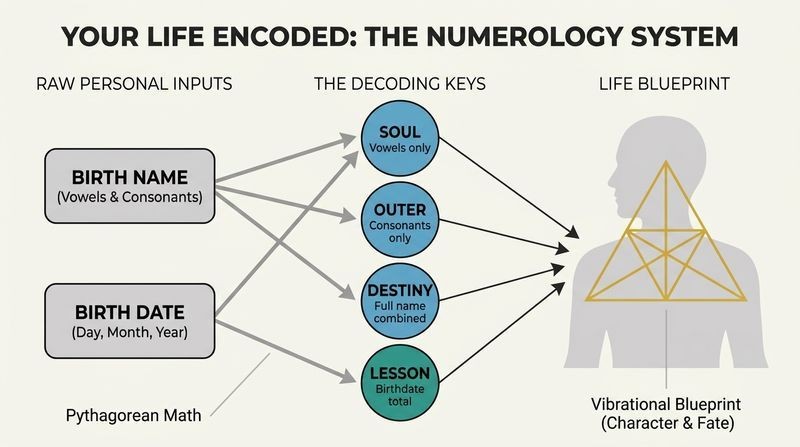
The core promise of this system. Faith Javane and Dusty Bunker argue that the moment you take your first breath, you enter the earth's energy field and absorb a fixed set of vibrations that shape your character and fate. Four personal numbers decode this: the Life Lesson Number (from your full birthdate), the Soul Number (vowels in your birth name), the Outer Personality Number (consonants), and the Path of Destiny Number (the two combined).
A claimed lineage. The authors trace the method to Pythagoras, who taught that "all things are numbers," and to Kabbalah, where letters and numbers conceal sacred meaning. The digits 1 through 9 represent the nine stages every idea passes through to become reality.
What's striking is the confidence with which a divination system borrows the prestige of mathematics. Pythagoras genuinely did believe numbers underpinned reality, and his discovery of numerical ratios in musical harmony was real science. Numerology inherits that mystique without the falsifiability. Modern psychology offers a sober explanation for why such readings feel accurate: the Barnum effect, where people accept vague, flattering descriptions as uniquely their own. Readers get the most value treating this as a structured mirror for self-reflection rather than cosmic law. The framework's real power is forcing introspection through a fixed vocabulary.
Reduce any name or date to a single digit, 1 through 9
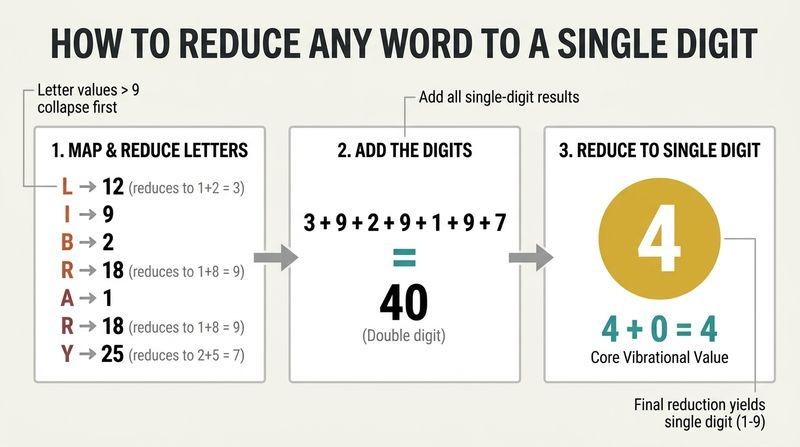
The mechanical foundation. Every letter gets a number: A is 1, B is 2, up to Z at 26, then reduced (L is 12, so 1+2=3). Any total above 9 collapses by adding its digits. The word LIBRARY totals 40, reducing to 4. Birthdates work the same way: November 12, 1940 becomes 11+12+14, totaling 37, then 3+7=10, then 1.
Memory shortcuts. Letters sharing a reduced value cluster: A, J, and S all equal 1. The authors offer mnemonic pegs like FOX for 6 or HQZ as "headquarters" for 8. Mastering the code lets you decode any word instantly, since the system insists every word carries an inner numeric meaning.
The reduction procedure is arithmetically arbitrary but psychologically clever. By forcing all complexity into nine archetypes, it guarantees a reading for everyone while feeling personalized. There is a genuine mathematical curiosity buried here: digital roots (repeatedly summing digits) relate to modulo-9 arithmetic, which is why multiples of 9 always reduce to 9. That is real number theory. The leap is assuming this arithmetic property carries spiritual significance. Worth noting that results depend entirely on alphabet and spelling conventions, meaning the same soul rendered in Cyrillic or Chinese would yield different numbers, a tension the system rarely addresses.
Each digit 1 to 9 is a personality archetype with a fixed signature
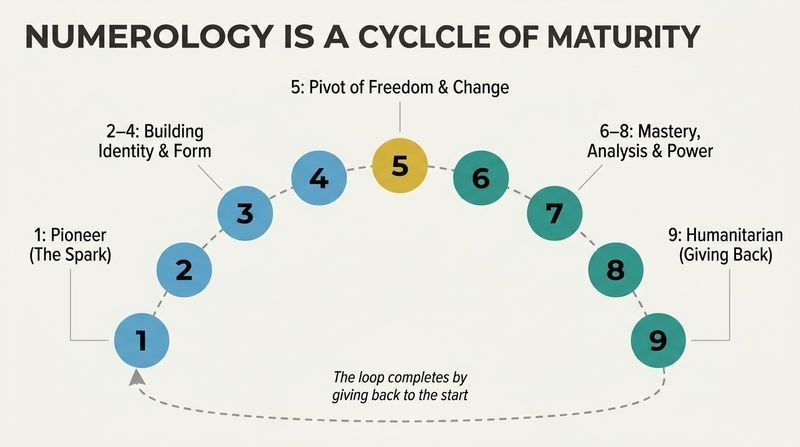
The nine essences. The system assigns every number a stable character. 1 is the pioneer, independent and dominant. 2 is the diplomat, cooperative and sensitive. 3 is the expressive performer. 4 is the disciplined builder. 5 is restless freedom and change. 6 is love, home, and responsibility. 7 is the introspective seeker. 8 is power, money, and material mastery. 9 is the selfless humanitarian.
A narrative of growth. These are not random. The authors frame them as a developmental cycle: the lone spark of 1 seeks union in 2, expression in 3, structure in 4, then pivots at the midpoint 5 toward responsibility, analysis, power, and finally the completion of 9, which gives back what it learned.
The progression resembles a hero's journey compressed into nine beats, and that narrative structure is part of its memorability. The archetypes also echo Jung's work on universal symbolic patterns, which lends them surprising psychological resonance even without metaphysical commitment. A skeptic notes the descriptions are elastic enough to flatter anyone: who does not see themselves as occasionally independent, occasionally cooperative? Astrology faces the same critique. Yet the value lies in the vocabulary. Having distinct words for nine modes of being gives people language to name traits they sense but cannot articulate, which is genuinely useful for self-understanding.
Master numbers 11, 22, 33, and 44 demand more and reward more
Numbers you never reduce. Normally 29 reduces to 2, but when a total lands on 11, 22, 33, or 44, the system preserves it as a master number. These vibrations are described as intensely powerful, offering greater potential but demanding far more effort. A person living an 11 will fluctuate down to its base 2 for periods of rest, because the higher vibration cannot be sustained continuously.
What each represents. 11 is spiritual illumination and inspired leadership. 22 is the master builder who works on a global scale. 33 is Christ-like sacrifice and teaching. 44 is disciplined material service to the world. Edgar Cayce, the famous psychic, carried a 44 Life Lesson Number.
The master-number concept introduces a clever escape valve: it explains why some people with the same base digit feel more burdened or gifted than others. This fluctuation-to-base mechanism mirrors how psychology describes peak states, which by definition cannot be maintained indefinitely. There is something honest in framing exceptional potential as exceptional difficulty rather than pure blessing, an idea echoed in talent research showing that high ability often comes with heightened sensitivity and pressure. The obvious critique is selection bias: master numbers are assigned to admired figures retroactively, making the category feel validated when it is really just curated.
Map your whole life onto Pythagoras's right triangle, the Divine Triangle
The signature framework. Faith Javane received this method from a teacher who claimed it came from the reincarnated Pythagoras. You draw a right triangle with squares built on each side, mirroring the theorem that the square of the hypotenuse equals the sum of the squares of the other two sides. Your birth name and date get placed on the lines, each line representing nine years of life.
Three squares, three life stages. The youth square covers ages 0 to 27 (mind formation), the power square 27 to 54 (material striving), and the wisdom square 54 to 81 (spiritual reflection). At ages 27 and 54, the soul touches the central triangle of spirit, echoing the astrological Saturn return near age 29.
The Divine Triangle is the book's genuinely original contribution, and its architecture is intellectually elegant regardless of whether one believes it predicts anything. Dividing life into three 27-year arcs maps loosely onto real developmental psychology: identity formation in youth, achievement and generativity in midlife, and integration in later years, themes Erik Erikson formalized. The Saturn-return parallel is also notable because astrologers and the lived experience of many people both flag the late twenties as a crisis of restructuring. The framework's weakness is rigidity. Real lives do not partition neatly at 27 and 54, and the nine-year line assignments are asserted, not demonstrated.
Drop your family surname; it is inherited, not uniquely yours
A telling rule. When placing a name on the Divine Triangle, you use only the first and middle names. The last name is excluded because the authors consider it a family vibration rather than your individual soul signature. When you run out of letters, you start the first name over again.
Vowels carry the soul. The system treats vowels as sacred, the sounds through which the soul entered the body. The very first vowel in your first name gets special weight, revealing core temperament: A for boldness and research, E for an eventful versatile life, I for intuition and art, O for method and order, U for a broad collecting mind. More than three of the same vowel means an overbalance in that trait.
The privileging of the given name over the surname inverts how most cultures think about identity, where lineage defines you. It reflects a distinctly modern, individualist assumption that the authentic self precedes and outranks family inheritance. The reverence for vowels has a curious real-world echo: in many ancient Semitic scripts, vowels were omitted or considered too holy to write, as with the unpronounced name of God in Hebrew. So the intuition that vowels carry hidden essence is culturally deep-rooted. Linguistically, of course, vowels are simply voiced sounds with no greater spiritual charge than consonants, but the symbolic tradition is genuinely old.
You relive a nine-year cycle, so this year echoes nine years ago
Personal years. Add your birth month and day to the year of your last birthday. The result, reduced, is your personal year vibration, running birthday to birthday rather than January to January. Life moves in nine-year waves: a 1 year starts fresh ventures, a 5 year brings change and travel, a 9 year demands endings and release.
Zoom in further. Each year splits into three four-month periods and even into personal months. The authors suggest looking back exactly nine years to verify the pattern: you might have been budgeting to build a house then, and budgeting for a child's college now. Different event, identical underlying theme of managing money.
The personal-year cycle is the most testable and most useful claim in the system because it invites direct self-checking against memory. That said, the verification method is vulnerable to confirmation bias: any year contains enough events that a motivated person can find one matching the predicted theme. Psychologists call this the feedback loop of subjective validation. Still, the underlying intuition that life has rhythms and recurring chapters is sound and supported by research on life-course patterns. The discipline of reviewing your life in structured intervals has real reflective value, whether or not the nine-year period is the true wavelength.
Choose careers and partners by matching Life Lesson Numbers
Numbers as vocational compass. Your Life Lesson Number points to compatible work. A 1 suits inventors, executives, and pioneers. A 4 fits builders, accountants, and engineers. A 6 belongs in nursing, teaching, counseling, and the arts. A 7 thrives in research, science, and ministry. The same job can appear under several numbers but expresses differently: a lawyer under 3 is a courtroom performer, under 7 a divorce specialist, under 8 a corporate attorney.
Relationship chemistry. Compare single-digit Life Lesson Numbers. Two 1s make a dynamic but competitive pair. A 1 and 2 form a natural leader-supporter match. Two 8s either accomplish anything together or destroy each other, described as a perfect pair for revolution.
Using a typology to guide career and compatibility decisions is exactly what the Myers-Briggs and Enneagram industries do at massive commercial scale, so numerology was early to a persistent human demand. The vocational lists are reasonable mostly because they are exhaustive: nearly every profession appears somewhere, so almost anyone finds validation. The compatibility framing is more interesting because it normalizes the idea that friction between types is structural, not personal, which can reduce blame in relationships. The danger is deterministic thinking, where someone forecloses a good partnership or career because the numbers warn against it. Used as conversation starter rather than verdict, it is harmless and occasionally illuminating.
Missing numbers in your name reveal the lessons you came to learn
The karmic gaps. Tally which digits 1 through 9 never appear in your name. These absent numbers, called karmic numbers, mark qualities you must consciously develop in this lifetime to atone for past-life shortcomings. Missing a 1 means building courage and decisiveness. Missing a 6 means deepening love and family responsibility. Missing an 8 means learning to handle money and material power.
Check everywhere first. Before declaring a number truly missing, the authors say to check your four personal numbers, your Power Number (Path of Destiny plus Life Lesson), and any nickname. A master number counts too: an 11 fulfills a 2, a 33 fulfills a 6. Only genuinely absent vibrations represent lessons to build into your character.
The missing-number concept cleverly converts absence into assignment, turning what your name lacks into a growth agenda. This reframe has therapeutic shape: it resembles the strengths-and-gaps inventories used in coaching, where naming a deficit is the first step to addressing it. The reincarnation framing, where gaps are debts from prior lives, is unfalsifiable but motivationally potent, giving struggle a narrative purpose. A sharper critique is that the analysis is rigged toward completeness: with so many places to check (personal numbers, nicknames, Power Number), almost any gap can be explained away or discovered at will, making the system unfalsifiable in both directions.
The Bible hides number codes, where 13 means transformation, not death
Scripture as cipher. The authors read biblical names and numbers as encoded teaching. Cain symbolizes the materialistic body, Abel the idealistic soul, so Cain killing Abel warns that materialism murders spiritual ideas. When Abram becomes Abraham, the added Hebrew letter Heh (vibrating to 9) signals attained spiritual light.
Reclaiming feared numbers. The number 7 appears over 360 times and governs the fall of Jericho, where seven priests circling seven times on the seventh day topple the walls through sound vibration, not warfare. The number 13, universally feared, actually means death only as transformation: birth into a new state, like marriage ending single life. There are no halfway measures with 13, only regeneration or degeneration.
Reading sacred texts for hidden numerical meaning is a real and ancient discipline called gematria, central to Kabbalistic interpretation, so the authors stand in a genuine tradition rather than inventing one. The reframing of 13 from doom to transformation is psychologically constructive and historically defensible, since triskaidekaphobia is culturally specific, not universal. The interpretive risk is obvious: once you permit symbolic decoding, the text can be made to say almost anything, a problem theologians call eisegesis, reading meaning into rather than out of scripture. The Jericho-as-sound-vibration reading is poetic but treats allegory as physics, which conflates literary symbol with mechanism.
Read double digits, not just single ones, for a fuller portrait
Beyond 1 through 9. Conventional numerology stops at single digits and a few low double numbers. This system runs all the way to 78, the number of cards in a Tarot deck and the sum of 1 through 12. A 32/5 and a 41/5 are both 5s, but they are different 5s: in 32/5 a 2 works through a 3 to reach 5, while in 41/5 a 1 works through a 4. The authors compare it to living in the same city on different streets.
The grand synthesis. Each of the 78 numbers is matched to a Tarot key and an astrological sign, decan, or planet. Number 1 pairs with the Magician card and Mars; 13 pairs with the Death card and Scorpio. The three systems are claimed to dovetail and confirm one another.
The double-digit refinement addresses a real weakness in pop numerology, its crude nine-bucket sorting, by adding a second layer that distinguishes people sharing a base number. That is a legitimate move toward granularity, the same impulse that drives personality systems to add facets and subtypes. Fusing numerology, Tarot, and astrology into one 78-part lattice is ambitious and aesthetically satisfying, but it compounds rather than resolves the falsifiability problem: three unfalsifiable systems stacked do not validate each other, they multiply interpretive freedom. The honest value is as a rich symbolic language for contemplation, comparable to how Jungians use Tarot archetypes as projective prompts for the unconscious.
Analysis
Numerology and the Divine Triangle is an anthology-style reference text, part instruction manual, part esoteric encyclopedia, written for serious students rather than casual curiosity-seekers. Its structure splits cleanly: Part I teaches calculation and the signature Divine Triangle method, and Part II catalogs all 78 double-digit numbers with Tarot and astrological correspondences. What makes it hard to summarize is precisely this encyclopedic density. The book is less an argument than a system, and a system resists compression because its value supposedly lies in working through one's own chart.
The authors' central innovation is the Divine Triangle, a life-mapping blueprint built on the Pythagorean theorem and claimed to descend from Pythagoras himself via channeled instruction. This provenance story matters: the book repeatedly anchors its authority in antiquity, invoking Pythagoras, Kabbalah, Egyptian initiation, and biblical gematria. This is a rhetorical strategy common to esoteric literature, where age confers legitimacy and channeled transmission sidesteps the need for evidence.
Intellectually, the work sits at the intersection of three unfalsifiable symbolic systems. Its claims cannot be tested in any rigorous sense, and its self-verification methods (look back nine years and find a matching theme) are textbook subjective validation. The Barnum effect explains much of its felt accuracy. Yet dismissing it as mere superstition misses why such systems endure across millennia. They function as structured mirrors, providing a fixed vocabulary that forces sustained introspection most people never otherwise undertake.
The most defensible elements are developmental: the three 27-year life arcs loosely echo Erikson's psychosocial stages, and the Saturn-return crisis around 29 corresponds to a genuinely documented period of upheaval. The extended Edgar Cayce case study, occupying a full chapter, demonstrates the method applied biographically, though retroactive fitting of a known life proves nothing predictive. Read as contemplative framework rather than cosmic law, the book offers a disciplined language for self-examination.
Last updated:
Report IssueReview Summary
Numerology and the Divine Triangle receives high praise from readers for its comprehensive coverage of numerology, astrology, and tarot connections. Many find it insightful and enlightening, appreciating its detailed explanations and practical applications. Readers value the book's thoroughness, especially in relating numbers to life patterns and self-discovery. Some note its academic nature but find it rewarding with sustained effort. A few critics mention logical inconsistencies in the Divine Triangle concept, but overall, the book is highly recommended for those interested in numerology and esoteric studies.
Glossary
Divine Triangle
Pythagorean life-blueprint diagramA life-mapping framework based on the Pythagorean right triangle, with squares built on each side. The birth name and birthdate are placed on its lines, each representing nine years, dividing life into a youth square (0-27), power square (27-54), and wisdom square (54-81). The authors claim it was transmitted from Pythagoras to reveal an individual's destiny step by step from birth to death.
Life Lesson Number
What you must learnDerived from the full birthdate by adding the month, day, and reduced year. It represents the central lesson a person came into this incarnation to learn, indicates the most suitable career, and is described as a constant that cannot be changed. On the Divine Triangle it always sits in the center of the triangle and is activated more than any other number.
Soul Number
Your true inner selfCalculated by adding the numeric values of the vowels in the full birth name. It represents the real, private personality known only to oneself, the inner desire of what one wishes to be. In the reincarnation framing, it also reflects accumulated growth from past lifetimes, acting as an underlying force influencing present actions.
Outer Personality Number
How others perceive youFound by adding the numeric values of the consonants in the full birth name. From the word persona, meaning mask, it represents the image one presents to the world and what others expect, not necessarily who one truly is. It is conveyed through dress, mannerisms, and body language.
Path of Destiny Number
What you must accomplishThe total of the entire birth name, calculated by adding the unreduced Soul Number and unreduced Outer Personality Number. It indicates one's aim in life, the path one must walk, and what one came to manifest. Though it can be modified somewhat by name changes, the birth-name destiny always persists as the underlying power.
Master Numbers
Intensified numbers never reducedThe double digits 11, 22, 33, and 44, which are preserved rather than reduced to a single digit. They carry intensified vibrations offering greater potential and demanding greater effort. Because their intensity cannot be sustained continuously, a person fluctuates down to the base digit (2, 4, 6, 8) for periods of respite before working with the master vibration again.
Missing Numbers
Karmic qualities to developThe digits 1 through 9 that never appear in a person's name. Also called karmic numbers, they represent qualities and attitudes one must consciously develop in this lifetime to expiate shortcomings from past lives. Before declaring a number missing, one checks the four personal numbers, the Power Number, and any nicknames, since a number present there is already active.
Personal Year
Annual vibration in nine-year cycleCalculated by adding the birth month and day to the year of one's last birthday. It reveals the dominant theme of a given year, running birthday to birthday rather than by calendar. Life unfolds in repeating nine-year cycles, so the same numbered year recurs with a similar underlying vibration roughly every nine years.
Power Number
Combined talents of midlifeThe sum of the unreduced Path of Destiny Number and unreduced Life Lesson Number. It represents a vibration that comes into play during a person's thirties and forties, combining all of one's talents. It is also checked when determining whether a number is genuinely missing from a person's makeup.
FAQ
What's Numerology and the Divine Triangle about?
- Exploration of Numerology: The book delves into the art and science of numerology, explaining how numbers influence our lives and personalities. It presents a unique method called the Divine Triangle, which combines numerology with astrology and Tarot.
- Divine Triangle Concept: The authors introduce the concept of the Divine Triangle, which connects numerology, astrology, and tarot, emphasizing how these elements influence personal development and destiny.
- Practical Applications: Readers learn how to apply numerological principles to their lives, including insights into personal strengths, challenges, and potential paths based on their birth numbers.
Why should I read Numerology and the Divine Triangle?
- Comprehensive Guide: This book serves as a complete textbook on numerology, making it suitable for both beginners and advanced practitioners. It synthesizes ancient wisdom with modern applications.
- Personal Growth: Readers can gain insights into their life paths, strengths, and challenges, which can lead to personal growth and better decision-making.
- Unique Framework: The book offers a unique framework that integrates three ancient systems, providing a holistic approach to self-discovery.
What are the key takeaways of Numerology and the Divine Triangle?
- Understanding Personal Numbers: The book emphasizes the importance of calculating and interpreting personal numbers, such as the Life Lesson Number, Soul Number, and Outer Personality Number.
- Integration of Sciences: It highlights the interconnectedness of numerology, astrology, and Tarot, suggesting that these systems can enhance one another for deeper insights.
- Life Blueprint: The Divine Triangle serves as a blueprint for understanding one’s life journey, revealing potentials and pitfalls through the lens of numbers.
What is the Divine Triangle method in Numerology and the Divine Triangle?
- Numerical Blueprint: The Divine Triangle is a visual representation that combines one’s birthdate and name to create a numerical blueprint of life experiences. It uses a right triangle to symbolize the relationship between mind, body, and spirit.
- Life Phases: The triangle is divided into three squares, each representing different life phases: youth (0-27), power (27-54), and wisdom (54-81). Each phase is associated with specific numbers that influence experiences during those years.
- Practical Application: Readers are guided on how to draw their own Divine Triangle and interpret the numbers to understand their life patterns and challenges.
How do I calculate my personal numbers using Numerology and the Divine Triangle?
- Name and Birthdate: To find your personal numbers, you need your full birth name and birthdate. Each letter corresponds to a number, and the birthdate is reduced to a single digit or master number.
- Four Key Numbers: The four personal numbers include the Life Lesson Number, Soul Number, Outer Personality Number, and Path of Destiny Number. Each number reveals different aspects of your personality and life purpose.
- Example Calculation: For instance, if your birthdate is November 12, 1940, you would calculate: 11 (month) + 12 (day) + 14 (year reduced) = 37/1 (Life Lesson Number).
What are the meanings of the numbers in Numerology and the Divine Triangle?
- Single Digits: Each number from 1 to 9 has specific meanings, such as 1 representing leadership and independence, while 2 symbolizes cooperation and balance. These meanings provide insights into personality traits and life challenges.
- Double Digits: Double-digit numbers (10-78) combine the meanings of their single digits, offering a more nuanced understanding of life experiences. For example, 12/3 indicates creativity and self-expression.
- Karmic Numbers: Missing numbers in your name indicate qualities you need to develop in this lifetime, referred to as karmic numbers. For instance, if you are missing the number 6, you may need to cultivate love and responsibility.
How does Numerology and the Divine Triangle connect numerology with astrology and Tarot?
- Synthesis of Sciences: The authors argue that numerology, astrology, and Tarot are interconnected systems that can enhance understanding of oneself and others. Each system provides unique insights that complement one another.
- Astrological Correspondences: Each number is associated with specific astrological signs and planets, which adds depth to the interpretation of personal numbers. For example, the number 1 is linked to Mars, representing action and initiative.
- Tarot Integration: The book includes Tarot symbolism for each number, illustrating how Tarot cards can reflect the energies and meanings of the corresponding numbers. This integration allows for a holistic approach to personal analysis.
What are the best quotes from Numerology and the Divine Triangle and what do they mean?
- "Everything lies veiled in numbers.": This quote encapsulates the essence of the book, emphasizing the belief that numbers hold the key to understanding life’s mysteries.
- "Your numbers tell the state of consciousness which you have reached.": This highlights the idea that personal numbers reflect one’s spiritual growth and life lessons.
- "The Divine Triangle reveals, step by step, from birth to death, what that life should express.": This quote underscores the book's premise that the Divine Triangle serves as a roadmap for one’s life journey.
How can I use the insights from Numerology and the Divine Triangle in my daily life?
- Self-Reflection: Use your personal numbers to reflect on your strengths and weaknesses, guiding your decisions and actions. Understanding your Life Lesson Number can help you focus on personal growth areas.
- Relationship Compatibility: Analyze the personal numbers of friends, family, or partners to understand compatibility and dynamics in relationships. This can enhance communication and cooperation.
- Goal Setting: Align your goals with the energies of your personal numbers. For instance, if you are in a 5 personal year, embrace change and new experiences to maximize opportunities.
What are the challenges presented in Numerology and the Divine Triangle regarding personal growth?
- Facing Karmic Lessons: The book discusses the importance of recognizing and addressing karmic lessons associated with personal numbers, which can be challenging but necessary for growth.
- Letting Go of Attachments: Readers are encouraged to let go of relationships and situations that no longer serve their evolution, which can be a difficult but essential part of personal development.
- Balancing Material and Spiritual: The authors highlight the challenge of balancing material pursuits with spiritual growth, urging readers to seek fulfillment beyond just material success.
How does Numerology and the Divine Triangle relate to tarot?
- Tarot as a Tool: The book uses tarot as a tool to interpret personal numbers and their meanings, linking the symbolism of tarot cards to numerological insights.
- Major Arcana Connections: Each number in the numerological system corresponds to a card in the Major Arcana, providing a deeper layer of understanding for readers familiar with tarot.
- Practical Exercises: The authors include exercises that combine tarot readings with numerological analysis, allowing readers to explore their personal journeys through both systems.
What are the astrological correspondences discussed in Numerology and the Divine Triangle?
- Linking Numbers to Zodiac Signs: The book discusses how each number corresponds to specific zodiac signs and planets, illustrating the astrological influences on personal traits and life events.
- Cycles of Influence: It explains how astrological cycles can affect the energies associated with personal numbers, providing a framework for understanding timing and opportunities.
- Integration with Numerology: The authors emphasize the importance of integrating astrological insights with numerology to gain a fuller picture of one’s life path and potential.
About the Author
Faith Javane is the author of "Numerology and the Divine Triangle," a highly regarded book in the field of numerology and esoteric studies. While specific biographical information is limited in the given content, Javane's work demonstrates extensive knowledge of numerology, astrology, and tarot. Her writing style is praised for being both accessible to beginners and engaging for more advanced readers. Javane's approach to numerology incorporates various spiritual and mystical traditions, including biblical references and Pythagorean principles. Her expertise in connecting numerology with other esoteric practices has made this book a valuable resource for those interested in these subjects.
Download PDF
Download EPUB
.epub digital book format is ideal for reading ebooks on phones, tablets, and e-readers.








































