


Key Takeaways
You don't need to be an attack dog to win at sales
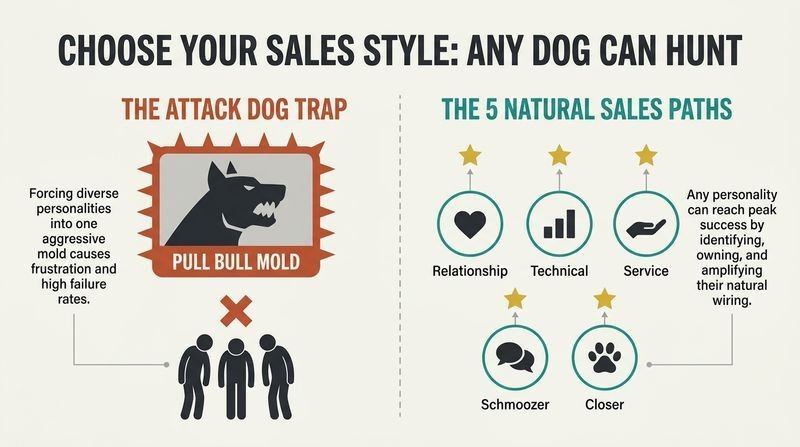
The central myth destroyed. Singer's whole thesis rejects the idea that selling belongs only to thick-skinned, aggressive closers. He argues there are five distinct sales personalities, and the pushy predator is just one of them. Trying to force every salesperson into that single mold produces frustrated, spectacularly unsuccessful people.
Instead, the shy introvert, the friendly server, the polished schmoozer, the data nerd, and the relationship builder can each get rich by leaning into their natural wiring. Singer himself was the smallest kid on the Ohio playground who talked his way out of fights, yet became the number-one salesperson in the United States for a computer company. His point: identify your innate style, amplify it, and borrow a few skills from the others rather than betraying who you are.
What's refreshing is how this counters decades of macho sales lore glorifying the ABC mantra (Always Be Closing) immortalized in Glengarry Glen Ross. Modern research supports Singer: Adam Grant's work found that neither strong extroverts nor strong introverts top sales charts. The winners are ambiverts who flex. Susan Cain's Quiet similarly rehabilitated introverts as persuaders. The dog metaphor is charming but also a Trojan horse for a serious personality-fit argument that predates and parallels tools like DISC and StrengthsFinder. The caution: self-typing can become an excuse to avoid necessary growth, which Singer himself flags.
Diagnose your breed, then hunt with your natural instincts
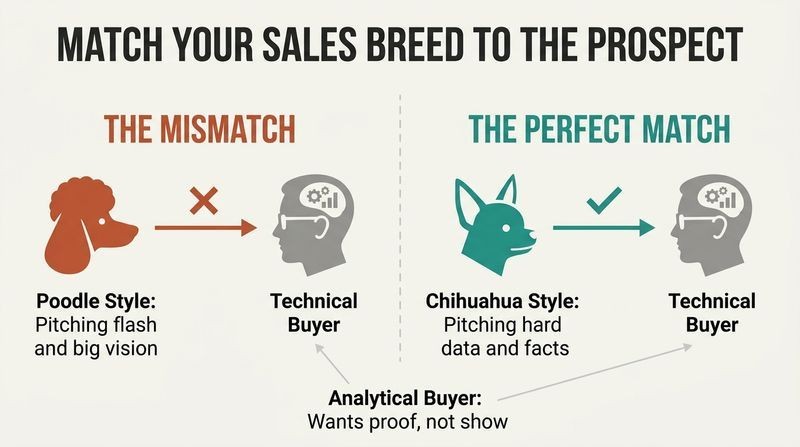
Five breeds, five superpowers. Singer sorts salespeople into canine archetypes:
1. Pit Bull: fearless, relentless, thrives on cold calls and rejection, weak on tact.
2. Golden Retriever: wins through obsessive service, believes giving more makes clients buy more.
3. Poodle: image and marketing genius, sells vision and flash, works the room.
4. Chihuahua: hyper-intelligent data fanatic, closes with irrefutable facts and research.
5. Basset Hound: builds deep, loyal relationships through trust, integrity, and patient tracking.
Each breed suits different prey. You wouldn't send a Poodle to charm a technical data freak, or a Basset to a status-obsessed executive. Singer's rule: match the right dog to the right quarry. A manager who sorts a struggling team this way, as his boss Steve did at Burroughs, can turn a worst-performing branch into number one within eighteen months.
The typology's power is diagnostic simplicity, but its risk is the Barnum effect, where vague descriptions feel personally accurate to everyone (astrology exploits this). Singer partly inoculates against it by tying each breed to concrete selling behaviors rather than fuzzy traits. The framework echoes the ancient four temperaments and modern personality science, yet its real innovation is situational: it treats sales as casting rather than character reform. A smart reader should ask whether products, not just people, dictate the ideal breed. Singer agrees, noting pharmaceutical sales reward Bassets while mass-market products reward Pit Bulls.
Stop fixing weaknesses; become a SuperMutt instead
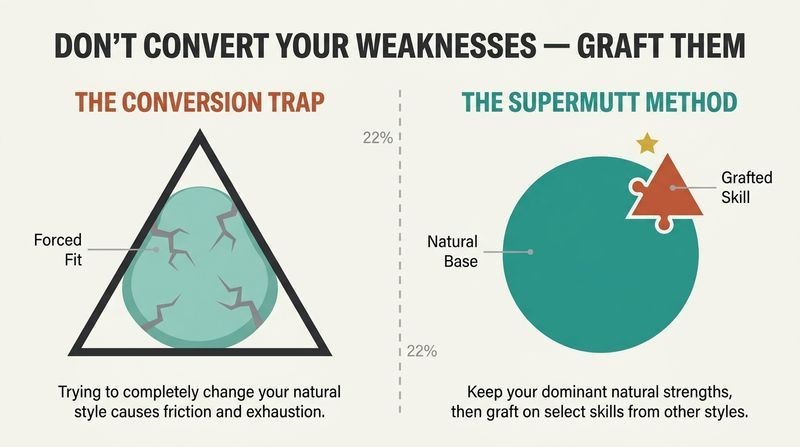
Cross-train, don't convert. Singer's most contrarian advice: converting weaknesses into strengths wastes time. Amplify what you naturally do well, then graft on select skills from other breeds. The champion is the SuperMutt, a cross-breed who leans on a dominant style while borrowing the best traits of others.
He proves it with his own transformation. A natural Basset-Retriever who dreaded cold calls, he forced himself to make sixty-eight in a single day, treating it as a game rather than a sales quest. He sold nothing that day, but burned a neurological pathway that killed his fear. A New York investment bank team of aggressive Pit Bull-Chihuahuas kept losing deals because they never listened. After being drilled knee-to-knee in Basset listening skills, they became the top-producing division globally, adding six-figure commissions each.
This lands squarely in the strengths-based movement popularized by Gallup's Marcus Buckingham, who argued organizations waste energy remediating weaknesses instead of leveraging talent. Yet Singer adds nuance the strengths purists miss: you must acquire foreign skills, just not build your identity around them. Neuroscience backs the drilling method. Deliberate practice and myelination (the neural insulation that automates repeated behaviors) explain why sixty-eight reps dissolve fear. The tension worth naming: some weaknesses are dealbreakers, not optional. A Chihuahua who never learns to connect emotionally, or a Retriever who never asks for the order, plateaus permanently regardless of natural gifts.
Sales is an energy business: highest energy in the room wins
Manage emotion like a professional athlete. Singer insists selling runs on energy and emotional state, not just technique. When two people meet in a sales situation, the one radiating higher energy prevails. So the master skill is state control.
He teaches a roughly one-minute recovery drill for handling rejection: catch the negative internal monologue, name the emotion out loud, spot universal words like always or never and replace them with specific ones (this time, in this case), externalize the cause (bad timing, prospect's mood) rather than blaming yourself, then deliberately choose the emotion you want and hold a vivid mental image until you feel it. He cites a MetLife study of thousands of salespeople: those who interpreted rejection as specific, external, and temporary outsold the self-blamers by over 34 percent.
The MetLife reference is real and foundational. It comes from Martin Seligman's research on explanatory style, later detailed in Learned Optimism, where MetLife hired optimists who failed the standard aptitude test and watched them outsell pessimists dramatically. Singer's three dimensions (specific, external, temporary) are Seligman's exact axes, giving this chapter unusual scientific weight. The state-shifting drill resembles cognitive behavioral therapy's cognitive restructuring plus NLP anchoring. One critique: deliberately externalizing blame can shade into avoiding accountability. Singer hedges by separating cause (externalize) from response (own it), a distinction that mirrors Stephen Covey's circle of influence and keeps the technique from becoming mere excuse-making.
Think like a dog: leap from 'I can' straight to 'I did'
The gap that separates winners. Singer argues success or failure comes down to a tiny internal cycle: you see an opportunity, you recognize you're capable (enablement), then you either act (ownership) or stall. Most people falter between I can and I will do it, letting the fearful inner voice invent reasons to postpone. Dogs skip the anguish entirely, spotting a chance and simply pouncing.
Michael Dell saw a market and shipped his first flyer from a dorm room. Singer relocated to a new island territory and made it number one. A Tahoe friend with idle earth-moving equipment saw unhappy snow-removal customers and won the contracts. The purpose of drilling calls and objections isn't the calls themselves, Singer says. It's conditioning your mind to cross that line reflexively, in sales and in life.
This is the book's philosophical core, and it echoes the action-bias literature. The Nike Just Do It reference Singer invokes is apt: behavioral economists call the stalling point the intention-action gap, and interventions like implementation intentions (Peter Gollwitzer's if-then planning) exist precisely to close it. What Singer adds is emotional: the inner voice, drawn from subconscious memories of past defeat, is the real adversary. His prescription to practice crossing the line in low-stakes reps parallels exposure therapy. The lovely closing move, applying this to hugging your spouse rather than closing deals, reframes a sales book as a life-agency manual.
Double your marketing and you halve your selling effort
Let prospects come to you. Singer offers a simple formula: sales effort equals S divided by M, where M is marketing. Pour more energy into marketing yourself, and the physical grind of selling drops proportionally. The goal is to become an order-taker whom prospects seek out, not a hunter chasing strangers.
Selling computers at Burroughs, he ran free one-hour seminars with refreshments promoted by letter, fax, and newspaper ads. Attendees arrived already knowing him as the expert, so his advice carried extra weight, and he outsold everyone with almost no cold calls. In another territory he partnered with Masa, a veteran field engineer who casually mentioned newer equipment to clients during service visits, pre-warming them. Singer replaced nearly every aging unit and made it the top United States territory two years running.
The formula is more mnemonic than mathematics, but the principle anticipates inbound marketing, the doctrine HubSpot built a company on a decade later: earn attention through valuable content so buyers arrive pre-qualified. Singer's seminar tactic is textbook authority positioning, which Robert Cialdini catalogs as one of six persuasion principles. The Masa partnership is a shrewd example of channel leverage and social proof through a trusted intermediary. The overlooked cost Singer names honestly: most salespeople refuse to spend the time, money, and effort marketing demands, preferring cheap physical endurance. That laziness, not lack of talent, is what keeps them stuck chasing.
Conquer rejection through overexposure, not clever comebacks
Get numb by drilling it. Singer calls handling objections and rejection the single most valuable skill in the book, worth more than any technique. His secret is unglamorous: there's no shortcut. The way past the fear is through it. Dogs shrug off rejection because they've been told no thousands of times and are simply used to it.
He and a brutal circle of friends locked themselves in rooms for hours, hurling the nastiest fake objections at whoever was presenting until the emotional charge vanished. One friend, John, tried to storm out mid-drill; a 250-pound colleague blocked the door and made him finish. That friend became a best-selling author and world-class speaker. Singer notes that when threatened, the brain downshifts from logic into survival mode, so repetition is what keeps emotion from hijacking reason under fire.
The neurological claim is sound: amygdala hijack, a term coined by Daniel Goleman, describes exactly how threat perception routes blood flow away from the prefrontal cortex, crippling reasoning. Singer's remedy is systematic desensitization, the same exposure protocol clinical psychologists use for phobias, applied to the fear of no. What elevates this beyond sales is his personal confession: his divorce stemmed from a shared inability to face conflict, which festered into an avalanche. The insight that avoiding small rejections forces you to eventually confront enormous ones has echoes in Nassim Taleb's antifragility, where systems denied small stressors become catastrophically brittle.
True selling means solving problems, not manipulating buyers
Redefine the word to sell it. The book opens with Kiyosaki's tin men, aluminum-siding hustlers who ripped a corner off the family house to pressure a sale and never returned. That trauma made the young Kiyosaki view all salespeople as crooks. His rich dad reframed it: tin men are simply bad salespeople. Real selling is caring, listening, solving problems, and serving others.
Singer builds on this with the magic wand question, asking a prospect what they'd want if he could wave a wand and create the ideal solution, then moving heaven and earth to deliver it. He lost deals by honestly telling prospects he wasn't the right fit, once spending weeks recommending competitors, which later produced an ongoing eighty-thousand-dollar-a-year contract. His mantra: the service road becomes the fast road.
This ethical reframing is strategically shrewd, not merely moralistic. It aligns with Daniel Pink's To Sell Is Human, which argues modern selling has shifted from caveat emptor to caveat venditor because buyers now have equal information. Singer's give-first instinct maps onto Cialdini's reciprocity and Adam Grant's finding that Givers, despite occupying the bottom of sales rankings, also occupy the very top. The magic wand technique is essentially needs-based consultative selling. One tension: Singer's Pit Bull archetype thrives on aggression that sits uneasily beside this service gospel, and he acknowledges attack dogs struggle most to grasp that a sale begins, rather than ends, the relationship.
Celebrate every tiny win to build unstoppable momentum
Anchor success physically and often. Singer treats celebration as a performance technology, not a frivolity. When anything positive happens, a booked appointment, a warm signal, he urges a physical anchor: a fist pump, a high-five, a howl. This cements the moment and fuels the next task. Adults abandon this instinct, thinking it childish, which he considers a costly mistake.
An overseas hotel he coached pushed managers to constantly acknowledge staff wins, difficult in a reserved Asian culture. When rivals ran at 40 to 50 percent occupancy during a downturn, this hotel hit over 90 percent, and its biggest account was landed by the housekeeping department. For managers, he stresses that the smarter and more aggressive the salesperson, the more lavish praise they need. Neglected or only-scolded dogs turn mean or quit.
The behavioral logic is impeccable: celebration is immediate positive reinforcement, and BJ Fogg's Tiny Habits research shows that instant emotion (what he calls Shine), not repetition alone, is what wires a behavior in. Sports psychology has long used celebration rituals to consolidate confidence. The hotel anecdote also gestures at distributed ownership, the idea that everyone sells, which parallels the total quality management movement. A worthwhile challenge: manufactured celebration can feel hollow or manipulative if not genuine, and cultures vary in how they receive praise, as Singer's own Asia example implicitly concedes. The skill is calibrating acknowledgment to the individual rather than performing enthusiasm.
Choose companies for their training, never their commission
Stay put and let your career compound. Singer's closing counsel warns against the grass-is-greener stray who jumps companies chasing quick money and never builds the critical mass that makes prospects seek him out. He chose Burroughs despite its overpriced, hard-to-use machines purely because its training was the best in the business, and those four years forged the fortitude that made him wealthy.
He frames a five-stage career migration: retail selling, corporate sales, franchise or network ownership, entrepreneurship, then building and selling businesses, with income rising exponentially at each sphere. His brother Tim wandered across industries for years but deliberately picked employers with elite training programs each time, and eventually landed wealthy. Frank, the hot network marketer who hopped six companies in two years, ended up an obscure administrator telling old glory stories.
The advice inverts the modern job-hopping orthodoxy, and the data is genuinely mixed. Studies show frequent movers often out-earn stayers in early career through salary bumps, yet Singer's point concerns a different asset: relationship equity and territory mastery that only accrue through patience. This resembles the compounding logic of Warren Buffett's long holding periods applied to human capital. His prioritizing of learning over pay echoes Robert Kiyosaki's rich dad philosophy explicitly, and modern research on skill acquisition supports it. The framework's limitation is that it assumes a company worth staying at exists; loyalty to a firm with poor training or a dying market is not patience but sunk-cost entrapment.
Analysis
SalesDogs is a framework-driven business self-help book wrapped in an extended canine metaphor, written by Blair Singer as part of Robert Kiyosaki's Rich Dad Advisors series. Its structural spine is a personality typology (five breeds plus the Big Dog and SuperMutt), scaffolded by four mindsets and five skills, and delivered through Singer's three decades of anecdotes from computer, airfreight, and training sales. The difficulty in summarizing it is that the dog conceit generates enormous surface volume relative to its conceptual payload; the actual ideas are compact, but they are diffused across playful riffs, and the book blends genuine research (Seligman's MetLife study, Cialdini's Influence) with folksy assertion.
Intellectually, the book sits at the intersection of three currents that were crystallizing around 2001: strengths-based development (Gallup, Buckingham), positive psychology's explanatory-style research, and the early stirrings of consultative, service-oriented selling that Daniel Pink would later systematize. Singer's originality is not in any single idea but in packaging personality-fit, emotional self-regulation, and action-bias into a memorable, low-intimidation system for people who fear or disdain selling. That accessibility is the point: the target reader is the reluctant entrepreneur or introvert who believes sales requires a personality they lack.
The book's weaknesses are real. The typology risks the Barnum effect and can license people to avoid growth. The energy-business framing verges on mysticism. And the aggressive Pit Bull archetype coexists awkwardly with the service gospel Singer preaches. Yet its strongest claims are unusually well-grounded: the rejection-desensitization protocol is textbook exposure therapy, the explanatory-style material is peer-reviewed, and the intention-action gap it targets is a documented obstacle. The most durable takeaway transcends sales entirely: the capacity to move from I can to I did, cultivated through deliberate low-stakes reps, is a general theory of personal agency. Read charitably, SalesDogs is less about selling than about overcoming the self-imposed fears that keep talent dormant.
Review Summary
Sales Dogs receives mixed reviews, with an average rating of 3.92 out of 5. Some readers appreciate the unique approach of comparing sales styles to dog breeds, finding it insightful and motivating. They value the book's emphasis on embracing one's strengths and personality in sales. However, critics find the dog analogy confusing and overused, arguing that the advice is generic and lacking concrete examples. While some praise its simplicity and accessibility, others criticize its superficial content and excessive focus on the dog metaphor.
People Also Read







Glossary
SalesDog
Anyone who persuades for a livingSinger's term for a salesperson, framed through the loyalty, persistence, and optimism of dogs. He extends it to nearly everyone, arguing that parents, spouses, employees, and leaders all sell constantly. A true SalesDog gets a rush from a yes, persists through rejection, and treats selling as a personal development journey rather than a job.
The five breeds
Five sales personality archetypesSinger's core typology: Pit Bull (aggressive, relentless), Golden Retriever (service-obsessed), Poodle (image and marketing focused), Chihuahua (data and knowledge fanatic), and Basset Hound (patient relationship and trust builder). Each has natural strengths suited to different prospects and products. Success comes from identifying your dominant breed and playing to its instincts.
SuperMutt
Cross-trained best-of-all-breeds sellerThe champion salesperson who leans on a dominant natural breed while deliberately acquiring the best skills of the other four. Singer argues the SuperMutt outperforms any pure breed because they can adapt to any prospect or situation. The more the mutt, the more the money.
Big Dog
Bold high-stakes deal closerNot a breed but a state of mind, created by landing one big deal. Big Dogs chase only major decision-makers and huge contracts, thrive on bravado and self-belief, exaggerate their conquests, and ignore small prey. They make big mistakes but are indispensable when a massive deal needs closing.
Magic wand approach
Asking what prospect ideally wantsA questioning technique where the salesperson asks the prospect what they would want if a magic wand could create the perfect solution, then commits to delivering it. It surfaces the true need, opens fresh possibilities, and positions the seller as a problem-solver. Singer sometimes pairs it with a money-back guarantee.
Making arrangements
Closing reframed as collaborative planningSinger's replacement for the word closing, which he argues makes both buyers and sellers uneasy. Instead of pressuring, the seller simply begins discussing when, where, and how the product will be delivered, implemented, or enrolled, treating the sale as a natural continuation of the relationship rather than a trap.
Trap negative dialogue
Intercepting and reframing inner monologueA roughly one-minute mental discipline for handling rejection: notice the emotional flash, name the feeling aloud, catch universal words like always or never and replace them with specific ones, externalize the cause, then deliberately choose and hold a positive emotion. Based on Seligman's finding that specific, external, temporary interpretations of failure boost resilience.
FAQ
What's "Sales Dogs" by Blair Singer about?
- Overview: "Sales Dogs" by Blair Singer is a guide that uses the metaphor of different dog breeds to describe various sales personalities and strategies. It aims to help individuals identify their natural sales style and leverage it for success.
- Sales Metaphor: The book categorizes salespeople into five breeds: Pit Bull, Golden Retriever, Poodle, Chihuahua, and Basset Hound, each with unique strengths and weaknesses.
- Purpose: The book is designed to dispel myths about sales, showing that anyone can be successful in sales by understanding and utilizing their natural strengths.
- Target Audience: It is aimed at sales professionals, managers, and anyone interested in improving their sales skills and understanding different sales dynamics.
Why should I read "Sales Dogs" by Blair Singer?
- Unique Approach: The book offers a unique and entertaining approach to understanding sales by comparing salespeople to different dog breeds, making it accessible and engaging.
- Practical Advice: It provides practical advice on how to identify your sales style and improve your skills by learning from other "breeds."
- Broad Applicability: The concepts are applicable not only to sales professionals but also to anyone involved in persuasion, negotiation, or leadership roles.
- Personal Development: It emphasizes personal growth and self-awareness, encouraging readers to embrace their natural talents and improve their weaknesses.
What are the key takeaways of "Sales Dogs" by Blair Singer?
- Identify Your Breed: Understanding your natural sales style is crucial. Each breed has its strengths, and knowing yours can help you leverage it effectively.
- Learn from Others: While you should play to your strengths, learning skills from other breeds can make you a more versatile and successful salesperson.
- Sales is a Team Sport: The book emphasizes the importance of teamwork and understanding the dynamics of different sales personalities within a team.
- Mindset Matters: The right mindset, including handling rejection and celebrating wins, is essential for long-term success in sales.
How does Blair Singer categorize salespeople in "Sales Dogs"?
- Pit Bull: Aggressive and tenacious, Pit Bulls are known for their direct approach and fearlessness in sales.
- Golden Retriever: Focused on customer service, Golden Retrievers build strong relationships and rely on loyalty and trust.
- Poodle: Image-conscious and sophisticated, Poodles excel in marketing and making strong first impressions.
- Chihuahua: Detail-oriented and knowledgeable, Chihuahuas thrive on technical expertise and data-driven sales.
- Basset Hound: Loyal and dependable, Basset Hounds build rapport through personal connections and integrity.
What is the "SuperMutt" concept in "Sales Dogs"?
- Definition: A "SuperMutt" is a salesperson who combines the strengths of multiple breeds, making them versatile and highly effective.
- Cross-Training: The book encourages salespeople to adopt skills from other breeds to become a SuperMutt, enhancing their overall sales capabilities.
- Adaptability: SuperMutts can adapt to different sales situations and customer needs, increasing their chances of success.
- Ultimate Goal: Becoming a SuperMutt is presented as the ultimate goal for sales professionals seeking to maximize their potential.
How does "Sales Dogs" address handling objections and rejections?
- Desensitization: The book emphasizes the importance of becoming desensitized to rejection through practice and repetition.
- Mindset Shift: It encourages shifting the mindset from taking objections personally to viewing them as opportunities for further discussion.
- Emotional Control: Managing emotions and maintaining composure during objections is crucial for effective sales.
- Practical Techniques: The book provides practical techniques for handling objections, such as asking clarifying questions and focusing on the customer's needs.
What are the "Four Mindsets of Champion SalesDogs" in "Sales Dogs"?
- Face the Challenge: Embrace challenges with confidence, drawing on past successes to fuel present actions.
- Trap Negative Dialogue: Recognize and control negative self-talk to maintain a positive and proactive mindset.
- Celebrate All Wins: Acknowledge and celebrate every success, no matter how small, to build momentum and confidence.
- Project Personal Intention: Set clear intentions for success and project them in interactions with customers and colleagues.
What role does customer service play in "Sales Dogs"?
- Golden Retriever Approach: Customer service is central to the Golden Retriever sales style, focusing on building long-term relationships.
- Service as Sales: The book highlights that excellent customer service can lead to repeat business and referrals, making it a critical component of sales.
- Value Addition: Providing value and exceeding customer expectations are key strategies for successful sales.
- Loyalty and Trust: Building loyalty and trust through exceptional service is emphasized as a pathway to sustained sales success.
How does "Sales Dogs" suggest managing a sales team?
- Identify Breeds: Recognize the different breeds within your team to assign roles that play to each member's strengths.
- Tailored Training: Provide training and coaching tailored to the specific needs and strengths of each breed.
- Motivation Strategies: Use breed-specific motivation strategies to inspire and drive your team to success.
- Team Dynamics: Foster a collaborative environment where team members can learn from each other and leverage their diverse skills.
What are some of the best quotes from "Sales Dogs" and what do they mean?
- "Play to your strength, let everyone play to theirs and you’ll all be playing to win." This emphasizes the importance of leveraging individual strengths within a team for collective success.
- "Sales is a pure energy business." This highlights the role of enthusiasm and energy in driving sales success.
- "Give them whatever they want!" This reflects the book's focus on customer-centric sales and the importance of meeting customer needs.
- "Every Dog Has Its Day." This encourages persistence and optimism, suggesting that success will come with time and effort.
How does "Sales Dogs" redefine the concept of selling?
- Beyond Aggression: The book challenges the notion that only aggressive sales tactics work, showing that different styles can be equally effective.
- Personal Development: Selling is framed as a journey of personal development, where understanding oneself is key to success.
- Service-Oriented: It redefines selling as a service-oriented activity, where the goal is to improve the customer's life.
- Diverse Approaches: By categorizing salespeople into different breeds, the book illustrates that there are multiple paths to sales success.
What is the significance of the "Code of Honor" in "Sales Dogs"?
- Team Cohesion: The Code of Honor is a set of rules that helps maintain team cohesion and ensures everyone is aligned with common goals.
- Behavioral Standards: It sets behavioral standards for the team, promoting professionalism and integrity.
- Conflict Resolution: The Code of Honor provides a framework for resolving conflicts and maintaining a positive team environment.
- Cultural Foundation: It serves as the cultural foundation of the sales team, guiding interactions and decision-making.
Download PDF
Download EPUB
.epub digital book format is ideal for reading ebooks on phones, tablets, and e-readers.








































