

Key Takeaways
Fixing weaknesses is the path of most resistance, not growth
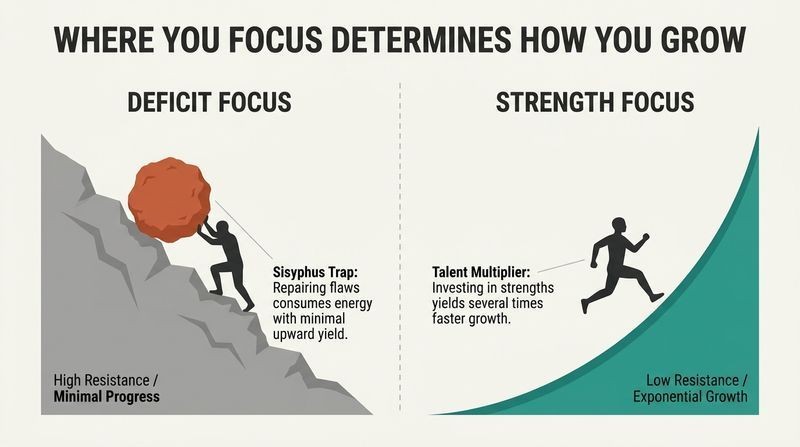
Our culture worships the wrong battle. From childhood report cards to corporate reviews, we pour energy into patching deficits while ignoring natural gifts. Tom Rath, working with Gallup's Donald Clifton, found people grow several times faster investing in strengths than correcting flaws. Yet only one-third of more than 10 million workers surveyed strongly agree they get to do what they do best every day.
The data on parenting is telling. In Gallup's studies, 77% of American parents believe a child's lowest grades deserve the most attention. We reward excellence with apathy and shower struggle with resources. The result: a person who cannot work with numbers will never be a great statistician, no matter how many remedial hours pile up.
The claim aligns with positive psychology's broader pivot under Martin Seligman, who argued the field spent a century cataloguing pathology while ignoring what makes people flourish. Clifton was honored as the father of strengths psychology for precisely this reframe. A useful tension worth naming: some weaknesses are not optional. A surgeon with poor attention to detail cannot simply outsource it. The book's nuance, that you should manage damaging weaknesses while building strengths, prevents the idea from sliding into a license to ignore growth areas that genuinely matter.
You can't be anything you want, only more of who you are
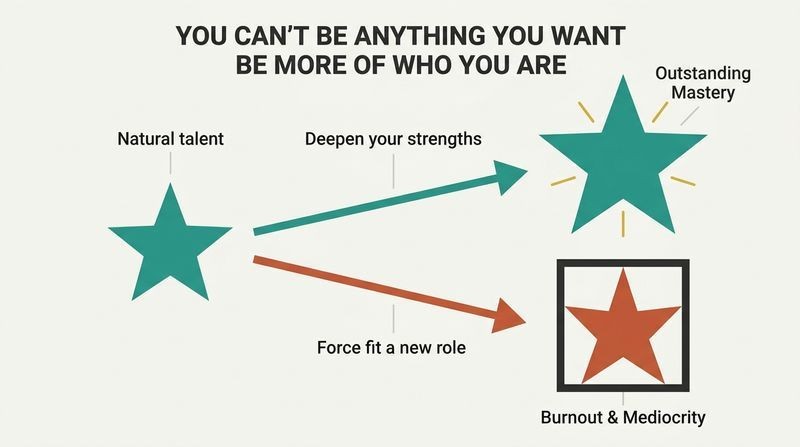
The American maxim is a lie. Rath spent five childhood years practicing basketball three to four hours daily, attending summer camps, chasing the dream of becoming the next Michael Jordan. He never made junior varsity. Effort alone could not manufacture talent he did not possess. He rewrites the cliche: you cannot be anything you want to be, but you can become a great deal more of who you already are.
The salesperson trap repeats this everywhere. A star seller gets promoted to manager, reads every leadership book, works nights at the cost of family and health, then discovers she lacks the natural talent to develop others. Organizations force advancement into ill-fitting roles instead of letting people deepen mastery where they already excel.
This punctures the bootstrap mythology that fuels much of self-help. It echoes Cal Newport's argument that passion follows mastery rather than preceding it, and the Peter Principle, which observes that people rise to their level of incompetence. The contrarian edge is real and bracing. Yet critics of trait-fixed thinking, notably Carol Dweck's growth mindset research, would push back: framing talent as relatively immutable risks discouraging effort precisely where neuroplasticity allows change. The reconciliation is probably domain-specific. Raw cognitive or relational dispositions are stubborn, but skills layered atop them remain highly trainable.
Strength equals natural talent multiplied by your investment
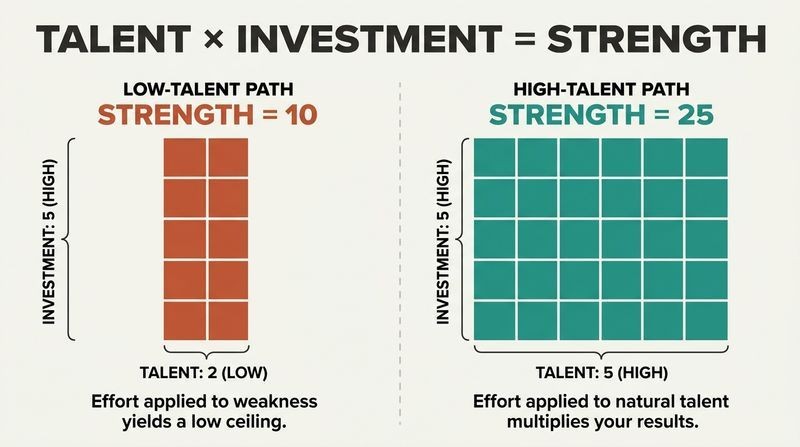
Talent is raw, strength is built. Rath defines talent as a recurring pattern of thought, feeling, or behavior that can be productively applied. Strength is the ability to deliver near-perfect performance consistently. The formula: Talent x Investment = Strength, where investment means time practicing, developing skills, and building knowledge.
The multiplication matters more than addition. Consider the film Rudy, the 5-foot-6 walk-on who fought for years to play seconds of Notre Dame football. Score him a perfect 5 on investment but a 2 on talent, and his ceiling is 10. A teammate with a 5 on talent investing the same effort reaches 25. Knowledge and skills are easy to add and amplify what already exists. Adding raw talent where little exists is the poorest use of your hours.
The multiplicative model is clever because it explains why hard work without aptitude plateaus while aptitude without work wastes. It resonates with Anders Ericsson's deliberate practice research, though Ericsson would resist the talent ceiling, arguing that what looks like inborn gift is often early, accumulated practice. The honest middle ground: at elite levels, where everyone has invested heavily, residual differences in disposition decide outcomes. The model's practical genius is allocation. Given finite time, pour investment into your high-talent multipliers rather than dragging a 2 toward a 3. Opportunity cost, not capability, is the real argument.
Living in your strengths zone makes you six times more engaged
The strengths zone is measurable. Gallup defines it as having the chance to do what you do best every day. People in it are six times more likely to be engaged at work and three times more likely to report excellent quality of life. Of those who strongly disagreed they use their strengths daily, not a single person in a 1,000-person poll was emotionally engaged.
Outside the zone, the symptoms compound. You dread work, clash with colleagues, treat customers poorly, badmouth your employer, and lose creative spark. Roughly 7 of every 10 million workers surveyed fall short of operating in their zone, meaning disengagement is less a personal failing than a widespread mismatch between people and roles.
These engagement figures became the spine of Gallup's lucrative workplace consulting, so a degree of healthy skepticism about self-reinforcing metrics is warranted. Still, the directional finding has held across decades of replication: strengths use predicts engagement and retention. What deserves emphasis is the framing of disengagement as a curable mismatch rather than a character flaw, which shifts responsibility partly to managers and job design. This dovetails with self-determination theory, where competence is a basic psychological need. People energized by tasks that fit their dispositions experience flow, in Csikszentmihalyi's sense, far more readily than those grinding against their grain.
A manager who ignores you damages more than one fixated on flaws
Indifference is the real poison. In a 2005 Gallup study of how managers affect employees, three approaches were compared. Managers who focused primarily on strengths nearly eliminated active disengagement. Managers who focused on weaknesses were worse. But managers who ignored employees entirely produced the most active disengagement of all.
The hierarchy of harm surprised even the researchers. Negative attention beats no attention. Being criticized at least signals that you exist and matter; being overlooked communicates irrelevance. The takeaway for anyone who leads people: the cheapest, highest-leverage move is simply to notice what your people do well and tell them.
This mirrors a counterintuitive finding in attachment and developmental psychology: children often prefer negative attention to neglect, because indifference threatens the bond itself. The same dynamic appears in Gallup's Q12 engagement research and in John Gottman's work on relationships, where contempt and stonewalling, a form of withdrawal, predict divorce more reliably than open conflict. The practical implication is liberating for time-strapped managers. Recognition costs minutes, not budget. The limitation is that strengths-only feedback can curdle into flattery if it never addresses real performance problems, so noticing must remain specific and honest rather than reflexively cheerful.
Pair your gaps with someone else's gifts instead of grinding alone
Complementary partnership beats self-repair. In Puebla, Mexico, Hector made shoes so good customers came from France, yet his business languished at 30 pairs a week because he was a poor salesman and worse at collecting payment. He spent most of his time in his weakest areas. A friend introduced him to Sergio, a natural salesman. Within a year the duo produced, sold, and collected on more than 100 pairs weekly, a threefold jump.
Three moves manage a weakness. Rath suggests you can stop doing the task entirely, build a system to compensate (a planner for poor organization), or partner with someone whose talent covers your gap. He admits his own weak Includer theme, so he relies on a colleague to ensure no one gets left out.
The shoemaker parable is essentially Adam Smith's division of labor scaled down to two people, and it anticipates the modern startup wisdom that founders should hire for complementary, not redundant, skills. Behavioral economics adds a wrinkle: people systematically overestimate their ability to improve weaknesses, a planning fallacy that keeps Hector grinding at sales he will never master. The partnering model also reframes humility as strategy rather than confession. Admitting what you lack becomes a competitive advantage. The caution is dependency risk. Outsourcing a weakness entirely can leave you fragile if the partnership dissolves, so a minimum baseline competence sometimes remains worth building.
Your dominant talents cast blind spots you must watch for
Every strength has a shadow. Rath warns that the same talents keeping you on track can derail you. Someone high in Command, who naturally takes charge and confronts, may bulldoze people and leave damage unnoticed. Someone high in Consistency, obsessed with treating everyone by identical rules, may fixate on uniform process while ignoring the actual outcome.
Awareness is the antidote. Knowing your areas of lesser talent helps you sidestep roadblocks before you hit them. Once you admit you are bad at detail, you can avoid detail-heavy roles, build a system, or hand it off. The goal is not a well-rounded personality but a clear-eyed map of where you soar and where you should not wander.
This is the book's most psychologically mature note, echoing Jungian shadow work and Aristotle's golden mean, where every virtue overextended becomes a vice. Courage unchecked is recklessness. The insight that a strength is also a liability appears in leadership research by Robert Kaplan and Robert Kaiser, who found executives often fail not from missing skills but from overusing their signature ones. The practical discipline, soliciting feedback specifically on how your strongest trait lands on others, is rarely done because the trait feels natural and therefore invisible. Self-knowledge here is less about adding capacities than about calibrating the volume on what you already have.
Trust your top five themes because talent is stable from age three
The assessment measures what endures. StrengthsFinder forces 20-second, instinctive responses across paired statements, because top-of-mind answers reveal genuine talent better than deliberated ones. It deliberately ignores knowledge, degrees, and skills, isolating the patterns least likely to shift. The output is your top five themes from a language of 34, plus over 5,000 personalized Strengths Insights.
Personality roots run deep. A 23-year longitudinal study of 1,000 children in New Zealand found that personality observed at age 3 closely matched reported traits at age 26. This stability is precisely why the tool targets talents rather than fleeting moods. With more than 33 million possible top-five combinations, the profile is closer to a fingerprint than a crude introvert-or-extrovert label.
The Caspi and Moffitt New Zealand cohort is genuinely influential developmental science, lending the assessment more empirical ballast than typical personality quizzes. That said, StrengthsFinder's test-retest reliability is imperfect. Rath concedes a couple of top-five themes may shift on retaking, which sits in tension with the stability claim and suggests measurement noise around the ranking boundary. Compared to the Big Five, the gold standard in personality science, the 34 themes are less validated as orthogonal constructs and more a practical, motivating vocabulary. Their real value may be less diagnostic precision than giving people permission and language to articulate gifts they sensed but could never name.
Analysis
StrengthsFinder 2.0 is less a book than a key to an online assessment, which shapes both its strengths and its limits. Structurally it is a brief thesis-driven introduction bolted onto a reference encyclopedia of 34 talent themes, each with definitions, real-voice testimonials, action ideas, and tips for collaborators. The argument itself is simple and repeated: human development works better when you build on natural talent than when you remediate weakness. Tom Rath, extending the life work of Donald Clifton and Gallup's four-decade research program, packages this into a movement about what is right with people rather than what is wrong.
The book's intellectual contribution is the reframing of a deeply held cultural script. The American promise that anyone can become anything through effort is, Rath argues, a recipe for frustration that sends people down the path of most resistance. His multiplicative formula, talent times investment, elegantly captures why grit without aptitude plateaus and aptitude without grit wastes. This is a meaningful corrective to a self-help genre saturated with willpower worship.
The weaknesses are worth naming. The research is overwhelmingly Gallup's own, creating an evidence ecosystem that is internally consistent but externally hard to audit. The 34 themes lack the construct validation of the Big Five, and the assessment's imperfect test-retest reliability undercuts the stability the book preaches. There is also a commercial architecture here. The book exists partly to sell the assessment and consulting services.
Yet the practical payoff is real. For most readers, the lasting value is permission and vocabulary: a structured way to name gifts they always sensed, paired with the strategic insight that managing weaknesses through partnership, systems, or avoidance beats hopeless self-repair. As applied folk psychology engineered for action, it succeeds. As rigorous personality science, it should be read with one eyebrow raised.
Review Summary
StrengthsFinder 2.0 receives mixed reviews. Many find it helpful for identifying personal strengths and improving workplace performance. The online assessment is praised for accuracy, though some question its validity. Critics argue the book is overpriced and lacks depth, serving mainly as a vehicle for the online test. Positive reviewers appreciate the focus on developing strengths rather than fixing weaknesses. Some find the results insightful and applicable to career development, while others see it as a marketing ploy for Gallup's services.
People Also Read







FAQ
What's "Strengths Finder 2.0" about?
- Focus on Strengths: "Strengths Finder 2.0" by Tom Rath is centered on identifying and developing individual strengths rather than focusing on weaknesses.
- Assessment Tool: The book includes access to the Clifton StrengthsFinder assessment, which helps readers discover their top five strengths from a list of 34 themes.
- Action-Oriented: It provides a personalized Strengths Discovery and Action-Planning Guide to help readers apply their strengths in practical ways.
- Community and Resources: The book is supported by an online platform offering discussion forums, downloadable guides, and other resources to foster a strengths-based community.
Why should I read "Strengths Finder 2.0"?
- Self-Improvement: It offers a structured approach to personal development by focusing on enhancing what you naturally do best.
- Career Advancement: Understanding your strengths can lead to better job satisfaction and performance, making it valuable for career growth.
- Engagement and Productivity: The book's insights can help increase engagement and productivity in both personal and professional settings.
- Research-Based: The content is backed by Gallup's extensive research, providing credibility and depth to the strategies presented.
What are the key takeaways of "Strengths Finder 2.0"?
- Strengths Over Weaknesses: Investing in strengths leads to greater growth and satisfaction than trying to fix weaknesses.
- Unique Talents: Each person has a unique combination of strengths that can be leveraged for success.
- Actionable Insights: The book provides specific strategies and actions to apply strengths in daily life.
- Community Support: Engaging with a community that understands and values strengths can enhance personal and professional relationships.
How does the Clifton StrengthsFinder assessment work?
- Online Assessment: The assessment is taken online using a unique access code provided with the book.
- 34 Themes: It measures 34 themes of talent, identifying the top five that are most dominant in the individual.
- Quick Responses: Participants have 20 seconds to respond to each item, capturing instinctual reactions.
- Personalized Results: The results include a detailed report with personalized insights and action plans based on the top five themes.
What are some examples of the 34 themes in "Strengths Finder 2.0"?
- Achiever: Describes a constant need for achievement and setting goals.
- Activator: Focuses on turning thoughts into action and making things happen.
- Adaptability: Emphasizes living in the moment and being flexible to change.
- Analytical: Involves looking for reasons and causes, and thinking about all the factors that might affect a situation.
How can I apply my strengths according to "Strengths Finder 2.0"?
- Set Goals: Align your strengths with your personal and professional goals to maximize effectiveness.
- Seek Roles: Choose roles and tasks that allow you to use your strengths regularly.
- Partner Wisely: Collaborate with others whose strengths complement your own.
- Continuous Learning: Use your strengths as a foundation for acquiring new skills and knowledge.
What is the philosophy behind "Strengths Finder 2.0"?
- Strengths-Based Psychology: The book is rooted in the idea that focusing on strengths leads to more significant personal and professional development.
- Positive Psychology: It aligns with positive psychology principles, emphasizing what is right with people rather than what is wrong.
- Individual Uniqueness: Recognizes that each person has a unique set of strengths that can be harnessed for success.
- Empowerment: Encourages individuals to take ownership of their strengths and use them to influence their environment positively.
What are the benefits of using a strengths-based approach?
- Increased Engagement: People who use their strengths daily are more engaged and productive.
- Better Quality of Life: Focusing on strengths is linked to higher life satisfaction and well-being.
- Improved Relationships: Understanding and valuing strengths can enhance personal and professional relationships.
- Organizational Success: Strengths-based development can lead to more effective teams and organizations.
How does "Strengths Finder 2.0" suggest managing weaknesses?
- Awareness: Recognize areas of lesser talent to avoid potential roadblocks.
- Avoidance: If possible, steer clear of tasks that require skills in your weaker areas.
- Partnerships: Collaborate with others who have strengths in areas where you are weaker.
- Systems and Tools: Use systems or tools to manage tasks that fall outside your strengths.
What are some of the best quotes from "Strengths Finder 2.0" and what do they mean?
- "You cannot be anything you want to be—but you can be a lot more of who you already are." This quote emphasizes the importance of focusing on and developing one's inherent strengths rather than trying to become something entirely different.
- "The key to human development is building on who you already are." It highlights the book's core philosophy of leveraging existing strengths for personal growth.
- "Our natural talents and passions—the things we truly love to do—last for a lifetime." This underscores the enduring nature of strengths and the importance of nurturing them throughout life.
How does "Strengths Finder 2.0" differ from other personality assessments?
- Focus on Strengths: Unlike many assessments that categorize weaknesses, this tool focuses on identifying and developing strengths.
- Dynamic Results: The assessment results can change over time, reflecting growth and development in different areas.
- Action-Oriented: It provides specific strategies and action plans for applying strengths in real-world scenarios.
- Community and Resources: Offers a comprehensive online platform for continued learning and community engagement.
What resources does "Strengths Finder 2.0" provide for continued development?
- Online Platform: Access to a strengths community area, discussion forums, and downloadable guides.
- Action-Planning Guide: A personalized guide with strategies for applying strengths in various time frames.
- Strengths Insights: Over 5,000 personalized insights to help understand and apply strengths uniquely.
- Supportive Tools: Includes a strengths screensaver, display cards, and a team strengths grid for mapping talents.
About the Author



Download PDF
Download EPUB
.epub digital book format is ideal for reading ebooks on phones, tablets, and e-readers.








































