
Key Takeaways
1. Out of the crucible of childhood deprivation, the soul of an artist is born
From such trivia I believe my soul was born.
Crucible of poverty. Chaplin's early life in South London was defined by extreme destitution, parental abandonment, and the constant threat of the workhouse. His mother, Hannah, a music-hall performer who lost her voice and her sanity to malnutrition, instilled in him a deep appreciation for the theatricality of everyday life.
The formative years. The grim realities of the Lambeth workhouse and the Hanwell school for orphans left indelible psychological scars on the young Chaplin. To survive these bleak environments, he learned to observe human behavior with acute sensitivity, transforming his pain into performance. His early experiences included:
- Watching his mother imitate passersby from their garret window
- Suffering public floggings and institutional isolation
- Joining the Eight Lancashire Lads as a clog dancer at age ten
A defensive drive. Chaplin's relentless pursuit of success was fueled by a desperate desire to escape the quicksands of poverty. His early theatrical engagements, such as playing the page-boy Billie in Sherlock Holmes, became a lifeline out of the slums. He sought knowledge and fame not for their own sake, but as a shield against the world's contempt.
2. True comedy is born from the friction of tragedy and pain
That stark, spring afternoon and that comedy chase stayed with me for days; and I wonder if that episode did not establish the premise of my future films – the combination of the tragic and the comic.
Tragicomic foundations. Chaplin's artistic philosophy was forged during a childhood incident where he watched a sheep escape from a slaughterhouse, capering in panic while onlookers laughed. The sudden realization of the animal's impending death transformed his laughter into tears, establishing the core premise of his future cinematic masterpieces.
The mechanics of humor. For Chaplin, humor was not merely about slapstick routines, but about the subtle discrepancies in human behavior under stress. He believed that the most effective comedy arises when characters attempt to maintain their dignity in the face of overwhelming adversity. Key elements of this philosophy include:
- Using physical violence as a choreographed, painless dance
- Juxtaposing raw slapstick with genuine, tear-evoking sentiment
- Allowing the audience to suffer vicariously through the characters
Defying grim reality. By laughing at the most terrifying aspects of existence, humanity asserts its defiance against helplessness. Chaplin utilized this principle to tackle heavy themes like starvation in The Gold Rush and industrial exploitation in Modern Times. True humor, in his view, heightens our sense of survival and preserves our collective sanity.
3. The "Little Tramp" was a physical manifestation of psychological contradictions
I wanted everything a contradiction: the pants baggy, the coat tight, the hat small and the shoes large.
Birth of an icon. The character of the Little Tramp was conceived spontaneously in a Keystone dressing room when Mack Sennett demanded a comedy make-up. Chaplin chose contrasting garments to create a visual paradox that immediately resonated with the audience. The costume instantly transformed his physical presence and unlocked a flood of creative ideas.
A complex psyche. The Tramp was far more than a simple clown; he was a multi-dimensional figure representing the duality of the human condition. He was a gentleman-tramp, a poet, and a dreamer who refused to let his impoverished circumstances crush his spirit. The character's complexity was defined by:
- A fastidious dignity maintained despite baggy pants and oversized shoes
- A chivalrous attitude toward women, contrasted with occasional mischief
- An adaptable nature that allowed him to pose as a duke or a scientist
Universal appeal. By embodying the struggles of the common man against a cold, mechanized world, the Tramp became a global symbol of hope. His silent pantomime bypassed language barriers, allowing audiences of all nationalities to identify with his quest for romance and survival. The character's enduring legacy lies in his ability to evoke both laughter and tears.
4. Creative autonomy is the ultimate safeguard of artistic genius
If people know how it’s done, all the magic goes.
The fight for control. Early in his film career, Chaplin realized that the assembly-line methods of directors like Henry Lehrman mutilated his comedic timing. He fought fiercely for the right to write, direct, and edit his own films, eventually securing complete creative autonomy. This independence allowed him to slow down the frantic pace of slapstick and focus on character development.
The directorial method. Chaplin's approach to filmmaking was highly intuitive and experimental, often starting a production with only a vague notion rather than a finished script. He would shoot thousands of feet of film, refining gags and story points through trial and error on the set. His meticulous process involved:
- Building elaborate sets to stimulate spontaneous comedic ideas
- Rehearsing scenes repeatedly to achieve choreographic perfection
- Controlling the editing process to protect his individual style
Defying the studios. By refusing to conform to the standard practices of the major film companies, Chaplin preserved the magic of his art. He was willing to risk his own capital to ensure that his creative vision remained uncompromised by commercial pressures. This uncompromising stance solidified his reputation as the world's first true film auteur.
5. True artistic expression requires a delicate balance of intellect and emotion
Our knowledge has made us cynical; our cleverness, hard and unkind. We think too much and feel too little.
The danger of over-intellectualizing. Chaplin believed that the primary purpose of the theatre and cinema is to appeal to the emotions rather than the intellect. While he was a deeply reflective man who read widely, he warned against letting academic dogma stifle the spontaneous warmth of acting. True art, in his view, must remain human and accessible.
The power of sentiment. For Chaplin, the most memorable moments in art are those that evoke a deep, emotional response. He used music as a crucial tool to establish the emotional counterpoint of his comedies, composing elegant melodies to frame the Tramp's struggles. His artistic principles emphasized:
- Using simplicity and restraint to convey complex psychological states
- Avoiding tricky camera effects that distract from the actor's performance
- Allowing the silent language of pantomime to speak directly to the heart
A humanist philosophy. In his masterpiece The Great Dictator, Chaplin used his platform to deliver a powerful, direct appeal for peace and humanity. He argued that modern progress and machinery are useless if they are accompanied by a loss of kindness and gentleness. The artist's duty, he believed, is to remind the world of its shared humanity.
6. United Artists proved that creators must control their own distribution
The four of us showed the report to D. W. Griffith and Bill Hart, and they had the same reaction as we did.
Combating the monopoly. In 1919, Chaplin, Mary Pickford, Douglas Fairbanks, and D.W. Griffith discovered that the major film distributors were planning a massive merger to control the industry. Realizing that this monopoly would reduce artists to mere employees and cap their earnings, they took a revolutionary step. They formed United Artists to distribute their own films independently.
The power of independence. By controlling their own distribution, the founders of United Artists bypassed the traditional studio system and retained the full profits of their work. This move allowed them to scale rental terms based on theatre capacity, maximizing their financial returns. The company's success was built on:
- Releasing high-quality, individual productions rather than mass-produced films
- Allowing creators to retain ownership of their negatives after a set period
- Providing a safe haven for independent filmmakers to work without interference
A lasting legacy. Despite initial skepticism from the industry, United Artists proved that creative independence could be highly profitable. The company successfully broke the studio stranglehold and paved the way for future generations of independent filmmakers. For Chaplin, it was the ultimate realization of his dream of complete artistic and financial freedom.
7. The transition to sound threatened the universal language of pantomime
I was a pantomimist and in that medium I was unique and, without false modesty, a master.
The threat of talkies. The advent of sound in the late 1920s threw the film industry into chaos, rendering the silent film obsolete almost overnight. Chaplin was deeply resistant to this change, believing that the spoken word would destroy the universal language of pantomime. He feared that his beloved tramp character would lose his magic if he ever spoke.
Preserving the silent art. Despite intense pressure from studios and exhibitors, Chaplin refused to let the Tramp speak. He continued to make silent masterpieces like City Lights and Modern Times long after the rest of Hollywood had transitioned to sound. His resistance was based on:
- The belief that pantomime is a more poetic and expressive medium than speech
- The fear that a spoken voice would destroy the universal, mythic quality of the Tramp
- The conviction that silent films possessed a unique, artistic integrity
A triumphant compromise. Chaplin eventually integrated sound into his films through synchronized music and sound effects, but kept the dialogue silent. This compromise allowed him to control the emotional tone of his pictures while preserving the purity of his pantomime. His success proved that silent art could still captivate a global audience in the sound era.
8. Political nonconformity in a paranoid society leads to inevitable exile
My prodigious sin was being a non-conformist. Although I am not a Communist, I refused to fall in line by hating them.
The price of independence. During the Cold War era, Chaplin's political nonconformity and his refusal to participate in the anti-Communist hysteria made him a target of intense hostility. He was accused of "un-American activities" and monitored by the FBI, while the press waged a relentless campaign to destroy his reputation. His humanitarian speeches and his film The Great Dictator were used as evidence against him.
The campaign of harassment. The US Government utilized every legal device to harass Chaplin, culminating in a highly publicized paternity suit and an indictment under the Mann Act. Despite being legally exonerated by a blood-test, he was subjected to public humiliation and political persecution. The campaign against him involved:
- Vicious press attacks that turned the American public against him
- Boycotts of his films organized by powerful pressure groups like the American Legion
- A grand jury investigation designed to find any technicality to deport him
The final exile. In 1952, while traveling to London for the premiere of Limelight, Chaplin learned that his re-entry permit to the United States had been revoked. Refusing to subject himself to further political interrogation, he decided to settle permanently in Switzerland. He chose freedom and peace over the paranoid atmosphere of a country he had called home for forty years.
9. True happiness is found not in fame or wealth, but in quiet, loving companionship
For the last twenty years I have known what happiness means.
The illusion of fame. Throughout his life, Chaplin was courted by princes, presidents, and the intellectual elite of the world. Yet, despite his immense wealth and global celebrity, he was often plagued by a deep, persistent loneliness. He discovered that the glittering world of high society was ultimately empty and could not provide lasting satisfaction.
Finding peace. It was not until his marriage to Oona O'Neill that Chaplin found the emotional stability and peace he had sought his entire life. In the quiet serenity of their Swiss estate, the Manoir de Ban, he surrounded himself with his family and devoted himself to his work. His final years were defined by:
- A deep, mutual love and understanding with his wife, Oona
- The joy of raising his eight children in a peaceful, natural environment
- A creative retirement spent writing, composing, and reflecting on his life
A grateful reflection. Looking back on his long and tumultuous journey, Chaplin felt a profound sense of gratitude for his destiny. He realized that his early struggles had prepared him to appreciate the simple, enduring joys of life. In the end, he found his ultimate sanctuary not on the silver screen, but in the quiet embrace of his family.
Review Summary
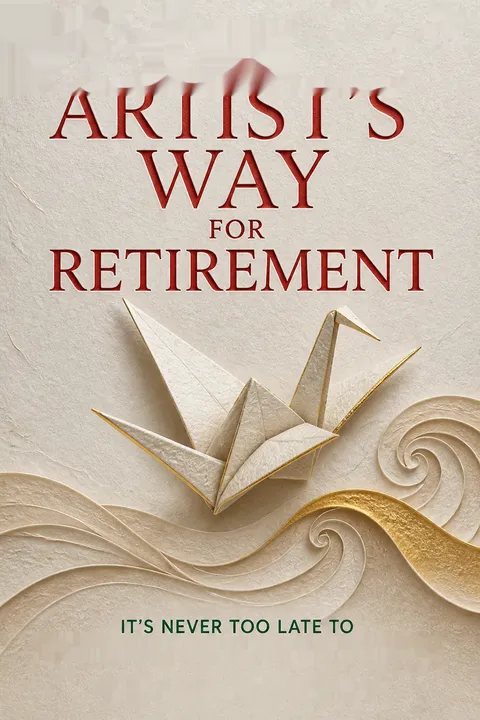
It's Never Too Late to Begin Again receives mostly positive reviews, praised for its practical approach to rediscovering creativity in retirement. Readers appreciate Cameron's tools like Morning Pages, Artist Dates, and memoir writing. Many find the 12-week program helpful for transitioning into retirement or navigating midlife changes. Some criticize the book's focus on privileged retirees and repetitive content. Overall, reviewers find the exercises valuable for self-discovery and reigniting passions, though some struggle with the time commitment required.
People Also Read


Download PDF
Download EPUB
.epub digital book format is ideal for reading ebooks on phones, tablets, and e-readers.








































