

Key Takeaways
"Get Rich Slow" hands you millions in a wheelchair
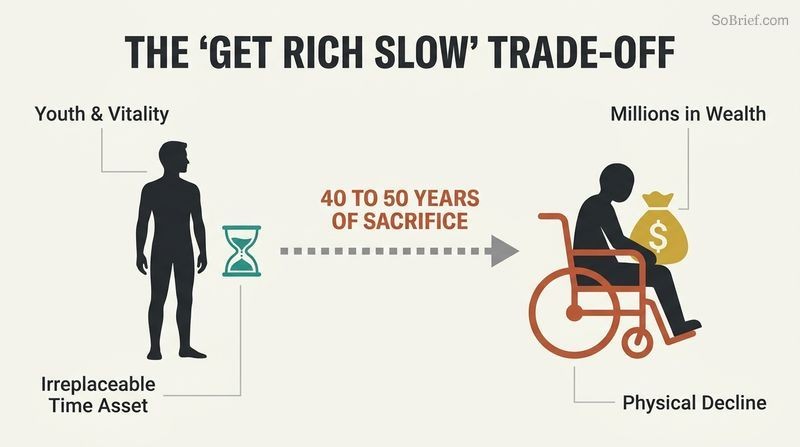
The conventional script is a sucker's bet. DeMarco attacks the financial gospel preached by mainstream gurus: go to school, get a job, save 10%, max your 401(k), clip coupons, and retire rich at 65. He calls this the Slowlane, and its fatal flaw is that it wagers your most irreplaceable asset, time, on a 40-to-50-year gamble dependent on factors you cannot control: a healthy economy, lifelong employment, and reliable 8% market returns.
Wealth wasted on old age is wealth wasted. Even if the plan works, your reward arrives alongside hip replacements and prescription pillboxes. He insists the real golden years are youth, when you have health, energy, and hair. A show like MTV Cribs never features a 22-year-old who got rich maxing his 401(k) at the cell phone store, because that person does not exist.
What's provocative here is the reframing of time, not money, as the scarce resource, an idea that aligns with research in behavioral economics on hyperbolic discounting. DeMarco's critique of the 2008-2009 crash exposing the Slowlane's fragility is fair, yet he understates survivorship bias in his own argument: the visible young rich are a tiny fraction of entrepreneurs, just as the visible old rich are a fraction of savers. Both paths have failure rates. His genuine contribution is challenging the unexamined assumption that deferred living is automatically prudent. The Stoics he quotes would agree that trading all of life's present for an uncertain future is its own form of recklessness.
Wealth is a road trip, not a single road
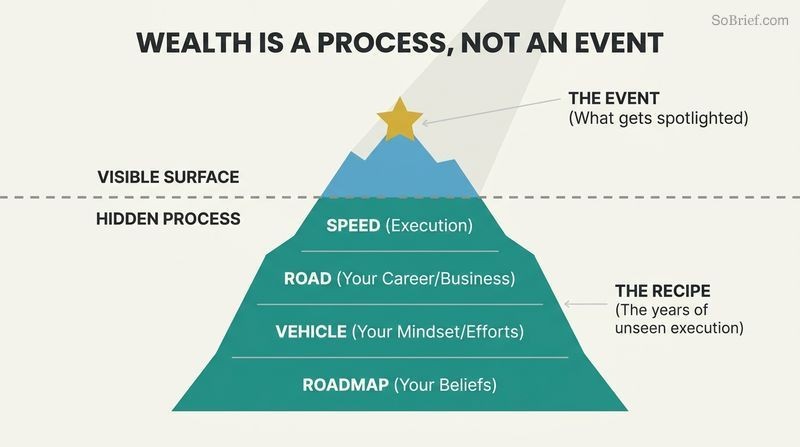
Process makes millionaires, events get the headlines. DeMarco argues most wealth books obsess over one ingredient (buy real estate, trade currencies, start a business) like trying to bake cookies with only sugar. Real wealth requires the full recipe: a roadmap (your beliefs), a vehicle (you), roads (your business or career path), and speed (execution). Miss one and the journey stalls.
The backstory is always hidden. When a 20-year-old sells a company for millions or an athlete signs a huge contract, society spotlights the event and buries the process: the years of coding in a garage, the torn ligaments, the credit-card debt at 21.99% interest. He uses the example of Glaceau Vitamin Water, sold to Coca-Cola for $4.1 billion after eleven years of struggle nobody talks about. The elevator to success is broken; you take the stairs.
This event-versus-process distinction echoes Daniel Kahneman's work on the narrative fallacy, our tendency to compress messy causation into tidy stories. DeMarco's insight that we glorify outcomes while ignoring inputs is psychologically robust and explains why get-rich-quick schemes sell: they promise the event without the process. The metaphor stretches thin at points, but the core warning is durable. One useful extension comes from Nassim Taleb: visible success is filtered by luck and hidden graveyards of failure, so even rigorous process guarantees nothing. Process improves the odds; it does not eliminate randomness. DeMarco mostly acknowledges this through his probability framing.
Pick one of three roadmaps: Sidewalk, Slowlane, or Fastlane
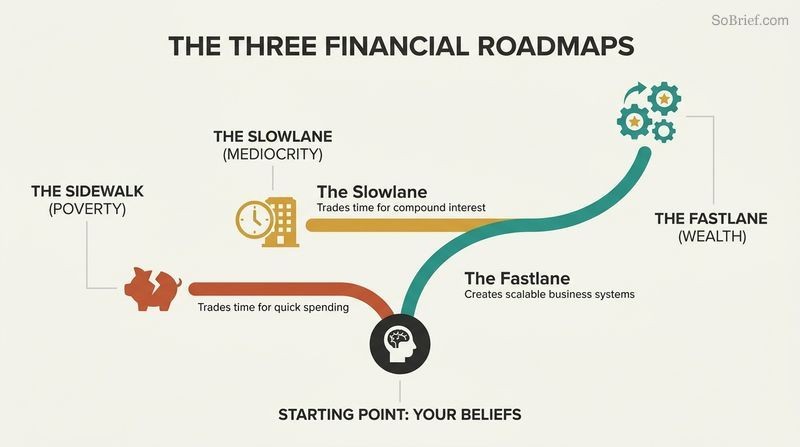
Your financial destiny is predetermined by your map. DeMarco sorts everyone into three mindsets, each with its own wealth equation and natural destination:
1. The Sidewalk leads to poorness: no plan, spend everything, one paycheck from broke.
2. The Slowlane leads to mediocrity: job plus market investments, sacrifice today for an uncertain tomorrow.
3. The Fastlane leads to wealth: build a business system with controllable, unlimited leverage.
Beliefs drive choices, choices drive outcomes. Each map carries "mindposts," preset attitudes about debt, time, education, and money. A Sidewalker sees time as infinite and money as a hot potato. A Slowlaner trades time for salary and worships compound interest. A Fastlaner treats time as the king asset and money as a reflection of lives impacted. To change your life, you must first switch maps, because your current bank balance is simply the output of the map you have been unconsciously following.
The taxonomy is the book's organizing spine, and its strength is making abstract financial psychology concrete and sortable. It resembles Carol Dweck's fixed-versus-growth mindset framework applied to money. The weakness is binary moralizing: real people drift between maps depending on life stage, and the Slowlane is caricatured to sharpen the Fastlane's appeal. Many financially secure people built wealth through disciplined investing plus a decent career, a hybrid DeMarco dismisses too quickly. Still, the diagnostic value is real. Forcing readers to name their default operating system surfaces unconscious assumptions, which is the necessary precondition for any behavior change, as cognitive behavioral therapy has long demonstrated.
Real wealth is family, fitness, and freedom, not Lamborghinis
Society poisoned the definition of wealth. DeMarco admits he uses the Lamborghini as bait because we have been conditioned, like Pavlov's dogs, to equate wealth with luxury goods. But his happiest moments were never the day he bought the supercar. True wealth, he argues, rests on three pillars: family (relationships), fitness (health), and freedom (choice).
Faux wealth destroys real wealth. He mocks the "30K millionaires" who finance entry-level BMWs and bottle service to look rich while owning nothing. Buying the appearance of wealth through monthly payments destroys the one component that actually matters: freedom. He tells of Henry, a pharmaceutical rep who buys a $1.8 million dream house, then loses his health, marriage, and time to the commute and corporate hours required to pay for it. His dream house ends up living him, rather than the reverse.
DeMarco's wealth trinity converges with decades of positive-psychology research: after basic needs are met, the World Values Survey and studies by Diener and others consistently find relationships, health, and autonomy predict wellbeing far better than income. His emphasis on freedom as the protective umbrella over health and relationships is sharp and underappreciated in finance writing. The tension worth naming is that the book simultaneously sells the Lamborghini dream and disavows it, a deliberate rhetorical bait-and-switch he confesses to. Readers should notice that the deepest claim here, that autonomy beats accumulation, quietly undercuts the cover's promise, which is arguably the most honest moment in the entire book.
A job traps wealth inside the cage of 24 hours
The Slowlane runs on Uncontrollable Limited Leverage. DeMarco's acronym ULL (pronounced "yule," as in "ULL never get rich") explains why salaries cannot build fast wealth. Your income equals either hourly wage times hours worked, or your annual salary. Both are pegged to time, and time caps out at 24 hours a day and roughly 50 working years. You cannot demand a 1,000% raise or work 400 hours in a day.
Compound interest shares the same disease. The guru promise that $10,000 grows to millions in 40 years requires impossible consistency and, worse, requires you to be alive and old to enjoy it. DeMarco's own forgotten Roth IRA, opened with $1,000 in 1997, was worth just $698 a decade later, less than his kitchen change bucket. Wealth pegged to mathematics based on time can never accelerate, because small numbers cannot make millionaires.
The leverage argument is the analytical heart of the book and its most defensible claim. It maps neatly onto the economist's distinction between linear and scalable income, what Taleb calls the difference between dentists and writers. Where DeMarco overreaches is the dismissal of compound interest itself: his single cherry-picked Roth IRA spanning the dot-com crash and 2008 is statistically misleading, since broad index funds delivered roughly 7% annualized over most long horizons. The valid point survives anyway: time-bound income has a hard mathematical ceiling. The invalid implication, that markets never build wealth, ignores that even he eventually parks his fortune in those same instruments for passive income.
Beware gurus who teach one map but get rich on another
The Paradox of Practice exposes financial hypocrisy. DeMarco coins this term for advisors who preach a strategy that did not actually make them wealthy. Would you take nutrition advice from an obese instructor? He argues famous money personalities got rich selling millions of books and seminars (a Fastlane), while teaching audiences to dollar-cost average into mutual funds (a Slowlane).
Follow the real money. He points to a reported fact that one prominent guru kept the bulk of her roughly $25 million fortune in municipal bonds, with only 4% in the stock market she championed for everyone else. The rich, he insists, use markets to preserve and generate income from wealth they already built elsewhere, not to create it. When gurus release books titled "Rebuild" or "Start Over" after a crash, it quietly admits the original plan failed the very people who followed it.
The Paradox of Practice is a genuinely useful heuristic that extends beyond finance into any advice market: incentives of the advice-seller rarely match the advice-buyer. It resonates with Charlie Munger's maxim, show me the incentive and I will show you the outcome. The critique has teeth because selling courses about making money is structurally more lucrative than the methods taught. That said, DeMarco commits a mild version of the same paradox, since this very book is part of his own Fastlane, a fact he openly concedes. The honest reader should apply his test to him too: his wealth came from a lead-generation business, then book sales, not from following anyone's index-fund advice.
Switch from Team Consumer to Team Producer
You were baptized to consume; wealth requires the opposite. From childhood toys to adult gadgets, DeMarco argues we are conditioned to demand, buy, and seek the cheapest products. The rich are a minority because producers are a minority. The fix is a deliberate reorientation: instead of buying products on TV, sell them; instead of taking a class, teach one; instead of borrowing money, lend it.
Producers see the matrix. Once you adopt the producer lens, advertising messages snap into focus as marketing weapons, and opportunities appear everywhere. DeMarco watches infomercials not to buy but to study what the pros are doing. The beautiful irony: succeed as a producer and you can consume anything you want with little consequence, because you will be rich. Most people have it backward, consuming first and producing never, which guarantees they stay on the wrong team.
This producer-consumer flip is the book's most actionable mental reframe and has roots older than DeMarco: it echoes the classic distinction between owning capital and selling labor. What modernizes it is the democratized access to production tools, software, content platforms, e-commerce, that did not exist for previous generations. The framing also dovetails with research on locus of control: producers operate from an internal locus, believing their actions shape outcomes. The limitation is that not everyone is temperamentally suited to production, and a healthy economy needs both roles. DeMarco frames consumption as near-moral failure, which overshoots. Strategic consumption (investing in skills, tools, health) is itself a producer behavior.
Affect millions and you make millions: the Law of Effection
Wealth is mathematically tied to lives impacted. DeMarco's central law states that the more lives you affect, in scale or magnitude, through an entity you control, the richer you become. Scale means reaching huge numbers (sell 20 million pens at 75 cents profit). Magnitude means deeply impacting fewer (a developer profiting $400,000 per office complex). Combine both and you create billionaires.
Stop chasing money; chase needs. He contrasts the Law of Effection with the Law of Attraction, which he dismisses as a non-law because thinking positively never finished his book until he sat down and wrote it. Effection is absolute because it is rooted in math. Trace any self-made fortune back to its source and you find millions of something: songs sold, customers served, problems solved. Money is simply a receipt for the value you have provided to other people.
The Law of Effection elegantly unifies the book's economics into one testable principle, and it aligns with value-creation theory: prices and profits reflect aggregate willingness to pay, which scales with reach and intensity of benefit. The insight that money is a reflection of value delivered is morally clarifying and matches Adam Smith's invisible hand more than DeMarco's brash tone suggests. His takedown of the Law of Attraction is rhetorically satisfying but slightly strawmanned, since serious proponents emphasize action alongside visualization. The deeper nuance he glosses: Effection rewards captured value, not created value. Plenty of high-impact work (teaching, caregiving) affects millions yet captures little, because capture depends on control and pricing power.
Test every business against the five NECST commandments
Most businesses cannot route to wealth. DeMarco offers a litmus test (NECST, pronounced "next") to validate whether a business road can actually reach the Law of Effection:
1. Need: solve a real market problem, not your selfish desire to "be your own boss."
2. Entry: avoid easy-entry fields; if anyone can join in ten minutes, competition crushes margins.
3. Control: own your system, pricing, and brand rather than hitchhiking on someone else's.
4. Scale: operate where you can reach large numbers or high magnitude.
5. Time: build a system that earns money detached from your hours.
Violations degrade wealth potential. He explains 90% of businesses fail because they violate the Commandment of Need, built on the founder's wishes rather than the market's. A hip-hop boutique opened next to a retirement home dies in eighteen months. A neighborhood sandwich franchise violates Scale (you cannot sell a sub to someone in Australia) and Time (you become the employee).
NECST functions as a practical pre-mortem checklist, and its diagnostic power is real, especially the Entry commandment, which captures Porter's barriers-to-entry from competitive strategy in plain language. The Control commandment anticipates the modern creator economy's hard lesson: building an audience on a platform you do not own (algorithm changes, demonetization) is renting, not owning. Where the framework invites pushback is its bias toward scalable tech and away from durable local businesses; plenty of dentists, plumbers, and restaurateurs build genuine wealth violating Scale, precisely because high entry barriers and local trust protect their margins. The five commandments are best read as probability-shifters, not absolute gates, which DeMarco mostly acknowledges.
Plant money trees that earn while you sleep
Passive income detaches money from your time, satisfying the Commandment of Time. DeMarco's "money tree" is a business system that produces income with minimal ongoing labor. He identifies five seedlings, ranked by passivity:
1. Rental systems (real estate, licenses, royalties, patents).
2. Computer/software systems (websites, apps).
3. Content systems (books, blogs, courses).
4. Distribution systems (franchising, network marketing you own, e-commerce).
5. Human resource systems (people, the most expensive and least passive).
The dollar itself is the ultimate seed. Once a business generates a large lump sum, money becomes the best money tree of all. DeMarco retired in his thirties as a lender: $10 million at 5% interest throws off roughly $40,000 a month, fully passive, without touching the principal. His Internet company once profited over $200,000 in a single month while he gambled, slept, or traveled, because the system, not his time, did the work.
The money-tree taxonomy is a clean operational guide and its passivity ranking is honest, correctly flagging that employees require management and erode passivity, a truth many aspiring "passive income" enthusiasts learn painfully. The deeper financial logic, that the endgame is converting a business asset into income-generating capital, is exactly how old wealth has always worked and reconciles his earlier compound-interest critique: the rich use interest for income, not creation. One caveat worth flagging for readers: nearly all these "passive" systems demand intense active work to build and ongoing maintenance to sustain. Truly passive income is the harvest, never the planting, a distinction DeMarco states clearly as a one-way street.
Your choices carry horsepower that compounds across decades
Poor choices, not bad luck, cause poorness. DeMarco argues your present circumstances are the cumulative output of thousands of choices, both of action and of perception. He distinguishes treasonous choices (drunk driving, unaffordable mortgages) that derail life permanently from accelerative ones. Like a golf club face rotated one degree, a small deviation today widens into a massive gap over years, an "impact differential."
Horsepower fades with age. Choices made young carry the most trajectory, like an asteroid nudged while still millions of miles from Earth. He offers two tools to choose better: Worst Case Consequence Analysis (asking the worst outcome, its probability, and whether the risk is acceptable) for daily decisions, and the Weighted Average Decision Matrix (scoring options numerically across weighted factors) for big ones. He used the matrix to decide to move to Phoenix and to avoid a $125,000 bad investment.
The horsepower-of-choice framing translates chaos theory's sensitive dependence on initial conditions into personal-finance terms, and it is psychologically sound: longitudinal studies on compounding life decisions (education, partner selection, debt) confirm early choices cast long shadows. The WCCA and WADM tools are practical decision hygiene, resembling expected-value reasoning and multi-criteria decision analysis used in operations research. The framework's blind spot is structural inequality: framing all poorness as choice-driven understates how starting position, systemic barriers, and genuine bad luck constrain the choice set itself. DeMarco's responsibility-and-accountability ethos is empowering for those with options, but it risks blaming people whose menu of choices was impoverished from birth.
Execution is king; your brilliant idea is a worthless pawn
Ideas are neurological flatulence until executed. DeMarco insists the owner of an idea is not who imagines it but who builds it. Borrowing a framework from Derek Sivers, he frames ideas as multipliers and execution as the actual dollar amount: a brilliant idea (200 mph potential) with no execution is worth about $200, while a so-so idea with brilliant execution can be worth millions. Refusing to sign NDAs, he notes a thousand people already share your idea; only the executor wins.
Burn the business plan and let the world react. A business plan is just an idea on steroids, invalidated the moment reality touches it. When DeMarco spent six weeks redesigning his website, complaints flooded in and conversions collapsed, so he scrapped it and reverted. Investors fund track records of execution, not bound PowerPoints. Facebook and Google were not first; they simply executed existing ideas better.
This is perhaps the most empirically vindicated claim in the book. Startup research consistently shows execution, timing, and team trump idea novelty, and the graveyard of "first movers" beaten by better executors (Friendster before Facebook, AltaVista before Google) supports him. The point connects to the lean-startup movement's build-measure-learn loop and Steve Blank's "get out of the building." DeMarco's anti-business-plan stance is slightly overstated for capital-intensive or regulated ventures, where planning is non-negotiable, but his core correction, that markets, not spreadsheets, reveal truth, is sound. The humbling implication for ambitious readers: hoarding and protecting ideas is a tell of inexperience, since value lives entirely in the doing.
Build a brand that delivers service so good it shocks
Businesses survive; brands thrive. DeMarco argues the antidote to commoditization (where customers buy purely on price) is a Unique Selling Proposition, a clear differentiating promise. His own USP was risk-free advertising: if we send you nothing, you pay nothing. He cites Domino's classic delivery guarantee as a USP that built an empire on an ordinary product.
Weaponize Superior Unexpected Customer Service (SUCS). Because customer service generally sucks, expectations are low, which is an opportunity. When you positively violate a customer's low expectation profile (answering emails in minutes, real humans instead of phone-tree mazes), you convert customers into evangelists who become free human-resource systems advertising for you. He treated complaints as a roadmap, logging them in a black book to expose unmet needs, and made the customer, not himself, the true boss of the business.
The SUCS concept is a memorable repackaging of expectation-disconfirmation theory from marketing science, which holds that satisfaction is relative to expectations, not absolute quality. DeMarco's insight that low industry-wide service creates an arbitrage opportunity is genuinely shrewd and explains how challengers like Zappos or Chewy disrupted incumbents purely on service. His complaint-logging practice anticipates the modern "voice of customer" and Net Promoter discipline. The brand-versus-business distinction aligns with brand-equity research showing loyalty commands pricing power. One nuance: SUCS is expensive and hard to scale, and as companies grow, the personal touch that created loyalty often erodes, the exact decay DeMarco observed at a luxury hotel. Sustaining shock-level service is a permanent operational fight, not a one-time setup.
Analysis
The Millionaire Fastlane is best understood as a polemic disguised as a how-to, and its enduring influence (it seeded a large online entrepreneur community) comes from emotional reframing more than novel tactics. DeMarco's genuine intellectual contribution is reframing time, not money, as the scarce asset, and exposing the hidden assumption inside mainstream financial advice: that deferring life for four decades is automatically prudent. By attacking compound-interest orthodoxy and the gurus who sell it, he performs a useful service even when his statistics are cherry-picked. His single underwater Roth IRA spanning two crashes is intellectually dishonest as evidence against index investing, yet his structural point survives: time-bound, single-variable income (wages, fixed savings rates) has a hard mathematical ceiling that scalable business systems do not.
The book's analytical spine, the contrast between Uncontrollable Limited Leverage and Controllable Unlimited Leverage, is a vernacular translation of the economist's distinction between linear and scalable income. NECST and the Law of Effection restate competitive strategy (barriers to entry) and value-creation theory in punchy, memorable language. This is the book's real skill: making abstract economics emotionally sticky for non-experts.
The central blind spot is survivorship bias, which DeMarco partly inoculates against with probability framing but never fully reckons with. The visible young rich are as filtered by luck as the visible old savers, and his choice-driven theory of poorness underweights structural constraints on the choice set itself. His responsibility ethic empowers those who already have options while risking blame for those who never did.
Ultimately the most honest and valuable thread is the quietest one: the wealth trinity of family, fitness, and freedom. It subverts the Lamborghini bait on the cover and converges with positive-psychology consensus. Read charitably, the book argues that entrepreneurship is a means to autonomy, and autonomy, not consumption, is what actually correlates with a life well lived.
Review Summary
The Millionaire Fastlane receives mixed reviews. Many praise its unconventional approach to wealth creation, emphasizing entrepreneurship and rapid business growth over traditional financial advice. Readers appreciate the author's candid style and practical insights on building scalable businesses. However, some criticize the book's repetitive nature, arrogant tone, and dismissal of traditional career paths. The book's main message encourages readers to create value, solve problems, and build businesses that can be sold for substantial profits, rather than relying on slow wealth accumulation through savings and investments.
People Also Read




Glossary
Fastlane
Rapid wealth via business systemsDeMarco's roadmap for fast wealth, built on Controllable Unlimited Leverage through a business you own. It centers on producing value, building scalable systems that detach income from your time, and ultimately generating large sums quickly, often within years rather than decades. Predisposed toward wealth rather than mediocrity or poorness.
Slowlane
Get-rich-slow through jobs and savingThe conventional wealth strategy of working a job, saving a percentage of income, and investing in markets for 40-plus years to retire around 65. DeMarco argues it is predisposed to mediocrity because its variables (salary, market returns, working years) are pegged to uncontrollable, time-limited mathematics.
Sidewalk
No financial plan, instant gratificationThe roadmap of those who have no financial plan and spend everything on instant gratification, living one paycheck, gig, or layoff from broke. Predisposed to poorness regardless of income level, since even high earners can ride the Sidewalk by spending more than they make.
Uncontrollable Limited Leverage (ULL)
Time-capped, uncontrollable wealth mathDeMarco's acronym (pronounced "yule") for why the Slowlane fails. Income from a job and returns from compound interest are both pegged to time, which is capped (24 hours daily, roughly 50 working years) and cannot be controlled or amplified. Small, fixed numbers cannot create fast wealth.
Controllable Unlimited Leverage (CUL)
Scalable, controllable wealth mathThe opposite of ULL and the engine of the Fastlane. In a business you control, variables like units sold and unit profit can scale toward unlimited numbers, and you control them directly. This makes exponential wealth creation mathematically possible rather than capped by time.
Law of Effection
Impact millions, make millionsDeMarco's core wealth law: the more lives you affect, in scale (large numbers reached) or magnitude (deep impact on fewer), through an entity you control, the wealthier you become. He calls it absolute because it is rooted in math, and traces all self-made fortunes back to millions of something sold or solved.
NECST Commandments
Five tests for Fastlane businessesDeMarco's litmus test (pronounced "next") for whether a business can reach wealth: Need (solve a real market problem), Entry (avoid easy-entry fields), Control (own your system and brand), Scale (reach large numbers or magnitude), and Time (earn income detached from your hours). Violations degrade wealth potential.
Money Tree (seedlings)
Passive-income-producing business systemsA business system that generates income with minimal ongoing labor, satisfying the Commandment of Time. DeMarco identifies five seedlings ranked by passivity: rental systems, computer/software systems, content systems, distribution systems, and human resource systems. The harvested fruit is passive income.
Paradox of Practice
Gurus not rich from own adviceDeMarco's term for advisors who teach one wealth strategy while getting rich using a different one. Many money gurus, he argues, earn their fortunes selling books and seminars (a Fastlane) rather than from the dollar-cost-averaging and mutual-fund advice (a Slowlane) they preach to audiences.
Lifestyle Servitude
Debt-driven trap forcing endless workThe self-perpetuating cycle where work creates income, income funds lifestyle and debt, and that debt forces continued work. Fueled by instant gratification and parasitic debt, it systematically erodes freedom, trapping both low and high earners in a treadmill of spending and obligation.
SUCS
Superior Unexpected Customer ServiceDeMarco's customer-service strategy: because service generally sucks, expectations are low, so positively violating a customer's low expectation profile (fast human responses, no phone mazes) converts customers into loyal evangelists who advertise your business for free, functioning as unpaid human resource systems.
Producer vs. Consumer
Sell and own, don't just buyDeMarco's reframe dividing people into two teams. Consumers (the majority) buy products, borrow money, and take jobs. Producers (the wealthy minority) sell products, lend money, and hire. He urges switching to Team Producer first, since producing value attracts money, after which you can consume freely.
FAQ
What's The Millionaire Fastlane about?
- Wealth Creation Focus: The Millionaire Fastlane by M.J. DeMarco offers a roadmap to achieving wealth quickly, challenging the traditional "Get Rich Slow" mindset. It emphasizes creating financial freedom through entrepreneurship rather than relying on conventional methods.
- Three Financial Paths: DeMarco outlines three paths: the Sidewalk (living paycheck to paycheck), the Slowlane (sacrificing today for a better tomorrow), and the Fastlane (rapid wealth creation through entrepreneurship).
- Personal Responsibility: The book stresses the importance of personal accountability and making informed choices to achieve financial success, encouraging readers to take control of their financial destinies.
Why should I read The Millionaire Fastlane?
- Challenging Conventional Wisdom: The book challenges traditional financial advice, offering a fresh perspective on wealth creation that can inspire readers to rethink their financial strategies.
- Real-Life Success Stories: DeMarco shares his journey and others' experiences in the Fastlane, providing motivation and practical examples of achieving financial independence.
- Actionable Strategies: It offers practical advice for building wealth quickly, emphasizing entrepreneurship and creating systems that generate passive income.
What are the key takeaways of The Millionaire Fastlane?
- Fastlane vs. Slowlane: The Fastlane focuses on entrepreneurship and rapid wealth creation, while the Slowlane relies on traditional employment and saving, often leading to delayed financial freedom.
- Control and Leverage: The Fastlane is built on Controllable Unlimited Leverage (CUL), maximizing income potential, contrasting with the Slowlane's Uncontrollable Limited Leverage (ULL).
- Wealth Equation: DeMarco introduces the wealth equation: Wealth = Net Profit + Asset Value, highlighting the importance of profitable businesses and appreciating assets.
What are the best quotes from The Millionaire Fastlane and what do they mean?
- "Normal is not something to aspire to, it’s something to get away from.": Encourages breaking free from societal norms that lead to mediocrity, urging readers to pursue extraordinary lives.
- "Wealth is a process, not an event.": Emphasizes that wealth accumulation requires consistent effort and strategic planning, challenging the notion of quick fixes.
- "The more lives you affect, the richer you will become.": Reflects the Law of Effection, suggesting that impacting many people leads to greater wealth by creating value and serving others.
What is the Fastlane mentality in The Millionaire Fastlane?
- Wealth Creation Mindset: The Fastlane mentality centers on the belief that wealth can be created quickly through entrepreneurship and innovation, rejecting the idea of waiting decades for financial freedom.
- Focus on Value Creation: Fastlaners prioritize creating value for others, generating wealth for themselves by serving a large audience or market.
- Embracing Risk and Action: It involves taking calculated risks and acting decisively to seize opportunities, encouraging readers to pursue their entrepreneurial dreams.
How does M.J. DeMarco define wealth in The Millionaire Fastlane?
- Wealth Beyond Money: DeMarco defines wealth as a combination of family, fitness, and freedom, emphasizing a fulfilling life beyond financial success.
- Freedom to Live: Wealth is about having the freedom to make choices and live life on your terms, including spending time with loved ones and pursuing passions.
- Impact on Others: Wealth is also measured by the positive impact on others, with greater wealth achieved by touching and improving more lives.
What are the three financial roadmaps discussed in The Millionaire Fastlane?
- The Sidewalk: Represents living paycheck to paycheck, characterized by poor financial decisions and a lack of planning, leaving individuals vulnerable to financial crises.
- The Slowlane: Involves sacrificing today for a better tomorrow through traditional employment and saving, often leading to mediocrity and delayed gratification.
- The Fastlane: Path to rapid wealth creation through entrepreneurship and innovation, emphasizing control, leverage, and systems that generate passive income.
What is the importance of personal responsibility in The Millionaire Fastlane?
- Taking Control of Your Life: DeMarco stresses that individuals must take responsibility for their financial decisions and outcomes, acknowledging that choices directly impact financial situations.
- Avoiding Victim Mentality: Encourages rejecting the victim mentality that blames external factors for financial struggles, promoting accountability and proactive decision-making.
- Empowerment Through Choices: Owning your choices empowers you to change your financial trajectory, crucial for transitioning from the Sidewalk or Slowlane to the Fastlane.
How does The Millionaire Fastlane suggest one can achieve financial freedom?
- Entrepreneurship as a Path: Advocates for entrepreneurship as the most effective way to achieve financial freedom quickly, emphasizing creating a business that generates passive income.
- Building Systems: Highlights the importance of creating systems that work for you, allowing you to earn money without being directly involved in day-to-day operations.
- Leveraging Assets: Encourages focusing on building and leveraging appreciating assets, such as businesses or investments, to create wealth.
What are the common pitfalls of the Slowlane according to The Millionaire Fastlane?
- Time-Consuming: The Slowlane often requires decades of hard work and saving, with no guarantee of success, leading to frustration if circumstances change.
- Lack of Control: Individuals in the Slowlane often have little control over their financial futures, relying on jobs and market conditions that can be unpredictable.
- Mediocre Outcomes: Predisposed to mediocrity, many end up in the middle class rather than achieving true wealth, leading to unfulfilled potential and missed opportunities.
What are the Five Fastlane Commandments in The Millionaire Fastlane?
- Commandment of Need: Successful businesses must solve real needs in the marketplace; failing to address genuine needs often leads to failure.
- Commandment of Entry: Businesses with low barriers to entry face high competition; a strong business should have significant entry barriers.
- Commandment of Control: Entrepreneurs must maintain control over business operations, pricing, and marketing strategies to avoid vulnerability and financial instability.
How can I start my Fastlane journey according to The Millionaire Fastlane?
- Define Your Goals: Clearly outline what you want to achieve and the lifestyle you desire, setting specific targets to guide your actions.
- Identify a Need: Look for unmet needs in the marketplace that you can address with a business idea, focusing on providing value to others.
- Take Action: Begin executing your plan, no matter how small the steps may be, as "the journey of a thousand miles begins with one step."
About the Author
Other books by M.J. DeMarco



Download PDF
Download EPUB
.epub digital book format is ideal for reading ebooks on phones, tablets, and e-readers.








































