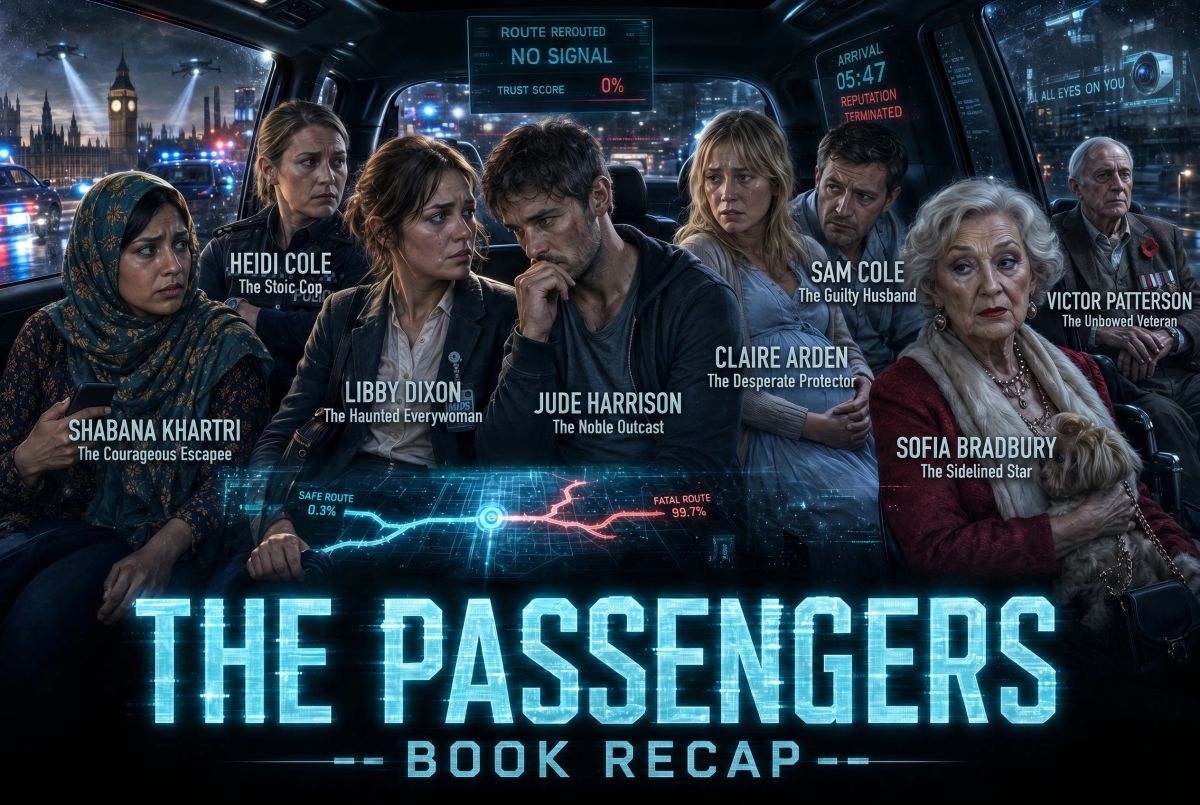


Plot Summary
Eight Cars, One Death Sentence
On an ordinary morning eight people climb into their driverless cars expecting routine trips. Claire,5 seven months pregnant, supposedly heads toward her husband's office. Jude,2 gaunt and living out of his car, drives north. Sofia,6 a fading actress, travels to a hospital event.
Police officer Heidi8 and her husband Sam7 ride in separate vehicles, bickering about their anniversary. Shabana,12 escaping an abusive husband, flees with hidden cash. One by one their doors lock, windows turn opaque, and a calm male voice4 announces that each car now answers to him.
He tells them that within roughly two and a half hours they will likely be dead. Their pleas dissolve into static as the vehicles reroute toward an unknown shared destination, sealing them inside moving steel.
Marrs opens by literalizing a modern dread: the surrender of control to systems we neither understand nor command. Each passenger's mundane intention (commute, errand, escape) is hijacked mid-motion, dramatizing how technology promises convenience while quietly stripping agency. The opaque windows are pointed, isolating victims from the very public that will soon judge them. By withholding the captor's identity and motive, the prologue-like sequence establishes dread as structure, not event, and frames the body itself as a prison the characters cannot argue, charm, or fight their way out of.
The Juror Who Hates Machines
Libby Dixon,1 a Birmingham mental health nurse who once marched against autonomous vehicles, is conscripted onto the secretive Vehicle Inquest Jury. For one week she must help decide whether fatal crashes are the fault of a car's AI or its passenger.
Foreman Jack Larsson,3 a smug Transport Minister, belittles every objection while the panel rubber-stamps verdicts blaming the dead. Watching footage of a motorcyclist crushed by a car that braked but refused to swerve, Libby1 insists the vehicle had other options.
She carries private wounds: her brother Nicky's suicide and a street crash she witnessed two years earlier. Her defiance seems futile until news erupts that several driverless cars have been hijacked, dragging the sealed inquest straight into the unfolding catastrophe.
This section seeds the novel's central irony: an opaque tribunal that condemns the dead on classified fragments is exactly the bias the Hacker will later weaponize. Libby's outsider status makes her the reader's proxy, her professional empathy clashing against bureaucratic detachment. Jack's passive-aggressive bullying illustrates how institutions silence dissent without overt force. Her trauma history is not decoration but motive, establishing why she alone refuses to reduce victims to case numbers, and why this assignment will reopen every wound she has spent years sealing.
The Hacker Joins the Room
As the hijacking floods every channel, the calm voice4 patches directly into the sealed chamber, greeting Jack3 by name. He has hidden dozens of cameras throughout the room and broadcasts the jurors' faces to billions.
He recites their private histories, then spills Jack3's offshore accounts, passwords, and call girls onto screens with download links the world instantly exploits. He reveals his design: the eight cars will collide head-on at seventy miles an hour, and the jury, joined by the watching public, must decide who lives.
Among the trapped, Libby1 recognizes Jude,2 the stranger she kissed in a Manchester bar six months earlier and searched for ever since. Her detached duty becomes unbearably personal as the man she could never find reappears, sentenced to die.
The collapse of the inquest's secrecy stages surveillance as a double-edged blade: the watchers become the watched. By exposing Jack's corruption first, the Hacker positions himself as a perverse agent of accountability, complicating any clean villainy. The reveal of Jude transforms the thriller into a love story, binding Libby's stakes to the spectacle. Marrs exploits coincidence deliberately, hinting that nothing here is accidental, that the convergence of nurse and stranger may itself be engineered information rather than romantic fate.
A War Hero Burns
To prove control, the Hacker4 interviews Victor Patterson,11 a one-legged Falklands veteran with terminal cancer riding a taxi to radiotherapy. When Jack3 defiantly pries a camera from the wall and crushes it underfoot, the Hacker4 delivers his promised reaction: Victor11's taxi erupts into a fireball, and a trailing car slams into the wreckage, killing more.
The jurors recoil as the threat proves lethal rather than theatrical. Only Sofia,6 convinced she is starring in a celebrity reality show, applauds the special effects.
The Hacker4 lays down ironclad rules: any interference, rescue attempt, or tampering triggers detonation. He also claims explosives sit in ten schools and nail bombs near their exits, paralyzing the government from evacuating millions of children without inviting slaughter.
Victor's death converts abstraction into horror, establishing the rules of a world where defiance is instantly priced in human life. The choice of a disabled veteran is provocative, daring the audience to weigh service against expendability, foreshadowing the novel's eventual thesis on ranked worth. Sofia's misreading of carnage as entertainment satirizes a culture so saturated with spectacle it can no longer distinguish performance from atrocity. The school-bomb threat scales the terror from individual to societal, trapping authority inside its own risk calculus.
Choosing Who Dies First
The Hacker4 demands the jury sacrifice one passenger to spare the rest, offering curated thumbnails of each life. He frames Bilquis,13 a Somali refugee, and Shabana,12 a non-English-speaking mother, in the harshest light.
Jack3 votes to kill Bilquis;13 the others follow, and the public's hashtags agree. As Bilquis13 begs and burns alive, Matthew9 steps in front of Libby1 to shield her eyes. Only then does the Hacker4 disclose the omitted truths: Bilquis13 had watched her child raped and murdered, yet rescued fifteen orphans.
His point cuts deep, that the jury condemns exactly as its inquests always have, on fragments. Soon after, Shabana12 dies when a selfie-hungry mob swarms her stalled car and police gas triggers her bomb, scattering bystanders and officers in the blast.
This is the moral engine made explicit: judgment based on engineered incompleteness. The Hacker's belated revelation about Bilquis indicts both jury and viewer for the speed of their verdicts, weaponizing shame as pedagogy. Shabana's death by mob curiosity is a savage commentary on bystander spectacle, where the impulse to film and photograph literally detonates a life. Marrs links institutional prejudice and crowd cruelty as twin failures of attention, suggesting that empathy requires the very context our information systems strip away.
The Body in the Boot
The game shifts: each juror will champion one passenger through an interview, after which the public votes for a sole survivor. Flamboyant social media guru Cadman,10 the self-styled sixth juror, narrates the trending tide.
Jack3 adopts Claire,5 coaxing out her story of eight miscarriages and her beloved husband Ben. As sympathy peaks, the Hacker4 asks why Ben's dead body lies curled in her boot. Claire5's mask shatters.
The withheld truth surfaces later: Ben carried a fatal aneurysm and begged her to deliver his corpse to his workplace so a larger insurance payout would secure their child. She was executing his plan when hijacked. Fed only the corpse, the world brands her a murderess while Cadman10 gleefully reports the internet devouring every twist.
Claire's reveal launches the novel's structural pattern: a sympathetic mask peeled to expose damnation, then re-contextualized into tragedy. Marrs trains the reader to convict, then rebukes the conviction. Ben's insurance scheme turns love into grim arithmetic, exposing how economic precarity distorts grief. Cadman personifies the attention economy, converting suffering into engagement metrics without conscience. His delight clarifies the book's target: not merely a hacker, but a public that consumes others' worst moments as content, complicit in the very judgment it pretends to deplore.
The National Treasure's Shame
Fiona14 champions Sofia,6 who still believes she is on a comeback reality program until Sam7 bluntly informs her people are truly dying. Sofia6 performs charm and charity, claiming a hysterectomy denied her motherhood.
The Hacker4 corrects her: she chose sterilization so her husband Patrick could never father a child, because Patrick is a serial paedophile whose crimes she buried for forty years with hush money. Mortified, Sofia6 drapes a scarf over her camera to hide.
Her memories reveal how she discovered Patrick abusing her young niece, weighed justice against her career, and chose silence, then complicity, paying off victims to protect her fame. A mob hurls bricks and petrol bombs at her car as she begs only to die in peace, her reputation already ash.
Sofia's vanity, initially comic, curdles into genuine horror, demonstrating how self-mythology enables atrocity. Her sterilization is a chilling act of partial conscience, protecting a hypothetical child while abandoning real ones, the precise hypocrisy the novel dissects. Marrs explores how celebrity functions as moral camouflage, invoking the Savile shadow over British culture. The mob's brutality complicates our satisfaction: even justified revulsion becomes savagery, and the book refuses to let collective punishment feel clean, implicating the watching crowd once more.
Two Wives, One Blackmailer
Muriel15 champions Sam,7 who performs the wronged, undervalued father, cleverly siphoning votes from his own trapped wife Heidi.8 The Hacker4 exposes him as a bigamist, secretly married to Josie with two more children, mirrored down to identical names.
Matthew9 then champions Heidi,8 only for the Hacker4 to unmask her too: she had discovered Sam7's double life and become the anonymous blackmailer demanding one hundred thousand pounds.
Heidi8's memories soften the cruelty, revealing she met Josie by chance, learned the woman was fighting cancer, and resolved to abandon revenge entirely. Their dueling betrayals enthrall the public, who rank deceit against deceit and decide that bigamy outranks driving with a corpse, dropping Sam7 below his wife in the polls.
The Cole marriage stages betrayal as a hall of mirrors, identical names underscoring how Sam industrialized his deceit into manageable symmetry. Heidi's blackmail, then her mercy upon meeting the ailing Josie, complicates the binary of victim and villain that the public craves. Marrs uses their mutual guilt to satirize trial by hashtag, where moral nuance is flattened into rankings. The competition between spouses for survival weaponizes intimacy itself, exposing how the spectacle corrodes even the bond it claims to celebrate.
Jude Never Wanted Saving
When Libby1 interviews Jude,2 they relive their single electric night, but he gently dismantles her hope. He confesses he had programmed his car toward Scotland's Forth Bridge to end his life that very morning, worn down by years of untreatable depression, lost work, and homelessness.
Libby,1 who found her brother Nicky hanging after his release from a psychiatric unit, recognizes the same exhausted resignation in his eyes. She pleads that she will not abandon him; he answers that she deserves a partner, not a patient, and that nothing, not even her, is reason enough to stay.
Unlike the others, Jude2 hands the Hacker4 no scandal to expose, having already surrendered the only thing left to lose. Libby1 fights to rescue a man indifferent to rescue.
Jude inverts the survival contest: he is the only passenger uninterested in living, transforming Libby's advocacy into a confrontation with her own unhealed grief. The parallel to Nicky exposes her savior complex, the dangerous fantasy that loving someone hard enough can override their illness. Marrs treats depression with rare clarity, refusing the romantic lie that affection cures despair. Jude's lack of a secret distinguishes him ominously from the others, planting the question of why a man with nothing to hide sits inside a doomed car at all.
The Internet Ships the Lovers
As jurors cast votes, the public stuns everyone: the hashtag begging to save Jude2 and Libby1 outpaces all others, splicing their names into a romance the world wants finished. The tally ties between Jude2 and Heidi,8 and the Hacker4 rules one juror must break it. Jack,3 financially gutted and politically doomed, grasps his last shred of power.
He forces Libby1 to beg, then twists the knife by choosing Heidi,8 sneering that Jude2's depression guarantees future heartbreak and that he is sparing Libby1 a second suicide on her conscience. Libby1 lunges at him and Matthew9 restrains her. Jude2 appears resigned to the death he originally sought, while Libby1's hope sours into helpless rage at a man who controls her future purely to wound her.
Jack's cruelty here is psychologically precise: stripped of wealth and status, he reclaims dominance through the only currency left, another's pain. His monologue about Jude's inevitable relapse is monstrous yet uncomfortably perceptive, using truth as a weapon. The public's romance hashtag reveals the audience hungering for narrative resolution over justice, treating real lives as a story to complete. Marrs captures how mass sentiment, however affectionate, remains a form of consumption, indifferent to the actual suffering of those it claims to champion.
Birth Pangs Change Everything
Claire5's waters break two months early, and genuine contractions seize her on camera. Muriel15 demands her release; the Hacker4 insists his word binds him only to whoever the jury formally chooses to save. Realizing that nothing short of a unanimous shift can free Claire5 and her baby, Libby1 looks to Jude,2 who nods his consent to be let go.
One by one the jurors switch their support to Claire,5 and the Hacker4 confirms her car will halt before impact. Libby1's surrender of Jude2 lands as a second loss stacked atop her brother's memory. The countdown ticks on as five remaining cars hurtle toward a derelict Birmingham car plant, spectators crowding barricades, hungry to witness the promised collision in the flesh.
The labor twist reframes the survival vote around the rawest claim on empathy, new life, forcing even Libby to relinquish her beloved. Jude's nod is an act of grace that doubles as self-erasure, consistent with a man already reconciled to death. Marrs sharpens the moral horror: saving one demands consciously condemning others, collapsing the comforting fiction that good intentions absolve us. The spectators massing for the crash render the audience's bloodlust physical, a coliseum reborn for the streaming age.
The Cars That Never Collided
At the final instant the five vehicles brake and veer in choreographed unison, striking nothing. Bomb technicians extract a labouring Claire,5 a shaken Heidi,8 a relieved Sam,7 and an unconscious Sofia,6 who has slit her wrists and overdosed rather than face the world.
When they open Jude2's car, it is empty: no rucksack, no food cartons, no Jude.2 He was never a passenger, only an actor performing on a green-screen set. As the truth detonates in Libby1's mind, real cars across Britain begin ramming one another and ploughing into crowds of bystanders.
The hijacking's actual purpose surfaces with sickening clarity: not to murder the eight on screen, but to turn the nation's own vehicles into weapons, slaughtering thousands who never knew they were targets.
The swerve is the novel's great structural feint, exposing the entire televised ordeal as misdirection. Jude's empty car retroactively recodes every tender moment as manipulation, devastating both Libby and reader. Marrs delivers his bleakest thesis here: the visible spectacle was bait, the real carnage offscreen and mass-scale. The reveal indicts our fixation on individual drama while systemic violence unfolds unwatched. Sofia's quiet suicide amid the chaos underscores that exposure itself can be lethal, a private death drowned by public catastrophe.
Machines That Rank Your Life
The Hacker4 compels Jack3 to reveal the secret beneath the inquests. Driverless cars do not merely minimize harm; in an unavoidable crash they scan each person's identity card and wearable data, weighing education, earnings, health, criminal record, and social usefulness to decide who lives.
A doctor outranks a police officer, a pregnant woman outranks a pensioner, the disabled and unemployed rank lowest. A buried cabal within government engineered this covert social cleansing, and Jack3 defends it as natural selection for a modern class system, comparing it to credit scoring and prenatal screening.
Libby1 realizes the machines were never the true enemy; the people encoding their hierarchies into them were. The inquests existed only as a smokescreen, lending false due process to a state-sanctioned ledger of human worth.
The climactic exposition makes the metaphor literal: a society that quantifies value will inevitably automate its prejudices. Jack's defense is chilling precisely because it echoes real mechanisms (insurance algorithms, screening tests) we already tolerate, collapsing the distance between dystopia and present. Libby's epiphany reorients the entire novel, exonerating technology and condemning the human intent behind it. Marrs argues that neutrality is a fiction; every system inherits its designers' values, and a hierarchy of usefulness is simply eugenics rebranded as efficiency and safety.
Fame, Suicide, and Sentencing
Half a year on, the fallout settles unevenly. Claire5 monetizes her trauma with a reality series and autobiography, befriending Heidi,8 who pleads guilty to blackmail and faces dismissal from the police force. Sam7 reconciles with Josie as she battles cancer, both in therapy.
Sofia6's death is formally ruled a suicide while her paedophile husband Patrick awaits sentencing. Libby,1 now public property, becomes spokesperson for a transparency campaign, eviscerating a government spin doctor on live television by exposing his cozy ties to Jack.3
Yet Jude2 haunts her relentlessly: billions know his face, but automated bots flood the web with fake sightings and false identities, and no one finds him. She cannot rest until she hears, from his own mouth, exactly what he really was.
The aftermath dissects how spectacle metabolizes survivors into commodities; Claire's reality career critiques a culture that rewards trauma with fame. Marrs tracks moral recalibration without sentimentality: Heidi accepts consequences, Sam attempts repair, while institutions protect their own. Libby's televised takedown shows individual conscience scaling into civic action. The bot-generated noise burying Jude's identity is prophetic, depicting truth drowned by manufactured data, the same informational corruption that powered the hack now shielding its architects from accountability.
The Man With Three Names
A tablet planted in Libby1's bag lures her to the very street where she once watched a family die. There Jude,2 disguised, calls himself Noah Harris2 and confesses everything: the family in those photographs, killed by a driverless car that protected an RAF pilot instead of them, were his wife Stephenie, daughter Gracie, and mother.
The car industry stole his father's software, bankrupting the family and inspiring the hack his brother Alex2 helped run. He swears he never intended deaths and begs her to vanish abroad with him, insisting their bond was always real.
But Libby1 reveals she attended Noah Harris's funeral and watched the grieving widower at the altar. The man before her is not Noah at all. He is Alex,2 who murdered his own brother to keep the slaughter on course.
The Russian-doll identity reversal completes the novel's meditation on counterfeit intimacy: the lover was engineered from harvested data, then layered with a false grief narrative, then exposed as a fratricide. Marrs probes how victimhood can be performed and how a true tragedy (a family destroyed by ranked cars) can be hijacked into justification for atrocity. Alex's confession reveals obsession masquerading as love, having coveted his brother's wife and child. Libby's quiet trump card, the funeral, restores her agency, proving she is no longer the manipulable woman he profiled.
A Sniper Ends the Lie
Cornered, Alex2 admits he loved his brother's wife Stephenie, fathered the daughter who died, and let grief fester into mass murder, eliminating Noah when his brother lost his nerve. He locks the door and lunges with the knife Libby1 had pocketed for protection. But she has secretly triggered a police tracking alarm that broadcast his entire confession from the moment she arrived.
A sniper's bullet shatters the glass and tears through his throat. Investigators later confirm the real Noah had been suffocated near the Irish barn used to film the fake passenger footage. Libby1 survives the man who deceived her as Jude, as Noah, and finally as himself,2 freed at last from the phantom lover who never existed and the brother who wore his face.
The resolution rewards Libby's hard-won shrewdness, inverting predator and prey through the same surveillance tools that enabled the crime. Alex's confession of love and fratricide exposes the rotten core beneath his ideological grievance: this was never justice but possession and envy. Marrs grants catharsis while refusing romance, killing the fantasy figure decisively so Libby can choose reality. The detail of Noah's suffocation seals the moral accounting, confirming that the man capable of compassion died early, and only the manipulator remained to be unmasked.
Epilogue
Two years on, Libby1 marries Matthew Nelson,9 the reserved pathologist who alone checked on her welfare, and carries their child toward the sea at Brighton. She declines to learn whether they are DNA Matched, no longer needing certainty to trust love.
On their wedding day, news breaks that Jack Larsson3 has been acquitted, his defense blaming all evidence on tampered software, and he plots a triumphant return to power and hidden millions. But the true architect of the catastrophe was Jack3 himself, who left the hackers' back door open to crash the industry and fatten his investments.
As he speeds toward Heathrow and exile, his bodyguards abandon him on the motorway and the Hacker4's voice returns. His own car becomes his coffin, the machine he built devouring its maker.
Analysis
The Passengers weaponizes our era's defining anxieties: surrendered autonomy, algorithmic judgment, and the gamification of human suffering. Marrs builds a moral pressure cooker in which strangers are reduced to live-streamed avatars while a watching world votes on their worth with the casual cruelty of reality-television fans. The novel's sharpest insight is structural: the Hacker4's lethal game is explicitly a mirror of the state's own inquest, which already condemns the dead on cherry-picked data. By forcing the jury to do openly what institutions do covertly, the book exposes how easily bureaucratic process launders prejudice into procedure. Each passenger arrives wearing a sympathetic mask the Hacker4 peels away, training the reader to judge, then punishing that judgment with withheld context. This is the ethical engine: it implicates the audience. We crave the next secret as greedily as Cadman10's trending hashtags, and the final revelation, that cars literally rank lives by earnings, education, and usefulness, makes the metaphor concrete. The technology was never the villain; the humans encoding their hierarchies into it were. Libby1 functions as the narrative's conscience, a wounded healer whose insistence on names and stories resists the reduction of people to case numbers. Her arc, from intimidated token juror to public truth-teller, argues that individual moral courage still matters against systemic machinery. The romance subplot doubles as a meditation on manipulation: the perfect lover assembled from harvested data warns that intimacy itself can be algorithmically counterfeited. Marrs distrusts certainty, ending with Libby1 declining to learn whether her love was genetically ordained. The closing reversal, an architect of cruelty3 devoured by his own creation, delivers grim poetic justice while refusing comfort: the surveillance machine outlives everyone. The novel lingers as a warning that a society which quantifies human value will eventually automate its appetite for atrocity, hiding it behind the language of safety and progress.
Review Summary
The Passengers is a gripping sci-fi thriller set in a near-future Britain where self-driving cars are mandatory. Eight passengers find themselves trapped in hacked vehicles, headed for a fatal collision. As their secrets are revealed, a jury and the public must decide who lives and who dies. Readers praise Marrs' innovative storytelling, fast-paced plot, and thought-provoking exploration of technology's dark side. While some found the ending convoluted, most were captivated by the book's suspense and social commentary, likening it to an episode of Black Mirror.
People Also Read
Characters
Libby Dixon
Reluctant conscience jurorA Birmingham mental health nurse in her late thirties, compassionate to a fault and quietly haunted. She lost her brother Nicky to suicide and witnessed a fatal street crash that left her with panic attacks and PTSD. Fiercely opposed to driverless cars, she distrusts a world that surrenders judgment to machines. Conscripted onto the inquest jury against her will, she begins meek and intimidated but uncovers a stubborn moral courage, becoming the lone voice defending the condemned. Romantically guarded since her fiance's betrayal, she has spent months pining for a stranger she kissed once2. Libby embodies the novel's conscience, a wounded healer who insists every life is more than a data point and refuses to let people become case numbers.
Jude Harrison
The trapped strangerThe gaunt, green-eyed man living out of his car, presented as one of the doomed passengers. Six months earlier he shared a single intoxicating night with Libby1 in a Manchester bar before vanishing without leaving his name. Charming yet shadowed by a sorrow that seems to predate his circumstances, he meets the prospect of death with unsettling calm. He appears to know Libby1 far more intimately than their brief encounter should allow, and his composure hints at concealed depths he is reluctant to surrender. Articulate about his own despair and disarmingly tender, he becomes both Libby1's emotional anchor and the story's deepest enigma, a man whose true nature unravels everything she believes she understands.
Jack Larsson
Domineering jury foremanTransport Minister, cabinet MP, and the inquest's bullying chairman. Stocky, shaven-headed, and corrosively arrogant, he champions driverless cars as his crowning political legacy. He patronizes Libby1, hides behind classification rules, and treats human lives as statistics to be tallied. Beneath the bluster lurk greed, offshore wealth, and a bottomless instinct for self-preservation that will sacrifice anyone to protect himself. A practiced debater who plays relentlessly to the cameras, he reveals genuine grief only once, recalling his first wife's miscarriages. Jack is the novel's embodiment of institutional cruelty dressed as pragmatism, a man convinced that some lives simply matter more than others and that he is entitled to decide which.
The Hacker
Voice behind the wheelA disembodied, eerily composed voice that seizes eight cars and the inquest chamber itself. Revealed to be a global collective using synthesized speech, the Hacker orchestrates a worldwide spectacle, exposing each victim's buried secret and forcing the jury into impossible votes. Theatrical, philosophical, and merciless, he frames every murder as a mirror held up to a society that already judges people on fragments. He insists on honesty while practicing relentless manipulation, claiming a higher purpose behind the bloodshed. Patient, articulate, and seemingly omniscient about everyone's data, he turns surveillance into a weapon and the public into accomplices, daring the world to recognize its own cruelty in his.
Claire Arden
Pregnant passengerA twenty-six-year-old teaching assistant, seven months pregnant after eight miscarriages and an ectopic pregnancy. Raised in care homes alongside her brother, she craves security and will do anything to protect her unborn son, whom she nicknames Tate. Her tearful vulnerability is genuine, yet beneath it runs a fierce, calculating maternal will. Devoted to her husband Ben, she guards a desperate secret that tests how far grief and love can push an ordinary woman toward the unthinkable.
Sofia Bradbury
Fading screen legendA seventy-eight-year-old grande dame of stage and screen, vain, brandy-soaked, and starving for relevance. Convinced at first that she is on a comeback reality show, she clings to applause, surgical enhancements, and her lapdog Oscar. Five marriages and decades of self-preservation have hardened her ambition into something brittle. A haunting inner voice has shadowed her for forty years, hinting at compromises that gnaw beneath her glittering public mask.
Sam Cole
Husband in his own carA forty-year-old construction-firm owner trapped in a separate vehicle from his wife8. Genial, quick-witted, and resourceful, he has spent a decade sustaining an elaborate architecture of lies that demand constant vigilance. He genuinely loves his family, yet under mortal pressure his charm sharpens into ruthless self-interest. A product of his own broken childhood, he is terrified of inflicting that damage on his children, even as his deceptions threaten exactly that.
Heidi Cole
Ice-cool police detectiveSam7's wife, a Bedfordshire detective nicknamed Elsa for her glacial composure. A full-time working mother of two who fought her way up from a rough estate, she trusts no one completely and has quietly been testing her husband's honesty. Beneath the frost lies a deeply wounded woman capable of both calculated vengeance and surprising compassion. Her training keeps her rational under terror, but the ordeal slowly cracks her hardened exterior.
Matthew Nelson
The humane pathologistA handsome, reserved pathologist representing the General Medical Council on the jury. Initially aloof and unsmiling, he proves the most decent of the panel, physically shielding Libby1 during the worst moments and repeatedly standing up to Jack3. A recent divorce, betrayed by an unfaithful partner, gives him quiet empathy for the deceived. Beneath his clinical exterior runs a steady, protective warmth.
Cadman
Social media interpreterA flamboyant, peroxide-haired social media expert summoned to translate the public's verdict, styling himself the sixth juror. Flippant, self-aggrandizing, and amoral, he treats mass tragedy as trending data and revenue. He embodies the spectacle culture the novel indicts, gleefully reporting hashtags while bodies burn, until Matthew9 shames him into silence.
Victor Patterson
Disabled war veteranA seventy-five-year-old veteran of the Falklands and Afghanistan, missing an arm and leg to a landmine, with terminal prostate cancer. Cheerful, blunt, and unflappable, he is riding a taxi to radiotherapy when the hijack catches him, and his fate becomes a brutal early demonstration of the Hacker4's resolve.
Shabana Khartri
Fleeing abused wifeA thirty-eight-year-old mother of five escaping a violent, controlling husband on the very morning she finally found freedom through her son's help. She speaks only Bengali and comprehends little of the terror around her, her dreams of a new life dissolving inside a car she never chose to enter.
Bilquis Hamila
Somali asylum seekerA forty-six-year-old Somali widow who fled civil war atrocities and a refused asylum claim. Devout and grieving, she prays through her ordeal, carrying private depths of loss and selfless courage that the Hacker4 withholds from the jury until it is too late.
Fiona Prentice
Pragmatic barrister jurorA sharp Scottish barrister on the panel, accustomed to weighing guilt and presuming innocence. Cool and professional, she gradually thaws into genuine feeling as the day's horrors accumulate, eventually defying Jack3 to follow her own conscience.
Muriel Davidson
Religious Pluralist jurorThe jury's Religious Pluralist representative, soft-faced and earnest, expecting a child with her wife. Her faith strains against the impossible cruelty she is asked to sanction, making her the panel's most openly anguished member and a persistent advocate for the defenseless.
Plot Devices
Autonomous Passenger Cars
Steel coffins on wheelsThe Level Five driverless vehicles with no manual override are the story's engine and prison. Once breached through a flaw in their shared communication software, doors lock, windows turn opaque, GPS reroutes, and the spacious cabins conceal kilos of explosives. They convert ordinary commutes into a televised death march, isolating victims from a public that can watch but not help. Beyond the eight hostages, the same vulnerability lets the hackers4 turn cars nationwide into weapons. The vehicles dramatize humanity's surrender of control to machines, the false promise of a system marketed as unhackable, and the terrifying intimacy of a captor4 who speaks through your own dashboard while you cannot open your own door.
The Vehicle Inquest Jury
Secret court of blameA clandestine, self-governing tribunal that meets one week a month at rotating locations to rule whether fatal crashes were caused by a car's AI or its passenger. Its verdicts are unappealable, its reasoning classified, its lone public member intimidated into silence. Built to reassure citizens that machines are accountable, it almost always blames the dead. The jury frames the entire narrative, supplying Libby1's vantage point and the moral arena where the Hacker4 stages his game. Crucially, it doubles as a mirror: the Hacker4 forces the panel to do openly, with curated half-truths, exactly what the inquest already does in secret, exposing the tribunal as theatre disguising a darker process beneath.
Social Media as Sixth Juror
The crowd becomes judgeThe watching public, tracked through trending hashtags and live reactions, is granted a real vote alongside the jury, interpreted by the social media guru Cadman10. Billions weigh in on who should live or die based on fragments fed to them, turning a life-and-death tribunal into the largest reality show in history. The device satirizes the attention economy: viewers debate a juror's shoes while children are threatened, ship a romance between strangers, and rank one person's crimes against another's with casual cruelty. It implicates the reader directly, exposing how mass sentiment, however passionate, consumes suffering as entertainment and launders prejudice into a popularity contest with fatal stakes.
Curated Passenger Secrets
Half-truths that condemnThe Hacker4 introduces each victim with a sympathetic, carefully edited profile, lets jurors champion them in interviews, then detonates a withheld secret that recasts them as guilty. Only afterward does he sometimes reveal the omitted context that would have changed the verdict. This pattern is the novel's ethical machinery: it trains the audience to judge swiftly, then punishes that judgment, demonstrating how decisions built on incomplete data inevitably distort justice. By staging revelation as spectacle, the device keeps both jury and reader hungry for the next scandal, exposing our complicity in a process that condemns people on appearances while pretending to weigh the truth.
Data-Ranked Social Value
Your worth, computedThe hidden truth beneath the inquests: in an unavoidable crash, driverless cars secretly scan each person's national identity card and wearable technology, then weigh education, earnings, health, criminal record, and social usefulness to decide who lives and who is sacrificed. A doctor outranks a police officer; the pregnant outrank pensioners; the disabled and unemployed rank lowest. Engineered by a buried government cabal as covert social cleansing, it reframes the entire conspiracy: the machines were never the enemy, only the humans who encoded their hierarchies into them. The device delivers the book's central warning, that any society which quantifies human value will inevitably automate its capacity for atrocity.
FAQ
Synopsis & Basic Details
What is The Passengers about?
- A Cybernetic Death Game: The Passengers plunges eight strangers into a terrifying ordeal when their self-driving cars are simultaneously hacked, setting them on an unavoidable collision course. A mysterious "Hacker" forces a public jury, broadcast globally, to decide which single passenger will survive, turning their lives into a high-stakes, real-time ethical dilemma.
- Unveiling Hidden Lives: As the countdown to impact progresses, the Hacker systematically exposes the deepest, darkest secrets of each passenger, from hidden crimes and betrayals to personal struggles and moral compromises. This public shaming aims to influence the jury and global audience's life-or-death votes.
- A Societal Reckoning: Beyond the immediate suspense, the novel explores the ethical implications of advanced AI, the dangers of unchecked government power, and the voyeuristic nature of modern media and social judgment. It forces readers to confront uncomfortable questions about who deserves to live and who decides.
Why should I read The Passengers?
- Propulsive Ethical Thriller: John Marrs crafts a relentlessly paced narrative that combines cutting-edge technology with profound moral questions, making it impossible to put down. The novel's "ticking clock" mechanism and constant twists keep readers on the edge, eager to discover who lives and who dies.
- Deep Character Exploration: Despite the large cast, Marrs delves into the complex psychological landscapes of each passenger and juror, revealing their motivations, flaws, and surprising depths. This human element grounds the high-concept plot, making their struggles intensely relatable and emotionally resonant.
- Timely Societal Commentary: The book serves as a chilling commentary on our increasing reliance on technology, the erosion of privacy, and the power of public opinion in the digital age. It provokes thought on themes of justice, prejudice, and the true cost of "progress," making it highly relevant to contemporary concerns.
What is the background of The Passengers?
- Near-Future Autonomous Society: The story is set in a near-future Britain where Level 5 autonomous vehicles, completely devoid of manual override, have become the norm, replacing human drivers. This "Road Revolution" is presented as a government-led initiative promising unprecedented safety and efficiency, a key technological backdrop for the central conflict.
- Erosion of Privacy & Data Collection: A crucial element of the world-building is the pervasive nature of personal data collection. National Identity Cards and wearable tech (like fitness trackers) constantly gather intimate details about citizens' lives, from medical records to spending habits, which the Hacker exploits to expose the passengers. This highlights a societal shift towards ubiquitous surveillance.
- Critique of Government & Corporate Power: The narrative implicitly critiques the government's role in sanctioning and promoting this technology, particularly the hidden "social cleansing" protocol embedded in the AI. It also touches on the impact of this revolution on traditional industries (like bus drivers, car manufacturers) and the economic displacement it causes, providing a socio-political context for the Hacker's motives.
What are the most memorable quotes in The Passengers?
- "For every one of your actions today, there will be a reaction.": This chilling statement by the Hacker (Chapter 15) encapsulates the novel's core theme of cause and effect, particularly in the context of unchecked power and societal judgment. It foreshadows the Hacker's retaliatory acts and underscores the irreversible consequences of the jury's and public's choices.
- "You are worse than artificial intelligence because at least AI can be programmed to care.": Matthew Nelson's scathing rebuke to Cadman (Chapter 35) powerfully critiques human indifference and the dehumanizing effect of online anonymity. It highlights the novel's central debate: whether human morality, when exposed to public scrutiny and manipulation, is superior to programmed ethics.
- "People like you never win over people like me.": Jack Larsson's defiant taunt to Libby (Chapter 51) embodies the entrenched power dynamics and class divide that the Hacker seeks to expose. This quote, delivered just before Jack's own downfall, ironically foreshadows his ultimate defeat by the very forces he believes he controls, emphasizing the novel's exploration of hubris and comeuppance.
What writing style, narrative choices, and literary techniques does John Marrs use?
- Multiple Perspectives & Shifting POVs: Marrs employs a multi-perspective narrative, primarily using third-person limited point of view, rotating between the passengers, jurors, and the Hacker. This allows for a comprehensive understanding of each character's internal state and motivations, building suspense as readers gain fragmented insights into the unfolding drama.
- High-Concept Premise with Relentless Pacing: The novel is built on a compelling "what if" scenario (hijacked self-driving cars) and maintains a breakneck pace through short chapters, constant revelations, and a literal countdown clock. This creates an immersive, high-tension reading experience, characteristic of a psychological thriller.
- Social Commentary through Character Archetypes: Marrs uses his diverse cast of characters to represent various societal archetypes (the politician, the celebrity, the immigrant, the family man, the victim of abuse). Their exposed secrets and public judgment serve as a vehicle for sharp social commentary on prejudice, privacy, and the ethics of a data-driven world, making the narrative both entertaining and thought-provoking.
Hidden Details & Subtle Connections
What are some minor details that add significant meaning?
- Claire's "Baby TATE" Nickname: The seemingly innocent nickname for Claire's unborn child, "TATE" (Chapter 1), derived from Tate & Lyle sugar, subtly foreshadows the Hacker's later revelation about Ben's body. It hints at a hidden "weight" or burden Claire carries, and the domestic normalcy it represents is brutally contrasted with the grim reality of her situation.
- Jude's Outdated Car Model: Jude's refusal to upgrade his "outdated" driverless car (Chapter 2), despite financial incentives, initially seems like a minor character quirk. However, it later gains significance as it implies his early distrust or detachment from the very technology he helped create, subtly hinting at his deeper connection to the hacking collective and his disillusionment with the "road revolution."
- Sofia's Hearing Aids & Brandy: Sofia's malfunctioning hearing aids and frequent brandy consumption (Chapter 3) are initially presented as signs of her aging vanity and coping mechanisms. However, they subtly underscore her detachment from reality and her inability to fully grasp the gravity of her situation, making her initial "reality TV show" delusion more plausible and tragic.
What are some subtle foreshadowing and callbacks?
- Libby's Recurring Panic Attacks: Libby's history of panic attacks and PTSD, triggered by past traumas (Monroe Street, Nicky's death), is a recurring motif (Chapter 19). This foreshadows her intense emotional vulnerability during the inquest and her deep empathy for the passengers, particularly Jude, as she sees echoes of her brother's struggles in him.
- The Hacker's Knowledge of Juror Identities: The Hacker's early, seemingly random revelation of personal details about the jurors (Fiona's daughter, Muriel's wife, Jack's divorces - Chapter 14) subtly foreshadows his later exposé of Jack's financial secrets and the government's hidden agenda. It establishes his omniscient control and the pervasive nature of data collection long before its full implications are revealed.
- Sam's "We'll See" Response to Travel: Sam's repeated "we'll see" (Chapter 4) when Heidi suggests family trips abroad, contrasted with his solo visits to his mother in the Algarve, subtly hints at his double life and financial strain. This seemingly innocuous detail foreshadows the later revelation of his bigamy and the complex logistics he manages to maintain two families.
What are some unexpected character connections?
- Libby and Noah's Shared Trauma: The most profound unexpected connection is between Libby and Noah (the real Jude/Alex's brother). They both witnessed the same horrific Monroe Street accident (Chapter 26, 64), with Libby attempting to save Noah's dying family. This shared trauma, unknown to Libby until much later, forms the emotional core of the Hacker's motivation and his specific targeting of Libby.
- Claire and Ben's DNA Match: Claire's revelation that she and Ben were a "DNA Match" (Chapter 34) from the "Match Your DNA" service connects her story to John Marrs's other work, The One. This subtle intertextual reference adds a layer of tragic irony, as their "perfect" genetic match ultimately leads to a desperate, illegal act and Ben's death, questioning the infallibility of such systems.
- Jack Larsson's Connection to the Harris Family Business: Jack's indirect connection to the Harris family business (Chapter 69), through his shell company's stake and his decision to award their contract abroad, reveals a deeper, systemic corruption. This personal link to the very family he destroyed provides a direct, albeit hidden, motivation for Alex's revenge, making Jack's downfall a direct consequence of his past actions.
Who are the most significant supporting characters?
- Cadman, the Social Media Expert: Cadman (Chapter 22) serves as a crucial conduit for public opinion and a cynical commentator on societal trends. His role highlights the power and fickleness of social media, acting as a "sixth juror" and influencing the narrative by revealing real-time public sentiment, often with a detached, almost amoral, perspective.
- Commander Riley, the Police Liaison: Commander Riley (Chapter 22) represents the official, albeit often powerless, response to the crisis. His presence underscores the government's struggle to control the situation and the Hacker's superior technological prowess, revealing the limitations of traditional law enforcement against a sophisticated cyber threat.
- Oscar, Sofia's Pomeranian: Sofia's dog, Oscar (Chapter 3), is more than just a pet; he symbolizes her last remaining source of unconditional affection and a link to her humanity amidst her vanity and secrets. His presence in the car, and Sofia's protective actions towards him, offer fleeting glimpses of her softer side, making her eventual fate more poignant.
Psychological, Emotional, & Relational Analysis
What are some unspoken motivations of the characters?
- Claire's Desperate Maternal Instinct: Claire's primary unspoken motivation is an overwhelming, almost primal, desire to protect her unborn child at any cost, stemming from multiple miscarriages (Chapter 34). Her decision to move Ben's body is driven by a desperate, grief-stricken attempt to secure Tate's financial future, overriding moral and legal considerations.
- Sam's Deep-Seated Insecurity: Sam's bigamy and elaborate double life are implicitly motivated by a profound insecurity and a need for constant validation, perhaps stemming from his parents' "dysfunctional marriage" (Chapter 47). He seeks to fulfill different emotional needs with two women, rather than confronting the complexities of a single, imperfect relationship, revealing a fear of true intimacy and commitment.
- Sofia's Fear of Irrelevance: Beyond her public persona, Sofia's unspoken motivation is a deep-seated fear of aging and losing her celebrity status and relevance (Chapter 3). Her initial belief that the hijacking is a reality TV show, and her willingness to perform for the cameras, stems from a desperate need to remain in the spotlight, even as her past crimes threaten to destroy her legacy.
What psychological complexities do the characters exhibit?
- Jude's Suicidal Ideation & Detachment: Jude (Noah) exhibits profound psychological complexity through his suicidal ideation and emotional detachment (Chapter 41). His calm acceptance of death, rooted in long-term depression and homelessness, contrasts sharply with the other passengers' terror. This reveals a mind that has already "given up," making his later manipulation of Libby even more chilling.
- Heidi's Calculated Revenge: Heidi's transformation from a composed police officer to a calculating blackmailer (Chapter 49) showcases the psychological impact of betrayal. Her methodical approach to tormenting Sam, using her professional skills for personal revenge, highlights how deep emotional wounds can warp one's moral compass and lead to uncharacteristic behavior.
- Jack Larsson's Narcissistic Hubris: Jack Larsson embodies narcissistic hubris, believing himself above reproach and immune to consequences (Chapter 51, 69). His condescending attitude, dismissal of public opinion, and unwavering belief in his own "value" reveal a profound lack of empathy and a distorted sense of reality, ultimately leading to his poetic downfall.
What are the major emotional turning points?
- Victor Patterson's Explosive Death: The sudden, brutal explosion of Victor Patterson's car (Chapter 16) is a major emotional turning point, shattering the illusion that the Hacker's threats are mere bluffs. This act of violence instills genuine terror in the remaining passengers and jurors, forcing them to confront the deadly reality of their situation and the Hacker's ruthlessness.
- Claire's Husband's Body Revelation: The Hacker's revelation of Ben's body in Claire's boot (Chapter 34) is a pivotal emotional shock. It instantly shifts public and jury perception of Claire from sympathetic victim to potential murderer, highlighting the power of selective information and the swiftness of public judgment.
- Heidi's Discovery of Sam's Double Life: Heidi's accidental discovery of Sam's second family via Facebook (Chapter 49) is a deeply personal emotional turning point. It transforms her internal world, leading to her calculated blackmail and revealing the profound pain and betrayal that fuels her actions, shifting her from a passive victim to an active, albeit morally compromised, agent.
How do relationship dynamics evolve?
- Libby and Jude's Fated Connection: The relationship between Libby and Jude (Noah/Alex) evolves from a fleeting romantic spark to a complex, manipulated connection. Libby's initial infatuation and desire to save him transform into a desperate need for truth and, ultimately, a confrontation with betrayal, highlighting how external forces can twist personal bonds.
- Sam and Heidi's Marriage of Deceit: Sam and Heidi's marriage dynamic devolves from a seemingly stable partnership into a web of profound deceit and mutual resentment. Sam's bigamy and Heidi's subsequent blackmail reveal a complete breakdown of trust, culminating in their public humiliation and the ultimate dissolution of their relationship, even as they are forced to fight for survival.
- The Jury's Fractured Camaraderie: The initial strained but professional dynamic among the jurors (Chapter 8) rapidly deteriorates under the Hacker's pressure. Personal biases, moral disagreements, and the public exposure of their own flaws lead to open hostility and accusations, demonstrating how extreme circumstances can shatter superficial alliances and expose underlying prejudices.
Interpretation & Debate
Which parts of the story remain ambiguous or open-ended?
- The Hacker Collective's Full Scope: While Alex Harris is revealed as a key Hacker, the full extent of the "global network of people" (Chapter 65) involved in the Hacking Collective remains somewhat ambiguous. Their ultimate goals beyond exposing government corruption and the driverless car industry are not fully detailed, leaving questions about their long-term impact and continued operations.
- The Fate of the Other Passengers' Families: The novel focuses on the immediate aftermath for the surviving passengers, but the long-term emotional and psychological impact on the families of those who died (e.g., Bilquis's daughter, Shabana's children, Victor's family) is largely left to the reader's imagination. This ambiguity highlights the ripple effect of the tragedy beyond the immediate victims.
- The True Nature of Libby and Alex's Connection: Despite Alex's claims of a "DNA Match" and a genuine connection with Libby (Chapter 66), the extent to which his feelings were authentic versus manipulative remains debatable. Libby's final rejection, based on his lies, leaves the "what if" of their relationship open-ended, questioning whether true connection can exist amidst such profound deception.
What are some debatable, controversial scenes or moments in The Passengers?
- The "Social Cleansing" Protocol: Jack Larsson's revelation of the driverless cars' hidden "social cleansing" protocol (Chapter 53), which prioritizes "valuable" lives over others, is highly controversial. This scene sparks debate on utilitarian ethics, classism, and the terrifying implications of algorithmic bias in life-or-death situations, forcing readers to question who society deems "worthy."
- The Public's Mob Mentality: The public's behavior, particularly their hounding of Sofia and Shabana (Chapter 45, 28), is a controversial depiction of mob mentality in the digital age. It raises questions about collective responsibility, the dehumanizing effect of online anonymity, and the ethics of live broadcasting human suffering for entertainment, prompting readers to reflect on their own consumption of media.
- Jude's (Noah's) Justification for the Hijacking: Noah's explanation that the hijacking was his idea, driven by grief and a desire for revenge after his family's death (Chapter 65), is a debatable moment. While his trauma is sympathetic, his justification for mass murder and manipulation forces readers to grapple with the line between justice and vengeance, and whether extreme actions can ever be truly justified.
The Passengers Ending Explained: How It Ends & What It Means
- The Non-Collision & Hacker's True Goal: The climax reveals the cars do not collide as promised; instead, they perform a perfectly choreographed stop (Chapter 54). The Hacker's true intention was not the collision of the passengers' cars, but to trigger a nationwide cascade of random, fatal accidents involving all driverless cars (Chapter 56). This exposes the vulnerability of the entire autonomous system and the government's lies about its infallibility.
- Alex Harris's Vengeance and Death: The Hacker is revealed to be Alex Harris, Noah's brother, who orchestrated the event for revenge after his family died in a driverless car accident (Chapter 65). He manipulated Libby and the public, using his brother's identity and story. In a final confrontation, Libby exposes his lies, and he is killed by a police sniper (Chapter 67), bringing a violent end to his reign of terror but leaving the collective's future uncertain.
- Societal Reckoning and Personal Aftermath: The ending signifies a societal reckoning with unchecked technological advancement and government corruption. Jack Larsson is acquitted but faces public disgrace and a new hijacking (Chapter 69), a poetic justice for his hubris. Libby, having confronted her past and found a new purpose, marries Matthew and embraces a future free from the ghosts of her past (Chapter 68), symbolizing hope and healing amidst the chaos. The novel concludes with the chilling implication that the Hacking Collective remains active, suggesting that the fight for transparency and accountability is far from over.
About the Author
Other books by John Marrs

Download PDF
Download EPUB
.epub digital book format is ideal for reading ebooks on phones, tablets, and e-readers.








































