

Key Takeaways
Launch your next curve before the current one peaks
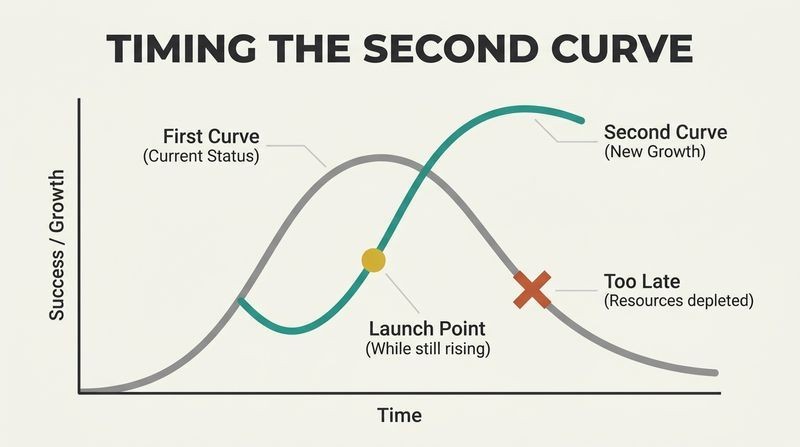
The sigmoid curve governs everything human. Imagine an S lying on its side: an initial dip of investment, a steep climb of success, then an inevitable decline toward oblivion. Lives, companies, empires, and democracies all ride it. The cruel catch is that the second curve must begin while the first is still rising, because only then do you have the money, energy, and credibility to absorb the new dip.
Handy illustrates this with Davy's Bar: lost in the Wicklow hills, he is told to turn right half a mile before the bright red pub. The turn comes before the landmark. Kodak missed digital photography; Steve Jobs conceived the iPod, iPhone, and iPad each before the prior product peaked. Company lifespans have collapsed from roughly 40 years to 14.
The framework echoes Clayton Christensen's innovator's dilemma: market leaders fail precisely because they rationally optimize a dying business. What is striking is Handy's psychological diagnosis. Success installs blinkers, making the peak invisible until hindsight. The weakness is timing. Telling someone to jump before the apex is easy in retrospect and nearly impossible in real time, when every signal says stay. Jim Collins documented the same arc in How the Mighty Fall, beginning with hubris born of success. The practical fix is engineering artificial triggers: sabbaticals, secondments, deliberate self-cannibalization, anything that forces fresh eyes while resources still flow.
Technology hands you control, then hands you the blame
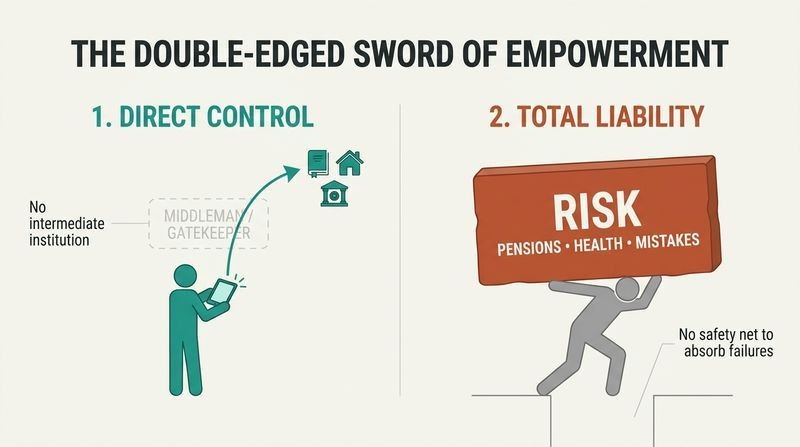
Bypassing the middleman is now your job. Just as Gutenberg's press let people read scripture without priests, the internet lets individuals skip the institutions in the middle. You can publish your own book, bank through crowdfunding, teach your own course, rent your spare room via Airbnb, or diagnose yourself with a monitor. The Airedale hospital in Yorkshire cut emergency visits by 69 percent using webcams and tablets in patients' homes.
But self-service has a sting. Being in control means being responsible. There is no attendant to tip and no one to sue when things go wrong except yourself. Handy calls this the rise of the self-responsible society: pensions, health, and financial planning all shift onto the individual. Researchers estimate that 47 percent of today's jobs could be computerized within two decades.
Handy anticipated the gig and platform economy with uncanny precision. The deeper insight is moral, not technological: convenience quietly transfers liability. Behavioral economists note that defaults and inertia favor whoever designs the system, so do-it-yourself freedom often becomes do-it-yourself exploitation, with customers happily printing their own boarding passes. The optimistic claim that people adapt deserves scrutiny. Adaptation is uneven; the displaced middle-tier workers rarely become the avatar designers and data managers of the new order. Those jobs go to the young. The challenge is whether a welfare architecture built for lifelong employment can support millions who must now fend for themselves.
Grow better, not bigger, and distrust the GDP scoreboard
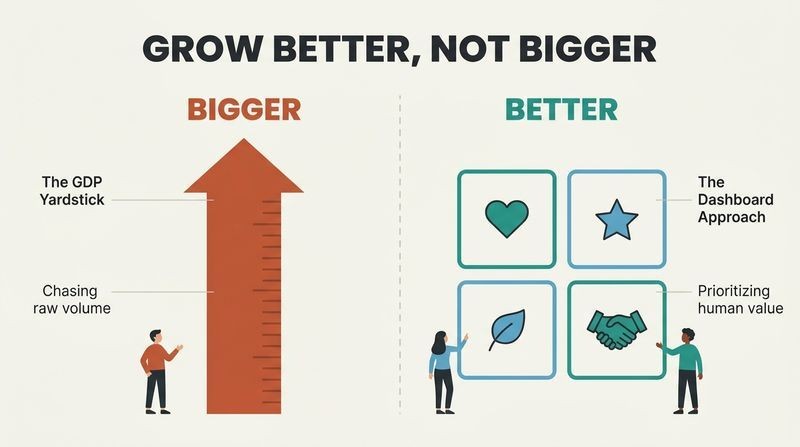
More is not always progress. An orchestra that asked Handy for growth advice did not want more trombonists; it wanted a wider repertoire and bigger audiences. Germany's Mittelstand firms, family-owned and rural, aim to do one thing superbly rather than swell in size. McDonald's and Tesco discovered in 2014 that too big becomes boring.
GDP is a dangerously flawed yardstick. It ignores unpaid work, counts car crashes and riots as gains, and misses free internet value entirely. Robert Kennedy noted it measures everything except what makes life worthwhile. Most acquisitions add no shareholder value yet inflate executive prestige. Handy endorses economist Diane Coyle's call for a dashboard of measures, as Australia attempts. The real freedom is learning to say enough, setting a target so you can stop chasing and start living.
The critique of GDP is now mainstream, echoed by Stiglitz, Sen, and Bhutan's Gross National Happiness. What is fresh is Handy's link between organizational gigantism and personal insatiability: both substitute a measurable proxy for an unanswered purpose. Ronald Coase justified the large firm by lower transaction costs; Handy notes digital tools have inverted that logic, making contracts cheaper than ownership. A fair challenge: growth funds the public goods that fairness requires, and a no-growth economy turns zero-sum and envious, as Handy himself concedes. The nuance is qualitative, not anti-growth. Distinguish growth that compounds wellbeing from growth that merely pillages the future.
Shareholder value is capitalism's most destructive idea
Companies were captured by a misreading of their own law. Shareholders do not own the business; they own shares and the right to elect a board. Directors owe duties to the company itself. Yet a 1976 paper by Jensen and Meckling, rooted in Milton Friedman's claim that business's only social duty is profit, recast managers as agents who should be paid in stock to think like owners. Business schools spread it for decades.
The results were short-termism and self-dealing. From 2003 to 2012, S&P 500 firms spent 54 percent of earnings, some 2.4 trillion dollars, buying back their own shares, plus 37 percent on dividends, leaving just 9 percent to reinvest. Jack Welch, who once embodied the doctrine, later called shareholder value the dumbest idea in the world. Even shareholders did worse than in the salaried-manager era.
This is the book's sharpest economic argument, and the empirical record supports it. William Lazonick's research on buybacks and the shift from retain-and-reinvest to downsize-and-distribute has become a touchstone for critics of financialization. Handy's legal point matters: the supremacy of shareholders was a cultural choice dressed up as a fiduciary obligation, never a statutory mandate. The steelman for the opposing camp is that diffuse stakeholder duties can leave managers accountable to no one, an empire-building license. The honest resolution is governance design: profit-sharing and broad ownership make money the prize rather than the point, aligning incentives without enthroning the share price.
Run firms like Athens, with citizens, not human resources
Most corporations resemble the Soviet bloc more than a democracy. They are centrally planned and brittle, and the engagement data is damning: roughly 80 percent of employees feel disengaged, a quarter actively so, with only about 20 percent committed. Handy proposes the citizen organisation, modeled on ancient Athens, which sustained self-governing democracy for 200 years, outlasting most companies whose average life is now 14 years.
The structure is his shamrock: a central leaf of core members who hold the organisation's essential skills, a second leaf of outsourced firms, and a third of hired specialists and part-timers. Only the core earns citizenship, with real voting rights, transparency, and open-book information. John Lewis in Britain shares ownership; mutuals there grow 9 percent yearly and outperform rivals by 7 percent.
Handy reframes the firm as a polity, a move with deep roots in industrial democracy and the works councils that anchor German codetermination. The engagement statistics he cites mirror Gallup's long-running global findings, lending the argument durable empirical weight. The Athenian analogy is seductive but instructive in its limits: Athens excluded women and slaves, and Handy honestly maps these onto today's contingent workers, exposing who gets left outside the shamrock's core. A reasonable caution is that participative governance can slow decisions, as universities demonstrate. His answer, that democracies still need strong persuasive leaders like Pericles, is sound but underdeveloped for fast-moving markets.
Define the jam, leave dough for initiative, then trust
Picture an English doughnut with jam in the middle. The jam is the non-negotiable core of any job, the things that must be delivered. The surrounding dough is open space for initiative and judgment. Efficiency-obsessed managers keep pulling discretion into the core until call-center workers simply read scripts, at which point a computer can replace them and creativity dies. The art is drawing the outer rim tight enough for coherence but leaving real room to act.
This works only on trust, which Handy insists is cheaper than control. Posted to remote Sarawak at 25 with mail taking a week, he learned fast precisely because no one could monitor him. Trust has a ceiling, though: Robin Dunbar's research caps the people any leader can truly know at around 150.
The doughnut elegantly resolves the autonomy-versus-accountability tension that plagues modern management. It rhymes with Daniel Pink's autonomy-mastery-purpose and with self-determination theory, which shows that perceived control fuels intrinsic motivation. The Sarawak anecdote contains a subtle truth: surveillance technology that promises safety often destroys the learning loop, because mistakes corrected privately build competence while mistakes reported instantly invite punishment. Handy's claim that trust is cheaper deserves a caveat. Trust without competence is recklessness, which is why he pairs it with investment in development and a track record. Haier's 2,000 self-managed teams and Buffett's 25-person headquarters show the model scales through federation, not central control.
Build a portfolio life; expect to live like an actor
The age of the lifelong job is ending. Handy divides the economy into elephants, the big organisations, and fleas, the independent specialists and small partnerships who sell skills back to them. He is a flea himself: a self-employed author paid by results, needed by his publisher but never employed by it. Self-employment has reached about 15 percent of Britain's workforce and accounted for 83 percent of employment growth since 2007.
He calls the proliferation of one-person ventures the acorn economy; 93 percent of British businesses are microbusinesses with fewer than five staff. His advice is to assemble a portfolio: a mix of clients and types of work, so no single failure is fatal. Actors live this way already, sporadic and uncertain, doing it because they love it. Soon most of us will too.
Handy practically invented the vocabulary of portfolio careers decades before LinkedIn made them ubiquitous. The framing is empowering and honest about the downside: fleas must master cash flow, pricing, and marketing, skills sheltered employees never learned, and many suffer delusions of grandeur, renting offices before finding customers. The unresolved tension is security. Portfolio life suits those with paid-off mortgages and marketable expertise far better than the precariat juggling multiple low-wage gigs. Research on gig workers shows wide variance in wellbeing depending on whether the arrangement is chosen or imposed. The freedom Handy celebrates is real, but it is unevenly distributed, a fault line he acknowledges.
Your pension is a Ponzi scheme; fund your own future
State pensions pay today's retirees from today's workers. That is the same mechanism Charles Ponzi and Bernard Madoff used, and it works only while entrants outnumber leavers. Britain once had six workers per pensioner who died in their seventies; by 2050 Europe will have two workers per pensioner living to nearly 90. National Insurance already collects 10 billion pounds less than it pays out.
Personal debt compounds the danger, running at 1.4 trillion pounds, yet only 18 percent feel burdened. Handy's family rule: borrow to invest, never to consume. A mortgage is an asset; a credit-card balance is a bottomless pit. One-third of working Britons have no private pension at all. He admires Singapore's Central Provident Fund, which sets aside 16 percent from employers and 20 percent from employees into each person's own guarded account.
The Ponzi label is provocative but technically apt for pay-as-you-go systems, which actuaries have warned about for decades as dependency ratios deteriorate. Handy's distinction between debt and deficit, asset-backed borrowing versus financing consumption, is the single most useful piece of household and fiscal literacy in the book. The Singapore model he praises is real but contested: forced saving can be regressive and reduces present consumption for the poor who most need it. The deeper point is behavioral. Hyperbolic discounting means humans systematically undervalue their future selves, so the self-responsible society demands financial education that schools rarely provide until the lessons arrive too late.
Everyone hides a golden seed schools never test for
Inside each person lies a seed of possibility. Fertilize it and it leads to fulfillment; the finest gift is helping someone find theirs. Handy's study of entrepreneurs, The New Alchemists, found that discovering this seed gave each the self-belief to proceed. Philip Hughes felt a flash of recognition reading a computing book and founded Logica; Terence Conran was selling dolls' houses at twelve before creating Habitat.
The problem is that schools recognize only two of Howard Gardner's seven intelligences. Gardner's 1983 theory of multiple intelligences holds that intellectual competence is not one thing but many: linguistic, logical-mathematical, musical, spatial, bodily-kinaesthetic, and the two personal intelligences of understanding self and others. Education prizes the first two and ignores the rest, including the interpersonal skills most vital to life. Seeds do not vanish; they lie dormant awaiting discovery.
Gardner's theory, while enormously influential among educators, has drawn criticism from psychometricians who argue the intelligences correlate more than he claims and that the framework resists rigorous measurement. That scientific caveat matters. Yet Handy's practical use is sound regardless: the cost of a one-dimensional ranking system is the talent it overlooks. His observation that most of his alchemists were second or third children, less disciplined and freer to differ, dovetails with research on birth order and openness. The Capability Brown pun, seeing potential rather than faults, captures a genuine pedagogical shift toward strengths-based development now echoed in positive psychology and coaching.
Teach children to think, not to memorize closed answers
School trained Handy to believe all problems were already solved. The answers sat in textbooks or his teachers' heads; his job was to memorize and reproduce them. But these were closed problems with proven answers, like the distance to Birmingham. Real life is full of open problems with no single right answer: should I marry this person, take this job, trust this deal? His schooling left him an indecisive conformist.
Only at Oxford did a philosophy tutor demand a 3,000-word essay on Truth caring only what Handy thought and why. He realized he was being taught how to think and learn, not what to know. Knowledge evaporates; learned skills endure. His prescription: turn students into teachers, because we learn best by teaching, and tie learning to real projects, apprenticeships, and use, since learning without application fades.
The open-versus-closed problem distinction is the book's most quietly subversive idea, indicting an education system optimized for exams over judgment. It aligns with John Dewey's experiential learning, Vygotsky's social construction of knowledge, and modern findings on the protege effect, where teaching others deepens one's own mastery. Handy's circle of learning, curiosity then search then hypothesis then test then reflection, is essentially the scientific method applied to living. A fair tension: closed knowledge still matters, since you cannot think critically about chemistry without knowing chemistry. The strongest reading is sequence and balance, not abolition. Front-loaded facts without context and use are simply warehoused and lost.
Loneliness damages health as much as smoking 15 cigarettes
Connection is not the same as closeness. Twenty thousand Twitter followers are not friends, and you can feel like a stranger in a crowded inbox. Handy argues loneliness is the new poverty: the British rank among Europe's loneliest, one in eight has no one to call on, and roughly a million people over 75 may go a month speaking to no one. The research is alarming: loneliness raises the risk of dementia, heart disease, and depression, with mortality effects comparable to smoking 15 cigarettes a day.
The cure is not propinquity but mattering, and mattering must be reciprocal. You will not matter to neighbors you never call. This is why workplaces, families, and chatty outlets like coffee shops and hairdressers matter even when the work bores or the family bickers: they supply joint endeavor and the feeling of being noticed.
The cigarettes comparison comes from Julianne Holt-Lunstad's landmark meta-analyses, which found social isolation as lethal as major clinical risk factors, work that prompted Britain to appoint a minister for loneliness and the US Surgeon General to declare an epidemic. Handy's framing of loneliness as a failure of reciprocal mattering, not merely a deficit of contacts, is psychologically precise and points toward agency rather than pity. His warning that social media can deepen isolation by fueling comparison and fantasy selves anticipates a decade of research on adolescent wellbeing. The actionable core is structural: design shared spaces and common projects, because no volume of messages substitutes for joint endeavor.
Define your good life: do your best at what serves others
Money is an intermediate goal, never the destination. Handy spent five decades trying to be someone he wasn't, comfortable in his skin only in his fifties. An Indian guru told him he was busy going nowhere in particular. Beyond about 15,000 pounds a year, more money fails to buy happiness, yet there is always a richer rival, so the financial journey never ends.
His answer is Aristotle's eudaimonia, which he translates as doing your best at what you are best at, for the benefit of others. He calls the personal version proper selfishness: invest in developing yourself, then turn that investment outward, since talent hoarded is wasted. His classroom obituary exercise asks people at their career peak to write the eulogy they would want, forcing a confrontation with unfulfilled potential and what they will leave behind.
Eudaimonia, often mistranslated as happiness, denotes flourishing through virtuous activity, and Handy rightly aligns it with Csikszentmihalyi's flow and Maslow's self-actualization, which sits atop a hierarchy of needs that must first be met. The honest acknowledgment that Aristotle's vision was that of a leisured, slave-owning gentleman, dismissed by philosopher Alasdair MacIntyre as appalling, keeps the idea from becoming pious. The obituary exercise is a practical memento mori, echoed by Stephen Covey's begin-with-the-end-in-mind and by Stoic reflection. The unifying thread of the whole book emerges here: every second curve, from capitalism to schooling, ultimately serves the question of what a human life is for.
Analysis
The Second Curve is best read as the late summation of a social philosopher who spent a career watching organizations and societies climb, plateau, and decline. Written for his grandchildren rather than for executives, it abandons the prescriptive confidence of management literature for the older European essay tradition: provocations meant to spark argument over a supper table, not playbooks. That is both its charm and its frailty. Handy explicitly poses questions he cannot answer, and readers seeking implementation will leave hungry.
The book's intellectual unity comes from a single geometric metaphor applied promiscuously across domains. The sigmoid curve is genuinely portable, and Handy's central insight, that renewal must begin amid success while resources and credibility still exist, holds up against Christensen's disruption theory and Collins's anatomy of decline. The recurring villain is gigantism in all its forms: too-big corporations, shareholder-value monomania, GDP fetishism, centralized states. The recurring hero is human scale, captured in Dunbar's 150, the shamrock, the doughnut, the Mittelstand, and Athenian citizenship.
Written in 2015, several forecasts have aged remarkably well. The gig economy, platform monopolies, the loneliness epidemic, and the buyback critique have all moved from heterodox to mainstream. Handy's weakness is the politics of transition. He repeatedly concedes that his proposals, from federalism to home-sale taxes to mandatory saving, would require a dictatorship or a patient new generation to enact, since democracies move at glacial speed and politicians optimize for reelection. He is candid that change must come from citizens, not the powerful who are wedded to the first curve.
The deepest contribution is moral rather than technical. By insisting that money is intermediate and eudaimonia ultimate, that companies are communities not properties, and that self-responsibility is the inescapable condition of the networked age, Handy reframes economic questions as questions about purpose. The book endures less as prophecy than as a humane invitation to ask what all the striving is for.
Review Summary
The Second Curve receives mostly positive reviews, praised for its thought-provoking essays on reinventing society. Readers appreciate Handy's insights on topics like business, technology, and personal growth. The book's central concept of starting a "second curve" before decline resonates with many. Some critics find certain essays lacking depth or evidence. Overall, reviewers commend Handy's wisdom and accessible writing style, though a few note organizational issues. The book is seen as particularly relevant in today's rapidly changing world.
People Also Read


FAQ
What's "The Second Curve: Thoughts on Reinventing Society" about?
- Exploration of Future Challenges: The book delves into the future challenges and opportunities that society faces, questioning the sustainability of current systems like capitalism.
- Rethinking Roles and Growth: Handy challenges the necessity of relentless growth and suggests rethinking our roles as students, parents, workers, and voters.
- Concept of the Second Curve: The central theme is the idea of the "Second Curve," which involves initiating change before the current system peaks to ensure sustainability and progress.
- Broader Societal Trends: Handy examines broader societal trends, including the impact of technology and the need for a more just and equitable society.
Why should I read "The Second Curve: Thoughts on Reinventing Society"?
- Insightful Analysis: The book offers a thought-provoking analysis of current societal trends and the potential future, making it a valuable read for those interested in social change.
- Practical Guidance: Handy provides practical guidance on how individuals and organizations can adapt to and thrive in a rapidly changing world.
- Challenging Assumptions: It challenges common assumptions about growth, capitalism, and societal roles, encouraging readers to think critically about the status quo.
- Inspirational Vision: The book inspires readers to envision a better future and consider their role in shaping it.
What are the key takeaways of "The Second Curve: Thoughts on Reinventing Society"?
- Second Curve Concept: Initiate change before the current system peaks to ensure sustainability and progress.
- Rethinking Growth: Question the necessity of relentless growth and consider alternative measures of success.
- Role of Technology: Recognize the impact of technology on society and the need for adaptation.
- Importance of Self-Responsibility: Emphasize the growing need for individuals to take responsibility for their own lives and futures.
What is the "Second Curve" concept in Charles Handy's book?
- Metaphor for Change: The "Second Curve" is a metaphor for initiating change before the current system peaks, ensuring sustainability and progress.
- Timing is Crucial: It emphasizes the importance of starting a new course while the first curve is still rising, to have enough resources for the transition.
- Avoiding Complacency: The concept warns against complacency and encourages proactive thinking and innovation.
- Application Across Sectors: Handy applies this concept to various sectors, including business, education, and government, suggesting that all need to find their Second Curve.
How does Charles Handy view capitalism in "The Second Curve"?
- Questioning Sustainability: Handy questions the sustainability of capitalism as it currently operates, suggesting it may not be serving society equitably.
- Need for Reform: He argues for a cultural shift in how companies behave and are perceived, emphasizing transparency and accountability.
- Focus on Community: Handy suggests viewing businesses as communities rather than mere profit-making entities, with responsibilities to all stakeholders.
- Critique of Shareholder Value: He criticizes the focus on shareholder value, advocating for a broader view of success that includes societal well-being.
What does Charles Handy mean by the "DIY Society"?
- Empowerment Through Technology: The "DIY Society" refers to how technology empowers individuals to manage their own lives, bypassing traditional structures.
- Rise of Self-Responsibility: It highlights the growing trend of self-responsibility, where individuals take charge of their education, health, and finances.
- Impact on Employment: Handy discusses how this shift affects employment, with more people becoming self-employed or working in microbusinesses.
- Challenges and Opportunities: While offering new opportunities, the DIY Society also presents challenges, such as the need for individuals to be more self-reliant.
How does "The Second Curve" address the concept of growth?
- Rethinking Growth: Handy challenges the notion that relentless growth is essential, suggesting that growth should be about quality, not just quantity.
- Sustainable Development: He advocates for sustainable development that considers environmental and social impacts.
- Alternative Measures: Handy calls for alternative measures of success beyond GDP, emphasizing well-being and societal progress.
- Critique of Bigger is Better: The book critiques the idea that bigger is always better, encouraging organizations to focus on being better, not just bigger.
What are the "Glass Towers of Capitalism" according to Charles Handy?
- Symbol of Corporate Power: The "Glass Towers" symbolize the power and influence of large corporations in modern society.
- Lack of Transparency: Despite their glass facades, these towers represent a lack of transparency and accountability in corporate governance.
- Need for Cultural Shift: Handy argues for a cultural shift towards more democratic and community-focused business practices.
- Critique of Current Practices: He critiques the current focus on shareholder value and short-term profits, advocating for a broader view of corporate responsibility.
What does Charles Handy suggest about the future of work in "The Second Curve"?
- Changing Workplaces: Handy envisions a future where workplaces are more flexible, with a mix of remote work, hubs, and traditional offices.
- Rise of Self-Employment: He predicts a rise in self-employment and microbusinesses, as individuals seek more control over their work lives.
- Importance of Adaptability: The book emphasizes the need for adaptability and continuous learning in a rapidly changing job market.
- Focus on Human Skills: Handy suggests that human skills, such as creativity and interpersonal abilities, will become increasingly important.
How does "The Second Curve" address the challenges of democracy?
- Need for Reform: Handy argues for reform in democratic systems to make them more responsive and representative.
- Federalism and Devolution: He advocates for federalism and devolution of power to local levels to better address regional needs.
- Separation of Powers: The book calls for a clearer separation of powers to prevent the concentration of authority and ensure accountability.
- Engagement and Participation: Handy emphasizes the importance of citizen engagement and participation in democratic processes.
What are some of the best quotes from "The Second Curve" and what do they mean?
- "For things to remain the same, things will have to change." This quote highlights the necessity of change to maintain stability and progress.
- "The Second Curve is our chance to make up for any shortcomings on the first curve." It emphasizes the opportunity for renewal and improvement.
- "We need to challenge orthodoxy, dream a little, think unreasonably and dare the impossible." Handy encourages bold thinking and innovation to address societal challenges.
- "Trust is cheaper but control is safer, or so we think." This quote reflects the tension between trust and control in management and governance.
What is the role of education in "The Second Curve"?
- Focus on Capabilities: Handy emphasizes the importance of education in developing individual capabilities and potential.
- Rethinking Traditional Models: He calls for a rethinking of traditional education models to better prepare students for a rapidly changing world.
- Lifelong Learning: The book advocates for lifelong learning and adaptability as essential skills for the future.
- Integration with Work: Handy suggests closer integration between education and work, with more emphasis on practical skills and real-world experience.
About the Author
Other books by Charles B. Handy



Download PDF
Download EPUB
.epub digital book format is ideal for reading ebooks on phones, tablets, and e-readers.








































