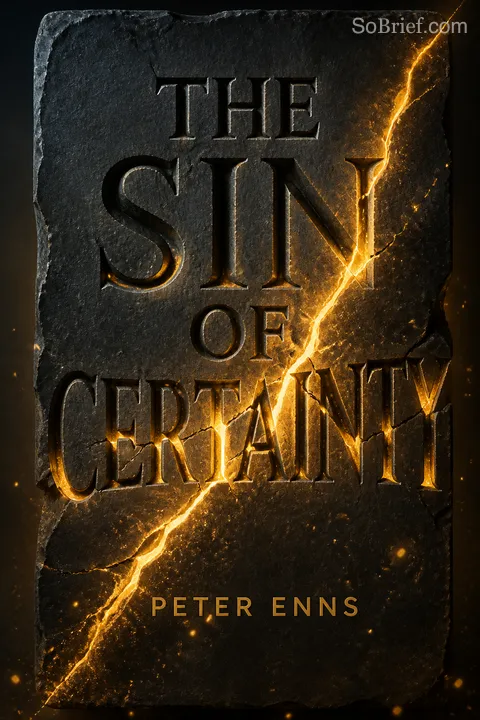
Key Takeaways
1. The "Sin" of Certainty: Faith Isn't About Knowing Everything
The need for certainty is sin because it works off of fear and limits God to our mental images.
Certainty isn't faith. We often equate strong faith with having rock-solid, unquestionable beliefs about God and the world. This preoccupation with correct thinking, however, can become a "sin" because it's rooted in fear and attempts to control God by boxing the divine into our limited human understanding. It turns faith into an intellectual exercise rather than a dynamic relationship.
Idolatry of thought. Just as ancient Israelites were warned against making physical idols that limited God, we can create mental idols by clinging too tightly to our ideas about God. When our faith rests on being right rather than trusting God, we are essentially trusting our own thoughts more than the Creator. This hinders growth and keeps us in a safe, predictable religious space.
Fear drives certainty. The intense need to be certain often stems from a deep fear of being wrong, of losing control, or of God being disappointed. This fear leads to defending beliefs fiercely, sometimes even attacking those who think differently, rather than embracing the vulnerability and openness that true trust requires.
2. Life's "Uh-Oh" Moments Shatter Our Certainties
Life’s challenges mock and then destroy a faith that rests on correct thinking and the preoccupation with defending it.
Life happens. Unexpected moments, like watching a Disney movie, encountering different perspectives, or facing personal tragedies, can suddenly challenge our familiar ways of thinking about God. These "uh-oh" moments introduce instability to our once-stable faith, showing up uninvited and forcing us to confront uncomfortable questions.
Certainty crumbles. A faith built on the foundation of knowing exactly what we believe is ill-equipped to handle the messy, unpredictable nature of human existence. When life doesn't follow our theological script – whether through suffering, scientific discoveries that contradict biblical literalism, or encountering genuinely good people outside our faith tradition – our carefully constructed certainty begins to unravel.
An invitation to grow. These unsettling experiences, while frightening, can be seen as "God moments" – invitations to deepen our relationship with God beyond intellectual assent. They expose the inadequacy of a faith that requires everything to make perfect sense and push us toward a faith rooted in trust, even when understanding fails.
3. The Bible Itself Models Doubt and Questioning God
Feeling like God is far away, disinterested, or dead to you is part of our Bible and can’t be brushed aside.
Honest lament. The Bible contains voices that express raw, unsettling honesty about their relationship with God, far from the polished certainty often expected in church. Psalms of lament, like Psalm 88, cry out in despair, feeling abandoned and blaming God directly for their suffering. These aren't examples of weak faith, but bracingly honest expressions of it.
God as unreliable? Figures like the author of Psalm 89 question God's faithfulness when divine promises (like the eternal Davidic line) seem broken by historical events (like the Babylonian exile). Qohelet in Ecclesiastes finds life absurd and futile, questioning the point of it all, even God's role, when death negates all effort and the world doesn't follow the expected rules of justice.
Job's righteous struggle. The story of Job directly challenges the simple "actions have consequences" theology, showing a righteous man suffering immensely for no apparent reason. Job's friends cling to their certain theology, insisting he must have sinned, while Job honestly confronts God, demanding an explanation. God ultimately affirms Job's honest questioning over his friends' rigid certainty.
4. Faith is Trusting in God (Who), Not Just Believing About God (What)
In this book I argue that we have misunderstood faith as a what word rather than a who word—as primarily beliefs about rather than primarily as trust in.
Beyond intellectual assent. In modern Western culture, "belief" often refers to intellectual agreement with a set of propositions ("I believe that God exists"). However, the biblical concept of faith (Hebrew 'aman, Greek pistis) is fundamentally about trusting in a person – God. It's a "who" word, not a "what" word.
Trust in action. Biblical examples illustrate this: Abraham "believed" (trusted) God's promise of descendants despite his age. The father asking Jesus to heal his son cries, "I believe; help my unbelief!" – a plea for help in trusting, not just intellectual certainty. James notes that even demons "believe" (that God is one) and shudder, showing that mere intellectual belief is insufficient.
All-in surrender. Replacing "believe" with "trust" in biblical passages reveals a deeper, more demanding call. Proverbs 3:5-6 urges, "Trust in the LORD with all your heart, and do not rely on your own insight." This is a call to complete surrender, leaning entirely on God rather than our own understanding, especially when things don't make sense.
5. True Trust Requires Letting Go of Control and "Dying" to Self
Doubt signals not God’s death but the need for our own—to die to the theology we hold to with clenched fists.
The ego's grip. Our need for certainty is often tied to our ego's desire for control. We want to understand, predict, and manage our lives and our relationship with God. Clinging to "correct" theology gives us a false sense of security and mastery over the divine.
Jesus calls us to die. Jesus' call to "take up your cross" and "lose your life" is a radical invitation to die to this self-centered need for control and certainty. It's not just a one-time conversion event, but a daily, moment-by-moment process of surrendering our will, our understanding, and our perceived control to God.
Crucified with Christ. The apostle Paul describes the Christian life as being "crucified with Christ," where "it is no longer I who live, but it is Christ who lives in me." This mystical language points to a profound transformation where our old self, including the need to be right and in control, dies, allowing a new life rooted in Christ and hidden in God to emerge.
6. Doubt and Suffering Can Be Sacred Paths to Deeper Trust
Doubt is God’s instrument, will arrive in God’s time, and will come from unexpected places—places out of your control.
Doubt is not the enemy. While painful and disorienting, doubt is not necessarily a sign of spiritual failure or God's absence. Instead, it can be a sacred instrument used by God to dismantle our false certainties and push us toward a more profound, resilient trust. It exposes the limitations of a faith based solely on intellectual understanding.
The dark night. Mystics like St. John of the Cross describe the "dark night of the soul" as a period of painful alienation from God, stripping away familiar comforts and ideas. This darkness, though feeling like abandonment, is seen as God's presence purifying us, forcing us to surrender our clinging and learn to trust God simply because God is God, not because we feel close or understand.
Suffering with Christ. The New Testament speaks of "sharing" in Christ's sufferings, suggesting that our own pain, including the anguish of doubt and feeling abandoned by God, connects us intimately with Jesus' experience on the cross. This suffering, while not sought, can be a path to knowing Christ more deeply, not just in resurrection power, but in shared vulnerability.
7. Cultivating Trust is a Lifelong Habit Forged in Darkness
Trusting God has been a habit, which is now ready and able to strengthen them in their hour of need.
Trust is a practice. Trust isn't a static state but a dynamic habit that must be cultivated over time, often through difficult experiences. Like a muscle, it strengthens with use, particularly when our usual coping mechanisms (like needing to understand or control) fail us.
Ebenezers of remembrance. Remembering past "God moments" – experiences of God's presence or help that defy rational explanation – can serve as "Ebenezers," stones of help that remind us to trust during periods of darkness or uncertainty. These moments, though perhaps rare or subtle, provide a foundation for continued trust when understanding is absent.
Ongoing renovation. The life of faith is an ongoing process of rebuilding and renovation, where old structures of certainty may need to be torn down. This requires accepting that the journey is not linear, embracing periods of unsettledness, and learning to honor our intellect without letting it be the sole arbiter of truth or the gatekeeper of our faith.
8. Love for Others is the Ultimate Expression of Trust in Action
Maybe my first order of business is to risk my own sense of certainty about God and love others where and how they are no matter how they do on my theology exam.
Beyond right thinking. A faith preoccupied with correct thinking can lead to judgment, exclusion, and even harm towards others who believe differently. This focus on being "right" often overshadows the core Christian call to love God and neighbor.
Love risks certainty. True love, as described by Jesus, extends even to enemies and those outside our familiar circles. This kind of love requires risking our own sense of certainty and letting go of the need for others to conform to our beliefs. It means seeing others as precious, made in God's image, regardless of their theological stance.
Acting like God. When we love others selflessly, especially those we might be tempted to judge or exclude based on our certainties, we are acting most like God. As 1 John 4:12 says, "No one has ever seen God; if we love one another, God lives in us, and his love is perfected in us." Love is the tangible expression of our trust in God and our faithfulness to the divine nature.
9. Letting Go of Certainty Makes Us Better People and Witnesses
Adopting and intentionally cultivating in Christians a culture of trust in God, rather than raising up soldiers for holy wars, would neutralize such public perceptions and reveal a bit more of the true Christian faith—and of God.
Freedom from fear. Releasing the need for certainty frees us from the anxiety and belligerence that often accompany it. Instead of being defined by dogmatic rigidity and a need to win arguments, a trust-centered faith fosters humility, openness, and vulnerability.
Authentic witness. When Christians are known more for their unwavering certainties and judgment than for their trust, love, and humility, it distorts the gospel message. A culture of trust, however, allows the true nature of Christian faith – rooted in a mysterious, incarnating, resurrecting God – to shine through, making it more compelling and less like just another ideology seeking power.
Protecting the future. Faith communities have a responsibility to cultivate a culture of trust for future generations. This means embracing the dynamic nature of faith, remaining open to the Spirit's movement, and valuing critical reflection rather than clinging rigidly to past forms or certainties. This flexibility, seen throughout biblical history, is not a compromise but a demonstration of faith in a living God.
10. Embrace Mystery: God is Bigger Than Our Understanding
Trusting this incarnating Creator gives us freedom to know or not know, to accept certainty when it comes or the absence of certainty, clarity or doubt, rest or restlessness.
Transrational faith. The core mysteries of Christianity – the incarnation (God becoming human) and the resurrection (overcoming death) – are fundamentally "transrational." They defy complete capture by our logical minds and are ultimately known through trust and experience, not just intellectual comprehension.
God is not contained. A God who can be fully understood and contained within our mental frameworks is too small. Embracing mystery acknowledges that God is infinite, eternal, and necessarily beyond our complete grasp. This doesn't negate the value of thinking about God, but it places it in proper perspective – as an aspect of faith, not its entirety or foundation.
Freedom in not knowing. Trusting in a God who is bigger than our understanding provides freedom from the pressure to have all the answers. It allows us to navigate life's complexities, doubts, and uncertainties with courage and humility, resting in the knowledge that our faith is anchored in a trustworthy God, not in the fragile certainty of our own minds.
Review Summary
The Sin of Certainty receives mixed reviews, with many praising its exploration of doubt and faith. Readers appreciate Enns' personal approach and his emphasis on trusting God over rigid beliefs. Some find the book freeing and insightful, while others criticize it as promoting unbelief or lacking depth. Critics argue that Enns undermines biblical authority, while supporters view it as a helpful resource for those struggling with faith crises. The book's accessible style and focus on embracing uncertainty in spiritual life resonate with many readers.

FAQ
What is "The Sin of Certainty" by Peter Enns about?
- Core Premise: The book challenges the idea that strong faith is about having the right beliefs or certainty about God, arguing instead that God desires our trust more than our "correct" beliefs.
- Personal Journey: Peter Enns shares his own faith crises and spiritual journey, illustrating how letting go of certainty led to deeper trust and intimacy with God.
- Biblical Exploration: The book examines how the Bible itself models faith as trust rather than intellectual certainty, using examples from Psalms, Job, Ecclesiastes, and the teachings of Jesus.
- Modern Relevance: Enns addresses the struggles many Christians face today—doubt, science, suffering, and religious conflict—showing how these can be invitations to a more authentic faith.
Why should I read "The Sin of Certainty" by Peter Enns?
- For Honest Doubters: If you’ve ever struggled with doubt, uncertainty, or felt out of place in faith communities that demand certainty, this book offers validation and hope.
- Biblical Insight: Enns provides a fresh, scholarly, yet accessible look at how the Bible itself embraces uncertainty and models trust in God.
- Practical Wisdom: The book offers practical advice for navigating faith crises, spiritual growth, and cultivating trust in God amid life’s unpredictability.
- Relatable Storytelling: Through personal anecdotes and humor, Enns makes complex theological ideas approachable and relevant to everyday life.
What are the key takeaways from "The Sin of Certainty"?
- Faith ≠ Certainty: True faith is not about having all the right answers or beliefs, but about trusting God even when certainty is impossible.
- Doubt as Growth: Doubt and spiritual crises are not failures but opportunities for deeper trust and transformation.
- Biblical Precedent: Many biblical figures—including psalmists, Job, and Jesus—expressed doubt, anger, and confusion, yet remained in relationship with God.
- Letting Go: Spiritual maturity involves letting go of the need to control or intellectually master God, and instead embracing trust, humility, and openness.
How does Peter Enns define "the sin of certainty" in his book?
- Idolatry of Correct Thinking: Enns argues that making certainty and correct beliefs the center of faith is a form of idolatry, replacing trust in God with trust in our own ideas.
- Fear-Based Faith: The need for certainty often stems from fear and leads to defensive, judgmental, and exclusionary religious communities.
- Limiting God: Certainty boxes God into our limited understanding, preventing growth and genuine relationship.
- Invitation to Trust: The "sin" is not doubt, but refusing God’s invitation to trust beyond what we can know or control.
What does "The Sin of Certainty" say about doubt and its role in faith?
- Doubt as Normal: Doubt is a natural and even necessary part of the faith journey, not a sign of spiritual failure.
- Catalyst for Growth: Doubt exposes the limitations of our beliefs and pushes us toward deeper trust and surrender.
- Biblical Validation: The Bible includes many voices of doubt and lament, showing that God welcomes honesty and struggle.
- Transformation Through Doubt: Doubt can be a sacred tool God uses to move us from superficial certainty to authentic trust.
How does Peter Enns use the Bible to support his arguments in "The Sin of Certainty"?
- Psalms of Lament: Enns highlights psalms where the writers express anger, confusion, and even accuse God, yet remain in relationship with Him.
- Job and Ecclesiastes: These books are explored as examples of biblical figures wrestling with suffering, injustice, and the apparent absence of God.
- Jesus’ Example: Jesus himself quotes lament psalms and models trust in God even in abandonment and uncertainty.
- Faith as Trust: Enns shows that in both Old and New Testaments, faith is more about trusting God than intellectual assent to doctrines.
What practical advice does "The Sin of Certainty" offer for dealing with faith crises?
- Embrace the Journey: Accept that faith involves seasons of doubt, loss, and reconstruction; these are not detours but part of spiritual growth.
- Let Go of Control: Practice surrendering the need to have all the answers, and allow trust in God to take center stage.
- Seek Community: Find or create safe spaces where questions and struggles are welcomed, not shamed.
- Cultivate Trust: Develop habits—such as prayer, reflection, and honest conversation—that nurture trust in God rather than certainty in beliefs.
How does "The Sin of Certainty" address the relationship between faith and science?
- Science as Challenge: Enns acknowledges that scientific discoveries (e.g., evolution, cosmology) can challenge traditional biblical interpretations and certainty.
- Faith Beyond Facts: He argues that faith need not be threatened by science, since trust in God is not dependent on defending every biblical detail as literal fact.
- Adjusting Expectations: The book encourages readers to adjust their expectations of what the Bible is and what it is meant to do, seeing it as a record of faith journeys rather than a science textbook.
- Openness to Mystery: Enns invites readers to embrace the mystery and vastness of creation as opportunities for awe and trust, not anxiety.
What does Peter Enns say about the dangers of making "correct beliefs" central to Christian faith?
- Division and Exclusion: Focusing on correct beliefs leads to tribalism, judgment, and exclusion of those who think differently.
- Spiritual Anxiety: It creates a stressful, defensive faith that is always on guard against being wrong.
- Stunted Growth: Preoccupation with certainty prevents genuine questioning, learning, and spiritual maturity.
- Missed Relationship: It shifts the focus from relationship with God to intellectual assent, missing the heart of biblical faith.
How does "The Sin of Certainty" redefine faith, belief, and trust?
- Faith as Trust: Enns argues that biblical faith is primarily about trusting God (a "who" word), not believing certain propositions (a "what" word).
- Belief ≠ Trust: Even demons can believe correct things about God, but trust involves surrender and relationship.
- Action-Oriented Faith: True faith is lived out in humility, love, and faithfulness to God and others, not just in mental agreement.
- Letting Go of Certainty: Trust remains even when beliefs are uncertain or incomplete.
What are the best quotes from "The Sin of Certainty" and what do they mean?
- "The need for certainty is sin because it works off of fear and limits God to our mental images." — This highlights how clinging to certainty is rooted in fear and reduces God to something manageable, rather than embracing His mystery.
- "Doubt is sacred. Doubt is God’s instrument, will arrive in God’s time, and will come from unexpected places." — Enns reframes doubt as a tool God uses for transformation, not something to be feared.
- "Trust is an all-in, no-wiggle-room word. It’s a hard word." — This emphasizes that trust, not belief, is the core of biblical faith, and it requires vulnerability and surrender.
- "Being obsessed with making sure we have all our thoughts about God properly arranged and defended isn’t faith." — Enns warns that intellectual obsession can replace genuine relationship with God.
What is Peter Enns’ overall message and hope for readers of "The Sin of Certainty"?
- Invitation to Trust: Enns hopes readers will move from a faith centered on certainty and correct beliefs to one rooted in trust, humility, and openness to God’s mystery.
- Permission to Question: He wants readers to know that doubt, struggle, and questioning are not only normal but can be holy and transformative.
- Freedom from Fear: By letting go of the need for certainty, readers can experience greater freedom, joy, and authenticity in their relationship with God.
- A More Loving Faith: Ultimately, Enns envisions a faith that is less about defending boundaries and more about loving God and neighbor with vulnerability and courage.
About the Author
Download PDF
Download EPUB
.epub digital book format is ideal for reading ebooks on phones, tablets, and e-readers.








































