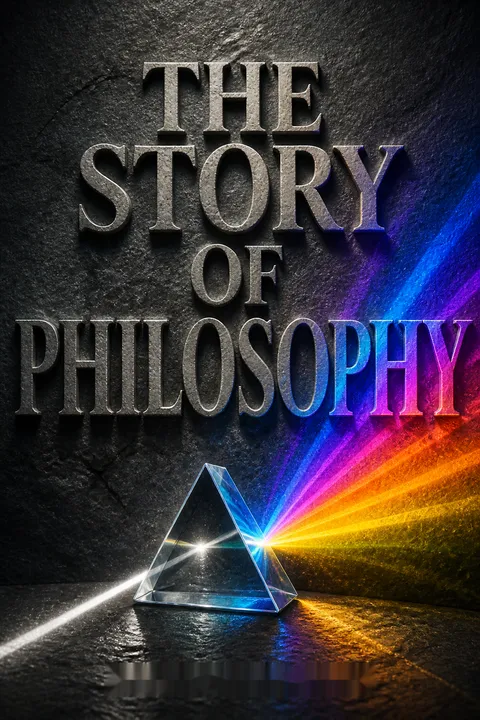
Key Takeaways
1. Philosophy is the pursuit of synthetic wisdom, distinct from the analytical focus of science.
Science gives us knowledge, but only philosophy can give us wisdom.
The vital distinction. Science dissects the world into isolated fragments, analyzing the mechanics of how things operate without questioning their ultimate value or purpose. Philosophy, conversely, seeks a grand synthesis, weaving these scattered threads of knowledge into a coherent tapestry of wisdom. It is not merely an academic exercise but a passionate quest to understand the meaning of life.
The fields of inquiry. To achieve this synthesis, philosophy divides its labor into five distinct branches of study:
- Logic: The study of ideal method in thought and research.
- Esthetics: The study of ideal form and beauty.
- Ethics: The study of ideal conduct and the wisdom of life.
- Politics: The study of ideal social organization.
- Metaphysics: The study of ultimate reality and the nature of mind and matter.
A guide for living. Ultimately, philosophy serves as a front-line trench in the siege of truth, venturing into unexplored territories where exact scientific formulation is not yet possible. It coordinates our desires and disciplines our energies, helping us see things in the light of eternity. Without this perspective, our lives remain chaotic, filled with sound and fury but signifying nothing.
2. Plato's political vision demands that statesmanship be guided by trained philosophical intelligence.
Until philosophers are kings, or the kings and princes of this world have the spirit and power of philosophy, and wisdom and political leadership meet in the same man, . . . cities will never cease from ill, nor the human race
The democratic dilemma. Plato witnessed the tragic execution of his master, Socrates, which instilled in him a lifelong disdain for mob-ruled democracies. He argued that leaving the administration of a state to the whims of an uneducated populace is as absurd as choosing a ship's pilot or a physician by popular vote. True statesmanship requires rigorous preparation, deep intellect, and a profound understanding of justice.
The educational winnowing. To realize his ideal republic, Plato proposed a state-controlled educational system designed to identify and train the finest minds:
- Physical training and music in early youth to build healthy bodies and harmonious souls.
- Rigorous testing at age twenty and thirty to eliminate those unsuited for leadership.
- Fifteen years of practical, real-world experience to harden theoretical scholars.
- A final selection of fifty-year-old philosopher-kings to govern the state.
Sterilizing political power. To prevent corruption, Plato's ruling class of guardians would live under a strict system of communism, owning no private property or gold. By separating political authority from economic greed, he hoped to ensure that rulers would govern solely for the common good. This bold blueprint remains the classic archetype of aristocratic political philosophy.
3. Aristotle established the systematic foundations of logic and organized natural science.
"To live alone," then, "one must be either an animal or a god."
The master of logic. Aristotle created the science of logic almost entirely from his own analytical thinking, providing Europe with its first intellectual discipline. He formulated the rules of the syllogism, a structured method of deduction that ensures consistency in thought. By insisting on precise definitions, he cleared away the vague myths of his predecessors and established a rigorous standard for scientific discourse.
The biological foundation. Armed with unprecedented resources from his pupil Alexander, Aristotle organized the first great zoological collections and laid the groundwork for biology:
- He observed the gradual transition from inanimate matter to living organisms.
- He recognized the structural similarities between diverse animal species.
- He pioneered the study of embryology by observing the development of the chick.
- He formulated early concepts of evolutionary adaptation and specialization.
The golden mean. In his ethical philosophy, Aristotle rejected perfectionist ideals in favor of a practical, balanced life. He defined virtue as the golden mean between two extremes of excess and deficiency, such as courage standing between cowardice and rashness. This realistic approach aimed at achieving happiness through the systematic cultivation of rational habits.
4. Francis Bacon championed the inductive method to conquer nature for human utility.
Nature cannot be commanded except by being obeyed.
The call for reconstruction. Francis Bacon arose during the Renaissance to announce that Europe had finally come of age, declaring that philosophy must abandon scholastic disputation and focus on practical utility. He argued that knowledge is not merely an ornament or a dogma, but a source of power to relieve the human estate. To achieve this, he planned a grand reconstruction of all human knowledge.
The idols of the mind. Before the intellect can discover new truths, it must purge itself of four fundamental fallacies or "idols":
- Idols of the Tribe: Errors natural to human perception and our tendency to see order where none exists.
- Idols of the Cave: Personal prejudices arising from our individual character and education.
- Idols of the Market-place: Confusions caused by the deceptive and imprecise nature of words.
- Idols of the Theatre: Dogmatic philosophical systems that represent unreal, staged worlds.
The inductive path. Bacon championed the inductive method, which builds general laws from the patient, systematic accumulation of observed facts and experiments. He envisioned a cooperative, international commonwealth of science, symbolized by "Solomon's House" in his New Atlantis. This vision laid the spiritual foundations for modern scientific research and technological progress.
5. Spinoza unified mind, matter, and God into a single, deterministic substance.
"Blessedness is not the reward of virtue, but virtue itself."
The pantheistic synthesis. Baruch Spinoza, excommunicated from his synagogue for his radical views, resolved the Cartesian division of the world into mind and matter by declaring them to be merely two aspects of a single, infinite reality. He identified this ultimate substance as both Nature and God, arguing that the universe is a unified, self-sustaining system. In this view, God is not a capricious ruler, but the eternal, unchanging order of natural law.
The mechanics of the soul. Spinoza applied a rigorous, geometric determinism to human psychology, viewing the mind and body as an inseparable unity:
- Every mental event corresponds precisely to a physical process in the body.
- Human actions are entirely determined by antecedent causes, rendering free will an illusion.
- The fundamental drive of every organism is the instinct for self-preservation.
- Passions are uncoordinated, passive reactions to external stimuli.
The path to freedom. True freedom, for Spinoza, is not the absence of causal law, but the intellectual mastery of our desires through reason. By forming clear and adequate ideas of our passions, we transform them from passive suffering into active, coordinated power. This rational poise culminates in the "intellectual love of God," a serene acceptance of the eternal necessity of all things.
6. Voltaire and the Enlightenment wielded reason and wit to dismantle ecclesiastical intolerance.
"My trade is to say what I think"
The warrior of wit. Voltaire was the brilliant, excitable soul of the eighteenth century, dedicating his immense literary talents to a relentless war against superstition and corruption. He used his sharp pen to expose the absurdities of dogmatic theology and the cruelties of the Old Regime. His weapon of choice was devastating laughter, which proved far more lethal to tyranny than solemn arguments.
The crusade for tolerance. Voltaire's philosophy was fundamentally practical, focusing on the defense of human rights and intellectual freedom:
- He championed the cause of victims of religious persecution, such as Jean Calas.
- He demanded the secularization of society and the separation of church and state.
- He advocated for freedom of speech and the press as the prerequisites of progress.
- He popularized English science and Newtonian physics in France.
The legacy of reason. Though exiled, imprisoned, and censored, Voltaire successfully forged a path for modern liberalism. He believed that the spread of knowledge and education would gradually make men more civilized and less brutal. His tireless campaign against intolerance laid the intellectual groundwork for the French Revolution and the modern secular state.
7. Kant reconciled science and religion by defining the limits of pure reason and the authority of moral duty.
"Experience is by no means the only field to which our understanding can be confined."
The critical revolution. Immanuel Kant sought to rescue both science and religion from the corrosive scepticism of David Hume. He argued that while all our knowledge begins with experience, the mind is not a passive receptacle but an active organ that shapes sensation. By applying its native forms of space and time, and its inherent categories of thought, the mind constructs the orderly world we perceive.
The limits of knowledge. Kant drew a sharp distinction between the world of appearances and the ultimate reality of things-in-themselves:
- Science is absolutely valid, but only within the realm of experienced phenomena.
- Theoretical reason cannot prove the existence of God, freedom, or immortality.
- Any attempt to apply scientific categories to ultimate reality results in insoluble contradictions.
- Religion must therefore be rescued from the fallible domain of theoretical logic.
The moral imperative. Having limited theoretical reason, Kant rebuilt faith upon the absolute authority of the moral sense. He formulated the "categorical imperative," an innate command of conscience to act only on principles that can be willed as universal laws. This sense of duty presupposes our freedom, implies a future life of justice, and postulates a benevolent Creator.
8. Schopenhauer exposed the restless, suffering Will as the ultimate reality of life.
"Life swings like a pendulum backward and forward between pain and ennui."
The primacy of will. Arthur Schopenhauer inverted the traditional rationalist view of man by declaring that the intellect is merely a servant of a blind, restless force called the Will. This Will is the ultimate reality of the universe, manifesting as gravity in stones, growth in plants, and desire in animals and men. It is an insatiable, purposeless striving that can never find permanent satisfaction or peace.
The tragedy of existence. Because the Will is endless and its desires are infinite, life is fundamentally a scene of suffering and conflict:
- Every satisfied desire is immediately replaced by a new desire, and so on endlessly.
- Human actions are entirely determined by the universal Will, rendering free will an illusion.
- The growth of intelligence increases the capacity for suffering, making genius the highest form of pain.
- Nature is a scene of perpetual war, where every species preys upon another to sustain itself.
The path to salvation. To escape this cycle of misery, Schopenhauer advocated for the temporary quiet of the Will through the contemplation of art and music. Ultimately, however, true salvation lies in the complete denial of the will to live, achieved through ascetic self-discipline and the cessation of reproduction. By stopping the source of life, humanity can finally bring an end to the tragedy of existence.
9. Modern philosophy evolved from Spencer's cosmic evolution to the pragmatic, action-oriented views of James and Dewey.
"Life is the continuous adjustment of internal relations to external relations."
The evolutionary synthesis. Herbert Spencer constructed a monumental system of philosophy by applying the concept of evolution to every field of human knowledge. He defined evolution as a universal progress from a simple, disorganized homogeneity to a complex, highly integrated heterogeneity. This mechanical view of reality dominated the late nineteenth century, reducing all phenomena to the redistribution of matter and motion.
The pragmatic reaction. William James reacted against this cold, deterministic mechanism by championing pragmatism, which defines the truth of an idea by its practical consequences and "cash-value" in action:
- He rejected closed, monistic systems in favor of an open, unfinished "multiverse."
- He defended the "will to believe" in religious hopes that enhance human vitality.
- He viewed consciousness as an active, selective stream rather than a passive mirror.
- He urged the release of human "reserve energies" for creative action.
The philosophy of growth. John Dewey completed this naturalistic transition by centering philosophy on education and social reconstruction. He viewed the mind as an evolved instrument of adaptation and active control, rather than a passive spectator of a finished world. By applying experimental, scientific methods to our moral and political conflicts, he sought to make philosophy an active organ for human growth.
Review Summary
The Story of Philosophy is praised for its accessible introduction to Western philosophy, covering major thinkers from Plato to Dewey. Readers appreciate Durant's engaging writing style and biographical approach. Some criticize the omission of non-Western philosophers and certain important figures. The book is recommended for beginners, though not as a comprehensive overview. Durant's personal biases are noted, with some chapters receiving more attention than others. Overall, it's considered a valuable starting point for exploring philosophical ideas, despite its limitations.
People Also Read







FAQ
What's Grit by Ben Connelly about?
- Focus on Toughness: Grit is a practical guide to developing both physical and mental toughness, emphasizing the importance of embracing discomfort and challenges.
- Intrinsic Motivation: The book argues that true grit comes from a deep desire to embrace discomfort and challenge oneself, rather than from external validation.
- Actionable Techniques: It provides practical advice and challenges that readers can implement immediately to build resilience and self-discipline.
Why should I read Grit by Ben Connelly?
- Overcoming Vulnerability: If you feel vulnerable or incapable, Grit offers strategies to help you overcome those feelings and improve resilience.
- Practical Techniques: The book is filled with actionable techniques that can be applied immediately, making it a useful resource for self-improvement.
- Personal Growth: Reading Grit can inspire you to push beyond your comfort zone and develop a stronger character.
What are the key takeaways of Grit by Ben Connelly?
- Value of Discomfort: Embracing discomfort is essential for growth, and the book emphasizes that life is richer with challenges.
- Building Habits: Developing grit involves creating habits that reinforce discipline and resilience, suggesting that "excellence is a habit."
- Antifragility Concept: The book introduces antifragility, where individuals grow stronger from stress and challenges.
How does Ben Connelly define grit in Grit?
- Overall Quality: Grit is defined as an intangible quality encompassing traits like tenacity, toughness, willpower, discipline, and resilience.
- Intrinsic Value: It involves the intrinsic motivation to pursue hard tasks and endure discomfort for personal growth.
- Action-Oriented: Grit requires taking action and facing challenges head-on, with a mindset shift to see challenges as opportunities.
What are some practical techniques mentioned in Grit by Ben Connelly?
- Cold Showers: Taking cold showers is a method to build mental toughness by enduring discomfort.
- Physical Exercise: Regular physical activity is emphasized as a cornerstone of developing toughness, improving both mental and physical resilience.
- Facing Fears: The book encourages confronting fears directly to transform them into strength and resilience.
How does Grit by Ben Connelly address the concept of failure?
- Learning from Failure: Failure is a natural part of growth, and the book encourages learning from these experiences.
- Resilience Building: Experiencing and overcoming failure builds resilience, crucial for facing future challenges.
- Avoiding Complacency: The author warns against complacency after successes, stressing the importance of continuous self-push.
What are the best quotes from Grit by Ben Connelly and what do they mean?
- “Courage is not simply one of the virtues but the form of every virtue at the testing point.”: Highlights that courage is essential in moments of challenge, revealing true character.
- “If you cannot be tough when life is easy, how can you be tough when life is hard?”: Emphasizes building resilience during easy times to prepare for tougher challenges.
- “You do not rise to the occasion, you sink to the level of your training.”: Underscores the importance of preparation and practice for success.
How can I apply the principles of Grit by Ben Connelly in my daily life?
- Set Small Goals: Start with small, achievable goals that challenge you, gradually increasing difficulty.
- Create a Routine: Establish a daily routine incorporating physical activity and discomfort to reinforce grit-building habits.
- Seek Accountability: Find a support system or honor group to help keep you accountable and motivated.
What role does the environment play in developing grit according to Grit by Ben Connelly?
- Challenging Environments: Tough environments can help build resilience, strengthening both body and mind.
- Removing Luxuries: Reducing reliance on comforts can enhance toughness, fostering a mindset of resilience.
- Restorative Spaces: Balancing tough experiences with restorative environments is crucial for maintaining well-being.
What methods does Ben Connelly suggest for building grit in Grit?
- Cold Showers: Introduce discomfort into daily life to build mental toughness and resilience.
- Fasting: Intermittent fasting challenges physical and mental endurance, reinforcing self-control.
- Physical Challenges: Engage in activities like running or hiking to confront discomfort and fears.
What is the significance of antifragility in Grit by Ben Connelly?
- Thriving Under Stress: Antifragility is the concept that some individuals benefit from stress and challenges, growing stronger.
- Resilience and Growth: Antifragile individuals not only withstand adversity but grow stronger from it, essential for navigating life's challenges.
- Long-term Success: Embracing antifragility allows for adaptability and thriving in changing environments, crucial for long-term success.
How can I start implementing the ideas from Grit by Ben Connelly in my life?
- Set Small Goals: Begin with small, achievable goals that challenge you, gradually increasing difficulty.
- Embrace Discomfort: Actively seek discomfort through cold exposure, fasting, or physical challenges to build tolerance.
- Reflect on Progress: Regularly reflect on experiences and progress to reinforce the value of challenges and motivate continued effort.
About the Author


Download PDF
Download EPUB
.epub digital book format is ideal for reading ebooks on phones, tablets, and e-readers.








































