

Key Takeaways
You are not the voice in your head, you're the one hearing it
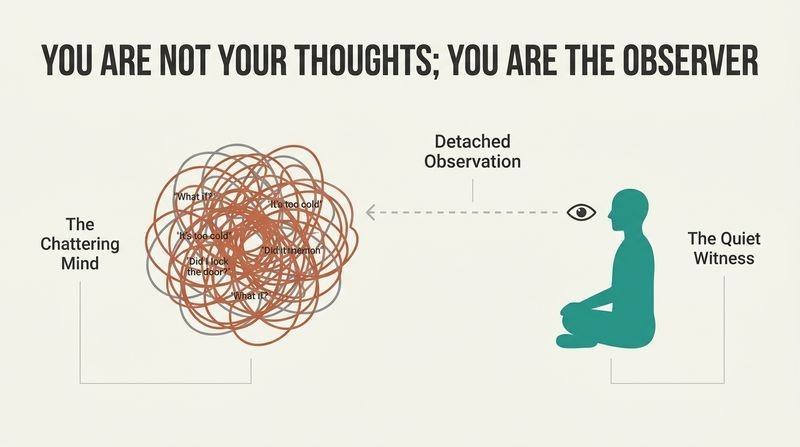
The narrator is not you. Singer opens with an uncomfortable observation: there's a voice inside that never shuts up, taking both sides of arguments, narrating trees and dogs as you walk past them, telling you it's cold when you already feel cold. People spend their lives trying to figure out which of these mental voices is their true self. The answer is none of them.
Awareness is the seat of self. Just as you'd never claim to be a flowerpot you're looking at, you're not the thoughts you're hearing. You are the subject perceiving the objects. Singer's liberating move is that you don't need to silence the voice. You just need to step back far enough to watch it chatter, treating it as a vocalizing mechanism rather than as yourself.
What's striking is how neatly this anticipates modern clinical psychology. Acceptance and Commitment Therapy calls it cognitive defusion: creating distance from thoughts rather than fighting them. Mindfulness research on metacognitive awareness shows measurable drops in rumination when people observe thoughts as passing events. Singer arrives at the same destination through contemplative tradition rather than data. One caveat worth noting: the disidentification move can slide into spiritual bypassing, where people use witnessing to avoid genuinely processing trauma. Watching the voice is powerful, but some inner voices carry information (fear signaling real danger) worth heeding rather than merely observing.
Stop asking what to do about problems, ask what part of you got disturbed
Reframe the problem entirely. Singer describes the inner voice as a roommate you'd evict within a day if it were an actual person moving in with you. It second-guesses your wedding, ruins your new car by cataloging every squeak, and gives disastrous advice you never fire it for. The trick he offers: personify the voice, imagine it sitting next to you on the couch narrating everything, and notice how insane it sounds externalized.
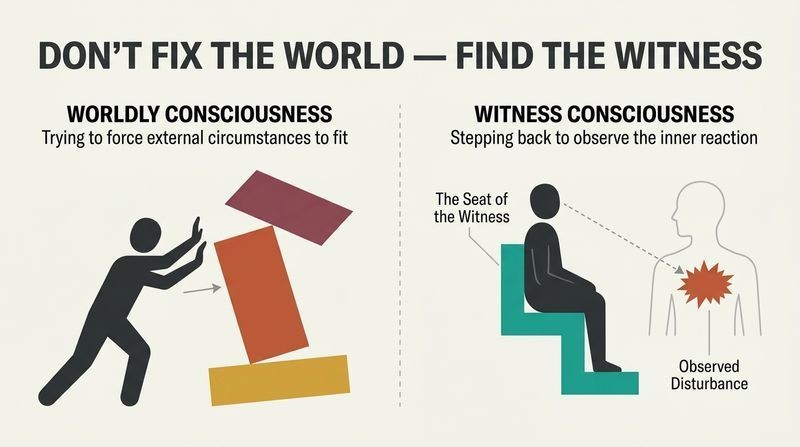
Worldly versus witness. A worldly person believes rearranging external circumstances will fix inner disturbance. But there's always a next problem. The permanent solution is to take the seat of the witness, the part that notices the disturbance. Since you can observe jealousy or anger, you cannot be it. This shift from outer-solution to inner-solution consciousness is the beginning of freedom.
The roommate device is genuinely useful, and it echoes internal family systems therapy, which treats the psyche as a collection of distinct parts rather than a unified self. Naming a reactive voice reduces its authority. The claim that no external fix ever solves inner disturbance is where careful readers should push back. Material security, safety from abuse, and treatment for clinical depression demonstrably change inner states. Singer would likely respond that these ease symptoms without removing the underlying sensitivity, which is fair, but the framing risks telling someone in genuinely harmful circumstances that their problem is purely internal.
Your energy isn't from food or sleep, it's blocked by a closed heart
The breakup phone call test. Singer's vivid example: after a breakup you lie depressed for months, no energy, pizza boxes everywhere. Then the ex calls, tearful, wanting you back. Within seconds you're cleaning, showering, awake till sunrise. Where did that energy come from? Not calories. It was always there, blocked.
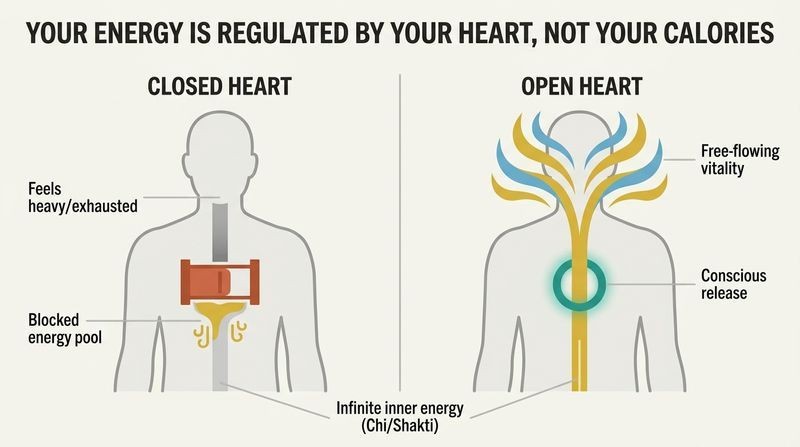
Chakras as valves. He describes energy centers, called chakras in yoga, that open and close. The heart is the one you know best. When someone hurts you, you feel your chest tighten, energy stops, and you feel drained or agitated. This inner energy goes by many names: Chi in Chinese medicine, Shakti in yoga, Spirit in the West. The practical instruction is radical in its simplicity: to stay filled with energy, love, and enthusiasm, simply never close. Closing is a habit that can be unlearned.
The phenomenology is undeniable even if the mechanism is contested. Anyone who has felt heartbreak drain them and good news electrify them recognizes the pattern. Modern affective neuroscience would reframe it: emotional states modulate autonomic arousal, dopamine, and perceived fatigue, which is why depression presents as physical exhaustion and infatuation suppresses appetite. Singer's chakra language is a metaphor pointing at something real. The prescription to never close, though, has limits. Boundaries and selective closing protect against genuine predation. The healthiest stance may be discernment about when openness serves and when it exposes, rather than an absolute vow.
Every unresolved experience becomes a Samskara that hijacks you years later
The blue Mustang. Singer explains why the heart closes: it gets encrusted with stored, unfinished energy patterns from the past, called Samskaras (Sanskrit for impression). Most experiences pass through you cleanly, like the thousands of trees you drive past without a trace. But something disturbing, say glimpsing what looked like your girlfriend hugging someone in a blue Mustang, doesn't make it through. You resist it, and it gets stored.
Stored energy reactivates. Five years later, happily married, another blue Mustang drives by and your heart skips, your mood sours, for no visible reason. The old impression, complete with its original feelings, got triggered. We store positive impressions too by clinging to them. The path is to let stored energy release when triggered: relax, forgive, smile, and let it pass through rather than stuffing it back down.
This maps remarkably onto trauma science. What Singer calls a Samskara resembles what Bessel van der Kolk describes in The Body Keeps the Score: unprocessed experience encoded somatically, reactivated by sensory cues. Pierre Janet's concept of fixed ideas and Pavlovian conditioning both describe stimulus-triggered emotional replay. Singer's release-through-nonresistance also parallels exposure therapy, where allowing a feared response to arise and subside extinguishes it. The tension is method. Serious trauma often does not dissolve simply by relaxing and letting go; it can require guided, titrated processing. Singer's approach may suit everyday accumulated hurts better than acute PTSD, where retraumatization is a real risk.
When your stuff gets hit, let go immediately, because it's harder later
The anatomy of falling. Singer describes a precise sequence. A blockage gets triggered, and the disturbed energy acts like a magnet pulling your consciousness in. You lose the witness seat without noticing, the way you vanish into a gripping movie. Now you see the world through the haze of disturbance: people you liked look ugly, everything turns negative. Then comes the crème de la crème, acting on it, quitting your job or unloading on someone, which drags you down another level and involves other egos.
The secret of the ascent. The law is stark: let go the moment you feel the tightening, because releasing gets exponentially harder once you've fallen in. If released, blocked energy purifies and strengthens you, and you rise. The secret of ascent is to never look down. Always turn your eyes upward and relax the heart.
The insight that intervention windows shrink rapidly has strong empirical backing. Emotion researchers describe the refractory period, the interval during which an emotion filters all incoming information to confirm itself, making early interruption far more effective than late. This is why anger management teaches catching the spark, not the fire. Singer's warning against externalizing disturbance also aligns with research on how venting entrenches rather than dissipates anger. Where he is optimistic to a fault: the felt experience of being unable to let go is not merely a failure of will. Neurobiological flooding can make in-the-moment release genuinely inaccessible, which is why prevention and nervous-system regulation matter alongside intention.
Remove the inner thorn instead of building your whole life around avoiding it
The thorn allegory. Imagine a thorn touching a nerve in your arm. It hurts whenever touched. You have two choices: protect it so nothing bumps it, or remove it. Choose protection and you thin out the woods before walks, invent devices for sleeping and hugging, eventually build a hydraulic contraption and widen every doorway. You declare yourself free, but the thorn now runs your entire life.
Loneliness works the same way. Singer applies this to inner thorns like loneliness, fear of rejection, and insecurity. Rather than removing them, we marry someone to feel less lonely, dress and speak to avoid rejection, and organize life around not triggering the wound. The problem compounds: now you must protect the relationship too. The alternative is to stop playing with the thorn, let the disturbance arise, and release it, since it's just blocked energy that can dissolve.
The allegory brilliantly exposes a cost most people never audit: the accumulated life-architecture built to avoid a feeling. Experiential avoidance is one of the most robust predictors of psychopathology in clinical research; the more elaborately people arrange life to dodge inner discomfort, the more constrained and symptomatic they become. Singer's using-people-as-shields point is a sharp diagnosis of codependency. The steelman is strong. The honest complication is that some thorns respond to processing while others benefit from external support that looks like accommodation. A person managing a genuine phobia may need graded real-world exposure, not only inner release. Removal and skillful accommodation are not always opposites.
Fire your mind from the impossible job of making everything okay
You gave your mind a task it cannot do. Singer argues suffering is nearly constant, so pervasive we don't see it, like a fish in water. The cause: you assigned your mind an impossible mandate, to arrange all people, events, and words so you feel okay, and to prevent anything you dislike while securing everything you want. No mind can control the weather, other people, or reality, so it runs frantically, producing anxiety and neurotic thought.
Stop, don't fight. The fix mirrors quitting smoking. You don't win by wrestling the mind; you relieve it of the job. When it starts scheming about how to fix the world to soothe you, don't participate. Be quiet, fall behind it, and watch. Use trigger points, getting in the car, picking up the phone, to remember you're the awareness behind the thinker. Everything will be okay when you're okay with everything.
The reframe that the mind is a broken tool given an impossible assignment is both compassionate and precise. It parallels the psychological concept of intolerance of uncertainty, a core driver of generalized anxiety, where the mind endlessly problem-solves unsolvable contingencies. Stoicism reaches the same wall from another angle with Epictetus's dichotomy of control: distinguish what is up to you from what is not, and grief over the latter is wasted. Singer's don't-fight-the-mind counsel matters neurologically, since suppression paradoxically amplifies thoughts, as Wegner's white-bear studies showed. The trigger-point practice is essentially habit-stacked mindfulness, a genuinely actionable behavioral hook rather than vague advice to be present.
Relax into pain and it passes; resist it and you store it forever
Pain is the price of freedom. Beneath the psyche sits a core of stored pain, and the entire personality is built to avoid touching it. Every avoidance behavior becomes a link back to the pain: approach someone hoping to avoid rejection and you'll feel rejection at the slightest sideways glance. Call your dog for comfort and feel hurt when he doesn't come. Small events wound because they're wired to a deeper reservoir.
Do the opposite of contracting. When pain arises, the instinct is to close, tighten, and defend, which dams it inside for life. Singer's counterintuitive instruction: relax your shoulders and heart, face the exact spot that hurts, and let the energy pass through. Each release removes a piece permanently. You may feel heat, which he calls the fire of yoga, the pain purifying. On the far side of that pain layer lies ecstasy, love, and freedom.
The relax-into-pain instruction is not mystical hand-waving; it is the mechanism behind exposure-based therapy and somatic approaches like Focusing and Somatic Experiencing. Physiologically, resisting an emotion sustains sympathetic arousal, while allowing it lets the parasympathetic system complete the cycle, which is why a fully felt wave of grief often subsides within minutes. Buddhist tanha (craving and aversion) names the same resistance Singer targets. The fire-of-yoga framing usefully reframes discomfort as evidence of progress rather than damage. A responsible caveat: for those with trauma histories, turning directly toward core pain without adequate resourcing can overwhelm rather than heal, which is why pacing and support are not weakness but wisdom.
Your beliefs and memories are walls of thought sealing you in darkness
The house in the sunlit field. Singer's central allegory: you build a fortress in a field of infinite light, seal the windows for security, and gradually the bulbs burn out until you live in darkness, terrified to step outside. A book describes natural light everywhere, but you can't grasp it because your whole world is the dark house.
The walls are your psyche. The house is built from your thoughts, emotions, opinions, memories, and self-concept. When someone challenges a foundational belief (imagine learning at twenty you were adopted), the walls crack and you patch them with more thoughts. Enlightenment, Singer argues, is not something to reach for. It's what remains when the walls of your own making crumble. Rather than striving for the light, stop defending the fortress and let everyday life dismantle it.
The image consciously echoes Plato's cave, and Singer makes the debt explicit. Where Plato's prisoners are deceived by shadows, Singer's captive is self-imprisoned by attachment to a constructed identity, which is a more psychological and arguably more actionable diagnosis. Constructivist psychology and Kelly's personal construct theory converge here: humans build predictive models of reality and defend them because their collapse feels existentially threatening. Terror management research shows people cling hardest to worldviews when mortality is salient, which explains the panic when a core belief cracks. The provocative move is redefining enlightenment as subtraction rather than attainment, aligning with apophatic mysticism across traditions: you don't add holiness, you remove obstruction.
Your comfort zone is an invisible electric fence you mistake for safety
The dog and the buried wire. Singer describes an electronic dog fence: no visible barrier, just a collar that shocks near the boundary. The dog learns to fear the edges and stays put, believing it's free. Humans do the same. Our comfort zone is a cage whose bars are insecurity, jealousy, fear, and self-consciousness. Hit an edge and the psyche zaps you, so you retreat.
Lean into the edge. But a determined dog that keeps stepping forward, tolerating the discomfort, discovers the collar can't actually hurt it and walks free. Spirituality, for Singer, is the commitment to go beyond, to relax through your edges every time they're hit rather than pulling back. A truly growing person always feels themselves against the edge, never retreating to comfort. Going beyond means letting go of the effort to keep life within your defined limits.
The fence metaphor captures something behavioral science formalizes as avoidance learning: a conditioned fear response maintained precisely because avoidance prevents the disconfirming experience. The dog never learns the shock is survivable because it never tests it, exactly the mechanism that keeps phobias and social anxiety alive. Therapeutic exposure works by having people lean into the edge until the alarm extinguishes. Singer's always-at-the-edge ideal resonates with the growth-mindset and flow literatures, where optimal development happens just beyond current capacity. The reasonable limit: perpetual edge-dwelling risks burnout, and nervous systems need recovery. Deliberate practice research pairs stretch with rest. Constant discomfort is not always the fastest route to growth.
Choose unconditional happiness once, and every hardship becomes your teacher
One decision, no qualifiers. Singer reduces life to a single choice: do you want to be happy or not? Most people silently qualify it, happy as long as my spouse stays, my car isn't dented, my flight isn't missed. But the real question means happy for the rest of your life regardless of what happens. Answer yes unconditionally and, he claims, you don't just become happy, you become enlightened, because any part of you that wants to add a condition must dissolve.
Happiness as spiritual practice. This isn't passive. Something always tests the vow, and each test forces growth. The mechanism ties back to the heart: happiness means keeping your heart open, so the practice is simply refusing to close, no matter what. When you slip, get back up and renew the commitment. Staying joyful becomes the fastest path through every stage of inner purification.
The unconditional framing is bold and philosophically contentious. It resembles the Stoic and Buddhist claim that suffering arises from our judgments about events rather than events themselves, and it echoes Viktor Frankl's insistence that the last human freedom is choosing one's attitude in any circumstance, forged in a concentration camp. Positive psychology's work on hedonic adaptation supports the idea that circumstances shape well-being less than we assume. The risk is that unconditional happiness, misapplied, becomes toxic positivity or a denial of legitimate grief and injustice. Singer's own emphasis on releasing rather than suppressing suggests he means openness to joy beneath pain, not the erasure of pain, a distinction worth holding carefully.
Let death make each moment precious instead of fearing it
Death as the ultimate teacher. Singer argues nothing teaches like death. It shows you that you are not your body, strips away everything you cling to, and makes everyone equal in an instant. The wise live knowing any breath out might not return. The exercise: imagine an angel tells you you'll die tonight. Suddenly every person you see, you see for the last time; petty grudges vanish; love pours out. Then ask, if that's how you'd spend your last week, what are you doing with all the other weeks?
Scarcity creates value. Death is not morbid but generous. It's scarcity that turns an ordinary rock into a rare gem, and death's scarcity is what makes life precious. A hospital patient begs to feel the rain one more time while you run from it. The awakened person is always ready to die because they've lived each moment fully, leaving no last wishes.
This is memento mori, the contemplative practice Stoics and Buddhist charnel-ground meditators used deliberately, and it has empirical teeth. Studies on mortality salience show that reflecting on death, when it does not trigger defensive terror, increases gratitude, intrinsic goal pursuit, and prosocial behavior. Terminal patients frequently report that dying clarified what mattered, a phenomenon documented in palliative care and Bronnie Ware's work on the regrets of the dying. Singer's scarcity-creates-value argument is economically and psychologically sound: abundance breeds hedonic numbness. The practical genius here is turning an abstract certainty into a daily lens. The only caution is that death contemplation can tip into anxiety for some, requiring the equanimity Singer's other practices are meant to build.
Analysis
The Untethered Soul belongs to a peculiar genre: experiential philosophy disguised as self-help. Michael Singer, a meditation teacher with an economics background and a doctoral-era awakening, refuses to argue from scripture, statistics, or authority. His entire method is to point relentlessly at the reader's own direct experience until a single realization lands: you are the awareness, not the contents of awareness. Everything else in the book is scaffolding around that one move.
Structurally, the book climbs a ladder. Part one establishes the witness. Part two explains inner energy and how stored impressions (Samskaras) block the heart. Part three teaches the core technique of letting go rather than closing. Part four uses two allegories, the sealed house and the electric-fence dog, to reframe enlightenment as the removal of self-built walls rather than the attainment of anything. Part five applies it all to living: unconditional happiness, nonresistance, death, the Taoist middle way, and finally a nondual vision of God as unjudging love. The progression from psychology to metaphysics is deliberate, and readers can extract enormous practical value long before Singer reaches the mystical summit.
What makes the book hard to summarize is that its power lies in repetition and felt recognition, not in novel propositions. Its concepts are ancient: witness consciousness from Vedanta, letting go from Buddhism, the middle way from Taoism, unconditional love from the Gospels. Singer's genuine contribution is packaging, an unusually clear, jargon-light articulation that lets a secular Western reader access contemplative insight without adopting any religion.
The book's blind spot is its near-total interiority. By locating all suffering in resistance and all freedom in release, it can underweight structural injustice, clinical illness, and the value of appropriate boundaries. Its prescriptions suit the accumulated frictions of ordinary life beautifully but demand caution with acute trauma. Read as an invitation to relate differently to one's own mind rather than as a complete theory of human flourishing, it is a quietly radical and genuinely useful book.
Review Summary
The Untethered Soul received mixed reviews, with many praising its life-changing insights on consciousness and letting go of negative thoughts. Readers appreciated Singer's simple yet profound approach to spiritual growth and mindfulness. Some found the book repetitive and oversimplified, while others criticized its privileged perspective and lack of practical advice. Many readers reported feeling more peaceful and self-aware after applying the book's teachings, while a few felt it invalidated trauma and mental health struggles. Overall, the book resonated strongly with spiritual seekers but faced criticism for its sweeping generalizations.
People Also Read





FAQ
What's "The Untethered Soul" about?
- Exploration of Self: "The Untethered Soul" by Michael A. Singer is a guide to understanding the self and consciousness. It explores the nature of the mind and the concept of the inner voice.
- Spiritual Journey: The book takes readers on a spiritual journey, encouraging them to transcend their limitations and discover their true selves.
- Practical Spirituality: It offers practical advice on how to achieve inner peace and freedom by letting go of the thoughts and emotions that hold us back.
Why should I read "The Untethered Soul"?
- Self-Discovery: The book provides insights into understanding who you truly are beyond your thoughts and emotions.
- Inner Peace: It offers techniques to achieve a state of inner peace and happiness by letting go of mental and emotional disturbances.
- Spiritual Growth: Readers are guided on a path of spiritual growth, helping them to live a more fulfilling and liberated life.
What are the key takeaways of "The Untethered Soul"?
- Awareness of Self: Recognize that you are not your thoughts or emotions; you are the consciousness observing them.
- Letting Go: Learn to let go of the inner disturbances and blockages that prevent you from experiencing true freedom and happiness.
- Living in the Present: Embrace the present moment and stop resisting life's natural flow to achieve a state of peace and contentment.
How does Michael A. Singer define the "inner voice"?
- Constant Dialogue: The inner voice is the constant mental dialogue that goes on inside your head, often without your conscious awareness.
- Not Your True Self: Singer emphasizes that this voice is not your true self; it is merely a part of your mind that you can observe.
- Objective Observation: By stepping back and objectively observing this voice, you can free yourself from its influence and find inner peace.
What is the "spiritual heart" according to "The Untethered Soul"?
- Energy Center: The spiritual heart is described as an energy center that can open and close, affecting your experience of love and joy.
- Blockages: Past experiences and emotions can block the heart, preventing the flow of energy and leading to feelings of emptiness or disturbance.
- Purification Process: By allowing these blockages to pass through and release, you can open your heart and experience a continuous flow of love and energy.
How does "The Untethered Soul" suggest dealing with fear?
- Recognize Fear as Energy: Fear is seen as a form of energy that can be observed and released rather than something to be avoided or suppressed.
- Let Go of Resistance: By letting go of the resistance to fear, you can allow it to pass through you without affecting your inner peace.
- Embrace Change: Accept that change is a natural part of life and that facing fear is essential for personal and spiritual growth.
What is the "path of unconditional happiness" in "The Untethered Soul"?
- Choice of Happiness: The book suggests that happiness is a choice and that you can decide to be happy regardless of external circumstances.
- Letting Go of Conditions: True happiness comes from letting go of the conditions and preferences that dictate your emotional state.
- Commitment to Openness: By committing to keeping your heart open and not closing off to life's experiences, you can maintain a state of unconditional happiness.
What does Michael A. Singer mean by "going beyond"?
- Transcending Limits: Going beyond means transcending the limitations and boundaries of your current state of consciousness.
- Infinite Possibilities: It involves recognizing that life is infinite and that you can move beyond your mental and emotional constraints.
- Continuous Growth: The journey of going beyond is about constant personal and spiritual growth, always moving past where you are.
How does "The Untethered Soul" address the concept of death?
- Death as a Teacher: Death is seen as a powerful teacher that can help you appreciate life and live more fully in the present moment.
- Embrace Mortality: By contemplating death, you can let go of fears and attachments, realizing the preciousness of each moment.
- Live Fully: The awareness of death encourages you to live life to the fullest, without holding back or wasting time on trivial concerns.
What are the best quotes from "The Untethered Soul" and what do they mean?
- "You are not your thoughts.": This quote emphasizes the idea that your true self is the consciousness observing your thoughts, not the thoughts themselves.
- "Let go of yourself.": It suggests releasing the attachments and identities that limit your experience of life and prevent you from finding true freedom.
- "The highest spiritual path is life itself.": This highlights the idea that everyday life is the ultimate spiritual journey, offering endless opportunities for growth and awakening.
How does "The Untethered Soul" suggest achieving inner freedom?
- Witness Consciousness: Achieve inner freedom by becoming the observer of your thoughts and emotions, rather than identifying with them.
- Release Blockages: Let go of the mental and emotional blockages that keep you trapped in patterns of suffering and limitation.
- Embrace the Present: Live fully in the present moment, allowing life's experiences to pass through you without resistance or attachment.
What is the role of "letting go" in "The Untethered Soul"?
- Central Practice: Letting go is a central practice in the book, essential for achieving inner peace and spiritual growth.
- Release Attachments: It involves releasing attachments to thoughts, emotions, and external circumstances that cause suffering.
- Freedom and Liberation: By letting go, you free yourself from the constraints of the mind and open up to a life of joy, love, and liberation.
About the Author

Download PDF
Download EPUB
.epub digital book format is ideal for reading ebooks on phones, tablets, and e-readers.








































