

Key Takeaways
Water wins by yielding: be soft enough to become unstoppable
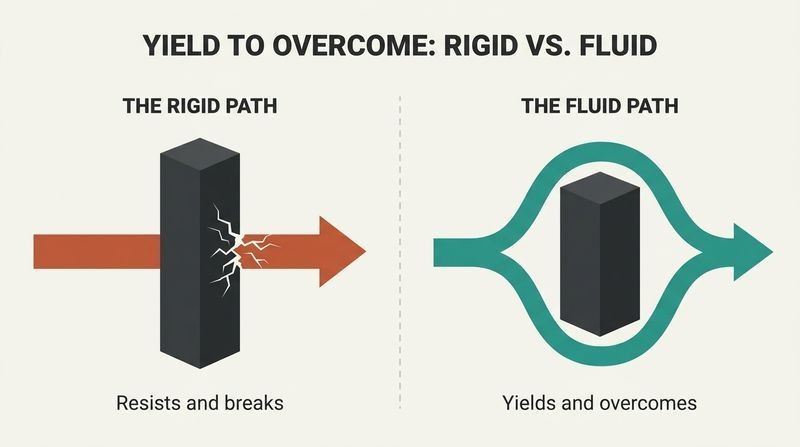
The book's spine is Bruce Lee's teenage epiphany. Frustrated that he couldn't grasp his teacher's lesson on gentleness, the seventeen-year-old punched the sea from a small boat and realized he couldn't hurt or hold the water. It absorbed his fist, slipped his grip, yet over centuries carves canyons through mountains. Shannon Lee, his daughter, translates this into a life philosophy: water adapts its shape to any container, flows around obstacles, and stays in constant readiness precisely because it never forces.
To be like water is to be fluid, sentient, natural, and unstoppable. It means responding to reality as it actually unfolds rather than imposing a rigid plan. Bruce Lee's core maxim: using no way as way, having no limitation as limitation.
What's striking is how neatly this maps onto modern resilience research. Psychologists studying stress distinguish reactive rigidity from flexible coping, and the flexible copers fare better on nearly every health measure. The bamboo-versus-oak parable that trained Lee also echoes ecology: systems that bend absorb shocks that shatter brittle ones. One caution worth naming: yielding is not passivity. Water still has direction and destiny. The philosophy risks being misread as go-with-the-flow surrender, when the actual claim is sharper, that softness combined with persistence beats force combined with fragility.
Empty your cup before every conversation to actually learn
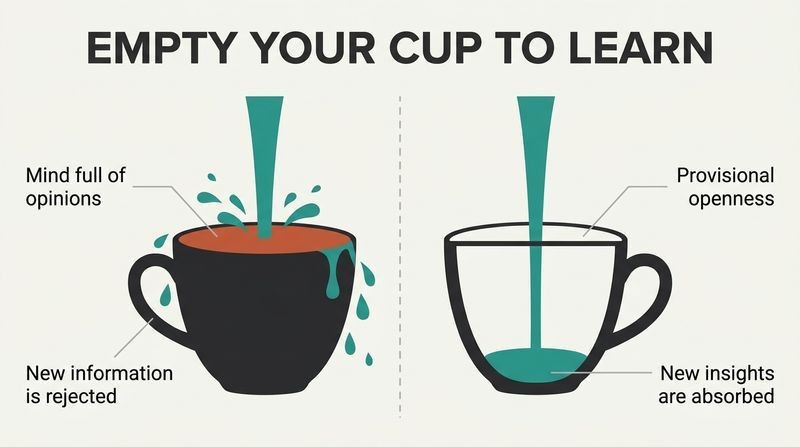
Lee opened his writing with a Zen parable: a scholar visits a master but keeps interrupting with 'we have that too,' so the master pours tea until it overflows the cup. The lesson lands physically. A full cup, a mind crowded with opinions and judgments, cannot receive anything new.
Emptying the cup does not mean forgetting what you know. It means meeting each moment with provisional openness, treating your beliefs as a work in progress. Lee called predetermined preferences the mind's worst disease and urged standing at the neutral point, neither for nor against. Shannon illustrates with a party: walk in braced for dread and you become an evidence collector, subconsciously hunting proof you were right. Walk in neutral and the party simply is what it is.
This anticipates confirmation bias, one of the most robust findings in cognitive science. Humans preferentially seek and weight information confirming existing beliefs, and Lee's evidence-collector image is a vivid folk version of it. The connection to Krishnamurti's choiceless awareness is explicit and worth flagging: Lee borrowed heavily from him. A useful tension: total neutrality is neither fully achievable nor always desirable, since discernment requires standards. The book handles this by distinguishing judgment (rigid conclusion) from discernment (fluid perception aimed at understanding), a genuinely helpful distinction that sidesteps the trap of confusing open-mindedness with having no views at all.
Your real purpose is to become fully yourself, not Bruce Lee
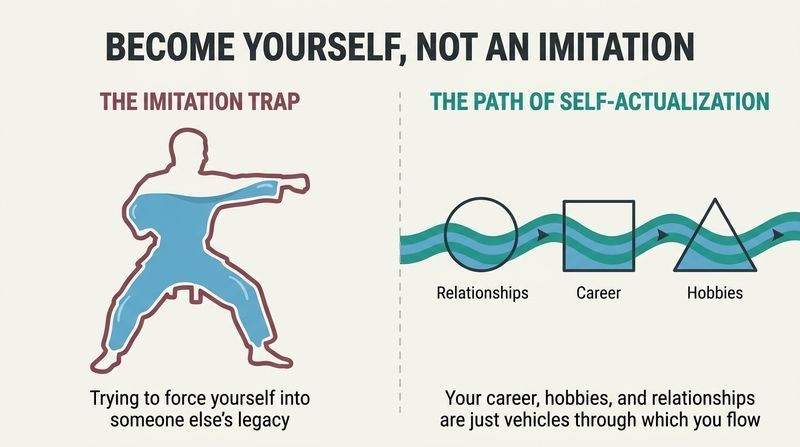
Shannon confesses the paralyzing pressure of trying to be even a tenth of her father. Her release came from realizing he never wanted imitators. His philosophy of self-actualization asks a single question: how can I be me? He phrased it bluntly, that he was not in the world to live up to your expectations and you were not there to live up to his.
Self-actualization means making a reality of your essential self, expressing your uniqueness so naturally it flows like water being water. Your job, relationships, and hobbies are just vehicles through which you shine. The point is not what you do but how you embody it. Lee even sabotaged his own legacy on purpose, refusing to publish his jeet kune do system so followers wouldn't copy him instead of finding themselves.
This is Maslow filtered through Taoism, and the fusion is genuinely original. Maslow placed self-actualization atop his hierarchy as becoming everything one is capable of becoming; Lee adds the Eastern twist that this self is not built but uncovered, like a sculptor hacking marble away rather than adding to it. The refusal to codify jeet kune do is a fascinating anti-guru move, reminiscent of how the Tao Te Ching warns that the Tao that can be named is not the eternal Tao. The practical risk is vagueness: 'be yourself' can become an excuse to avoid discipline. Lee's answer, relentless practice, keeps it honest.
Stay the eternal student; the moment you master, you decline
In 1964 the San Francisco Chinatown establishment challenged the brash young Lee to a match to shut down his school. He won in about three minutes, chasing his fleeing opponent around the room. Yet afterward he sat on the curb, head in hands. He had won ugly, gotten winded, improvised sloppily, and realized his traditional training had failed him. Rather than celebrate, he treated the flawed victory as data.
That honesty birthed jeet kune do. Lee commissioned a miniature tombstone reading, in memory of a once fluid man crammed by the classical mess, a reminder that his rigid old self had to die. He refused the title 'master,' calling himself the eternal student, and drew from boxing, fencing, biomechanics, and philosophy. His method: research your own experience, reject what is useless, absorb what is useful, add what is uniquely yours.
The counterintuitive genius here is treating a win as a diagnostic failure. Most people bank victories as proof they were right; Lee mined his for weakness. This mirrors what deliberate-practice researchers like Anders Ericsson found: expertise grows only when practitioners stay in the discomfort zone, correcting errors rather than coasting on wins. Lee's cross-disciplinary raiding also prefigures modern innovation research showing breakthroughs cluster at the boundaries between fields. The refusal of mastery has a Zen precedent, shoshin or beginner's mind, but it also carries real cost: Lee's insistence on never finalizing his art meant his deepest ideas survived only as fragments.
Everyone you meet is a mirror reflecting you back
Lee reframed the opponent not as an enemy but a sparring partner who reveals you to yourself. Combat is intense relationship: you read your partner, adjust, and get exposed. Life is the same low-stakes version all day long. Shannon offers her own on-and-off relationship where she felt chronically undervalued. She blamed him, until she turned the finger around and saw she had abandoned herself, hadn't asked for what she needed, and was watching her own lack of self-worth reflected back.
Lee rejected competition entirely as a growth model, since it sorts everyone into winners and losers and pulls attention outward. He catalogued six diseases of rivalry: craving victory, showing off cunning, displaying everything learned, awing others, playing the likeable pushover, and even performing self-improvement to look virtuous. Each disconnects you from real relationship.
The mirror metaphor risks sliding into a blame-the-victim trap, and the book mostly dodges it by insisting that owning your part does not absolve the other person's behavior. That nuance matters. Relational psychology supports the core claim: attachment patterns formed early get reenacted, so recurring relationship complaints often point inward. The sixth disease, performing self-work to look good rather than change, is a razor-sharp observation that anticipates critiques of wellness culture and performative growth on social media. The rejection of competition is more debatable, since competition demonstrably drives excellence in many domains; Lee's point is narrower, that it is a poor model for self-knowledge and inner peace.
Bruce Lee wasn't gifted; he did 5,000 punches before breakfast
The book dismantles the myth of natural talent. Lee was nearsighted, five foot seven, sickly as a child, had one leg shorter than the other, and was rejected by the military. His single logged training day in 1968 included 1,500-plus punches, cycling, and evening sparring. He did pushups while waiting for elevators and stretched while watching boxing. His edge was a cultivated work ethic and attitude, not destiny.
Shannon lays out his concrete tools:
1. Take aim (his 1969 'Definite Chief Aim' letter naming fame and fortune)
2. Take action (be a practical dreamer backed by action)
3. Affirm (seven daily written affirmations)
4. Be symbolic (his 'Walk On!' card on a stand)
5. Journal (he wrote constantly, drafting and redrafting)
6. Get physical (the body as instrument of self-knowledge)
This is the book's most empirically grounded chapter and its most contestable claim. The growth-mindset literature associated with Carol Dweck supports the idea that effort beliefs shape outcomes, though replication debates have tempered early enthusiasm. Lee clearly had unusual raw coordination, so 'not gifted' overstates it; the fairer reading is that talent without his obsessive practice would have produced no icon. His reframe of affirmations is genuinely useful: instead of the false 'I am strong,' write 'I am working every day to be strong,' or borrow his kickboxing coach's word, 'yet.' That single word converts fixed self-judgment into a trajectory, which is psychologically far more durable than wishful autosuggestion.
It is not the obstacle that matters, only your reaction to it
In 1970 Lee severely injured his fourth sacral nerve doing a heavy Good Morning exercise without warming up. Doctors told him he might never do martial arts or walk without pain again. His family nearly lost their house; his wife took a night switchboard job. Instead of despair, he went into research mode, buying back-pain books, and wrote 'Walk On!' on a business card set on a stand to face him daily.
He never fully healed. He had back pain for the rest of his life. But he strengthened the surrounding muscles, warmed up meticulously, and made every shredded on-screen performance with that weak back. His reframe: pessimism blunts the tools you need to succeed, and defeat is only real once you accept it. The obstacle itself is neutral; meaning is something you assign.
This is classic Stoicism arriving via a Cantonese martial artist. Marcus Aurelius wrote that the impediment to action advances action, that what stands in the way becomes the way, almost verbatim to Lee's stepping-stone-versus-stumbling-block framing. Ryan Holiday later packaged the same idea for modern readers. What Lee adds is embodied credibility: this is not armchair philosophy but a man rebuilding a career on a permanently damaged spine. The 'be a nobody' instruction is subtle and valuable, drop the ego of being the great Bruce Lee so you can rest and recover appropriately rather than reinjure yourself proving a point. Patience, he insisted, is concentrated strength, not passivity.
Don't expunge your pain; keep company with it to heal
Shannon's brother Brandon was killed in 1993 in an accident on the film The Crow. She describes years of anti-existence, a devout resistance to living, going through the motions of career and marriage while shut down inside. She later realized she had been mildly depressed most of her life since her father's death when she was four.
The turn came from a line in her father's papers: the medicine for his suffering was inside him all along, but he hadn't taken it, and he would never find light unless, like a candle, he became his own fuel. Lee's counterintuitive prescription: go with the disease, keep company with it, and that is how you get rid of it. In the middle of chaos lies opportunity. Shannon stopped resisting the grief, sought books, therapists, and healers, and slowly bloomed.
The instruction to sit with pain rather than suppress it aligns with decades of clinical evidence. Acceptance and Commitment Therapy and mindfulness-based approaches show that experiential avoidance, trying to not feel, tends to amplify and prolong suffering, while acceptance reduces it. Lee's candle image is more poetic than most therapy manuals but points at the same mechanism. The rainstorm metaphor, that violent storms are followed by flourishing growth, echoes post-traumatic growth research documenting that many survivors report deepened meaning after trauma. One honest caveat the book itself makes: growth does not justify the loss. The trauma remains trauma; the gifts do not cancel the grief.
Master a skill so completely you can forget it entirely
Lee mapped four stages of cultivation, using how a person throws a punch as the metaphor:
1. Partiality: the beginner's wild, unskilled punch, all reaction, no technique
2. Fluidity: conscious learning, seeing the whole body and situation in every punch
3. Emptiness: skill so honed a punch becomes just a punch again, spontaneous and masterful
4. Jeet kune do: the punch becomes uniquely, unmistakably yours
Stage three is the living void, or no-mindedness, feeling that is not sticky or blocked. In the restored Enter the Dragon scene, Lee tells a monk that facing an opponent he does not hit, 'it hits all by itself.' The goal is to bridge the gap, the tiny space between sensing and doing, until response becomes immediate, effortless, and natural.
This is one of the cleanest folk descriptions of what psychologists call automaticity and what Mihaly Csikszentmihalyi named flow: the merging of action and awareness where self-consciousness disappears. Lee's four stages track almost perfectly onto the modern skill-acquisition model from unconscious incompetence to unconscious competence. The Zen concept of mushin, no-mind, is his direct source. What elevates it is stage four, which Western skill models lack: after achieving effortless mastery, the true artist adds signature individuality. This resists the standardization that mastery often produces. The insight that you must fail faster to succeed faster, moving quickly through bad ideas, is a striking anticipation of lean-startup iteration logic.
Fight for your vision even when it costs you everything
When Warner Brothers finally gave Lee his Hollywood feature, the script for what became Enter the Dragon was terrible, stripped of the philosophical scenes he wanted. On the first day of shooting in Hong Kong, Lee simply refused to appear. For two weeks the crew filmed around their missing star while producers pleaded at his house and spread rumors that he was paralyzed by fear.
He was not afraid. He understood the opportunity better than anyone and would rather blow it up than waste it on something half-hearted. He knew he would get only one introduction to the world. The studio caved, shot his script, and the film made him a global icon. The lesson: root yourself so deeply in what matters that you can hold your ground without malice, or yield when yielding is wiser.
The standoff reframes what looks like ego as integrity rooted in accurate self-knowledge. Behavioral economists would note Lee correctly resisted the sunk-cost pressure and status quo bias that make people accept bad deals to avoid losing an opportunity. His willingness to walk away was itself his leverage, a principle straight from negotiation theory, where the party with the strongest alternative and least desperation controls the outcome. Worth noting the survivorship bias, though: Lee's gamble worked partly because he genuinely had the goods. The same defiance from a less capable person reads as career suicide. The deeper teaching is holding to your core, which the book calls functioning from the root.
Treat every human as friend first, embellishments second
Kicked out of his own wing chun school as a teen because his mother was part European, making him only three-quarters Chinese, Lee later opened his schools to all races, an unheard-of policy in 1960s kung fu. In a 1971 interview he said he preferred to think of himself simply as a human being, since under heaven there is but one family. He argued there is no Chinese or Japanese way of fighting, because humans share the same two arms and two legs.
His phrase 'my friend' was no throwaway sign-off but a stance: an arm around the shoulder, a claim of shared humanity. In 2005, warring factions in Mostar, Bosnia, who could agree on nothing else, erected a statue of Bruce Lee because he was the one symbol that united rather than divided them.
The Mostar statue is a remarkable real-world validation of the claim that a figure can transcend ethnic division, chosen precisely because he belonged to no local faction. Lee's insight that racism is a formula inherited from fear-mongering elders, requiring active reform, aligns with contagion research on how prejudice transmits socially rather than arising innately. His observation that personal contact dissolves bias is one of social psychology's best-supported findings, Gordon Allport's contact hypothesis, confirmed across hundreds of studies. The practical downgrade of lofty words like compassion into the more accessible 'friend' or 'neighbor' is smart pedagogy: it lowers the barrier to a behavior most people can actually perform today.
Analysis
This is a hybrid book: part philosophy primer, part memoir, part self-help manual, narrated by Shannon Lee about a father she barely knew before his death when she was four. That structural oddity is also its power. She is not reconstructing memories but interpreting an archive, thousands of pages of Bruce Lee's letters, essays, and training logs, filtered through her own grief and recovery. The result reframes a martial arts icon as a serious twentieth-century philosopher who happened to express his ideas through combat.
The intellectual scaffolding is a synthesis of Taoism (wu wei, yin yang), Zen Buddhism (mushin, the empty cup), and Krishnamurti (choiceless awareness), fused with mid-century Western self-help (Napoleon Hill's definite chief aim and autosuggestion are visible fingerprints). What makes it more than derivative is Lee's insistence on embodiment: philosophy validated against the unforgiving feedback of a real fight, where self-deception gets you knocked out. His epistemology is pragmatist and experimental, research your own experience, reject the useless, absorb the useful, add what is yours.
The book's weakness is its greatest strength inverted. Its circular, contradictory structure (apply willpower, then yield your will) mirrors water's fluidity but frustrates readers wanting a linear system. Shannon flags this openly. The reliance on a single heroic exemplar also invites survivorship bias: Lee's defiance worked because he was extraordinary, and the same advice could ruin an ordinary person.
What endures is the central metaphor's rare combination of poetic memorability and practical utility. Be water compresses resilience psychology, flow states, Stoic reframing, and beginner's mind into two words a child can grasp. The most transformative move is treating everything, opponents, obstacles, grief, and even one's own victories, as teachers and mirrors rather than enemies. That reframe, more than any technique, is the book's gift.
Review Summary
Be Water, My Friend receives mixed reviews, with many praising its accessible approach to Bruce Lee's philosophy. Readers appreciate Shannon Lee's personal anecdotes and her father's teachings on adaptability, self-improvement, and mindfulness. Some find the book inspirational and relevant to daily life, while others criticize it as simplistic or repetitive. Fans of Bruce Lee generally enjoy the insights into his life and thoughts, but more critical readers feel the book lacks depth or originality. Overall, it's seen as a solid introduction to Lee's ideas for newcomers.
People Also Read
Glossary
Be Water
Adaptive, fluid, unstoppable livingBruce Lee's central metaphor for how to live: like water, be formless and adaptable enough to fit any circumstance, soft yet capable of penetrating hardness, and persistent enough to flow around or through any obstacle. It represents fluidity, present-moment awareness, naturalness, and relentless forward movement, applied not just to combat but to all of life.
Empty your cup
Clear the mind to receiveDrawn from a Zen parable about a scholar whose overfull mind cannot receive teaching. It means setting aside preconceptions, judgments, and the need to be right so you can meet each experience with neutrality and openness. Not forgetting what you know, but holding beliefs as provisional and revisable.
Choiceless awareness
Observing without judgingA term Lee borrowed from philosopher Krishnamurti meaning full, continuous awareness of what is happening inside and around you without labeling it good or bad, right or wrong. You simply perceive reality in its totality rather than filtering it through comparison, condemnation, or preconceived conclusions.
Jeet kune do
The way of the intercepting fistThe martial art and philosophy Bruce Lee created, meaning the way of the intercepting fist. Beyond a fighting method, it represents the fourth and highest stage of cultivation: total, spontaneous self-expression with no fixed style. Its motto is using no way as way, having no limitation as limitation.
The living void
Aware emptiness that generates actionLee's term for a state of heightened, effortless awareness and no-mindedness from which spontaneous, masterful action arises. Not a black nothingness but an alive emptiness, free of ego and mental blocks, where response becomes immediate. The place from which, as Lee put it, the fist hits all by itself.
Stages of cultivation
Four levels of skill maturityLee's four-stage model of mastery, illustrated with a punch: partiality (wild, unskilled reaction), fluidity (conscious skilled learning), emptiness (skill so honed it becomes effortless and spontaneous), and jeet kune do (fully individual, uniquely your own expression). He commissioned four plaques representing each stage.
Bridging the gap
Closing space between sensing and actingOriginally the martial concept of efficiently closing distance to an opponent. Lee expanded it to mean shrinking the gap between sensing and doing in life, so thought becomes action with minimal hesitation. Requires mobility, sensitivity, timing, understanding, and spontaneity, and produces the seamless feeling of true flow.
Walk On!
Keep moving forward relentlesslyA phrase Lee wrote on a business card and set on a stand during his back injury recovery. It became his reminder to keep moving forward one step at a time regardless of setbacks or uncertainty about the destination, trusting that progress compounds if you never stop.
Definite Chief Aim
Written, energized life goalA goal-setting practice, borrowed from Napoleon Hill's success literature, that Lee used in a 1969 document declaring he would become the highest paid Oriental superstar and achieve inner harmony. The idea is to write a clear, emotionally charged goal and re-excite yourself with it repeatedly to fuel action.
FAQ
What's "Be Water, My Friend" about?
- Author's Perspective: "Be Water, My Friend" is written by Shannon Lee, Bruce Lee's daughter, and it explores the philosophical teachings of her father, focusing on his famous "Be Water" philosophy.
- Core Philosophy: The book delves into Bruce Lee's philosophy of self-actualization and personal growth, using the metaphor of water to illustrate adaptability, fluidity, and resilience in life.
- Personal Journey: Shannon Lee shares her personal journey of understanding and applying her father's teachings to her own life, offering insights into how these principles can be universally applied.
- Legacy and Influence: The book also highlights Bruce Lee's legacy as a martial artist and philosopher, emphasizing his impact on both his family and the world.
Why should I read "Be Water, My Friend"?
- Practical Wisdom: The book offers practical wisdom on how to live a more fulfilled and authentic life by embracing change and being adaptable like water.
- Personal Growth: It provides tools and exercises for personal growth, encouraging readers to explore their potential and overcome obstacles.
- Inspiration from Bruce Lee: Readers gain inspiration from Bruce Lee's life and teachings, learning how his philosophy can be applied to modern challenges.
- Emotional Connection: Shannon Lee's personal anecdotes create an emotional connection, making the philosophical concepts relatable and accessible.
What are the key takeaways of "Be Water, My Friend"?
- Embrace Fluidity: Like water, be adaptable and open to change, allowing yourself to flow around obstacles rather than resisting them.
- Self-Actualization: Focus on becoming the best version of yourself by understanding your true nature and potential.
- Mindfulness and Presence: Cultivate a state of awareness and presence, letting go of preconceived notions and judgments to fully experience life.
- Personal Responsibility: Take ownership of your actions and responses, using challenges as opportunities for growth and learning.
How does Shannon Lee describe Bruce Lee's "Be Water" philosophy?
- Metaphor of Water: Bruce Lee's philosophy uses water as a metaphor for adaptability, resilience, and naturalness, encouraging individuals to be flexible and open to life's changes.
- Formlessness and Shapelessness: The idea is to be formless and shapeless, like water, which can adapt to any container and situation, symbolizing the ability to adjust to life's circumstances.
- Flow and Crash: Water can flow gently or crash powerfully, representing the balance between being gentle and assertive when necessary.
- Self-Expression: The philosophy emphasizes self-expression and authenticity, encouraging individuals to be true to themselves and their unique paths.
What are some of the best quotes from "Be Water, My Friend" and what do they mean?
- "Empty your mind. Be formless, shapeless, like water." This quote emphasizes the importance of letting go of rigid thoughts and being open to new experiences and perspectives.
- "Using no way as way, having no limitation as limitation." It suggests embracing flexibility and adaptability, not being confined by traditional methods or limitations.
- "The medicine for my suffering I had within me from the very beginning." This highlights the idea that personal growth and healing come from within, and individuals have the power to overcome their challenges.
- "Walk on!" A reminder to keep moving forward despite obstacles, maintaining resilience and determination in the face of adversity.
How does Shannon Lee incorporate her personal experiences in "Be Water, My Friend"?
- Identity and Legacy: Shannon shares her journey of grappling with her identity as Bruce Lee's daughter and her role in preserving his legacy.
- Personal Challenges: She discusses personal challenges, including the loss of her brother, and how her father's teachings helped her navigate these difficulties.
- Application of Philosophy: Shannon illustrates how she applies Bruce Lee's philosophy to her own life, offering practical examples and insights.
- Emotional Connection: Her personal stories create an emotional connection with readers, making the philosophical concepts more relatable and impactful.
What tools and exercises does "Be Water, My Friend" offer for personal growth?
- Goal Setting: The book emphasizes the importance of setting clear goals and maintaining focus on personal aspirations.
- Affirmations: Shannon discusses the use of affirmations to cultivate a positive mindset and reinforce personal beliefs.
- Journaling: Writing and reflecting on personal experiences is encouraged as a way to gain clarity and understanding.
- Physical Practice: Engaging in physical activities to connect with the body and enhance overall well-being is highlighted.
How does "Be Water, My Friend" address overcoming obstacles?
- Mindset Shift: The book encourages viewing obstacles as opportunities for growth rather than insurmountable barriers.
- Resilience and Adaptability: Emphasizing the importance of resilience and adaptability, Shannon shares strategies for navigating challenges with grace.
- Learning from Setbacks: Readers are encouraged to learn from setbacks and use them as stepping stones toward personal development.
- Emotional Resilience: Developing emotional resilience and maintaining a positive outlook are key themes in overcoming life's challenges.
What is the significance of the "living void" in "Be Water, My Friend"?
- Concept of Emptiness: The "living void" represents a state of openness and receptivity, free from preconceived notions and judgments.
- Dynamic Awareness: It involves being fully present and aware, allowing for spontaneous and authentic responses to life's situations.
- Integration of Mind and Body: The concept emphasizes the integration of mind and body, fostering a holistic approach to personal growth.
- Creative Potential: The "living void" is seen as a space of infinite creative potential, where individuals can express their true selves.
How does "Be Water, My Friend" explore the theme of self-actualization?
- Personal Journey: Shannon Lee shares her journey of self-discovery and how she applies her father's teachings to achieve self-actualization.
- Authenticity and Expression: The book emphasizes the importance of being authentic and expressing one's true self in all aspects of life.
- Continuous Growth: Self-actualization is portrayed as a continuous process of growth and learning, rather than a fixed destination.
- Inner Potential: Readers are encouraged to explore and realize their inner potential, using Bruce Lee's philosophy as a guide.
How does "Be Water, My Friend" address the concept of personal responsibility?
- Ownership of Actions: The book emphasizes taking ownership of one's actions and responses, rather than blaming external circumstances.
- Empowerment: Personal responsibility is seen as empowering, allowing individuals to shape their own destinies and overcome challenges.
- Self-Reflection: Readers are encouraged to engage in self-reflection and introspection to understand their motivations and behaviors.
- Proactive Approach: The book advocates for a proactive approach to life, where individuals actively create the life they desire.
What role does mindfulness play in "Be Water, My Friend"?
- Presence and Awareness: Mindfulness is highlighted as a key practice for cultivating presence and awareness in daily life.
- Letting Go of Judgments: The book encourages letting go of judgments and preconceived notions to fully experience the present moment.
- Emotional Regulation: Mindfulness is seen as a tool for regulating emotions and maintaining a balanced state of mind.
- Connection to Self: Practicing mindfulness helps individuals connect with their true selves and align their actions with their values.
Download PDF
Download EPUB
.epub digital book format is ideal for reading ebooks on phones, tablets, and e-readers.








































