

Key Takeaways
Bet on what never changes, not on what might
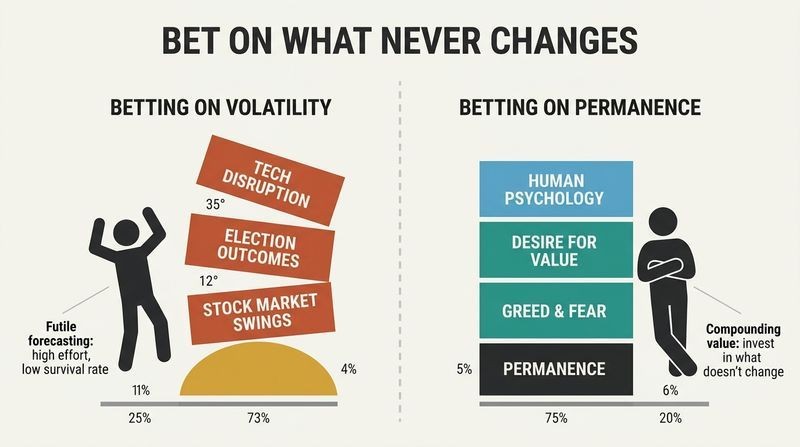
Housel's central wager: forecasting events is a fool's errand, but forecasting behavior is reliable. Jeff Bezos asks what won't change in ten years rather than what will, because you can pour investment into permanence. Amazon customers will always want low prices and fast shipping. Similarly, Housel admits he cannot predict the stock market or the next election, but he is certain people will keep responding to greed, fear, envy, and tribalism exactly as they have for millennia.
Naval Ravikant's parallel-universe test sharpens the idea: if your life played out a thousand times, what would be true in 999 of them? Those luck-proof truths deserve your attention. A time traveler dropped into any century would be baffled by the technology yet instantly recognize human overconfidence and shortsightedness.
The framing echoes Stoic philosophy's dichotomy of control and Nassim Taleb's distinction between the fragile specific and the robust general. What's powerful is the inversion of how most people allocate attention: we obsess over volatile headlines while ignoring the constants that actually shape outcomes. One nuance worth adding: behavioral constants are reliable in aggregate but useless for timing. Knowing humans panic does not tell you when. The book's strength is humility about prediction; its limit is that 'timeless behavior' can become an all-purpose explanation that resists falsification, the way evolutionary psychology sometimes does.
The biggest risk is always the one nobody is discussing
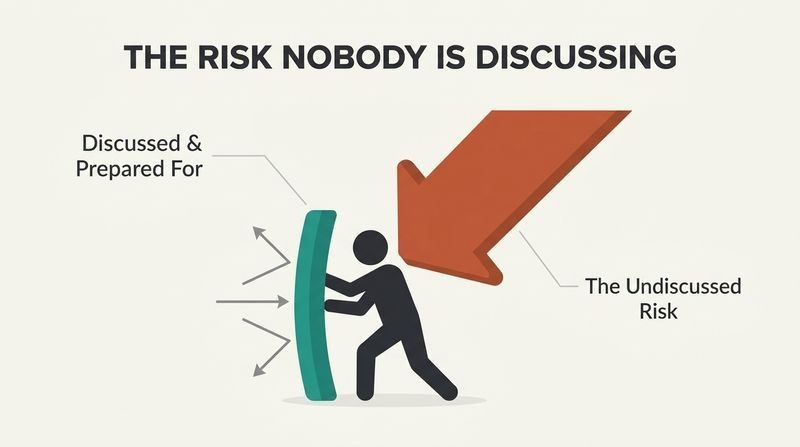
Risk is what's left over after you've prepared for everything you could imagine. NASA planned every contingency for high-altitude flights, yet astronaut Victor Prather drowned in 1961 because he opened his helmet faceplate before slipping into the ocean, a trivial detail no one war-gamed. Houdini survived chains and rivers but died from an unexpected punch he hadn't braced for.
The truly devastating events (COVID-19, Pearl Harbor, the 1929 crash) share one trait: almost no one saw them coming. Nobel laureate Robert Shiller found zero economists who predicted the Great Depression. Housel's prescription, borrowed from Taleb: invest in preparedness, not prediction. California prepares for earthquakes without knowing when. Keep savings that feel slightly excessive, because the right buffer should make you wince a little.
This is the epistemics of tail risk made vivid. It connects to Donald Rumsfeld's 'unknown unknowns' and to Philip Tetlock's research showing expert forecasters barely beat chance. The actionable core, preparedness over prediction, mirrors antifragility and engineering safety margins. A subtle tension: infinite preparedness is impossible and costly, so the real skill is calibrating redundancy without paralysis. Behavioral finance adds that humans systematically underprice tail risk because vivid recent memory dominates probability estimates. The wince test is a clever heuristic precisely because it overrides our optimism bias rather than asking us to forecast the unforecastable.
Happiness is what you have divided by what you expected
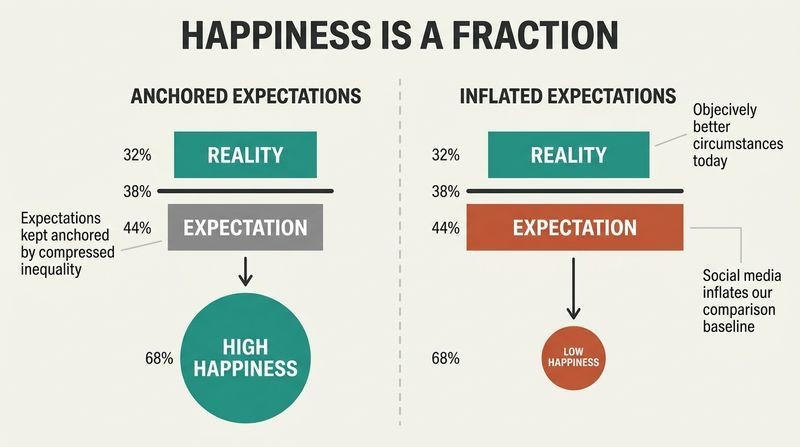
Your wellbeing tracks the gap between reality and expectations far more than your absolute circumstances. The 1950s are remembered as a golden age, yet by nearly every metric (income, home size, workplace safety, life expectancy) today is better. Median family income rose from roughly $29,000 in 1955 to over $70,000 today. What made the postwar era feel great was compressed inequality: your neighbors lived much like you did, so expectations stayed anchored.
Social media shattered that. Jonathan Haidt notes people now perform rather than communicate, broadcasting airbrushed highlight reels. A Match.com founder worth $10 million called himself a nobody in Silicon Valley. Charlie Munger's prescription is blunt: the first rule of a happy life is low expectations. Manage the expectation side of the equation, which is more in your control than circumstances.
This is the hedonic treadmill formalized, with a sociological twist Housel underplays elsewhere: reference groups, not absolute wealth, drive satisfaction. Economist Richard Easterlin documented the paradox that rising national income doesn't raise national happiness. The social-comparison mechanism connects to Festinger's social comparison theory and to research showing relative income predicts life satisfaction better than absolute. One worthwhile challenge: deliberately lowering expectations risks dampening ambition, a tension Housel acknowledges. The sharper move may be choosing reference groups wisely rather than crushing aspiration altogether. Gratitude practices work precisely because they reset the denominator without requiring you to want less from life.
The traits that make people exceptional also make them insufferable
You cannot cherry-pick a role model's qualities. Unique minds come as a package, and the genius you admire is inseparable from the flaws you'd never want. John Boyd revolutionized fighter combat with his aerial tactics manual, still used today, yet he screamed at superiors, chewed dead skin off his hands in meetings, and was nearly court-martialed. The Air Force needed his brilliance and couldn't stand the man.
Newton devoted over 100,000 words to alchemy and potions for eternal life. Musk's conviction that normal constraints don't apply to him is the same trait that fuels both Mars ambitions and reckless tweets. Naval Ravikant's test: you can't envy one slice of someone's life; you'd have to swap wholesale, reactions, insecurities, and all. Either you want the entire package or you don't.
This reframes the halo effect, our tendency to assume a person excellent in one domain is excellent across all. Housel's package-deal insight aligns with research on the dark side of high achievers and with the idea that disagreeableness correlates with certain forms of creative output. The deeper claim, that abnormal skill robs bandwidth from other faculties, is more speculative than established neuroscience supports. Still, the practical wisdom is sound: stop expecting visionaries to also be moral exemplars, and stop dismissing their gifts because of their flaws. Eat the orange, throw away the peel, as Housel puts it elsewhere.
People crave certainty far more than they want accuracy
In a probabilistic world, humans desperately want yes-or-no answers. When the CIA director demanded to know if bin Laden was in the compound, analysts offered 60 to 80 percent; he wanted a yes or no. Munger called this the Doubt-Avoidance Tendency: brains evolved to kill uncertainty fast, because a prey animal that deliberates gets eaten.
This blinds us to large numbers. Evelyn Adams won the lottery twice, odds of 1 in 17 trillion for one person, but with millions playing weekly, the odds someone wins twice are about 1 in 30. With eight billion people, a one-in-a-billion daily event strikes thousands. Freeman Dyson calculated that 'miracles' should occur about once a month per person. The world feels broken partly because global media now surfaces every rare catastrophe that always happened locally unseen.
Housel braids two distinct cognitive failures: intolerance of ambiguity and innumeracy about base rates. The lottery example is a textbook illustration of the law of truly large numbers, popularized by statisticians Diaconis and Mosteller. The media point is underappreciated: as local newspapers collapsed (1,800 US outlets vanished between 2004 and 2017), our information diet globalized, and since bad news travels and base rates of disaster across eight billion people guarantee daily horror, perceived risk inflates even as actual safety improves. Tetlock's superforecasters succeed precisely by thinking in probabilities and updating, the discipline most people instinctively reject because uncertainty is psychologically painful.
The best story beats the best idea every single time
Persuasion rewards the storyteller, not the truth-teller. Martin Luther King Jr.'s 'I Have a Dream' wasn't in his prepared text; he improvised it after gospel singer Mahalia Jackson shouted 'Tell 'em about the dream!' The most celebrated speech in American history was an ad-lib. Yuval Noah Harari sold over 28 million books with Sapiens, which he cheerfully admits contained zero new research, just common knowledge presented beautifully.
Darwin wasn't first to evolution; he wrote the most compelling book. Ken Burns's Civil War documentary drew 40 million viewers by matching sentence lengths to musical beats. The Titanic is famous while deadlier shipwrecks (the SS Kiangya killed nearly 4,000) are forgotten, because the Titanic had story potential. Stephen Hawking was told each equation would halve his sales.
This is rhetoric's oldest truth, Aristotle's pathos outranking logos, validated by modern narrative-transportation research showing stories lower counter-arguing and boost persuasion. The implication cuts both ways: it explains how charlatans win and how vital truths languish unheard. Housel's most useful prompt is the discomforting pair of questions: who has the right answer but I ignore because they're inarticulate, and what do I believe that's actually just good marketing? For knowledge workers, the lesson is that communication is not decoration but leverage. The risk Housel names honestly is that storytelling power, untethered from truth, is exactly how dangerous ideas spread fastest.
Calm itself plants the seeds of the next crisis
Stability breeds the behavior that destroys stability. Economist Hyman Minsky's financial instability hypothesis: when economies are calm, people grow optimistic; optimism breeds debt; debt breeds fragility. A market guaranteed never to fall would be bid up until it was guaranteed to fall. The mere belief in safety makes systems dangerous.
The pattern repeats everywhere. A century of conquering infectious disease (deaths fell 94 percent from 1900 to 2014) left the world psychologically unprepared for COVID-19; public health budgets were cut precisely because they succeeded. Carl Jung's enantiodromia holds that excess breeds its opposite: California's record 2017 rains grew record vegetation, which dried into kindling for record wildfires. Things become most dangerous exactly when they feel safest. The full cycle runs from assuming good news is permanent to panic and back again.
Minsky was obscure until 2008 made him prophetic; the phrase 'Minsky moment' now describes sudden collapses after long calm. The insight generalizes beyond finance into ecology (fire suppression increasing catastrophic fires), immunology (hygiene hypothesis), and organizational complacency. What Housel captures elegantly is the reflexivity: the belief about safety changes the system's actual safety, a dynamic George Soros called reflexivity in markets. The practical takeaway resists easy action, since you cannot opt out of cycles, but you can resist extrapolating calm indefinitely and build slack before you need it. The wildfire and pandemic analogies make an abstract financial theory viscerally intuitive.
Push anything past its natural size and it backfires
Most things have a most convenient size and speed; force them beyond it and they break. Robert Wadlow, the tallest human ever at nearly nine feet, needed leg braces and a cane and died from a leg infection because the human frame doesn't scale. Biologist J.B.S. Haldane showed a flea blown up to human size couldn't jump thousands of feet; physics changes with scale.
Starbucks opened a new store every four hours by 2007, then closed 600 and watched its stock fall 73 percent. Howard Schultz concluded growth is a tactic, not a strategy. Glasgow biologists found fish force-fed early growth died 15 percent earlier, while slow-grown fish lived 30 percent longer; haste diverts resources from repair. Trees grown fast in open sunlight produce soft, rot-prone wood. Patience and scarcity create value; speeding up destroys it.
The scaling principle draws on Geoffrey West's work at the Santa Fe Institute showing biological and organizational properties follow power laws, not linear ones. Housel's cross-domain sweep (Wadlow, fish, trees, Starbucks, Uber's culture) is the book's signature move, finding one law beneath disparate phenomena. The growth-versus-repair tradeoff in the fish study echoes the disposable soma theory of aging. A useful extension: venture capital's blitzscaling ethos directly contradicts this, and sometimes wins, suggesting the optimal size depends on whether network effects reward speed. The honest synthesis is that most things have natural limits, but a few winner-take-all domains genuinely reward outpacing them.
Stress and crisis fuel innovation that comfort never could
The biggest leaps come from pain, not prosperity. The 1930s, America's darkest economic decade, were also its most technologically productive: total factor productivity hit levels never seen before or since, and output rose 40 percent by 1941 with no increase in hours worked. Desperation forced supermarkets, laundromats, and ruthless factory efficiency into existence.
Militaries birthed radar, the internet, jets, antibiotics, and GPS, not because soldiers are the best engineers, but because they face problems that must be solved right now or people die. World War II began on horseback and ended with nuclear fission. The Triangle Shirtwaist fire of 1911, where 146 workers died, galvanized Frances Perkins into a lifetime of labor reform. Nixon observed that the idle rich at resorts are the unhappiest people, because purpose requires struggle.
This is the innovation-through-adversity thesis, supported by economic historian Alexander Field's work rehabilitating the 1930s as a great leap forward. It connects to post-traumatic growth research in psychology and to the observation that constraints boost creativity (necessity as the mother of invention is empirically defensible). The danger Housel flags honestly is the thin line between productive stress and crippling catastrophe; trauma that saps resources prevents innovation rather than sparking it. The view risks romanticizing suffering, so the careful reading is descriptive, not prescriptive: crises happen to to produce breakthroughs, which is not a reason to wish for them.
Progress creeps in silently; ruin arrives all at once
Good news compounds slowly and invisibly; bad news strikes instantly and demands attention. Heart disease death rates fell over 70 percent since the 1950s, saving an estimated 25 million American lives, yet no one builds statues for cardiologists because the improvement averaged just 1.5 percent a year. A headline reading 'Heart Disease Deaths Decline 1.5%' makes you yawn.
Meanwhile, Pearl Harbor and 9/11 each took about an hour. Lehman Brothers went from 158-year-old institution to bankrupt in 15 months. A human embryo takes billions of precise steps to build, but death usually comes down to one simple failure: insufficient blood and oxygen. Harari notes peace requires almost everyone to choose well, while war needs only one bad actor. Growth fights headwinds; decline gets out of the way.
The asymmetry between constructive and destructive timescales is profound and underexploited in everyday thinking. It explains media negativity bias structurally rather than morally: destruction is an event, progress is a trend, and journalism covers events. The embryo-versus-death contrast crystallizes a thermodynamic truth, that ordered states are hard to build and easy to destroy, which connects to entropy. One practical reframe Housel offers is brilliant: asking whether Americans will be twice as rich in 50 years sounds absurd, but asking for 1.4 percent annual growth sounds pessimistic, and they're identical. Reframing slow compounding in annual terms is a cognitive antidote to despair.
Save like a pessimist, invest like an optimist
Progress demands holding two opposing mindsets at once. Admiral Jim Stockdale, the highest-ranking POW in Vietnam, said the prisoners who died were the optimists who kept expecting release 'by Christmas' and broke when it didn't come. Survival required unwavering faith you'd prevail combined with brutal acceptance of present reality.
Bill Gates embodied this: relentlessly confident enough to drop out and bet on a computer on every desk, yet paranoid enough to keep a year of payroll in cash from day one. Housel calls the sweet spot the rational optimist: someone who knows history is a chain of setbacks but stays optimistic because setbacks don't prevent eventual progress. Pure optimists and pure pessimists are equally detached from reality, both rooted in ego. The trick is surviving the short run so you can enjoy the long run.
Stockdale's insight became the Stockdale Paradox in Jim Collins's work, and it maps onto research distinguishing dispositional optimism from defensive pessimism, both of which can be adaptive in different contexts. The save-pessimist invest-optimist formula resolves an apparent contradiction by assigning each mindset to its proper domain and time horizon. The concept of depressive realism, that mildly depressed people judge risk more accurately, adds intriguing texture, though the original Alloy-Abramson findings have faced replication challenges. Housel's framing is psychologically mature: it rejects the toxic-positivity industry while also rejecting doom, locating wisdom in the uncomfortable both-and rather than the comfortable either-or.
Disagreements are experience gaps, not intelligence gaps
What you've lived through shapes your beliefs more than what you know. Wounds heal but scars last: the Pentagon shows no trace of the 9/11 crash, yet airport security rituals remain forever. People who survived the Great Depression craved security and distrusted risk for the rest of their lives, a trait still visible in 1950s surveys when unemployment was under 3 percent.
Pavlov's dogs, after surviving a 1924 Leningrad flood that nearly drowned them, lost their conditioned behaviors entirely; trauma rewired them permanently. You can separate today's entrepreneurs by whether they lived through the dot-com crash. Housel's most useful question for any disagreement: what have you experienced that I haven't that makes you believe what you do? Most arguments aren't real disagreements, just people with different scars talking past each other.
This is standpoint epistemology rendered humane and apolitical. It connects to research on formative experiences shaping risk attitudes: economists Malmendier and Nagel found that people who lived through high-inflation or low-return eras invest differently for life, dubbing it the 'Depression babies' effect. The framing offers a genuine tool for depolarization, reframing opponents as differently-experienced rather than stupid or evil. Benedict Evans's observation that exposure to opposing views online often increases anger rather than empathy is a sobering counterweight to techno-optimism about dialogue. The closing question is the book's most actionable gift: it converts contempt into curiosity, which is the precondition for actually learning anything.
Analysis
Same as Ever is an anthology of 23 loosely connected essays, derived largely from Housel's Collaborative Fund blog, unified by a single thesis: in a world obsessed with change, the durable edge comes from studying what stays constant. It belongs to the behavioral-finance-meets-history genre Housel pioneered in The Psychology of Money, but ranges wider into evolutionary biology, military history, and psychology.
The book's method is its message. Housel finds one timeless law (compounding, scaling limits, expectation gaps) and illustrates it through a dazzling sweep of anecdotes: Pavlov's flooded dogs, Robert Wadlow's failing legs, Stockdale's POW camp, the Triangle fire. This cross-domain pattern-matching is genuinely original and makes abstract principles stick. The structure's strength (each chapter stands alone) is also its weakness: there's no cumulative argument, some chapters overlap (calm-breeds-crazy and tiny-risks-compound cover similar ground), and the essayistic looseness occasionally substitutes vivid story for rigorous evidence.
Epistemically, Housel is at his best preaching humility about prediction and the primacy of behavior over events. His debts are clear and acknowledged: Taleb on tail risk and antifragility, Munger on psychology and incentives, Minsky on instability, Kahneman on cognition. The risk in his approach is that 'timeless human nature' can become unfalsifiable, explaining any outcome after the fact. A skeptic might note that survivorship bias lurks in his examples, and that selecting history's most arresting stories proves rhetorical skill more than scientific law.
Yet the practical payoff is real. The book equips readers with durable mental models rather than expiring tips: think in probabilities, prepare rather than predict, manage expectations, recognize that scars shape beliefs. Housel's closing move, replacing forecasts with historical pattern recognition, and ending on questions rather than answers, reflects intellectual honesty rare in the genre. It is less a how-to than a recalibration of attention toward what actually endures.
Review Summary
Same as Ever receives mixed reviews, with ratings ranging from 1 to 5 stars. Many readers appreciate Housel's storytelling and thought-provoking ideas about human behavior and timeless truths. Some find the book insightful and full of wisdom, praising its readability and relevance. However, critics argue that the content lacks depth, feels repetitive, or rehashes ideas from other authors. Some readers who enjoyed Housel's previous work, "The Psychology of Money," express disappointment with this book, while others consider it equally valuable.
People Also Read




FAQ
What's "Same as Ever: A Guide to What Never Changes" about?
- Exploration of Timelessness: The book explores the idea that while the world changes, certain human behaviors and patterns remain constant over time.
- Human Behavior Focus: It delves into aspects of human psychology, such as resilience, stability, and change, and how these traits have persisted throughout history.
- Historical Context: Morgan Housel uses historical anecdotes and stories to illustrate how these unchanging aspects of human nature manifest in different eras.
- Practical Insights: The book offers insights into how understanding these timeless behaviors can help individuals make better decisions in their personal and professional lives.
Why should I read "Same as Ever: A Guide to What Never Changes"?
- Timeless Lessons: The book provides valuable lessons on human behavior that are applicable across different contexts and time periods.
- Improved Decision-Making: By understanding what never changes, readers can make more informed decisions about the future.
- Engaging Stories: Housel uses engaging stories and historical examples to make complex ideas accessible and relatable.
- Broader Perspective: It encourages readers to look beyond immediate changes and focus on enduring patterns, offering a broader perspective on life and history.
What are the key takeaways of "Same as Ever: A Guide to What Never Changes"?
- Stability Breeds Instability: Housel discusses how periods of stability often lead to complacency, which can result in instability.
- Importance of Expectations: Managing expectations is crucial for happiness and success, as they often dictate our perception of reality.
- Role of Incentives: Incentives are powerful motivators that can lead people to justify almost any behavior, highlighting the importance of aligning incentives with desired outcomes.
- Power of Stories: Stories are more persuasive than statistics, and understanding this can help in effectively communicating ideas and influencing others.
What are the best quotes from "Same as Ever: A Guide to What Never Changes" and what do they mean?
- "History never repeats itself; man always does." - Voltaire: This quote underscores the idea that while historical events may not repeat exactly, human behavior remains consistent.
- "The first rule of happiness is low expectations." - This highlights the importance of managing expectations to achieve contentment and avoid disappointment.
- "Risk is what's left over after you think you've thought of everything." - Carl Richards: This emphasizes the unpredictability of risk and the importance of being prepared for the unexpected.
- "The best story wins." - This suggests that compelling narratives often have more influence than factual accuracy, highlighting the power of storytelling.
How does Morgan Housel define resilience in "Same as Ever: A Guide to What Never Changes"?
- Enduring Challenges: Resilience is the ability to endure and adapt to challenges and setbacks over time.
- Psychological Strength: It involves maintaining psychological strength and stability in the face of adversity.
- Learning from History: Housel illustrates resilience through historical examples, showing how individuals and societies have bounced back from crises.
- Practical Application: Understanding resilience can help individuals better navigate personal and professional challenges.
What is the "financial instability hypothesis" mentioned in the book?
- Concept by Hyman Minsky: The hypothesis suggests that periods of economic stability lead to increased risk-taking, which eventually results in financial instability.
- Cycle of Boom and Bust: It describes a cycle where stability breeds complacency, leading to excessive borrowing and risk, which then causes economic downturns.
- Relevance Today: Housel uses this hypothesis to explain why financial crises occur and how they are a natural part of economic cycles.
- Implications for Investors: Understanding this concept can help investors recognize the signs of financial instability and make more informed decisions.
How does "Same as Ever" address the concept of expectations and reality?
- Expectations Shape Reality: The book emphasizes that our expectations significantly influence our perception of reality and happiness.
- Managing Expectations: Housel advises managing expectations to align them with reality, which can lead to greater satisfaction and less disappointment.
- Historical Examples: The book uses historical examples to show how expectations have shaped societal outcomes and individual experiences.
- Practical Advice: By understanding the role of expectations, readers can better navigate personal and professional challenges.
What role do incentives play according to Morgan Housel in "Same as Ever"?
- Powerful Motivators: Incentives are powerful forces that can drive behavior and decision-making, often more than logic or reason.
- Behavior Justification: People can justify almost any action if the incentives are strong enough, highlighting the need for careful incentive design.
- Historical Context: Housel provides historical examples to illustrate how incentives have shaped major events and individual actions.
- Aligning Incentives: The book suggests aligning incentives with desired outcomes to achieve better results in various aspects of life.
How does Morgan Housel explain the power of stories in "Same as Ever"?
- More Persuasive than Facts: Stories are often more persuasive and memorable than statistics or data, influencing people's beliefs and actions.
- Emotional Connection: A good story creates an emotional connection, making it easier for people to relate to and remember the message.
- Historical Impact: Housel uses historical examples to show how powerful storytelling has shaped events and movements.
- Practical Application: Understanding the power of stories can help individuals communicate more effectively and influence others.
What does "Same as Ever" say about the unpredictability of risk?
- Unseen Risks: The book highlights that the biggest risks are often those that are unseen or unanticipated.
- Preparedness Over Prediction: Housel emphasizes the importance of being prepared for risks rather than trying to predict them.
- Historical Lessons: Through historical anecdotes, the book illustrates how unexpected risks have shaped events and outcomes.
- Practical Implications: By acknowledging the unpredictability of risk, individuals can better prepare for and navigate uncertainties.
How does Morgan Housel address the concept of time horizons in "Same as Ever"?
- Long-Term Thinking: The book advocates for long-term thinking in investing, careers, and personal goals, emphasizing patience and endurance.
- Challenges of Long-Term: Housel acknowledges that long-term thinking is challenging due to short-term distractions and pressures.
- Collective Short Runs: The long run is a series of short runs, and enduring these is crucial for achieving long-term success.
- Flexibility and Adaptation: Flexibility and the ability to adapt to changing circumstances are key components of effective long-term thinking.
What does "Same as Ever" suggest about the balance between optimism and pessimism?
- Coexistence of Both: The book suggests that progress requires a balance between optimism and pessimism, as both are necessary for different reasons.
- Optimism for Growth: Optimism drives innovation, growth, and the pursuit of new opportunities.
- Pessimism for Caution: Pessimism provides caution, helping individuals prepare for risks and setbacks.
- Historical Context: Housel uses historical examples to show how this balance has played out in various contexts and eras.
About the Author

Download PDF
Download EPUB
.epub digital book format is ideal for reading ebooks on phones, tablets, and e-readers.








































