
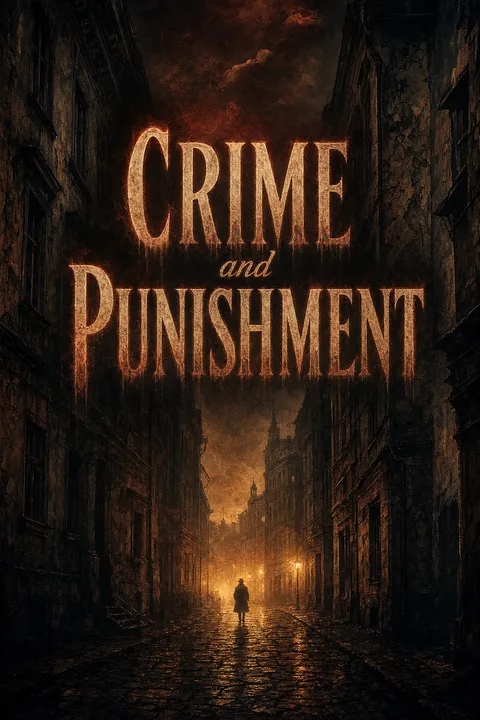


Plot Summary
The Trial Run
In a sweltering Petersburg July, a former law student named Raskolnikov1 leaves his coffin-sized garret and walks seven hundred and thirty counted steps to the apartment of Alyona Ivanovna, a shrewish old pawnbroker.15 He brings a silver watch to pledge, but the visit is reconnaissance: he studies the rooms, the keys, the bell.
Horrified by the thing taking shape in his mind, he flees to a tavern, telling himself it is all fantasy, a plaything. Crushed by debt and pride, he has withdrawn from everyone, brooding for a month in his cupboard. The loathing he feels is real, yet so is the calculation. He cannot decide whether he is a man toying with monstrosity or a monster persuading himself he is only a man.
Dostoevsky opens not with action but with paralysis, the hesitation of a will divided against itself. Raskolnikov's name derives from raskol, schism, and the split is already audible in his monologues, where contempt for cowardice wars with revulsion at his own scheme. The counted steps reveal an obsessive intellect trying to make murder a problem in arithmetic. Petersburg's heat, stench, and crowding press on overwrought nerves, making the city a participant rather than backdrop. The genius here is ambiguity: we never receive a clean motive, only a man circling an abyss he both dreads and craves, testing whether thought can be converted into deed.
Marmeladov's Tavern Confession
In the tavern Raskolnikov1 is accosted by Marmeladov, a dismissed titular councillor9 reeking of five days' drinking. The man unspools his ruin with theatrical anguish: he stole his consumptive wife Katerina Ivanovna's10 last money, drank away even her stockings, and watched his gentle daughter Sonya2 take a yellow pass, the prostitute's certificate, to feed the starving children.
Sonya2 laid thirty roubles silently before her stepmother and turned to the wall, weeping. Marmeladov9 begs not for joy but for sorrow, for someone to pity rather than reproach him.
Moved despite himself, Raskolnikov1 helps the swaying man home, witnesses Katerina Ivanovna's10 frenzied grief and the terrified children, and leaves his last coppers on the windowsill before regretting the gesture on the stairs.
The Marmeladov subplot smuggles in the novel's moral counterweight to Raskolnikov's icy theorizing: suffering freely borne for love. Sonya's silent sacrifice, money laid down without a word or glance, embodies an ethic of self-emptying that no rational system can compute. Marmeladov's drunken eloquence, with its vision of a Christ who receives the shameless precisely because they consider themselves unworthy, introduces the theme of grace beyond merit. Raskolnikov's involuntary charity, instantly retracted in spite, dramatizes his fractured nature: generosity and nihilist calculation coexist. The encounter plants Sonya as the figure who will eventually stand opposite his pride, the meek witness who refuses judgment.
His Mother's Letter
Back in his garret, Raskolnikov1 receives a thick letter from his mother, Pulcheria Alexandrovna.7 It reports that his proud sister Dunya,6 after enduring slander and harassment in the household of the lecherous Svidrigailov,5 has agreed to marry Pyotr Petrovich Luzhin,8 a smug, self-made lawyer of forty-five who prefers a penniless bride he can dominate.
The family is coming to Petersburg; Luzhin8 may even employ Raskolnikov.1 He reads it with tears, then bile. He sees instantly that Dunya6 is selling herself for him, just as Sonya2 sold herself for her family.
Enraged at being made the cause of such sacrifice, he refuses the marriage in his mind. Wandering, he rescues a drunk, abused girl from a predatory dandy on a boulevard, then abandons the effort with bitter indifference.
The letter converts abstract resentment into concrete pressure. Dunya's bargain mirrors Sonya's prostitution so exactly that Raskolnikov collapses the two: both women trade their bodies and freedom to save those they love, and his pride cannot bear being the beneficiary. This humiliation feeds the murder fantasy, supplying the alibi of altruism, the dream of seizing means to rescue them all. The boulevard episode, where compassion flares and then curdles into the chilling notion of a statistical percentage destined to perish, shows his theory eating his humane impulses alive. Dostoevsky binds private shame to ideological abstraction, suggesting ideas grow from wounded vanity.
The Beaten Mare
Exhausted, Raskolnikov1 sleeps in the bushes and dreams of himself as a small boy watching drunken peasants whip a feeble old nag to death for failing to pull a monstrous load, while he runs sobbing to kiss the dying animal. He wakes renouncing the crime, light with relief.
But crossing the Haymarket, he overhears Lizaveta, the pawnbroker's meek, perpetually pregnant half-sister and servant,15 arranging to be away the next evening at seven. The old woman15 will be home alone. The relief vanishes.
Earlier he had overheard a student argue that murdering the useless, malicious crone for the good of thousands would be simple arithmetic. Now coincidence feels like fate pushing him. He returns home like a condemned man, certain everything has been decided.
The dream is the novel's moral seismograph: the child's anguished pity for the tormented horse exposes the compassionate self that the theory must suffocate. His waking renunciation proves the murder is not inevitable, which makes the overheard timetable all the more devastating, recasting choice as destiny. Dostoevsky stages the tension between freedom and determinism: Raskolnikov experiences himself as dragged by an external machine, a coat caught in cogs, yet the dragging is his own divided will. The student's tavern syllogism externalizes his thoughts, giving them the false authority of common sense, and the eerie convergence of chance and desire becomes the superstition that haunts him afterward.
The Axe Falls Twice
Stealing an axe from a caretaker's room, Raskolnikov1 sews a loop inside his coat, carries a fake pledge wrapped to delay the old woman, and climbs to the fourth floor. While Alyona Ivanovna15 fumbles with the string, he brings the butt down on her skull, again and again, and takes her keys and a stuffed purse from her neck.
Then the unthinkable: Lizaveta, the gentle sister,15 returns early and stands frozen before her dead kin. He splits her skull with the blade's edge. Nearly trapped when two visitors ring and rattle the hooked door, he survives only because they leave for the caretaker, letting him slip past and hide in a freshly painted empty flat. He staggers home and collapses, the stolen goods forgotten in his pockets.
The second murder annihilates the theory at its birth. Raskolnikov killed the pernicious louse by argument, but Lizaveta, meek, pregnant, one of the very downtrodden his ideology claimed to serve, dies for the crime of witnessing. The blade, edge first this time, marks the difference between calculated execution and panicked butchery. His failure to rob efficiently, leaving cash in the trunk while grabbing trinkets, reveals that money was never the true object. Dostoevsky renders the act with hallucinatory physicality, the blood, the hook jumping in the eye, the suffocating proximity of the visitors, so that abstraction drowns in sensation. The transgression opens dimensions of self he never anticipated.
Summoned to the Station
The next morning a police summons terrifies Raskolnikov,1 but it concerns only an overdue promissory note owed to his landlady. Relief floods him until the assistant superintendent, the explosive Lieutenant Gunpowder, begins discussing the murder.
Officers casually mention the bodies were found warm, the killer barely escaped. Raskolnikov1 faints, then recovers, convinced he has betrayed himself. He flees, retrieves the loot he had crammed into a hole behind the wallpaper, and realizes how absurdly he hid it.
Burning with fever, he wanders the city for hours, then buries everything beneath a heavy stone in a deserted courtyard. His sickness deepens into delirium; for days he drifts in and out of consciousness, tended by the cook Nastasya and, increasingly, by a loyal acquaintance.3
The summons inaugurates the punishment phase, which Dostoevsky locates not in law but in the psyche. The crime detected itself: the criminal's own failure of will, the darkening of reason Raskolnikov theorized about, now overtakes him exactly as predicted. His faint is the body confessing what the mouth withholds. The buried loot, never used, becomes the perfect emblem of a murder committed for an idea rather than profit, a transgression whose only product is isolation. The fever externalizes guilt as illness, blurring inner and outer worlds. The state he feared, alienation from all humanity, descends as a tormenting sensation deeper than any rational awareness of danger.
The Loyal Friend and the Family
Raskolnikov1 surfaces from delirium to find Razumikhin, his cheerful, indestructibly kind former classmate,3 installed as nurse, buying him clothes with money sent by his mother7 and clearing his debts. The doctor Zossimov13 hovers, intrigued by the patient's fixation on the murder he keeps overhearing discussed.
When the prim Luzhin8 visits to introduce himself, Raskolnikov,1 raw and contemptuous, provokes a quarrel and orders him out, repudiating the marriage.
That same night his mother7 and Dunya6 arrive at his door, weeping with joy, but he faints at the sight of them and then coldly demands that Dunya6 break with Luzhin.8 Razumikhin,3 instantly smitten with Dunya,6 takes charge of the bewildered women, swearing to protect them while their loved one behaves like a man possessed.
Razumikhin functions as Raskolnikov's photographic negative: equally poor and proud, yet sociable, generous, anchored in life and labor rather than theory. His name, from reason, suggests a healthier rationality that serves people instead of dominating them. The family reunion that should comfort becomes torture, because love now presses against the secret walling Raskolnikov off from everyone. His repudiation of Luzhin is partly genuine moral disgust and partly the displaced rage of a man who cannot bear his sister's sacrifice mirroring his own crime. Dostoevsky shows how guilt corrodes intimacy: the murderer recoils from the very tenderness he craves, because to be loved is to risk being known.
Marmeladov Under the Wheels
Escaping his family, Raskolnikov1 taunts the clerk Zamyotov12 in a tavern, half-confessing in riddles, then witnesses a crowd around a man crushed by a carriage. It is Marmeladov,9 dying. Raskolnikov1 has him carried home, where Katerina Ivanovna10 and the children watch him expire after a priest's hurried rites. Sonya2 arrives in her gaudy street clothes, and her father9 dies begging her forgiveness in her arms.
Raskolnikov1 presses his remaining twenty roubles into the widow's10 hands for the funeral, then feels a strange surge of restored life, as if pardoned at the scaffold. Marmeladov's9 daughter Polenka chases him down to learn his name and promises to pray for him; he leaves the dead man's house feeling, for one evening, that he can still live.
Marmeladov's grotesque death and the tender deathbed grief restore Raskolnikov to feeling, proving life can still move him. His impulsive gift of the funeral money is genuine charity, but it is also a man clutching at human connection to escape the void of isolation. The encounter binds him irrevocably to Sonya, the only soul he will later be able to address. Polenka's innocent promise of prayer plants a seed of intercession. Dostoevsky stages resurrection in miniature: the sensation of a condemned man reprieved foreshadows the novel's final movement, while exposing the cruel irony that vitality returns to the murderer through another family's catastrophe.
The Article on Crime
To recover his pawned watch and ring, Raskolnikov1 visits the magistrate Porfiry Petrovich,4 a plump, watery-eyed investigator with a teasing, womanish manner concealing a razor mind.
Porfiry4 has read an article Raskolnikov published months earlier, arguing that extraordinary men, the Napoleons and lawgivers, possess an inner right to step over moral limits and shed blood in pursuit of a new idea, while the ordinary mass must obey. Porfiry4 presses him with mock innocence: how does one tell the categories apart, and did the author perhaps count himself among the extraordinary?
Zamyotov12 listens; Razumikhin3 protests in horror. Raskolnikov1 defends the theory coolly, sensing a trap closing, suspecting Porfiry4 already knows everything yet has no proof, only psychology.
The article scene is the novel's intellectual core, where Raskolnikov's ideology is stated plainly: history's benefactors were all criminals who transgressed sacred law, and conscience permits the strong to spill blood for a higher purpose. Porfiry's interrogation is a duel of consciousness, not evidence, conducted through irony and feigned buffoonery. He understands that the crime sprang from this very theory, and that the criminal's pride is both his motive and the lever that will break him. Dostoevsky exposes the fatal flaw: the act of asking whether one has the right proves one does not, since true Napoleons never question. Theory meets the unrepeatable particularity of an actual, ordinary, suffering man.
The Man from Under the Ground
After secretly returning to the murder flat to ring the bell and feel its horror again, Raskolnikov1 is followed by a hunched tradesman who looks him in the eye and quietly calls him a murderer before vanishing. The accusation shatters him; he collapses into feverish dreams of striking the laughing old woman15 whose skull will not break.
He wakes to find a stranger watching from his doorway: Svidrigailov, the dissolute landowner5 who pursued Dunya,6 freshly arrived after his wife Marfa Petrovna's sudden death. Svidrigailov5 claims to be haunted by her ghost, professes idle curiosity about Raskolnikov,1 and offers ten thousand roubles to free Dunya6 from the wretched Luzhin8 marriage, plus news that Marfa left Dunya6 three thousand in her will.
The anonymous tradesman embodies guilt made flesh, a voice from under the ground that seems to know all. Its terror lies in the gap between the accusation's certainty and its lack of evidence, leaving Raskolnikov suspended over the abyss. Svidrigailov's arrival introduces the novel's most disturbing double: a man who also steps over moral limits but without theory, agonized conscience, or hope of redemption, having reached the point where evil turns monotonous. His casual talk of ghosts blurs the line between guilt and the supernatural. Where Raskolnikov still struggles, Svidrigailov is the spiritual terminus of unchecked will, a mirror showing where the theory ends: in a soot-filled bathhouse of eternity.
Luzhin Cast Down the Stairs
At the family meeting, Luzhin8 arrives offended that Raskolnikov1 was permitted to attend against his written demand. He compounds the insult by slandering Raskolnikov,1 claiming he gave money to a girl of notorious behavior rather than a grieving widow, and by reminding Dunya6 that he stooped to take her despite gossip about her name.
He boasts of preferring a poor wife who will regard her husband as a benefactor. Dunya,6 her pride flaring, sees the controlling, vindictive man beneath the polish and orders him out. Pulcheria7 turns on him too. Luzhin,8 who never imagined the helpless women could escape his power, leaves carrying a furnace of spite, blaming Raskolnikov1 alone, and privately vowing the broken match can still be repaired.
Luzhin is the bourgeois ego stripped of grandeur, the petty incarnation of Raskolnikov's egoism translated into respectable economics: his creed that universal prosperity flows from self-interest justifies acquiring a wife who must worship her rescuer. His humiliation is comic yet sinister, because wounded vanity in such a man does not subside but seeks revenge. Dunya's expulsion of him is an act of moral self-rescue that proves she will not, after all, sell her soul, distinguishing her from the sacrifice her brother feared. Dostoevsky contrasts two predators of women, Luzhin and Svidrigailov, and lets Dunya's integrity refuse them both, asserting a freedom the theorist denied her.
Lazarus Read in the Lamplight
Raskolnikov1 seeks out Sonya2 in her bleak rented room, drawn and repelled at once. He interrogates her cruelly about her hopeless situation, the looming deaths of Katerina Ivanovna10 and the children, the prostitution she cannot escape, asking what sustains her. Her answer is God.
He demands she find and read aloud the Gospel passage of Lazarus raised from the tomb; trembling, she obeys, her voice rising in triumph at the miracle, willing him too to believe. He tells her he has abandoned his family and chosen her, that they are both transgressors who have stepped over, and promises that if he comes again he will tell her who killed Lizaveta.15 Unknown to them, Svidrigailov5 listens through the wall.
The murderer and the harlot bent over the eternal book is the novel's central icon, two who have killed something in themselves, his victim, her own life. Raskolnikov's savage probing is the cruelty of a man seeking in another's suffering a mirror for his own, yet he also seeks the one thing his theory lacks: a reason to live amid horror. Sonya's reading of Lazarus offers the answer reason rejects, resurrection through faith and love, the quintessential particular case that violates natural law. Svidrigailov's eavesdropping turns the sacred scene into intelligence he will weaponize, juxtaposing grace and predation across a thin wall, the novel's two answers to evil pressed back to back.
Nikolai Confesses Instead
Summoned again, Raskolnikov1 endures Porfiry's masterful psychological siege. The magistrate4 explains his method: he will not arrest his suspect but let him circle like a moth toward the candle, tormented by uncertainty until he breaks. He hints he possesses a small trace, teases the bell-ringing return to the flat, and promises a surprise behind a locked door.
Just as the pressure peaks and Raskolnikov1 nearly snaps, the door bursts open and Nikolai, a young house painter who found the dropped jewelry case,14 falls to his knees and confesses to the murders. Porfiry4 is thrown, furious at the interruption, but Raskolnikov,1 momentarily reprieved, walks out shaken, knowing the confession is false and that the duel is far from over.
Porfiry articulates a theory of detection that is really a theory of conscience: the guilty man cannot run, not because he lacks somewhere to flee but because psychologically he is bound to return and confess. Nikolai's false confession introduces the Russian impulse to embrace suffering, a religious craving for expiation that Porfiry reads as a spiritual phenomenon, not a legal one. The interruption is both comic deus ex machina and structural irony, granting reprieve while deepening dread. Dostoevsky stages the contest as cat and mouse where the mouse half-wants to be caught. Porfiry's restraint reveals an investigator who seeks not conviction but the criminal's own movement toward redemptive truth.
The Hundred-Rouble Frame
At Katerina Ivanovna's10 chaotic memorial dinner, where the proud, consumptive widow quarrels with the German landlady and humiliates her shabby guests, Luzhin8 summons Sonya.2 Before witnesses he accuses her of stealing a hundred-rouble note from his room, having earlier given her ten roubles as charity.
The note is found in her pocket; she stands paralyzed as the room turns hostile. But Lebezyatnikov,11 Luzhin's8 progressive young roommate, erupts: he saw Luzhin8 secretly slip the larger note into Sonya's2 pocket as she left.
Raskolnikov1 then explains the motive aloud, exposing Luzhin's8 scheme to disgrace Sonya,2 vindicate his slander, and reconcile with the family. Luzhin,8 unmasked, retreats with insolent threats, while the enraged landlady evicts the grieving Katerina Ivanovna10 and her children on the spot.
Luzhin's frame-up is calculated cruelty, an attempt to convert an innocent into a criminal to salvage his own injured pride, the bourgeois egoist's revenge. Its exposure depends on the most unlikely witness, the muddled radical Lebezyatnikov, whose doctrinaire foolishness conceals genuine decency, suggesting goodness survives even in caricature. Raskolnikov's forensic defense of Sonya is his most morally lucid public act, a foreshadowing of the confession that will require the same courage turned on himself. Dostoevsky orchestrates the scandal scene as tragicomedy: amid grief and poverty, vanity, slander, and farce collide. The eviction completes Katerina Ivanovna's destruction, the social order grinding the helpless beneath spite and respectability.
I Am the Murderer
Returning to Sonya,2 Raskolnikov1 confesses the killings without words at first, until she reads it in his face and recoils, then embraces him, crying that no one on earth is more wretched. He tries to explain: he killed to test whether he was a louse or a man with the right to step over, to dare as Napoleon dared, for himself alone, not to help his mother.7
He admits the theory failed because he proved himself ordinary by the very act of asking. Sonya2 begs him to go to the crossroads, kiss the earth, and confess aloud to the world, then accept suffering as redemption. He resists, unwilling to call his deed a crime, but she vows to follow him to prison and to Siberia.
The confession strips the ideology to its rotten core: not altruism but the will to prove himself extraordinary, a Napoleon unbound by the moral law binding the trembling mass. By voicing it, Raskolnikov discovers the theory's self-refutation, his torment proves his ordinariness. Sonya's response inverts every value he holds: where he sought power and self-sufficiency, she offers shared suffering and submission to the earth and God. Her demand that he bow and confess aloud reframes punishment as the only road to resurrection. Dostoevsky locates the turning of the soul here, though Raskolnikov still cannot repent. Love arrives as a burden, heavier than solitude, because to be loved demands the surrender of pride.
Katerina Ivanovna in the Street
Evicted and unhinged, Katerina Ivanovna10 drags her terrified children into the street, dressing them in rags as performers, forcing them to sing and dance for coins, raving that she will appeal to the governor and the tsar.
She collapses, blood pouring from her consumptive chest, and is carried to Sonya's2 room, where she dies refusing a priest, declaring God should forgive her without confession. Svidrigailov5 suddenly appears and announces he will pay for the funeral and place all three orphans in good institutions, settling money on each and freeing Sonya.2
Then he turns to Raskolnikov1 and quietly repeats phrases Raskolnikov1 spoke to Sonya2 about whether Luzhin8 should live or die, revealing he overheard the murder confession through the wall.
Katerina Ivanovna's death completes the Marmeladov tragedy, a portrait of pride destroyed by poverty yet never morally broken, raging against injustice to the end. Her refusal of the priest, insisting she has suffered enough to be forgiven, voices the novel's anguished theodicy. Svidrigailov's philanthropy is genuine yet uncanny, charity from a man beyond moral categories, and his quotation of Raskolnikov's own words detonates the worst fear: the secret is now a weapon in the hands of the one man who covets Dunya. Dostoevsky tightens the noose not through law but through this predatory double, whose knowledge gives him power over both siblings, fusing the family's danger with the murderer's exposure.
Porfiry's Open Hand
Porfiry4 visits Raskolnikov's1 room and drops all pretense. He explains how he came to suspect him, how he played his tricks, why he never searched or arrested: the psychology was double-ended, the evidence absent, and Nikolai's14 false confession, born of a sectarian craving to embrace suffering, muddied everything. But Porfiry4 declares plainly that Raskolnikov1 is the killer.
He offers a deal: confess voluntarily and receive a reduced sentence. More than that, he counsels him almost tenderly to stop reasoning, to give himself directly to life, to seek faith and accept suffering as a great thing, predicting he will not flee but will come of his own accord. He grants him a day or two to decide, even hinting he might choose suicide instead.
Porfiry abandons the hunter's mask to become an ambiguous prophet, the representative of law who counsels something law cannot give: spiritual rebirth through embraced suffering. His insistence that Raskolnikov needs air, faith, and life rather than cleverness rebukes the entire ideology of the autonomous intellect. The offer of a reduced sentence is pragmatic, but his real argument is that the criminal cannot psychologically run, that conscience is destiny. Dostoevsky makes Porfiry both shrewd investigator and reluctant pastor, perhaps the novel's most ambiguous scene. The choice now belongs to Raskolnikov: confession or the river, Sonya's path of resurrection or Svidrigailov's terminus, with the magistrate gently weighting the scale toward life.
Svidrigailov's Last Night
Svidrigailov5 lures Dunya6 to his rooms, locks the door, and offers to save her brother1 from Siberia in exchange for herself. When she resists, he reveals the full confession and presses closer. Dunya6 draws Marfa Petrovna's revolver and fires, grazing his scalp; a second shot misfires. He waits, willing her to kill him, but she throws the weapon down.
Asked whether she could ever love him, she says never. Something breaks in him; he gives her the key and lets her go. That night he settles money on Sonya2 and the orphans, visits his teenage fiancee to leave her a fortune, and after a sleepless night of nightmares about a drowned girl and a corrupt child, walks to a watchtower at dawn and shoots himself before a baffled sentry.
Svidrigailov's release of Dunya is his single act of grace, and it costs him the last thread holding him to life. Her absolute refusal denies him the love that might have redeemed him; recognizing there is no movement left in his soul, he chooses the river's alternative. His dreams, the drowned fourteen-year-old, the child who becomes a whore, dramatize the monotony of evil Dostoevsky diagnoses: a man soaked through with corruption who cannot reach the innocence he glimpses. His suicide is the fate Raskolnikov rejects, the natural man who reaches the dead end of the will. Announcing he is going to America, the era's euphemism, he completes the double's tragic function: showing the road not taken.
Confession at the Station
Stunned by news of Svidrigailov's5 suicide, Raskolnikov1 says farewell to his mother,7 who senses catastrophe, and to Dunya,6 who now knows everything and blesses his decision to suffer.
Still defiant, insisting his only fault was failing to endure, he walks to the Haymarket and, remembering Sonya's2 command, kneels and kisses the filthy earth before a jeering crowd, the words of confession freezing on his lips. Sonya2 follows at a distance in her green shawl.
At the police station he encounters the babbling Lieutenant Gunpowder, learns again of Svidrigailov's5 death, and walks out, faltering. Outside he sees Sonya's2 anguished face. He turns back, returns to the office, and at last declares plainly that he killed the old pawnbroker and her sister Lizaveta15 with an axe.
The confession is willed yet incomplete: Raskolnikov surrenders to the law without repenting of the crime, calling himself a failure rather than a sinner. His pride survives even his submission, which is why the bow in the Haymarket misfires, the public words choke. Sonya's silent presence is the gravitational force pulling him back when he nearly walks away, love accomplishing what reason and law could not. Svidrigailov's death frames the act as the alternative chosen: not the pistol but the cross. Dostoevsky withholds catharsis deliberately; the confession is the beginning of punishment proper, the long descent into a humility the intellect still resists, the act of submission preceding any change of heart.
Epilogue
In a Siberian prison fortress on a wide river, Raskolnikov1 serves an eight-year sentence, his confession and prior good deeds having earned leniency. His mother7 dies in feverish delirium, half-knowing her son's fate.
Sonya2 follows him into exile, sewing for the town, beloved by the convicts who despise the proud, godless Raskolnikov.1 He remains unrepentant, ashamed only of having failed, until a fever and a dream of a world-destroying plague of self-certain reason shake him.
Recovering, he sees Sonya2 by the river and is suddenly flung at her feet, weeping. Love resurrects him at last. Beneath his pillow lies her Gospel, still unopened, but he senses her faith may become his own. A new story, of gradual regeneration, begins where this one ends.
The epilogue refuses easy conversion: Raskolnikov's regeneration is announced, not achieved, deferred into an unwritten future. His prison dream, mankind driven mad by individual claims to absolute truth, is the theory's logical endpoint universalized, the nihilism of the autonomous self multiplied into apocalypse. Only after this vision can love break through. Dostoevsky stages resurrection through Sonya, whose patient, unpreaching presence finally cracks pride open by the river, in sight of the timeless steppe where Abraham's centuries seem present. The unopened Gospel signals that faith remains potential, a threshold not yet crossed. The novel ends honestly: redemption is not a verdict but a beginning, dearly bought, requiring a future deed.
Analysis
Crime and Punishment is less a detective story than an interior tragedy about the bankruptcy of the autonomous intellect. Dostoevsky takes a brilliant, impoverished young man1 infected by fashionable ideas, rational egoism, utilitarian arithmetic, the cult of the Napoleonic strong individual, and lets him follow the logic to its end: murder justified as a higher right. The terror of the book is that the theory does not survive contact with reality. The moment Raskolnikov1 swings the axe, the abstraction shatters against the warm body of meek Lizaveta15 and against his own undeniable suffering, which proves he is not extraordinary but ordinary, bound to the same conscience he sought to transcend. The novel's deepest insight is that punishment is not the sentence but the isolation, the schism within the self and the abyss separating the transgressor from all humanity. Petersburg itself, hot, stinking, fevered, becomes a mirror of his soul, a city of half-mad people talking to themselves. Against this Dostoevsky sets Sonya,2 whose faith and self-sacrifice answer the unanswerable problem of evil not with argument but with the mute example of love that shares suffering rather than inflicting or escaping it. The contrast with Svidrigailov,5 the double who reaches the same theoretical conclusions and finds only the monotony of evil and the river, clarifies the choice: the pistol or the cross, despair or resurrection. Porfiry,4 the strange investigator-pastor, insists that the criminal needs air, faith, and life rather than cleverness. The book refuses cheap redemption; even the epilogue defers regeneration into an unwritten future, the Gospel unopened. Its enduring power lies in dramatizing, with carnival comedy and tragic depth, that no idea, however logical, can account for a human soul, and that two times two as four is the beginning of death.
Review Summary
Crime and Punishment is a masterpiece that deeply explores human psychology and morality. Many readers find it captivating and emotionally powerful, praising Dostoevsky's ability to create complex characters and delve into the depths of the human mind. The novel's themes of guilt, redemption, and the consequences of one's actions resonate strongly with readers. While some find it challenging or slow-paced, most consider it a profound and thought-provoking work that examines the nature of good and evil, justice, and the human condition.
People Also Read





Characters
Raskolnikov
Tormented theorist-killerA handsome, impoverished former law student whose name means schism, Rodion Raskolnikov is a man split against himself: capable of sudden generosity and cold calculation, proud beyond reason yet drowning in poverty and shame. He has nursed in his garret a theory that extraordinary men possess the right to transgress moral law for a higher purpose, and he tests it on himself. Hypochondriac, brilliant, alternately feverish and icy, he isolates himself like a turtle in its shell. His core wound is wounded vanity disguised as philosophy; his deepest hunger, beneath the intellect, is for connection he cannot allow himself. He oscillates between Napoleonic dreams of power and an irrepressible pity that his theory cannot suffocate, the battleground on which the novel is fought.
Sonya
Self-sacrificing believerSofya Semyonovna Marmeladov, called Sonya, is the timid, frail daughter of the drunken official9, forced onto the yellow pass of prostitution to feed her starving stepfamily. Eighteen yet childlike, she carries an unshakeable Christian faith and an almost limitless capacity for compassion and shame. She does not preach or judge; she offers only the mute witness of example and an instinct to share suffering rather than escape it. Her reading of the Gospel and her insistence on confession and embraced suffering make her the moral and spiritual counterweight to Raskolnikov's1 intellectual pride. Self-effacing to the point of believing herself unworthy of others' respect, she nonetheless possesses a quiet, indestructible strength that draws even hardened souls to her.
Razumikhin
Loyal, ebullient friendDmitri Prokofych Razumikhin is Raskolnikov's1 former classmate: tall, dark, perpetually unshaven, immensely strong, poor but resourceful, and unfailingly generous. His name derives from reason, and he embodies a healthy, sociable rationality that serves people instead of dominating them. Cheerful, talkative, sometimes naive, he insists that lying one's own way leads to truth. He becomes nurse, protector, and advocate, looking after Raskolnikov's1 mother7 and sister6 and falling ardently in love with Dunya6. No setback crushes him; he is the novel's image of vitality and decency anchored in work and friendship, the man Raskolnikov1 might have been without his fatal theory.
Porfiry Petrovich
Psychological investigatorThe magistrate in charge of the murder case, Porfiry is plump, prematurely aged, with watery eyes, a teasing womanish manner, and a mind like a razor beneath the buffoonery. He pursues his suspect not through evidence but through psychology, understanding that the guilty man is bound by conscience to return and confess. He laughs, digresses, lays traps, and feigns sincerity, yet his interest in Raskolnikov1 becomes genuine and almost pastoral. He believes suffering holds an idea, counsels faith and surrender to life over clever theorizing, and offers a strange mixture of legal threat and spiritual mentorship, the law's representative who paradoxically points beyond the law toward redemption.
Svidrigailov
Depraved, haunted doubleArkady Ivanovich Svidrigailov is a sensual, idle landowner of about fifty, well-preserved, charming, and utterly without conventional scruple. Once Dunya's6 employer and would-be seducer, recently widowed under suspicious circumstances, he arrives in Petersburg trailing dark rumors and claiming to be visited by his dead wife's ghost. He is Raskolnikov's1 terrifying mirror: a man who steps over moral limits without theory, guilt, or hope, having reached the monotonous dead end of unchecked will. Bored, mystical, capable of both casual cruelty and unexpected generosity, he embodies the spiritual terminus the protagonist might reach. His obsessive desire for Dunya6 drives his final actions, and his fate frames the choice the novel poses.
Dunya
Proud, principled sisterAvdotya Romanovna Raskolnikov, called Dunya, is the protagonist's1 beautiful, intelligent sister, resembling him in looks and temperament: firm, proud, magnanimous, with an ardent heart held under strict control. Having endured slander and harassment, she is prepared to marry for her brother's sake but refuses to trade her moral freedom for comfort. She can endure much yet possesses a limit beyond which no circumstance can push her, proving her capable of decisive courage when cornered.
Pulcheria Alexandrovna
Devoted, fragile motherRaskolnikov's1 widowed mother, still beautiful at forty-three, sentimental, timid, and yielding only up to the limits of her honesty. She idolizes her son, lives for his letters and his future, and reads his published article obsessively. Sensing without daring to name the catastrophe surrounding him, she retreats into fantasies of his greatness, her mother's heart foreboding a grief her mind refuses to confront.
Luzhin
Smug, vengeful suitorPyotr Petrovich Luzhin is a self-made, prosperous lawyer of forty-five, vain, calculating, and morally hollow, who preaches that universal good flows from rational self-interest. He seeks a poor, grateful wife he can dominate, choosing Dunya6 for her helplessness. Petty rather than grand, he embodies bourgeois egoism, and when his pride is wounded, he turns to slander and cruelty to salvage his self-image and revenge.
Marmeladov
Eloquent ruined drunkardSemyon Zakharovich Marmeladov is a dismissed titular councillor whose drinking has destroyed his family. Self-aware to the point of agony, he speaks with ornate, tavern-bred eloquence, craving not pity's comfort but sorrow and judgment, and dreaming of a Christ who will receive even the shameless. His confession sets the novel's moral counter-theme of suffering and grace in motion.
Katerina Ivanovna
Proud consumptive widowMarmeladov's9 wife, an educated colonel's daughter fallen into squalor, consumptive, fierce, and increasingly deranged by misfortune. She clings to memories of past gentility, demands that life be peaceful and just, and flies into frenzies when it is not. Proud and unbroken in spirit even as circumstances crush her, she cannot be made morally downtrodden, only destroyed.
Lebezyatnikov
Earnest muddled progressiveAndrei Semyonovich Lebezyatnikov, Luzhin's8 young roommate, a thin, scrofulous clerk who parrots fashionable radical ideas about communes and women's emancipation, vulgarizing everything he touches. Foolish yet fundamentally honest, his blunt decency proves decisive at a crucial moment.
Zamyotov
Foppish police clerkAlexander Grigorievich Zamyotov, a young, vain head clerk at the police office with rings and pomaded hair, whom Raskolnikov1 recklessly taunts in a tavern, half-confessing in riddles and testing how close he can dance to the flame of discovery.
Zossimov
Detached young doctorA plump, self-satisfied physician of twenty-seven, Razumikhin's3 friend, who treats Raskolnikov1 and grows fascinated by the possibility that his patient suffers from monomania, observing the case with a beginner's clinical relish.
Nikolai
Painter who confessesMikolka, a young house painter and religious sectarian working near the murder scene, who finds the dropped jewelry case and, gripped by a craving to embrace suffering, falsely confesses to the killings, tangling the investigation.
Alyona and Lizaveta
Pawnbroker and her sisterAlyona Ivanovna is the malicious, miserly old pawnbroker Raskolnikov1 targets; Lizaveta is her tall, meek, perpetually pregnant half-sister and servant, gentle and downtrodden, who befriended Sonya2 and exchanged crosses with her, an innocent caught fatally in events.
Plot Devices
The Extraordinary Man Theory
Ideological engine of the crimeRaskolnikov's1 published article argues that humanity divides into ordinary people, who must obey law, and extraordinary ones, the Napoleons and lawgivers, who possess an inner right to transgress moral limits and shed blood for a new idea. This theory both motivates the murder and becomes the lens through which Porfiry4 reads his suspect. It supplies the false alibi of altruism over the true motive of proving himself superior. The theory's fatal flaw, that questioning whether one has the right proves one lacks it, drives Raskolnikov's1 psychological collapse. Dostoevsky uses it to anatomize the nihilist ideologies of his era, showing how abstract reasoning, severed from conscience and life, leads logically toward bloodshed and self-destruction.
The Stone in the Courtyard
Buried, unused evidenceAfter the murders Raskolnikov1 hides the stolen purse and trinkets beneath a heavy stone in a deserted courtyard and never touches them, never even counting the money. The buried loot becomes the perfect physical proof that the crime was committed for an idea rather than profit, baffling investigators who cannot understand a robber who fails to rob. It functions as a recurring image of his self-betrayal and the sterility of his transgression, a treasure that yields nothing but isolation. Porfiry4 exploits Raskolnikov's1 careless mentions of a stone in conversation, and the stone reappears at the trial as the location where the articles are finally recovered, sealing the case the criminal built against himself.
The Raising of Lazarus
Symbol of possible resurrectionThe Gospel account of Christ raising Lazarus from the tomb, which Sonya2 reads aloud to Raskolnikov1 at his insistence, is the novel's central religious motif and its answer to the problem of evil that reason cannot accept. The passage, an event that violates all natural law, the quintessential particular case, mirrors the protagonist's own dead, entombed soul and the possibility of its rebirth. The same Gospel, given to Sonya2 by the murdered Lizaveta15, follows Raskolnikov1 to Siberia, where it lies unopened beneath his pillow. Dostoevsky deploys Lazarus as a structural promise: the schismatic, spiritually dead theorist may yet be called forth into a new life through love and faith rather than logic.
Porfiry's Cat and Mouse
Psychological interrogation methodRather than arrest his suspect, Porfiry4 pursues Raskolnikov1 through three escalating conversations built on irony, feigned buffoonery, sudden traps, and deliberate ambiguity, betting that the guilty man cannot psychologically flee and will circle back to confess like a moth to a candle. The method dramatizes Dostoevsky's conviction that punishment is internal, that conscience, not evidence, convicts. Porfiry's4 lack of hard proof keeps Raskolnikov1 suspended over an abyss of uncertainty, while the magistrate's eventual open counsel to embrace suffering and surrender to life transforms detection into spiritual direction. The technique structures the novel's suspense and externalizes the protagonist's inner war between pride that resists and conscience that demands surrender.
The Double (Svidrigailov)
Mirror of the unrepentant selfSvidrigailov5 functions as Raskolnikov's1 dark double, a man who has also stepped over moral limits but without theory, guilt, or hope of redemption, having reached the monotonous terminus of unchecked will. Through him Dostoevsky shows where the protagonist's ideology leads when followed to its end: a soul soaked in evil, haunted by ghosts, glimpsing innocence it cannot reach. Svidrigailov's5 parallel desire for a woman, his casual generosity and cruelty, and his ultimate fate present Raskolnikov1 with the alternative he might choose, the pistol rather than the cross. The device sharpens the novel's central choice between despair and resurrection by embodying despair in a living, charming, terrifying form.
FAQ
Synopsis & Basic Details
What is Crime and Punishment about?
- Psychological exploration of crime: The novel delves into the mind of Rodion Raskolnikov, a former student who commits murder and grapples with the psychological and moral consequences of his actions.
- Social commentary on poverty: It portrays the harsh realities of poverty and its impact on individuals, particularly in the context of 19th-century St. Petersburg.
- Journey of redemption: The story follows Raskolnikov's path as he struggles with guilt, paranoia, and the possibility of redemption through suffering and confession.
Why should I read Crime and Punishment?
- Deep psychological insights: Dostoevsky masterfully explores the inner workings of the human mind, offering a complex and nuanced portrayal of guilt, morality, and the consequences of one's actions.
- Timeless themes: The novel tackles universal themes of crime, punishment, redemption, and the struggle between good and evil, making it relevant to readers across generations.
- Compelling characters: The characters are richly developed and complex, each with their own motivations and flaws, making them both relatable and thought-provoking.
What is the background of Crime and Punishment?
- 19th-century St. Petersburg: The novel is set in the bustling and impoverished city of St. Petersburg, Russia, during the 1860s, a time of social and political upheaval.
- Influence of nihilism: The novel reflects the intellectual and philosophical currents of the time, particularly the rise of nihilism and its impact on Russian society.
- Dostoevsky's personal experiences: Dostoevsky's own experiences with poverty, imprisonment, and exile are reflected in the novel's themes and characters.
What are the most memorable quotes in Crime and Punishment?
- "I did not bow down to you, I bowed down to all the suffering of humanity.": This quote reveals Raskolnikov's complex motivations and his struggle with guilt and redemption.
- "To go wrong in one's own way is better than to go right in someone else's.": This quote highlights the theme of individual freedom and the dangers of blindly following societal norms.
- "Pain and suffering are always inevitable for a large intelligence and a deep heart.": This quote speaks to the idea that suffering is a necessary part of the human experience and can lead to growth and understanding.
What writing style, narrative choices, and literary techniques does Fyodor Dostoevsky use?
- Psychological realism: Dostoevsky employs a style that delves deep into the characters' inner thoughts and emotions, creating a sense of psychological realism.
- Multiple perspectives: The narrative shifts between different characters' points of view, providing a multifaceted understanding of the events and themes.
- Use of symbolism: Dostoevsky uses recurring symbols and motifs, such as the city of St. Petersburg, the color yellow, and the axe, to enhance the novel's themes and create a sense of atmosphere.
Hidden Details & Subtle Connections
What are some minor details that add significant meaning?
- The recurring motif of the color yellow: The prevalence of yellow in Raskolnikov's room, the wallpaper, and even the objects in the pawnbroker's apartment, symbolizes decay, illness, and the moral corruption that permeates the story.
- The significance of the watch: The old silver watch that Raskolnikov pawns is a symbol of his past and his connection to his family, highlighting the loss of his former life and values.
- The description of the city: The oppressive and claustrophobic descriptions of St. Petersburg reflect Raskolnikov's inner turmoil and the suffocating weight of his guilt.
What are some subtle foreshadowing and callbacks?
- Marmeladov's prophetic words: Marmeladov's drunken ramblings about suffering and redemption foreshadow Raskolnikov's own journey towards atonement.
- Raskolnikov's dream of the horse: The dream of the beaten horse foreshadows the violence and suffering that Raskolnikov will inflict and experience.
- The recurring image of the axe: The axe, a symbol of violence and transgression, appears throughout the novel, foreshadowing the murder and its consequences.
What are some unexpected character connections?
- Raskolnikov and Svidrigailov: The two characters are connected by their shared capacity for evil and their fascination with transgression, serving as dark mirrors of each other.
- Sonya and Lizaveta: The connection between Sonya and Lizaveta, the pawnbroker's sister, highlights the theme of innocent suffering and the possibility of redemption through faith.
- Razumikhin and Porfiry Petrovich: The two characters, though seemingly opposites, are connected by their shared interest in Raskolnikov and their attempts to understand his motivations.
Who are the most significant supporting characters?
- Sonya Marmeladova: Sonya's unwavering faith and compassion serve as a moral compass for Raskolnikov, guiding him towards redemption.
- Dmitri Razumikhin: Razumikhin's loyalty and kindness provide a stark contrast to Raskolnikov's inner turmoil, highlighting the importance of friendship and support.
- Porfiry Petrovich: Porfiry's cunning and psychological insight make him a formidable opponent for Raskolnikov, driving the plot forward and forcing him to confront his guilt.
Psychological, Emotional, & Relational Analysis
What are some unspoken motivations of the characters?
- Raskolnikov's desire for power: Raskolnikov's crime is driven by a desire to prove his superiority and his ability to transcend conventional morality, a motivation that is often unspoken but evident in his actions.
- Svidrigailov's search for meaning: Svidrigailov's actions are driven by a search for meaning and purpose in a life that he sees as empty and meaningless, a motivation that is often hidden beneath his cynical exterior.
- Dunya's desire for independence: Dunya's decision to marry Luzhin is driven by a desire to secure her family's financial stability and her own independence, a motivation that is often unspoken but evident in her actions.
What psychological complexities do the characters exhibit?
- Raskolnikov's internal conflict: Raskolnikov is torn between his intellectual pride and his moral conscience, leading to a constant internal struggle and a descent into madness.
- Svidrigailov's moral ambiguity: Svidrigailov is a complex character who embodies both depravity and a strange sort of compassion, making him difficult to categorize as simply good or evil.
- Katerina Ivanovna's pride and despair: Katerina Ivanovna's pride and her desperate attempts to maintain her dignity in the face of poverty and suffering reveal her complex psychological state.
What are the major emotional turning points?
- Raskolnikov's confession to Sonya: Raskolnikov's confession to Sonya is a major emotional turning point, marking the beginning of his journey towards redemption and his acceptance of his guilt.
- Dunya's rejection of Luzhin: Dunya's rejection of Luzhin is a powerful emotional moment, highlighting her strength and independence and her refusal to compromise her values.
- Svidrigailov's suicide: Svidrigailov's suicide is a tragic emotional turning point, revealing the depths of his despair and his inability to find meaning in life.
How do relationship dynamics evolve?
- Raskolnikov and Sonya: The relationship between Raskolnikov and Sonya evolves from one of mutual suffering to one of love and forgiveness, as they find solace and strength in each other.
- Raskolnikov and Razumikhin: The relationship between Raskolnikov and Razumikhin evolves from one of friendship to one of deep loyalty and support, as Razumikhin remains steadfast in his commitment to his troubled friend.
- Dunya and Luzhin: The relationship between Dunya and Luzhin deteriorates as Dunya comes to see his true nature, leading to a final and decisive break.
Interpretation & Debate
Which parts of the story remain ambiguous or open-ended?
- Raskolnikov's true motivations: Raskolnikov's true motivations for committing the murder remain ambiguous, leaving readers to ponder the complex interplay of intellectual pride, social injustice, and personal despair.
- The nature of Svidrigailov's character: Svidrigailov's character remains enigmatic, leaving readers to debate whether he is a purely evil figure or a more complex and tragic one.
- The extent of Raskolnikov's redemption: The ending of the novel leaves the extent of Raskolnikov's redemption open to interpretation, prompting readers to consider the nature of forgiveness and the possibility of a new beginning.
What are some debatable, controversial scenes or moments in Crime and Punishment?
- Raskolnikov's justification for murder: Raskolnikov's theory of extraordinary men and their right to transgress moral boundaries is a controversial topic, prompting readers to question the nature of morality and the limits of individual freedom.
- Svidrigailov's actions towards Dunya: Svidrigailov's pursuit of Dunya and his attempts to manipulate her are highly controversial, raising questions about consent, power, and the nature of evil.
- The ending of the novel: The ending of the novel, with Raskolnikov's confession and his newfound faith, is often debated, with some readers finding it too simplistic and others seeing it as a genuine path to redemption.
Crime and Punishment Ending Explained: How It Ends & What It Means
- Raskolnikov's confession: Raskolnikov confesses to his crime, driven by a desire for redemption and a need to unburden his soul.
- Penal servitude in Siberia: Raskolnikov is sentenced to penal servitude in Siberia, where he begins his journey towards atonement.
- Resurrection through love: Raskolnikov's relationship with Sonya and his newfound faith offer him a path to redemption and a new beginning, highlighting the transformative power of love and forgiveness.
About the Author
Other books by Fyodor Dostoevsky




Download PDF
Download EPUB
.epub digital book format is ideal for reading ebooks on phones, tablets, and e-readers.








































