

Key Takeaways
Stop selling cheap trials; charge $500+ up front to get clients
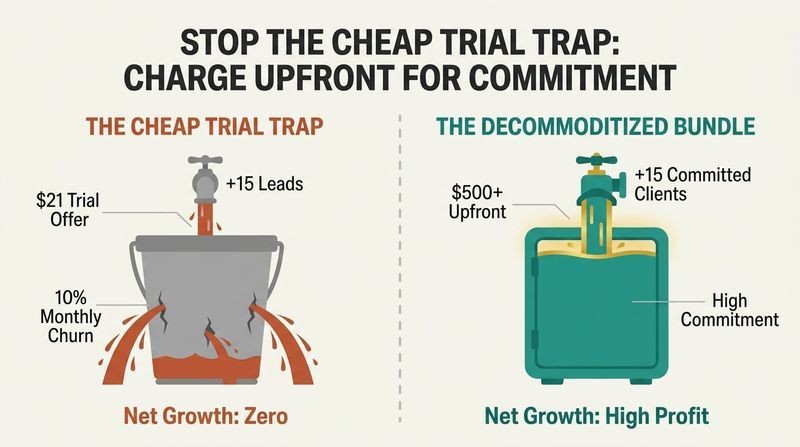
The cheap-offer trap drains gyms dry. Hormozi opens with the math that kills most gyms: you run a $21-for-21-days promotion, get 100 leads, sell 30 trials, convert half to members, and end up with 15 new members. But over the six weeks the campaign runs, normal 10% monthly churn eats roughly 15 of your existing members. Net growth: zero. Cost: over $1,000 and your sanity.
The fix is decommoditization. When you compete on price, customers compare you to every other gym and pick the cheapest. Instead, bundle your services into an irresistible offer (Hormozi's favorite is a free six-week challenge priced at $500-$600 that refunds money if the client hits their goal) so unique that price comparison becomes impossible. Premium pricing funds everything else.
The zero-sum churn math is the book's most clarifying contribution, because it reframes acquisition as a leaky-bucket problem rather than a volume problem. The decommoditization logic echoes Blue Ocean Strategy: escape competition by making the comparison irrelevant. One caveat worth flagging: a free-if-you-fail guarantee works partly because most buyers never claim refunds (loss aversion and sunk-cost effects keep them paying), which means the offer's economics depend on predictable human irrationality. That is ethically fine when the service genuinely helps, but operators should remember the model assumes the gym actually delivers results, not just collects deposits.
Make customers pay for their own acquisition, then never budget for ads
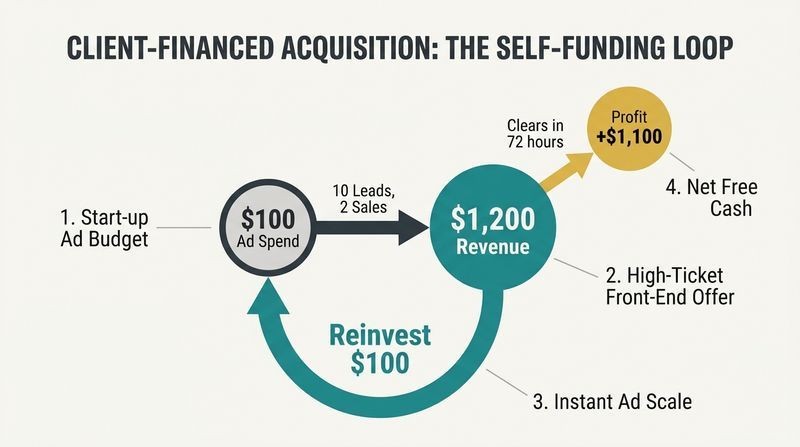
Client-financed acquisition flips the funnel. Big-box chains like LA Fitness can lose money for a year because private-equity money funds them. Microgyms cannot play that game. Hormozi's solution: charge enough up front that front-end sales exceed ad costs immediately. His example: spend $100/day on ads, get 10 leads at $10 each, close 2 at $600. That is $1,200 from $100, a 12-to-1 return.
The result is a negative acquisition cost. Once payment processors release funds (usually 72 hours), every new campaign pays for itself plus profit. You stop spending until you run out of cash and start spending until your gym physically fills up. Hormozi compares it to a casino where you only gamble with winnings. He spends roughly $100K monthly testing 150+ ads across markets to find the few winners.
This is the engine of the whole book, and it is genuinely powerful: a self-funding growth loop removes the capital constraint that strangles small operators. The principle generalizes far beyond gyms. Any business that can front-load revenue (high-ticket offers, deposits, prepayments) gains a structural advantage in customer acquisition, a point Hormozi later built his entire $100M Offers thesis around. The honest tension is that this depends on a high enough close rate and average order value to clear ad costs on day one. In thin or skeptical markets, that math gets fragile, which is precisely why his team tests at industrial scale before handing winners to clients.
The set is the close: book same-day appointments and reach out 15 times
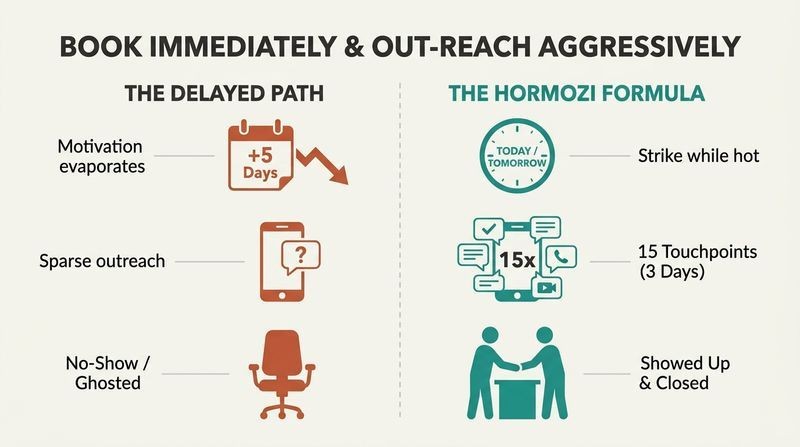
Getting leads is useless if they ghost you. A clicked ad reflects a fleeting moment of motivation that evaporates within minutes. So Hormozi insists on same-day or next-day appointments only, because show rates collapse after that. He recommends roughly 15 outreach attempts (text, call, email) over the first three days, plus daily reminders and a personalized video text the morning of the appointment.
Scarcity and urgency must be real to work. He learned this watching a traveling sales team double their numbers in the final five days of a campaign, not because of new scripts but because their conviction changed when commissions were on the line. He adds the Integrity Tie-Down: ask someone if they are a person who keeps their word, get them to agree, then hold them to the appointment. People act consistently with the identity they just claimed.
The Integrity Tie-Down is textbook Cialdini: commitment and consistency, plus self-labeling research showing people behave in line with traits they have just affirmed. The deeper insight, that genuine conviction outperforms scripting, is underappreciated in sales literature, which obsesses over words while ignoring tonality and belief. Humans are remarkably good at detecting manufactured urgency, so the advice to make scarcity true is both ethical and practical. The fifteen-touch cadence will strike some as aggressive, and in privacy-conscious markets it risks annoyance, but the underlying claim (contact frequency correlates with show rate) is well supported across direct-response industries.
Sell the vacation, not the flight, using the C-L-O-S-E-R framework
People buy outcomes, not programming. Nobody booking a trip to Maui wants to hear about TSA lines. Likewise, prospects do not care about your exercise selection or nutrition science; they want the result. Hormozi's six-step sales structure, forged over 4,000 one-on-one closes, is C-L-O-S-E-R:
1. Clarify why they came (establish the gap between current and desired state)
2. Label them with the problem you solve
3. Overview past pains and failed attempts
4. Sell them the vacation (the outcome, not the mechanism)
5. Explain away their concerns
6. Reinforce the decision and wow them
Diagnose past failures with three pillars. He shows clients that previous attempts failed because they only had one or two of fitness, nutrition, and accountability, never all three. This belief-breaking reframe makes failure not their fault, but the fault of an incomplete plan.
C-L-O-S-E-R is a clean, memorable distillation of consultative selling, and its strength is the diagnostic middle. By cataloging what a prospect tried before and why it failed, the seller manufactures both rapport and a logical reason this time will differ. The fitness-nutrition-accountability triad is a useful Schelling point, simple enough to hold in the mind during a live conversation. Critics of high-pressure sales will note that the framework optimizes for the close, not the customer's deliberation. Hormozi's defense, that indecision is itself a decision to stay unhealthy, is rhetorically clever but conveniently aligns the seller's incentive with a moral frame. Worth holding both truths.
Raise prices to start a virtuous cycle of better results and service
Most gym owners price by copying neighbors who are broke. Hormozi's blunt rule: if you do only one thing from the book, raise your prices. He frames it as two cycles. In the vicious cycle, lower prices reduce client emotional investment, perceived value, and results, while the cheapest clients demand the most and starve the business of money to serve them. In the virtuous cycle, higher prices increase investment, value, results, and the owner's ability to overdeliver.
Premium pricing is how you actually help people. When his client Kirk Huggins tripled prices to $150/month in a depressed market, the gym swung from losing $2,000/month to netting $4,000, in one week. People do not value what they do not pay for, and they will not give you their time until they give you their money. Recommended ranges: $167-$225/month for large group, $500-$700 for semi-private.
The price-value feedback loop has solid grounding in behavioral economics. The placebo and expectancy literature shows that people who pay more for an identical product report better outcomes, and higher financial commitment raises adherence (the sunk-cost effect working in the customer's favor). The claim that cheap clients are the neediest is widely observed by service operators and consistent with research on entitlement. The blind spot is selection: premium pricing also filters the customer base toward the affluent and motivated, which inflates results independent of any virtuous cycle. Part of what Hormozi attributes to price may actually be the higher-quality cohort that price selects for.
Pull price, capacity, and overhead levers all at once for a fast turnaround
There are only three ways to grow any business: acquire more clients, increase average purchase, or get people to buy more often. Within those, Hormozi identifies three macro profit levers. Price levers cover pricing, membership tiers, and billing cycle. Capacity levers squeeze more revenue from your square footage. Overhead levers cut waste.
The big moves are concrete and combinable. Switch from monthly billing to weekly or 28-day cycles (the year has 13 four-week periods, instantly adding roughly 8% revenue and aligning inflow with biweekly payroll). Sell weekly amounts ($49/week sounds cheaper than $211/month) but bill every 28 days to cut admin work. Cut sessions to hit an 80% service margin. His rule: cut once, cut deep, pulling every lever in a single week. A typical struggling gym can swing from breakeven to $77,000-$140,000 added annual profit.
The billing-cycle arbitrage is the cleanest free lunch in the book: the gap between how humans perceive weekly versus monthly amounts, combined with the calendar's hidden thirteenth period, is pure framing exploited responsibly. This is the same psychological lever insurers use when they quote coverage per day. The 80% service margin as a North Star is a useful operating heuristic that forces discipline most passion-driven owners avoid. The cut-once-deep advice is shrewd change management, concentrating customer backlash into one painful window rather than dragging it out. The risk is overconfidence: pulling every lever simultaneously also means you cannot isolate which change caused which result if something breaks.
Kill unlimited memberships; capacity hides where you least expect it
One jump rope can strangle a gym. Hormozi tells of a 3,000-square-foot gym convinced it could only fit 14 people per class. The bottleneck was double-unders, a jump-rope exercise that needs huge space and trips beginners. Swap space-hungry exercises for compact ones, pair clients up (one rests while one works, doubling capacity), tear out the office and sell from a cubicle, and run 45-minute back-to-back sessions instead of 60-minute sessions with breaks.
Unlimited access destroys value and capacity. Anything unlimited is perceived as worthless (there is no unlimited personal training). Switch members to 3x/week scheduled sessions, call them sessions not classes, and ask new sign-ups for the least-popular time slots first. This one change can double how much a facility earns overnight while improving accountability, since scheduled commitments get kept.
The jump-rope parable is a vivid lesson in constraint theory: Goldratt's Theory of Constraints argues a system's throughput is governed by a single bottleneck, and that resolving it often requires no new resources, just attention. Hormozi's operators repeatedly mistook a self-imposed exercise choice for a fixed physical limit. The unlimited-equals-worthless claim is sharp and mostly right, though it inverts the buffet logic that gyms historically used (sell unlimited, bet on non-attendance). The crucial difference is the business model: big-box gyms profit from people who pay and never show, while microgyms profit from people who show, transform, and stay, which makes scarcity and scheduling genuinely aligned with retention.
You are not in the fitness business; you are in the accountability business
This is the book's deepest reframe. Hormozi argues you can never beat Equinox or Life Time on equipment, amenities, parking, or price. So how do you win? By realizing you sell accountability, relationship, community, and coaching. The fitness is incidental. Clients sign up for weight loss but they stay for the friendly hello, the text when they miss a workout, the handwritten card, the flowers when their mom passes.
Community by accident is not enough. Every owner thinks their community is special, but if it were, they would not bleed 10% of members monthly. In the early days you nurtured each relationship by hand. As you grew past 70-80 members, that personal attention collapsed, and new clients stopped sticking. The OGs forgive you because they got the best of you early. The job is to systematize that early-days intimacy at scale, deliberately rather than by chance.
This is the most transferable idea in the book and the one most businesses miss. It reframes a commodity product (workouts) as a relationship business (belonging), which aligns with decades of research on social connection and behavior change: people adhere to programs because of accountability and tribe, not information. The loneliness economy angle is striking, people pay therapists to be heard, and a gym that listens captures that unmet need. The challenge is operational, not conceptual: systematizing genuine care risks making it feel scripted, the very automation Hormozi warns against. The tension between systematized and authentic attention is real and never fully resolved.
Cutting churn from 10% to 3% triples every client's lifetime value
Retention is the silent multiplier. Using his pie equation (monthly sign-ups divided by churn rate equals maximum membership), Hormozi shows that halving churn doubles your ceiling just as surely as doubling sign-ups does. Dropping churn from 10% to 3% multiplies lifetime value 3.3x. Spending roughly $10/month to retain a member who then stays 33 months instead of 10 yields about $3,841 in extra revenue for $330 of effort, an 11-to-1 return.
Five horsemen of retention do the work:
1. Reach-outs: personally text every member every 14 days
2. Attendance tracking: flag anyone under 3 visits/week by Wednesday
3. Handwritten cards at signup and milestones
4. Member events every 21 days (pay the babysitter, free if they bring a friend)
5. Exit interviews that re-sell and can save half of cancellations
The lifetime-value math is the quiet heart of any subscription business, and Hormozi's pie equation makes it intuitive for non-analysts. The asymmetry he highlights, that retention and acquisition are mathematically equivalent growth levers but retention is far cheaper, is the foundational insight of modern SaaS economics (the famous finding that a 5% retention bump can lift profit dramatically). The attendance leading-indicator is especially clever: visits-per-week predicts cancellation before the customer consciously decides to quit, allowing intervention upstream. The exit interview as a re-sell using C-L-O-S-E-R is elegant, treating a cancellation as a coaching conversation. The honest critique is labor intensity; these systems demand relentless human discipline that many owners abandon.
Treat your team like gold and run three communication cadences religiously
Clients are only as happy as your team. Hormozi insists a business is a reflection of its owner, you cannot lead what you do not live. He prescribes hiring before you need the role, paying on time without exception (one late paycheck breaks trust forever), and three non-negotiable communication rhythms:
1. Daily huddles (under 10 minutes, review yesterday's numbers and client wins)
2. Weekly team meetings (tightly scripted, each role gets a time slot)
3. Weekly one-on-ones (you mostly listen and ask leading questions)
Motivate trainers extrinsically and intrinsically. Pay base plus commission on supplements, internal challenges, and 25% of semi-private revenue (a trainer can reach $42,000+/year). Then layer the six human needs: praise publicly, name a trainer of the month, buy them books and certifications, and ask what the company could do better. Clear outcomes equal motivated employees.
The treat-the-garden-not-the-machine metaphor signals a more humane management philosophy than the hard-charging sales chapters suggest, and the three-cadence system is essentially the meeting architecture popularized in Verne Harnish's Rockefeller Habits and EOS. The insight that one-on-ones are where businesses actually scale (because you grow people, not processes) aligns with research showing manager quality is the single largest driver of employee engagement. Paying trainers a revenue share on semi-privates is the smartest structural move: it converts the perennial threat of trainers poaching clients into an aligned incentive. The six-needs framing borrows from Tony Robbins and is more motivational scaffolding than rigorous psychology, but it is operationally useful.
Stack revenue streams like a wedding cake: large group, semis, supplements
Maximize profit per customer two ways. First, an accommodating buying curve: most clients spend modestly, but roughly 20% will pay 3x-5x more, so give them the chance. Second, tap multiple wallets, the same person spends on classes, supplements, apparel, and meal prep, so capture more of them. Hormozi's Wedding Cake Model has three tiers, each with icing (front-end cash) and cake (recurring revenue):
1. Large-group training ($167-$225/month recurring, $500 challenges up front)
2. Semi-private 1-on-4 ($500-$700/month, $2,000-$3,000 high-ticket programs)
3. Supplements (drop-shipped, 40-50% margin, sold as a prescription not a pitch)
Internal plays are the sprinkles. Themed campaigns to existing members (Lean by Halloween, Big Booty Bootcamp) cost nothing to market, run 90% margins, and funnel people into higher tiers. The full model can push one facility past $108,000/month.
The wedding cake is a tidy mental model for revenue diversification, and the accommodating-buying-curve insight is the most economically sophisticated idea in the book: it is price discrimination done openly and ethically, letting willingness-to-pay sort itself rather than averaging everyone to the middle (Hormozi's No Man's Land). The supplement-as-prescription tactic leans on authority bias, the same mechanism that makes patients fill prescriptions without price-shopping, which is effective but ethically loaded since the seller profits from the recommendation. Hormozi's own warning against starting five businesses is the wise counterweight: most operators lack the bandwidth, and stacking streams prematurely multiplies complexity faster than profit. The model rewards sequencing, not simultaneity.
Analysis
Gym Launch Secrets is a tactical operations manual disguised as a turnaround story, built from Hormozi's experience scaling six gyms and then consulting 1,500+ others. Structurally it is framework-driven, organized around three diagnosed problems (broken acquisition, broken profit model, the hole-in-the-bucket of churn) plus a capstone revenue model. Its difficulty for a summarizer is density: the book is wall-to-wall numbers, scripts, and micro-tactics, with the front third consumed by testimonials and the back third by a sales-objection appendix. The challenge is extracting durable principles from a sea of gym-specific arithmetic.
What elevates the book above niche how-to is that its best ideas are domain-agnostic. Client-financed acquisition (front-load revenue so growth self-funds), the price-value virtuous cycle, the lifetime-value-over-acquisition retention math, and the accommodating buying curve are general business principles that Hormozi later abstracted into his more famous Acquisition.com work. This text is essentially the prototype, where the ideas are still wearing their gym clothes. Reading it now, one sees the laboratory in which a billion-dollar operator first systematized his thinking.
The intellectual through-line is a refusal to compete on price and a relentless focus on unit economics. Hormozi's contrarian core, that work ethic will not save you and that gym owners fail from business illiteracy rather than laziness, is both compassionate and bracing. His most profound reframe, that gyms sell accountability and belonging rather than fitness, connects commerce to the loneliness epidemic and behavior-change science.
The book's blind spots are worth naming. It optimizes aggressively for the close, and its ethical defenses (indecision is a decision, charge more to help more) conveniently align profit with virtue. Premium pricing's results may owe as much to customer selection as to any psychological cycle. And the systems demand a discipline most owners abandon. Still, as a coherent, tested, self-funding growth machine, it delivers exactly what it promises.
Review Summary
Gym Launch Secrets receives mostly positive reviews, with readers praising its practical advice for gym owners and entrepreneurs. Many find value in the book's strategies for increasing profits, sales techniques, and business model optimization. Some readers appreciate its applicability beyond the fitness industry. However, a few criticize the book for being too number-heavy or not aligning with larger gym models. Overall, reviewers commend the author's generous sharing of information and consider it a valuable resource for those in the fitness business.
People Also Read









FAQ
What's Gym Launch Secrets about?
- Business Growth Focus: Gym Launch Secrets by Alex Hormozi is a guide for gym owners to build profitable fitness businesses, focusing on client acquisition, retention, and revenue maximization.
- Core Challenges: It addresses three main issues: broken acquisition systems, flawed revenue models, and high attrition rates, offering solutions to these challenges.
- Practical Frameworks: The book provides tested frameworks and systems, emphasizing accountability, community, and high-quality service for client retention.
Why should I read Gym Launch Secrets?
- Proven Strategies: The book offers methods that have led many gym owners to financial success, based on real-world experience.
- Comprehensive Approach: It covers all aspects of running a gym, from marketing to client retention, making it useful for both new and experienced owners.
- Actionable Advice: Readers receive steps and templates that can be immediately implemented to enhance business operations and profitability.
What are the key takeaways of Gym Launch Secrets?
- Client-Financed Acquisition: Introduces high-ticket front-end offers to cover marketing costs and generate cash flow.
- Retention Systems: Details processes and strategies to reduce churn and increase client lifetime value.
- Wedding Cake Model: Describes a multi-tiered revenue model to maximize profitability through diverse service offerings.
What is the Wedding Cake Model in Gym Launch Secrets?
- Multi-Tiered Revenue Structure: Consists of large group training, semi-private sessions, and supplement sales, each with front-end and recurring revenue components.
- Maximizing Customer Value: Allows gym owners to maximize profit per customer by catering to different spending levels.
- Sustainable Growth: Helps create a business that generates consistent revenue while providing client value.
How does Hormozi suggest acquiring clients in Gym Launch Secrets?
- High-Ticket Offers: Emphasizes creating compelling offers that attract clients and cover marketing costs.
- Client-Financed Acquisition: Ensures revenue from front-end offers exceeds client acquisition costs, allowing more marketing spend.
- Effective Marketing Strategies: Includes social media campaigns and referral programs to convert leads into paying clients.
What are the Five Horsemen of Retention mentioned in Gym Launch Secrets?
- Reach-Outs/Touch Points: Regular communication with clients to maintain engagement and show value.
- Attendance Tracking: Identifies at-risk clients for proactive re-engagement.
- Handwritten Cards: Personalized notes to enhance client loyalty and celebrate milestones.
- Member Events: Social events to build community and encourage client engagement.
- Exit Interviews: Gather feedback from departing clients to improve the gym experience.
What is the significance of client retention in Gym Launch Secrets?
- Cost-Effectiveness: Retaining clients is more cost-effective than acquiring new ones, increasing lifetime value.
- Community Building: Fosters a sense of community, leading to higher satisfaction and loyalty.
- Sustainable Growth: Effective retention strategies ensure business growth and profitability in a competitive market.
What are some effective sales techniques from Gym Launch Secrets?
- Assumed Close: Leads conversations as if the prospect has already decided to buy, reducing hesitation.
- Value Proposition: Clearly articulates how the service solves problems and improves lives.
- Overcoming Objections: Provides strategies to address common objections, guiding prospects through decision-making.
What are the best quotes from Gym Launch Secrets and what do they mean?
- “You are NOT in the fitness business. You are in the accountability business.”: Highlights the importance of relationships and accountability for client retention.
- “If you do not have this portion of your business dialed in, systematized, and laid out with intention, you will FAIL.”: Stresses the need for clear systems for retention and community building.
- “You can’t just start at month 10, silly.”: Emphasizes investing in retention strategies from the start.
How can I implement the strategies from Gym Launch Secrets in my gym?
- Start with Client Acquisition: Create high-ticket offers to attract clients and cover marketing costs using the client-financed acquisition model.
- Focus on Retention: Implement the Five Horsemen of Retention to keep clients engaged and satisfied.
- Utilize the Wedding Cake Model: Structure services around this model to maximize revenue streams and provide client value.
What are the three main problems identified in Gym Launch Secrets?
- Broken Acquisition Systems: Many gyms struggle with ineffective client acquisition strategies.
- Flawed Revenue Models: Revenue models often fail to maximize profitability and sustainability.
- High Attrition Rates: High client turnover is a common issue, impacting long-term success.
What is client-financed acquisition in Gym Launch Secrets?
- High-Ticket Offers: Focuses on creating offers that generate immediate cash flow to cover marketing expenses.
- Revenue Exceeds Costs: Ensures that the revenue from these offers surpasses the cost of acquiring new clients.
- Sustainable Marketing: Allows gym owners to invest more in marketing, driving growth and profitability.
About the Author



Download PDF
Download EPUB
.epub digital book format is ideal for reading ebooks on phones, tablets, and e-readers.








































