


Key Takeaways
Whatever your mind decides is true, it quietly hunts for proof
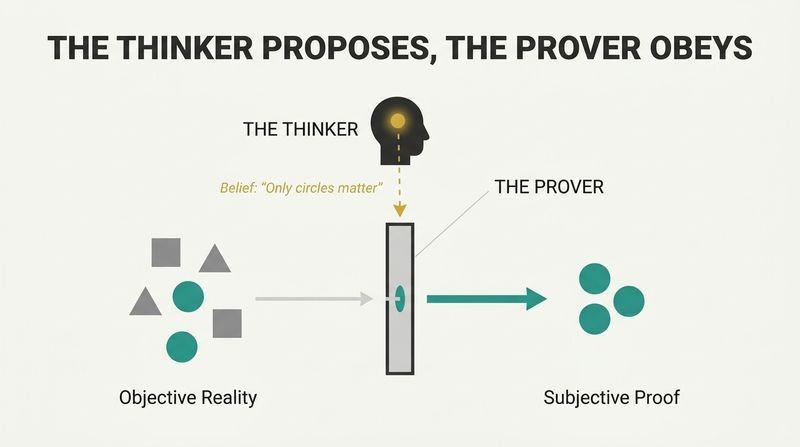
The Thinker proposes, the Prover obeys. Borrowing from Leonard Orr, Wilson splits the mind into two engines. The Thinker can believe anything: the Earth rides on turtles all the way down, Jews are rich, holy water heals lumbago. The Prover then obediently organizes every perception to confirm it. Believe you are ugly and boring, walk into a party, and people treat you accordingly. Believe you are witty and irresistible, and the room rearranges itself.
Even scientists are not immune. Edison insisted alternating current was deadly out of jealousy toward Tesla. Three labs proved LSD damaged chromosomes while three proved it did not. Objectivity is a group achievement of scientific method over generations, never a private possession of any individual brain.
This is essentially confirmation bias promoted to a governing law of consciousness, decades before it became a psychology-textbook staple. What Wilson adds is the unsettling reflexive twist: it is easy to spot the Prover running in other people and nearly impossible to catch it in yourself. Modern research on motivated reasoning and predictive processing (the brain as a prediction machine that treats sensory data as evidence for its existing models) strongly supports him. The practical leverage is real: if beliefs are self-fulfilling, deliberately installing a generous, optimistic belief is not naive, it is strategic. The risk is relativism, which Wilson courts on purpose.
You never touch reality, only your brain's heavily edited highlight reel
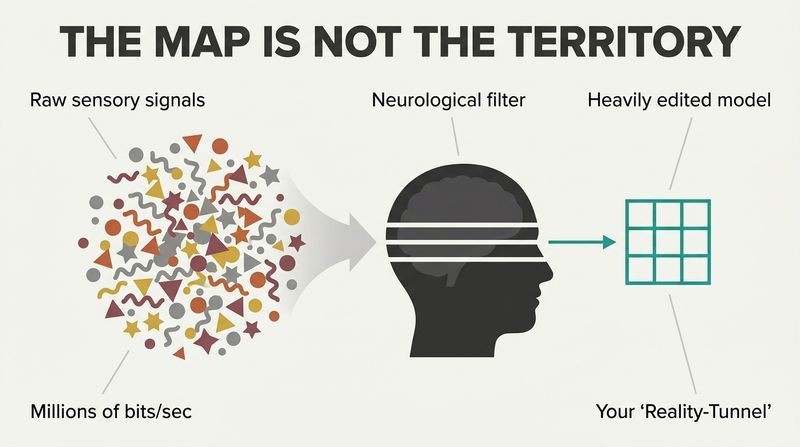
The map is not the territory. Wilson leans on semanticist Alfred Korzybski: what you experience is a model your nervous system builds from a flood of raw signals, not the world itself. The menu is not the meal. Light hits your retina upside down and your brain flips it, edits it, labels it, and files it, running roughly 100 million operations a minute below awareness.
Hence neurological relativism. A vegetarian and a butcher do not see the same slab of meat. A racist does not see the same person the victim's mother sees. Each of us lives inside a private reality-tunnel, a personalized construction as idiosyncratic as a fingerprint. Communication fails so often because we assume everyone inhabits the single objective world we mistake our tunnel for.
Wilson's reality-tunnel anticipates constructivist cognitive science and the enactivist view that perception is active interpretation, not passive reception. The concept overlaps with Thomas Kuhn's paradigms and the anthropological insight that culture filters what counts as real. The danger, which critics rightly press, is sliding into an anything-goes relativism where a flat-earther's tunnel and a physicist's are merely different tastes. Wilson hedges: tunnels differ in usefulness and predictive power even if none is final. The empowering read is epistemic humility as a skill. Cromwell's plea echoes here: think it possible you may be mistaken. Few habits improve thinking more.
Your mind runs on eight circuits, and most people only boot up four
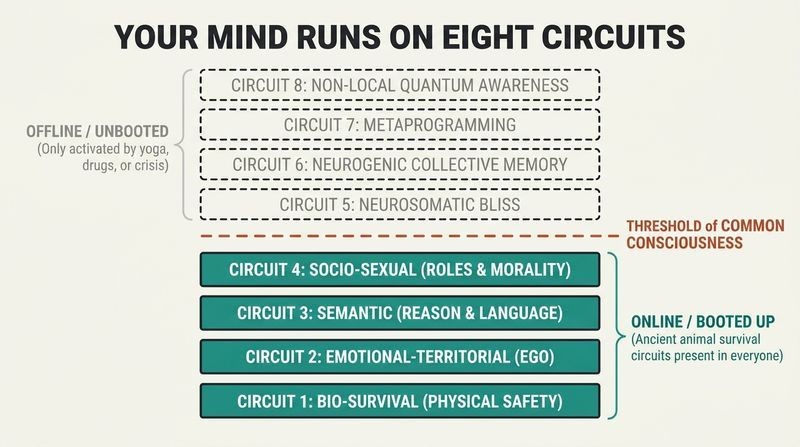
The brain as an eight-program bio-computer. Adapting Timothy Leary, Wilson maps consciousness onto eight neural circuits. The first four are ancient, shared with other animals, and present in nearly everyone:
1. Bio-survival (approach the nourishing, flee the threatening)
2. Emotional-territorial (dominance, submission, ego, pecking order)
3. Semantic (language, tools, maps, reason)
4. Socio-sexual (adult roles, morality, reproduction)
The next four are newer and rarer, activated by yoga, drugs, shock, or crisis: neurosomatic bliss, neurogenetic collective memory, metaprogramming, and non-local quantum awareness. Wilson insists this is a map for convenience, expecting a better one within fifteen years. The point is not literal neuroanatomy but a diagnostic ladder for understanding why people behave as they do.
The eight-circuit model has no standing in mainstream neuroscience as literal brain architecture, and Wilson knows it, repeatedly flagging it as a provisional map. Read as metaphor rather than anatomy, it is a surprisingly useful developmental typology, rhyming with Maslow's hierarchy, Freud's oral-anal-genital stages (which Wilson explicitly folds in), and Piaget's cognitive stages. Its distinctive contribution is placing so-called mystical states on the same continuum as digestion and status anxiety, refusing to quarantine transcendence as supernatural. The lower four circuits stand on solid ethological ground; the upper four are speculative frontier. Treat the ladder as a lens, not a lab result.
A single vulnerable moment can hardwire you for life
Imprints are software that becomes hardware. At specific windows of neural vulnerability, the brain grabs whatever is present and stamps it in permanently. Konrad Lorenz's gosling imprinted a ping-pong ball as mother and spent adulthood trying to mate with round white objects. An orphaned giraffe imprinted the jeep that killed its mother, following and nuzzling the machine.
Humans are no different, only slower and more complex. Each circuit has its imprint moment: the nursing infant bonds bio-survival to the mother, the toddler wires emotional dominance or submission, the adolescent's first orgasm often fixes lifelong sexual triggers. These imprints, laid down by accident, override later conditioning and learning. This is why 85 percent of Americans in a 1968 survey carried symptoms of anxious first-circuit wiring: dizzy spells, palpitations, nightmares.
Ethology's imprinting is real and Nobel-worthy, though Wilson stretches it further than the evidence strictly licenses, especially the claim that a single adolescent event fixes sexual orientation. Contemporary developmental science favors sensitive periods that are influential but more plastic than his language suggests, and neuroplasticity research shows adult brains rewire more than mid-century models assumed. Still, the core insight endures: early experience carves deep channels, trauma imprints somatically (echoing Bessel van der Kolk's body-keeps-the-score findings), and much adult behavior is accidental wiring mistaken for fixed identity. The liberating corollary, that imprints laid down by chance can be deliberately re-imprinted, is Wilson's whole therapeutic wager.
In a money economy, cash is your umbilical cord to survival
Money replaced the tribe as the bio-survival lifeline. Ancient humans hooked their survival circuit to the gene-pool, the pack, the extended family. Exile meant death, which is why banishment terrified people through Shakespeare's day. Modern humans hook that same primal circuit to abstract tickets called money. Lose the tickets and infant-grade panic floods the body instantly.
The data is chilling. Economist C.H. Douglas charted interest rates against suicide rates from 1812 to 1932, and the two curves nearly overlapped. When interest rose, businesses failed, jobs vanished, survival anxiety spiked, and people killed themselves. Welfare, socialism, and totalitarianism are all clumsy attempts to make the State stand in for the vanished tribe, which is why the dependent feel perpetually paranoid about being cut off.
Reframing money as a bio-survival object rather than a rational medium of exchange dissolves a lot of mystery around financial panic, hoarding, and status spending. It converges with behavioral economics showing that loss aversion and scarcity distort cognition (Mullainathan and Shafir's work on how poverty itself taxes bandwidth). Wilson's provocative move is diagnosing anti-Semitism and conspiracy theory as first-circuit paranoia about who controls the survival tickets. The Douglas correlation is suggestive but dated and vulnerable to confounds, so treat it as illustration, not proof. His prescription, abundance-through-technology rather than redistribution-through-coercion, reflects his libertarian streak and remains genuinely contested.
Most personalities plot onto a grid of dominance and warmth
Two circuits, four quadrants. Combine the bio-survival axis (approach or retreat) with the territorial axis (dominance or submission) and you get four durable personality types, which Wilson traces from medieval humors through Leary's 1957 interpersonal grid:
1. Friendly Strength (the beloved leader, the Lion)
2. Friendly Weakness (the compliant follower, the Angel)
3. Hostile Weakness (the resentful complainer, the Bull)
4. Hostile Strength (the domineering boss, the Eagle)
Strand four such people on an island and the outcome is predictable as chemistry: the two strong types fight to lead, the friendly weakling happily follows whoever wins, and the hostile weakling complains endlessly while dodging responsibility. The tragedy is that none of them recognize their behavior as robotic, blaming circumstances instead.
This maps almost exactly onto the interpersonal circumplex still used in personality psychology, where agency (dominance) and communion (warmth) are the two master axes, and it prefigures modern frameworks from the DISC model to attachment styles. Wilson's value-add is Nietzsche: the top row is master morality, the bottom row slave morality, and the friendly weakling harbors disguised hostility (the passive-aggressive, the resentment Nietzsche diagnosed in conventional piety). The ideal he sketches is not a fixed quadrant but a mobile center, a mandala able to move into any quadrant as circumstances demand. That flexibility, not a single virtuous type, is the sign of an un-robotized person.
To reprogram a mind, first reduce it to a helpless infant
Brainwashing follows one reliable recipe. Whether it is the U.S. Army, the SLA that turned heiress Patty Hearst into bank-robber Tania in 57 days, or a cult, the method is identical. First, strip the subject of the old world: the naked physical exam, the ride in the trunk, isolation from every prior bond. This triggers infant-grade first-circuit helplessness. Then the captor becomes the new mothering figure, especially by controlling food.
Next, attack the ego and rebuild it. Break second-circuit status until submission feels sincere, install a new semantic reality complete with deliberate nonsense (rules that violate common sense) to wall the convert off from outsiders and forge group solidarity. Wilson's dark punchline: the easiest way to get brainwashed is simply to be born into a culture.
Wilson's schema anticipates Robert Cialdini on commitment and consistency and Robert Lifton's classic study of thought reform, which independently identified milieu control, loaded language, and demand for purity. The insight that captives bond with captors is now textbook Stockholm syndrome. His most subversive equation, that normal socialization and cult indoctrination differ in degree rather than kind, is philosophically bracing and empirically defensible: children absorb their parents' religion and politics through the same imprint mechanisms. The nuance he underplays is that ordinary enculturation usually leaves exit doors open, while coercive cults weld them shut. Degree can matter enormously.
Honest communication only flows freely between equals
The SNAFU Principle, or Celine's Law. In any hierarchy shaped like a pyramid, information warps as it climbs. Underlings carry a burden of nescience: they must report only what pleases the person holding the gun, the pink slip, or the court-martial. So the powerful, saddled with a burden of omniscience, receive only flattering confirmation of what they already believe. Over time the whole structure goes clinically brain-dead, knowing nothing real.
Secrecy accelerates the rot. A secret police must be watched by a second secret police, which must be watched by a third, an infinite regress. Stalin executed three secret-police chiefs in a row. The pursuit of total national security produces national insecurity and universal paranoia, because everyone has rational grounds to suspect everyone else of lying.
This is a sharp organizational-behavior insight dressed as satire. It aligns with what management scholars call the CEO information bottleneck and with research showing that psychological safety, the freedom to speak uncomfortable truth upward, is the single strongest predictor of high-performing teams (Amy Edmondson's Google-validated work). Wilson generalizes it into political theory: surveillance states blind themselves precisely by demanding loyalty over accuracy. The claim that communication is possible only between equals is an overstatement he admits softening, since useful information does move across power gradients when trust or incentives align. But as a warning about how hierarchy corrupts feedback loops, it is durable and widely underappreciated.
You can seize the controls and reprogram your own nervous system
Become the metaprogrammer. Wilson's seventh circuit is the brain becoming aware of itself, the painter who paints himself painting himself, endlessly. Once you grasp that your reality-tunnel is your own creation, you can revise it deliberately instead of running inherited software on autopilot. John Lilly's formula: in the province of the mind, what you believe true becomes true within limits, and those limits are themselves further beliefs to be transcended.
A practical drill: the Magic Computer. Imagine an omniscient computer that answers any question but shuts down if you harbor doubt. Start small (your second-grade teacher's name), then feed it metaprogramming commands like I am at cause over my body, or ask it to translate an enemy into their own reality-tunnel so you see yourself as they do.
Strip away the sci-fi framing and this is a rigorous cognitive-behavioral technique: beliefs are editable, and installing empowering premises changes outcomes because the Prover gets to work. It anticipates the visualization and self-efficacy research of Albert Bandura and the reframing core of NLP and CBT. The Magic Computer is a clever cognitive prosthesis, externalizing self-talk so doubts register as commands not to answer. The honest caveat Wilson himself supplies: try to fly by willing it and you will be disappointed. Metaprogramming reliably alters interpretation, mood, and behavior; it does not suspend physics. Knowing which limits are beliefs and which are walls is the whole art.
Human knowledge is doubling faster every decade, and that is cause for hope
Intelligence is accelerating, not decaying. Wilson stacks up the futurists. Henry Adams guessed energy use climbs by an inverse-square law. Korzybski named time-binding, our species' unique power to pass information across generations so each builds on the last. Economist Georges Anderla measured it: the knowledge humanity held at year 1 took 1,500 years to double, but by the 1960s it was doubling every seven years, then every few months.
This is Prometheus rising. Wealth, Wilson argues, is not land or labor but coherent ideas (negative entropy) generated by nervous systems. Chemist Ilya Prigogine showed that highly complex, unstable systems are mathematically more likely to leap to higher order than to collapse. The odds, Wilson insists, favor the utopians. Stupidity, like poverty and death, is becoming obsolete.
Wilson's exuberant techno-optimism is his signature and his biggest liability. Some forecasts landed (networked computers, longevity research, the information explosion); the timelines for immortality and space migration by the 2010s did not. His deeper argument, grounded in Prigogine's genuine Nobel work on dissipative structures, is more defensible: complex systems far from equilibrium can reorganize upward rather than disintegrate. But complexity also breeds fragility, and the twentieth century supplied ample counter-evidence that accelerating capability amplifies destruction (illth, in his Ruskin-borrowed term) as readily as flourishing. The honest position, which Wilson grants in fine print, is probabilistic hope, not destiny. Read as an antidote to fashionable doom, it bracingly reframes acceleration as opportunity.
Reading about consciousness changes nothing; only the exercises rewire you
The lab is your own nervous system. Wilson ends every chapter with exercizes and warns that the book is useless without them, because you never truly understand anything by reading about it. Just as chemistry demands lab work, brain-change demands practice done in the only laboratory available: your own skull.
The drills are deliberately destabilizing. Spend a week believing everyone likes you and watch how people respond. Subscribe to a magazine from the political tribe you despise and inhabit its reality-tunnel for an hour a month. Convince yourself you are dull, go to a party, observe the results, then reverse it. Practice pranayama breathing to dissolve grief and anger. The goal is not agreement with Wilson but flexibility: proving experientially that your reality is editable.
This experiential imperative is what separates Prometheus Rising from armchair philosophy and aligns it with contemplative traditions that always paired doctrine with practice, from yoga to Zen to the Jesuit spiritual exercises. It also prefigures the experimental self-tracking of the quantified-self movement and the exposure techniques of clinical psychology, where behavior change precedes belief change rather than following it. The pedagogical wager is sound: embodied experiments produce insight that argument cannot. The obvious caution is that some drills court genuine instability (deliberately inducing paranoia or believing you can levitate), and Wilson's playful tone can undersell the value of a guide. Still, the principle that knowledge without practice is inert is unimpeachable.
Analysis
Prometheus Rising is a guerrilla-ontology self-help manual disguised as neuroscience, disguised as a doctoral dissertation, disguised as a stand-up routine. Robert Anton Wilson takes Timothy Leary's eight-circuit model and welds it to Korzybski's semantics, Freud's developmental stages, Nietzsche's master-slave morality, Gurdjieff's mechanical man, ethology, quantum physics, and cybernetics. The synthesis should not cohere, yet it does, held together by one relentless thesis: human beings are programmable robots who can, with effort, seize the console and reprogram themselves. What makes the book hard to summarize is that its content and its method are inseparable. Wilson does not want assent; he wants you destabilized. The exercizes are the argument.
The book's enduring strength is its psychological realism about self-deception. The Thinker-Prover loop, the reality-tunnel, the SNAFU Principle, and the four-quadrant grid have all been independently validated under other names by confirmation-bias research, constructivist cognition, organizational psychology, and the interpersonal circumplex. Wilson was a gifted popularizer who arrived early. His weakness is calibration. The upper four circuits rest on anecdote, drug experience, and mysticism rather than evidence, and his 1980s-90s predictions about imminent immortality and mass space migration read as period optimism. He also flirts with a relativism that, taken literally, would corrode the very scientific method he praises.
Read correctly, though, Prometheus is not a set of claims to believe but a set of tools to try, which is exactly how Wilson framed it: model agnosticism, not belief. Its lasting gift is a stance. Treat your convictions as provisional software, your identity as an accident of imprinting that can be revised, and your future as something you compose rather than inherit. In an age of algorithmic reality-tunnels and tribal certainty, that invitation to radical mental flexibility feels less like a countercultural relic than an urgent survival skill.
Review Summary
Prometheus Rising received mixed reviews, with many praising its mind-expanding concepts and witty writing style. Readers found the book thought-provoking and potentially life-changing, appreciating Wilson's synthesis of various disciplines. However, some criticized its dated predictions, pseudoscientific claims, and lack of coherence. The eight-circuit model of consciousness was central to the book's ideas, though opinions varied on its validity. Many readers recommended the book for its unique perspective on human consciousness and potential, while others found it frustrating or difficult to follow.
People Also Read









FAQ
What's Prometheus Rising about?
- Exploration of Consciousness: Prometheus Rising by Robert Anton Wilson explores the eight-circuit model of consciousness, detailing how different brain circuits influence human behavior and perception.
- Neurosociological Framework: The book presents a framework for understanding how societal conditioning affects individual consciousness, emphasizing the interplay between personal beliefs and societal norms.
- Utopian Vision: Wilson suggests humanity is on the brink of an evolutionary leap, proposing that understanding and reprogramming our consciousness can lead to greater freedom and creativity.
Why should I read Prometheus Rising?
- Unique Perspective: The book combines humor, philosophy, and science, making complex ideas accessible and engaging, encouraging critical thinking about personal beliefs and societal conditioning.
- Practical Exercises: It includes exercises designed to help readers explore their consciousness and reprogram thought patterns, promoting active participation.
- Cultural Relevance: Themes of consciousness, societal control, and personal liberation are increasingly relevant, offering insights into modern challenges and the nature of reality.
What are the key takeaways of Prometheus Rising?
- Eight-Circuit Model: Introduces a model categorizing different aspects of human experience and behavior, each circuit representing a different way of processing information.
- Thinker and Prover: Discusses how beliefs shape reality, with the Thinker generating thoughts and the Prover seeking evidence to confirm them, often leading to self-fulfilling prophecies.
- Mindwashing and Reprogramming: Explores techniques for mindwashing and brain programming, emphasizing the potential for individuals to rewire their consciousness for greater self-awareness and empowerment.
What are the best quotes from Prometheus Rising and what do they mean?
- "All that we are is the result of all that we have thought.": Highlights the power of thought in shaping reality, suggesting beliefs and perceptions directly influence experiences and actions.
- "Whatever the Thinker thinks, the Prover will prove.": Emphasizes the relationship between belief and reality, indicating thoughts can create experiences, reinforcing the importance of positive beliefs.
- "We are all giants, raised by pygmies, who have learned to walk with a perpetual mental crouch.": Critiques societal conditioning that limits potential, suggesting conformity to norms often stifles true capabilities and creativity.
What is the eight-circuit model of consciousness in Prometheus Rising?
- Basic Structure: Divides human consciousness into eight circuits, each representing different functions and experiences, from basic survival instincts to higher cognitive and spiritual functions.
- Evolutionary Perspective: Reflects both evolutionary history and potential for future development, suggesting access to higher circuits allows for greater awareness and creativity.
- Practical Application: Serves as a framework for understanding personal development and societal influence, helping individuals work towards reprogramming for improved mental and emotional health.
How does Prometheus Rising address societal conditioning?
- Cultural Influence: Discusses how societal norms shape individual consciousness, often leading to conformity and limitation, emphasizing the need to challenge these factors for personal freedom.
- Mind Control Techniques: Explores techniques used by governments and institutions to manipulate perception and behavior, empowering individuals to resist and reprogram beliefs.
- Call for Awareness: Advocates for increased awareness of societal conditioning's effects on thoughts and actions, encouraging individuals to reclaim autonomy and creativity.
What exercises are included in Prometheus Rising?
- Practical Engagement: Includes exercises designed to help readers explore consciousness and apply discussed concepts, encouraging active participation and self-reflection.
- Mind-Body Connection: Focuses on the mind-body connection, emphasizing physical awareness in mental processes, fostering a deeper understanding of oneself.
- Reprogramming Techniques: Provides techniques for reprogramming thought patterns and beliefs, allowing experimentation with different perceptions of reality.
What is the significance of the "Thinker" and "Prover" in Prometheus Rising?
- Cognitive Framework: The "Thinker" generates thoughts and beliefs, while the "Prover" seeks evidence to support them, illustrating how perceptions shape reality.
- Self-Fulfilling Prophecies: The Prover finds evidence to confirm the Thinker's beliefs, leading to self-fulfilling prophecies, highlighting the importance of positive beliefs.
- Awareness of Thought Patterns: Understanding these roles helps individuals become more aware of thought patterns and their impact, crucial for personal growth and transformation.
How does Prometheus Rising relate to modern psychology and neuroscience?
- Integration of Disciplines: Integrates psychology, neuroscience, and philosophy to create a comprehensive understanding of consciousness, enriching the discussion with a broader context.
- Neuroscience Insights: Reflects contemporary insights into brain function and consciousness plasticity, aligning with modern neuroscience's understanding of neural pathways.
- Psychological Techniques: Techniques like reprogramming resonate with current psychological practices for personal development and mental health, making it a valuable resource for self-improvement.
What are the implications of the Utopian vision presented in Prometheus Rising?
- Potential for Human Evolution: Suggests humanity is on the verge of an evolutionary leap driven by increased awareness, inspiring hope for a more enlightened future.
- Responsibility for Change: Emphasizes individuals' power to shape reality and contribute to societal transformation, encouraging proactive engagement in growth.
- Caution Against Complacency: Warns against complacency and societal conditioning dangers, stressing continuous self-exploration and reprogramming to realize Utopian potential.
How does Prometheus Rising relate to personal growth?
- Self-Discovery: Provides a framework for understanding oneself and motivations, offering insights into behaviors and thought patterns through the eight circuits.
- Empowerment: Encourages taking control of mental programming to actively shape reality, crucial for personal development and achieving goals.
- Practical Techniques: Exercises serve as tools for transformation, helping break free from limiting beliefs and enhancing overall well-being.
What methods does Wilson suggest for achieving higher consciousness in Prometheus Rising?
- Meditation and Yoga: Emphasizes practices like meditation and yoga to quiet the mind and access higher consciousness, detaching from lower circuit anxieties.
- Neuropharmacology: Discusses using substances like psychedelics to expand consciousness and explore reality-tunnels, advocating responsible use for personal insight.
- Meta-Programming: Introduces meta-programming to reprogram mental circuits for greater flexibility and awareness, leading to profound perception shifts.
About the Author



Download PDF
Download EPUB
.epub digital book format is ideal for reading ebooks on phones, tablets, and e-readers.








































