
Key Takeaways
Find the vital 2.5% of effort that drives 95% of body change
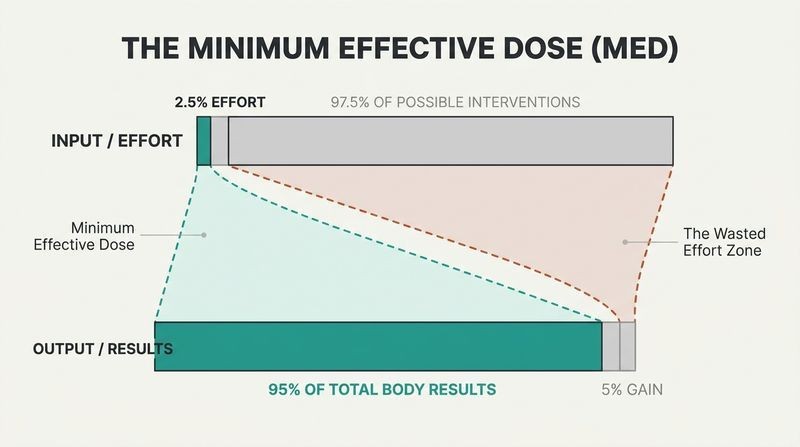
Minimalism beats maximalism. Ferriss frames the entire book around the Pareto principle taken to an extreme: roughly 2.5% of possible interventions deliver 95% of results in reshaping the body. Just as learning 2,500 high-frequency Spanish words (2.5% of the language) gets you to 95% conversational comprehension, a handful of precise levers reshape your physique.
The Minimum Effective Dose (MED) is the operating principle. Coined via exercise pioneer Arthur Jones, MED means the smallest input that triggers the desired outcome. Water boils at 212F; more heat wastes fuel. For muscle, 80 seconds of tension at the right load can trigger growth as surely as an hour-long routine. Exceeding your MED in biological systems can stall progress for weeks. The challenge is resisting the urge to do more.
The MED concept echoes pharmacology's dose-response curve and lean manufacturing's waste elimination, giving it credibility beyond fitness. What's striking is how it inverts the Protestant work-ethic assumption that more effort equals more virtue. Behavioral economists would note it also reduces decision fatigue: fewer levers mean higher adherence. The weakness is that biology varies enormously between individuals, and Ferriss himself is an n-of-1 experimenter, not a controlled trial. The 2.5% figure is rhetorically punchy but not empirically derived. Still, as a heuristic against overtraining and program-hopping, MED is genuinely useful and aligns with research showing single-set-to-failure protocols rival multi-set routines for hypertrophy.
Track something, anything, or your program will quietly collapse
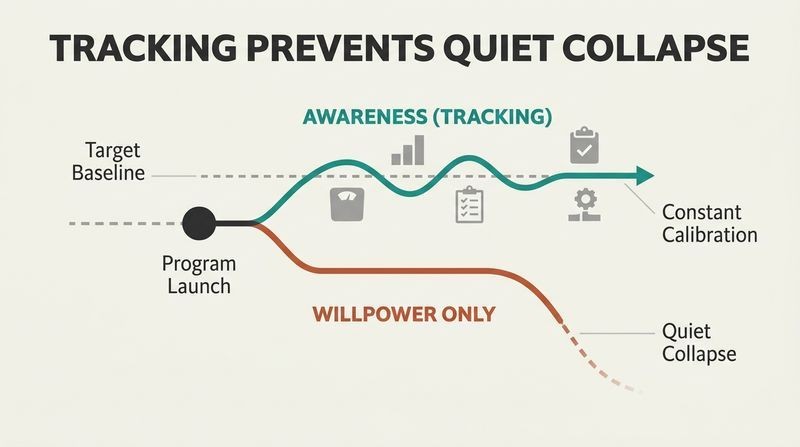
Awareness beats willpower. Ferriss argues people fail at change for two reasons: insufficient pain (no emotional trigger) and no tracking. He calls the emotional trigger a Harajuku Moment, named after programmer Chad Fowler's epiphany in Tokyo when he heard himself say his looks were hopeless and realized he had surrendered control of his health while succeeding everywhere else.
Measurement creates behavior change even without intent. Evernote CEO Phil Libin lost 28 pounds over six months doing nothing but weighing himself daily and plotting the trend against a target line in a spreadsheet. He deliberately did not change diet or exercise. The Nike+ team found runners who logged five sessions got hooked permanently. Photograph your meals before eating, take unflattering before-photos, and use the scale plus a tape measure, since muscle gain can mask fat loss.
This is the book's most transferable insight and dovetails with the modern Quantified Self movement, which Ferriss helped popularize. The Hawthorne Effect (workers improve when observed) explains why measurement alone shifts behavior, and Libin's spreadsheet is essentially self-surveillance. Research on food journaling confirms trackers lose roughly twice the weight of non-trackers. The caution: tracking can tip into obsessive quantification and orthorexia for some personalities. Ferriss also conflates correlation and causation in Libin's case, since a person motivated enough to weigh in daily likely makes unconscious better choices. Still, the principle that you cannot manage what you do not measure is robust across domains.
Eat the same slow-carb meals daily and binge one day a week
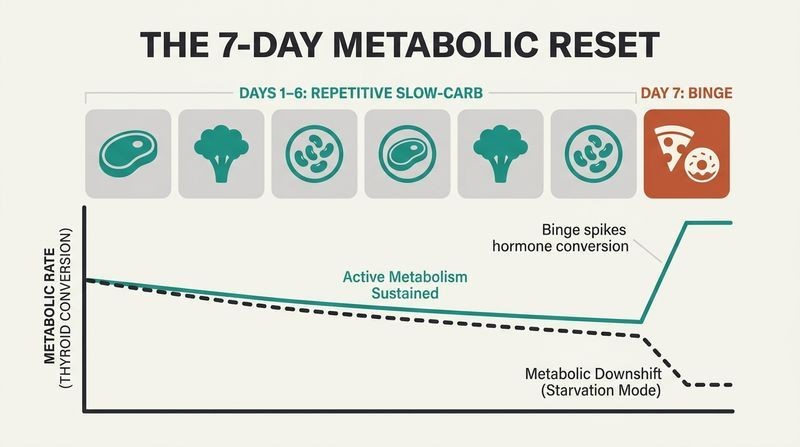
Five rules, no counting. The Slow-Carb Diet averaged 19 pounds of fat loss per follower. The rules: avoid white carbohydrates (bread, rice, potatoes, pasta), eat the same few meals built from protein, legumes, and vegetables, don't drink calories, skip fruit six days a week, and take one full cheat day. No calorie counting required.
The weekly binge is a feature, not a cheat. Spiking calories dramatically once a week prevents the metabolic downshift (reduced thyroid conversion of T4 to T3) that sabotages sustained dieting. Get 30 grams of protein within an hour of waking. Legumes supply calories that vegetables lack, preventing the low-energy quitting spiral. The diet is engineered for adherence over optimization, since a decent method you follow beats a perfect method you abandon.
The slow-carb approach is essentially a low-glycemic, high-satiety diet dressed in memorable rules, and its power lies in reducing choice rather than any metabolic magic. The cheat-day rationale (leptin restoration) has some support: short-term overfeeding does raise leptin, though whether weekly refeeds meaningfully accelerate fat loss in non-lean people is debated. The repetition principle is underrated: decision fatigue research shows fewer food decisions improve compliance dramatically. The gap is nutritional variety and the fruit ban, which many nutritionists would challenge given fruit's fiber and micronutrients. Ferriss's own data is self-reported and survivorship-biased, a limitation he candidly flags in his bad-science chapters.
Blunt fat storage during a binge with fructose, cinnamon, and air squats
Damage control turns gluttony into science. Ferriss consumed over 6,200 calories in 12 hours and lost bodyfat over the following 48 hours by manipulating three variables. First, minimize insulin spikes using small doses of fructose (grapefruit juice), cinnamon, lemon juice, and supplements that boost insulin sensitivity. Second, speed gastric emptying with caffeine and yerba mate so food passes through less absorbed. Third, do 60-90 seconds of muscular contraction (air squats, wall presses) right before and after eating.
The mechanism is GLUT-4. Brief intense contraction recruits glucose transporters to the surface of muscle cells, opening gates so calories flow into muscle instead of fat. A Japanese rat study showed 280 seconds of high-intensity training raised GLUT-4 nearly as much as six hours of endurance work.
The GLUT-4 translocation science is real: exercise-induced glucose uptake operates through a partly insulin-independent pathway, which is why activity before carb-heavy meals matters. Ferriss's extrapolation from rodent studies and self-experiments to precise protocols is where rigor thins. The gastric-emptying claim (that speeding transit reduces absorption) is biologically plausible but modest in effect, and his poo-weighing evidence is charming but crude. What's genuinely useful is the reframe that timing and pre-meal movement can shift nutrient partitioning. The ancient Chinese proverb about walking 100 steps after meals turns out to have a mechanistic basis. Readers should treat the specific supplement stack as optional flourish rather than essential.
Gain 20-plus pounds of muscle on two 30-minute workouts a week
Occam's Protocol strips lifting to essentials. Ferriss gained 34 pounds in 28 days on four hours of total gym time by doing one set to true failure per exercise, using a slow 5/5 cadence (five seconds up, five seconds down) to eliminate momentum. Just two primary lifts per workout, alternating A and B sessions.
Recovery time must grow with size. The counterintuitive rule: as you get bigger and stronger, train less often, not more. Repair systems don't scale as fast as muscle, so rest days increase from two to twelve between identical workouts. Failure means you literally cannot move the weight, not stopping when it gets hard. Eating is the real work: overfeed aggressively, adding milk (GOMAD, a gallon a day) if gains stall. Most people who fail to grow simply undereat.
The one-set-to-failure, low-frequency approach descends from Arthur Jones and Mike Mentzer's High Intensity Training, and a 2004 research review Ferriss cites found single sets rival multiple sets for hypertrophy. Modern volume-focused hypertrophy research (Schoenfeld and others) complicates this, showing higher weekly volume generally produces more growth, so Occam's Protocol likely underperforms for advanced lifters. But for beginners and time-constrained people, the effort-to-result ratio is excellent, and the insight that intensity of effort can substitute for volume is well-supported. The recovery-scaling principle is astute and often ignored. The extreme overfeeding advice risks fat gain, which Ferriss acknowledges but somewhat downplays.
Manipulate cold exposure to burn fat like a human space heater
Heat, not just exercise, is a fat-loss lever. Former NASA scientist Ray Cronise realized Michael Phelps burned 12,000 calories partly because water conducts heat 24 times faster than air. Adding cold exposure to a standard diet tripled his weekly fat loss, from 1.48 to 4.77 pounds. The physics: the body is an open thermodynamic system that sheds calories as heat, a variable diet books ignore.
Brown fat burns to warm you. Cold stimulates brown adipose tissue (BAT), a mitochondria-rich fat that dissipates calories as heat rather than storing them. Practical protocols: ice packs on the neck and upper back for 20-30 minutes, drinking ice water on waking, cold showers, or shiver-inducing ice baths. Cold showers also treat depression and improve immunity.
The thermogenesis angle is scientifically legitimate and has since gained mainstream traction through researchers like Wim Hof collaborators and studies confirming cold-activated BAT in adults via PET scans. Ferriss was early here. The caveat is dose-response: the actual caloric cost of brief cold exposure is small (his own math shows about 15 grams of fat per two-hour immersion), so the dramatic results Cronise saw likely involved additional mechanisms like adiponectin signaling and appetite effects, which Ferriss honestly notes don't fully add up. Cold exposure is a real but modest metabolic tool, best viewed as an adjunct. The depression-treatment claim rests on small studies and deserves cautious optimism.
Never blame your genes; muscle fiber and predisposition are reprogrammable
Predisposition is not predestination. Ferriss's DNA test showed he lacked the ACTN3 gene variant for fast-twitch muscle and his enzyme profile scored below a couch potato, yet he repeatedly gained 20-plus pounds of muscle. Kenyan marathon dominance was assumed to be slow-twitch genetics, but biopsies revealed high fast-twitch fiber; their edge came from low-mileage, high-intensity training.
The lever is behavior and environment. Human Genome Project leader Eric Lander stresses that a genetic component does not make a trait unchangeable. Fat parents may pass on overeating behavior rather than fatness genes (fat people tend to have fat pets). Messenger RNA can be switched on and off by environment. The practical takeaway: stop using bad genetics as an excuse, because feeding and training can redirect your born profile.
This is an empowering and largely accurate counter to genetic fatalism, aligning with epigenetics research showing gene expression responds to environment, exercise, and diet. The Kenyan fiber-type finding is a useful myth-buster. However, Ferriss overcorrects: genetics absolutely set ranges and ceilings for muscle mass, height, and response variability, as twin studies on training response (the HERITAGE study) clearly demonstrate. Some people are hyper-responders and some are non-responders to identical programs. The honest framing is that genes load the gun and lifestyle pulls the trigger, and that most people are nowhere near their genetic ceiling, so the excuse is premature. As motivation against learned helplessness, the message lands.
Two exercises plus a lean diet build visible abs, not endless crunches
The standard crunch is nearly useless. After a decade of conventional ab work with no visible six-pack, Ferriss got results in three weeks with two moves done twice weekly. The myotatic crunch uses the fully stretched range of motion (over a ball) rather than the half-range of floor crunches, leveraging the stretch reflex for stronger contraction. The cat vomit exercise targets the transverse abdominis, the deep corset-like muscle whose fibers run horizontally.
Abs are made in the kitchen. Visible abs require sustained bodyfat of 12% or less, which no amount of ab exercise achieves without diet. EMG data shows bicycle crunches activate the rectus abdominis 248% more than traditional crunches. For women, timed planks are preferred over resistance ab work to avoid thickening the waist.
The core message (abs are revealed by low bodyfat, not built by high crunch volume) is nutritionally sound and worth repeating, since spot reduction is a persistent myth. The transverse abdominis focus reflects legitimate physical-therapy thinking about deep-core stabilization, popularized by researchers like Stuart McGill, though McGill would caution against spinal-flexion crunches entirely for back health, favoring planks and anti-rotation work. Ferriss's stretch-reflex rationale for the myotatic crunch is plausible but not rigorously tested. The EMG activation percentages are real but activation does not perfectly equal growth. The practical synthesis (get lean, do a couple of targeted moves) is correct even if the exercise selection is debatable.
Strength is a skill you can rapidly learn, not just muscle you grow
Technique unlocks hidden strength. Kettlebell expert Pavel Tsatsouline took a stuck lifter from 53 to 72 pounds overhead in five minutes through tension techniques alone. Sprint coach Barry Ross builds athletes who deadlift double their bodyweight on under 15 minutes of lifting per week, using heavy low-rep sets kept under 10 seconds to avoid lactic acid buildup and fatigue.
Lift heavy but not hard. The rule of 10 reps: pick two or three compound lifts, train three times weekly, do sets of two or three reps totaling about 10 reps per lift, never train to failure, and rest five minutes between sets. Strength for athletes must not interfere with sport practice, so the goal is leaving the gym fresher, not exhausted. More support force from stronger muscle equals faster running.
The neurological view of strength (that early gains come from improved motor-unit recruitment and coordination, not muscle growth) is well-established exercise science, which validates the skill framing. Ross's low-fatigue, high-frequency model contrasts sharply with Occam's Protocol's failure-based approach, exposing a productive tension in the book: hypertrophy and maximal strength are trained differently. This distinction is real and important. The under-10-seconds rule to minimize lactate is sensible for athletes who must recover daily. What Ferriss captures well is that for sport, strength is a means, not an end, and that grinding to failure can be counterproductive. Charlie Francis's never-max philosophy with Ben Johnson exemplifies elite practice.
Fix injuries by correcting movement imbalances before drugs or surgery
Attack in order: movement, manipulation, medication, surgery. After a $10,000 injection disaster that gave him a staph infection, Ferriss found that the cheapest interventions worked best. Postural correction (Egoscue method), removing shoe heels for flat or minimalist shoes, and soft-tissue work reversed years of chronic pain.
Imbalance, not weakness, causes most injury. Gray Cook, injury specialist to NFL teams and special forces, argues strength should never exceed stability. His Functional Movement Screen identifies left-right asymmetries. The Critical Four corrective exercises (chop and lift, Turkish get-up, single-leg deadlifts) fix these. Muscles can be neurologically switched off: one therapist quadrupled Ferriss's rotator-cuff strength in five minutes by reactivating a dormant muscle. Active-release technique and biopuncture eliminated six-year-old shoulder pain in single sessions.
The escalation ladder (try conservative, reversible interventions before invasive ones) is sound medical logic and mirrors evidence-based physical therapy, where movement retraining often outperforms surgery for conditions like meniscus tears and shoulder impingement. Cook's stability-over-strength principle is widely respected in athletic training. The muscle-inhibition and reactivation claims (AMIT) are more contested and lack strong peer-reviewed support, bordering on the placebo-prone. Biopuncture's homeopathic lineage makes its mechanism dubious, and Ferriss himself expresses skepticism while reporting results, a tension he handles honestly. The barefoot-shoe evidence has grown since publication but remains mixed. The durable lesson: chronic pain is often a movement-pattern problem, not a tissue-damage problem requiring the knife.
Reverse-engineer any skill by copying the outliers, not the textbook
Deconstruction beats convention. Ferriss learned to swim after a lifetime of failure using Total Immersion, cutting his strokes per length from 25 to 11 by focusing on staying horizontal and rolling side to side rather than kicking harder. He held his breath 3:33 after David Blaine's 15-minute lesson, having never exceeded a minute. He raised off-bat ball speed 35% in 45 minutes with baseball coach Jaime Cevallos.
Look in uncommon places. Ferriss positions himself as a dark horse who pulls from disciplines that rarely touch: bodybuilders knew testosterone chemistry doctors didn't; a homeless man's garlic tip informed a fat-loss stack. Those closest to a problem often can't see it fresh. Progress flows from challenging basic assumptions rather than accepting one-size-fits-all rules that were never field-tested for exceptions.
This meta-skill (rapid skill acquisition through deconstruction and modeling elite performers) is arguably the book's most valuable export and became the spine of Ferriss's later work. It resonates with expertise research: deliberate practice targeting specific sub-skills, and the finding that novices improve fastest by mimicking correct patterns rather than self-discovering. The cross-disciplinary arbitrage insight parallels innovation research showing breakthroughs cluster at field boundaries. The risk is dangerous overconfidence, especially with the breath-holding and self-injection experiments, where Ferriss nearly harmed himself and issues genuine warnings. The dark-horse framing also underweights the value of accumulated professional consensus. Used wisely, though, deconstruction plus outlier-modeling is a legitimately powerful learning accelerant.
Interrogate every study: percentages, controls, and self-reported data lie
Learn the Big Five red flags before trusting any health claim. First, relative changes (a 20% improvement) hide trivial absolute changes. Second, observational studies show only correlation, never causation; hormone replacement therapy looked heart-protective in observation but harmful in controlled trials. Third, self-reported food surveys are wildly inaccurate, as in the $415-million Women's Health Initiative. Fourth, diet studies rarely have true control groups because changing one macronutrient forces changes in others. Fifth, funding sources bias findings, as when a Harvard nutrition chair defended sugar while funded by Coca-Cola.
Understand p-values and survivorship bias. A p-value under 0.05 means under 5% chance the result was random luck. Fooled-by-randomness errors abound: 23 people at a party have a 50% chance of sharing a birthday.
This scientific-literacy toolkit, co-written with physician Ben Goldacre, is the book's intellectual backbone and its most broadly applicable content, transcending fitness entirely. The correlation-causation distinction and survivorship bias (invisible dropouts inflating success rates) are exactly the errors that make nutrition journalism unreliable. What's admirable is that Ferriss applies these tools to critique his own self-experiments, conceding they lack controls and randomization. The obvious irony, which he embraces, is that a book of n-of-1 anecdotes teaches you to distrust weak evidence. His resolution (self-experimentation is for generating actionable hypotheses for yourself, not proving universal truths) is philosophically defensible and pragmatically honest. In an era of health misinformation, this chapter alone justifies the book.
Analysis
The 4-Hour Body is best understood not as a fitness manual but as an anthology of applied contrarianism, structured around a single meta-thesis: the human body responds to precise, minimal inputs, and the conventional wisdom about which inputs matter is largely untested folklore. Ferriss occupies an unusual epistemic position, the self-described dark horse who is neither doctor nor scientist but a meticulous data-cruncher with elite access. This grants him freedom to test hypotheses that credentialed professionals cannot risk, but it also produces the book's central tension: it champions rigorous skepticism (the bad-science chapters are genuinely excellent) while its evidence base is overwhelmingly n-of-1 anecdote and testimonial. Ferriss resolves this honestly by reframing self-experimentation as hypothesis-generation for the individual rather than proof of universal law.
The book's durable contributions are conceptual rather than protocol-specific. The Minimum Effective Dose, the tracking-as-behavior-change insight, the deconstruction approach to skill acquisition, and the scientific-literacy toolkit have aged far better than specific supplement stacks or the fringier injury therapies. Ferriss was genuinely early on several fronts later validated by mainstream science: brown adipose tissue thermogenesis, the value of high-intensity minimal-volume training, and the Quantified Self ethos he helped birth.
The weaknesses are equally clear. The book systematically underweights genetic variability in training response, occasionally extrapolates from rodent studies to human protocols, and includes therapies (AMIT muscle reactivation, biopuncture) with weak evidentiary support. Its survivorship-biased success data is a limitation Ferriss flags but cannot fully escape.
What makes the work transformative is its underlying philosophy of agency: the body is one of the few systems almost entirely within individual control, and controlling it produces psychological spillover into every other domain. That mind-body reciprocity, borrowed from figures like Branson, is the book's real argument. The physical is a Trojan horse for self-efficacy.
Review Summary
The 4-Hour Body by Tim Ferriss receives mixed reviews. Many readers find it informative and inspiring, praising Ferriss's unconventional approaches to health and fitness. The book's emphasis on self-experimentation and efficiency resonates with some, while others criticize its lack of scientific rigor and potential dangers. Readers appreciate the actionable advice and Ferriss's engaging writing style, but some find his claims exaggerated and his methods impractical. The book's diverse topics, from weight loss to sexual performance, elicit both fascination and skepticism, making it a polarizing yet thought-provoking read.
People Also Read







Glossary
Minimum Effective Dose (MED)
Smallest input triggering desired resultThe smallest dose or stimulus that produces a desired outcome, beyond which additional effort is wasteful or counterproductive. Borrowed from exercise pioneer Arthur Jones, it holds that just as water boils at 212F regardless of extra heat, muscle growth or fat loss can be triggered by a precise minimal input. Exceeding the MED in biological systems can stall progress for weeks.
Slow-Carb Diet
Five-rule low-carb fat-loss dietFerriss's fat-loss diet built on five rules: avoid white carbohydrates, repeat the same few meals of protein, legumes, and vegetables, don't drink calories, avoid fruit six days a week, and take one unrestricted cheat day weekly. It requires no calorie counting and is engineered for adherence, averaging 19 pounds of fat loss among followers.
Harajuku Moment
Epiphany turning wish into necessityThe decisive emotional turning point that converts a nice-to-have goal into a must-have commitment, named after programmer Chad Fowler's realization while shopping in Tokyo's Harajuku district that he had passively surrendered control of his health. Ferriss argues no amount of instruction works without this trigger, because most people have insufficient reason for sustained action.
Occam's Protocol
Minimalist muscle-building lifting programA hyper-abbreviated strength routine using one set to complete failure per exercise at a slow 5/5 cadence, just two primary lifts per workout, with rest days that increase as the lifter grows larger and stronger. Designed to trigger maximal muscle growth on under 30 minutes of gym time per week, paired with aggressive overfeeding.
GLUT-4
Muscle glucose transporter opened by contractionGlucose transporter type 4, a protein that moves to the surface of muscle cells to let glucose in. Brief intense muscular contraction recruits GLUT-4 through a partly insulin-independent pathway, so exercising just before and after eating can shunt calories preferentially into muscle instead of fat. Central to Ferriss's binge damage-control strategy.
Brown Adipose Tissue (BAT)
Fat that burns calories as heatA mitochondria-rich, iron-containing type of fat that dissipates energy as heat rather than storing it, derived from the same stem cells as muscle. Cold exposure stimulates BAT to burn glucose and fat for warmth and may increase its amount. Once thought absent in adults, it was later confirmed via PET imaging in the neck and upper chest.
Functional Movement Screen (FMS)
Test identifying movement imbalancesGray Cook's series of movement tests that identify left-right asymmetries and motor-control problems that predict injury risk. Based on the principle that imbalance, not weakness or tightness, most commonly causes injury, and that strength should never exceed stability. Low scores correlate with substantially higher injury rates among athletes.
Total Immersion
Efficiency-focused freestyle swimming methodA swimming technique associated with coach Terry Laughlin that emphasizes reducing drag by staying horizontal and rolling from side to side, rather than propelling through arm-pulling and hard kicking. Ferriss used it to overcome a lifelong fear of swimming, cutting his strokes per length from over 25 to 11.
Cevallos Swing Rating (CSR)
Baseball swing power-and-consistency metricA number coined by hitting coach Jaime Cevallos measuring the quality of a baseball swing at the point of impact, calculated from the elbow angle and the wrist-to-bat angle. A high CSR indicates a tighter, more powerful swing with a longer contact window, correlating strongly with elite hitting performance.
Damage Control
Minimizing fat gain during bingesFerriss's protocol for eating large quantities without fat gain, built on three principles: minimizing insulin release with fructose, cinnamon, and lemon juice, speeding gastric emptying with caffeine and yerba mate, and performing brief muscular contractions before and after meals to activate GLUT-4 transporters.
FAQ
What's The 4-Hour Body about?
- Comprehensive Guide: The 4-Hour Body by Timothy Ferriss is a detailed manual for achieving rapid fat loss, muscle gain, improved sexual performance, and enhanced overall health.
- Self-Experimentation Focus: The book emphasizes self-experimentation, encouraging readers to track their own results and adjust methods based on personal data.
- Diverse Topics: It covers a wide range of topics, including fat loss, muscle gain, sleep optimization, injury recovery, and sexual enhancement.
Why should I read The 4-Hour Body?
- Transformative Results: Readers can expect significant changes in body composition and overall health by following the methods outlined in the book.
- Unique Approach: Ferriss challenges conventional wisdom about diet and exercise, offering alternative methods that are often simpler and more effective.
- Practical and Accessible: The book is filled with practical tips and easy-to-follow advice, making it accessible for anyone, regardless of their fitness level.
What are the key takeaways of The 4-Hour Body?
- Minimum Effective Dose: Ferriss introduces the concept of achieving maximum results with minimal effort, applicable to both exercise and diet.
- Self-Tracking and Experimentation: The importance of self-tracking is emphasized, encouraging readers to measure progress and adjust methods based on data.
- Holistic Health Approach: The book covers interconnected areas of health, including diet, exercise, sleep, and sexual health, for overall well-being.
What is the Slow-Carb Diet in The 4-Hour Body?
- Five Simple Rules: The diet consists of avoiding white carbohydrates, eating the same meals repeatedly, not drinking calories, not eating fruit, and taking a cheat day each week.
- Focus on Protein and Legumes: Emphasizes high protein intake and legumes to maintain energy levels and promote fat loss.
- Cheat Day Benefits: Allows for indulgence once a week, preventing feelings of deprivation and potentially boosting metabolism.
How can I lose weight quickly with the Slow-Carb Diet from The 4-Hour Body?
- Adhere to Diet Rules: By eliminating white carbohydrates and focusing on protein and legumes, you can create a calorie deficit while feeling satisfied.
- Incorporate Resistance Training: Short, intense workouts focusing on compound movements can maximize muscle gain and fat loss.
- Utilize PAGG Stack: A combination of supplements suggested to enhance fat loss by improving insulin sensitivity and promoting fat oxidation.
What is Occam's Protocol in The 4-Hour Body?
- Minimalist Muscle Gain: A training regimen designed for rapid muscle gain with minimal time commitment, focusing on high-intensity, low-frequency training.
- One Set to Failure: Emphasizes performing one set to failure for each exercise to maximize muscle engagement and growth.
- Recovery Focus: Stresses the importance of recovery time, suggesting decreased workout frequency as muscle size increases.
How does Timothy Ferriss suggest improving sleep in The 4-Hour Body?
- Optimize Sleep Environment: Create a conducive sleep environment with a cool room temperature and blackout curtains.
- Pre-Sleep Routine: Establish a routine that includes winding down and avoiding screens before bed.
- Supplements and Techniques: Discusses using supplements like melatonin and techniques like cold baths to improve sleep quality.
What exercises are most effective for fat loss and muscle gain in The 4-Hour Body?
- Kettlebell Swings: Highlighted as a key exercise for building strength and burning fat, targeting multiple muscle groups.
- Compound Movements: Exercises like squats, deadlifts, and bench presses engage multiple muscle groups for effective muscle building.
- Short, Intense Workouts: Emphasizes high-intensity workouts that maximize fat loss and muscle gain through increased metabolic demand.
What is the PAGG stack in The 4-Hour Body, and how does it help with fat loss?
- Supplement Combination: Consists of Policosanol, Alpha-lipoic acid, Green tea flavanols, and Garlic extract, supporting fat loss through various mechanisms.
- Timing and Dosage: Recommended to be taken before meals and at bedtime for maximum effectiveness.
- Synergistic Effects: Designed to work synergistically, enhancing overall fat-loss effects when combined with the Slow-Carb Diet.
What is the Pose Method of Running in The 4-Hour Body?
- Biomechanical Efficiency: Focuses on running form and technique to enhance efficiency and reduce injury risk.
- Key Principles: Includes using gravity for motion, landing on the balls of the feet, and maintaining a high cadence.
- Video Analysis: Advocates for using video analysis to assess and improve running form.
How does self-experimentation work in The 4-Hour Body?
- Personalized Approach: Encourages experimenting with different diets, exercises, and supplements to find what works best for individual bodies.
- Tracking Results: Keeping detailed records of progress is crucial for understanding effective methods.
- Learning from Failures: Emphasizes learning from failures to refine strategies and improve results over time.
What are the best quotes from The 4-Hour Body and what do they mean?
- “What gets measured gets managed.”: Highlights the importance of tracking progress to make informed decisions and adjustments.
- “The minimum effective dose is the smallest dose that will produce a desired outcome.”: Encourages efficiency in diet and exercise, suggesting small, consistent changes can lead to significant improvements.
- “You can’t change your muscle fiber type? Sure you can. Genetics be damned.”: Challenges the notion that genetics solely determine physical capabilities, advocating for self-experimentation.
About the Author




Download PDF
Download EPUB
.epub digital book format is ideal for reading ebooks on phones, tablets, and e-readers.








































