

Key Takeaways
The four elements of your DNA allegedly spell God's ancient name
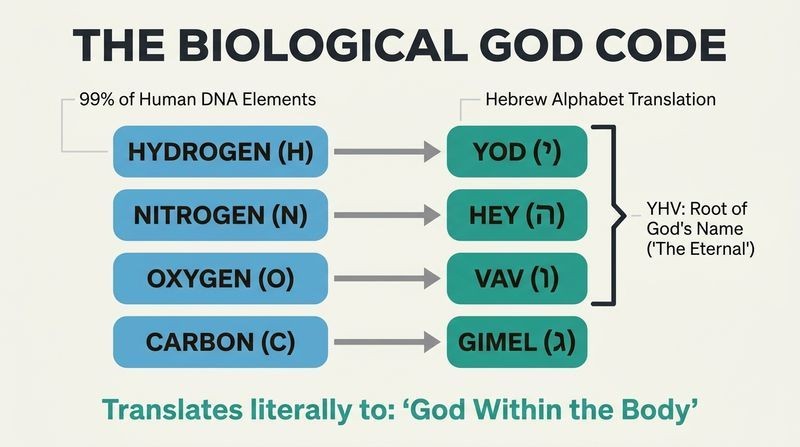
The core claim. Braden argues that hydrogen, nitrogen, oxygen, and carbon, the four elements composing over 99% of human DNA, translate directly into letters of the ancient Hebrew alphabet: Yod, Hey, Vav, and Gimel (YHVG). The first three letters form YHV, the root of YHVH, the unspeakable name God gave Moses. Read literally, the code in every cell spells a message: God, or Eternal, within the body.
Why it supposedly matters. If true, this means every human, regardless of religion, race, or belief, carries the identical divine signature. Braden frames this as tangible, verifiable proof that humanity is one family born of intentional creation. He spent twelve years, from 1990, hunting this pattern in monasteries and ancient texts, presenting it not as metaphor but as a decodable alphabet hiding in plain biological sight.
What's striking is the ambition: a single claim meant to dissolve every religious war at once. But readers should hold it at arm's length. The mapping rests on numerology, not molecular biology. DNA bases are conventionally read as adenine, thymine, guanine, and cytosine, not as raw element counts. Choosing to translate constituent atoms into Hebrew letters is an interpretive act layered onto chemistry, not a discovery within it. The idea echoes Pythagoras and Kabbalists who believed number underlies reality. Treated as poetry about shared humanity, it inspires. Treated as science, it invites the same scrutiny that undid the Bible Code craze of the late 1990s.
Reducing atomic mass to a single digit is how the code is cracked
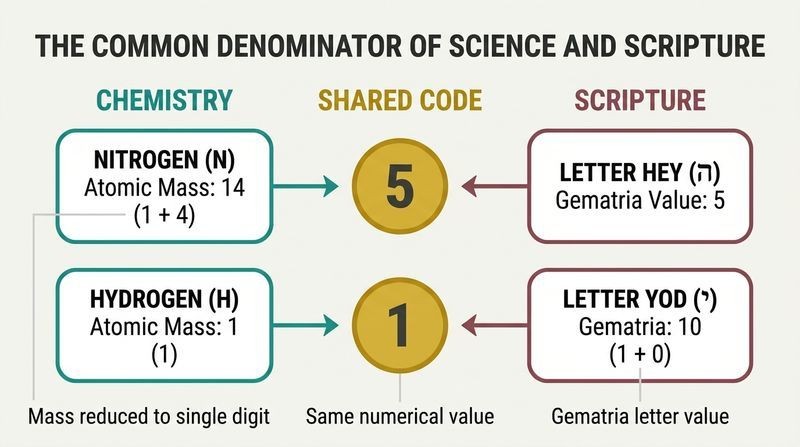
The translation engine. Braden uses gematria, the ancient practice of assigning number values to letters, as his bridge between chemistry and scripture. Each Hebrew letter carries a hidden number. Each element carries an atomic mass. By reducing masses to single digits, he claims exact matches: hydrogen mass 1 equals Yod (which reduces to 1), nitrogen 14 reduces to 5 equals Hey, oxygen 16 reduces to 6 equals Vav, carbon 12 reduces to 3 equals Gimel.
The apples-to-apples move. His argument is that comparing spirituality and science requires a common denominator, just as comparing a mile to 7,920 feet requires converting both to the same unit. Number, he says, is that shared language. He illustrates gematria first with a cleaner example: the Hebrew words for soul and Heaven both sum to 395, which he reads as proof they are the same in nature.
The method is elegant and also its own weakness. Digit-summing (called reduction) is arbitrary: why add 1 and 4 to get 5 for nitrogen? Any sufficiently flexible numerical scheme can find matches, a phenomenon statisticians call the look-elsewhere effect. Note too that YHVH contains Hey twice, yet the DNA code yields YHVG, so the match is partial and the fourth letter deliberately differs. Braden turns that mismatch into meaning (carbon makes us physical, unlike God). That is clever theology but circular reasoning. The soul-equals-Heaven example is charming, yet gematria can link almost any two words if you hunt long enough.
Ancient alchemy's Fire, Air, and Water may just be hydrogen, nitrogen, and oxygen
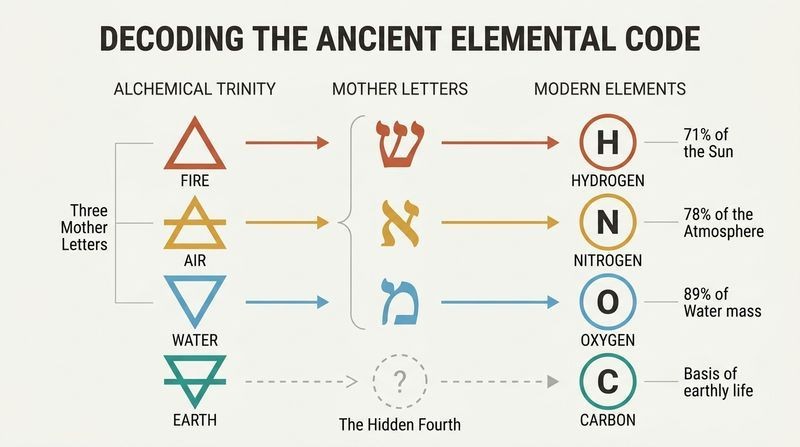
Old words, modern elements. Braden's most intriguing bridge decodes the alchemical trinity. Alchemists said the world was built from Fire, Air, and Water, with a hidden fourth element, Earth. Applying modern chemistry, he argues these are code words for elements. Air, surprisingly, is not oxygen but nitrogen, which makes up 78% of the atmosphere. Water by mass is dominated by oxygen (roughly 86% to 89%). Fire's source, the sun, is 71% hydrogen. So Fire, Air, Water, and Earth become hydrogen, nitrogen, oxygen, and carbon.
The Sepher Yetzirah connection. The ancient Hebrew Book of Creation names three Mother Letters, Alef, Mem, and Shin, and explicitly links them to Air, Water, and Fire, describing how God formed the universe from combinations of 22 letters. Braden reads this not as symbolism but as a literal recipe for creation predating modern chemistry by millennia.
The nitrogen point is a genuinely nice observation, one most people get wrong when they assume air means oxygen. But mapping four mystical categories onto four biological elements requires choosing which modern element each ancient term secretly meant, and Braden picks the ones that fit. Historians of science read Fire, Air, Water, and Earth as pre-scientific attempts to classify states and qualities of matter (hot, fluid, gaseous, solid), not encrypted atomic recipes. The Sepher Yetzirah, as scholar Karen Armstrong notes, describes creation through language symbolically. Reading it as literal chemistry is the interpretive leap the whole edifice depends on.
One shared signature could make killing over differences absurd
The peace thesis. The entire book is aimed at a single goal: giving humanity a reason to see past the divisions that fuel war. Braden opens with a grim ledger. He cites estimates that the 20th century lost between 167 and 175 million people to politically motivated violence, and that roughly 80 million died from genocide and ethnic cleansing, more than five times the combined toll of that century's natural disasters and the AIDS epidemic.
Why the code changes the math. If every enemy carries the same divine name in every cell, then wars waged in the name of God, or over bloodline and border, rest on a misunderstanding. Braden argues that inquisitions, crusades, and cleansings drew on ignorance of a common heritage. Knowing the code, he claims, makes ignorance an unavailable excuse and offers a starting point for reconciliation.
The moral instinct here is sound and moving: shared identity reduces the psychological distance that enables atrocity, an idea supported by social psychology's work on dehumanization and in-group bias. Yet history complicates the hope. People who share obvious kinship, language, and even DNA still slaughter each other; the Rwandan genocide and countless civil wars were intimate, not stranger-driven. Recognizing common humanity has rarely required molecular proof. The deeper question Braden sidesteps is motivational: violence usually serves power, resources, and fear, not simply a failure to know we are related. A beautiful fact may not disarm a determined ideology.
Our own differences, not nature, are humanity's deadliest force
The bloodiest century. Braden marshals sobering data to argue that the greatest threat to our species is ourselves. Historian Eric Hobsbawm called the 1900s the most murderous century in recorded history. The United Nations coined the term genocide in 1948 to describe the denial of an entire group's right to exist, defining five categories from mass killing to forcibly transferring a group's children.
Peace is more than the absence of war. He argues imposed peace fails. Like poking a water balloon, suppressing conflict in one region makes it bulge elsewhere. UN peacekeeping missions, 54 of them by 2002, buy time but cannot resolve the underlying hurt. True peace, he insists, forms in hearts and minds before it forms between governments. The pattern is consistent: when people dishonor life and see only difference, violence spirals.
The balloon metaphor captures something real that political scientists study as conflict displacement, where military suppression relocates rather than resolves grievance. The claim that peace must be internal before it is institutional aligns with reconciliation research from post-apartheid South Africa and Northern Ireland, where truth-telling mattered as much as treaties. Where the framing strains is causation. Attributing megadeath primarily to a failure to perceive sameness underweights the role of scarcity, propaganda, and organized power. Steven Pinker's data even argue violence has declined over centuries, suggesting institutions, trade, and norms, not metaphysical revelations, drive durable peace.
Treat evolution and creationism as incomplete, not as enemies
A hybrid origin story. Braden refuses the usual either or. He accepts deep time and the geologic record (the Earth is roughly 4.5 billion years old, humans appear around 160,000 to 200,000 years ago) while questioning whether random chemistry alone explains life. He notes puzzles: modern-looking skeletons allegedly found in ancient strata, human chromosome 2 appearing to be two fused ape chromosomes, and a 1987 study suggesting Neanderthals were not our direct ancestors.
Order implies intelligence. He leans on the scientists themselves. Francis Crick, DNA co-discoverer, called life's origin almost a miracle given how many conditions had to align. Darwin admitted the eye seemed absurd to attribute to natural selection alone. Braden's proposed synthesis keeps evolution's timeline but adds an unaccounted-for organizing force, the same intelligence he believes signed its work in our genetic code.
Quoting Crick and Darwin on the difficulty of origins is fair, but both remained committed naturalists; expressing awe at complexity is not conceding design. This is the classic argument from incredulity, where a gap in current knowledge becomes evidence for intention. Modern abiogenesis research, self-organizing chemistry, and the discovery that eyes evolved independently dozens of times have narrowed those gaps considerably. Still, Braden's instinct that rigid dichotomies obscure truth has merit. Many working biologists and theologians hold theistic evolution comfortably. The honest takeaway is epistemic humility about ultimate origins, without smuggling a predetermined conclusion into the uncertainty.
We are in technological adolescence and may not survive it
Sagan's warning, dramatized. Borrowing from Carl Sagan, Braden argues humanity has just gained godlike power (to edit genomes, alter weather, split atoms) without the maturity to wield it. Frank Drake's famous equation estimated up to 10,000 intelligent civilizations could exist, yet we detect none. Sagan's chilling hypothesis: perhaps they destroyed themselves during their own technological adolescence, and their silence is a graveyard.
A possible rehearsal in our past. Braden points to the Mahabharata, the Sanskrit epic, which describes a weapon as brilliant as ten thousand suns, boiling water, incinerating creatures, and causing hair and nails to fall out, language eerily like radiation sickness. He cites contested reports of radioactive skeletons and glassed sand near ancient Indus sites like Mohenjo Daro. His question: if a civilization annihilated itself before, are we repeating it with today's roughly 36,000 warheads?
The adolescence metaphor is genuinely useful and now central to existential-risk scholarship at institutions studying AI, biotech, and nuclear policy. Physicist Enrico Fermi's paradox (where is everybody?) makes the same unsettling point Braden dramatizes. The weakness is the ancient-astronaut evidence. The Mahabharata quotes come secondhand, the radioactive-skeleton claims trace to a single unsourced Soviet-era book that mainstream archaeology rejects, and Mohenjo Daro's decline is better explained by climate and river shifts. Braden's framing is compelling futurism weakened by fringe sourcing. The core insight stands without it: our power has outrun our wisdom, and that gap is the survival question of the century.
Cooperation, not competition, is nature's actual survival strategy
Rewriting survival of the fittest. Braden challenges the popular reading of Darwin. In his later work, The Descent of Man, Darwin wrote that the communities with the most sympathetic members flourished and raised the most offspring. Russian naturalist Peter Kropotkin, in his 1902 Mutual Aid, showed ants building roads, granaries, and shared nurseries, thriving through cooperation, not combat.
Cooperation beats conflict. Braden cites researcher Alfie Kohn, who reviewed over 400 studies and concluded the ideal amount of competition in any setting, classroom, workplace, or family, is essentially none. The lesson scales up through a tragic historical example: Chief Miantonomo of the Narragansett urged tribes to unite against colonial encroachment in 1642, foreseeing that scythes, axes, cattle, and hogs would consume native land and food. Infighting prevented unity in time, and the way of life was lost.
This corrects a real distortion. Herbert Spencer's phrase survival of the fittest was weaponized into social Darwinism, justifying inequality Darwin never endorsed. Modern evolutionary biology confirms cooperation's power through kin selection, reciprocal altruism, and multilevel selection; even bacteria and cells cooperate. Lynn Margulis showed complex cells arose from symbiosis, not conquest. Kohn's blanket anti-competition claim is more contested, since some rivalry demonstrably spurs innovation and effort. The Miantonomo story is a poignant, evidence-grounded illustration of a broader pattern: fragmented groups facing a coordinated threat lose. That lesson translates cleanly to climate, pandemics, and nuclear risk today.
Humans are fundamentally good, violent only under extremity
A species of goodness. Braden argues that beneath our capacity for cruelty lies a default kindness. Psychologist Abraham Maslow, who studied primates before turning to humans, concluded that people are all decent underneath and possess a higher nature, even amid contemporaries like Freud who saw us driven by lust and aggression. Violence, Braden contends, is what we do under threat, not what we are by nature. Serial killers and tyrants are the rare exception, not the rule.
The man on the board. In Nepal, a legless holy man rolled up to Braden on a wooden board. Assuming a beggar, Braden offered money. The man refused it and instead gestured toward a beautiful ancient temple Braden's group had walked past unnoticed. He had come not to take but to give, to share a piece of his world. The encounter reframed Braden's assumptions about need, poverty, and human nature.
The optimistic view has gained empirical backing since Braden wrote. Rutger Bregman's Humankind assembled evidence that disaster brings out cooperation, not looting, and that the infamous studies suggesting human savagery (Milgram, the Stanford Prison Experiment) were methodologically compromised. Anthropology shows most human history was cooperative small-group living. The nuance: goodness is real but fragile, and situational forces, deindividuation, dehumanizing propaganda, and obedience to authority, can flip ordinary people fast, as Hannah Arendt's banality of evil warned. Braden's beggar story is the book's most human moment, a reminder that our snap judgments about others are often exactly backward.
Use a shared, undeniable truth as the starting point for peace
Begin from common ground. Braden ends practically. He draws on indigenous conflict resolution, particularly shared-vision exercises studied among the Berber people of Morocco's M'goun Valley. Warring parties each describe what a successful resolution looks like and what failure would cost. That shared vision becomes an anchor to return to when tempers flare, giving both sides ownership of the outcome. Resolutions often close with a sulha, a public ritual of forgiveness and celebration that wipes the slate clean and makes the agreement binding.
The code as anchor. For enemies too wounded to imagine a shared future, Braden proposes the genetic message as the undeniable starting fact: both sides carry the same signature. Remarkably, he claims the code reads identically in Hebrew and Arabic, the languages of traditions descended from Abraham, offering Jews, Muslims, and Christians one common denominator that no interpretation can dispute.
The mediation techniques are the book's most durable contribution, independent of the metaphysics. Shared-vision framing anticipates modern interest-based negotiation (the Harvard Getting to Yes model) and appreciative inquiry, both of which start from desired futures rather than past grievances. Rituals of closure like the sulha map onto restorative justice practices now used in courts and post-conflict reconciliation worldwide. The Hebrew-Arabic parallel is rhetorically powerful for Abrahamic peace work, though skeptics note the number values were selected to converge. Even a reader who rejects the DNA claim can extract a real tool: conflicts resolve faster when adversaries first name what they share.
Analysis
The God Code is best understood as a work of spiritual persuasion dressed in scientific costume. Braden, a former aerospace systems designer, structures the book in three movements: a survey of human violence and the unanswered question of who we are, the central discovery that DNA elements translate to Hebrew letters spelling God's name, and an application arguing this fact can ground world peace. The genre is New Age synthesis, blending Kabbalah, gematria, alchemy, molecular biology, and astronomy.
The intellectual machinery deserves candid appraisal. The keystone claim relies on gematria and digit-reduction, techniques with no standing in chemistry or genetics. The mapping requires choosing which modern element each ancient term secretly encoded, then reducing atomic masses by an arbitrary rule until they match preselected Hebrew values. This is the signature of pattern-seeking that survives only when the analyst controls the degrees of freedom. The cited odds of 1 in 200,000 measure the wrong thing; they assume the pattern was specified in advance rather than found by searching, the same fallacy that sank the 1990s Bible Code phenomenon. That the code yields YHVG rather than the actual name YHVH is quietly turned into a feature.
Yet dismissing the book entirely misses its value. Its moral architecture is serious and its supporting scholarship (on 20th-century death tolls, Kropotkin's cooperation research, Sagan's technological adolescence, and indigenous mediation) is real and worth knowing. The underlying conviction, that emphasizing shared identity over difference reduces atrocity, is defensible on psychological grounds even without the genetic proof. Braden's genuine contribution is not the code but the reframing: cooperation as evolutionary strategy, human goodness as default, and shared vision as a peace tool. Readers get the most by treating the DNA thesis as inspirational metaphor while extracting the humanistic and practical insights. The book works far better as a plea for unity than as a scientific demonstration of it.
Review Summary
The God Code receives mixed reviews, with ratings ranging from 1 to 5 stars. Positive reviewers find the book's premise fascinating, praising Braden's research linking DNA to God's name and his message of human unity. Critical reviewers argue the science is flawed, calling it pseudoscience and lacking critical thinking. Some readers appreciate the book's spiritual aspects and potential for bridging science and faith, while others find it confusing or misleading. Overall, the book is polarizing, with readers either deeply inspired or highly skeptical of its claims.
People Also Read

FAQ
What's The God Code about?
- Exploration of Creation's Secrets: The God Code by Gregg Braden explores the idea that a universal message is embedded in our DNA, linking it to the name of God. This connection offers insights into our origins and existence.
- Unity Through Understanding: Braden suggests that recognizing this shared heritage can foster unity among humanity, transcending differences in race, religion, and culture.
- Scientific and Spiritual Intersection: The book merges scientific discoveries with spiritual insights, using ancient Hebrew texts and modern chemistry to explore our place in the universe.
Why should I read The God Code?
- Insightful Perspective: The book offers a unique perspective on the intersection of science and spirituality, valuable for those interested in both fields.
- Encourages Reflection: It prompts readers to reflect on their beliefs and the nature of creation, inspiring personal growth and understanding.
- Timely Message: In a divided world, Braden's message of unity and shared heritage is particularly relevant, reminding us of our interconnectedness.
What are the key takeaways of The God Code?
- Universal Message in DNA: The book suggests that the name of God is encoded in our DNA, indicating a profound connection between all living beings.
- Historical Context: Understanding our past is crucial for navigating our future, with ancient texts informing modern life.
- Call for Unity: Recognizing our shared origins can foster peace and cooperation among diverse groups, dissolving barriers that divide humanity.
How does The God Code link DNA to the name of God?
- Hebrew Letters and Elements: Braden explains that Hebrew letters correspond to the elements in our DNA—hydrogen, nitrogen, oxygen, and carbon.
- Mathematical Relationships: The book uses gematria to show how the letters of God's name (YHVH) align with life's elements, providing a framework for understanding language and existence.
- Message of Unity: This connection suggests we are all interconnected through a shared divine heritage, promoting peace and understanding.
What is the significance of the name YHVH in The God Code?
- Divine Representation: YHVH symbolizes the divine essence permeating all creation, not just a title but a representation of existence's fundamental nature.
- Connection to Humanity: The letters of YHVH correspond to life's elements, indicating we are made from the same divine essence, emphasizing shared humanity.
- Spiritual Implications: Understanding YHVH in our genetic code invites reflection on spiritual identity and purpose, exploring what it means to be human.
How does The God Code address the concept of creation?
- Creation as a Process: Braden views creation as ongoing, not a singular event, with humanity co-creating reality.
- Role of Humanity: Made in God's image, humanity has the power to influence the world positively and participate in creation.
- Interconnectedness of Life: Understanding our role in creation can lead to greater compassion and responsibility toward others and the planet.
How does The God Code link science and spirituality?
- Scientific Discoveries: Braden shows how modern genetics align with ancient spiritual teachings, bridging the two realms.
- Unified Field of Consciousness: The book posits a unified field connecting all beings, suggesting thoughts and emotions influence the world.
- Practical Applications: Braden offers insights on applying this knowledge to foster peace and understanding in daily life.
What are the best quotes from The God Code and what do they mean?
- “God/Eternal within the body.”: This encapsulates the thesis that the divine is embedded in us, leading to deeper self-understanding.
- “The odds that this relationship has occurred by ‘chance’ are approximately 1 in 200,000.”: Highlights the improbability of DNA's divine connection being coincidental, suggesting purposeful design.
- “We are not alone. We are here ‘on purpose,’ as the result of an intentional act of creation.”: Reassures readers of their significance, reinforcing the belief in a purposeful existence.
How does The God Code propose we apply its teachings in our lives?
- Personal Reflection: Encourages reflection on beliefs and existence, leading to personal growth and transformation.
- Fostering Unity: Insights from shared origins can promote unity and cooperation among diverse groups.
- Living with Intention: Emphasizes aligning actions with unity and interconnectedness principles for a fulfilling life.
What role does the concept of “Eternal” play in The God Code?
- Eternal Nature of God: Linked to YH, representing the timeless, unchanging divine aspect, always present and accessible.
- Connection to Humanity: The “Eternal” aspect is within each individual, inviting exploration of spiritual identity and purpose.
- Implications for Life: Inspires living with intention and purpose, transcending time and space limitations.
How does The God Code suggest we view our differences?
- Celebrating Diversity: Encourages seeing diversity as a strength, fostering appreciation and understanding.
- Unity in Diversity: Despite differences, we are connected through the same divine essence, recognizing shared humanity.
- Path to Peace: Viewing differences as growth opportunities can lead to collaboration and innovation, benefiting society.
What challenges does The God Code present?
- Overcoming Division: Suggests understanding shared origins to bridge gaps in race, religion, and culture.
- Navigating Scientific and Spiritual Tensions: Urges finding common ground between scientific and spiritual perspectives.
- Embracing Complexity: Encourages embracing complexity in topics like God, creation, and existence for personal growth.
About the Author
Other books by Gregg Braden
Download PDF
Download EPUB
.epub digital book format is ideal for reading ebooks on phones, tablets, and e-readers.








































