


Key Takeaways
Ask whether your church's sex advice actually works, then measure it
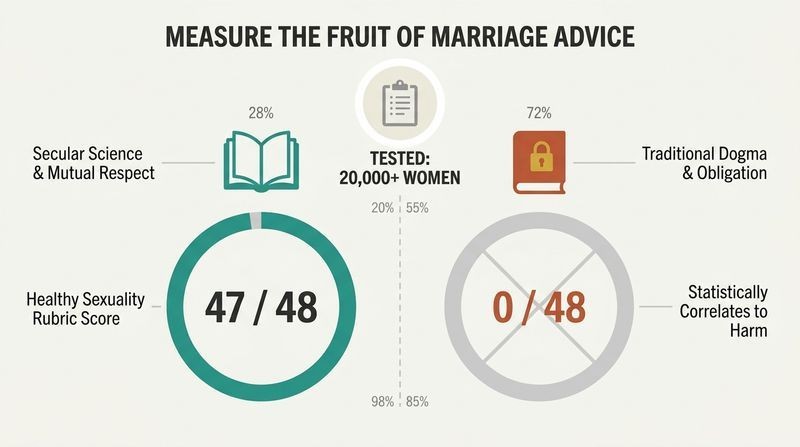
The authors, running a marriage blog with an epidemiologist on the team, noticed that bestselling Christian sex books gave advice no one had tested. So they surveyed over 20,000 women in the Bare Marriage Project, asking 130+ questions about their sex lives, marriages, upbringings, and beliefs, then scored 14 popular books against a rubric of healthy sexuality.
The results were damning. The bestselling secular marriage book (Gottman's Seven Principles) scored 47 out of 48. The bestselling Christian book, Love & Respect, scored 0. The team's thesis: well-meaning evangelical teaching has statistically worsened women's sexual and marital satisfaction. Good information alone cannot help if people simultaneously absorb harmful messages from the wider Christian culture.
What's striking is the move from anecdote to evidence in a domain usually governed by proof-texting and pulpit authority. Applying epidemiological methods to religious teaching is genuinely novel, though the sample was self-selected (recruited through blogs and influencers), which skews toward women already questioning the teachings. Correlation cannot fully establish that beliefs cause dysfunction rather than dysfunction shaping recalled beliefs. Still, the effect sizes are large enough to demand attention. The parallel is evidence-based medicine displacing folk remedies: a tradition insisting its treatments work has an obligation to check, and refusing to check is its own kind of malpractice.
Redefine sex as mutual knowing, not a husband's guaranteed climax
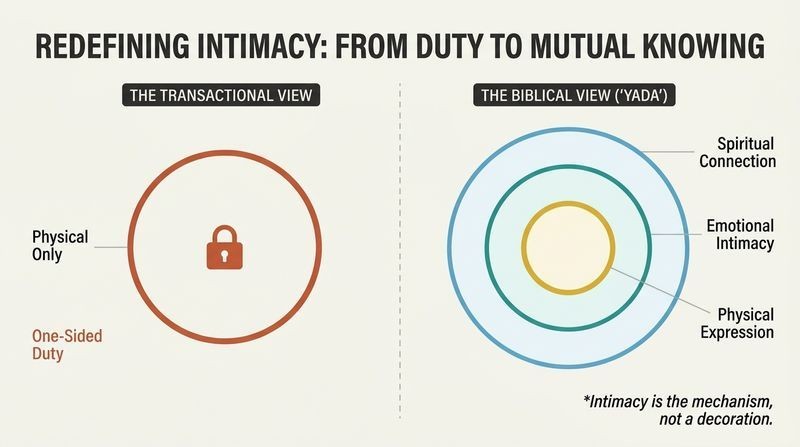
The authors argue the root problem is definitional. Most people picture sex as intercourse ending in the man's orgasm. Plug that into the most-quoted marriage verse (do not deprive each other) and you get women dutifully welcoming one-sided encounters. The Hebrew word for sex in Genesis, translated as Adam knew Eve, is the same word for God searching and knowing a heart.
They reserve the word intercourse for the one-sided physical act, and sex or making love for the full experience: spiritual, emotional, and physical knowing combined. Their data backs this up: women in the happiest 20% of marriages were four times more likely to orgasm reliably, and women satisfied with closeness during sex were five times more likely to climax. Intimacy is not decoration; it is the mechanism.
The distinction resonates with philosopher Martin Buber's I-Thou versus I-It: relating to a person as a subject versus using them as an object. The authors essentially argue much Christian sex advice accidentally trains an I-It posture. Their claim that emotional closeness drives female orgasm aligns with sex researchers like Rosemary Basson, whose intimacy-based model of female desire displaced the older linear model. One caution: correlation runs both ways. Great sex also builds closeness. The authors acknowledge you cannot manufacture intimacy in a bad marriage, which sensibly resists the trap of promising sex as a cure-all for relational rot.
Close the orgasm gap by slowing down, not making her catch up
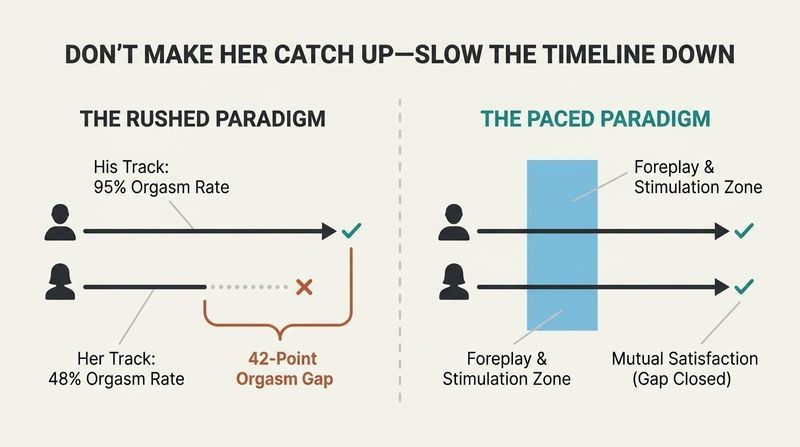
Roughly 95% of men orgasm during almost every sexual encounter; the survey found only 48% of women do. That is at least a 42-point orgasm gap. It is not a female defect: women reach orgasm in under ten minutes when masturbating. The problem is that only 39% of orgasming women get there through intercourse alone; the rest need other stimulation, and adequate foreplay made a woman 6.43 times more likely to orgasm frequently.
Older books blamed women (men orgasm more because they are more active) or chased simultaneous orgasm, which researchers call rare and overrated. The authors propose a reframe: God designed the clitoris so men must slow down and serve. No man should be satisfied unless his wife regularly is. She does not need to catch up; he needs to slow down.
The physiology is well established: the clitoris, not the vaginal canal, is the primary orgasm organ, a point popularized by researchers like Beverly Whipple and echoed in Nagoski's Come As You Are. The authors' theological framing (delayed female arousal as a divine feature that forces male unselfishness) is clever apologetics, though it risks over-reading intent into anatomy. More persuasive is the practical point: treating foreplay as the main event rather than a toll booth. The finding that 60% of women have faked orgasm underscores how ego-protection and poor communication compound the gap. The fix is behavioral and teachable, not medical.
Wait for sex until married and aroused, not just married
About half of women who were virgins on their wedding night were not aroused their first time. Arousal is the mandatory stop on the way to orgasm, like a train that cannot reach its destination without passing through the junction. Skip it and couples stall out, sometimes for decades.
The culprit is often the gatekeeper role: 81% of women believe boys will push sexual boundaries, so girls learn to be the brakes while boys enjoy the accelerator. That hypervigilant, self-monitoring stance (women called it spectator-ing) does not vanish at the altar. The authors urge couples to rediscover pressure-free arousal, essentially returning to unhurried making out with no obligation to proceed, so the body can learn to want. They also debunk the myth that not kissing before marriage is traditional: over 99% of Christian women over 60 kissed before their weddings.
The gatekeeper critique connects to research on self-objectification (Fredrickson and Roberts), where women trained to monitor how they appear to others suffer measurable declines in flow states, including sexual pleasure. Teaching girls to police male arousal produces exactly the dissociative self-watching that blocks their own. There is also a troubling safety implication the authors flag: a script assuming all boys will push boundaries normalizes coercion and leaves girls unable to recognize a partner who respects them, or to name assault when it occurs. The reframe (arousal precedes penetration, not the reverse) is simple, physiologically sound, and rarely taught.
Noticing a woman is attractive is not the same as lusting
The Every Man's Battle framework taught that all men constantly battle lust, must bounce their eyes off women, and that women should dress modestly to help. The authors distinguish seeing (involuntary), looking (deliberate but neutral), and lusting (looking to ogle and fantasize). Attraction is not sin; sustained objectifying intent is.
The data shows the all-men-lust message harms marriages. Women who believe it are 79% more likely to have obligation sex and 59% less likely to be frequently aroused. Even women who reject it, but were taught it, are 64% less likely to trust a genuinely trustworthy husband. The authors reframe the goal: not avoiding women as threats, but seeing them as whole people made in God's image. The antidote to objectification is fuller humanization, not blindness.
The pink-elephant problem the authors invoke has real cognitive backing: thought suppression research (Daniel Wegner) shows that trying not to think of something increases its salience. Hypervigilant eye-bouncing may manufacture the very fixation it fights. The framing also echoes feminist critiques that both the leering man and the eye-averting man reduce a woman to a body. One nuance worth adding: the meta-analytic evidence on whether men are actually more visually aroused than women is contested, as the authors note. Their strongest move is ethical rather than empirical, relocating responsibility from women's clothing to men's chosen intent, which aligns with how consent culture assigns agency.
You cannot cure porn addiction by having more sex
The dominant evangelical script tells wives to service husbands so they will not turn to porn, casting the woman as her husband's methadone. The authors show this backfires: women who married believing frequent sex prevents porn are 37% more likely to have obligation sex and less likely to orgasm or feel close. It also ignores that porn can wreck male libido and cause erectile dysfunction, so more sex is not even available.
Using composite couple Jared and Melissa, they trace how the message turns a wife into a receptacle, destroys her desire, and deepens the addiction rather than curing it. Real recovery, seen in stories like Karen's and Anne's, requires the user to own the sin without blaming a spouse and take concrete accountability steps. Porn's core distortion is that sex means using someone; transferring that lust to a wife does not defeat it.
The addiction analogy is apt: you do not treat alcoholism by keeping the drinker sedated at home. Behavioral research on pornography and novelty (the Coolidge effect, dopamine habituation to new stimuli) explains why no single partner can out-compete infinite variety, which is why the sedation strategy fails on its own terms. The book also usefully surfaces female porn users, whom the entire genre ignored, leaving women like Audrey Assad feeling like freaks. One gap: the authors lean on the framing that only 40% of biblically literalist Christian men use porn, which is self-reported and likely undercounts, but their central causal argument stands independent of the exact prevalence.
Libido runs on a spectrum, and responsive desire is real desire
The stereotype that men want sex and women want romance mangles real couples. The authors distinguish spontaneous libido (a felt craving that precedes sex) from responsive libido (arousal that kicks in once things start). Among women reliably aroused by the end of sex, 71% were not aroused when they began but knew they would get there. Having responsive desire does not mean you lack a libido.
The numbers defy the stereotype: 41.5% of marriages do not have the wife as lower-drive, with 19% of women reporting higher libido than their husbands. The infamous seventy-two-hour rule (men must release every three days) traces to a single 1977 Dobson claim with no scientific basis. Frequency poorly predicts satisfaction; low libido is usually a symptom (unmet needs, no orgasm, stress) rather than the disease.
The spontaneous-versus-responsive distinction comes from sex researcher Rosemary Basson and is amplified in Nagoski's dual control model, which the authors credit. It is one of the most practically liberating ideas in modern sexology because it reframes a woman waiting to feel desire (and never acting) as simply misreading her own operating system. The debunking of the seventy-two-hour rule is a nice piece of intellectual archaeology, showing how a single unsourced assertion ossified into doctrine. The deeper insight (low desire as a downstream symptom of unmet needs, not a defect) mirrors Maslow's hierarchy and shifts couples from a frequency arms race to root-cause diagnosis.
Treat sexlessness as a symptom, not the disease to attack
Only 6.9% of marriages are fully sexless, and the data shatters the assumption that bored wives unilaterally cut men off. Women in sexless marriages were 62 times more likely to land in the unhappiest group than the happiest, and 9.3 times less likely to have felt close during sex when they had it. Sexlessness is usually the culmination of porn use, male sexual dysfunction, anorgasmia, vaginismus, or emotional disconnection, not a whim: 73.5% of sexless marriages had two or more of these factors.
The authors add a category they call the sexless marriage in disguise: 5.9% of women have regular intercourse yet never orgasm and feel no closeness, effectively used as a masturbatory aid. For men, sex often functions as the relationship's thermometer; a wife who keeps having sex despite pleading for change inadvertently signals that things are fine.
The thermometer-not-thermostat metaphor is the chapter's engine: sex measures the marriage's temperature rather than setting it, so cranking frequency to fix a cold marriage is like holding a match to a thermometer. This inverts standard advice that prescribes more sex as the cure. The disguised-sexless category is a genuine conceptual contribution, naming an experience clinical literature rarely isolates. The Tolstoy-style opening (healthy sex lives resemble each other; each unhealthy one differs) is elegant. A fair challenge: the survey cannot capture husbands' perspectives, so causal direction in these marriages remains partly inferred, which the authors honestly concede.
Without a real right to say no, a yes means nothing
Christian books routinely teach that women may never refuse (1 Corinthians 7, do not deprive). The authors distinguish depriving from refusing: the biblical need is for a healthy, mutual sex life, not for intercourse on demand, just as a child's need for food does not entitle them to Cheetos before lunch. Women who enter marriage believing they are obligated are 37% more likely to have sexual pain and 29% less likely to orgasm.
Strikingly, most of these women's husbands never demanded obligation sex; the message came from books, sermons, and conferences. When women have sex out of guilt, fear, or to prevent his sinning, negative motivations dominate. But when sex is genuinely pleasurable, the whole obligation apparatus becomes unnecessary, because a woman who enjoys sex does not need to be threatened into it.
The consent logic here mirrors a foundational principle in ethics and law: consent is meaningful only when refusal is a live option. A yes extracted under threat is compliance, not agreement. The authors' exegetical move (do not deprive is not do not refuse) is defensible and returns the passage to its mutual, reciprocal framing, which is directed at both spouses equally. The finding that the harmful message travels through media rather than husbands is important: it means the problem is cultural infrastructure, not just individual bad actors. The parallel motivational research (intrinsic versus controlled motivation, per Deci and Ryan) predicts exactly this collapse of desire under obligation.
Obligation teaching can echo trauma and trigger physical sexual pain
The book's most sobering finding: 32.3% of Christian women have experienced sexual pain, and rates of vaginismus (involuntary vaginal muscle spasms making penetration painful or impossible) are known to run higher in conservative religious communities. Believing the obligation-sex message before marriage raised vaginismus and painful-sex rates by 37%, an effect statistically close to the impact of abuse itself.
The authors argue the body interprets you must, your needs do not matter much like trauma, freezing to protect itself. Women who push through painful sex reinforce the pain-sex association, making treatment harder. Multiple books dismissed or ignored marital rape entirely; not one bestseller except the secular control mentioned consent. Their prescription pairs pelvic floor physiotherapy with dismantling the beliefs, shown in Sandra's story, whose pain eased once her husband proved she could truly say no.
The claim that a belief system can produce a somatic pain disorder is bold but plausible. Psychosomatic and pain-science research (the biopsychosocial model, fear-avoidance loops in chronic pain) supports the idea that anticipatory anxiety and learned threat can drive involuntary muscular guarding. The comparison of obligation messaging to trauma is provocative and will be contested, but the mechanism (chronic felt powerlessness plus repeated aversive experience) is coherent. The most damning journalistic detail is structural: PubMed had roughly ten times more articles on erectile dysfunction than on painful sex. That research asymmetry, mirrored in the church's silence, is itself evidence of whose pleasure and pain the culture prioritizes.
Build passion on trust and kindness, not on pushing boundaries
The book's constructive climax argues great sex is not a checklist and cannot be forced. Passion flows from vulnerability, vulnerability flows from trust, and trust flows from a safe, kind relationship. That reverses the usual advice that passionate sex builds a good marriage; the causation runs the other way.
Kindness is the operative virtue: considering your spouse's needs as your own (Philippians 2). Concretely, that means a husband not requesting a hand job from a cramping or postpartum wife (Old Testament law gave men a week off during a wife's period, a higher view of male self-control than many modern books), addressing your own health because obesity measurably reduces a partner's pleasure, and never pressuring a spouse into acts that humiliate or trigger them. Sex seen through the lens of the cross is about serving, not being serviced.
The trust-then-vulnerability-then-passion sequence is well supported by attachment theory: secure attachment (Sue Johnson's Emotionally Focused Therapy) reliably predicts richer sexual connection, while anxiety and threat suppress it. The authors' insistence that novelty and technique are secondary to safety pushes usefully against a culture obsessed with performance hacks. The candor about weight and physical health cuts both ways, correcting older books that policed only wives' bodies. Their servanthood framing risks sounding like more self-erasure, but they carefully distinguish mutual sacrifice (Keller's mutual fulfillment through mutual sacrifice) from one-sided martyrdom. The through-line of the whole book crystallizes here: women, and men, are people, not instruments.
Analysis
The Great Sex Rescue is a work of evidence-based cultural criticism aimed at a genre that had never been audited. Its method (a 20,000-woman survey plus a scoring rubric applied to 14 bestsellers) is its signature strength and its main vulnerability. The self-selected, blog-recruited sample tilts toward women already skeptical of purity culture, and cross-sectional survey data cannot cleanly separate cause from effect. Yet the effect sizes are large, consistent, and often counterintuitive, and the authors are unusually transparent about confidence intervals and limitations, which lends credibility rare in the category.
The book's intellectual core is a single reframe with many applications: sex is mutual knowing, not male release. From that seed grows every argument, the orgasm gap, the lust debate, the porn critique, the libido spectrum, and the consent chapters. This gives the book coherence but also a polemical edge; it reads the harmful books at their worst and the healthy ones at their best, and its foils (Love & Respect scoring zero, Every Man's Battle) are chosen partly for shock value.
Where it transcends genre is in connecting theology to physiology to psychology. The insight that obligation teaching may produce vaginismus, that responsive desire is normal, and that sexlessness is a symptom rather than a sin, would be at home in secular sex therapy (Basson, Nagoski, Gottman, Johnson), which the authors openly credit. Their achievement is translating that clinical consensus into a theological idiom evangelical readers will accept, arguing that the science and a servant-hearted reading of scripture point the same direction. The book is less a manual than an act of reform, insisting that Christian resources meet a bar the secular ones already clear: help without harming. Its final four-word thesis, women are people too, is deceptively simple and, in its context, genuinely radical.
Review Summary
The Great Sex Rescue challenges harmful teachings about sex in Christian marriage books, based on a survey of 20,000 women. It emphasizes mutual pleasure, debunks myths about male lust and female obligation, and promotes healthy intimacy. Many readers found it healing, eye-opening, and liberating, praising its evidence-based approach and biblical perspective. The book critiques popular Christian marriage resources, offering a more balanced view of sexuality. While some readers had minor critiques, most highly recommend it for married couples, engaged couples, and church leaders.
People Also Read





FAQ
What's The Great Sex Rescue about?
- Focus on Biblical Sexuality: The book explores the true nature of biblical sexuality and intimacy in marriage, aiming to dismantle harmful teachings that have negatively impacted couples' sexual experiences.
- Research-Based Insights: The authors conducted extensive surveys and research, including the "Bare Marriage Project," to understand the sexual experiences of over twenty thousand women and identify common issues.
- Call for Change: It advocates for a shift in how Christians view and discuss sex, emphasizing mutual pleasure, emotional connection, and the importance of both partners' needs.
Why should I read The Great Sex Rescue?
- Addressing Common Issues: If you’ve struggled with sexual intimacy or feel disconnected from your spouse, this book provides insights and solutions based on real data and experiences.
- Empowering Couples: It aims to empower both men and women to reclaim a healthy, fulfilling sexual relationship that aligns with biblical principles.
- Challenging Harmful Teachings: The book critiques traditional evangelical teachings that have perpetuated myths about sex, helping readers to recognize and reject these damaging ideas.
What are the key takeaways of The Great Sex Rescue?
- Mutual Pleasure is Essential: The authors emphasize that both partners should experience pleasure in sex, moving away from the notion that sex is primarily for men.
- Importance of Emotional Connection: The book highlights that emotional intimacy is crucial for a satisfying sexual relationship, and couples should prioritize this connection.
- Rejecting Harmful Myths: It encourages readers to challenge and deconstruct harmful teachings about sex that have been prevalent in evangelical culture.
What are the best quotes from The Great Sex Rescue and what do they mean?
- “Sex should be personal, pleasurable, pure, prioritized, pressure-free, put the other first, and passionate.”: This quote encapsulates the authors' vision for a healthy sexual relationship, emphasizing that sex should be a mutual and joyful experience.
- “We want to rescue couples from teachings that have wrecked sex and put you back on the road to great sex.”: This statement reflects the authors' mission to help couples overcome damaging beliefs and rediscover the beauty of intimacy.
- “Sex is not just physical; it’s about your whole relationship.”: This quote underscores the idea that sexual satisfaction is deeply intertwined with emotional and relational health.
How does The Great Sex Rescue redefine sex in marriage?
- From Duty to Desire: The book shifts the narrative from viewing sex as an obligation to seeing it as a shared desire that enhances intimacy.
- Emphasis on Communication: The authors encourage open dialogue about sexual needs and preferences, fostering a safe space for both partners to express themselves.
- Focus on Emotional Connection: The book argues that emotional intimacy is foundational for a satisfying sex life.
What is the "orgasm gap" mentioned in The Great Sex Rescue?
- Definition of the Orgasm Gap: The term refers to the significant difference in orgasm rates between men and women, with studies showing that while 95% of men orgasm regularly, only about 48% of women do.
- Impact on Relationships: This gap can lead to dissatisfaction in marriages, as many women feel unfulfilled and men may feel frustrated by their partners' experiences.
- Focus on Women's Needs: The authors argue that addressing this gap is crucial for improving sexual satisfaction for both partners, emphasizing the need for better communication and understanding of women's sexual pleasure.
How does The Great Sex Rescue address the issue of porn in marriage?
- Critique of Pornography: The book discusses how pornography can distort sexual expectations and lead to issues like erectile dysfunction and decreased sexual satisfaction in marriages.
- Responsibility for Change: It emphasizes that both partners must take responsibility for their sexual health and that relying on sex to combat porn addiction is not a sustainable solution.
- Encouragement for Open Dialogue: The authors advocate for honest conversations about porn use and its effects, encouraging couples to work together to overcome these challenges.
What role does emotional health play in sexual satisfaction according to The Great Sex Rescue?
- Emotional Connection is Key: The authors emphasize that a strong emotional bond between partners is essential for a satisfying sex life.
- Addressing Underlying Issues: Emotional pain or unresolved conflicts can lead to decreased sexual desire.
- Trust and Vulnerability: Building trust allows partners to be vulnerable with each other, which is crucial for experiencing passion and intimacy.
How can couples improve their sexual intimacy according to The Great Sex Rescue?
- Prioritize Emotional Connection: The authors stress the importance of building emotional intimacy through communication, affection, and shared experiences.
- Explore Together: They encourage couples to engage in activities that foster closeness and understanding, such as exploring each other's bodies and desires.
- Open Communication: The book emphasizes the need for honest discussions about sexual needs and preferences.
What are some practical exercises suggested in The Great Sex Rescue?
- Explore Together Exercises: Each chapter includes activities designed to help couples connect and communicate better about their sexual relationship.
- Check-Ins: The authors provide reflective questions for couples to discuss, helping them to assess their feelings about sex and intimacy.
- Rescuing and Reframing: This section offers alternative ways to discuss sensitive topics about sex, encouraging healthier conversations.
How does The Great Sex Rescue suggest addressing sexual dysfunction?
- Seek Medical Treatment: The authors stress the importance of seeking medical help for sexual dysfunction.
- Utilize Professional Resources: The book recommends working with licensed professionals, such as therapists or physiotherapists.
- Practice Patience and Understanding: While addressing sexual dysfunction, it’s important for partners to show patience and understanding toward each other.
What are the implications of the obligation-sex message discussed in The Great Sex Rescue?
- Increased Sexual Pain: The book highlights that believing in the obligation-sex message can lead to higher rates of sexual pain among women.
- Emotional Disconnect: The obligation to have sex can lead to emotional detachment, as one partner may feel used or unvalued.
- Encouragement of Coercive Dynamics: The authors argue that the obligation-sex message can create an environment where coercion becomes normalized.
About the Author
Other books by Sheila Wray Gregoire
Download PDF
Download EPUB
.epub digital book format is ideal for reading ebooks on phones, tablets, and e-readers.








































