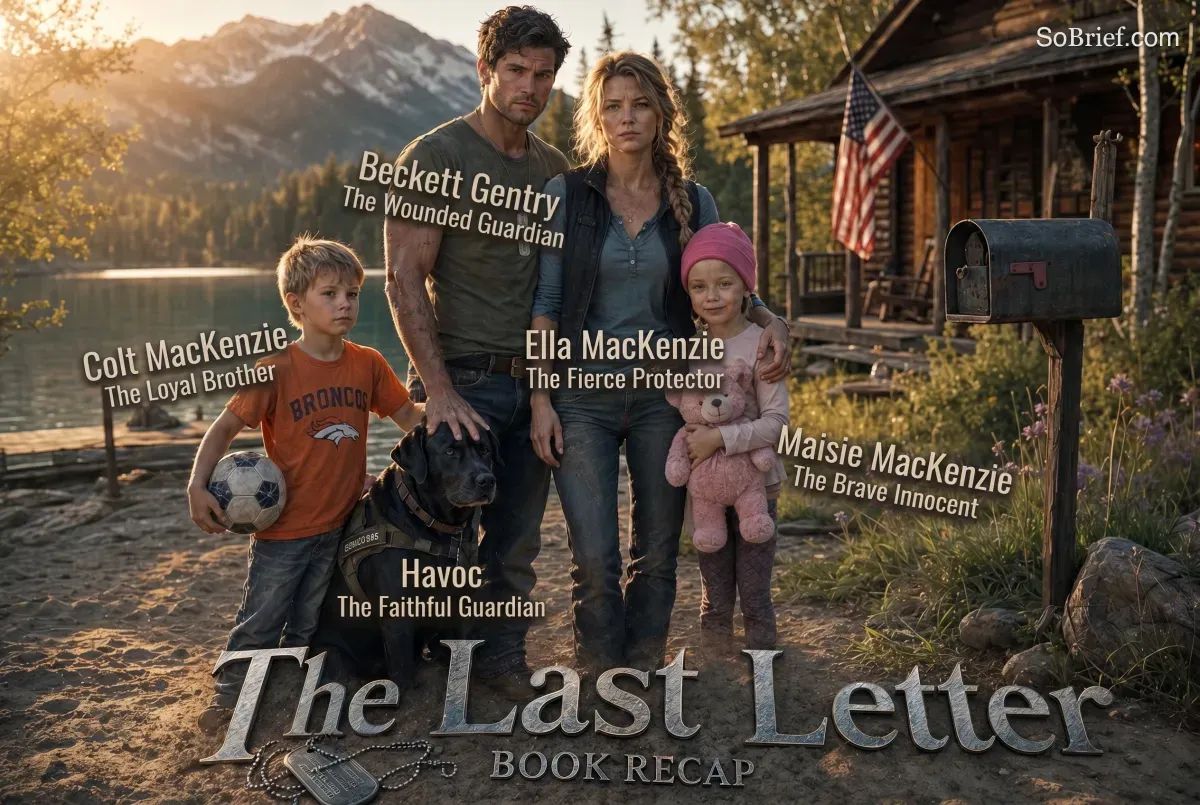


Plot Summary
Cookies for a Pen Pal
Beckett Gentry1 — call sign Chaos — serves on a tier-one special operations team alongside his only real friend, Ryan MacKenzie.5 Ryan's5 sister Ella2 has been writing letters to deployed soldiers, and Ryan5 slips one of hers onto Beckett's1 bunk.
Beckett1 ignores it for two weeks. Then a new teammate is killed on his third night, and Beckett1 turns twenty-eight in the dark, gripped by mortality. He rips open the letter. Ella2 is warm, funny, unflinching — a single mom of five-year-old twins running a mountain B&B called Solitude in Telluride, Colorado.
She writes in pen, never erasing, never censoring. Beckett1 writes back immediately, demands his stolen cookies from Ryan,5 and asks the one question haunting him: what does it feel like to be the center of someone's universe?
Ten Percent
For weeks, Ella's2 daughter Maisie3 has complained of hip pain that local doctors dismiss as growing pains. Then Maisie3 collapses on the playground with a 104-degree fever.
Ella2 drives her to Montrose, then Denver, where an oncologist named Dr. Hughes8 finally diagnoses what everyone else missed: Stage 4 neuroblastoma, a childhood cancer that has consumed ninety percent of Maisie's3 bone marrow. Ella2 asks for her daughter's odds. Dr. Hughes8 says ten percent — of surviving the year. Ella's2 knees give out.
But something ignites inside her: a driving purpose that eclipses all else. Chemo begins immediately. Maisie3 loses her hair on the eve of her sixth birthday. Her twin brother Colt4 shaves his head the same day. Ella2 doesn't cry. Not once. Not yet.
Two Losses, One Night
On New Year's Eve, military officers arrive at Ella's2 doorstep with the sentence every military family dreads: her brother Ryan5 has been killed in action. The details are classified — where he was, how it happened, who he was with.
When Chaos's1 letters stop arriving too, Ella2 draws her own conclusion. They were in the same unit. They must have died together. She finally breaks. Ryan5 was her last surviving family, the brother who promised to come home. Now both he and the faceless pen pal who had anchored her through Maisie's3 diagnosis are gone.
Four months pass. Ella2 reconstructs herself because she has no alternative — Maisie3 needs chemo, Colt4 needs normalcy, and Ella2 has no one left to lean on. The letters were the last private thing she had, and they've stopped forever.
The Stranger Ryan Sent
Beckett1 drives to Telluride carrying Ryan's last letter — a plea to watch over Ella2 and help save Maisie.3 He checks into Solitude for seven months, bringing Havoc,6 his retired military working dog. When Ella2 sees him, she is suspicious and cold.
He reveals Ryan5 sent him but cannot explain why Chaos1 stopped writing, or how Ryan5 died — because the truth would exile him instantly. On a prior mission, Beckett1 had accidentally killed a child and pulled himself from the next operation.
Ryan5 volunteered to take his place, was captured, tortured, and executed. Confessing any of this to Ella2 — a woman who has sworn she never forgives people who hurt her family — would end his mission before it starts. So Beckett1 offers the safe half-truth and locks the rest behind his teeth.
Colt Chooses First
Colt4 sneaks his quad to Beckett's1 lakeside cabin to meet Havoc6 and interrogates the stranger about his sanity, his profession, and his staying power. Ella2 arrives furious, but Colt4 has already rendered his verdict: since Beckett1 was Ryan's5 brother in arms, he qualifies as family.
Beckett1 asks if Colt4 can visit Havoc6 again; Ella2 reluctantly agrees. Over the following weeks, Beckett1 finds his footing — joining Telluride's Search and Rescue team, reading everything published on neuroblastoma, showing up for breakfast in the main house.
When Ella2 visits his cabin one evening to read Ryan's last letter with her own eyes, she recognizes the truth: her brother really did send this man. She promises to call if she needs anything, certain she never will.
Twelve Hours at the Blue Line
Chemo has shrunk Maisie's3 tumor enough for surgery. Beckett1 drives the medical binder Ella2 forgot to Denver and stays overnight at the hospital — at Maisie's3 insistence, after she makes him promise not to leave her mother alone.
The next morning, Ella2 walks beside Maisie's3 bed to the thick blue line marking the surgical wing, then crumbles against the wall clutching Maisie's3 pink teddy bear. Beckett1 wraps his arms around her for the first time. They play Scrabble, pace sixty-five laps of the floor, and endure eleven agonizing hours.
When the surgeon announces the entire tumor has been removed and Maisie's3 kidney saved, Ella's2 legs give out. Beckett1 catches her and holds her on his lap as she sobs out months of imprisoned grief. For the first time, she lets someone hold her together.
The Price of Saving Maisie
Despite the successful surgery, Maisie's3 bone marrow remains overwhelmingly cancerous — without further treatment, another tumor will grow. Dr. Hughes8 recommends MIBG therapy, a specialized radiation-chemo combination available at only eighteen hospitals nationwide, including Denver Children's.
Ella's2 bargain-rate insurance covers almost nothing at that facility. She has already drained her savings and Ryan's5 life insurance. Each chemo session costs twenty thousand dollars; MIBG therapy runs fifty thousand per round; the eventual stem cell transplant averages half a million.
Meanwhile, Beckett1 realizes his military insurance would cover everything at full rate — if the kids were his legal dependents. He makes the only calculation his problem-solving mind can construct and presents it to Ella2 on her porch: marry him, on paper only, so Maisie3 can live.
Marry Me (On Paper)
Ella2 rejects the proposal outright — marriage means love to her, not paperwork, and the last time she married for convenience she was divorced within months. But she cannot deny that Maisie3 will die without treatment. She proposes an alternative: Beckett1 could adopt the twins instead.
Adoption would make them his legal children with military insurance coverage, without a marriage she does not trust herself to survive. They consult Ella's2 lawyer, Mark Gutierrez,12 who confirms the plan can work if the twins' absent biological father, Jeff,10 signs over his parental rights.
There is a catch: they must share decision-making authority, and the local judge must be convinced the adoption is genuine. Ella2 agrees but insists the children not be told until Maisie3 is healthy — in case Beckett1 eventually leaves.
Half a Million in Shreds
Beckett1 visits Jeff10 at his father's Denver law firm armed with leverage: sign the parental release, or face public exposure for refusing to help his dying daughter while courting a senator's family. Jeff10 signs. Beckett1 also extracts a half-million-dollar check in back child support.
When he presents both documents to Ella,2 she reads the custody release with trembling fingers — then rips Jeff's10 check to pieces. She will not take his money. That check would give him a sense of ownership she refuses to allow.
By destroying it, she declares her independence and her choice. Meanwhile, Beckett1 also quietly signs military papers that keep his insurance active — a temporary disability status his former captain11 arranged. The path to adoption is finally clear.
Beckett Becomes Their Father
At the Telluride courthouse, Beckett1 and Ella2 sign the adoption documents. He is now legally Maisie3 and Colt's4 father. Before the ceremony, he sends Ella2 to a salon with Hailey9 — his idea, his credit card — so she can feel like herself for a few hours. Afterward, he takes her to dinner, then dancing at an open-air concert under the mountains, and walks her to her door.
He hugs her goodnight. She is furious at the restraint, but his loyalty to Ryan's5 memory keeps him from crossing the line. That night, watching Beckett's1 hospital wristband still bearing Maisie's3 name, Ella2 admits to herself what she's been fighting for months. She is hopelessly, completely in love with the man her brother sent to save them.
Ella Crosses the Kitchen
Ella2 drives to Beckett's1 cabin that night, done waiting for a man who won't kiss her to make the first move. He opens the door shirtless. She tells him their date should have ended with a kiss and presses her mouth to his. Beckett1 turns to stone for one heartbeat, then his control detonates. He lifts her onto the kitchen counter, and seven years of celibacy and months of throttled longing ignite between them.
Afterward, still tangled together, he tells her what he has been swallowing since his first letter: he has loved her since the beginning, before he ever saw her face. She says it back. They agree to date exclusively, tell the kids they are together, and start building the life that feels inevitable — until the truth catches fire.
The Letters in the Box
An insurance investigator threatens to freeze Maisie's3 treatments, claiming the adoption is a scheme for coverage. She demands proof Beckett1 knew the children before the diagnosis. Only one thing qualifies: the box of Ella's2 handwritten letters and the kids' crayon drawings that Chaos1 received overseas.
Beckett1 retrieves the box from his nightstand and slides it across the table. The investigator photographs the evidence and calls off the probe. But Ella2 is staring at her own handwriting — letters she wrote to a dead man, now in a living man's dining room.
The tree house lettering matches the diploma Beckett1 made Maisie.3 Havoc's6 name. The choppy capitals. The truth assembles itself in front of her eyes. She asks him to say it. He does: his name is Beckett Gentry,1 call sign Chaos.
Chaos Unmasked
Ella2 demands the full story. Beckett1 confesses everything: how he pulled himself from a mission after killing a child in a ricochet, how Ryan5 volunteered to replace him and was captured and executed, how guilt drove him to stop writing, how Ryan's last letter brought him to Telluride under a name Ella2 wouldn't connect to the pen pal she'd loved.
He chose the lie because the truth would have expelled him from her life before he could help. Ella2 absorbs the magnitude of his deception — eleven months of shared beds and shared children built on a concealed identity. She does not scream. She tells him it is not enough. She loves him, but she can no longer trust him. Without trust, love is a house without a floor. She walks out.
Remission and Reckoning
Seven months of separation follow. Beckett1 does not leave Telluride — he moves into a house he has been secretly building on acreage behind Solitude, land he purchased years earlier. He signs his permanent military discharge and takes a full-time Search and Rescue position.
When Colt4 is suspended for defending a girl at school, Beckett1 is the only emergency contact available. The reunion cracks the ice: Colt4 tells Beckett1 to fight for their family. Ella2 visits the house, sees bedrooms built for her children, and proposes co-parenting.
Months later, at a family dinner, Maisie3 bows her head in grace and thanks God for making her cancer-free. The news breaks every dam. Ella2 and Beckett1 find each other again that night, first tentatively, then irrevocably.
Colt Falls
On a school hiking trip, a section of mountain trail collapses. Colt4 pushes his classmate Emma14 to safety but plummets fifty feet down a cliff. Beckett1 and Havoc6 deploy by helicopter. They find Colt4 pinned beneath a boulder, his spine severed, his spleen ruptured, his aorta torn. Beckett1 applies a tourniquet that buys minutes, not hours.
He lies down beside his son and tells Colt4 the truth he has been saving: the adoption is real, and he has been Colt's4 father all along. Colt4 smiles and calls him Dad. He asks Beckett1 to tell his mom and Maisie3 he loves them, whispers that having a dad was everything he ever wanted, and closes his eyes. The helicopter arrives minutes after his last breath leaves Beckett's1 arms.
The House He Built
Colt4 is buried on the small island beside Ryan.5 Maisie3 wears yellow instead of black. Ella2 kneels at Ryan's5 headstone and asks him to take care of her boy. In the weeks that follow, Ella2 reads Beckett's1 own last letter — written as Chaos before the fatal mission, declaring his love and asking her to love enough for both of them.
Three months later, she moves into the house Beckett1 built for their family. She walks across the frozen lake to visit both graves and finds something she did not expect: peace — not the absence of pain, but the ability to walk beside it. Beckett1 waits for her at the shore. She tells him she loves him. They are imperfect people shaped by an imperfect world, and their love is enough. So is she.
Epilogue
Five years after Colt's4 death, thirteen-year-old Maisie3 sits at her brother's grave with a bag of M&M's. She tells him the five-year mark has passed — she is officially cancer-free, the risk of relapse nearly gone. Their little sister Rory is a wildcard who jumps banisters. Their baby brother Brandon is sweet and gentle.
Mom and Dad still sneak kisses in the kitchen. Maisie3 promises Colt4 she will live twice as awesome for both of them, because the deal they made as twins — to never be apart — has simply changed shape. She carries him everywhere. Some bonds, she knows, cannot be broken by distance or death or even time. The future is wide open, and she intends to fill it for two.
Analysis
The Last Letter interrogates a question most love stories avoid: what happens when the person you trust most has been lying about the most fundamental thing? Yarros constructs her narrative so that Beckett's1 deception is simultaneously unforgivable and completely understandable — a moral paradox that refuses easy resolution. He lies to Ella2 not out of malice but out of the same protective instinct that drives Ella2 to shield her children. Both characters build fortresses: hers around her kids, his around his identity. The tragedy is that the same impulse — fierce love expressed as control — is what eventually wounds them both.
The novel's deepest insight concerns the mathematics of triage that single parents perform daily. Ella2 must constantly choose which child receives her presence, knowing the other pays the cost of her absence. This isn't melodrama; it's the structural reality of parenting a critically ill child while raising a healthy sibling. Yarros refuses to resolve this tension cheaply — Colt's4 trajectory is shaped by every moment his mother chose Maisie,3 not because Ella2 failed him but because the universe dealt an impossible hand.
Beckett's1 arc dismantles the myth that military men are either stoic heroes or broken casualties. He is both — a man capable of extraordinary tenderness with children and extraordinary violence in combat, whose greatest wound is not physical but the conviction that he ruins everything he touches. His foster care background creates a psychological architecture where love and abandonment are synonyms, making Ella's2 eventual trust the most radical gift anyone has offered him.
The novel argues that love is not a feeling but a sustained act of showing up — that trust is rebuilt not through grand gestures but through the accumulation of ordinary mornings where the person you doubted is still there, making pinwheels for lunch.
Review Summary
The Last Letter received mostly positive reviews, with readers praising its emotional depth and powerful storytelling. Many found it heartbreaking and moving, with compelling characters and a touching romance. The book deals with heavy themes like cancer, grief, and loss. Some readers felt the tragedy was excessive, especially towards the end. A few criticized the medical inaccuracies and emotional manipulation. Despite the mixed reactions, most agreed it was a memorable and impactful read that left them deeply affected.
People Also Read






Characters
Beckett Gentry
Soldier-turned-father seeking homeA tier-one special operations soldier whose call sign—Chaos—precedes him like a prophecy. Abandoned at a bus station at four by his mother, raised in a revolving door of foster homes, Beckett learned early that attachments are liabilities and wanting something guarantees losing it. He compensates through rigid self-control: he never swears aloud, never forms lasting bonds, never stays anywhere long enough for roots to take. His only tethers are his working dog Havoc6 and his best friend Ryan5. Beneath the emotional armor lives a man starving for connection—someone whose letters reveal a vulnerability his physical presence conceals. His central conflict is the war between the certainty that he destroys everything he touches and the desperate, growing suspicion that maybe, with Ella2, he could build something instead.
Ella MacKenzie
Fierce mother defending her worldA twenty-five-year-old single mother who runs her late grandmother's B&B in Telluride. Married at eighteen to a man who fled when the pregnancy test showed twins, Ella rebuilt her life through sheer stubbornness—raising Maisie3 and Colt4 alone, mortgaging the property for renovations, and insulating herself from anyone who might leave. Her defining trait is a protectionism so fierce it borders on fortress-building: she shelters her children at the cost of her own isolation. She writes in pen and never erases—a metaphor for her refusal to soften her truths. Her hard limit is deception; lies are unforgivable because they represent intentional pain inflicted for selfish reasons. Beneath her competence lies an exhaustion she won't admit and a loneliness she fills with productivity instead of people.
Maisie MacKenzie
The quiet twin fighting cancerElla's2 daughter and the quieter twin, Maisie possesses a preternatural ability to judge character—she likes you or she doesn't, and silence means you haven't earned her time. Diagnosed with Stage 4 neuroblastoma at five, she endures chemo, surgery, radiation, and transplants with a resilience that humbles every adult around her. She worries more about her mother's sadness than her own pain, hiding fear to spare others. Her bond with Colt4 is almost telepathic—they finish each other's sentences and sense distress across distance. Maisie's quiet strength is the engine driving every sacrifice: she is the reason Beckett1 moves to Telluride, the reason Ella2 accepts help, and the reason an entire community rallies around one family's impossible fight.
Colt MacKenzie
The protector twin seeking a dadElla's2 son and the louder twin—fiercely independent, protectively devoted, and perpetually somewhere he shouldn't be. Where Maisie3 observes, Colt acts: he shaves his head when she loses her hair, refuses to leave her during hospitalizations, and punches a boy who forces kisses on his sister. He craves a father with an intensity he doesn't fully understand, asking Beckett1 after a soccer game if this is what having a dad feels like. His moral compass is unerring—he protects smaller people, gives second chances generously, and speaks with a directness that regularly outmatches adults. His openness to love is both his most endearing quality and his greatest vulnerability.
Ryan MacKenzie
The brother who sends helpElla's2 older brother and Beckett's1 best friend—a gregarious special operations soldier who talks about Telluride like sacred ground. He arranged the pen pal exchange between Ella2 and Beckett1, sensing they needed each other before either of them knew it. His death on a mission is the catalyst that launches the novel's present-day narrative, and his last letter—asking Beckett1 to care for Ella2 and Maisie3—functions as both compass and conscience for the man he left behind. Even from the grave, Ryan's influence shapes every major decision.
Havoc
Military dog turned family anchorBeckett's1 seventy-pound black Labrador retriever, a retired special operations working dog trained in explosives detection and human scenting. She obeys only Beckett's1 commands, will attack on his order, and serves as his emotional anchor across the transition from combat to civilian life. With the children, she transforms into a gentle companion who sleeps beside hospital beds and chases tennis balls with equal commitment. She is the bridge between Beckett's1 violent past and his tender present.
Ada
Solitude's matriarch and truth-tellerIn her sixties, Ada has helped raise Ella2 since childhood and serves as the closest thing to a mother she has. She runs Solitude's kitchen and domestic operations with warmth and iron will. Shrewd and unafraid to deliver hard truths—she once told Ella2 that broken hearts belong only to the living—Ada pushes Ella2 toward vulnerability when stubbornness threatens to isolate her entirely. Her devotion to the family is generational and unconditional.
Dr. Hughes
Maisie's oncologist and allyMaisie's3 neuroblastoma specialist, competent and compassionate, who splits her time between Montrose and Denver Children's Hospital. She is the first doctor to correctly diagnose Maisie's3 condition when others failed. She delivers devastating prognoses with honesty and fights for Maisie's3 treatment with the same tenacity Ella2 brings, becoming a trusted presence through years of scans, surgeries, and crisis calls.
Hailey
Receptionist and comic foilSolitude's young receptionist and Ella's2 friend—cheerful, romantically impulsive, and the comic-relief counterpoint to Ella's2 gravity. She moves into Ella's2 cabin to help with overnight child care and serves as a mirror reflecting the carefree life Ella2 might have led.
Jeff Danbury
The father who never wasThe twins' absent biological father—a former trust-fund kid who married Ella2 at eighteen, asked her to abort the twins, and vanished. He has never seen his children. His cowardice serves as the negative measuring stick against which Beckett's1 devotion is measured.
Captain Donahue
Beckett's commanding officerThe unit commander who delivers Ryan's last letter and engineers a temporary disability loophole to keep Beckett's1 military insurance active. He serves as the persistent thread between Beckett's1 old life and his new one.
Mark Gutierrez
Lawyer and rescue teammateA Telluride family lawyer and Search and Rescue volunteer who handles the adoption paperwork and becomes Beckett's1 ally and friend. He watches over Ella2 on the community's behalf and advocates for both families.
Larry
Solitude's quiet groundskeeperAda's7 husband and Solitude's groundskeeper—the first person to welcome Beckett1 and Havoc6 without suspicion, reading something in the soldier's face that earns immediate trust.
Emma
Colt's classmate and friendA quiet, kind girl in Colt's4 class who becomes his first crush. Her presence in the story deepens the consequences of Colt's4 protective instincts and eventually connects her to Maisie3 as a lasting friend.
Plot Devices
The Letters
Connection, identity, and time bombThe correspondence between Ella2 and Chaos1 spans twenty-four letters and forms the novel's emotional spine. Through pen-on-paper honesty, two strangers build an intimacy deeper than most face-to-face relationships: Ella2 writes about her twins, her isolation, her fears; Beckett1 reveals a vulnerability his physical presence conceals. Each chapter opens with a letter that contextualizes present action, generating dramatic irony as the reader recognizes Chaos1 in Beckett1 before Ella2 does. The letters function simultaneously as proof of genuine love—they predate the diagnosis, saving the adoption from fraud charges—and as the mechanism of catastrophic exposure. When Beckett1 produces them to satisfy an insurance investigator, they unmask his identity and detonate the relationship they helped build. The letters are the story's soul: evidence that words alone can create and destroy a life.
Ryan's Last Letter
Moral compass from beyond deathWritten before his final mission, Ryan's5 death letter to Beckett1 asks the one friend he trusts to go to Telluride, care for Ella2, and help save Maisie3. The letter transforms Beckett1 from a man without attachments into one bound by sacred obligation. He carries the folded envelope in his back pocket every day as a talisman and justification—it is the document Ella2 reads to verify his claim, the reason he stays when she pushes him away, and the moral standard against which he measures every decision. Ryan's5 voice from beyond the grave operates as both catalyst and conscience, giving Beckett1 permission to want something he never believed he deserved: a home, a family, and the love of the woman his best friend knew he needed.
Havoc
Living bridge between worldsBeckett's1 retired military working dog serves multiple narrative functions beyond companionship. Trained in explosives and human scenting, she obeys only Beckett's1 commands—a living metaphor for his isolation and the trust he cannot extend to humans. Yet Havoc becomes the first bridge to each family member: Colt4 sneaks to meet her, Maisie3 accepts her instantly, and Ella2 trusts her with the children before she trusts Beckett1. Havoc alerts to danger when Jeff's10 hostile parents approach the twins outside a pizza shop, defends the children on Beckett's1 command, and serves as search tool in the novel's rescue sequences. She represents the possibility that something bred for violence can learn domesticity—the same transformation Beckett1 undergoes across the story.
The Adoption Papers
Legal bond as emotional crucibleThe legal adoption of Maisie3 and Colt4 by Beckett1 functions as both practical mechanism and emotional fulcrum. Practically, it enrolls the children in military insurance, enabling the MIBG therapy and stem cell transplant that save Maisie's3 life. Emotionally, it gives a man raised in foster care the family he never had and forces a fiercely independent mother to share parental authority with someone she loves but does not fully trust. The adoption creates conditions for the insurance investigation that exposes Beckett's1 true identity, and it provides the legal reality behind the story's most devastating moment—when a father can finally tell his son who he truly is to him. The papers evolve from strategic document to the most important truth Beckett1 will ever speak.
The Twin Bears
Symbols of unbreakable twin bondA pair of teddy bears—one pink, one blue—gifted by the twins' grandmother but swapped by the children as toddlers. Colt4 claimed the pink bear; Maisie3 kept the blue. They send the bears with each other during every separation: Maisie3 takes pink Colt4 to hospitalizations so her brother is with her; Colt4 keeps blue Maisie3 at home so his sister stays close. The bears externalize the twins' symbiotic bond and function as stand-ins for physical presence during the long months of treatment. They track the emotional temperature of every hospital stay and goodbye, small totems carrying a weight far beyond their stuffing—proof that the twins think of themselves not as individuals but as two halves of one whole.
FAQ
Synopsis & Basic Details
What is The Last Letter about?
- A Pen Pal Lifeline: The Last Letter introduces Ella, a single mother navigating small-town judgment and financial strain, and Beckett, a battle-hardened soldier isolated by his deployments. They begin an anonymous correspondence, facilitated by Ella's brother, Ryan, finding unexpected solace and connection in each other's words across continents.
- Love Forged in Crisis: The story quickly shifts as Ella faces her daughter Maisie's aggressive cancer diagnosis, plunging her into a world of medical and financial challenges. Simultaneously, Beckett grapples with profound loss and guilt from his military service. Their letters become a raw, honest space where they share their deepest fears and vulnerabilities.
- Unconventional Family Building: Tragedy strikes when Ryan is killed, severing the pen pal connection. However, Ryan's dying wish sends Beckett to Telluride, where he integrates into Ella's life, becoming an indispensable support for Maisie's treatment and a father figure to her twins. The narrative explores the complexities of love, trust, and family forged through adversity, culminating in an unexpected adoption and the revelation of long-held secrets.
Why should I read The Last Letter?
- Emotional Depth & Raw Honesty: Readers are drawn into a deeply emotional journey, exploring themes of grief, resilience, and the profound impact of trauma. The epistolary format allows for an intimate look into the characters' internal struggles, making their vulnerabilities and triumphs incredibly relatable and moving.
- Unique Relationship Development: The story masterfully builds a connection between Ella and Beckett first through words, then through shared crisis, and finally through a complex, unconventional family structure. This slow-burn romance, intertwined with the high stakes of childhood illness and military life, offers a fresh perspective on how love and trust can be forged in the most challenging circumstances.
- Exploration of Found Family: Beyond the central romance, the novel champions the concept of chosen family, highlighting the unwavering support of secondary characters like Ada and Larry, and the transformative power of adoption. It's a testament to the idea that family isn't always defined by blood, but by unwavering commitment and love.
What is the background of The Last Letter?
- Military Life & Trauma: The novel deeply embeds itself in the realities of military service, particularly special operations, portraying the intense bonds, the psychological toll of combat, and the challenges of reintegration into civilian life. Beckett's experiences reflect the hidden scars of war, including PTSD and the struggle with attachment, offering a poignant look at the sacrifices made by soldiers.
- Small-Town Dynamics & Community: Set in the picturesque but insular town of Telluride, Colorado, the story explores the double-edged sword of small-town life: the judgment and gossip Ella faces as a young single mother, contrasted with the fierce, unwavering support of her chosen community (Ada, Larry, Mark). This backdrop emphasizes the importance of local networks in times of crisis.
- Childhood Cancer Realities: Maisie's neuroblastoma diagnosis is depicted with unflinching realism, drawing on real-life experiences (as noted in the acknowledgments). The narrative delves into the grueling treatments, financial burdens, and emotional toll on families, highlighting the unpredictable nature of illness and the relentless fight for survival.
What are the most memorable quotes in The Last Letter?
- "You are enough, Ella. You're more than enough.": This recurring affirmation from Chaos (Beckett) in Letter #9 and later echoed by Ms. May, serves as a powerful thematic anchor. It directly addresses Ella's deep-seated insecurities about her capabilities as a mother and business owner, highlighting her immense strength and resilience in the face of overwhelming adversity.
- "I'm not good for anyone.": Spoken by Beckett in Chapter 3, this line encapsulates his profound self-worth issues and the "Chaos" identity he believes defines him. It reveals his internal struggle with attachment and his fear of harming those he cares about, foreshadowing the central conflict of his hidden identity and its impact on Ella.
- "Sometimes bad things happen. And there's no blame to be placed.": Ella's profound realization in Chapter 24, delivered to Beckett, is a pivotal moment of emotional maturity and forgiveness. This quote speaks to the novel's overarching theme of accepting life's unpredictability and finding peace amidst tragedy, offering a path toward healing beyond guilt and blame.
- "I'm a Gentry and a MacKenzie. Always.": Colt's final, whispered declaration in Chapter 27, after learning Beckett is his father, is incredibly poignant. It symbolizes the powerful theme of chosen family and enduring love, transcending biological ties and even death, cementing Beckett's place in the family's heart.
What writing style, narrative choices, and literary techniques does Rebecca Yarros use?
- Intimate Epistolary & Dual POV: Yarros primarily employs an epistolary structure, using letters to reveal the characters' inner worlds and build their connection before they meet. This is complemented by alternating first-person perspectives (Ella and Beckett), creating dramatic irony as the reader often knows more than the characters, intensifying emotional impact and suspense.
- Emotional Intensity & Sensory Detail: The prose is highly emotive, immersing the reader in the characters' raw feelings of grief, fear, love, and hope. Yarros uses vivid sensory descriptions, particularly in combat scenes and Maisie's illness, to ground the emotional turmoil in tangible experiences, making the stakes feel incredibly real.
- Symbolic Language & Metaphor: The author frequently uses metaphors, such as Ella's "gravity" and Beckett's "chaos," to explore character traits and thematic conflicts. Recurring symbols like the island (representing grief and memory), the tree house (representing family and future), and even specific colors (e.g., Maisie's pink bear) subtly enrich the narrative's deeper meanings.
Hidden Details & Subtle Connections
What are some minor details that add significant meaning?
- Ella's Pen Choice: In her first letter, Ella mentions, "Profound regret for writing this letter in pen. I almost erased that last line, but it's true. Also, I'm just too lazy to rewrite the whole thing." This seemingly throwaway detail subtly establishes her authentic, uncensored nature, which Beckett later praises, noting, "It means you don't go back and censor yourself. You don't overthink, just write what you mean." This highlights the genuine connection formed through their unfiltered correspondence, a stark contrast to the lies he later tells.
- Colt's Hair Shaving: After Maisie loses her hair due to chemo, Colt shaves his head in solidarity for his sixth birthday (Chapter 3). This small, selfless act by a child reveals his deep empathy and protective nature, foreshadowing his later heroic act of saving Emma and emphasizing the profound bond between the twins, which becomes a central emotional pillar of the story.
- The "YOU ARE ENOUGH" Sign: Beckett sends Ella a handwritten sign with "YOU ARE ENOUGH" (Chapter 8), which she hangs on her bulletin board. This seemingly minor gift becomes a powerful, recurring symbol of his unwavering belief in her strength, directly countering her self-doubt and the judgment she faces. It subtly reinforces his deep understanding of her inner struggles, even before their true identities are revealed.
What are some subtle foreshadowing and callbacks?
- Chaos's Name as Foreshadowing: Beckett's call sign, "Chaos," is introduced early (Chapter 1) and later explained as meaning "destruction inevitably followed" (Letter #20). This subtly foreshadows the profound disruption and pain he inadvertently brings into Ella's life, particularly through Ryan's death and the revelation of his identity, making his self-perception as a bringer of chaos a tragic reality.
- Ella's "Gravity" Metaphor: In Letter #6, Ella describes herself as her children's "gravity," keeping them "locked down tight, their feet on the ground." Beckett later reflects on this, wondering if gravity is "comforting" or "suffocating" (Chapter 3). This metaphor subtly foreshadows his own yearning for stability and roots, and his eventual role as a grounding force for Ella and the kids, even as his secret threatens to pull them apart.
- Maisie's 10% Chance Echoes Dedication: When Maisie is given a "10 percent chance of surviving the year" (Chapter 3), it's a direct callback to the book's dedication: "To David Hughes, who beat his 10 percent chance with 100 percent heart." This subtle intertextual reference immediately imbues Maisie's struggle with a glimmer of hope and resilience, suggesting that despite the grim odds, survival is possible, and setting a tone of fierce determination.
What are some unexpected character connections?
- Danielle Wilson (Insurance) and Cassie Ramirez: The insurance investigator, Danielle Wilson, is revealed to be the sister of Ramirez, Beckett's former unit member who lost his arm (Chapter 21). This connection explains her personal vendetta against Donahue and Beckett, adding a layer of external conflict rooted in the military's impact on families, and highlighting the far-reaching consequences of combat beyond the battlefield.
- Dr. Hughes's Personal Connection: While not explicitly stated in the main narrative, the acknowledgments reveal that Maisie's neuroblastoma timeline is based on the author's friend Ashton Hughes's son, David. This deep personal connection to the subject matter imbues Dr. Hughes's character with an unspoken authenticity and empathy, making her a more significant figure than just a medical professional.
- Jeff's Parents' Callousness: The brief but impactful encounters with Jeff's parents (Chapter 12) reveal their cold, transactional nature, mirroring Jeff's abandonment of Ella and the twins. Their refusal to help with Maisie's insurance and their disdain for the children underscore the profound difference between biological ties and true family, reinforcing the theme of chosen family.
Who are the most significant supporting characters?
- Ada and Larry: The Unwavering Anchors: Beyond their role as caretakers, Ada and Larry represent the steadfast, unconditional love of chosen family. They provide Ella with practical support (watching kids, running Solitude) and emotional wisdom, often acting as her conscience or sounding board. Their presence symbolizes the enduring strength of community and tradition in Ella's life, contrasting with the transient nature of others.
- Mark Gutierrez: The Bridge to Civilian Life: Mark, as a local lawyer and fellow search and rescue volunteer, serves as a crucial bridge for Beckett into civilian life and a trusted ally for Ella. He not only facilitates the adoption but also offers a grounded, empathetic perspective on relationships and community, helping Beckett navigate his new world and providing a voice of reason in complex situations.
- Captain Donahue: The Moral Compass and Enabler: Donahue, Beckett's former commanding officer, is more than just a military figure; he acts as a moral compass and a catalyst for Beckett's journey. He understands Beckett's trauma and self-blame, strategically offering him the "temporary disability" loophole to ensure Maisie's care, even while pushing Beckett towards healing and a life beyond the military. He represents the complex loyalty within military brotherhood.
Psychological, Emotional, & Relational Analysis
What are some unspoken motivations of the characters?
- Ella's Fear of Abandonment: Ella's fierce independence and reluctance to trust, particularly with her heart, are deeply rooted in her past experiences of abandonment by her father, her ex-husband Jeff, and the perceived abandonment by Ryan (due to his military life and death). Her initial resistance to Beckett's help, despite her overwhelming need, is an unspoken motivation to protect herself and her children from further heartbreak.
- Beckett's Self-Punishment & Unworthiness: Beckett's relentless drive to "fix" things for Ella and Maisie, and his initial refusal to acknowledge his own worthiness of love or happiness, stems from his profound guilt over the child he accidentally killed and his belief that he caused Ryan's death. His secrecy about his identity as Chaos is an unspoken act of self-punishment, believing he doesn't deserve Ella's love if she knew the "truth" of his destructive nature.
- Colt's Precocious Protection: Colt's actions, like shaving his head for Maisie or confronting Drake Cooper, are driven by an unspoken, deeply ingrained protective instinct. Having witnessed his mother's struggles and Maisie's illness, he matures beyond his years, taking on a silent burden of responsibility for his family's well-being, which motivates his desire for a "dad" figure like Beckett.
What psychological complexities do the characters exhibit?
- Ella's Compartmentalization of Grief: Ella exhibits a complex psychological defense mechanism of compartmentalization, particularly evident in her handling of Ryan's death and Maisie's illness. She "shoves the emotions back in the neat little box they belonged in" (Chapter 6), allowing herself to feel only what she can manage at a given moment to avoid being overwhelmed. This coping strategy, while enabling her to function, also hinders her ability to fully process trauma and trust.
- Beckett's Identity Crisis (Chaos vs. Beckett): Beckett grapples with a profound identity crisis, torn between his self-perceived "Chaos" persona—a destructive force—and the man he becomes through his love for Ella and the kids. His internal monologues reveal a constant battle between the hardened soldier who believes he "ruins everything" and the yearning for connection and family, leading to his lie of omission and subsequent emotional turmoil.
- Maisie's Wisdom and Acceptance: Despite her young age, Maisie displays remarkable psychological maturity and acceptance of her illness. Her quiet observations ("Only boring people are bored," "The monster doesn't like this kind") and her ability to articulate her fears ("Am I dying?") reveal a child processing profound trauma with a wisdom that often surpasses the adults around her, highlighting the unique resilience of children.
What are the major emotional turning points?
- Beckett's Decision to Go to Telluride: The moment Beckett reads Ryan's last letter (Chapter 5) and decides to leave the military and go to Telluride is a major emotional turning point. It signifies his first conscious step towards breaking his pattern of detachment and embracing a sense of responsibility and connection beyond his unit, driven by a profound sense of loyalty and a nascent love for Ella.
- Ella Allowing Beckett to Hold Her After Maisie's Surgery: After Maisie's successful surgery, Ella collapses in the waiting room, and Beckett holds her, a moment where she whispers, "I'd forgotten what this felt like. Being held together" (Chapter 10). This is a critical emotional turning point for Ella, as she consciously allows herself to be vulnerable and accept comfort from Beckett, breaking down a significant wall of self-reliance and marking the true beginning of their romantic connection.
- Colt's Death and Its Aftermath: Colt's tragic death (Chapter 27) is the most devastating emotional turning point, shattering the fragile peace the family had found. It forces Ella and Beckett to confront their deepest fears and grief, leading to a raw, honest reckoning of their relationship and individual traumas. This shared loss ultimately becomes a crucible for their enduring love and commitment, pushing them towards a deeper, more authentic bond.
How do relationship dynamics evolve?
- From Anonymous Pen Pals to Deeply Intertwined Souls: The relationship between Ella and Beckett evolves from an anonymous, emotionally intimate pen pal connection to a complex, real-world partnership. Initially, their letters allow for a vulnerability they can't express elsewhere. Upon meeting, their dynamic shifts to reluctant allies, then to a slow-burn romance, and finally to a co-parenting unit, demonstrating how shared trauma and unwavering support can forge an unbreakable bond.
- The Twins' Bond as a Mirror to Ella's Grief: The relationship between Colt and Maisie is central, mirroring Ella's own emotional journey. Their inseparable bond, their shared experiences (like Maisie's illness and Colt's protective instincts), and their eventual separation through Colt's death, reflect the profound impact of loss on Ella's heart. Their dynamic highlights the theme of enduring connection, even beyond physical presence.
- Community as a Shifting Support System: The relationship dynamics with the broader community evolve from initial judgment (Ella as a young single mom) to a complex web of support and occasional intrusion. Characters like Ada and Larry provide consistent, unconditional love, while others like Maggie Cooper represent the well-meaning but sometimes insensitive aspects of small-town life. This evolution underscores the importance of discerning true allies and accepting help.
Interpretation & Debate
Which parts of the story remain ambiguous or open-ended?
- The Full Extent of Beckett's "Chaos" Past: While Beckett reveals the accidental killing of a child and his role in Ryan's death, the full scope of his "Chaos" persona and the specific "destruction" he claims to bring remain somewhat ambiguous. Readers are left to infer the depth of his past trauma and the specific nature of his special operations work, allowing for individual interpretation of his internal struggles and the weight of his guilt.
- Long-Term Implications of Maisie's Remission: The novel concludes with Maisie in remission and later cancer-free, but Dr. Hughes explicitly states the high relapse rates for neuroblastoma. This leaves a subtle open-endedness regarding Maisie's long-term health, acknowledging the unpredictable nature of cancer and the lingering anxiety that often accompanies remission, even in a happy ending.
- The Future of Ella and Beckett's Relationship (Marriage vs. Partnership): While the epilogue shows Ella and Beckett as a cohesive family unit with new children, and Maisie refers to him
About the Author
Other books by Rebecca Yarros




Download PDF
Download EPUB
.epub digital book format is ideal for reading ebooks on phones, tablets, and e-readers.








































