


Key Takeaways
You literally become whatever you dwell on most
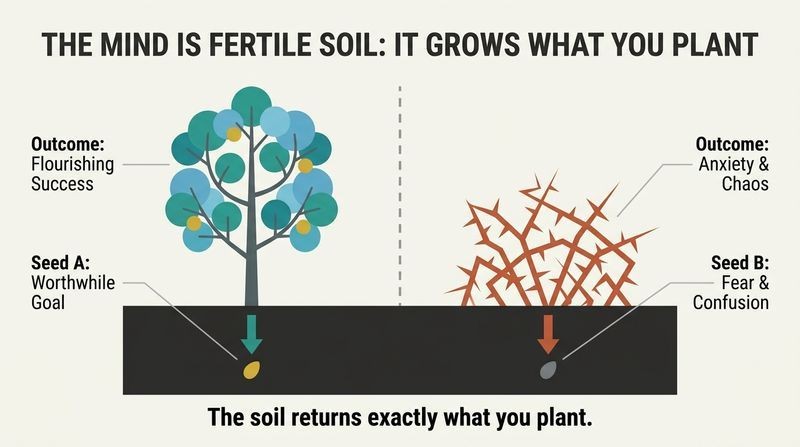
The strangest secret is deceptively simple: we become what we think about. Nightingale claims every great thinker across history, from Marcus Aurelius to Emerson to William James, converges on this single point, even when they agreed on nothing else. A mind fixed on a concrete, worthwhile goal moves toward it. A mind marinating in fear, confusion, and worry manufactures exactly that.
He calls it a secret only because almost nobody applies it. It appears throughout ancient wisdom and scripture, yet stroll down any main street asking people the secret of success and you'd struggle to find one person who could name it. Familiarity has bred contempt. The idea is hidden in plain sight, dismissed as too obvious to matter, which is precisely why so few act on it.
What's striking is how much modern psychology validates this 1956 record. Cognitive behavioral therapy rests on the premise that thought patterns shape emotional and behavioral outcomes. The reticular activating system in the brain does filter reality toward what we focus on. Yet the claim deserves nuance: thinking alone does not defy circumstance. Structural barriers, luck, and access matter enormously, a limitation Nightingale's optimistic postwar America underweighted. The steelman is that attention is the scarcest cognitive resource, and directing it deliberately is genuinely rare. The idea is less magic than a theory of sustained attention dressed in the language of destiny.
Redefine success as chasing a goal, not hoarding money
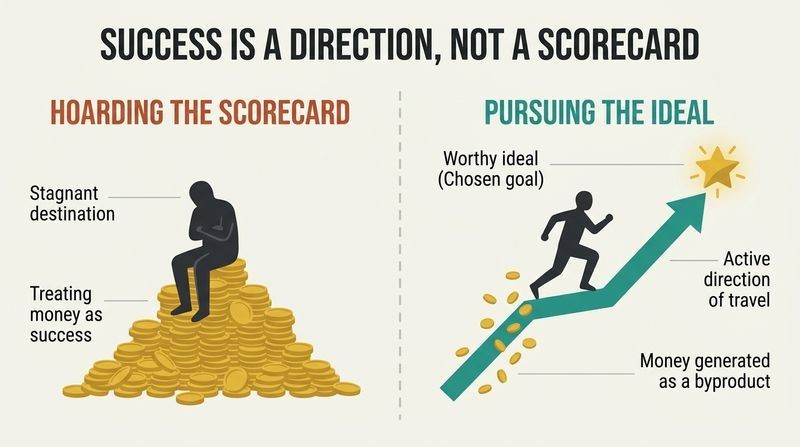
Nightingale's definition upends the usual scorecard: success is the progressive realization of a worthy ideal. Anyone deliberately pursuing a predetermined goal they chose is, by this measure, already successful. The teacher who teaches because she wanted to, the gas station owner running the business he dreamed of, the parent who chose parenthood, all qualify. Success is a direction of travel, not a bank balance.
This inverts the money equation entirely. Most people believe money makes you successful. Nightingale insists the reverse: success produces money as a byproduct. Like the man who sits before a cold stove demanding heat before he'll add wood, most people want the reward before rendering the service. Decide what you want, aim at it deliberately, and you join the rare minority who actually know where they are going.
This reframing anticipates modern self-determination theory, which distinguishes intrinsic goals (chosen, autonomous) from extrinsic ones (imposed, status-driven) and finds intrinsic pursuits far more sustaining. Viktor Frankl made a parallel case: chase success and it flees, but let it ensue from dedication to something larger. The definition is generous to a fault, though. By counting anyone with a chosen goal as successful, it risks becoming unfalsifiable. Still, the practical payoff is real: it shifts the locus of achievement from external validation to internal direction, which is psychologically healthier and far more within an individual's control than outcomes ever are.
A life without a goal drifts like a rudderless ship

Nightingale's shipping metaphor is the spine of his argument. A vessel that leaves harbor with a charted course, captain, and crew reaches its destination nearly every time. Launch an identical ship with no crew, no captain, and no destination, just an engine running, and it either sinks or washes up a derelict on some deserted beach. Human beings behave identically. Without a defined goal, thoughts default to confusion and anxiety, and the person becomes exactly that.
The numbers frame the stakes. Of 100 ambitious 25-year-olds, by age 65 only one is rich, four are financially independent, five are still working, and 54 are broke. All started with the same spark. The difference, Nightingale argues, is that the successful few chose a destination while the rest conformed, drifting on the currents of what everyone else was doing.
The 5% statistic is folklore rather than tracked data, and readers should treat it as rhetorical rather than empirical. But the underlying insight about goal-setting has robust support. Edwin Locke and Gary Latham's decades of research on goal-setting theory show specific, challenging goals reliably outperform vague intentions or none at all. The ship metaphor also echoes Seneca's line that no wind favors the sailor who knows no port. Where the argument thins is in treating drift purely as personal choice; systemic factors steer many ships. Yet the corrective remains sound: naming a destination is the cheapest, highest-leverage act available to anyone.
Conformity, not cowardice, is the true enemy of success
Nightingale borrows from psychiatrist Rollo May: the opposite of courage in our society is not cowardice, it is conformity. People act like everyone else without knowing why or where they are headed. When working men were surveyed about why they get up and go to work, 19 out of 20 had no real answer beyond the fact that everyone does it.
These are outer-directed people, convinced their lives are shaped by external circumstances and things that happen to them rather than by their own thinking. The tragedy is that they unconsciously imitate the wrong group, the 95% who never make the grade. Nightingale's antidote is to stop competing and start creating. Because so few chart their own course, there is barely any real competition, only the imitation game most people mistake for ambition.
May's insight connects to Solomon Asch's famous conformity experiments, where subjects denied the plain evidence of their eyes to match a group's obviously wrong answer. Herd behavior is neurologically cheap; independent thought is metabolically expensive. David Riesman's The Lonely Crowd, published just years before this recording, coined the very term outer-directed to describe postwar Americans who took their cues from peers rather than internal compass. The claim that conformity requires no courage is powerful, but it can flatten a subtler truth: some conformity is prosocial and adaptive. The real lesson is choosing when to conform consciously rather than defaulting to it blindly.
Your mind is fertile soil that grows whatever you plant
The farmer parable explains the mechanism. Imagine good, fertile land. The farmer can plant corn or deadly nightshade, and the land does not care. It returns, in abundance, whatever seed is sown. The human mind works identically but is far more fertile and mysterious. Plant a worthwhile goal and it yields success; plant fear and confusion and it yields frustration with equal generosity. As you sow, so shall you reap.
Why do so few use this power? Because the mind arrives free at birth, and humans undervalue what costs nothing. We prize what we pay for and neglect what we were given, which is backwards, since everything truly priceless (mind, body, love, dreams) came free while replaceable things cost money. Studies, Nightingale notes, suggest most people operate at roughly 10% of their capacity.
The agricultural metaphor descends directly from James Allen's As a Man Thinketh and biblical parable, giving it deep cultural roots. The neutrality of the soil is the sharp part: the mind does not moralize about its inputs, which is why rumination and catastrophizing compound as reliably as constructive planning. Modern neuroscience of neuroplasticity gives the metaphor teeth; repeated thought patterns physically strengthen neural pathways. The 10% brain claim, however, is a persistent myth, thoroughly debunked by imaging that shows we use virtually all of our brain. The spirit survives the error: attention allocation, not raw capacity, is the real bottleneck on most lives.
Carry a card with one clear goal for thirty days
Nightingale designs a concrete experiment. Write on a card the single thing you want most, whether a doubled income, a better home, or a more harmonious family. Keep it to one clearly defined goal. Carry it everywhere and read it several times daily: on waking, throughout the day, and before sleep. On the reverse, write the passage about asking, seeking, and knocking. The card externalizes focus so the goal stays in front of you.
The hard part is thought discipline. Every time fear or a negative thought surfaces, replace it with a mental picture of your goal. Do more than required each day and give more than you're paid for, knowing returns match contribution. If you slip into negativity, restart the 30-day count. Persistence, Nightingale insists, is simply faith in action.
This is arguably the book's most durable contribution: a specific, repeatable behavioral protocol rather than mere inspiration. It anticipates implementation-intention research by Peter Gollwitzer, which shows that concrete cues and repeated rehearsal dramatically raise follow-through versus vague resolve. The physical card is a commitment device and an attention primer, much like modern habit-tracking. One caution: the instruction to leave the how entirely to a higher power can breed passivity if misread. The healthier interpretation is that clarity of destination frees cognitive bandwidth to spot routes, which aligns with how the brain's pattern-matching surfaces relevant opportunities once a goal is salient.
Your rewards always equal the service you render
Nightingale frames prosperity as an exchange law. Financial return is directly proportional to service. The only people who make money without serving work at the mint; everyone else must provide something needed and useful. This is why chasing something for nothing fails. Want more return? Render more service. Want less? Reduce it. Anyone, he says, can practically forecast their own fortune by auditing the value they give.
Two practical multipliers follow. First, close the gap between the effort you actually give your work and the 100% you're capable of; the raise appears on its own. Second, improve your work daily and even a dull job takes on fresh meaning. Nightingale adds a memorable rule: treat everyone, including a difficult boss, as the customer who pays your bills, because no one enriches himself by diluting others.
The service-equals-reward law is essentially the labor theory of value fused with the golden rule, and it is more aspirational than descriptive. Markets routinely reward scarcity, timing, and negotiating leverage over raw service; caregivers and teachers render immense value for modest pay. Adam Grant's research in Give and Take complicates it usefully, showing givers cluster at both the top and bottom of success distributions, meaning generosity must be paired with self-protection to pay off. Still, as a controllable input, service beats entitlement. The advice to raise your effort toward your full capacity is sound; discretionary effort is the variable most workers actually govern.
Treat creative thinking as the brain's highest, learnable function
Nightingale calls the brain a goldmine between your ears, a resource so complex one physicist estimated replicating it electronically would cost three billion billion dollars. Its highest function is creative thinking, and crucially, creativity is a learnable skill, not a genetic gift. The barrier is that childhood imagination gets trained out of us by schooling that rewards conformity and playing it safe, leaving the imagination switch rusty.
He offers concrete idea-generating moves. To spur fresh thinking, deliberately run problems through several lenses:
1. Combination (merge two things, like comedy plus music equals musical comedy)
2. Adaptation (burlap sacks become stylish dresses)
3. Substitution (plastic for wood)
4. Magnification or minification (skyscrapers or transistors)
5. Rearrangement (put the mink inside the coat)
Forcing your mind through these angles reliably surfaces ideas that pure staring never would.
These transformation lenses predate and closely mirror the SCAMPER technique later popularized in creativity training, and they hold up as practical ideation tools. The insight that schooling suppresses divergent thinking found dramatic support in George Land's longitudinal study, where 98% of five-year-olds scored at genius level for divergent thinking, a figure that collapsed as they aged through formal education. Where Nightingale is most useful is reframing creativity as procedural rather than mystical; you can practice it like scales. The mind as computer contrast is dated, but his core point that machines compute while humans judge and imagine remains a defensible line even in the age of AI.
Ask open-ended questions to mine every mind you meet
Questions are the creative acts of intelligence. Nightingale champions the open-ended question, one that cannot be answered with yes or no, built from Kipling's serving men (who, what, when, where, why, how) plus which and if. Children fire off why constantly to expand their limited knowledge, then get shushed into abandoning the tool. Adults should reclaim it, because inside everyone you meet sits knowledge that could benefit you if only you could unlock it.
A salesman example shows the leverage. Instead of declaring we make the best product, the skilled seller asks the prospect what features matter most to them. This disarms defensiveness and gets people talking to your advantage. With two ears and one mouth, listen twice as much as you speak. Paradoxically, the more you let others talk, the better a conversationalist they consider you.
This maps neatly onto modern findings in negotiation and rapport. Research from Harvard by Alison Wood Brooks shows people who ask more questions, especially follow-ups, are better liked and extract more information. The FBI's tactical empathy approach, detailed in Chris Voss's work, similarly weaponizes open-ended calibrated questions to shift control of a conversation. Nightingale's insight that questions expand the asker's mind, not just the relationship, is the deeper point: interrogatives are how attention gets pointed at gaps in knowledge. The only caveat is authenticity; questions deployed purely as manipulation eventually read as hollow, whereas genuine curiosity compounds trust over time.
Capture ideas instantly because they slip away like fish
Ideas are slippery and demand immediate capture. The creative person always keeps paper and pencil handy, because a single great thought can change a whole life, yet ideas vanish if not written the moment they arrive. Nightingale describes idea banks: labeled envelopes sorted by topic. A writer friend labels one envelope per book chapter, drops every relevant idea into its slot, and finds the book has practically written itself by the time he sits down.
Protect ideas from idea killers. Fragile early-stage ideas get crushed by reflexive dismissals like that's crazy, it won't work, or we've always done it this way. Worse, people aim these killers at their own ideas before testing them. Create a receptive atmosphere, welcome input from anyone (ideas, like babies, don't pick their parents), and judge only after the ideas are safely captured.
The externalization of memory is validated by cognitive science: the Zeigarnik effect shows unfinished thoughts consume working memory until offloaded, so writing an idea down actually frees mental bandwidth. David Allen built an entire productivity system, Getting Things Done, on this principle of capturing everything into a trusted external system. The idea-killer warning connects to organizational research on psychological safety by Amy Edmondson, which finds teams innovate only when members feel safe voicing half-formed thoughts without ridicule. Nightingale's separation of generation from judgment is the operational heart of brainstorming; the fatal error most people make is evaluating and creating simultaneously, which strangles both.
Separate wild idea generation from cold, hard judgment
Nightingale's problem-solving method runs in strict sequence. Define the problem precisely (a problem well stated is half solved), gather facts, consult authorities, then brainstorm, either solo (individual ideation) or in a group of five to ten. During brainstorming, four rules govern: no negative thinking, the wilder the better, quantity is essential, and build on or combine ideas. Judgment is suspended entirely until every idea is on paper.
Only then does evaluation begin. Screen each idea against two scales, effectiveness (very effective, probably, or doubtful) and facility (easy, not so easy, or difficult), plus time and cost. Winners move to an Action Plan specifying who, when, where, and how, with two firm deadlines: one to start and one to finish. Groups, studies suggested, generate at least 50% more ideas than the same people working alone, thanks to chain reactions between minds.
The rigid separation of divergent and convergent phases is the enduring gold standard of structured creativity, echoed in design thinking and Osborn's original brainstorming rules that Nightingale is clearly channeling. Interestingly, later research by Marvin Dunnette challenged the group-superiority claim, finding individuals brainstorming alone often outproduce groups because of social loafing and production blocking, where people forget ideas while waiting to speak. The modern reconciliation is brainwriting: generate silently and individually first, then combine, capturing the chain-reaction benefit without the interference. Nightingale's deadline discipline is the underappreciated gem; Parkinson's Law confirms work expands to fill available time, so bounding it forces completion.
Analysis
The Strangest Secret occupies a strange historical position: a 12-minute spoken-word record from 1956 that sold over a million copies, earned a Gold Record, and effectively seeded the modern personal-development industry. Understanding it means reading it as a foundational text whose ideas have since been diluted through a thousand imitators, which paradoxically makes the original feel both familiar and freshly clarifying.
Nightingale's genius was compression and synthesis. He distilled a lineage running from Marcus Aurelius through Emerson, William James, and James Allen into a single transmissible line: we become what we think about. This is not original philosophy; it is masterful curation aimed at working salesmen rather than scholars. The book's power lies in its democratic promise, that the decisive variable in a life is a free resource everyone already owns, the direction of one's attention.
The work splits cleanly into two halves. The first, the famous secret, is essentially a motivational theory of attention wrapped in the deterministic language of natural law. The second, the bonus material on creative thinking, is more procedural and arguably ages better, offering concrete ideation techniques (combination, adaptation, substitution, rearrangement) and a structured problem-solving sequence that anticipates design thinking and Osborn's brainstorming rules.
The book's blind spots are those of its era: an optimistic postwar Americanism that treats circumstance as almost wholly self-authored, dubious statistics presented as fact (the 5% success figure, the 10% brain myth), and a service-equals-reward economics that markets routinely violate. Read literally, it risks victim-blaming and magical thinking.
Read charitably, it is a theory of agency. Its most defensible core, validated by cognitive behavioral therapy, goal-setting research, and neuroplasticity, is that deliberately directing attention toward a specific worthy aim is rare, controllable, and disproportionately consequential. That insight, stripped of its 1950s excesses, remains genuinely useful.
Review Summary
The Strangest Secret receives high praise from readers, with an average rating of 4.44/5. Reviewers consistently highlight the book's motivational message centered on the power of positive thinking and goal-setting. Many appreciate Nightingale's emphasis on becoming what you think about and the importance of having clear objectives. Readers find the advice practical and life-changing, particularly the 30-day plan for positive thinking. Some critics note the repetitive nature of the content and its reliance on 1950s American values, but overall, the book is considered a classic in self-help literature.
People Also Read


FAQ
What's "The Strangest Secret" by Earl Nightingale about?
- Core Message: "The Strangest Secret" is about the power of thought and how it shapes our lives. Earl Nightingale emphasizes that we become what we think about.
- Historical Context: Originally recorded in 1956, the message was intended for a group of salesmen and unexpectedly became a bestseller, influencing the personal development industry.
- Success Definition: Nightingale defines success as the progressive realization of a worthy ideal, meaning anyone working towards a goal is successful.
- Impact: The book has been credited with positively affecting countless lives by encouraging individuals to take control of their thoughts and, consequently, their destinies.
Why should I read "The Strangest Secret" by Earl Nightingale?
- Timeless Wisdom: The principles discussed are as relevant today as they were in the 1950s, offering timeless advice on personal development.
- Practical Guidance: Nightingale provides actionable steps, such as the 30-day experiment, to help readers apply the concepts in their own lives.
- Inspiration: The book is filled with motivational insights that can inspire readers to pursue their goals with renewed vigor.
- Foundation of Personal Development: As a seminal work in the personal development field, it offers foundational knowledge for anyone interested in self-improvement.
What are the key takeaways of "The Strangest Secret" by Earl Nightingale?
- Thoughts Shape Reality: The central idea is that we become what we think about, highlighting the importance of maintaining positive and goal-oriented thoughts.
- Success is a Journey: Success is defined as the progressive realization of a worthy ideal, emphasizing the importance of having clear goals.
- Conformity vs. Individuality: Nightingale warns against conformity and encourages individuals to think independently and pursue their unique paths.
- Actionable Experiment: The book includes a 30-day experiment to help readers focus their thoughts and actions towards achieving their goals.
What is the 30-day experiment in "The Strangest Secret" by Earl Nightingale?
- Goal Setting: Write down a specific goal you want to achieve and carry it with you, reviewing it multiple times a day.
- Positive Thinking: Replace negative thoughts with positive ones related to your goal, maintaining a cheerful and optimistic outlook.
- Daily Action: Do more than is required each day, giving more of yourself to your work and relationships.
- Persistence: If you falter, start the 30 days over, reinforcing the habit of positive thinking and goal orientation.
How does Earl Nightingale define success in "The Strangest Secret"?
- Progressive Realization: Success is the progressive realization of a worthy ideal, meaning it is a continuous journey rather than a final destination.
- Goal-Oriented: A successful person is someone who is working towards a predetermined goal, regardless of the field or endeavor.
- Individual Definition: Success is personal and varies from person to person, depending on their goals and aspirations.
- Non-Conformity: True success involves breaking away from societal conformity and pursuing one's unique path.
What are the best quotes from "The Strangest Secret" and what do they mean?
- "We become what we think about." This quote encapsulates the book's central theme that our thoughts directly influence our reality and outcomes.
- "Success is the progressive realization of a worthy ideal." It means that success is about continuously working towards a meaningful goal.
- "Men simply don’t think." This quote highlights the problem of conformity and the lack of independent, purposeful thinking in society.
- "The opposite of courage in our society is not cowardice, it is conformity." It emphasizes the importance of individuality and the courage to pursue one's own path.
What is the significance of the title "The Strangest Secret"?
- Unexpected Discovery: The "strangest secret" refers to the surprising and often overlooked power of thought in shaping our lives.
- Universal Truth: Despite being a well-known concept, few people truly understand and apply the principle that we become what we think about.
- Historical Impact: The title reflects the profound impact this simple yet powerful idea has had on personal development and self-help literature.
- Mystery and Curiosity: The title piques curiosity, inviting readers to explore the secret that can transform their lives.
How does "The Strangest Secret" by Earl Nightingale address conformity?
- Conformity as a Barrier: Nightingale identifies conformity as a major obstacle to success, as it prevents individuals from thinking independently.
- Courage to Be Different: He encourages readers to have the courage to pursue their own goals and ideals, rather than following the crowd.
- Societal Pressure: The book discusses how societal norms and expectations can lead to a lack of personal fulfillment and achievement.
- Breaking Free: Nightingale provides strategies for breaking free from conformity, such as setting personal goals and focusing on individual growth.
What role does goal setting play in "The Strangest Secret" by Earl Nightingale?
- Foundation of Success: Goal setting is presented as the foundation of success, as it provides direction and purpose.
- Clarity and Focus: Having clear goals helps individuals focus their thoughts and actions, making it easier to achieve desired outcomes.
- Motivation: Goals serve as a source of motivation, driving individuals to take consistent action towards their aspirations.
- Measurement of Progress: Setting goals allows individuals to measure their progress and adjust their strategies as needed.
How can "The Strangest Secret" by Earl Nightingale help improve one's life?
- Mindset Shift: The book encourages a shift in mindset from negative to positive thinking, which can lead to improved outcomes in various areas of life.
- Goal Achievement: By following the principles outlined, readers can set and achieve meaningful goals, leading to personal and professional growth.
- Increased Awareness: It raises awareness of the power of thoughts and the importance of taking control of one's mental focus.
- Empowerment: The book empowers readers to take charge of their lives and create the future they desire through deliberate thought and action.
What is the historical context of "The Strangest Secret" by Earl Nightingale?
- 1956 Recording: The message was originally recorded in 1956 for a group of salesmen and unexpectedly gained widespread popularity.
- Gold Record Achievement: It became the first spoken word recording to receive a Gold Record, selling over a million copies.
- Foundation of Personal Development: The success of the recording is credited with laying the groundwork for the modern personal development industry.
- Enduring Relevance: Despite being over 60 years old, the principles discussed remain relevant and continue to inspire new generations.
How does "The Strangest Secret" by Earl Nightingale relate to the personal development industry?
- Pioneering Work: The recording is considered one of the first works to popularize the concept of personal development and self-help.
- Influence on Authors: It has influenced countless authors and speakers in the personal development field, shaping the industry's evolution.
- Timeless Principles: The book's principles, such as the power of thought and goal setting, are foundational concepts in personal development literature.
- Continued Impact: "The Strangest Secret" continues to be a source of inspiration and guidance for individuals seeking to improve their lives.
About the Author
Other books by Earl Nightingale


Download PDF
Download EPUB
.epub digital book format is ideal for reading ebooks on phones, tablets, and e-readers.








































