

Key Takeaways
Wear a thick face as your shield, wield a black heart as your spear
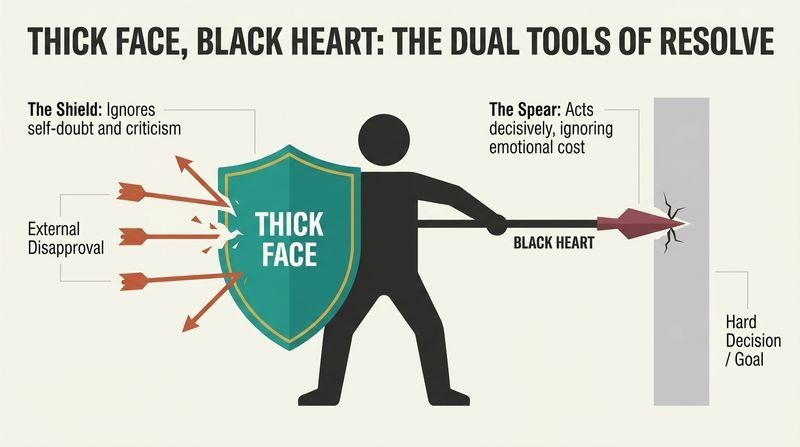
Two tools, one strength. Chin-Ning Chu builds her philosophy on Lee Zhong Wu's banned 1911 tract, Thick Black Theory. Thick Face is a psychological shield: the capacity to silence self-doubt and the disapproval of others while holding an unshakable image of your own worth. She contrasts Ronald Reagan, who acted decisively even when ignorant of issues and stayed popular, with Jimmy Carter, who agonized publicly and was voted out. Black Heart is the spear: acting toward your goal without being paralyzed by how the cost falls on others. Picture a surgeon before anesthesia cutting through the patient's screams, or a general who must send soldiers to die. Ruthless, yes, but not necessarily evil.
Inseparable. The same inner steel that ignores ridicule also lets you cut cleanly toward your aim.
What's striking is how neatly this maps onto modern psychology. Thick Face resembles Bandura's self-efficacy and the impression-management research showing that confidence itself signals competence to observers. Black Heart echoes what decision scientists call the paralysis of empathy: leaders who cannot tolerate imposing costs often impose larger ones through inaction. The Reagan-Carter framing is politically loaded and arguable, since self-assurance can also mask incompetence. Still, the core distinction between protecting your inner state and executing despite discomfort is durable. The book's provocation is deliberate: by using words like ruthless, Chu forces readers to separate effective action from the moral judgments that usually smother it.
Ruthlessness climbs three levels; aim for the warrior, not the con man
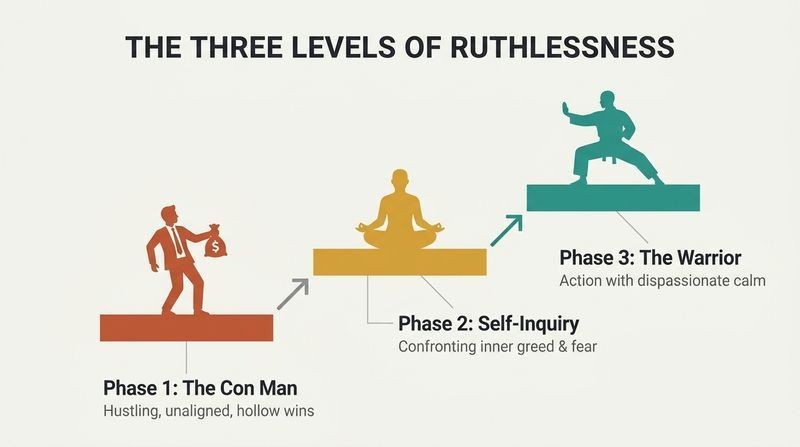
Not all ruthlessness is equal. Chu splits the philosophy into three phases. Phase One is winning at all costs with no conscience, the realm of hustlers, corrupt executives, and the savings-and-loan swindlers who bled trusting depositors dry. It works, but the victory is hollow. Phase Two is self-inquiry, when a person recoils from that cruelty and confronts their own inner enemies: greed, envy, fear, hypocrisy. Phase Three is the warrior, who fuses both, doing hard battle with dispassion and detachment.
The warrior's mark is calm. A thirteenth-century sage observed that even the greatest fighter sweats with fear on the battlefield, yet his spirit stays fearless. The warrior is not numb; he simply refuses to be controlled by emotion, pressing forward with grace rather than being ground down like grain in a millstone.
This tiered model quietly answers the obvious objection that the philosophy is a manual for sociopaths. Chu insists the crude version, divorced from what she elsewhere calls Dharma, produces predators. The framing resembles developmental stage theories such as Kohlberg's moral stages or Kegan's orders of mind, where the same behavior means different things depending on the consciousness behind it. The weakness is that Phase Three is defined largely by spiritual language that resists verification. How does an observer distinguish a serene warrior from a polished Phase One operator? Chu's own answer, that the difference lies in inner motive rather than outer act, is honest but hard to audit.
Your addiction to being nice is costing you; reclaim your true self
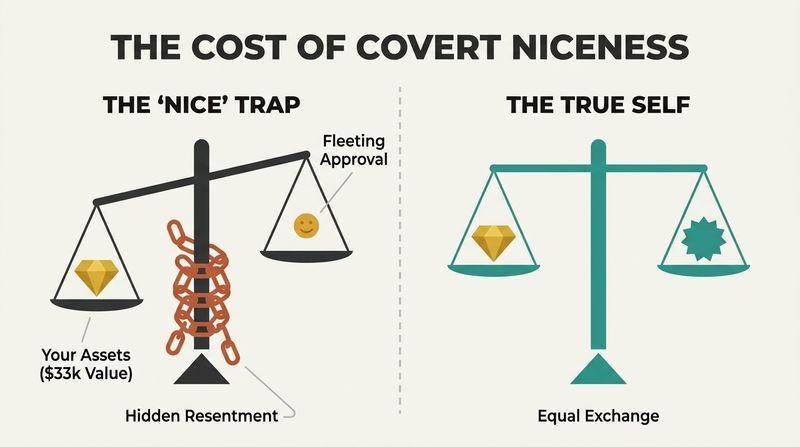
Approval is a trained reflex. From childhood, Chu argues, we learn that goodness means pleasing parents, teachers, and playmates, tangling morality up with the need for others' approval. The result is covert selfishness disguised as virtue, and a life spent purchasing goodwill by surrendering our own interests. She paid a literal price for this. She gave a Washington contact thousands of dollars' worth of media booking connections as a favor, then let him pressure her into renewing a subscription she did not want. She calls it a $33,000 lesson, because had she named the value of her contacts and bartered them, she could have secured that much in speaking engagements.
Niceness with a hidden ledger. Her giving was not truly generous; it was a bid for approval, and it left her resentful.
The insight anticipates what therapists now call people-pleasing or fawning, a stress response as real as fight or flight. Research on emotional labor and self-silencing links chronic accommodation to burnout, resentment, and depression, especially in women, whom Chu explicitly addresses. Her sharpest point is subtle: unconditional generosity is admirable, but disguised, expectation-laden giving corrodes relationships because the ledger eventually surfaces. The prescription is not to become cold but to be honest about what you want and to price your value openly. A useful complement is the negotiation literature's finding that people who never state their worth are systematically underpaid, regardless of talent.
In every situation ask: what is my duty right now?
Dharma is the compass. Borrowed from Sanskrit, Dharma means acting in accordance with your duty in a given moment. A warrior's duty is to slay enemies; a physician's is to save even enemies. Opposite acts, both correct. Chu makes Dharma the moral foundation that separates a righteous practitioner from a mere winner-at-all-costs. She tells of Leslie, a bookkeeper who discovered the owner's sons were embezzling. Duty-bound, she risked her job to report it. Instead of shooting the messenger, the owner fired her sons and sold Leslie the company on installments from its own receivables.
Duty protects you. In the Bhagavad Gita, the warrior Arjuna despairs at fighting his kinsmen until Krishna tells him to perform his duty without passion or attachment. Chu's employees, salesmen, and debtors all find clarity by asking the same question.
Anchoring ambition to duty is what keeps this philosophy from collapsing into pure Machiavellianism, and it resonates with modern research on purpose and meaning. Viktor Frankl argued that people endure almost any how when they have a why; Angela Duckworth's grit studies link sustained achievement to a sense of calling rather than raw drive. The Leslie story is almost too tidy, functioning more as parable than proof, since whistleblowers are frequently punished, not rewarded with companies. The deeper claim is defensible: acting from a clear sense of role reduces the paralysis of self-interested calculation and, as behavioral studies of intrinsic motivation show, often produces better long-term outcomes than transactional scheming.
Stop fixing your negativity; succeed exactly as you are
Positivity is oversold. Chu attacks the self-help gospel that you must convert negative attitudes to positive ones before you can win. Success, she insists, has no rules and no personality prerequisite. Mark Twain was a sarcastic pessimist, and that darkness fueled his genius. Lincoln was melancholy and self-doubting. She urges readers to weaponize their so-called flaws: turn jealousy into fuel to surpass rivals, turn worry into action, turn a love of eating into a food career.
Remember the wombat. This slow, fat, thick-skinned Australian creature never learned to be a lean fighting machine. When a predator's head enters its burrow, the wombat crushes it against the roof using its bony back. It defends itself with its liabilities. The evil is never the trait itself, only our guilt-ridden judgment of it.
This is a bracing corrective to toxic positivity, and empirical psychology increasingly agrees. Defensive pessimism, studied by Julie Norem, shows that some high performers do better by anticipating worst cases rather than forcing optimism. Research on emotional acceptance versus suppression finds that fighting negative feelings often amplifies them, while acceptance frees energy for action, precisely Chu's advice to ignore the inner critic rather than argue with it. The caution is that some negative patterns, like chronic hostility or avoidance, genuinely impair outcomes and health. Chu's blanket reframing risks romanticizing dysfunction. The wombat metaphor lands because it targets the judgment, not the trait, as the real saboteur.
Greatness is measured by how much you can endure, not how fast you win
Ascend before you soar. Chu retells Chuang Tzu's fable of the Pung, a giant bird that must beat its wings upward for ninety thousand kilometers, making no visible progress, mocked by smaller birds, before it can glide to its destination. Extraordinary journeys demand extensive, invisible preparation. She reminds us that Lincoln failed in business, lost his sweetheart, suffered a breakdown, and lost race after race before becoming president at fifty-two. A Chinese maxim she cites: defeat is the mother of success.
Endure by enduring. When a young man asked an elder how to endure, the elder simply said, you endure by enduring. In crisis, she counsels giving up the struggle, letting solutions surface, and even choosing inactivity, because thrashing like a drowning swimmer prevents rescue.
Endurance as the master virtue aligns with a large body of modern evidence. Duckworth's grit, Carol Dweck's growth mindset, and Nassim Taleb's antifragility all argue that adversity tolerance predicts success better than talent or speed. Chu's insistence that we are judged only at death cleverly removes the tyranny of arbitrary deadlines that make people quit prematurely. Her advice to embrace inactivity during chaos parallels the counterintuitive wisdom that in many complex systems, doing nothing beats reactive meddling. The blind spot: not all endurance is virtuous. Persisting in a doomed venture is the sunk-cost fallacy. The skill she underweights here is discerning which battles deserve endurance.
Money is guarded by two spears: the outer battle and the inner one
Read the character. The Chinese word for money, Chu notes, combines gold with two spears. The first spear is the outward struggle for survival and resources; anyone who wants a share of the earth's abundance must fight for it. The second, and more important, is the inner battle. Poverty, she argues, is more a state of mind than a bank balance. Most people settle for small rewards because they secretly believe they are unworthy of finer things.
Choose your ground. A self-made man told her the world is a pyramid of people struggling; you cannot avoid the fight, but you can choose where to stand. Do not fight at the crowded bottom. Car salesmen know it is often easier to sell a luxury car than a beat-up used one to someone who can barely afford it.
The claim that poverty is largely psychological is both powerful and hazardous. It is powerful because self-worth demonstrably shapes salary negotiation, risk-taking, and persistence, and because Chu's advice to aim high echoes findings that ambitious anchors produce better outcomes. It is hazardous because it flirts with victim-blaming, ignoring the structural barriers, discrimination, and luck that behavioral economists like Sendhil Mullainathan document, whose work shows scarcity itself taxes cognition and traps people. Chu's own story of watching her wealthy parents fail to rebuild their fortune, precisely because they never fought the inner and outer battles, is a genuinely sharp illustration that inherited or accidental wealth builds no such muscle.
Deceive without deceit by wrapping a real benefit in attractive bait
The worm hides the hook. Chu treats deception as a morally neutral tool, evil only in its use, citing Sun Tzu's dictum that war is a game of deception and appearing weak when strong. The businessman and the con man both use bait; the difference is that the businessman ultimately delivers the promised benefit and the con man never intends to.
Selling grass to China. The Chinese saw grass as a weed to pull up, so selling them lawn seed was like selling refrigerators to Eskimos. Instead of pitching directly, Chu told officials the naive Americans wanted low-cost production and would buy the seed back, letting China earn foreign currency. Knowing China could not produce it cheaply, she used the venture to teach them the seed's value. They soon bought it directly, and it starred at the 1990 Asian Games.
This is applied game theory dressed in Taoist strategy. The grass-seed maneuver is essentially a demonstration effect: lower the perceived risk of trying something until experience does the persuading, a tactic marketers formalize as the free trial or the loss leader. Chu's ethical line, that deception becomes fraud only when the promised value never materializes, is a serviceable working standard, close to how contract law distinguishes puffery from misrepresentation. The uncomfortable question she leaves open is consent: the Chinese officials acted on a framing she engineered, even if they ultimately benefited. Beneficial paternalism is still paternalism, a tension that also haunts modern behavioral nudging.
When winning costs more than losing, play the fool and yield
Submission can be strategy. Chu argues that no matter how strong you are, someone is stronger, so the crucial skill is knowing when to fight and when to bend. Japan, crushed in World War II, chose decades of silent submission and rose to economic dominance. She invokes a lesson from St. Francis: when you win, you lose, illustrated by a man who spent three years and his savings winning a lawsuit against a fraudster who had already liquidated everything.
The third option. When a Japanese businessman used her for free market information without committing, she rejected both revenge and quiet resentment. She chose to play the fool, endure, and stay available for future business while banishing the possibility of loss from her mind. A year later he placed a sizeable order.
Yielding as power is the essence of judo and of Taoist water imagery, and it maps onto negotiation research on BATNA and emotional detachment: the party who can walk away, and who refuses to let ego drive the interaction, holds leverage. Chu's reframing of waiting as being available rather than anxiously expecting is psychologically astute, resembling acceptance-based therapies that reduce suffering by loosening attachment to outcomes. The risk is that endless yielding shades into learned helplessness or lets exploiters run unchecked. Chu guards against this by pairing submission with an unwavering internal objective, so the fool's mask is tactical, never a genuine surrender of intent.
Cultivate the killer instinct: the courage to finish the job cleanly
Finish, or lose everything. The killer instinct, Chu's term for the root of Black Heart, is the will to complete a task decisively despite fear or squeamishness. She dramatizes it through the ancient rivalry of Xiang Yu and Liu Bang. Xiang Yu was the superior warrior but spared his captured rival out of a false sense of honor; that mercy let Liu Bang escape, regroup, and conquer him. Liu Bang, blacker of heart, once told an enemy threatening to boil his captured father alive to send him a cup of the broth.
Flipping a pancake. Chu insists this instinct is not violence but a state of total, detached focus. Too timid and the pancake flops; too forceful and it lands on the stove. The sword master Musashi put it plainly: whatever your state of mind, ignore it, think only of cutting.
Chu is describing what performance psychologists call task focus under pressure, or being in the zone, where self-consciousness and outcome anxiety dissolve into pure execution. Surgeons, elite athletes, and fighter pilots train precisely this detached completion. The pancake metaphor is the book's best democratizing move, insisting the same mental state governs the mundane and the momentous. The Liu Bang story is genuinely unsettling and reveals the philosophy's hard edge: Chu argues that at the decisive moment, clinging to a flattering self-image of nobility is itself a failure of duty. The modern reader should note the difference between finishing worthy tasks and rationalizing cruelty, a line Chu draws through Dharma but that ambition easily blurs.
Detachment is the secret key: stop wanting, and the thing arrives
The lotus in the mud pond. Chu names detachment the highest code of living, the power source behind everything else. The detached person owns his possessions rather than being owned by them, like a lotus that grows from mud yet stays untouched by it. Her paradox: notice how the moment you stop wanting something, it tends to come to you naturally. She learned this the hard way. After pushing herself and her editor to exhaustion to publish a book on schedule, Operation Desert Storm swallowed all media attention and the launch flopped, teaching her that human striving is nothing against what she calls Heaven's timing.
Acceptance, not passivity. Detachment does not mean abandoning effort. It means doing everything in your power, then gracefully accepting the outcome, which frees you to act with courage and clarity rather than fear.
This is the Bhagavad Gita's central teaching, act without attachment to the fruits, and it has striking modern support. Studies of intrinsic versus extrinsic motivation find that obsessive focus on rewards degrades both performance and well-being, while process focus enhances both. The counterintuitive claim that releasing desire attracts the object has a mundane mechanism: desperation repels, whether in dating, sales, or negotiation, while calm confidence signals value. The mystical framing, invoking Heaven's timing, will strain secular readers, and it risks becoming an all-purpose rationalization for any disappointment. Yet stripped to psychology, the principle is sound: attachment breeds the anxiety that sabotages the very outcomes we chase.
Conquer fear by staring into its eyes, not running from it
Fear is energy, not verdict. Chu, raised in a household where fear was, she says, served at every meal, treats fear as the biggest barrier to potential and offers a counterintuitive method: stop resisting it. The more she tried not to feel afraid before her first seminar, the worse it grew. So she mentally placed the fear on her car dashboard and stared at it fiercely, resolving to be more fierce than the fear itself. By the time she arrived, dread had converted into power, and the seminar was a hit.
Dissolve separation. She traces fear to a sense of being separate from the oneness of things. Afraid of deep water, she calmed herself by affirming unity with the ocean. A salesman fears the customer only when he sees their interests as opposed; find shared benefit and the fear evaporates.
Chu's stare-down technique prefigures exposure therapy, the most evidence-based treatment for anxiety, which works by ceasing avoidance and letting the feared stimulus be faced until arousal subsides. Her reframe of fear as raw energy convertible to exhilaration matches research on emotional reappraisal, where subjects told to relabel anxiety as excitement outperform those told to calm down, since both states share the same physiological signature. The sales example is quietly brilliant, locating fear in perceived zero-sum conflict and dissolving it through genuine mutual benefit. The unity mysticism may not persuade everyone, but the operational core, approach rather than flee, and reframe rather than suppress, is among the most reliably validated findings in modern clinical psychology.
Analysis
Thick Face, Black Heart occupies an unusual niche: a 1992 business-philosophy book that smuggles Taoist, Hindu, Confucian, and Buddhist metaphysics into the vocabulary of Reagan-era American ambition. Chin-Ning Chu's achievement is synthetic rather than original. She takes Lee Zhong Wu's cynical, banned 1911 analysis of how power actually operates and fuses it with the Bhagavad Gita's ethic of detached duty, producing something neither purely Machiavellian nor purely spiritual. The tension between those poles is the book's engine and its instability.
The central move is rhetorical and shrewd: by deliberately using repellent words like ruthless and black-hearted, Chu forces Western readers to separate effective execution from the moral squeamishness that usually smothers it. This is genuinely useful. Much of what she calls Thick Face is now validated as self-efficacy and emotional reappraisal; much of Black Heart is task focus under pressure and tolerance for imposing necessary costs. Her insistence that endurance, not talent or positivity, separates achievers from pretenders anticipates the grit and antifragility literatures by two decades.
The book's weakness is verifiability and safety rails. Concepts like Dharma, the three gunas, and Heaven's timing do the heavy moral lifting, yet resist audit. The same framework that produces Leslie the rewarded whistleblower could rationalize the exploitation Chu elsewhere warns against. Her anecdotes are parables, selected for resonance, not representativeness, and her claim that poverty is chiefly a mental state underweights structure and luck.
Read critically, though, the book delivers something rare in the genre: permission to stop performing virtue for approval, to accept one's flawed temperament, and to act decisively without waiting to become worthy first. Its enduring value is psychological liberation dressed as strategy. The warrior it describes is ultimately someone who has made peace with being disliked, an underrated prerequisite for doing anything significant.
Review Summary
Thick Face, Black Heart receives mixed reviews, with many praising its unique perspective on success and power dynamics. Readers appreciate its blend of Eastern and Western philosophies, practical advice, and thought-provoking insights. Some find it life-changing and a masterpiece of contradictions. However, critics argue it promotes selfishness, lacks coherence, and misinterprets Eastern wisdom. The writing style and religious references are divisive. Despite controversy, many readers consider it a valuable resource for personal growth and understanding Asian business culture.
People Also Read








FAQ
What's Thick Face, Black Heart about?
- Inner Strength Focus: Thick Face, Black Heart by Chin-Ning Chu emphasizes the importance of inner strength as the true path to success in both personal and business life.
- Dual Concepts Explained: The title refers to "Thick Face," the ability to withstand criticism, and "Black Heart," the capacity to act decisively and ruthlessly when necessary.
- Practical Application: The book provides strategies and insights for embracing one's true self and pursuing goals without fear of judgment.
Why should I read Thick Face, Black Heart?
- Timeless Wisdom: Offers wisdom that transcends cultural boundaries, relevant for personal or professional growth.
- Transformative Insights: Helps readers gain insights into their behaviors and thought processes, encouraging a mindset shift.
- Practical Strategies: Provides actionable strategies for improving life and achieving success.
What are the key takeaways of Thick Face, Black Heart?
- Embrace Inner Strength: Success comes from understanding and harnessing one's inner strength, essential for overcoming obstacles.
- Balance Ruthlessness and Compassion: Balancing ruthlessness (Black Heart) with self-esteem (Thick Face) is crucial for effective leadership.
- Dharma as a Guiding Principle: Following one's Dharma leads to fulfillment and success, aligning actions with true purpose.
What are the best quotes from Thick Face, Black Heart and what do they mean?
- "Character is not made of sunshine and roses.": True character is forged through challenges, not just positive experiences.
- "Defeat is the mother of success.": Failures are stepping stones to success, encouraging viewing defeat as a learning experience.
- "When you conceal your will from others, that is Thick.": Thick Face involves maintaining a strong self-image, regardless of external opinions.
What is the concept of Thick Face and how is it applied?
- Definition of Thick Face: Ability to protect self-esteem from criticism and negative opinions, acting as a shield.
- Practical Application: Enables individuals to ignore societal pressures and act decisively and confidently.
- Cultural Context: Rooted in Asian philosophies, emphasizing dignity and self-respect.
What is the Black Heart and how does it relate to success?
- Definition of Black Heart: Represents the ability to take decisive action without concern for others' consequences.
- Importance in Leadership: Crucial for leaders making tough decisions for the greater good.
- Balance with Thick Face: Actions should be taken with integrity and self-respect, balancing decisiveness with compassion.
How does Thick Face, Black Heart address the idea of negative thinking?
- Reframing Negativity: Negative thinking can be a source of motivation and a catalyst for action.
- Acceptance of Self: Encourages accepting negative thoughts and feelings without judgment, using them for growth.
- Success Regardless of Attitude: Success is not solely dependent on mindset but also on actions taken.
What role does Dharma play in Thick Face, Black Heart?
- Definition of Dharma: Understanding one's duty and appropriate actions for any circumstance.
- Connection to Success: Following Dharma aligns actions with innate strengths and values, crucial for long-term goals.
- Practical Examples: Illustrates how adhering to Dharma leads to success in various contexts.
How can I apply the principles of Thick Face, Black Heart in my life?
- Self-Reflection: Reflect on strengths and weaknesses to cultivate a Thick Face or Black Heart.
- Set Clear Goals: Establish goals aligning with Dharma for focused efforts and decision-making.
- Embrace Challenges: View challenges as growth opportunities, adopting resilience and determination.
What is the Thick Face, Black Heart method?
- Definition: Combines resilience (Thick Face) with strategic ruthlessness (Black Heart) to navigate challenges.
- Practical Application: Applied in business negotiations and personal relationships, maintaining integrity while being assertive.
- Cultural Relevance: Draws from Eastern philosophies, emphasizing understanding oneself and opponents for victory.
How does Thick Face, Black Heart relate to leadership?
- Leadership Qualities: Essential qualities include compassion, wisdom, and the ability to inspire others.
- Power and Responsibility: True leadership involves guiding and protecting one's team, linking power with accountability.
- Self-Reflection: Leaders should engage in self-reflection to foster trust and respect among followers.
What are the seven stages of self-unfoldment in Thick Face, Black Heart?
- Desire to Do Right: Involves a strong moral desire, often with feelings of helplessness and frustration.
- Confusion and Negativity: Recognizing self-victimization through denial, marked by anger and confusion.
- Acceptance of Imperfect Perfection: Embracing flaws and recognizing inherent worth, leading to authentic self-expression.
Download PDF
Download EPUB
.epub digital book format is ideal for reading ebooks on phones, tablets, and e-readers.








































