

Key Takeaways
These women were extraordinary through God's grace, not their own talent
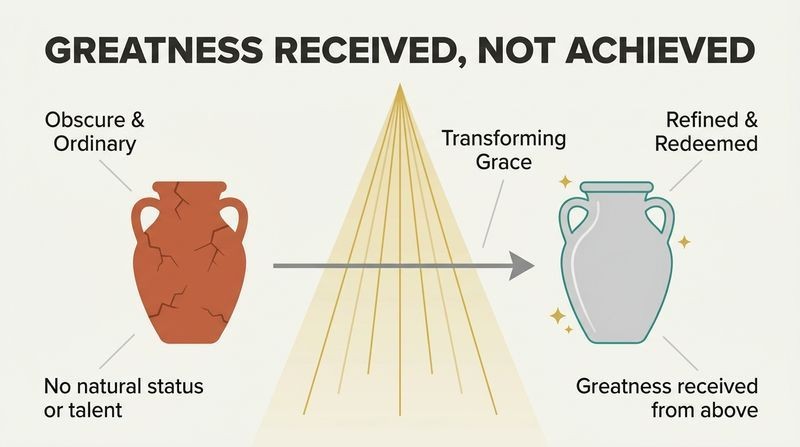
MacArthur's central thesis reverses expectation. His companion volume called the apostles ordinary; here he calls the women extraordinary, yet insists most were unremarkable in themselves. A Samaritan divorcee whose name is lost, an obscure elderly widow named Anna, a prostitute named Rahab, a peasant teenager from a despised village. What set them apart was not beauty, wealth, or status but a transforming encounter with the God of Israel.
The pattern holds across all twelve. Eve began in perfection and fell; the rest rose from obscurity. In each case the same divine grace refined them like silver. The lesson is deliberately democratic: extraordinariness is available to anyone God chooses to redeem, which reframes greatness as something received rather than achieved.
What's striking is how this inverts modern celebrity logic, where we assume the famous possess rare innate gifts. The sociologist's concept of the halo effect (we retroactively invent virtues to explain success) is precisely what MacArthur resists. His view resembles the Calvinist doctrine of monergism: God does the decisive work. A skeptic might counter that attributing all merit to grace can erase human agency and courage, flattening genuinely different personalities into interchangeable vessels. Yet MacArthur preserves the individuality of each woman, which suggests grace amplifies character rather than dissolving it. The framing offers dignity to the overlooked, an oddly egalitarian message inside a hierarchical worldview.
Scripture judges a woman by character, not appearance or resume
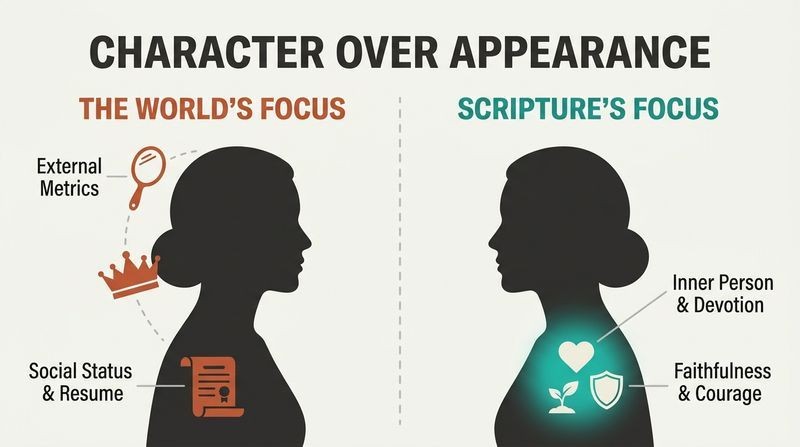
MacArthur repeatedly notes what the Bible declines to tell us. Eve was surely of unsurpassed beauty, yet Scripture gives zero physical description, focusing instead on her duty and role. Sarah's legendary looks are mentioned, but her enshrinement in the Hall of Faith rests on perseverance. The apostle Peter located true beauty in the inner person, a gentle and quiet spirit, rather than in braided hair, gold, or fine clothing.
The practical upshot: measure worth by faithfulness, hospitality, courage, and devotion rather than external metrics. MacArthur argues Western culture, including much of the church, has grown confused on this point, obsessing over image, cosmetics, and body shape. The biblical women were influential because of who they were internally, not what they looked like or which position they held.
This lands in interesting tension with contemporary body-positivity and beauty-industry critiques, which arrive at a similar destination (stop over-valuing appearance) from opposite premises. Psychology research on the attractiveness halo confirms MacArthur's worry: attractive people are presumed kinder and smarter, a bias that distorts judgment. Where readers may push back is the adjacent claim that character for women is best expressed domestically. That is a separate argument from the appearance point, and conflating them weakens both. The stronger, universally portable insight is simply that durable respect flows from conduct, a claim virtue ethicists from Aristotle onward would endorse regardless of theology.
Believe God's promise longest when every earthly reason for hope is dead

Sarah waited until age ninety to bear Isaac. God deliberately delayed until natural fertility was exhausted, so that no one could credit anything but divine power. MacArthur frames this as the whole point of the delay: God's timetable often runs past the deadline of human possibility. Sarah's faith is called extraordinary precisely because it survived twenty-five years of silence after the initial promise.
Her failure illuminates the same principle. Impatient, she engineered a shortcut, giving her servant Hagar to Abraham. The scheme produced Ishmael and a lifetime of bitter household strife, which MacArthur ties to enduring Middle Eastern tension. The contrast is instructive: faith waits on God's power, while flesh manufactures counterfeit fulfillments. Hannah echoes this, praying for years before Samuel arrived, then surrendering him back to God.
The psychology of delayed gratification (Mischel's marshmallow work) offers a secular parallel: the capacity to wait predicts better outcomes. But MacArthur's point cuts deeper than self-control; it concerns trusting an external agent whose timing you cannot control, which is closer to what researchers call tolerance of uncertainty. The Hagar episode is a sharp case study in what behavioral economists call action bias, our compulsion to do something rather than wait, even when waiting is optimal. What's valuable here is the reframe of barren decades not as God's absence but as the setup for an unmistakable outcome, a narrative device that turns delay into meaning.
God rebuilds the most wrecked life, even a prostitute's, into a hero
Rahab was a working prostitute in Jericho, a city God had marked for total destruction. MacArthur calls her a moral bottom-feeder in a culture that had filled the measure of wickedness. Yet she hid the Israelite spies, staked her life on their God, and was spared. The New Testament names her among the heroes of faith and places her in the very genealogy of Christ.
MacArthur is careful: Rahab is not commended for the lie she told to protect the spies, nor did she earn rescue by good deeds. She is an example of faith producing immediate action. He rejects attempts by embarrassed commentators to sanitize her into a mere innkeeper, quoting Spurgeon's insistence that she was a real harlot. Remove the stigma of sin, MacArthur argues, and you remove the need for grace.
The refusal to launder Rahab's past is the intellectually honest move, and it anticipates a genuine problem in hagiography: the tendency to retroactively purify saints until they become useless as models for actual sinners. Addiction-recovery literature makes the same discovery, that testimony loses its power when the wreckage is edited out. There is also a shrewd theological point buried here about lying. MacArthur declines to justify it even for a good cause, resisting situational ethics. Some readers will find that rigid, given the Nazis-at-the-door thought experiment philosophers use to defend protective deception. But his separation of Rahab's faith from her methods is a clean analytical distinction.
Loyalty that costs you everything is the truest form of love
Ruth, a Moabite widow from a nation Israel despised, refused to abandon her destitute mother-in-law Naomi. Her declaration (your people will be my people, your God my God) bound her to poverty, foreignness, and an uncertain future. MacArthur reads her as a picture of every sinner: an outcast with no resources who cannot redeem herself.
Rescue comes through Boaz, her goel, a Hebrew term meaning kinsman-redeemer, a relative with the legal right and means to buy back family land, pay off debts, or marry a childless widow to preserve the family line. Boaz, himself a descendant of Rahab, redeems Ruth's poverty and marries her. Their son becomes grandfather to King David. The impoverished foreigner enters the royal, messianic line, illustrating how redemption elevates the destitute into unearned privilege.
The goel institution is a fascinating piece of ancient social engineering. By legally obligating kin to rescue impoverished relatives and by preventing permanent land sales (reversion at Jubilee), Israelite law built an anti-poverty mechanism into family structure, a form of distributed social insurance that predates the welfare state by millennia. Anthropologists studying gift economies and kin obligation would recognize it instantly. Ruth's story also functions as quiet polemic: a Moabite, member of a reviled group, is celebrated as more faithful than native Israelites, an early instance of Scripture undercutting ethnic pride. The theme of loyalty transcending self-interest anticipates what evolutionary biologists call costly signaling, commitment proven by sacrifice.
Turn frustration into prayer instead of complaint or nagging
Hannah desperately wanted a child while her husband's second wife taunted her cruelly. MacArthur highlights that she never grumbled against God or badgered her husband. Instead her anguish drove her toward God, not away. She prayed silently and so intensely that the priest Eli mistook her for drunk. Her distinctive virtue was constant, steadfast faith that cast its burden on God and then left it there, so that she departed the temple with her face no longer sad.
MacArthur draws a parenting principle from her. The most important trait of a godly mother, he argues, is not her bond with her children but her love for her husband; a healthy home has marriage at its center rather than revolving around the kids. Hannah dedicated Samuel to God's service, surrendering him young, and he became Israel's pivotal prophet.
The move from silent, non-performative prayer to emotional relief maps neatly onto modern research on expressive writing and disclosure (Pennebaker's studies), where articulating distress, even without solving it, measurably reduces anxiety. Hannah essentially practices cognitive offloading. The claim that spousal love matters more than parental focus is supported by family-systems therapy, which finds that a strong marital dyad stabilizes children better than child-centered households. Where the argument narrows is the framing of motherhood as the highest calling; MacArthur hedges by citing Deborah and Miriam, but the tension with his own examples of childless, influential women suggests the principle is more about wholehearted devotion than domesticity per se.
Mary was blessed by God, never a dispenser of blessing herself
MacArthur presents Mary as supremely favored yet emphatically ordinary: a teenage peasant from Nazareth, a town so lowly a future disciple asked whether anything good could come from it. He mounts a direct critique of elevating her to near-divine status, arguing that veneration, prayers addressed to her, and titles like co-redemptrix have no biblical warrant. Mary herself called God her Savior, an admission that she needed redemption from sin.
Crucially, Jesus twice gently corrected attempts to leverage her maternal authority over his mission, at the Cana wedding and when his family tried to pull him from the crowds. As man he was her son; as God he was her Lord. Her own song of praise magnifies God's greatness while repeatedly confessing her lowliness. She points consistently away from herself and toward her son.
This is the book's most polemical chapter, a Protestant argument against Marian devotion, and readers from Catholic or Orthodox traditions will contest the exegesis (the brothers of Jesus, the meaning of blessed among women). Setting the denominational dispute aside, the psychological observation is sharp: humans crave an approachable, maternal intercessor, which is why Marian piety flourishes across cultures. That impulse resembles what attachment theory describes as seeking a secure, nurturing figure. MacArthur's counter is that Mary modeled worship rather than receiving it. The stronger transferable insight, independent of doctrine, is her self-effacement: greatness that deflects credit upward, the opposite of self-promotion, which leadership studies increasingly link to durable influence.
Decades of faithful, unseen devotion prepare you for one defining moment
Anna appears in just three verses of Luke, yet MacArthur builds a full portrait. A widow after only seven years of marriage, she had spent perhaps six decades fasting and praying in the temple, never departing from it. When the infant Jesus was brought for dedication, she recognized the Messiah instantly and began telling everyone awaiting redemption. Her lifetime of quiet preparation positioned her to become one of Christ's earliest witnesses.
MacArthur clarifies that prophetess did not mean fortune-teller or office-holder; only five women in the entire Old Testament carry the title. It designated a woman devoted to declaring God's Word. Anna's constant fasting-with-prayer signaled a heart so consumed with its request that food lost interest. Her example: obscure, sustained faithfulness is not wasted; it is rehearsal for a purpose you cannot yet see.
Anna embodies what psychologists call preparation meeting opportunity, or in Pasteur's phrase, chance favoring the prepared mind. Sixty years of scriptural immersion meant recognition was instantaneous when the moment arrived. There is also a striking counterpoint to achievement culture here: Anna produces nothing measurable for decades, yet the narrative treats that hidden constancy as the whole point. Contemplative traditions across religions (Buddhist monasticism, Christian desert fathers) similarly valorize unseen faithfulness. A modern skeptic might ask whether idealizing lifelong widowed seclusion romanticizes what was, for most ancient widows, brutal economic hardship with no alternative. MacArthur acknowledges widowhood nearly guaranteed poverty, which makes Anna's chosen devotion more remarkable, not less.
Jesus revealed himself as Messiah first to a shamed Samaritan outcast
In John 4, Jesus deliberately traveled through Samaria, territory pious Jews detoured miles to avoid, and initiated conversation with a woman fetching water alone at midday, likely because her five marriages and current live-in relationship made her a village outcast. MacArthur stresses the layered scandal: a Jewish man speaking to a Samaritan woman of ill repute, drinking from her vessel, discussing theology.
Then the astonishing turn. This is the very first time in the gospel record Jesus explicitly declares himself the Messiah, and he chooses her. He offers living water, exposes her sin without condemning it, and answers her theological question about where to worship by declaring that true worshipers worship in spirit and truth, not on any particular mountain. She becomes an evangelist, and her whole town believes. Her sin, once hidden, becomes the testimony she broadcasts.
The choice of recipient is the theological hammer blow. In status-conscious first-century Judea, revealing messianic identity first to a low-status foreign woman rather than to religious authorities is a calculated subversion. Sociologists of religion note that early Christianity spread disproportionately among the marginalized, women and the enslaved, and this scene functions almost as a founding charter for that pattern. The worship-in-spirit teaching also decentralizes religion from sacred geography, a radical move that anticipates the portability that let the faith go global. One might add that the woman's transformation from evasive shame to public testimony illustrates what trauma researchers call post-traumatic growth, where owning one's story becomes a source of power.
Sitting and listening to Christ outranks busily serving him
When Jesus visited the sisters Martha and Mary, Martha bustled with hosting duties while Mary sat at his feet listening. Martha, resentful, demanded Jesus order Mary to help. He gently refused: Mary had chosen the better portion. MacArthur uses this to establish worship as the highest priority, above even service rendered on Christ's behalf.
He extracts three lessons: prefer others over self (Martha's public criticism humiliated her sister and revealed pride creeping into good works), prioritize worship over service, and prize faith over works. The danger, he argues, is subtle: Martha's activity was genuinely good, but the moment doing for Christ eclipsed being with Christ, self-righteousness contaminated the whole enterprise. MacArthur admits he identifies with Martha, tempted to let ministry activity crowd out worship. Both sisters loved Jesus; the point is ordering, not condemning, their instincts.
This is a durable insight about the tyranny of usefulness. Modern productivity culture is essentially Martha-ism: identity built on output, worth measured in tasks completed. The chapter anticipates burnout research, which finds that helping professionals who lose their grounding sense of purpose collapse fastest. There is also a shrewd observation about how virtue curdles into vice through comparison: Martha's service was fine until she measured Mary against herself, at which point pride, resentment, and judgment ignited within minutes. Social psychology's work on upward comparison confirms the corrosive effect. The nuance MacArthur preserves, that action and contemplation are both gifts needing integration rather than a winner, keeps this from becoming anti-work.
Freedom from your darkest bondage fuels the fiercest loyalty
Mary Magdalene was delivered by Christ from seven demons, a torment MacArthur describes as relentless agony, not the sexual sin that later legend falsely pinned on her. He debunks the myths: she was not the anonymous sinner of Luke 7, not the adulteress of John 8, and certainly not Jesus's secret wife of pulp fiction. She was a woman freed from spiritual captivity who then followed him faithfully.
Her gratitude produced unmatched devotion. She stayed at the cross after most fled, tracked where the body was laid, came first to the tomb at daybreak, and became the first person to see the risen Christ. When he spoke her name, she recognized him instantly and clung to him. MacArthur contrasts her eagerness with the skeptical Thomas, whom Jesus had to coax; Mary needed no coaxing.
The point that the depth of rescue predicts the intensity of devotion echoes Jesus's own teaching that the one forgiven much loves much, and it finds secular support in gratitude research, where people who vividly recall being helped show stronger prosocial commitment. The demythologizing is also historically responsible; the conflation of Mary Magdalene with a repentant prostitute traces to a sixth-century papal sermon and stuck for 1,400 years, a cautionary tale about how casual textual conflation calcifies into dogma. That the risen Christ appeared first to a woman, whose testimony was legally worthless in that culture, is itself an argument some historians cite for the resurrection accounts' authenticity: no one inventing a legend would choose such witnesses.
You do not open your own heart; God opens it to believe
Lydia, a wealthy dealer in purple dye from Thyatira, became the first recorded European convert to Christianity. Paul, redirected by a vision from Asia to Macedonia, found no synagogue in Philippi (Jewish law required ten men to form one) and went to a riverside where women prayed. Lydia listened, and MacArthur emphasizes the exact wording: the Lord opened her heart to heed Paul's message.
This anchors his doctrine of grace. Even a sincere seeker like Lydia sought only because God was already drawing her. MacArthur insists this drawing is not coercion but liberation; grace does not shove people against their wills but makes Christ appealing so they come willingly. Lydia responded instantly, was baptized with her household, and pressed the missionaries to lodge with her, turning her home into Europe's first church despite the legal risk of harboring them.
This is Reformed theology's signature move, and it will divide readers along the ancient free-will debate that has run from Augustine versus Pelagius to Calvinism versus Arminianism. MacArthur's careful phrasing, that grace draws willingly rather than coerces, tries to dissolve the apparent contradiction between sovereignty and consent, a maneuver philosophers call compatibilism. Whether it succeeds is contested. Setting the metaphysics aside, the Lydia narrative carries a fine sociological observation: Christianity often advanced through economically independent women whose homes became house-churches, an infrastructure of hospitality that female patrons like Lydia uniquely supplied. Her willingness to absorb legal and financial risk to host the mission shows conviction expressed as concrete generosity, not mere sentiment.
Analysis
This is a devotional character study, the female sequel to MacArthur's Twelve Ordinary Men, built as an anthology of biographical sermons rather than a thesis-driven argument. Its structure is chronological through Scripture, from Eve to Lydia, and its intended audience is conservative evangelical readers, especially women and small-group Bible studies. The difficulty in summarizing lies in its double nature: it is simultaneously narrative retelling and doctrinal instruction, and its theology (complementarian gender roles, Reformed grace, anti-Marian polemic, biblical inerrancy) is inseparable from the storytelling.
The unifying architecture is Christocentric. MacArthur reads every woman as pointing forward or backward to Christ, tracing the messianic thread from God's promise in Eden that the woman's seed would crush the serpent through the genealogy running Eve, Sarah, Rahab, Ruth, to Mary. This gives the anthology cohesion but also flattens historical and personal distinctiveness into a single interpretive template, which a critical reader should notice.
The book's intellectual honesty is uneven but real. MacArthur refuses to sanitize Rahab's prostitution or Sarah's cruelty, and he vigorously debunks the Mary Magdalene mythology that Dan Brown popularized. Yet his complementarianism is asserted more than defended, resting on proof-texts and analogy to the Trinity rather than engagement with opposing scholarship, and his dismissal of feminism is polemical caricature.
What gives the work lasting value beyond its tradition is its recurring reversal: the overlooked, the shamed, and the foreign are chosen for the highest honors, and greatness is reframed as received grace rather than personal achievement. That message resonates well outside its theological home. The strongest transferable insights (waiting through delay, faithfulness in obscurity, worship over frantic usefulness, gratitude fueling loyalty) survive translation into secular psychology and virtue ethics. The weakest material is the gender-role apologetics, which many contemporary readers, including some evangelicals, will find dated. Read as literature and moral portraiture rather than systematic theology, it rewards.
Review Summary
Twelve Extraordinary Women receives mixed reviews. Some readers appreciate MacArthur's insights into biblical women's lives and faith, finding the book inspiring and educational. However, many criticize his interpretation as biased, misogynistic, and overly focused on traditional gender roles. Several reviewers note his anti-Catholic stance and tendency to make assumptions. While some praise the historical context provided, others feel the book lacks depth and misrepresents certain biblical figures. The book's treatment of Mary is particularly controversial, with some finding it disrespectful.
People Also Read








Glossary
Extraordinary (vs. Ordinary)
Made remarkable by graceMacArthur's organizing contrast with his earlier book on the apostles. The women were ordinary in background, talent, and status (some were outcasts) but became extraordinary through a transforming encounter with God, who refined and redeemed them. The point is that their greatness was received from God rather than generated by native ability, marriage, or worldly accomplishment.
Protevangelium
The first gospel in GenesisLiterally the first gospel. MacArthur's term for God's words in Genesis 3:15, spoken while cursing the serpent, promising that the woman's seed would bruise the serpent's head. He reads this as the earliest glimmer of the redemption plan, a hope Eve clung to and a thread traced through Scripture to its fulfillment in Christ.
Goel (kinsman-redeemer)
Relative who rescues familyA Hebrew legal term for a prominent male relative obligated to protect the family's honor: avenging a murdered kinsman, buying back sold family land, paying to free relatives from slavery, or marrying a childless widow to preserve the lineage. Boaz served as Ruth's goel. MacArthur presents the role as a living illustration of Christ redeeming his people.
Kiddushin
Binding Jewish betrothal yearThe formal Jewish engagement that legally bound a couple as husband and wife, typically lasting a year, dissolvable only by divorce, during which the partners lived separately with no physical relations. Mary was in kiddushin to Joseph when the angel announced she would conceive, which is why her pregnancy carried the stigma of apparent infidelity.
Levirate marriage
Marrying a brother's widowThe duty, described in Deuteronomy 25, for a surviving relative to marry a dead man's childless widow and father a child who would inherit the deceased's name and property. Refusal brought public disgrace. This obligation was central to the negotiation in which Boaz acquired the right to marry Ruth and preserve her late husband Mahlon's line.
Irresistible grace
God draws believers willinglyMacArthur's Reformed term for how God brings sinners to faith. He stresses it involves no coercion; grace does not force people against their wills but opens their hearts so they see their sin, despise what they once loved, and find Christ appealing, so they come willingly. Lydia, whose heart the Lord opened to believe, is his prime example.
FAQ
What's Twelve Extraordinary Women about?
- Focus on Biblical Women: The book explores the lives of twelve significant women from the Bible, highlighting their faith and influence.
- Character Studies: Each chapter is a character study that delves into the unique qualities and experiences of women like Eve, Sarah, Rahab, and Ruth.
- Encouragement for Readers: John F. MacArthur Jr. aims to inspire readers by illustrating how these women navigated their challenges and maintained their faith in God.
Why should I read Twelve Extraordinary Women?
- Inspiration from Real Lives: The book provides inspiration through the real-life stories of women who overcame adversity and exemplified faith.
- Understanding God’s Grace: It emphasizes the theme of grace, showing how God can redeem and use anyone, regardless of their past.
- Practical Applications: MacArthur provides practical applications of the lessons learned from these women, encouraging readers to apply these principles in their own lives.
Who are the twelve women featured in Twelve Extraordinary Women?
- Diverse Backgrounds: The women include Eve, Sarah, Rahab, Ruth, Hannah, Mary, Anna, the Samaritan Woman, Martha and Mary, Mary Magdalene, and Lydia.
- Key Themes: Each woman’s story illustrates themes of loyalty, love, grace, and redemption.
- Significance in Redemption: The author highlights how each woman played a critical role in the story of redemption.
What are the key takeaways of Twelve Extraordinary Women?
- God’s Faithfulness: A central takeaway is that God remains faithful to His promises, as demonstrated through the lives of these women.
- Redemption and Grace: The book emphasizes that no one is beyond redemption; God can transform lives and use anyone for His purposes.
- Encouragement for Women: It serves as an encouragement for women today, affirming their value and potential in God’s plan.
What are the best quotes from Twelve Extraordinary Women and what do they mean?
- “The God of Abraham, Isaac, and Jacob is the God of Sarah, Rebekah, and Rachel too.”: This quote emphasizes the continuity of God’s faithfulness across generations.
- “What made them extraordinary was a memorable, life-changing encounter with the God of the universe.”: This highlights that true greatness comes from a relationship with God.
- “Your life can be extraordinary, too, by His wonderful grace.”: This serves as a reminder that every reader has the potential for an extraordinary life through faith.
How does John F. MacArthur Jr. approach the stories of these women in Twelve Extraordinary Women?
- Character Study Format: MacArthur uses a character-study format, focusing on the personal attributes, struggles, and faith of each woman.
- Biblical Context: He grounds each story in its biblical context, providing historical and cultural insights.
- Practical Application: The author draws practical applications from each story, encouraging readers to see themselves in these women.
How does Twelve Extraordinary Women address the theme of motherhood?
- Motherhood as a High Calling: The book presents motherhood as one of the highest callings a woman can have, particularly through the example of Hannah and Mary.
- Influence on Future Generations: It emphasizes that a mother’s faith and values significantly impact her children and future generations.
- Balance of Priorities: The book discusses the importance of balancing love for God, husband, and home.
What lessons can be learned from Hannah’s story in Twelve Extraordinary Women?
- Power of Prayer: Hannah’s persistent prayer life exemplifies the importance of bringing one’s burdens before God.
- Dedication to God: Her vow to dedicate her son Samuel to God’s service illustrates the significance of prioritizing spiritual commitments.
- Faith Amidst Trials: Hannah’s story teaches that faith can flourish even in the face of deep disappointment and heartache.
How does Lydia’s story in Twelve Extraordinary Women illustrate the importance of hospitality?
- Welcoming the Gospel: Lydia’s hospitality to Paul and his companions opened her home to the early church.
- Generosity and Service: Her willingness to provide for the needs of the missionaries reflects a heart of service and generosity.
- Impact on Community: Lydia’s actions not only transformed her life but also had a lasting impact on her community.
What does Twelve Extraordinary Women say about the role of women in the church?
- Valuable Contributions: The book highlights that women play vital roles in the church, contributing through their gifts of service, hospitality, and teaching.
- Examples of Faith: Each woman featured serves as an example of faithfulness and devotion.
- Empowerment through God’s Work: The narratives illustrate that God empowers women to fulfill His purposes.
How does John MacArthur Jr. portray the character of Mary Magdalene in Twelve Extraordinary Women?
- Transformed by Grace: Mary Magdalene is depicted as a woman whose life was dramatically changed by Christ’s deliverance.
- Devotion and Loyalty: Her unwavering loyalty to Jesus highlights her deep love and commitment to Him.
- First Witness of the Resurrection: Mary’s honor as the first person to see the risen Christ underscores her significance in the gospel narrative.
How does Twelve Extraordinary Women connect the stories of these women to the overall narrative of the Bible?
- Part of Redemption Story: Each woman’s story is intricately woven into the larger narrative of redemption.
- Foreshadowing Christ: The author illustrates how the lives of these women foreshadow the coming of Christ.
- Unified Theme: The book presents a unified theme of God’s faithfulness, grace, and redemption.
About the Author
Other books by John F. MacArthur Jr.








Download PDF
Download EPUB
.epub digital book format is ideal for reading ebooks on phones, tablets, and e-readers.








































