

Key Takeaways
Tube sites turned porn into a drug your grandfather never faced
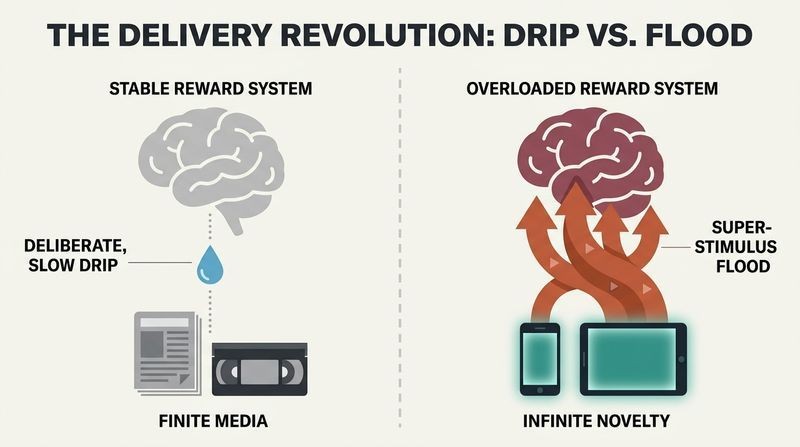
A delivery revolution, not just content. The book's central claim is that streaming video galleries (so-called tube sites) that arrived around 2006 made internet porn qualitatively different from magazines or rented videos. The difference isn't nakedness. It's the endless, on-demand novelty available with a click, for free, in total privacy. One user described years of magazines causing no trouble, then months of online porn leaving him hooked.
The reports came first, then the science. Wilson, an anatomy and physiology teacher, noticed men flooding his wife's relationship forum describing erectile dysfunction, vanishing libido, escalating fetishes, and social anxiety they couldn't explain. Doctors misdiagnosed them. Only after quitting did they connect their symptoms to porn. Wilson built yourbrainonporn.com, which drew tens of thousands of daily visitors worldwide.
What's striking is that Wilson positions himself as a curator of a grassroots natural experiment rather than a moralist. He repeatedly insists this is not about religion or shame. That framing is smart because it sidesteps the culture war that usually swallows the topic. The weakness worth flagging: most evidence is self-reported anecdote from self-selected forum members, not controlled study. Wilson concedes this. The parallel to junk food is apt, though. Neuroscientists like Nora Volkow have shown hyperpalatable food hijacks reward circuitry much like drugs, lending plausibility to the idea that engineered novelty can override ancient appetite systems.
Dopamine makes you crave, not enjoy, so satisfaction stays around the corner
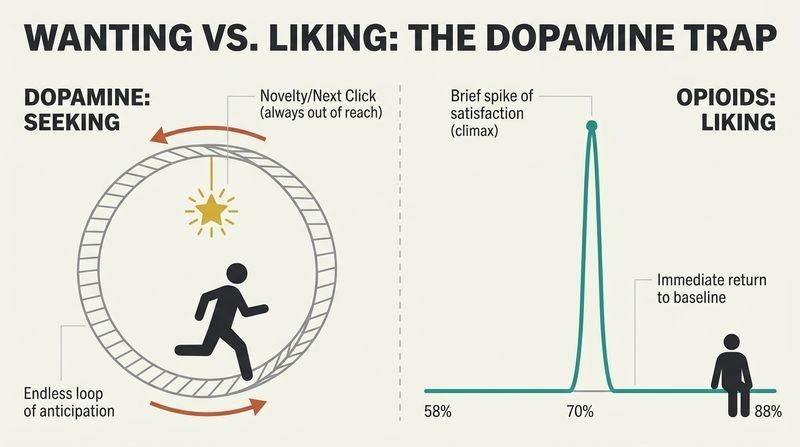
Wanting versus liking. Dopamine is popularly called the pleasure molecule, but Wilson stresses it is really the seeking and anticipation chemical. The actual pleasure of climax comes from opioids. Dopamine says keep going, satisfaction is just ahead; opioids deliver the brief liking. Because the seeking system is stronger than the satisfaction system, endless pursuit feels more compelling than arrival.
Novelty is dopamine's rocket fuel. The Coolidge effect illustrates this: a male rat exhausted with one female instantly revives when a fresh female appears, repeating until collapse. Australian researchers showed the same erotic film loses arousal power over 18 viewings, then a novel clip snaps subjects back to attention. Internet porn weaponizes this: a new partner, act, or genre is always one click away, keeping dopamine elevated far longer than nature intended.
The wanting versus liking distinction comes from Kent Berridge and Terry Robinson's incentive-sensitization research, and it is one of the most useful ideas in modern addiction science. It explains why people pursue things that no longer feel good, from slot machines to doomscrolling. The Coolidge effect naming (after President Coolidge's quip about roosters) is a memorable teaching device. A fair caveat: humans are among the roughly 3 to 5 percent of mammals capable of long-term pair bonds, so mapping rat sexual behavior onto human intimacy has limits Wilson acknowledges but sometimes glosses over when generalizing.
Internet porn is a fake egg your brain can't stop trying to hatch
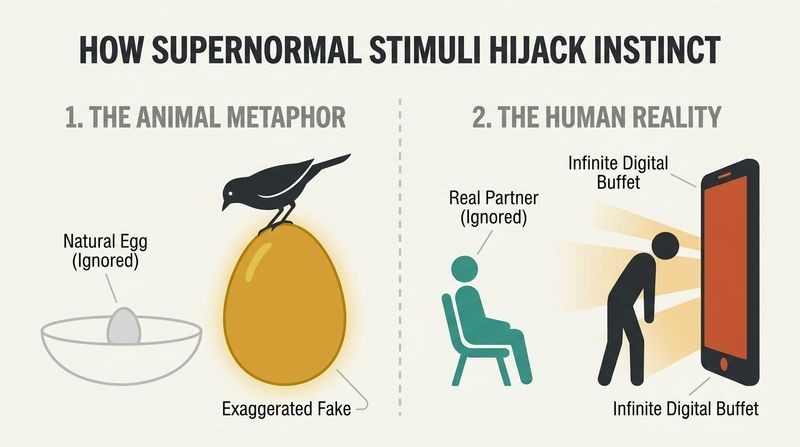
Supernormal stimuli hijack instinct. Nobel laureate Nikolaas Tinbergen found animals prefer exaggerated fakes over the real thing: birds abandon their own eggs to sit on larger, brighter plaster ones, and male jewel beetles try to mate with shiny brown beer bottles. These supernormal stimuli exploit instincts that never evolved a stopping point. Wilson argues internet porn is exactly this for human sexuality.
Why it beats reality. Porn offers three exaggerations at once:
1. Endless novel partners on demand
2. Artificially enhanced bodies and impossible scenarios
3. High-definition video that constantly violates expectations, which the brain finds more stimulating than stills
A real partner cannot compete with a supernormal buffet, just as boiled roots cannot compete with a 32-ounce soda and salty snacks. There is no natural satiation limit, only the need for sleep.
Deirdre Barrett popularized supernormal stimuli for a general audience, arguing modern life is saturated with them: fast food, television, even exaggerated cartoon faces. Wilson's application to porn is one of the more persuasive because the mismatch between ancestral environment and modern abundance is so stark. The concept generalizes powerfully to Instagram, video games, and ultraprocessed food. One nuance worth adding: supernormal stimuli only capture individuals whose reward systems tip out of balance under overconsumption. The beer-bottle beetle went extinct-adjacent only where bottles littered the ground. Environment and dose, not mere existence of the stimulus, determine harm.
Behavioral addictions rewire the same brain circuits as heroin
All addiction is one condition. Wilson argues that whether the trigger is cocaine, gambling, junk food, or porn, chronically elevated dopamine flips the same molecular switch, a protein called DeltaFosB, which accumulates in the reward center and physically rewires it. Addictive drugs only work because they magnify circuitry that already evolved for natural rewards like food and sex. The American Society of Addiction Medicine formally redefined addiction in 2011 to include behaviors, not just substances.
Standard diagnosis, the Three Cs. Addiction shows up as craving and preoccupation, loss of control over frequency or intensity, and continued use despite negative consequences. Dutch researchers found online erotica had the highest addictive potential of any internet application. Roughly 10 to 15 percent of drug users become addicts, but supernormal versions of natural rewards can hook people who would never be vulnerable to drugs.
The DeltaFosB argument is Wilson's strongest scientific card because it moves the debate from philosophy to molecular biology. That said, the porn addiction debate remains genuinely contested. The DSM-5 declined to include hypersexual or porn use disorder, though ICD-11 later added Compulsive Sexual Behavior Disorder as an impulse-control condition rather than an addiction. Critics like Nicole Prause argue high desire, not addiction, explains much of the data. Wilson's rebuttal, that there is no neural difference between a compulsion and an addiction, is clever but sidesteps that labels shape treatment. The honest position is that mechanisms are shared and severity varies enormously.
Overuse numbs pleasure while super-charging cravings for the very thing numbing you
Four brain changes drive the trap. Wilson describes a self-defeating loop common to all addictions:
1. Desensitisation: a numbed response to everyday pleasure, so more stimulation is needed for the same buzz (tolerance)
2. Sensitisation: a Pavlovian super-memory that makes cues trigger intense cravings
3. Hypofrontality: weakened willpower as the prefrontal cortex loses grip
4. Dysfunctional stress circuits: minor stress now triggers relapse
The cruel paradox. Desensitisation moans it can't get satisfaction; sensitisation whispers it knows just what you need, which is the exact thing that caused the numbness. A 2014 Max Planck study found even moderate porn users had less grey matter and weaker reward-to-willpower connections, with more use predicting less activation to sexual images.
This four-part model mirrors the mainstream neuroscience of addiction associated with Volkow's work: a hijacked reward system, sensitized cue reactivity, and compromised executive control. The elegance is in showing why willpower feels like losing a tug-of-war. One important caveat about the Max Planck finding: it was correlational, and the researchers themselves noted the brains might have been pre-shrunken rather than shrunken by porn. Wilson favors the causal reading but honestly reports the ambiguity. Cross-disciplinary readers will recognize the same loop in slot-machine gambling and smartphone design, where variable-ratio reward schedules manufacture exactly this sensitized craving with dulled satisfaction.
Your fetishes may be trained habits, not your true sexual identity
Nerve cells that fire together wire together. Wilson distinguishes conscious learning (this is how sex works) from unconscious sexual conditioning (this is what turns me on). Because dopamine spikes not just for novelty but for shock, surprise, and anxiety, users bored with one genre click toward stranger, more taboo material, and each aroused climax wires a new association. Many report escalating to content that alarms them or seems to contradict their orientation, triggering panic they call sexual-orientation OCD.
Plasticity runs both directions. The reassuring flip side: after months without porn, users repeatedly report that fetishes they assumed were permanent simply faded, and attraction to real partners returned. A boner is not proof of fundamental orientation; arousal can be conditioned, and anxiety-driven adrenaline is easily mistaken for desire.
This is perhaps the book's most socially consequential and most delicate claim. The upside is genuinely liberating for someone tormented by intrusive content: it reframes disturbing tastes as reversible conditioning rather than fixed destiny. The danger is that the same logic could be misused to pathologize genuine, stable sexual identities, including gay identity, as mere conditioning. Wilson is careful to say the problem lies in porn's effect on the brain, not in any particular orientation, and that true identities are durable. The testable prediction, that porn-induced tastes fade after abstinence while core identity persists, is elegant, though it rests almost entirely on self-report.
Young men now get erectile dysfunction from screens, not from age
A new and not-rare phenomenon. Historically ED was an older man's problem tied to blood flow. Wilson documents a wave of men in their teens and twenties who can achieve rock-hard erections to extreme porn but go limp with a willing real partner. A 2014 Canadian study found over half of sexually experienced male teens reported a sexual problem, with ED and low desire most common, a rate that would be unthinkable in young bulls or stallions.
A simple self-test. Rule out medical causes with a urologist, then compare two sessions: masturbate to porn, and separately masturbate with no porn or porn fantasy. A strong erection to porn but failure without it points to porn-induced ED rather than performance anxiety. Recovery for older men often takes weeks; for young men wired to screens since puberty, months.
The reversal here is genuinely counterintuitive and clinically important. Urologists including Harry Fisch and Abraham Morgentaler independently reported the same pattern, lending credibility beyond the forums. The self-test is a rare piece of falsifiable, actionable advice in a field thick with ideology. Skeptics counter that rising youth ED could stem from anxiety, SSRIs, obesity, or performance pressure amplified by unrealistic expectations rather than a rewired reward circuit per se. The most defensible synthesis: porn is likely one significant and underdiagnosed contributor among several, and the low-cost intervention of abstaining offers a clean way for an individual to test causation on himself.
Adolescent brains wire sexuality to whatever delivers the biggest hit
Puberty is peak plasticity. A prime evolutionary task of adolescence is learning about sex, and the teen brain wires arousal to environmental cues with startling speed. Teen reward circuitry produces bigger dopamine spikes, is more sensitive to dopamine, and generates more DeltaFosB, the memory-and-repeat protein. So a boy who spends his formative years hunched over ten browser tabs may wire his sexual response to novelty, voyeurism, and screens instead of to a real person.
Use it or lose it. After age twelve the brain prunes unused connections, so pathways for pursuing real partners can wither while porn pathways deepen into ruts. This explains why young men who started on high-speed porn need far longer to recover than older men, who first conditioned themselves to actual partners and are merely relearning.
The developmental argument aligns with well-established neuroscience: the adolescent brain shows heightened reward sensitivity alongside an immature prefrontal cortex, the same asymmetry Laurence Steinberg invokes to explain teen risk-taking. Applying it to sexual conditioning is a reasonable extension. It also raises the most serious public-health stakes in the book, since minors now access streaming porn years before first kiss. The uncomfortable implication is that a first sexual template is being set by an industry optimizing for engagement, not intimacy. The counterpoint researchers raise is that adolescent sexuality has always been shaped by available cues; the open question is whether streaming novelty is different in kind or merely degree.
Rebooting means starving the porn pathways until real life feels rewarding again
Give the brain a rest. Recovery, which forum members call rebooting, means abstaining from all artificial sexual stimulation for months to let the reward circuit resensitize, weaken craving pathways, restore willpower, and calm stress reactivity. Artificial stimulation includes more than porn: erotic surfing of social media, cam sites, sexting, escort ads, and porn fantasy all count. Switching to tamer material is like an alcoholic switching to light beer.
Practical levers rebooters use.
1. Delete porn and bookmarks, rearrange the physical space tied to use
2. Install blockers as speed bumps early on
3. Exercise, cold showers, and time in nature to raise baseline dopamine
4. Socialize and pursue hobbies that offer slower, sustainable reward
5. Meditate to strengthen the prefrontal cortex over impulsive circuits
There is no fixed day count; brains rebalance on their own schedules.
The reboot protocol reads like sound behavior-change science even independent of the porn debate: remove cues, reduce friction, replace the habit, and recruit social support, principles familiar from Charles Duhigg and James Clear. The environmental-cue advice echoes classic relapse research showing context triggers craving, which is why addicts are told to avoid old neighborhoods. One genuine tension: the forums themselves are online, so recovery from an internet compulsion partly depends on more internet use. Wilson notes members eventually outgrow the forums. The emphasis on beneficial stressors like cold showers and exercise as dopamine regulators is supported by exercise-addiction literature, though the effect sizes for mood are modest, not miraculous.
Expect a brutal flatline where libido vanishes before it roars back
Withdrawal is real and physical. Wilson warns that quitting can trigger insomnia, irritability, anxiety, brain fog, headaches, mood swings, and severe cravings, symptoms that mirror drug withdrawal because all addictions share neurochemical machinery. Swansea and Milan researchers found internet addicts suffer a genuine cold-turkey response.
The flatline surprise. Uniquely, many quitters hit a flatline: a temporary but total loss of libido, with lifeless genitals and no spontaneous erections, as if castrated. Unwarned, men panic that they are permanently impotent and rush back to porn, only to find they cannot override it. Those who wait, sometimes seven weeks or more, find desire and erections return, often stronger. Related pitfalls include edging (staying aroused without climaxing, which bathes the brain in dopamine for hours) and the chaser effect (intense cravings that surge right after orgasm and can trigger a binge).
Naming and normalizing the flatline may be the book's most practically valuable move, because the fear of permanent damage is precisely what drives relapse at the worst moment. The pattern resembles post-acute withdrawal syndrome documented in substance recovery, where symptoms wax and wane for months. The mouse-like behavior of sexually exhausted male rats showing a recovery period offers a suggestive if imperfect animal parallel. A reasonable skeptic would note that expectation and suggestion can shape symptom reporting in tight-knit forums, producing something like a nocebo effect. Still, the advice to ride it out rather than test with more porn is low-risk and internally consistent with the resensitization model.
Run your own experiment instead of waiting decades for consensus
The tobacco playbook, again. Wilson compares porn skepticism to the Tobacco Wars, when industry-funded studies manufactured doubt for decades while smokers died, a strategy now studied as agnotology, the deliberate cultural production of ignorance. Causation studies on porn are impossible for the same reason they were for smoking: you cannot ethically assign children to years of exposure. So consensus may be decades away.
You don't need to wait. Because quitting porn is like cutting refined sugar, not undergoing surgery, the risk of experimenting is near zero. Wilson urges readers to remove the single variable and observe themselves for a few months. He is pointedly neutral: if you feel no problem, he will not argue. But teens already sense the harm; a 2014 UK poll found 70 percent believed porn damages young people's views of sex, even while only 19 percent thought watching it was wrong.
The tobacco analogy is rhetorically potent and historically grounded, though it cuts both ways: anti-tobacco advocates were right, but the same doubt-merchant framing has been misapplied to dismiss legitimate scientific disagreement. Wilson's more defensible point is epistemological humility flipped into empowerment: given that gold-standard trials are impossible and the intervention is harmless, the rational move for an individual is a personal n-of-1 experiment. That is genuinely good reasoning, and it mirrors how self-experimentation is gaining respectability in nutrition and sleep science. The UK poll finding is intriguing because it separates moral disapproval from perceived harm, suggesting a generation that rejects shame yet still senses cost.
Analysis
Your Brain on Porn occupies an unusual niche: a science-communication book built almost entirely on crowd-sourced anecdote, published just as the first two brain-imaging studies on porn users appeared. Gary Wilson, an autodidact physiology teacher rather than a credentialed neuroscientist, functions as an aggregator and translator, synthesizing addiction neuroscience, evolutionary biology, and thousands of recovery narratives from forums like NoFap into a single coherent thesis: high-speed streaming porn is a supernormal stimulus capable of rewiring the reward circuit in ways that produce sexual dysfunction, escalation, and withdrawal.
The book's intellectual architecture is sturdier than its evidentiary base. Its mechanistic story, dopamine as seeking, DeltaFosB as the molecular switch, and the desensitisation-sensitisation-hypofrontality loop, is drawn from mainstream research (Berridge, Robinson, Volkow, Nestler) and is largely uncontroversial as applied to substances and food. The leap is applying it wholesale to pornography, where controlled data remain thin and genuinely disputed. Wilson is more candid about this than critics allow, repeatedly labeling the forum reports anecdotal and calling for research. His rhetorical masterstroke is reframing the entire debate away from the moralism versus sex-positivity axis that has paralyzed it, and toward a testable, individual empiricism: remove the variable and watch.
The book's lasting contribution is less its contested addiction claim than its clinical observations: porn-induced ED in young men, the flatline, escalation dynamics, and the reversibility of conditioned tastes. These generated hypotheses that clinicians and researchers subsequently took seriously. Its blind spots are the self-selection and confirmation bias baked into recovery forums, the nocebo risks of a community that shares symptom scripts, and a tendency to treat correlation as causation when it flatters the thesis. Read as a rigorous verdict, it overreaches. Read as an urgent, plausible early warning paired with a zero-risk self-experiment, it is hard to dismiss, and its junk-food and tobacco analogies feel more prescient each year.
Review Summary
Your Brain on Porn offers a scientific look at pornography addiction, its effects on the brain, and strategies for overcoming it. Readers found it eye-opening and valuable, praising its mix of research and personal accounts. Many were surprised by the extent of porn's negative impacts on mental health, relationships, and sexual function. The book's approach is non-judgmental and focuses on the neurological aspects of addiction. While some found parts repetitive, most considered it an important read for understanding modern porn consumption's risks and potential consequences.
People Also Read






Glossary
Supernormal stimulus
Exaggerated fake beating the realA term from ethologist Nikolaas Tinbergen for an artificial, exaggerated version of a natural stimulus that triggers a stronger instinctive response than the real thing, like birds preferring oversized plaster eggs. Wilson argues internet porn is a supernormal stimulus for human sexuality because its endless novelty and enhanced imagery outcompete real partners at the level of the brain's reward response.
Coolidge effect
Novelty reignites sexual driveThe phenomenon, observed across mammals, in which a sexually exhausted male instantly revives when presented with a fresh partner. Named after a quip attributed to President Calvin Coolidge. Wilson uses it to explain why constantly novel porn keeps dopamine and arousal elevated far beyond what a single stimulus could, driving compulsive clicking.
Rebooting
Abstaining to reset the brainThe forum-coined recovery method of abstaining from all artificial sexual stimulation, including porn, porn fantasy, and erotic surfing, for an extended period so the reward circuitry can resensitize, cravings weaken, and willpower recover. The computer metaphor is imperfect since the brain cannot literally be wiped, but many users reverse porn-related problems this way.
Flatline
Temporary total loss of libidoA withdrawal symptom reported during rebooting, especially in men with porn-induced ED, involving a temporary but complete loss of libido, lifeless genitals, and no spontaneous erections. Often lasting weeks to months, it can panic quitters into relapse, but libido and erectile function typically return, sometimes stronger, once it passes.
DeltaFosB
Molecular switch for addictionA protein that accumulates in the brain's reward center in proportion to chronic dopamine release from either drugs or natural rewards like sex, sugar, and exercise. It activates genes that physically rewire the reward circuit to want and repeat the behavior. Considered a sustained molecular switch shared by both substance and behavioral addictions.
Sensitisation
Super-memory triggering intense cravingsAn addiction-related brain change in which rewired pathways make the reward circuit hyper-reactive to cues associated with the addiction, producing powerful, often involuntary cravings when triggered. Based on the fire-together-wire-together principle, it makes the addictive behavior feel more compelling than other activities.
Desensitisation
Numbed response to pleasureAn addiction-related dialing down of the reward system's responsiveness, driven by reduced dopamine signaling. It leaves the person less able to enjoy everyday pleasures and hungry for stronger stimulation (tolerance), pushing porn users toward more time online, edging, or more extreme genres to achieve the same buzz.
Hypofrontality
Weakened willpower brain regionsReduced activity and altered grey and white matter in the prefrontal regions of the brain, which govern impulse control and foreseeing consequences. In addiction it weakens willpower against strong subconscious cravings, producing the sensation of two brain parts in a tug-of-war.
Edging
Prolonged arousal without climaxMasturbating repeatedly to the edge of orgasm without climaxing, often for hours while viewing porn. Wilson identifies it as a major reboot-derailer because it keeps dopamine near its peak for abnormally long periods, strengthening addictive associations and desensitizing the brain more than a quick single climax would.
Chaser effect
Cravings surging after orgasmThe intense, often unexpected cravings for porn or sex that can follow an orgasm or wet dream. It can throw an unwary rebooter into a binge, though it sometimes helps kick-start libido after a long flatline. Understood as an amplified version of the natural neurochemical swings following climax.
FAQ
What's "Your Brain on Porn" about?
- Focus on Internet Pornography: The book explores the impact of internet pornography on the brain, particularly how it can lead to addiction.
- Emerging Science of Addiction: It delves into the neuroscience behind addiction, explaining how internet porn can alter brain function and behavior.
- Personal Accounts and Research: The book combines scientific evidence with personal stories from individuals who have experienced porn addiction and recovery.
- Cultural and Biological Intersection: It discusses how cultural changes, especially technological advancements, interact with our biological makeup to influence behavior.
Why should I read "Your Brain on Porn"?
- Understanding Addiction: It provides insights into how internet pornography can become addictive and affect mental health.
- Scientific Perspective: The book offers a scientific explanation of how porn affects the brain, making it a valuable resource for those interested in neuroscience.
- Practical Advice: Readers can find practical advice on how to overcome porn addiction and regain control over their lives.
- Cultural Relevance: It addresses a widespread issue in modern society, making it relevant for anyone interested in the effects of technology on human behavior.
What are the key takeaways of "Your Brain on Porn"?
- Addiction is Real: Internet pornography can lead to real addiction, with significant impacts on mental and physical health.
- Brain Changes: Chronic porn use can cause changes in the brain's reward system, leading to desensitization and altered sexual preferences.
- Recovery is Possible: The book emphasizes that recovery from porn addiction is possible through understanding and altering behavior.
- Cultural Impact: The widespread availability of internet porn has profound effects on social and sexual norms.
How does "Your Brain on Porn" explain the science of addiction?
- Dopamine's Role: The book explains that dopamine, a neurotransmitter, plays a crucial role in the brain's reward system and is heavily involved in addiction.
- Neuroplasticity: It discusses how the brain's ability to change (neuroplasticity) can lead to addiction when exposed to constant novelty and stimulation from porn.
- Desensitization: Chronic exposure to porn can desensitize the brain, requiring more extreme content to achieve the same level of arousal.
- Sensitization and Cravings: The book describes how sensitization creates powerful cravings, making it difficult to quit porn.
What are the symptoms of porn addiction according to "Your Brain on Porn"?
- Loss of Control: Inability to control porn use despite negative consequences is a key symptom.
- Escalation: Users may escalate to more extreme or varied content to achieve the same arousal.
- Sexual Dysfunction: Issues like erectile dysfunction and delayed ejaculation can arise from porn addiction.
- Emotional and Social Impact: Addiction can lead to depression, anxiety, and social withdrawal.
How does "Your Brain on Porn" suggest overcoming porn addiction?
- Rebooting: The book recommends a period of abstinence from all artificial sexual stimulation to reset the brain.
- Support Systems: Engaging with support groups or forums can provide encouragement and accountability.
- Lifestyle Changes: Incorporating exercise, meditation, and social activities can help restore balance and reduce cravings.
- Education and Awareness: Understanding the science behind addiction can empower individuals to make informed choices.
What is the "Coolidge Effect" mentioned in "Your Brain on Porn"?
- Definition: The Coolidge Effect refers to the phenomenon where males exhibit renewed sexual interest when introduced to new receptive females.
- Dopamine Surge: This effect is driven by dopamine, which spikes with novelty and anticipation.
- Relevance to Porn: Internet porn exploits this effect by providing endless novelty, keeping users engaged and addicted.
- Evolutionary Perspective: The Coolidge Effect is an evolutionary mechanism to promote genetic diversity, but it can lead to addiction in the context of internet porn.
What role does dopamine play in porn addiction according to "Your Brain on Porn"?
- Motivation and Reward: Dopamine is crucial for motivation and the pursuit of rewards, making it central to addiction.
- Anticipation and Seeking: It rises with anticipation, driving the search for novel and stimulating content.
- Desensitization: Chronic overstimulation from porn can lead to reduced dopamine sensitivity, requiring more extreme content for the same effect.
- Addiction Cycle: Dopamine's role in the reward system creates a cycle of craving and consumption, reinforcing addictive behavior.
How does "Your Brain on Porn" address the impact of porn on relationships?
- Devaluation of Partners: Porn use can lead to a devaluation of real-life partners, affecting relationship satisfaction.
- Intimacy Issues: It can interfere with the ability to form and maintain intimate connections.
- Altered Expectations: Porn can create unrealistic expectations about sex and relationships.
- Recovery Benefits: Quitting porn can improve relationship dynamics and increase emotional intimacy.
What are the potential withdrawal symptoms from quitting porn as described in "Your Brain on Porn"?
- Physical Symptoms: Users may experience insomnia, fatigue, and headaches.
- Emotional Symptoms: Anxiety, irritability, and mood swings are common during withdrawal.
- Flatline Effect: Some may experience a temporary loss of libido, known as the flatline.
- Duration and Intensity: Withdrawal symptoms vary in duration and intensity, but they generally improve over time.
What are some common misconceptions about porn addiction addressed in "Your Brain on Porn"?
- Not Just a Moral Issue: The book emphasizes that porn addiction is a neurological issue, not just a moral failing.
- Addiction vs. Compulsion: It clarifies that porn addiction is a real addiction, similar to substance abuse, not merely a compulsion.
- Impact on Sexual Orientation: The book addresses the misconception that porn-induced changes in sexual preferences are permanent.
- Recovery Possibility: It counters the belief that recovery from porn addiction is impossible, highlighting successful recovery stories.
What are the best quotes from "Your Brain on Porn" and what do they mean?
- "Addiction is wanting run amok." This quote highlights how addiction is driven by an overwhelming desire that overrides rational decision-making.
- "The brain is a highly plastic, flexible organ." It emphasizes the brain's ability to change and adapt, which is central to both addiction and recovery.
- "Porn is to sex what looking at a photograph of a Ferrari is to driving one." This analogy illustrates the difference between virtual and real experiences, underscoring the limitations of porn.
- "We are what we repeatedly do." This quote, borrowed from Aristotle, underscores the importance of habits in shaping our lives and the potential for change through conscious effort.
Download PDF
Download EPUB
.epub digital book format is ideal for reading ebooks on phones, tablets, and e-readers.








































