


Summary Unavailable
This book is not suitable for a summary (it may be a textbook, workbook, cookbook, reference book, or collection). However, you can still explore the FAQs, about author, and other metadata below!
Key Takeaways
Kill the soul-mate fantasy; obsessing over the ONE paralyzes you
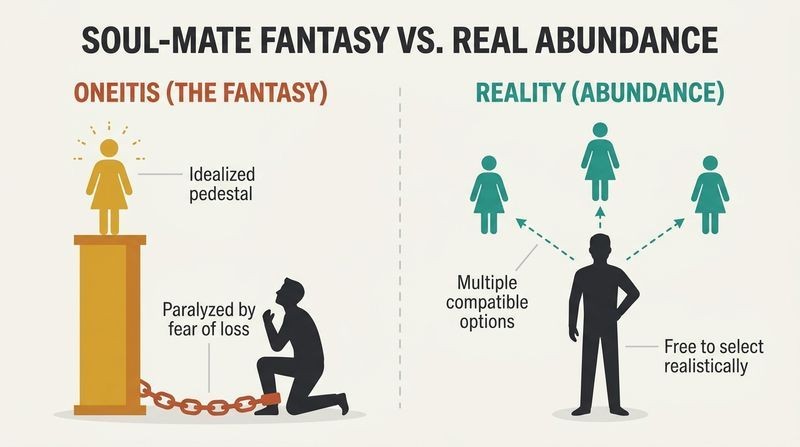
ONEitis is the disease. Tomassi coins ONEitis for the unhealthy fixation on a single idealized person, usually unreciprocated and built on fantasy. He argues the Western soul-mate myth, sold by rom-coms, pop songs, and dating sites like eHarmony, functions almost like a religion even for atheists. In a psychology class he watched nearly every self-described rational student raise a hand to believing in a predestined partner.
Why it cripples you. Believing one irreplaceable person exists makes you needy, and neediness surrenders power. Ask any widow or divorcee who remarried and swears the new spouse is their real soul-mate. There are good ones and bad ones, but no cosmic ONE. Dropping this belief, he insists, is not nihilism; it frees you for a relationship built on genuine desire rather than terror of loss.
The critique of romantic destiny has serious intellectual company. Historian Stephanie Coontz documents that love-based marriage is a recent invention, and philosopher Alain de Botton calls Romanticism a catastrophe for relationships, arguing compatibility is an achievement of love, not its precondition. Where Tomassi overreaches is treating the soul-mate belief as purely a tool of female social engineering rather than a broadly human cognitive bias. Attachment research suggests idealization also stabilizes bonds and buffers stress. The insight that scarcity thinking breeds desperation is sound and echoes negotiation theory's BATNA: your power rises with your alternatives, in love as in business.
In any relationship, whoever needs the other least holds the power
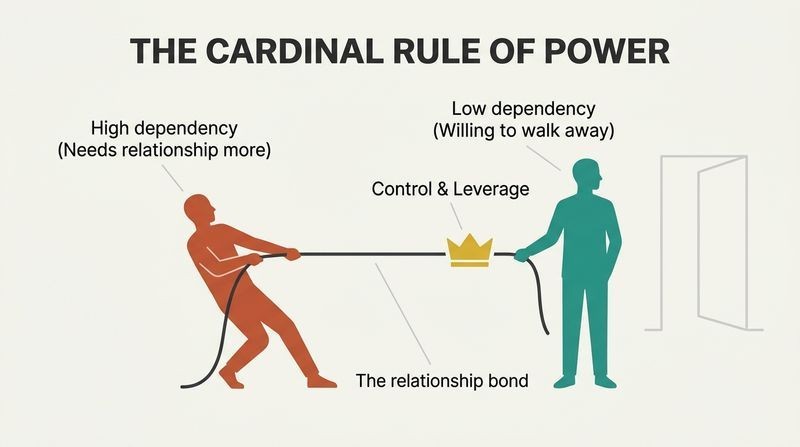
The Cardinal Rule. Tomassi's foundational principle: control flows to the person who is less dependent. He reframes power not as money or status but as command over your own life. This dynamic operates everywhere, from employer and employee to spouses, and it is always live whether you acknowledge it or not.
Control versus manipulation. He distinguishes healthy relationships, where control passes back and forth as needs shift, from unhealthy ones, where one partner blackmails the other using something that should be freely given. The classic example is a woman withholding intimacy to win an argument, what he calls a shit test. Caving to keep the peace, he warns, lowers her respect rather than raising it. His prescription is enlightened self-interest: refuse to compromise yourself for manufactured leverage, and be willing to walk.
This is the principle of least interest, formulated by sociologist Willard Waller in 1938, repackaged with sharper edges. Decades of social exchange and interdependence research (Thibaut, Kelley, Rusbult) confirm that the partner with better alternatives wields more influence. The framework's blind spot is its zero-sum flavor. Gottman's longitudinal marriage studies find the healthiest couples build interdependence and mutual influence rather than jockeying for who cares less. Treating every concession as capitulation can corrode the very trust that stable partnerships require. The kernel of truth is real: chronic self-abandonment breeds contempt. But power-balancing and genuine intimacy are not the same project.
Genuine desire cannot be negotiated into existence, only inspired
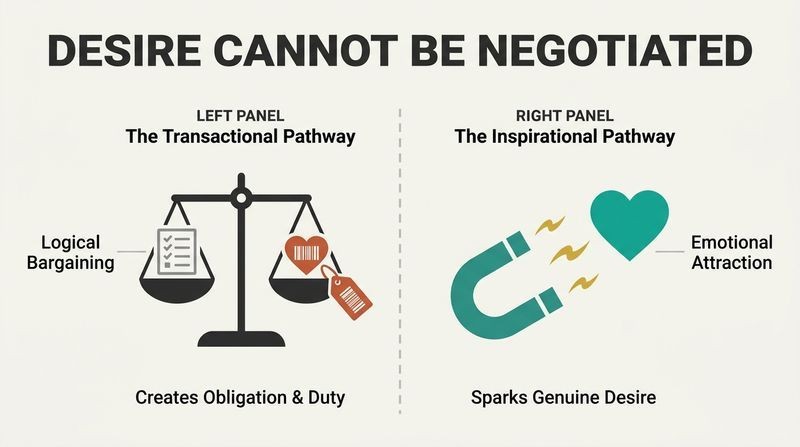
Negotiated desire equals obligation. The most common plea Tomassi fields is how do I get her back, usually meaning how do I restore the passion. Men default to deductive logic: perform chores, buy gifts, meet stated conditions, receive sex. But desire is a spontaneous chemical reaction, not a transaction. The more a man overtly bargains for intimacy, the more her willingness curdles into duty, producing the lackluster compliance that frustrates him further.
Lead, don't ask. A prostitute will sleep with you for money without wanting to; obligation is not attraction. You cannot make a woman want to want you by telling her to. Desire must be provoked covertly, so she experiences it as her own idea. This is why couples counseling that treats sex as a term to be negotiated so often fails.
The distinction between wanting and having-to maps onto self-determination theory, where autonomous motivation (doing something because you want to) is psychologically distinct from controlled motivation (doing it from pressure or reward). Esther Perel makes a parallel argument in Mating in Captivity: desire needs distance, mystery, and unpredictability, which the logistics of committed domesticity quietly erode. The observation that transactional bids kill eroticism is robust and gender-neutral, applying equally to needy partners of any sex. The weaker move is Tomassi's implication that covert manipulation is the only route. Perel and others suggest honest cultivation of separateness and playfulness can rekindle desire without deception.
Date several women non-exclusively; abundance manufactures real confidence
Spin plates. Plate Theory likens a man to a plate spinner keeping several prospects going at once. Some fall and break, some slow down, but the point is that confidence is derived from options. A man with alternatives radiates a subconscious ease that women detect and compete for; a necessitous man broadcasts scarcity. Tomassi insists this must be done through honest non-exclusivity, not a player's lies, and that non-exclusivity should be implied covertly rather than declared.
Monogamy as byproduct. The abundance mindset cures ONEitis both in and out of relationships. He advises men to date widely into their thirties before committing, so they can recognize a genuinely good partner rather than idealizing the first woman who accepts them. The quoted maxim: women would rather share a high-value man than be saddled with a faithful loser.
Behavioral economics backs the emotional logic: having a strong walk-away alternative measurably improves outcomes and reduces anxiety in any negotiation. The confidence-through-options mechanism also resembles exposure therapy, since serial low-stakes dating desensitizes approach anxiety. The empirical claim that women universally prefer sharing a high-status man is far shakier and rests on contested evolutionary-psychology readings. Mate-preference research (Buss, Eastwick's meta-analyses) shows women's stated and revealed preferences are highly variable and context-dependent, and most seek exclusivity. The durable takeaway is psychological, not romantic: cultivating a rich, self-sufficient life makes any single relationship optional rather than load-bearing, which paradoxically makes you a better partner.
Alpha is a mindset you cultivate, not wealth or status you display
Alpha is as Alpha does. Tomassi rejects defining Alpha by income, looks, or morality. His deliberately provocative example is Corey Worthington, an oblivious Australian teen who threw a destructive house party and shrugged off a reporter's shaming attempts on camera. A poor human being, Tomassi says, but a textbook of unselfconscious Alpha bravado that men pay fortunes at seminars to fake.
Origins and context. He argues Alpha energy is partly biological (testosterone-fueled) and partly nurtured, and that every healthy five-year-old boy has it before feminized conditioning represses it. Alpha is also contextual: a teacher or uniformed cop is Alpha within his theater but may be Beta everywhere else. Crucially, you do not earn achievements and then become Alpha; the mindset comes first and the results follow.
The biology here is oversold. In actual wolf packs, the term alpha was retracted by the very researcher who popularized it, David Mech, who found wild packs are simply families led by parents, not dominance-contest winners. So the animal metaphor collapses at its root. Yet the psychological reframe has value and overlaps with research on internal locus of control and self-efficacy (Bandura): people who believe they author their own outcomes behave more boldly and often get better results. The Corey example cleverly separates social dominance from virtue, a genuinely uncomfortable observation. The danger is that decoupling Alpha entirely from character can valorize antisocial behavior as aspirational.
Hypergamy: women instinctively seek the best genes and best provider
The dual mating strategy. Hypergamy, as Tomassi uses it, is women's evolved drive to secure the highest-status mate they can attract, filtered through a conflict between two rarely-combined qualities: good genes (the exciting, arousing bad boy for short-term breeding) and good dad (the loyal provider for long-term security). This, he says, is why a woman might marry the stable nice guy yet lust after the surfer, cheating reactively or proactively to get both.
Not a conscious plot. He repeatedly stresses hypergamy operates below awareness; most women neither recognize nor scheme it. His blunt refrain is that hypergamy doesn't care: not about your loyalty, your sacrifices, your years of provisioning, or how good a father you are. Understanding this, he argues, is what blindsided divorced men failed to grasp.
This is the book's most contested pillar. The good-genes/good-dad tension draws on real theory (Gangestad and Simpson's strategic pluralism, ovulatory-shift hypotheses), but that literature has taken serious replication hits. Large studies and meta-analyses since roughly 2014 have failed to reliably reproduce the ovulatory-cycle mate-switching effects Tomassi treats as settled fact. Cross-culturally, hypergamy as strict status-climbing is also weakening as women out-earn men. The framework's real problem is unfalsifiability: fidelity confirms it (restrained hypergamy), infidelity confirms it (expressed hypergamy), so no observation can ever count against it. Useful as a caution against complacency, unreliable as biological law.
Men and women peak sexually at opposite times, fueling midlife conflict
Divergent value curves. Tomassi maps sexual market value (SMV), a person's overall desirability, across the lifespan. Women's SMV, rooted mainly in youth and fertility, peaks sharply around 22 to 24 and declines from the late twenties. Men's SMV builds slowly, climbing through status, maturity, and resources to peak around 36. The two curves cross painfully in the years when women most need to lock down commitment and men are just discovering their rising worth.
The Wall. The Wall is the point (loosely age 30) when a woman loses her edge against younger rivals. Single motherhood, obesity, and careerism accelerate it. Tomassi argues social conventions like the sexual-peak myth exist to disguise this decline, and that men awakening to their own late-blooming value threatens the whole arrangement.
The asymmetry has partial empirical support: fertility does decline with age, and dating-app data (OkCupid's own analyses) show men rating younger women highly across their own lifespans. But Tomassi's tidy bell curves are crude. Desirability is multidimensional and increasingly decoupled from fertility in an era of assisted reproduction and assortative mating on education and income. Reducing a woman's worth to a fertility window ignores the substantial value of shared life-building that Gottman and others find predicts marital satisfaction. The genuinely useful nugget for men is temporal strategy: your leverage compounds with age, so avoid panic-driven early decisions. The framing's cruelty, however, is a feature he embraces, not a bug he examines.
Frame is everything: enter your reality, or you'll live in hers
Whose reality wins. Iron Rule number one: frame is the subconscious narrative under which a relationship operates, the ambient sense of whose world you both inhabit. Frame is not the same as power or as her interest level; a woman can be wildly attracted yet still resist entering your frame. Tomassi says shit tests exist precisely to probe whether your frame is genuine.
Establish it early. Frame is fluid and shifts with whoever applies more will, but it must be set before commitment, not renegotiated afterward. He observes many modern marriages default to the wife's frame, with husbands seeking permission for trivial choices, because nature abhors a vacuum: when a man won't provide secure frame, a woman anxiously supplies it herself and resents doing so. His claim is that even fiercely independent women crave a man whose frame holds.
Frame is essentially what sociologist Erving Goffman meant by framing in Frame Analysis: the interpretive structure that defines a social situation. Tomassi's applied version resembles what therapists call differentiation of self (Bowen): the capacity to stay grounded in your own values under relational pressure rather than fusing with a partner's anxiety. That is a legitimately healthy trait. The overreach is the gendered insistence that frame must be male-led. Bowen's concept applies to both partners, and rigid frame-holding can shade into control. Still, the core advice, that quietly self-assured people set the emotional tone of a relationship, is sound and broadly observable.
Judge women by behavior, not words; the medium is the message
Behaviorism applied to dating. Tomassi's academic grounding is behaviorism, whose cardinal principle is that behavior is the only reliable evidence of motivation. Applied to relationships: when actions and words conflict, believe the actions. Ten dates before sex, flaking, hot-then-cold, that pattern is the message, not a mystery to decode.
Covert versus overt. He argues men communicate overtly (information, bluntness, problem-solving) while women communicate covertly (context, subtext, feeling), and much intergender frustration comes from men taking words literally. When a woman finally switches to blunt overt statements like get away from me, she has exhausted her covert toolkit. His practical corollary: never give full disclosure, because a woman's imagination and the mystery you preserve drive desire more than any fact you volunteer.
The behaviorist maxim, watch what people do not what they say, is genuinely useful and echoes revealed-preference economics and the therapy adage that people teach you how to treat them through actions. Attachment research also confirms that inconsistent signals often reflect ambivalent attachment rather than deception. Where the analysis strains is the sweeping claim that communication styles cleanly divide by sex. Deborah Tannen's linguistics work does find gendered conversational patterns (rapport-talk versus report-talk), but describes tendencies shaped heavily by socialization, not hardwired opposites. The advice to withhold disclosure is double-edged: mystery can spark attraction, but the intimacy literature (Aron's closeness studies) shows mutual self-revelation is what deepens bonds.
Stop hiding behind buffers; raw rejection teaches better than regret
Buffers defined. A buffer is any mechanism men use to minimize exposure to rejection, which then hardens into an ego-invested preference. Tomassi's catalog includes:
1. Long-distance relationships as a safe fiction of commitment.
2. Endless texting and online dating as low-risk substitutes for face-to-face nerve.
3. Objectifying or idealizing women so rejection stings less.
4. Pornography as free reward requiring no social risk.
5. The leagues mentality that preemptively disqualifies you.
Rejection beats regret. He estimates that most of the problems men bring him trace back to fear of rejection. Buffers compound over time until they feel like just who I am. The remedy is embracing rejection as the harsh but best teacher, the way a hot stove teaches faster than any warning. A man who takes rejection on the chin and returns signals the confidence women actually respond to.
This is arguably the book's most universally applicable and least controversial insight, and it aligns with clinical psychology's core treatment for avoidance: exposure. Avoidance behaviors reduce anxiety short-term while entrenching it long-term, exactly Tomassi's compounding trap. His identification of pornography and infinite digital messaging as anxiety-management tools rather than genuine connection anticipates later research on problematic use displacing real-world social risk-taking. The reframe of rejection as data and teacher mirrors resilience and antifragility literature (Taleb). One caveat: not all of his listed buffers are dysfunctional. Long-distance relationships and online dating can be legitimate, not merely cowardice, depending on circumstance. But the underlying diagnosis, that comfort-seeking quietly shrinks a life, is bracing and correct.
Unplug from the Feminine Imperative; personality is remade, not fixed
Seeing the Matrix. The Feminine Imperative is Tomassi's term for the largely invisible way society organizes itself around women's sexual strategy, from divorce law to media that ridicules masculinity. Unplugging, borrowing from The Matrix, means becoming aware of this conditioning and the red pill is the disillusioning knowledge that follows. He warns it brings a bitter, near-nihilistic phase before a man rebuilds.
Just be yourself is a trap. Because personality is malleable, not static (he cites PTSD as proof that identity changes with conditions), the advice to just be yourself is a social convention that discourages growth. Men are conditioned to compromise their identity to win female approval, which is precisely what repels women. Positive Masculinity means deliberately reforging yourself, faking it until the new response becomes genuinely who you are.
The claim that culture is quietly structured around one sex's interests is a mirror image of feminist standpoint theory, which argues the same about patriarchy. Both share a totalizing, hard-to-falsify quality: any counter-evidence gets absorbed as the system disguising itself. Read charitably, unplugging is critical consciousness (Freire), the act of examining norms you absorbed unreflectively, which is valuable regardless of ideology. The malleable-self point is well supported: identity is more narrative and situational than fixed, per Dan McAdams's life-story research, and fake-it-till-you-make-it has modest support in behavioral activation. The shadow side is the conspiratorial frame, which can curdle into resentment, the very bitterness Tomassi himself flags as a danger.
Women love opportunistically; men love unconditionally, and that hurts
Iron Rule number six. Tomassi's most nihilistic claim: women are incapable of loving a man the way a man idealizes being loved. He argues men are the true romantics who believe love matters for its own sake, while women love opportunistically, contingent on a man's qualities and status. When a man asks can men really not tell when a woman doesn't love them, his answer is no, because they desperately want to believe otherwise.
Different concepts, not less love. He clarifies this is not that women lack capacity for love but that their concept of love differs from men's. Traditional wedding vows, love for richer or poorer, in sickness and health, he reads as a desperate plea to bind hypergamy against its own nature. The mature response is accepting this asymmetry rather than being driven mad denying it.
This is the book at its bleakest and most speculative. The romantic-realist inversion is a striking rhetorical move, but the evidence cuts against it: attachment researcher studies and behavioral data show women, on average, report deeper emotional investment and suffer breakups intensely, not opportunistically. Anthropologist Helen Fisher's brain-imaging work finds romantic love activates the same reward circuitry across sexes. What Tomassi may be circling is a real phenomenon in narrower terms: love expressed conditionally on a partner's continued contribution versus love as unconditional acceptance. But framing that as women love opportunistically overgeneralizes clinical observations of specific dysfunctional relationships into a universal law, the recurring methodological flaw of the whole project.
Analysis
The Rational Male (2013) is a foundational manosphere text, an anthology of refined blog posts that codified red pill vocabulary now ubiquitous online: hypergamy, frame, plate theory, unplugging, ONEitis, SMV. Tomassi, trained in behavioral psychology and personality studies, positions himself not as guru but as a man who connected dots between behaviorism, evolutionary psychology, and a decade of forum debate. The book's structure is thematic rather than sequential, building from relationship dynamics toward a sweeping theory of gender and society.
Its intellectual DNA is genuine. Behaviorism's insistence on judging motivation by action, Waller's principle of least interest, exposure-based approaches to fear, and self-efficacy research all appear, usually unattributed but broadly consistent with mainstream psychology. The book's most durable contributions are gender-neutral even though framed for men: neediness repels, options confer confidence, avoidance compounds anxiety, and self-abandonment breeds contempt. Stripped of ideology, much of this is competent applied psychology.
The fatal methodological flaw is unfalsifiability. Hypergamy explains fidelity and infidelity equally; the Feminine Imperative explains both female power and female complaint. A theory that no observation can contradict is a worldview, not a science, however much it borrows scientific vocabulary. Tomassi also treats contested evolutionary-psychology findings, particularly ovulatory mate-switching, as settled law precisely as those results were entering a replication crisis. His slide from descriptive claims (this is how attraction often works) to prescriptive and totalizing ones (this is how all women are) is the recurring weakness.
Culturally, the book matters enormously regardless of its validity, having shaped a generation of online discourse about dating, masculinity, and gender. It should be read as an influential, internally coherent, and deeply cynical ideology, useful for its behavioral observations, dangerous where it launders bitterness into biological inevitability. Readers gain most by extracting its psychology of self-possession while rejecting its unfalsifiable determinism.
Last updated:
Report IssueReview Summary
The Rational Male receives mixed reviews, with some praising it as life-changing and eye-opening, while others criticize it as misogynistic and poorly edited. Supporters view it as essential reading for understanding male-female dynamics and self-improvement. Critics argue it promotes unhealthy relationships and relies on pseudoscience. Many readers found the book thought-provoking but controversial. Some appreciate Tomassi's insights into societal dynamics, while others feel it oversimplifies gender relations. The book's impact on readers' perspectives is frequently noted, whether positive or negative.
People Also Read






Glossary
ONEitis
Obsessive fixation on one personTomassi's coined term for an unhealthy romantic obsession with a single idealized person, usually involving unreciprocated affection and unrealistic idealization. He roots it in the culturally marketed soul-mate myth and argues it paralyzes maturation, breeds neediness, and traps people in damaging relationships out of fear that no comparable partner exists.
Hypergamy
Women's dual mate-seeking driveAs used in the book, women's evolved, largely subconscious drive to secure the highest-status mate they can attract, split between good genes (arousing short-term partners) and good dad (long-term providers). Tomassi treats it as the master motivator behind female sexual strategy, summarized by his refrain that hypergamy doesn't care about a man's sacrifices or loyalty.
Plate Theory
Dating multiple women non-exclusivelyThe practice of pursuing several women simultaneously (like a plate spinner keeping many plates going) to cultivate an abundance mindset. The stated purpose is confidence derived from options rather than accumulating conquests, curing scarcity thinking and ONEitis so that monogamy becomes a chosen byproduct rather than a desperate goal.
AFC (Average Frustrated Chump)
Conditioned, unsuccessful supplicating manA man socially conditioned into supplicating, identifying with women, and believing that niceness and self-sacrifice earn intimacy. Borrowed from early pickup culture and roughly synonymous with Beta, the AFC clings to buffers and the soul-mate myth, and represents the mindset Tomassi urges men to unplug from.
Frame
Whose reality governs a relationshipThe often subconscious narrative or reality under which a relationship operates. Iron Rule number one holds that you operate either in your own frame or in hers, that frame is fluid and shifts with applied will, and that a man must establish his frame before commitment to build a healthy relationship.
The Feminine Imperative
Society organized around female strategyTomassi's term for the pervasive, largely invisible way he claims society is structured to serve women's sexual strategy, spanning media, law, and social conventions. Recognizing it is central to unplugging, framed through The Matrix as taking the red pill and awakening from feminine-primary conditioning.
SMV and The Wall
Desirability value and its declineSexual Market Value is a person's overall desirability, which Tomassi charts peaking around 22 to 24 for women and 36 for men. The Wall is the point (loosely age 30) when a woman loses competitive edge to younger rivals, accelerated by single motherhood, obesity, or careerism.
Buffers
Rejection-avoidance mechanismsAny method men use to reduce exposure to rejection, such as long-distance relationships, endless texting, online dating, pornography, or the leagues mentality. Tomassi argues buffers harden into ego-invested preferences over time and that embracing raw rejection, since rejection beats regret, is the healthier path.
FAQ
What's The Rational Male about?
- Exploration of Gender Dynamics: The Rational Male by Rollo Tomassi examines the psychological and sociological factors that shape male and female interactions.
- Red Pill Philosophy: It introduces the "Red Pill" concept, urging men to recognize the realities of female nature and societal expectations, challenging traditional romantic ideals.
- Practical Advice for Men: The book provides strategies for men to navigate dating, relationships, and self-improvement, focusing on understanding one's value in the sexual marketplace.
Why should I read The Rational Male?
- Empowerment Through Knowledge: The book equips men with insights into female behavior and societal conditioning, empowering informed relationship decisions.
- Challenging Conventional Wisdom: It debunks myths about love and relationships, such as the "soulmate" myth, promoting a pragmatic approach.
- Real-World Applications: The principles can enhance dating success and personal confidence, making it a valuable resource for men seeking self-improvement.
What are the key takeaways of The Rational Male?
- Understanding Hypergamy: The book explains hypergamy as a woman's instinct to seek the best possible mate, influencing her relationship choices.
- Plate Theory: Advocates for non-exclusivity in dating, allowing men to maintain multiple romantic interests to boost their value and confidence.
- The Cardinal Rule of Relationships: Emphasizes that the person with the most power in a relationship is the one who needs the other the least.
What is hypergamy as defined in The Rational Male?
- Definition of Hypergamy: Described as a woman’s instinctual drive to seek a partner of higher status or value, affecting both short-term and long-term relationships.
- Impact on Relationships: Explains why women may leave stable relationships for seemingly better options, highlighting the competitive nature of female attraction.
- Cultural Implications: Discusses how hypergamy shapes societal norms and expectations, influencing behaviors in the dating market.
What is Plate Theory in The Rational Male?
- Concept of Plate Theory: Suggests that men should date multiple women simultaneously, akin to a plate spinner maintaining balance and interest.
- Abundance Mindset: Fosters an abundance mentality, where a man’s confidence grows from having options, reducing fear of rejection.
- Avoiding ONEitis: Helps men avoid becoming overly attached to one woman, allowing better assessment of relationship dynamics.
What is ONEitis, and why is it harmful according to The Rational Male?
- Definition of ONEitis: Described as an unhealthy obsession with a single person, leading to idealization and paralysis in personal growth.
- Paralyzing Effect: Prevents individuals from moving on or exploring other relationships, fixating on a "perfect" partner.
- Myth of the Soulmate: Argues that the belief in a soulmate is a societal construct leading to disappointment and emotional dependency.
How does The Rational Male define the Alpha male?
- Alpha as Mindset: Defined not by social status or wealth but as a mindset characterized by confidence, decisiveness, and self-awareness.
- Behavioral Manifestations: Includes assertiveness, the ability to attract women, and a lack of neediness, which are attractive traits.
- Contextual Alpha: Discusses the idea of a "Contextual Alpha," where a man may exhibit Alpha traits in certain situations but not universally.
What are the Iron Rules of Tomassi in The Rational Male?
- Guidelines for Men: A set of principles designed to help men navigate relationships and maintain self-worth and independence.
- Examples of Rules: Includes "Never allow a woman to be your priority while allowing yourself to be her option."
- Framework for Decision-Making: Serves as a framework for men to prioritize their own interests and well-being in relationships.
What is the Feminine Imperative as described in The Rational Male?
- Definition of Feminine Imperative: Refers to societal norms prioritizing female perspectives and needs, often at the expense of male autonomy.
- Impact on Men: Shapes male behavior and societal expectations, leading men to internalize beliefs that may not serve their best interests.
- Challenge to Traditional Roles: Encourages men to recognize and challenge these norms for a balanced understanding of gender dynamics.
How does The Rational Male address the concept of "the Wall"?
- Understanding "the Wall": Refers to the point in a woman’s life, typically around age 30, when her sexual market value begins to decline.
- Psychological Effects: Can lead to anxiety and urgency in women as they seek to secure a partner before their options diminish.
- Men's Awareness: Encourages men to be aware of this dynamic, influencing their dating strategies and interactions with women.
What is the significance of "frame" in The Rational Male?
- Definition of Frame: Refers to the psychological narrative or reality individuals operate within during interactions.
- Control of Frame: Stresses that men should control their own frame in relationships to maintain power and attraction.
- Dynamic Nature: Frame is fluid and can shift, making it essential for men to be aware of their positioning in interactions.
What are some of the best quotes from The Rational Male and what do they mean?
- "You cannot negotiate genuine Desire.": Emphasizes that true attraction must come naturally from both partners.
- "Women would rather share a high value Man than be saddled with a faithful loser.": Highlights the reality of female attraction towards successful men.
- "In any relationship, the person with the most power is the one who needs the other the least.": Underscores the importance of self-sufficiency and independence in relationships.
About the Author
Rollo Tomassi is the pen name of the author of The Rational Male. He is a Southern California native who spent his twenties as a rock musician in Los Angeles. This experience provided him with opportunities to interact with women, forming the basis for his writing on intergender relations. Tomassi has been happily married since his late twenties and has at least one daughter. He holds two bachelor's degrees, one of which is in psychology. Tomassi is considered a leading voice in the "Manosphere," an online male-focused community. He began writing about these topics on his blog, therationalmale.com, before compiling his work into book form.
Other books by Rollo Tomassi


Download PDF
Download EPUB
.epub digital book format is ideal for reading ebooks on phones, tablets, and e-readers.








































