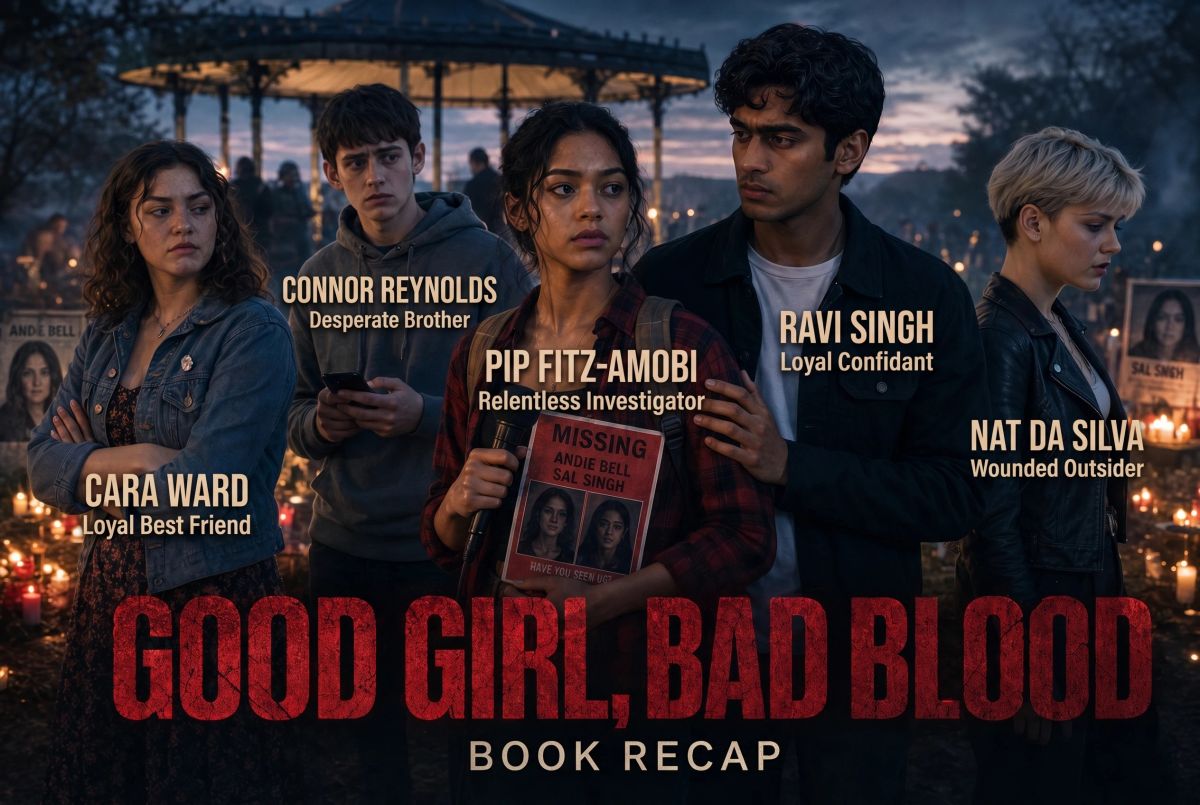


Plot Summary
Prologue
Six months after solving the murders of Andie Bell and Sal Singh, Pip Fitz-Amobi1 sits in her dark bedroom replaying recordings of a killer who deceived her. Ravi Singh,2 her almost-boyfriend, coaxes her out of the obsession. Together they name her podcast — A Good Girl's Guide to Murder — and she releases six episodes that storm the iTunes charts.
In a public statement, Pip1 declares her detective days are over. There will be no second season. She means it. She has learned what investigation costs: a hospital stay, a dead dog, her best friend's family shattered. The consequences mapped across her body like a second skeleton. She will not do this again.
Lanterns for the Dead
Six months after solving the Andie Bell case, Pip1 attends Max Hastings'15 rape trial as a prosecution witness while Ravi2 watches from the public gallery. She helps her best friend Cara Ward10 sleep nightly by watching television together over the phone — Cara10 cannot be alone with her thoughts since her father went to prison for murder.
On Friday evening, hundreds gather on Little Kilton Common for a memorial honoring Sal Singh and Andie Bell. Ravi's father2 delivers a speech about his murdered son, playing Sal's favorite song — a squeaky mouse chorus from the film Babe — and the crowd claps in time as Chinese lanterns float skyward.
But Pip1 notices Jamie Reynolds,3 Connor's4 twenty-four-year-old brother, pushing urgently through the crowd mid-ceremony, a strange intensity on his face, chasing someone only he can see.
The memorial functions as both closure and catalyst—a community's attempt to lay the past to rest becomes the opening scene of a new tragedy. Pip's observation of Jamie pushing through the crowd demonstrates that her detective instinct survives despite her conscious rejection of it. Everyone else looks skyward at the ascending lanterns; Jamie looks sideways, chasing someone invisible. This visual irony establishes the novel's central question: can Pip truly retire from being herself, or is the detective identity something deeper than a role she plays?
The Reluctant Return
The next afternoon, Connor Reynolds4 appears at Pip's1 door, flushed and frantic. Jamie3 hasn't been home since the memorial — over twenty-one hours now. Their mother filed a missing persons report, but the officer classified Jamie3 as low-risk because he's an adult who has disappeared before.
Connor4 begs Pip1 to investigate and release it on her podcast. She refuses. She reminds him what happened last time: the hospital stay, her dead dog, her shattered friendships. Pip1 drives to the Amersham police station and pleads with DI Hawkins13 to reclassify Jamie's3 case.
He won't — a missing eight-year-old takes priority, and resources are stretched to breaking. In the parking lot, standing in the rain, Pip1 calls Ravi.2 He tells her whatever she decides will be right. She calls Connor4 back. She'll do it.
Pip's refusal and eventual capitulation expose the paradox of moral responsibility: the qualities that make her capable of helping—obsessiveness, boundary-crossing, self-sacrifice—are the ones she's been told are pathological. The police risk-assessment framework, designed to allocate scarce resources, becomes the mechanism forcing a teenager into a dangerous investigation. Pip's decision isn't heroic in any simple sense; it's the product of institutional failure creating a void only she can fill, establishing a pattern that will define and ultimately damage her.
Season Two Goes Live
At the Reynolds house, Pip1 sets up microphones and interviews Joanna7 and Connor4 separately. Jamie's mother7 describes his recent erratic behavior — mood swings, obsessive texting, sneaking out past midnight. Connor4 reveals their father Arthur11 called Jamie3 a waste of space during a brutal argument hours before the memorial.
In Jamie's3 chaotic bedroom, Pip1 finds a delicate rose-gold women's watch belonging to no one in the family, a scrap of paper bearing the name of a woman who died in 2006, and a laptop sealed behind a password no one can crack.
Arthur Reynolds11 refuses to participate, convinced Jamie3 has simply run off again. Pip1 takes the investigation public: she persuades Stanley Forbes5 at the local newspaper to print a missing notice, records her announcement, and posts flyers throughout town. Season two begins.
The investigation's opening moves reveal as much about the Reynolds family as about Jamie. Arthur's refusal is testimony by absence—his conviction that Jamie has run off reveals how their volatile relationship has normalized disappearance as an outcome of conflict. The locked laptop becomes a metaphor for the son Joanna thought she knew completely. By launching season two, Pip transforms a private family crisis into public spectacle, gaining investigative power at the cost of the family's privacy and dignity—a bargain that will grow costlier with every episode.
The Calamity Party Trail
Cara10 tells Pip1 she thinks she spotted Jamie3 at a high-school party after the memorial. The party's host confirms it — an older guy in a burgundy shirt standing alone, watching the room. Pip1 finds Jamie3 in a video background at 9:38 PM, eyes locked intently on someone near the fireplace.
A witness outside the house provides the critical break: at 10:32 PM, Jamie3 was pacing the pavement on his phone, visibly agitated. He kept repeating that he couldn't do something, mentioned calling the police, and said something about a child.
Then he walked away and never returned. Separately, bookshop employees report seeing Jamie3 hurrying up Wyvil Road at 11:40 PM, breathing hard. Two of the four witnesses thought he was wearing something darker — a hoodie over his shirt, not just the burgundy alone.
Social media becomes inadvertent forensic evidence—Snapchat stories and Instagram posts function as surveillance footage no authority requested. The overheard phone call introduces fragments that won't resolve for hundreds of pages: Jamie insisting he can't do something, mentioning police, referencing a child. The discrepancy in witness descriptions—burgundy shirt versus dark hoodie—illustrates how unreliable human perception is under ordinary conditions, but also provides the crucial clue that Jamie returned home for additional items before his final journey.
Layla Knows Her Name
A party video reveals Jamie3 tapping a girl on the shoulder, calling her a name she doesn't recognize. The girl is Stella Chapman14 from Pip's1 school year — but she's never met Jamie.3 He insisted she was someone called Leila, commented she'd changed her hair, and questioned why she was at a high-school party.
Pip1 realizes Jamie3 was catfished: someone stole Stella's14 photos and altered the hair color. On Tinder, they find the profile — Layla Mead, twenty-five, less than a mile away. Her Instagram shows that Pip's1 history teacher, Mr. Clark, also follows her.
Clark admits Layla ghosted him immediately after he mentioned his profession. When Pip1 messages Layla from an anonymous account, the response arrives instantly — addressing Pip1 by name and declaring she's getting closer, punctuated with a smiley face. Then every one of Layla's accounts vanishes.
The catfish revelation operates on layered deception: Jamie was catfishing too, lying about his age and career, creating uncomfortable symmetry between deceiver and deceived. Layla's immediate identification of Pip signals an antagonist observing the investigation in real time, transforming hunter into prey. Her three-word message carries sinister ambiguity—closer to finding Jamie, but also closer to doing exactly what Layla wants. The instantaneous account deletion demonstrates sophisticated counter-surveillance, suggesting someone far more dangerous and more deliberate than a romance scammer.
Life or Death
Pip's1 own mother drops a bombshell: she fired Jamie3 two and a half weeks ago after catching him trying to steal the company credit card. When confronted, Jamie3 claimed the situation was life or death. He never told his family he'd lost his job, pretending to leave for work each morning.
Then Charlie Green,6 a neighbor who moved in four doors down, shows Pip1 doorbell camera footage from the previous Tuesday at 3 AM: Jamie3 breaks into the Greens' house through a window, stays forty-one seconds, and leaves with Flora's12 rose-gold watch — the same one Pip1 found in his bedside drawer.
Back at the Reynolds house, Joanna7 discovers Jamie's3 black hoodie is missing entirely, confirming the witnesses who saw him in darker clothing. She also finds a grey jumper from his birthday with drops of dried blood on the front and a smear on the sleeve.
Each revelation strips another layer from Jamie's carefully maintained persona. The credit card theft demolishes the image of a harmless son; the break-in suggests someone following external instructions; the blood raises the specter of violence. Jamie's claim of life-or-death urgency acquires retrospective weight—he described his situation accurately, not hyperbolically. The dramatic irony deepens when the neighbor presenting break-in footage is the very person who orchestrated it, using Jamie as a puppet from four doors away, though neither Pip nor the reader yet recognizes this.
Heartbeat to Flatline
Pip1 cracks Jamie's3 laptop password — a portmanteau of his childhood nickname for his mother7 and her birth year. His browser history reveals targeted searches for brain cancer and clinical trials, what constitutes assault, and how to fight.
But the Fitbit, a birthday gift Jamie3 wore reluctantly, holds the most devastating data. On the night he vanished, his steps continued past the last sighting. Just after midnight he stopped moving for several minutes while his heart rate climbed to 126.
Then he walked nearly two thousand more steps before his heart peaked at 158 and flatlined to zero. A search party of eighty-eight volunteers discovers the missing yellow-handled kitchen knife in the grass beside the abandoned farmhouse on Sycamore Road — right at the outer edge of the Fitbit's calculated radius.
The Fitbit transforms a consumer wellness device into a horror instrument. Heart rate data creates an emotional graph more devastating than any verbal testimony—126 BPM while stationary means pure physiological fear, and 158 before the flatline suggests fight-or-flight at its ceiling. The reader experiences Jamie's terror through numbers, which paradoxically feel more intimate than narrative description could. The knife's discovery at the farmhouse grounds abstract step-count data in physical space, converting digital breadcrumbs into a specific location where something violent occurred.
Not Guilty, Not Jamie
A body is found in woodland near the main road — a white male in his early twenties. The Reynolds family clusters in their living room, Arthur11 on the phone to police, all of them holding hands through the worst wait of their lives. When Arthur's11 face cracks, Pip's1 heart stops — until he chokes out the words: it isn't Jamie.3
The family collapses into each other, crying with relief. Arthur11 finally agrees to be interviewed, revealing that Jamie3 asked to borrow exactly nine hundred pounds weeks earlier and was refused. But within hours, a second blow lands.
Ravi2 calls from the courthouse: the jury has found Max Hastings15 not guilty on all charges. Pip1 sinks to the pavement. She sprints back to Nat da Silva's8 house, arriving before anyone else can deliver the news. When Nat8 reads the verdict on Pip's1 face, she crumbles against the hallway wall. Pip1 catches her, and for the first time, Nat8 holds on.
The body-that-isn't-Jamie and the verdict-that-acquits-Max create emotional whiplash that fractures Pip's belief system. Relief from Jamie's continued possible survival is immediately poisoned by the jury's decision. Pip's instinct to reach Nat before anyone else reveals empathy transcending their antagonistic history—she understands no one should receive devastating news alone. When these two women who have been adversaries embrace on the hallway floor, shared suffering overrides personal grievance, rewriting their relationship from enmity to reluctant solidarity in a single wordless moment.
Pip Burns It Down
A classmate's eyewitness account proves fabricated — he lied about seeing Jamie3 at Nat's8 house for podcast fame. A tabloid claims the entire investigation is staged for content. When their friend Ant accuses Pip1 of faking Jamie's3 disappearance, something detonates.
She shoves him into the school lockers and screams in his face. Three-day suspension. She pushes Ravi2 away. That night, soaking and aimless in the rain, she sits on Charlie Green's6 porch. He tells her that when the justice system fails, ordinary people get to decide right and wrong for themselves.
Pip1 drives to Max Hastings'15 empty house with a pot of paint and a hammer — writes one word across his front door, shatters every window, and uploads his recorded confession online. Later, standing in the rain outside Ravi's2 house, she tells him she loves him and is finished pretending to be someone she's not.
Pip's violence, vandalism, and public release of the confession represent the complete dismantlement of her good-girl persona. Charlie Green's porch conversation functions as the novel's philosophical hinge—his assertion that ordinary people must define justice when institutions fail sounds wise and liberating in the moment. But the reader will later understand these words as the worldview of someone who spent nineteen years planning murder. Pip's acceptance of her own ruthlessness mirrors Charlie's moral framework with uncomfortable precision, raising the question the novel refuses to answer: where exactly does righteous anger become something darker?
Child Brunswick
Nat8 contacts Pip1 with something unexpected: screenshots from Luke Eaton's9 phone showing messages with Layla Mead. Luke9 went to meet Layla at a car park around midnight the Friday Jamie3 vanished — but Jamie3 was there instead. Pip1 offers Luke9 nine hundred pounds, the exact amount Jamie3 owed him, in exchange for his full account.
Luke9 explains that Jamie3 approached him, uttered something like child broomstick, studied his face for a reaction, got none, then bolted. Every person Layla targeted shares an uncanny profile: white men with brown hair, aged twenty-nine to thirty. Ravi2 suggests the misheard phrase might be Child Brunswick.
A search confirms it: Scott Brunswick was a serial killer whose young son helped lure seven teenagers to their deaths in the late 1990s. The son was given a new identity upon release. He would be twenty-nine or thirty now, living under a court-ordered pseudonym somewhere in England.
The misheard phrase becoming Child Brunswick literalizes how truth hides in plain language—a single phoneme separating nonsense from a serial killer's legacy. Luke's testimony reveals that Jamie was performing a recognition test: speak the trigger words, watch for a reaction, identify the target. This reframes Jamie from victim to unwitting operative in someone else's revenge plot. The age-matching pattern among Layla's targets elevates the catfish from romance scam to methodical identity hunt, revealing every flirtatious message as interrogation in disguise.
Stanley's Original Name
On a forum, someone posts that Child Brunswick lives in Little Kilton — the information traced back through a chain of prison gossip to Howie Bowers, a local drug dealer Pip1 put away during her first investigation. Pip1 remembers photographs she took months ago of Stanley Forbes5 secretly handing Howie an envelope of cash.
The blackmail connection clicks: Howie knew Stanley's5 secret and was extorting him. Everything aligns. Stanley5 is the right age, has no visible family history, maintains no personal social media, and sometimes fails to respond to his own name — a quirk his colleague attributed to selective hearing but which suggests a man still adjusting to a name he hasn't carried for long. Pip1 tells Ravi2 and Connor:4 Stanley Forbes5 is Child Brunswick. If Layla sent Jamie3 to test two suspects that night, Stanley5 was the one who reacted.
Identifying Stanley requires Pip to synthesize evidence across two separate investigations—photographs taken months ago for an entirely different purpose become the key to the current case. This narrative recursion suggests investigations never truly end; evidence persists, waiting for contexts the investigator never imagined. Stanley's desperate payments to Howie resolve into blackmail over a hidden identity, demonstrating how a single secret creates permanent vulnerability. The irony that Stanley's pseudonym sounds unremarkable while concealing one of Britain's most controversial identities speaks to the novel's deep preoccupation with performed selfhood.
Alive Behind the Door
The plan unfolds at night: Pip1 texts Stanley5 as Layla, luring him to the farmhouse at eleven. When he drives away, Ravi2 and Connor4 break into his house through a back window. Pip1 watches the farmhouse from the trees, sixty feet away, phone pressed to her ear.
Through the speaker she hears Connor's4 ragged shout — Jamie's3 name, desperate and breaking. Jamie3 is locked in a downstairs bathroom, chained from the outside, but alive and talking. He tells them to leave; he's made a deal. When Stanley5 re-emerges from the empty farmhouse, Pip1 steps out of the shadows to confront him.
Shaken but relieved she isn't Layla, he tells his side: Jamie3 attacked him with a knife on Layla's instructions, he defended himself, knocked Jamie3 out, and kept him prisoner — not to harm him, but because calling police would destroy the identity and the life he'd spent eight years building.
Finding Jamie alive delivers the emotional climax that precedes the violent one. The detail that Jamie made a deal with his captor introduces moral nuance—Stanley didn't simply imprison him; they negotiated mutual protection born from mutual fear. Stanley's choice to keep Jamie rather than call police reveals how identity-based trauma creates impossible decisions: losing one's constructed life feels equivalent to death itself. Jamie's plea for his rescuers to leave shows how even victims can be drawn into protecting the machinery of their own captivity.
Six Shots at the Farmhouse
Charlie Green6 walks into the farmhouse, asks to borrow Pip's1 phone, and pockets it. He draws a gun. His real name is Charlie Nowell. His sister Emily was the last teenager murdered by Scott Brunswick — lured from a playground by the killer's ten-year-old son while nine-year-old Charlie6 waited at the swings, counting to three, praying she'd reappear.
He spent nineteen years and ten different towns hunting for Child Brunswick, creating a new Layla Mead in each one. He groomed Jamie3 through escalating tasks — steal money, steal a watch, beat a stranger — preparing him to kill on command.
The memorial forced his hand too early. He thanks Pip1 for finishing the identification. Then he fires six times. Pip1 tears her jacket into tourniquets, drags Stanley5 out as the building catches fire, and performs chest compressions on the grass until paramedics arrive and stop. Stanley5 is gone.
Charlie's monologue retrospectively reframes the entire novel. Every kindness—baked goods, porch wisdom, encouragement—was calculated to keep Pip investigating until she identified his target. His explicit parallel with Pip is the novel's most uncomfortable moment: both cross legal boundaries for perceived justice, both feel failed by the system, both act where institutions won't. The difference between them is degree, not kind. Stanley dies performing his sole act of genuine selfhood—pushing Pip back to protect her—granting him the heroism his own narrative always denied him while denying the reader any clean moral resolution.
The Gun Inside Her
Pip1 arranges Stanley's5 funeral — no family claims him, no friends remain after the truth surfaces. Eight people attend. Protesters arrive with signs calling Charlie Green6 a hero and Stanley5 a monster. Pip1 charges at them, tears their placards apart, and is dragged back by her father.
Weeks later, at a barbecue in the Reynolds garden, Jamie3 sits beside Pip1 and promises to live a full life for Stanley,5 who cannot anymore. He plans to train as a paramedic. He walks over to Nat,8 and something bright and reciprocal passes between their eyes.
Pip1 watches from the garden steps with Ravi's2 foot tucked under her leg. She cannot join the others yet. The sound of the gun has taken up residence inside her — hiding in every closing door, every dropped pencil, every beat of her own heart. Charlie6 and Flora Green12 remain at large.
The gun as permanent internal tenant is the novel's final metaphor for how proximity to violence rewrites the nervous system. Pip's attack on funeral protesters and her inability to join the barbecue circle reveal someone whose baseline sense of safety has been fundamentally altered. Jamie's promise to live well transforms Stanley's death from senselessness into moral obligation—the living carrying forward the unrealized potential of the dead. The novel closes not with resolution but continuation: Pip still searching, the gun still firing, some wounds never closing over, some investigations never truly ending.
Epilogue
In the evening after the barbecue, Pip1 sits at her desk in the dark, the screen her only light. She tells her parents she is studying. She is lying — she does that now. She searches for the latest sightings of Charlie6 and Flora Green:12 security footage from Portsmouth nine days ago, an unverified report from a petrol station in Dover.
She writes every detail down on a fresh sheet of paper. The gun is always with her. It beats inside her chest and hides in thunderstorms and the tap of keys and every creak of her quiet house. Pip1 cannot stop hearing it. And she will not stop searching.
Analysis
Good Girl, Bad Blood is fundamentally a novel about the vacuum left when institutions meant to protect people — police, courts, schools — prove inadequate or indifferent. The police classify Jamie3 as low-risk. A jury acquits a confessed rapist. The legal system shields a killer's son with anonymity while victims' families spend decades in anguish. Into each void steps an eighteen-year-old who doesn't want the responsibility but accepts it because no one else will.
The novel's central tension isn't whodunit but who-is- Pip.1 She promised to never investigate again, but the promise was always performative — not because she's addicted to mystery-solving, but because she cannot tolerate injustice left unaddressed. Her arc across the novel is one of radical self-acceptance: shedding the performance of goodness to embrace the reckless, obsessive, boundary-crossing person who actually gets results. Holly Jackson draws a deliberate parallel between Pip1 and Charlie Green6 — both believe in extrajudicial justice, both take matters into their own hands, both cross legal and ethical lines for what they believe is right. Charlie6 explicitly tells Pip1 they are the same. The novel's final horror is that Pip1 cannot fully disagree.
Jamie Reynolds3 functions as both mystery and mirror. His creation of a fictional self online — older, successful, independent — echoes the novel's preoccupation with performed identity. Stanley Forbes5 lives under his third name. Charlie Green6 is really Charlie Nowell. Layla Mead doesn't exist at all. Everyone in Little Kilton wears a mask, and the investigation becomes an exercise in peeling them away to find something more frightening underneath.
The Fitbit provides the novel's most haunting literary mechanism: a heart rate graph that tells a story of terror more eloquently than testimony could. When the line flatlines, every reader feels it viscerally. Technology here is both savior and horror — it locates Jamie3 but also records his fear with inhuman precision. The gun that takes up residence inside Pip1 at the novel's end is Jackson's most powerful image: trauma as permanent tenant, the cost of pursuing justice in a world where justice itself has become unreliable. Some investigations close. Some wounds don't.
Review Summary
Good Girl, Bad Blood received largely positive reviews, with many readers praising its gripping plot, character development, and unexpected twists. Fans enjoyed the returning characters Pip and Ravi, as well as the podcast format. Some found it even better than the first book, while a few felt it suffered from middle-book syndrome. Readers appreciated the exploration of deeper themes and the realistic portrayal of Pip's emotional struggles. The ending left many eagerly anticipating the next installment, though some found the twists too far-fetched.
People Also Read






Characters
Pip Fitz-Amobi
Podcast detective, reluctant heroEighteen-year-old amateur detective and podcast creator who solved two murders in Little Kilton the previous year. Pip is driven by a near-pathological need for truth and justice, rooted in a belief that someone must step up when institutions fail. She carries significant guilt from her first investigation—her dog was killed, she was hospitalized, and her best friend's father turned out to be a murderer. She promised never to investigate again, but her sense of responsibility overpowers self-preservation every time. Pip exists in constant tension between who she wants to be and who she actually is: someone willing to break rules, manipulate witnesses, and cross ethical lines when the cause feels righteous. Her relationship with Ravi2 grounds her, though she pushes him away at her worst.
Ravi Singh
Pip's partner, Sal's brotherYounger brother of Sal Singh, who was murdered and framed as a killer six years earlier. Pip1 cleared Sal's name during her first investigation, and their partnership evolved into romance. Ravi serves as Pip's1 moral compass and emotional anchor—knowing when to challenge her and when to simply be present. He attends Max Hastings'15 trial daily, taking notes for Pip1, and sees Jamie's3 case as a personal second chance to save someone's brother where he couldn't save his own. Ravi deflects anxiety with humor—calling Pip1 'Sarge,' making puns under pressure—but beneath the levity lies someone who understands loss at a cellular level. He loves Pip1 fiercely, even when she tries to self-destruct, and refuses to let her do it alone.
Jamie Reynolds
Connor's missing older brotherTwenty-four years old and the eldest Reynolds sibling, Jamie is sweet-natured, sensitive, and fundamentally lost. After dropping out of university following a panic attack during exams, he has drifted between jobs and struggled with self-worth, constantly measuring himself against peers who seem to have life figured out. His father's11 disappointment compounds his insecurity. When his close friendship with Nat da Silva8 turns romantic on his side and she chooses someone else, Jamie's vulnerability deepens. He creates a false online identity—older, successful, independent—revealing the chasm between who he is and who he desperately wants to be. This hunger for connection and validation makes him dangerously susceptible to manipulation by anyone who makes him feel needed.
Connor Reynolds
Jamie's frantic little brotherEighteen, freckled, and angular, Connor is Jamie's3 closest confidant and the person who initiates the investigation by arriving at Pip's1 door. He and Jamie3 have always shared everything—until recently, when Jamie3 began keeping secrets. Connor's desperation manifests as nervous energy: reading toxic comments despite warnings, occasionally undermining the investigation with emotional outbursts. He lacks Pip's1 detective instincts but compensates with dogged loyalty. His relationship with Jamie3 carries almost parental protectiveness—he monitors Jamie's3 moods, covers for family fights, and struggles deeply with the revelation that the brother he thought he knew had been living a hidden life right under his nose.
Stanley Forbes
Secretive newspaper volunteerA late-twenties volunteer journalist at Little Kilton's small-town newspaper. Awkward and earnest, Stanley struggles with social interaction—sometimes failing to respond to his own name, a quirk colleagues attribute to selective hearing. He has no visible family connections and no personal social media. During Pip's1 first investigation, he spoke cruelly about Sal Singh and has since issued extensive apologies and led fundraising for a memorial bench. Stanley is driven by a deep, almost desperate need to belong and prove he can be good. He carries an unnamed burden, manifesting as nervous energy and intense desire to be useful. His relationship with imprisoned drug dealer Howie Bowers involved mysterious cash payments whose purpose Pip1 initially cannot explain.
Charlie Green
Pip's thoughtful new neighborA twenty-eight-year-old freelance web designer who recently moved four doors from Pip1 with his wife Flora12. Charlie works from home, is warm and welcoming, and quickly integrates into the neighborhood—attending the memorial, offering baked goods, chatting with neighbors. He installed a doorbell security camera after previous break-ins at a former home. His philosophical perspective on justice, shared during a late-night conversation with Pip1, carries the weight of deeply personal experience: he speaks about systemic failure with the conviction of someone who has been profoundly failed. His calm confidence and thoughtful manner make him an unexpected source of comfort during Pip's1 lowest moment, and his encouragement pushes her to continue the investigation when she is ready to quit.
Joanna Reynolds
Jamie's devoted motherJamie's3 mother, who shares an exceptionally close bond with her eldest son—they have pet names and daily rituals. She is the family's emotional center, shrinking visibly under the weight of Jamie's3 absence but refusing to surrender hope. She volunteers for password-cracking duty and tirelessly calls hospitals. Her fear is raw and poorly concealed: she retreats upstairs to cry where Connor4 cannot see, convinced that visible grief would destroy her younger son's hope.
Nat da Silva
Jamie's guarded closest friendA former suspect in Pip's1 first investigation who harbors deep resentment toward Pip1 for treating her as a murder suspect. Sexually assaulted at a party, she testified at Max Hastings'15 trial. Fierce and guarded, she initially refuses all cooperation. Her bond with Jamie3 runs deeper than she admits—both feel left behind by their peers, and their friendship was forged from shared stagnation. Her relationship with boyfriend Luke Eaton9 conceals uncomfortable truths she is reluctant to confront.
Luke Eaton
Nat's intimidating boyfriendNat's8 new boyfriend, tattooed across his neck and driving a flashy white BMW. Luke operates a county-lines drug distribution network using the abandoned farmhouse as a pickup point and a teenager to transport product from London. He loaned Jamie3 nine hundred pounds and threatened violence over repayment. Behind his menacing exterior, Luke proves surprisingly transactional—willing to trade information for cash with a directness that borders on professional.
Cara Ward
Pip's insomniac best friendPip's1 closest friend and daughter of convicted murderer Elliot Ward. Cara masks profound trauma behind sharp humor about her imprisoned father—jokes that most people have no idea how to handle. She cannot sleep alone, so Pip1 calls nightly to watch shows until Cara drifts off. Despite her own pain, Cara shows up consistently: distributing posters, leading search teams, sliding a chocolate bar across the lunch table when Connor4 cannot eat. Her dark comedy is survival, and only Pip1 knows how to match it.
Arthur Reynolds
Jamie's frustrated fatherJamie's3 father, whose relationship with his eldest son cycles through explosive arguments about ambition and responsibility. Initially convinced Jamie3 has simply run off again, Arthur refuses to participate in the investigation and leaves the house for hours. His practical demeanor clashes with Jamie's3 sensitivity. He called Jamie3 a waste of space hours before the disappearance—a fact that haunts him when he's forced to confront the possibility his son may never return.
Flora Green
Charlie's warm, baking wifeCharlie's6 wife, who works as a teaching assistant at Pip's1 brother's school. Warm and generous, she bakes for neighbors and befriends the community. Her rose-gold watch becomes a key piece of evidence when Jamie3 steals it under external direction.
DI Hawkins
Dismissive lead detectiveThe detective who led the original Andie Bell investigation. He refuses to upgrade Jamie's3 case from low-risk, citing limited resources and budget cuts. His institutional inaction forces Pip1 back into detective work and represents the systemic failure driving the entire plot.
Stella Chapman
Student with stolen photosA student in Pip's1 year whose Instagram photos were stolen and digitally altered to create the Layla Mead catfish identity. When Jamie3 approaches her at the party calling her by the wrong name, she has no idea who he is or what he's talking about.
Max Hastings
Accused rapist on trialThe defendant in a rape trial running parallel to Jamie's3 disappearance. Pip1 testified against him, and Ravi2 attends daily to take notes. Max represents everything Pip1 fought to expose in her first investigation—a predator shielded by wealth, legal maneuvering, and social privilege. His case tests whether truth and justice are genuinely connected.
Plot Devices
The Podcast
Investigation engine and weaponPip1 records her investigation in real-time as podcast episodes, interviewing witnesses, presenting evidence, and narrating findings to hundreds of thousands of subscribers. The podcast serves as a tool for crowdsourcing information—generating tips, photos, and sightings from listeners—a pressure mechanism on reluctant witnesses, and a public accountability system the police lack. But it also makes the investigation exploitable: Layla Mead uses Pip's1 public broadcasts to monitor progress and steer the detective toward the outcome she desires. The podcast exposes Pip1 to trolls, death threats, and a fabricated article claiming the investigation is staged, illustrating how public-facing work creates vulnerability alongside power.
Jamie's Fitbit
Digital forensic black boxA birthday gift from Arthur Reynolds11 that Jamie3 wore reluctantly. The Fitbit tracks step counts and heart rate, providing precise data about Jamie's3 movements and physical state during the hours he disappeared. Step-count data allows Pip1 to calculate a search radius from the last confirmed sighting, narrowing the probable location of whatever happened. Heart rate data tells a story of escalating terror—climbing from resting levels to 126 during a stationary period, then to 158 before dropping to zero. The flatline creates the novel's most devastating ambiguity: did Jamie3 remove the device, or did his heart stop? The Fitbit transforms a consumer fitness gadget into an involuntary recorder of fear, giving Pip1 forensic evidence the police never collected.
The Layla Mead Identity
Antagonist's manipulation weaponA fabricated online persona using stolen and altered photographs of a real student14. Layla appears across Tinder, Instagram, and Facebook, targeting white men aged twenty-nine to thirty with brown hair who live in Little Kilton. The profile asks probing questions about age, family, and occupation—screening potential matches against a very specific profile. Layla catfished Jamie3 and exploited his emotional vulnerability, escalating demands from depositing cash at a graveyard to stealing a watch to physical violence, systematically testing how far devotion could be pushed. The catfish identity has been deployed in various forms across multiple towns over several years, each iteration hunting for the same person.
The Missing Kitchen Knife
Escalating danger signalA six-inch chef's knife with a yellow handle that goes missing from the Reynolds kitchen rack sometime after Wednesday. Pip1 notices its absence through a photograph comparison—the knife present in birthday photos, gone from the rack days later. Its disappearance from the family home coinciding with Jamie's3 disappearance suggests either he armed himself or someone armed themselves against him. When the search party discovers the knife in grass beside the abandoned farmhouse, it marks the probable site of Jamie's3 confrontation and confirms the case has turned violent. The knife is collected by police as physical evidence, representing the first meaningful engagement of authorities with Jamie's3 case.
The Doorbell Camera
Proof of Jamie's secret tasksA motion-activated security camera installed by the Green family6 after break-ins at a previous home. The night-vision footage captures Jamie3 breaking into the house at 3:07 AM, entering through a window, staying exactly forty-one seconds, and leaving with Flora's12 rose-gold watch. The footage proves Jamie3 was performing tasks for someone—actions completely out of character that his family cannot explain. It establishes that Jamie3 bypassed far more valuable items to steal a nearly worthless sentimental object, suggesting he was following specific instructions rather than acting on his own criminal impulse.
FAQ
Synopsis & Basic Details
What is Good Girl, Bad Blood about?
- Sequel to a mystery: The story follows Pip Fitz-Amobi as she gets drawn into another investigation, this time the disappearance of Jamie Reynolds, a friend's brother.
- Unraveling a web of lies: Pip must navigate a complex web of deceit, manipulation, and hidden identities as she tries to uncover the truth behind Jamie's disappearance.
- Personal and emotional stakes: The investigation forces Pip to confront her past actions and the emotional toll of her previous case, while also putting her and her loved ones in danger.
Why should I read Good Girl, Bad Blood?
- Intricate mystery: The book offers a complex and engaging mystery with unexpected twists and turns, keeping readers guessing until the very end.
- Character-driven narrative: The story delves into the psychological complexities of its characters, exploring their motivations, fears, and desires.
- Exploration of moral ambiguity: The book raises thought-provoking questions about justice, redemption, and the blurred lines between right and wrong.
What is the background of Good Girl, Bad Blood?
- Small-town setting: The story is set in the fictional town of Little Kilton, where secrets and hidden connections are prevalent.
- Social media influence: The book explores the impact of social media and online identities on real-life events, highlighting the dangers of catfishing and online manipulation.
- True crime podcast: The narrative is framed around Pip's true crime podcast, "A Good Girl's Guide to Murder," which serves as a platform for her investigation and a commentary on the media's role in shaping public perception.
What are the most memorable quotes in Good Girl, Bad Blood?
- "If you want something done right, you have to do it yourself.": This quote highlights Pip's determination to take matters into her own hands when the authorities fail to act, reflecting her proactive nature.
- "Missing is missing.": This quote emphasizes the seriousness of Jamie's disappearance, regardless of the circumstances, and underscores Pip's commitment to finding him.
- "You need to draw people in, intrigue them. Have a word like 'kill' or 'dead' in there.": This quote, spoken by Ravi, reveals the tension between sensationalism and accuracy in true crime storytelling, a theme explored throughout the book.
What writing style, narrative choices, and literary techniques does Holly Jackson use?
- Multi-media approach: Jackson incorporates podcast transcripts, text messages, and social media posts into the narrative, creating a dynamic and immersive reading experience.
- First-person perspective: The story is told from Pip's point of view, allowing readers to experience her thoughts, emotions, and investigative process firsthand.
- Foreshadowing and red herrings: Jackson uses subtle clues and misdirection to keep readers guessing, creating a suspenseful and unpredictable plot.
Hidden Details & Subtle Connections
What are some minor details that add significant meaning?
- The broken mug: The broken mug in Jamie's room foreshadows the violence and chaos surrounding his disappearance, hinting at a struggle or a sudden event.
- The missing yellow-handled knife: The absence of the yellow-handled knife from the knife block in the Reynolds' kitchen foreshadows its later appearance at the farmhouse, linking Jamie to the scene.
- The repeated phrase "life or death": Jamie's use of this phrase when asking for money and when talking to his mum about his job loss foreshadows the life-threatening situation he finds himself in.
What are some subtle foreshadowing and callbacks?
- The "You're getting closer" message: Layla's message to Pip after she contacts her on Instagram foreshadows the danger Pip is in and the fact that Layla is aware of her investigation.
- The mention of Woodhill Prison: Cara's mention of visiting her father in Woodhill Prison is a callback to the previous book, reminding readers of the consequences of Elliot Ward's actions.
- The description of the Reynolds' house as a face: The description of the Reynolds' house as a face, usually happy but now incomplete, foreshadows the family's emotional turmoil and the absence of Jamie.
What are some unexpected character connections?
- Stanley Forbes and Child Brunswick: The revelation that Stanley Forbes is actually Child Brunswick, the son of a notorious serial killer, is a shocking twist that connects him to the dark history of the town.
- Charlie Green and Emily Nowell: The reveal that Charlie Green is Emily Nowell's brother, seeking revenge on Child Brunswick, adds a layer of personal tragedy and motivation to his actions.
- Luke Eaton and Layla Mead: The connection between Luke Eaton and Layla Mead, as revealed through their messages, shows that Luke was also a victim of Layla's manipulation, adding another layer of complexity to the story.
Who are the most significant supporting characters?
- Cara Ward: Pip's best friend, Cara, provides emotional support and a sense of normalcy, while also grappling with her own family's dark past.
- Connor Reynolds: Jamie's younger brother, Connor, is a driving force in the investigation, pushing Pip to help find his missing brother and providing crucial information.
- Nat da Silva: A former suspect in Pip's previous case, Nat's connection to Jamie and her own experiences with manipulation make her a key figure in the investigation.
Psychological, Emotional, & Relational Analysis
What are some unspoken motivations of the characters?
- Stanley Forbes' desire for normalcy: Stanley's motivation is to protect his new identity and the life he has built in Little Kilton, fearing that his past will catch up to him.
- Charlie Green's need for revenge: Charlie's actions are driven by a deep-seated desire for revenge for his sister's murder, which has consumed his life for years.
- Pip's need for control: Pip's need to control the narrative and the investigation stems from her past trauma and her desire to prevent further harm to those around her.
What psychological complexities do the characters exhibit?
- Pip's guilt and self-doubt: Pip struggles with guilt over her past actions and doubts her ability to solve the case, leading to moments of self-sabotage and emotional turmoil.
- Jamie's vulnerability and desperation: Jamie's vulnerability and desperation make him susceptible to Layla's manipulation, highlighting his emotional fragility and need for connection.
- Charlie's obsession and rage: Charlie's obsession with avenging his sister's murder consumes him, driving him to extreme actions and blurring the lines between justice and revenge.
What are the major emotional turning points?
- Pip's decision to help Connor: Pip's decision to help Connor despite her initial reluctance marks a turning point in her character development, showing her willingness to put others before herself.
- The discovery of Jamie's bloodied jumper: The discovery of Jamie's bloodied jumper intensifies the emotional stakes of the investigation, highlighting the potential danger he is in.
- The revelation of Stanley's identity: The revelation that Stanley Forbes is Child Brunswick is a major emotional turning point, forcing Pip to confront the complexities of his past and the consequences of his actions.
How do relationship dynamics evolve?
- Pip and Ravi's relationship: Pip and Ravi's relationship is tested by the pressures of the investigation, but their love and support for each other remain a constant source of strength.
- Pip and Connor's relationship: Pip and Connor's relationship evolves from a professional partnership to a deep friendship, as they both grapple with the emotional toll of Jamie's disappearance.
- Pip and Nat's relationship: Pip and Nat's relationship shifts from animosity to a fragile understanding, as they both recognize their shared experiences with manipulation and loss.
Interpretation & Debate
Which parts of the story remain ambiguous or open-ended?
- Layla Mead's true identity: While Charlie Green is revealed to be behind the Layla persona, the story leaves open the possibility that there may be other individuals involved in the online manipulation.
- The full extent of Luke Eaton's involvement: Luke's role in the drug trade and his connection to Layla remain somewhat ambiguous, leaving room for speculation about his true motivations.
- The long-term consequences of the events: The story ends with the promise of a better future, but the long-term consequences of the trauma experienced by Pip, Jamie, and their loved ones remain open-ended.
What are some debatable, controversial scenes or moments in Good Girl, Bad Blood?
- Pip's decision to release the audio of Max Hastings: Pip's decision to release the audio of Max Hastings admitting to drugging and raping Becca Bell, despite it being inadmissible in court, raises questions about the ethics of using private recordings for public justice.
- Pip's violent outburst against Ant: Pip's violent reaction to Ant's comments about Jamie's disappearance raises questions about her own moral compass and the extent to which she is willing to go to protect those she cares about.
- The ending with Charlie and Flora on the run: The ending, with Charlie and Flora on the run, leaves the reader questioning whether justice will ever be served and whether the cycle of violence will ever end.
Good Girl, Bad Blood Ending Explained: How It Ends & What It Means
- Stanley's death and Jamie's survival: The ending sees Stanley Forbes, revealed to be Child Brunswick, die after being shot by Charlie Green, while Jamie Reynolds is found alive but traumatized.
- The cycle of violence: The ending highlights the cyclical nature of violence and revenge, as Charlie Green's actions are driven by his own past trauma and desire for retribution.
- The importance of personal justice: Despite the failures of the formal justice system, the ending emphasizes the importance of personal justice and the need to find meaning and purpose in the face of tragedy.
A Good Girl's Guide to Murder Series


About the Author
Other books by Holly Jackson
Download PDF
Download EPUB
.epub digital book format is ideal for reading ebooks on phones, tablets, and e-readers.








































