

Key Takeaways
The gentle, receptive man is life-preserving but not life-giving
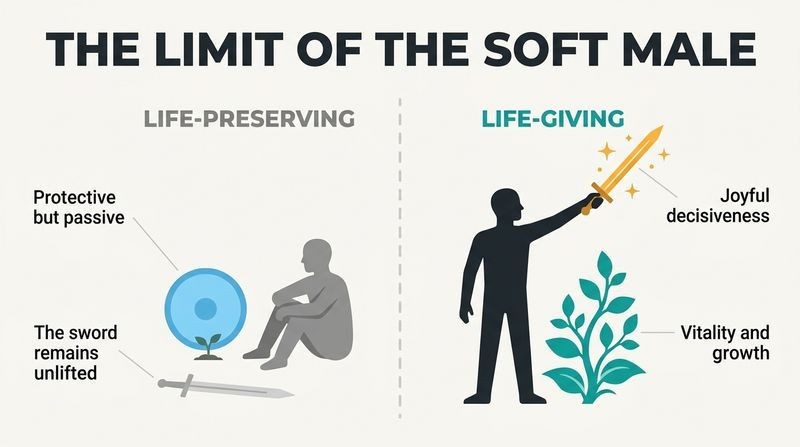
The soft male lacks fire. Bly opens by tracing American masculinity through the responsible, emotionally armored "Fifties male" to the sensitive man who emerged after the sixties, who welcomed his feminine side, wrote poetry, and refused to dominate. Bly likes these men, but notices something is wrong: they radiate little vitality, often pairing with fierce women who carry the couple's energy.
At early men's gatherings in the 1980s, younger men wept within minutes, grieving absent fathers and failing relationships. Their receptivity could say "I feel your pain," but could not say "This is what I want, and I will stand by it." Bly's image: when Odysseus approaches Circe, Hermes tells him to show his sword. Showing the sword is not violence. It is joyful decisiveness, and the soft male cannot lift it.
What's striking is how precisely this 1990 diagnosis anticipated decades of debate about young men's disengagement. Bly refuses the easy binary: he does not want the swaggering "John Wayne" macho man back, nor does he dismiss the sensitivity gained. He wants a third thing. Sociologists studying declining male labor participation and the "failure to launch" phenomenon echo his intuition that gentleness without agency stalls. The weakness of the argument is its reliance on gender essentialism and a nostalgic reading of the past. Yet the core observation, that nurturance and firmness need not be opposites, remains psychologically sharp and unusually generous toward the men it critiques.
Buried at the bottom of every man's psyche is a Wild Man, not a savage
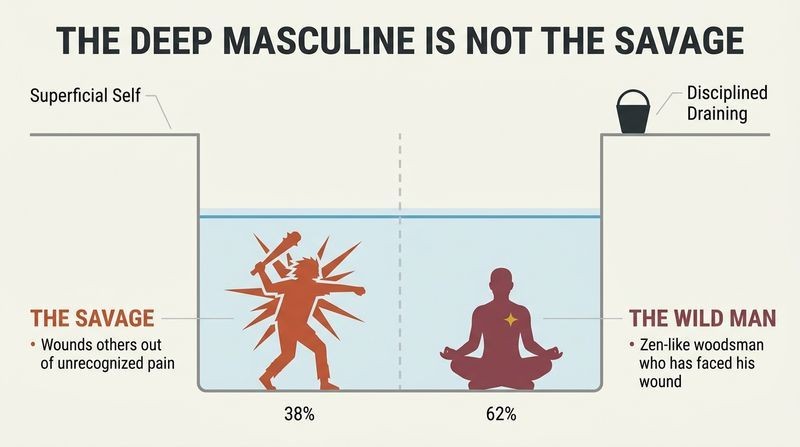
Descend to find the deep masculine. In the Grimm tale, hunters vanish near a forest pond. A stranger drains it bucket by bucket and finds a large man covered in rust-colored hair. Bly reads this hairy figure as the Wild Man: the primitive, instinctual, earthy masculine energy lying underwater in the modern male psyche, untouched for generations.
Crucially, the Wild Man is not the savage. The savage wounds others and refuses to examine his own hurt. The Wild Man has looked at his wound and resembles a Zen priest, a shaman, or a woodsman more than a brute. Reaching him is frightening, unlike the pleasant discovery of one's receptive side. And the draining is slow, disciplined labor, like the years Rembrandt or Rilke gave their craft. No drug, no weekend workshop substitutes for the buckets.
The distinction between Wild Man and savage is the book's ethical hinge, and readers who caricature Bly as promoting macho regression miss it entirely. His Wild Man is closer to what psychologists call integrated aggression: forceful energy that is conscious rather than acted out blindly. This maps onto Jung's shadow work, where disowned instinct becomes destructive precisely when repressed. It also resonates with modern trauma research suggesting that dissociated, unfelt anger drives more harm than anger that is owned. The bucket-by-bucket image is the honest part: Bly insists on discipline and slowness, an antidote to the instant-transformation promises that later plagued the men's movement he inspired.
You cannot get your lost wholeness back from a woman
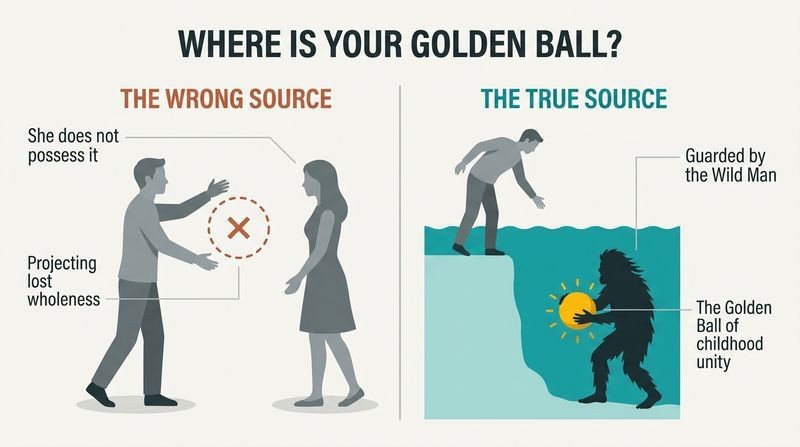
The golden ball hides with the Wild Man. The king's eight-year-old son loses his beloved golden ball into the caged Wild Man's enclosure. Bly reads the ball as the radiant unity of childhood, the wholeness we possess before splitting into male and female, good and bad. Everyone loses it around age eight, and spends life trying to recover it.
His provocative claim: men keep looking in the wrong place. The Fifties man begged a woman to return his ball. The sixties and seventies man asked his own inner feminine. Neither works, because the ball sits in the magnetic field of the deep masculine, guarded by the instinctual figure underwater. A wife would return it if she could, Bly says, but she does not have it, having lost her own. The Wild Man will only bargain: the ball for his freedom.
This is the book's most contested move, and its most useful when read charitably. Bly is not saying women are useless to men. He is saying men outsource their vitality, expecting a partner or an internalized feminine to supply what only their own descent can. Attachment theory offers a friendly amendment: humans genuinely co-regulate, so total self-sourcing is a myth. But relationship researchers also document how one partner carrying the other's emotional life breeds resentment and collapse. Bly's insight predicts exactly this failure mode. The golden ball is less about gender than about refusing to make anyone else responsible for your aliveness.
Steal the key from under your mother's pillow; you cannot ask for it
Separation must be seized, not granted. To free the Wild Man, the boy needs a key, and the Wild Man reveals it lies under the mother's pillow, exactly where Freud predicted. The pillow, Bly notes, is also where a mother stores her expectations: my son the doctor, my son the analyst. Few dream "my son the Wild Man."
The key must be stolen, not requested. When a young man once suggested politely asking mom for it, Bly felt every woman in the room want to strangle him. No mother worth her salt hands over the key, and a son who cannot steal it does not deserve it. This is not about attacking or shouting at the mother, which accomplishes nothing. It is about a decisive, cunning act of self-liberation, best done "when the parents are away," meaning free of internalized inhibition.
Bly borrows Freud's Oedipal frame but reroutes it away from blame toward agency. The theft metaphor is deliberately transgressive because healthy individuation often feels like a small betrayal. Developmental psychology supports the underlying claim: differentiation from caregivers is a task the young person must actively drive, not something parents can bestow without the child undoing it. The gendered specifics are dated, and daughters face parallel binds Bly barely addresses. Still, the practical wisdom holds broadly. Reasoned negotiation with the forces that formed you rarely liberates you. Consensus-seeking with your own conditioning keeps the key exactly where it was.
Boys need older men to become men; women cannot do it alone
Manhood requires active intervention by elders. Bly's blunt thesis: a woman can grow a boy in her body, but only men can turn a boy into a man, through ritual and effort. In the Kikuyu initiation, elders each open a vein and let the fasting youth drink their blood, teaching him nourishment comes from men too, and that the knife serves more than wounding.
The Industrial Revolution severed this. Fathers left for factories and offices, and sons stopped seeing what fathers actually did. Drawing on analyst Alexander Mitscherlich, Bly argues that when a son cannot witness his father's work, a hole opens in his psyche and fills with "demons" of suspicion that make him distrust all older men. Gang members, he notes, are boys who have never met a responsible older man. Without elders, boys cannot cleanly break from the mother, so they turn ugly and rude instead.
The Mitscherlich "hole fills with demons" model is the book's most testable claim, and contemporary data lends partial support. Studies on father absence correlate with elevated behavioral problems in boys, and mentorship programs show measurable protective effects, echoing Bly's "active intervention." His diagnosis of gangs as substitute initiation anticipated later scholarship on youth violence as botched rites of passage. The vulnerability is the strong essentialist claim that only men can initiate men, which excludes the many boys raised well by women and single mothers. A steelman: Bly is describing a specific transmission of embodied male experience, not a verdict on parenting competence.
Your deepest wound is the exact address of your genius
Where it hurts is where the gift lives. Sitting by the Wild Man's golden spring, the boy is told to keep everything out of it. But his throbbing finger, wounded when he opened the cage, involuntarily dips in and turns to gold. Bly reads this as the core teaching: the wound that hurts most is where your gift to the community will emerge.
Our culture teaches men that a wound is shameful, that a real man keeps walking while dragging his guts behind. Bly reverses this. Munch painted from his crippling anxiety; Kafka, Dickinson, and Vallejo gave their gifts through their injuries. The task is neither to climb above the wound in grandiosity nor to sink into it as a permanent victim, but to learn, in the presence of a mentor, when to dip it in the water. Therapy at its best is this patient waiting by the pond.
This is Bly's most quoted and most transferable idea, and it converges with independent lines of research. Post-traumatic growth studies document how a substantial share of trauma survivors report new strengths, purpose, and creative output. The "wounded healer" archetype runs from shamanism through Jung to the disproportionate presence of early loss in eminent creators. Bly's crucial nuance is the third path between grandiosity and victimhood, which resembles the psychological concept of integration: neither denying nor identifying with pain, but relating to it. The caution worth adding is that not all wounds alchemize, and romanticizing suffering can discourage people from seeking treatment that actually heals.
Growth requires descent into ashes, not just ascent toward the light
Go down and out, not just up. After his golden head appears, the Wild Man sends the boy into the world to "learn what poverty is." He becomes a kitchen boy, raking cinders. Bly names this katabasis, the Greek word for descent: the drop through the floor into ordinary lowliness, grief, and failure that the elevated "flying boy" must undergo.
Bly distinguishes the manic ascender (the puer aeternus, the eternal boy chasing purity and higher consciousness) from the man who has touched ashes. Descent arrives through divorce, addiction, illness, depression, or being fired. He praises Jung's response to news of a promotion: sorry to hear it. To a firing: wonderful, let's open wine. Handling ashes literally means grieving what has turned to ash: dead dreams, cold relationships, the corpse of a shamed boy. A culture built on Disneyland denial of death produces men who skip this and stay brittle.
Bly's polemic against "ascensionism" is a shrewd corrective to spiritual bypassing, a term coined by psychologist John Welwood for using transcendence to dodge unresolved wounds. The insistence that midlife descent is developmental, not pathological, aligns with Jung's individuation and with Murray Stein's work on midlife as liminal passage. Bly's reading of depression as "a small katabasis" that something in the psyche arranges is poetically compelling but clinically risky if taken to mean depression should not be treated. The stronger claim survives scrutiny: a life organized entirely around upward mobility and positivity leaves people unequipped for inevitable loss, and grief work is a skill our culture barely teaches.
Reclaim Zeus energy: male authority accepted for the community's good
Not all male power is oppression. Bly laments that popular culture, from Dagwood comics to bumbling sitcom dads, has spent a century portraying adult men as fools outwitted by everyone. This trains sons to see all male authority as corrupt. He names the alternative the Greeks honored: Zeus energy, meaning intelligence, robust health, compassionate decisiveness, and generous leadership. Male authority exercised for the sake of the group, as a Seneca chief who owns almost nothing accepts power to serve.
Bly ties the vanishing of Zeus energy to the death of the "King" in three forms: the Sacred King (mythological order and blessing), the political king (whom modernity beheaded), and the inner King (the part that knows what you truly want). When leaders like the assassinated Kennedys and Martin Luther King fell, a generation lost figures onto whom they could safely project their developing inner King.
Bly is drawing on Robert Moore's influential King, Warrior, Magician, Lover archetypes, and the framework has real explanatory reach. His observation that men cannot develop internal authority without external figures to safely project it onto echoes Kohut's self psychology, where idealization of others scaffolds a stable self. The dismissal of buffoonish father figures in media has since been quantified by content analysts. The blind spot is that suspicion of male authority is not merely a media artifact; much of it responds to genuine abuses of patriarchal power. Bly knows this, distinguishing the Blessing King from the tyrant, but the distinction can be exploited to rehabilitate authority uncritically.
Put the doorknob on the inside: guard your boundaries with iron, not copper
Wake the inner warrior to defend your soul-house. Bly argues the warrior inside modern men has gone weak, leaving them unable to stop others from crossing their boundaries, abusing them, and walking off. In dysfunctional families, a child's "warriors" die early because a parent's overwhelming mood swamps the child's own. The result is a psyche whose door has the knob only on the outside.
He contrasts two metals. The child who becomes a "copper wire" conducts everyone else's rage and anguish through his body to keep peace, losing his own distinctness. The mature response is iron: setting limits, naming shame when someone tries to pass it to you, fighting cleanly in relationships by naming your inherited "weapons" before the argument. The three-legged horse the boy is given represents a body crippled by one leg of shame; he must bring it to the Wild Man to briefly ride a whole horse.
The copper-versus-iron metaphor is one of Bly's most practically useful, mapping neatly onto the family-systems concept of the parentified child and the therapeutic language of enmeshment and differentiation. Naming "I don't think I'll be shamed by you today" as a boundary move prefigures assertiveness and nonviolent-communication techniques now standard in therapy. The warrior-as-boundary-defender, not aggressor, is an important reframe: he defends the border rather than invading, like the Fianna guarding Ireland. Where Bly overreaches is casting nearly all peacemaking as pathological conduction. Some accommodation is love, not self-erasure, and the skill lies in discernment, which Bly acknowledges through intuition but underweights.
Men mature through three horses: red intensity, white engagement, black humanity
Do not skip the red. Bly borrows a color sequence from initiation lore to map masculine development, insisting the order runs red, white, then black. Each is a horse the Wild Man lends the young man at the festival, and no stage can be skipped.
1. Red is Mars energy: flaring anger, arrogance, fighting for what is yours, being fierce and untrustworthy. African Masai elders let young men stay red for years.
2. White is the engaged knight who fights for the good, like Ralph Nader taking on corporations, but is insufferable if he never lived the red.
3. Black is retrieved shadow and humanity, marked by humor and the giving up of blame.
Bly's example: Lincoln, aging into the black, spares a sleeping soldier with a joke rather than red fury or white rule-worship. Ministers get frozen in white; politicians must look white while being other colors. A man forced to skip red at eighteen must go back and be obnoxious at forty.
The sequence is a folk-psychology model, not empirical stage theory, but it rhymes usefully with observed patterns. Developmental research on moral reasoning and on emotion regulation does suggest that suppressed developmental tasks resurface later, Bly's "skip red, revisit it at forty." His warning about stalled white knights, righteous but untested by their own aggression, is a sharp portrait of performative virtue that projects all badness outward, which he links to Cold War binaries. The framework's looseness is also its charm: Bly explicitly refuses to rank the horses or claim a single correct order, positioning it as a lens rather than a ladder, which guards against the rigidity that plagues most stage models.
A late second wound gives a man a compassionate second heart
The leg wound makes a man double-hearted. Near the tale's end, the king's men chase the young rider and gash his leg. Bly reads this not as a sexual wound but as an initiatory one, echoing ancient rituals where elders deliberately wounded youths. He connects it to the boar wound that once killed the uninitiated boy-god Adonis, but which, under the care of the old men, becomes only a scar, as with Odysseus, whose thigh scar lets his old nurse recognize him.
Drawing on the tradition that women have two hearts, one in the chest and one in the womb, Bly says the ritual wound gives a man a second, compassionate heart. The scar is generative: Native American lore says the dead who lack scars go blind in the next world. Finally, the Wild Man is revealed at the wedding as an enchanted King, freed by the boy's journey. The whole story, it turns out, was the Wild Man's story too.
The reveal that Iron John was a captive King all along reframes the entire book: liberating your buried instinctual depth also frees a noble, ordered power you did not know was imprisoned. This is a sophisticated psychological claim, that wildness and kingship are the same energy in different states, echoing the alchemical idea of base matter transmuting to gold. The "second heart" born from wounding aligns with research linking personal suffering to increased empathy, though the causal path is not automatic. Bly's genius here is structural: he lets the fairy tale do argumentative work, showing that maturity is not the elimination of the primitive but its transformation into service.
Analysis
Iron John is best understood as mythopoetic psychology, a genre Bly effectively founded by reading a single Grimm fairy tale as a slow-release map of male maturation. Its lineage is explicitly Jungian, filtered through Marie-Louise von Franz, Joseph Campbell, James Hillman, and Robert Moore's archetype work. The method is its message: Bly argues that stories are humanity's reservoir of responses for when conventional scripts wear out, so he refuses linear exposition, spiraling instead through images (pond, key, ashes, spring, horses) that resist summary. This is precisely what makes the book hard to distill and easy to caricature.
Historically, the book detonated. It topped bestseller lists, launched the mythopoetic men's movement, and drew ferocious criticism for essentialism, drum-circle theatrics, and inattention to gay men, men of color, and the structural realities of patriarchy. Much of that critique lands. Bly's biology (the "three percent" DNA difference) is rhetorical, his history romanticizes preindustrial life, and his insistence that only men can initiate men reads as dated.
Yet the enduring value is real and often underestimated. Bly identified the crisis of fatherlessness and male aimlessness years before it became a mainstream concern, and his refusal to prescribe either macho revival or apologetic softness remains rare. His strongest ideas, the wound as the site of genius, the necessity of descent, boundaries as iron versus copper conduction, and the danger of spiritual ascensionism, stand independent of the gender framing and anticipate post-traumatic growth research, family-systems theory, and Welwood's spiritual bypassing.
Read today, the book is less a manual than a provocation. It asks readers to grieve, to descend, to distinguish fierceness from cruelty, and to treat their pain as vocation. Those invitations survive their dated packaging, which is why the work still finds readers a generation on.
Review Summary
Iron John receives mixed reviews, with some praising its insights into masculinity and others criticizing its mystical approach. Supporters appreciate Bly's analysis of male initiation rituals and psychological development, while critics find the writing difficult to understand and the arguments far-fetched. Many readers value the book's exploration of male identity and father-son relationships, but some question its relevance to modern society. Overall, the book sparks discussion about masculinity and its role in contemporary culture.
People Also Read
Glossary
Wild Man
Deep instinctual masculine energyThe hairy figure found at the bottom of a pond in the Grimm tale, whom Bly reads as the primitive, earthy, instinctual masculine energy buried in the modern male psyche. Distinct from the savage: the Wild Man has examined his own wound and resembles a shaman or woodsman. Reaching him requires slow, disciplined descent. Revealed at the story's end to be an enchanted King.
Soft male
Gentle man lacking vitalityBly's term for the sensitive, receptive man who emerged after the 1960s, who welcomed his feminine side and refused aggression. Bly finds these men admirable but insufficiently alive: life-preserving rather than life-giving, able to feel another's pain but unable to say clearly what they want and stand by it.
Golden ball
Lost childhood wholenessIn the tale, the boy's treasured toy that rolls into the Wild Man's cage. Bly interprets it as the radiant unity and wholeness of early childhood, lost by around age eight. His controversial claim is that men cannot recover it from women or their inner feminine; it lies guarded by the deep masculine.
Zeus energy
Positive male authority for communityBly's term, from Greek myth, for constructive male leadership: intelligence, robust health, compassionate decisiveness, and generosity. Male authority accepted for the sake of the community rather than for domination. Bly argues popular culture has systematically eroded respect for it by depicting adult men as fools.
Katabasis
Ritual descent into lowlinessThe ancient Greek word for descent. Bly uses it for the necessary drop through the floor into poverty, grief, failure, and ordinary lowliness, symbolized by the prince becoming a kitchen boy raking ashes. He contrasts it with manic upward ascension and argues men must go down, often via divorce, illness, or being fired, to mature.
The three-legged horse
A body crippled by shameThe lame horse the young man is left in the stable represents, in Bly's reading, a man's animal body crippled by a fourth leg of shame accumulated in childhood. He must bring this horse to the Wild Man to briefly ride a whole, four-legged horse, experiencing what it is to move without shame.
Copper versus iron
Conducting rage versus setting boundariesBly's metaphor for two responses to family conflict. The child who becomes a copper wire conducts others' rage and anguish through his body to keep peace, losing his distinctness. The mature warrior uses iron: setting limits, naming shame passed to him, and fighting cleanly, keeping the doorknob on the inside of his own soul.
Red, white, black horses
Three-stage masculine development sequenceBly's masculine developmental sequence, drawn from initiation color symbolism. Red is fierce, arrogant Mars energy; white is the engaged knight fighting for good; black is retrieved shadow, humor, and mature humanity that gives up blame. No stage can be skipped, and a man forced to skip red early may have to revisit it in midlife.
Second heart
Compassion born from ritual woundingBly's interpretation of the leg wound the king's men give the young rider. Echoing the tradition that women are double-hearted, he argues the initiatory wound gives a man a second, compassionate heart alongside his physical one. The resulting scar is generative, a mark of maturity, not shame.
Father hunger
A son's craving for father connectionBly's term for the deep, bodily longing sons feel when they receive too little father presence and teaching. Drawing on Mitscherlich, he argues that when a son cannot witness his father's work, a hole opens in his psyche and fills with demons of suspicion toward all older men.
FAQ
What's Iron John: A Book about Men about?
- Exploration of Masculinity: The book uses the fairy tale of Iron John as a metaphor to explore the emotional and psychological aspects of being a man.
- Cultural Critique: Robert Bly critiques contemporary male identity, suggesting that traditional images of manhood are outdated and inadequate.
- Mythological Framework: Bly employs mythological references to illustrate the journey from boyhood to manhood, emphasizing initiation and mentorship.
Why should I read Iron John: A Book about Men?
- Transformative Insights: The book offers profound insights into the struggles men face, making it valuable for those interested in gender studies or personal development.
- Cultural Relevance: Bly's exploration of masculinity is relevant in today's discussions about gender roles, providing historical context.
- Emotional Depth: Readers engage with themes of grief, loss, and identity, resonating across different life experiences.
What are the key takeaways of Iron John: A Book about Men?
- Importance of Initiation: Bly emphasizes that male initiation is crucial for personal development, often lacking in modern society.
- Connection to the Wild Man: The "Wild Man" represents the untamed side of masculinity that men must reconnect with for wholeness.
- Role of Mentorship: The need for older male mentors is highlighted to guide younger men, fostering community and shared wisdom.
What is the significance of the Wild Man in Iron John: A Book about Men?
- Symbol of Untamed Masculinity: The Wild Man represents primal aspects of masculinity that are often suppressed.
- Path to Self-Discovery: Engaging with the Wild Man allows men to explore deeper emotions and reconnect with their authentic selves.
- Contrast to Civilized Man: Bly contrasts the Wild Man with the "civilized" man, who often lacks emotional depth and vitality.
How does Robert Bly address the relationship between men and women in Iron John: A Book about Men?
- Mutual Understanding: Understanding masculinity is essential for improving relationships between men and women.
- Not Anti-Women: Bly clarifies that his exploration of masculinity does not undermine women or feminism.
- Shared Journey: Both genders are on a journey of self-discovery, and men must confront their issues for healthier relationships.
What role does initiation play in Iron John: A Book about Men?
- Rites of Passage: Initiation helps boys transition into manhood, providing guidance and purpose.
- Cultural Disconnection: Modern society often lacks structured initiation, leaving men feeling lost.
- Emotional Growth: Initiation is necessary for emotional growth, allowing men to confront fears and desires.
How does Iron John: A Book about Men relate to contemporary issues of masculinity?
- Crisis of Masculinity: Bly addresses the crisis many men face, feeling disconnected from traditional roles.
- Cultural Commentary: The book critiques modern masculinity, encouraging exploration of emotional depths.
- Healing and Growth: Bly advocates for confronting personal wounds and embracing the complexities of being a man.
How does Robert Bly suggest men can reconnect with their masculinity in Iron John: A Book about Men?
- Engage with the Wild Man: Men should explore their instincts and emotions for a fuller understanding of themselves.
- Seek Mentorship: Finding older male mentors is crucial for guidance and support.
- Participate in Community: Engaging in community fosters connections that help navigate emotional landscapes.
What are the best quotes from Iron John: A Book about Men and what do they mean?
- “You walker, there are no roads, only wind trails on the sea.”: Life is a series of choices and experiences, not a predetermined path.
- “Where a man’s wound is, that is where his genius will be.”: Deep struggles often lead to strengths, encouraging men to embrace their wounds.
- “The key is under your mother’s pillow.”: A man must confront his relationship with his mother to access his true potential.
How does Robert Bly address the concept of shame in Iron John: A Book about Men?
- Shame as a Barrier: Shame prevents men from expressing their true selves and connecting with emotions.
- Healing Through Vulnerability: Acknowledging and confronting shame is necessary for healing and authenticity.
- Cultural Implications: Bly critiques societal norms that perpetuate shame, advocating for a cultural shift.
How does Robert Bly use fairy tales to convey his message in Iron John: A Book about Men?
- Universal Themes: Fairy tales explore themes of growth and transformation, resonating on an archetypal level.
- Symbolic Language: Complex ideas about masculinity are communicated through rich symbolism.
- Cultural Reflection: Analyzing fairy tales reflects on cultural narratives surrounding masculinity and initiation.
What is the relationship between the Wild Man and the King in Iron John: A Book about Men?
- Symbolic Connection: The Wild Man and the King represent different aspects of masculinity.
- Mutual Growth: Both characters undergo transformation, reflecting their interdependence.
- Integration of Masculine Qualities: True masculinity involves integrating qualities of both the Wild Man and the King.
Download PDF
Download EPUB
.epub digital book format is ideal for reading ebooks on phones, tablets, and e-readers.








































