

Key Takeaways
Fear of God draws you closer, not away
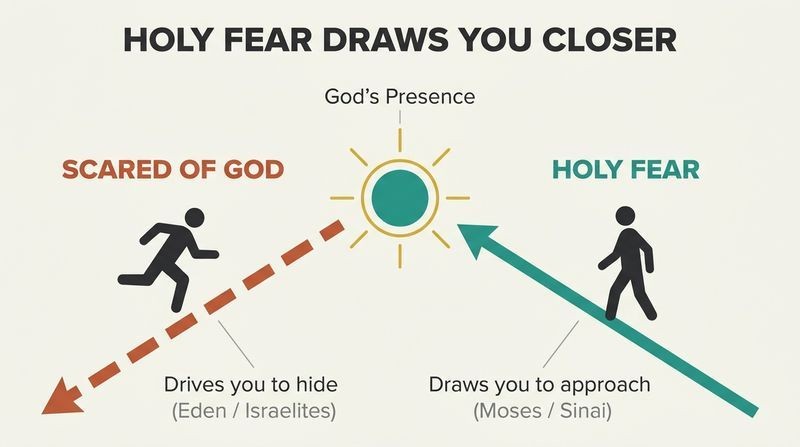
Holy fear is misunderstood. Most people lump all fear into one bad category and try to eliminate it. Bevere separates two things. Being scared of God makes you hide, like Adam covering himself after sinning in Eden. Holy fear does the opposite: it terrifies you of being distant from God, so you run toward Him. At Mount Sinai, the Israelites recoiled in terror while Moses drew near. Both stood before the same God; only their hearts differed.
The distinction matters. Bevere argues the Bible says "fear not" roughly 365 times (always about destructive fear) yet commands "fear God" nearly 200 times. One pastor once publicly corrected Bevere for teaching this, confusing the "spirit of fear" with "the fear of the Lord." They are opposites.
What's striking is how Bevere reclaims a word modern culture treats as toxic. The "No Fear" ethos of the late twentieth century assumed all fear diminishes life. Yet psychologists distinguish adaptive fear (which keeps you off cliff edges) from pathological anxiety. Bevere maps a third category entirely: fear as reverent intimacy. The parallel in secular thought is awe research by Dacher Keltner, who found that experiencing vastness (mountains, cathedrals, the cosmos) shrinks the ego and increases prosocial behavior. Bevere essentially argues that awe directed at a personal God produces not paralysis but nearness, a claim that reframes fear as a relational posture rather than a threat response.
You determine how close you get to God, not Him
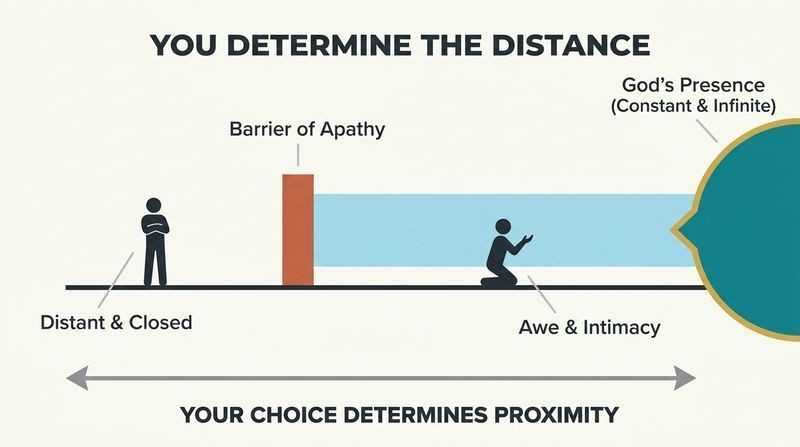
Intimacy is a two-way street. The Latin roots of "intimate" mean innermost secrets. Bevere notes God already searches us exhaustively: Psalm 139 says He knows when you sit, stand, and what you will say before you speak. His thoughts toward you outnumber every grain of sand on Earth (an estimated 500 million to a billion grains in a single cubic foot of beach). God has done His part.
The gap is on our side. God cries out, "Come and talk with me." The fear of the Lord is called "the beginning of knowledge" and specifically the beginning of knowing God intimately. The Hebrew word for this knowing, yada, is the same word used for the deepest union between husband and wife. Without holy fear, you cannot even reach the starting line.
The reciprocity framing is theologically sharp and psychologically resonant. Attachment theory holds that secure bonds require mutual responsiveness; one party's availability is insufficient. Bevere applies this to the divine relationship: omniscience does not equal intimacy, because intimacy requires the beloved to reciprocate the searching. The claim that we, not God, set the ceiling on closeness is empowering but also raises a tension Bevere sits with uneasily: it places enormous weight on human effort in a tradition that emphasizes grace. His resolution, that holy fear generates the desire while grace supplies the power, keeps the paradox intact rather than collapsing it prematurely.
You can love Jesus deeply yet never fear God
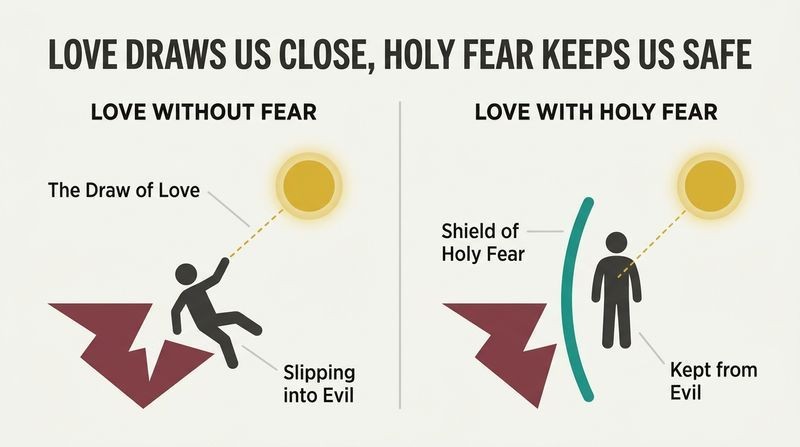
A jailed televangelist's confession. Bevere visited a famous evangelist imprisoned for fraud, whose ministry had once been the largest on Earth. Bevere asked when he fell out of love with Jesus. The man insisted he never did, even during the seven years he committed adultery before his crimes. His diagnosis: "I loved Jesus, but I didn't fear God." Then the line that reframed Bevere's ministry: millions of Americans are just like that.
Love and fear do different jobs. Bevere's formula: the love of God draws us to Him; the fear of God keeps us from the evil that destroys us. Proverbs says it is "by the fear of the LORD one departs from evil," not by love. Warm feelings toward Jesus coexisting with unrepentant sin is the signature of missing holy fear.
This is Bevere's most provocative and clarifying distinction. It dissolves a common puzzle: how sincere believers rationalize ongoing moral failure. Behavioral science offers a parallel in the gap between attitudes and behavior; loving an ideal predicts action poorly without an internalized restraining norm. The televangelist framing echoes what moral philosophers call the difference between admiration and obligation. One can admire virtue while not feeling bound by it. Critics might counter that scripture also says perfect love casts out fear, and that mature love naturally produces obedience. Bevere would reply that the two forces are complementary guardrails, not competitors, each preventing a different ditch.
God manifests His presence only where He is revered
Brazil, 1997. Bevere arrived to a packed arena of believers but sensed God's manifest presence was absent. People chatted, shopped concessions, and ignored the Scripture reading. He distinguishes God's omnipresence (everywhere always) from His manifest presence (when God reveals Himself to human senses). After Bevere confronted the crowd's irreverence, 75 percent stood to repent, and the atmosphere transformed: weeping, then a roaring wind heard by security guards outside though no decibel meter registered it.
Reverence changes the room. Bevere later found the same principle in his own prayer life. When he stopped rushing into words and simply pondered God's holiness first, he entered God's presence almost instantly. This mirrors the Lord's Prayer, which opens "hallowed be Your name" before any request.
The Brazil account will strain skeptical readers, and Bevere leans on eyewitness corroboration to bolster it. Setting the supernatural claims aside, the underlying principle is defensible on human terms: attention and posture shape experience. Rituals across traditions (Japanese tea ceremony, Quaker silence, Jewish shuckling) use deliberate reverence to alter participants' inner states. Cognitive science of religion suggests that costly, focused attention primes felt presence. Bevere's practical tip, front-loading contemplation of greatness before petition, resembles gratitude and awe practices shown to shift mood and reduce self-focus. The insight survives even for readers who bracket the miraculous: environments of casual familiarity rarely produce transcendence.
Obey immediately, fully, even when it makes no sense
Five marks of trembling at God's Word. Bevere argues holy fear shows up as a specific quality of obedience:
1. Obey immediately (delay signals God is not your priority)
2. Obey even when it makes no sense (Naaman washing in a river, Jericho's silent marches)
3. Obey when you see no personal benefit (Esther risking death: "If I must die, I must die")
4. Obey even when it is painful (Jesus in Gethsemane)
5. Obey to completion (Saul destroyed 99.99 percent of the Amalekites and God called it rebellion)
Almost-obedience is disobedience. King Saul spared the enemy king and best livestock, then claimed the animals were for sacrifice. His real motive was securing his reputation with his troops, the fear of man. Partial compliance driven by image is not obedience at all.
The Saul example lands hard because it violates our intuition that near-total compliance deserves credit. Bevere's insistence that motive determines the verdict aligns with virtue ethics, where the intention behind an act, not just its outcome, defines its moral character. The five-part structure also resembles what management researchers call the fidelity of implementation: partial or delayed execution of a directive often produces worse results than none, because it creates false confidence. The weakness is scope: Bevere gives little room for discernment errors or hearing God wrongly, which can make radical immediate obedience risky. Wisdom traditions usually pair boldness with counsel and testing.
Fearing people is the trap that enslaves your integrity
You serve whom you fear. Bevere confesses he was once known as one of the kindest men in his megachurch, until God revealed he complimented people even falsely because he feared their rejection. That is the fear of man: gravitating toward pleasing whoever is in front of you for your own protection or gain. It manufactures hypocrisy.
Even apostles fell for it. Paul publicly confronted Peter, who ate freely with Gentiles until conservative Jews arrived, then pulled back to protect his image. Barnabas got swept along too. Ananias and Sapphira died after lying about a donation to appear more generous than they were. Bevere's antidote: the fear of God frees you from the fear of man, because you stop performing for an audience you can see and start living for the One you cannot.
This is one of the book's most practically useful threads. The fear of man maps cleanly onto what social psychology calls impression management and the sociologist Erving Goffman's dramaturgy: we perform selves for audiences. Bevere's confession about false compliments illustrates people-pleasing as a form of self-protection disguised as kindness, a distinction therapists working with codependency emphasize constantly. His claim that authentic love sometimes requires uncomfortable truth-telling echoes research on high-quality relationships, which depend on candor, not just warmth. The nuance worth adding: fear of man and healthy social attunement can look similar. The dividing line is whether the underlying motive is self-preservation or genuine care.
Everyone has three images; only the actual one is judged
Perceived, projected, actual. Your perceived image is how others see you. Your projected image is how you want to be seen. Your actual image is who you really are, fully visible to God. At the believer's judgment (the judgment seat of Christ, distinct from the final judgment of unbelievers), it is the actual image that gets revealed, including hidden motives.
Jesus modeled the actual. Misunderstood, called a drunkard and heretic, He refused to manage His reputation, often telling healed people to stay silent and withdrawing when crowds wanted to crown Him king. Adam and Eve invented image management the moment they sinned and sewed fig leaves. Bevere reimagines Ananias and Sapphira as a modern couple posting curated "relationship goals" photos while their marriage crumbled, their holy fear eroding with each act of hypocrisy.
The three-image framework is genuinely useful and translates instantly to the social media age, which Bevere exploits well. It parallels the psychological distinction between the ideal self, the ought self, and the actual self in Higgins's self-discrepancy theory, where gaps between them predict anxiety and depression. Bevere adds a theological stakes layer: the projected self is not just psychologically costly but spiritually consequential. The curated-Instagram reimagining of Ananias and Sapphira is a shrewd modernization. One caution: the framework could fuel unhealthy introspection or scrupulosity if a reader begins policing every motive. Bevere's own remedy, repentance and renewed grace, keeps it from curdling into paralysis.
How you live now sets your eternal position forever
Salvation decides where; conduct decides how. Bevere insists the cross determines where you spend eternity, but how you live as a believer determines how you live in eternity. Heaven is not disembodied cloud-sitting; he pictures cities to build, nations to oversee, galaxies to explore. Your judgment functions like an interview setting your everlasting role.
Building with fire-tested materials. Paul describes believers building on Christ's foundation with gold and jewels or with wood and straw. Fire (God's Word) tests each life's work. Some enter eternity rewarded; others are "saved, but like someone barely escaping through flames," losing everything they built for self. Bevere adds that "evil" at this judgment includes the Greek kakos sense of retreating, meaning missed opportunities count, not only wrong actions committed.
The claim that eternal reward is differentiated, not flat, is a serious and often-neglected strand of Christian theology that Bevere foregrounds effectively. It counters a cheap-grace assumption that all outcomes converge once you are "in." The economic logic (present investment compounding into eternal position) resembles delayed-gratification research and Derek Parfit's work on how we discount our future selves. Bevere's inclusion of sins of omission is philosophically robust; most ethical systems now recognize that failing to act carries moral weight. The speculative vision of heaven as productive civilization is extrabiblical embroidery, but it serves a real motivational purpose: it makes eternity concrete enough to care about today.
Ignore your conscience repeatedly and it goes silent
Searing happens by degrees. Bevere describes the conscience as a God-given gift whose sensitivity strengthens with holy fear and dulls without it. His progression: the first time you slander someone, it feels like a knife in the gut. Ignore and justify it, and next time it is only a hard pinch. Then a faint tingle. Finally, nothing. Paul calls this a conscience "seared with a hot iron," and warns it leads to shipwrecked faith.
A minister's question. When a well-known pastor asked young Bevere how to avoid falling like so many leaders, the answer that came: guard your conscience as your most prized possession. Searing also locks in the corruption the way searing meat traps juices, cutting off the Holy Spirit's witness entirely. The remedy at any stage is simple repentance.
The searing metaphor has strong empirical backing under a different name: moral disengagement and desensitization. Albert Bandura documented how people incrementally silence self-sanction through rationalization, euphemism, and diffusion of responsibility. Neuroscience of habituation shows repeated exposure literally dampens response. Bevere's staircase (knife, pinch, tingle, numbness) is a vivid folk model of a real phenomenon. The practical genius is his insistence that the danger is invisible: there is no alarm announcing the final warning, so delay is a gamble with unknown odds. This connects to the "boiling frog" of ethical drift studied in organizational fraud, where small compromises normalize larger ones until catastrophe.
God shares His secrets only with friends who fear Him
Two righteous men, opposite access. Abraham, called God's friend, learned of Sodom's coming destruction in advance and even negotiated over it. His nephew Lot, also called righteous, was as clueless about the judgment as the wicked around him and had to be dragged out by angels. The difference: Abraham feared God; Lot flirted with the world, camping ever closer to Sodom until it absorbed him.
Friendship has a condition. Psalm 25 says the secret counsel of the Lord belongs to those who fear Him. Jesus told the disciples "you are my friends if you do what I command." Bevere illustrates with an employee he prematurely befriended, who grew critical and had to be released, then returned humbled and twice as faithful. God keeps some believers at servant level not to withhold but to protect them from the fate of the presumptuous.
The Abraham-Lot contrast is a compelling argument that proximity to God's plans correlates with reverent distance from compromise. It reframes worldliness not as scandalous sin but as strategic hedging, camping near Sodom to enjoy its benefits without its risks, which Bevere argues never works. This resonates with research on ethical fading and gradual assimilation to a corrupt environment. The friendship-with-conditions claim is theologically bold and may unsettle readers raised on unconditional-acceptance framing. Bevere's employee story humanizes it: withholding intimacy can be protective, not punitive. The distinction between covenant standing (secure) and relational trust (earned) is a mature nuance often flattened in popular Christianity.
Holy fear is the key that unlocks wisdom's storehouse
The most important thing you can do. Bevere calls wisdom the supreme pursuit, and the fear of the Lord its only entry point, quoting Isaiah's image of holy fear as "the key" to the treasure of wisdom and knowledge. It functions as a constant flowing fountain of counsel, steering us from hidden, baited traps of destruction the way a hunter conceals and baits a snare.
A pagan king outperformed pastors. Abimelech, with no covenant and no Scripture, trembled at the thought of taking Abraham's wife Sarah, and God credited him with innocence. Bevere contrasts this with modern church leaders who commit adultery despite years of teaching. The pagan had God's law written on his conscience and honored it; the leaders professed Christ but lacked holy fear. Wisdom, Bevere insists, is proven right by its results.
Anchoring wisdom in reverence rather than raw intelligence is an ancient move (the Hebrew wisdom tradition, Confucian humility, Socratic recognition of ignorance) and Bevere restates it forcefully. The Abimelech example is rhetorically effective because it severs the assumed link between religious knowledge and righteous behavior. This mirrors findings that expertise and ethics are weakly correlated; knowing the right thing predicts doing it poorly without an internalized restraint. Bevere's snare metaphor captures why smart people self-destruct: destructive paths are disguised as attractive ones, so intelligence alone cannot detect them. The claim's edge is its exclusivity, that no lasting wisdom exists outside holy fear, which secular readers will contest, though the behavioral point about humility preceding judgment is broadly supported.
Pride grows louder in church while faith quietly dies
Uzziah's hidden fall. King Uzziah took Judah's throne at sixteen and prospered for decades while he sought God. Then success bred pride, and he barged into the temple to burn incense, a priest-only act. Bevere's counterintuitive insight, prompted in prayer: pride made Uzziah more religiously active, not less. A spirit of pride and a spirit of religion reinforce each other, each hiding the other. Leprosy broke out on his forehead; he died isolated.
Fallen leaders had a pride problem, not a hormone problem. Bevere argues affairs and addictions are the visible "leprosy," but the invisible cause is pride replacing humility and holy fear. The safeguard is Jesus's line, "apart from me you can do nothing," kept vivid precisely during success. True humility is total dependence, and it is the twin of holy fear that produces longevity and finishing well.
The observation that pride can express itself through intensified religious performance is genuinely penetrating and rarely stated. It explains why moral collapse often strikes the outwardly devout: spiritual busyness camouflages the rot. This parallels research on moral licensing, where doing good grants psychological permission to do bad, and on hubris in high performers whose past success inflates risk tolerance. Bevere's link between success momentum and spiritual drift is astute; the fruit keeps growing after the root is severed, delaying detection. The finishing-well emphasis is the book's quiet climax: a Bible professor's research he cites found roughly 75 percent of scripturally called leaders had their effectiveness cut short. Reverence, Bevere argues, is what sustains a life to its end.
Analysis
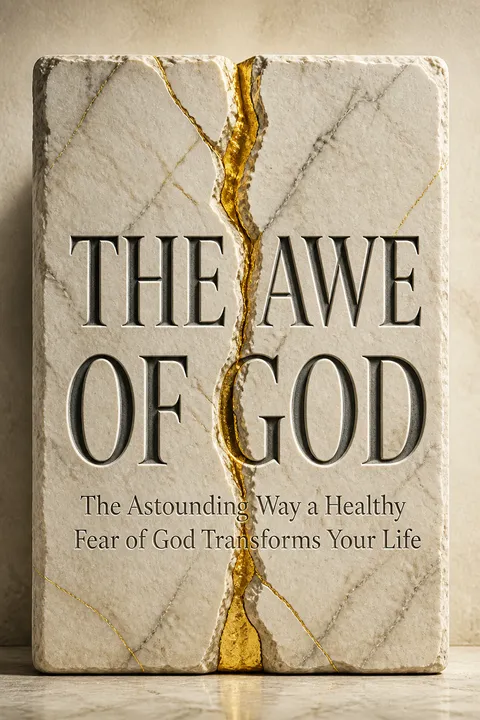
John Bevere's The Awe of God is a devotional-length work of practical theology disguised as a 42-chapter daily reader, though it builds cumulatively like a single argument. Its thesis is contrarian by design: in a culture obsessed with eliminating fear, Bevere resurrects one specific fear as the master virtue, the treasure God Himself delights in. The book's engine is a sustained distinction between being scared of God (which drives hiding and withdrawal) and the fear of the Lord (which drives nearness, obedience, and intimacy).
Structurally, Bevere is a pattern-preacher. He moves through paired biblical figures (Abraham versus Lot, Moses versus Israel, Saul versus Jesus) and pairs them with vivid personal testimony (Brazil, Malaysia, the imprisoned televangelist). His most durable contributions are frameworks rather than doctrines: the three images (perceived, projected, actual), the five marks of trembling obedience, and the progressive searing of conscience. These translate unusually well into secular vocabularies of impression management, moral disengagement, and habituation, which is why the book earns attention beyond its intended evangelical audience.
The intellectual weaknesses are predictable for the genre. Bevere reads motive into biblical narratives that scripture leaves silent, and his supernatural anecdotes (the roaring wind, redirected bullets) demand more credulity than skeptics will extend. His radical-immediate-obedience ethic leaves thin room for discernment error, and his exclusivity claims (no wisdom outside holy fear) overreach. His critique of "counterfeit grace" caricatures opponents he never names precisely.
Yet the central psychological insight is sturdy and underexplored elsewhere: that affection for God without reverent restraint produces the exact pattern of sincere-yet-corrupt religiosity that scandalizes the modern church. Bevere's diagnosis of leadership collapse, pride expressed through intensified religious activity, is genuinely original. The book's enduring value is its reframe: reverence as the precondition of intimacy, not its enemy.
Review Summary
The Awe of God receives mostly positive reviews, praised for its depth, scriptural insights, and transformative message about fearing God. Readers appreciate Bevere's writing style and the book's devotional format. However, some critics find certain passages confusing or contradictory to scripture. Many recommend it for new believers or those seeking to deepen their faith, while others caution about potential misinterpretations. Overall, the book is viewed as timely and impactful, encouraging readers to develop a healthy fear of God and strengthen their relationship with Him.
People Also Read







Glossary
The fear of the Lord (holy fear)
Reverent awe drawing you toward GodBevere's central concept: not being scared of God and withdrawing, but being terrified of distance from Him and therefore drawing near. It means to revere, esteem, and be in awe of God above all, to love what He loves and hate what He hates, and to obey Him instantly and completely. He calls it God's treasure and the beginning of wisdom and intimacy.
Spirit of fear
Destructive, tormenting, unholy fearThe opposite of holy fear. This is the paralyzing, self-protective dread the Bible commands believers to reject. Bevere argues a pastor once confused this with the fear of the Lord. The spirit of fear makes people hide from God like Adam, whereas holy fear makes them run toward Him like Moses.
Manifest presence
God revealing Himself to sensesDistinct from God's omnipresence (His being everywhere at all times). The manifest presence is when God actively reveals Himself to human minds and senses, as Bevere describes experiencing in Brazil and Malaysia. He argues this presence appears only in atmospheres where God is genuinely revered and honored, not treated casually.
Three images
Perceived, projected, actual selfBevere's framework for identity. The perceived image is how others see you; the projected image is how you want to be seen; the actual image is who you truly are, fully visible to God. Only the actual image, including hidden motives, is revealed and evaluated at the believer's judgment.
Judgment seat of Christ
Believers' evaluation of how they livedDistinct from the final judgment of unbelievers. Here believers, whose sins are already forgiven, are examined for how they lived, both good and "evil" (including missed opportunities). Bevere teaches it determines eternal reward and position, comparing it to an interview that sets one's everlasting role in God's kingdom.
Positional versus behavioral holiness
Status in Christ versus conductPositional holiness is the complete, unearned status of being made holy the instant one is saved, through Christ's work (justification). Behavioral holiness is the ongoing process (sanctification) of one's conduct aligning with that position. Bevere argues confusing the two lets people excuse worldly living by claiming Jesus already made them holy.
Seared conscience
Conscience deadened by ignored convictionBevere's picture of moral desensitization. Each time conviction is ignored and justified, the conscience's warning weakens, from a knife-like jab, to a pinch, to a tingle, to nothing. Ultimately it is "seared with a hot iron," cutting off the Holy Spirit's guidance and leading to shipwrecked faith. Holy fear keeps the conscience sensitive.
Fear of man
Self-protective craving for approvalThe opposite of holy fear. It is gravitating toward pleasing the people in front of you for personal satisfaction, protection, or gain. Bevere calls it a dangerous trap that produces hypocrisy and enslaves integrity. It drove Peter's withdrawal from Gentiles, Saul's disobedience, and Ananias and Sapphira's deceptive giving.
FAQ
What's The Awe of God about?
- Transformative Message: The Awe of God by John Bevere delves into the concept of a healthy fear of God, emphasizing that it is about reverence and understanding His holiness, not fear in the traditional sense.
- Holiness and Intimacy: The book argues that true holiness leads to intimacy with God, and that the fear of the Lord is crucial for a fulfilling Christian life.
- Practical Application: Bevere offers practical advice on cultivating this holy fear, encouraging readers to reflect on their relationship with God and its impact on their actions.
Why should I read The Awe of God?
- Life-Changing Insights: The book provides profound insights that can deepen one's understanding of God and enhance their relationship with Him.
- Addressing Misconceptions: It challenges the notion that fear is negative, presenting it as a vital component of a healthy relationship with God.
- Encouragement for Growth: Readers are encouraged to pursue holiness and intimacy with God, leading to personal growth and transformation.
What are the key takeaways of The Awe of God?
- Fear of the Lord: The book emphasizes that "the fear of the Lord is the beginning of wisdom," crucial for making wise decisions and living a fulfilling life.
- Holiness as a Pursuit: Holiness is portrayed as an active pursuit requiring effort and intention, not just a state of being.
- Consequences of Irreverence: Bevere discusses the dangers of irreverence, using biblical examples to illustrate the serious consequences of failing to honor God’s holiness.
What are the best quotes from The Awe of God and what do they mean?
- "The fear of the Lord is His treasure": This quote suggests that God values holy fear as a precious gift, essential for a fulfilling relationship with Him.
- "By the fear of the Lord one departs from evil": It highlights the protective nature of holy fear, helping believers avoid sin and live righteously.
- "You will serve whom you fear": This statement illustrates that our fears dictate our loyalties and actions, reminding us to prioritize the fear of God.
How does John Bevere define holy fear in The Awe of God?
- Respect and Awe: Holy fear is defined as a profound respect and awe for God, drawing believers closer to Him.
- Transformational Power: This fear is transformative, leading to a life that reflects God’s character and purposes.
- Foundation for Wisdom: Bevere connects holy fear to wisdom, stating it is the foundation for making sound decisions.
What practical steps does Bevere suggest for cultivating holy fear?
- Daily Reflection: Spend time in prayer and reflection, asking God to reveal areas lacking holy fear.
- Scripture Engagement: Immerse oneself in Scripture to understand God’s character and commands, fostering deeper reverence.
- Community Accountability: Surround oneself with a community of believers for support and accountability in pursuing holiness.
How does The Awe of God address the concept of judgment?
- Eternal Perspective: Bevere emphasizes understanding that believers will face judgment for their actions and motives, focusing on rewards and consequences in eternity.
- Call to Holiness: The book reminds readers that living a holy life is essential for receiving God’s blessings and rewards.
- Fear of the Lord: Holy fear is linked to judgment, motivating believers to align their lives with God’s will.
What role does community play in the message of The Awe of God?
- Support and Encouragement: Being part of a community of believers provides support and encouragement in the pursuit of holiness.
- Shared Learning: Discussing principles of holy fear with others deepens understanding and application of these truths.
- Collective Worship: Worshiping together enhances the experience of God’s presence, creating an atmosphere conducive to experiencing His glory.
How does Bevere differentiate between holy fear and the fear of man?
- Focus on God vs. People: Holy fear centers on revering God, while the fear of man seeks approval from others.
- Consequences of Each: Fear of man can lead to compromise, while holy fear leads to righteousness and integrity.
- Empowerment through Fear: Fearing God empowers believers to overcome the fear of man, allowing them to live boldly in their faith.
What is the significance of the title The Awe of God?
- Emphasis on Reverence: The title reflects the importance of cultivating awe and reverence for God, foundational for a healthy relationship with Him.
- Invitation to Experience: It invites readers to explore God’s character and the transformative power of holy fear.
- Call to Action: The title challenges believers to embrace the awe of God in their lives, prioritizing their relationship with Him.
How does The Awe of God define the relationship between holy fear and wisdom?
- Foundation of Wisdom: Holy fear is described as the beginning of wisdom, essential for making sound decisions.
- Protection from Deception: It acts as a safeguard against deception and poor choices, guiding individuals away from harmful paths.
- Source of Joy: Those who fear God experience joy and fulfillment, rooted in the wisdom of living according to God’s will.
How can I cultivate holy fear in my life as suggested in The Awe of God?
- Seek God’s Presence: Actively pursue God’s presence through prayer, worship, and studying His Word.
- Practice Obedience: Emphasize immediate and complete obedience to God’s commands.
- Reflect on God’s Greatness: Regularly reflect on God’s attributes and works to maintain a sense of awe and reverence.
About the Author
Other books by John Bevere







Download PDF
Download EPUB
.epub digital book format is ideal for reading ebooks on phones, tablets, and e-readers.








































