

Key Takeaways
The gym is a laboratory where you rehearse conquering the rest of life
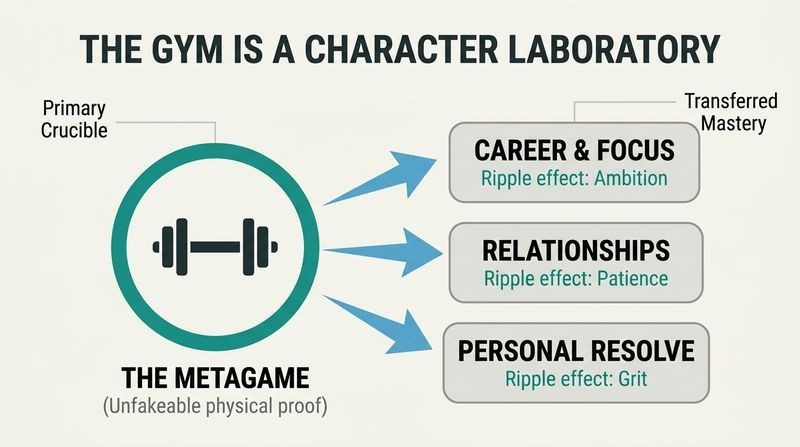
Matthews' central claim reframes fitness entirely. Working out is not vanity or self-punishment; it is proof that effort produces results in a domain that cannot be faked, bought, or bluffed. You either lift the weight or you do not. Because of this brutal honesty, the gym becomes a training ground for character traits that transfer everywhere: discipline, patience, grit, delayed gratification, and taking responsibility.
Consider Dan, a 37-year-old who had failed every diet and fired every trainer, convinced his metabolism was broken. After learning correct principles, he transformed his body, then watched that newfound resolve ripple into his career and relationships. The deeper lesson: if you can master your own physiology, you gain evidence you can master almost anything. Fitness is a "meta-game" that prepares you for every other game.
This mirrors what psychologists call self-efficacy, Albert Bandura's finding that mastery experiences in one domain boost confidence in others. It also echoes Jordan Peterson's "clean your room" logic: order the small, controllable arena first. The strength of the framing is that it dignifies exercise as philosophy rather than aesthetics. The weakness is that transfer effects are notoriously overstated in psychology; discipline in squatting does not automatically make someone disciplined with taxes. Still, the gym's unforgiving feedback loop, where results correlate directly with effort, is a genuinely rare and honest teacher in a world full of luck and noise.
Stop asking what you want; ask what pain you'll endure to get it
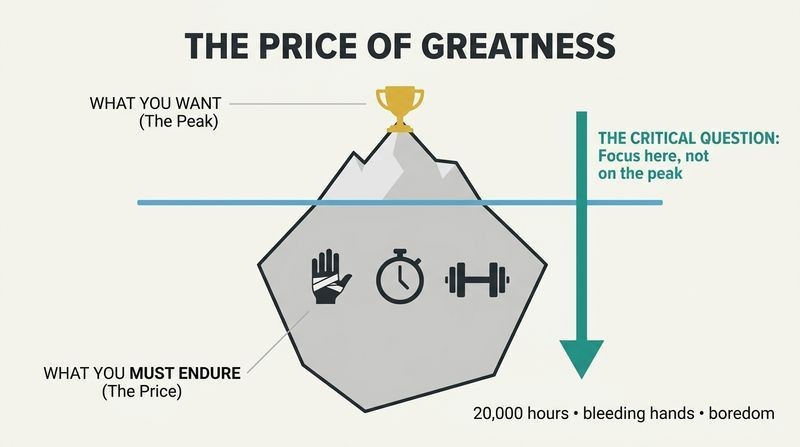
Everyone wants a lean body, more money, or freedom. Matthews argues the useful question is not desire but price: how much boredom, doubt, and discomfort are you willing to swallow? Golfer Gary Player told an admirer who envied his swing, "No, you wouldn't" want it, because it required hitting balls until his hands bled, taping them, and hitting more.
Greatness is forged, not gifted. Michelangelo apprenticed from age six. Leonardo painted The Last Supper at 46. James Joyce spent roughly 20,000 hours on Ulysses. The famous marshmallow experiments, where children who resisted one treat for two later showed better life outcomes, point to the same muscle: trading immediate pleasure for future reward. That capacity is trainable through mindset, precommitment tools like blocking software or wagering money, and keeping temptation out of sight.
The sacrifice frame is more honest than most self-help, which sells outcomes while hiding costs. Anders Ericsson's deliberate-practice research supports the "forged not gifted" claim, though Ericsson himself resisted the pure 10,000-hour reading; genetics and quality of practice matter enormously. Matthews responsibly flags that the marshmallow findings have been challenged, notably by 2018 replications suggesting family affluence explained much of the effect. What survives scrutiny is the reframe technique: viewing a temptation as sacrificing your larger goal, not merely gaining a snack. Loss aversion, Kahneman and Tversky's insight that losses sting more than equivalent gains, makes that mental flip genuinely powerful.
Change your actions first and your attitude follows, not the reverse
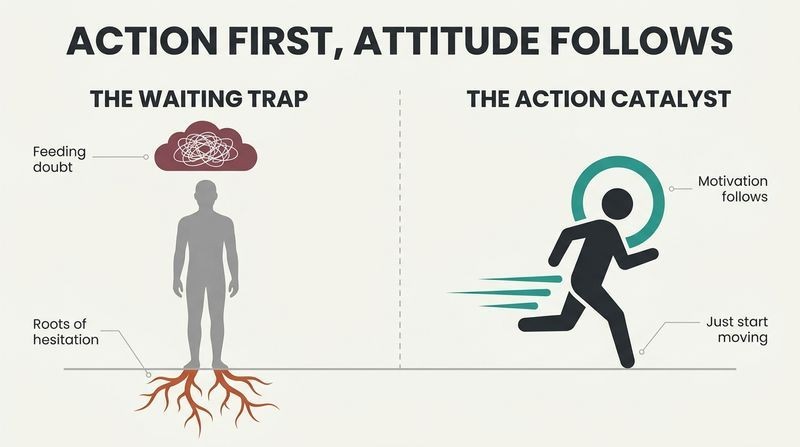
Most people wait to feel ready, motivated, or confident before acting. Matthews says this is backward. Research on attitudes and behavior suggests we infer who we are by watching what we do, then adjust our beliefs to match. You find your balance in the running, not before it.
Elon Musk decided to send a rocket to Mars with zero rocketry background; he "just started reading books." Arnold Schwarzenegger snuck out of the Austrian army, rode a train 26 hours, and borrowed trunks to win his first competition before he was "ready." The practical move: quit waiting for the perfect moment and take one small action now, a ten-minute jog instead of a marathon plan. Action starves the doubt that thinking feeds, because standing still lets the roots of hesitation take hold.
This aligns with cognitive dissonance theory and with behavioral activation, a clinically validated depression treatment where patients act first and motivation arrives afterward. William James anticipated it a century ago: "If you want a quality, act as if you already have it." The Musk and Schwarzenegger anecdotes are inspiring but suffer from survivorship bias; countless people leapt without preparation and crashed. The nuance Matthews mostly preserves is that bold action should still be paired with reading, planning, and reality-testing. Bias toward action is the correct default for the chronically hesitant, less so for the recklessly impulsive, who need the opposite medicine.
Sprint through five finished goals instead of juggling twenty half-done ones
Matthews adapts Warren Buffett's "2 List" method, introduced to him by James Clear. Write your top 25 goals, then circle the 5 most important. The counterintuitive step: the other 20 are not a someday list, they become your "avoid at all costs" list until the top 5 are done. They are distractions dressed as ambitions.
The enemy is "goal competition," where objectives fight over your finite time and attention until everything frays. He compares your life to a stove with limited burners: cook a few meals to completion rather than rotating a dozen in frantic culinary juggling. Vague goals also fail; a study at Erasmus University found students who wrote, clarified, and planned goals earned more credits, with ethnic-minority students earning 44% more and 54% more likely to stay enrolled. Get specific: "lose weight" becomes "fit into my size-five jeans."
The burner metaphor captures what productivity researchers call the cost of context-switching, and Gary Keller's The ONE Thing makes the same case for radical focus. Buffett's actual quote, that maturity is rejecting good options for better ones, echoes Greg McKeown's Essentialism. The writing-goals study cited is the Self Authoring Program associated with Jordan Peterson; its dramatic effects have not always replicated at scale, so treat the exact percentages cautiously. Yet the core mechanism, that specificity converts a wish into a plan the brain can execute, is robustly supported by Edwin Locke and Gary Latham's goal-setting theory, one of psychology's most validated findings.
Write down what, when, and where, and follow-through nearly triples
One of the book's most concrete tools. In a University of Bath study of 248 adults, those who read about exercise benefits AND wrote a specific plan ("During the next week I will do 20 minutes of vigorous exercise on [DAY] at [TIME] at [PLACE]") hit 91% adherence versus about 35 to 38% for the other groups. Over 100 studies confirm the effect across dieting, screenings, and more.
Add if-then statements to armor the plan against life's curveballs: "If I miss my morning workout, then I will do it after work." Psychologists call this stress-testing "mental contrasting," imagining obstacles while holding the goal. These formulas work because they speak the brain's native trigger-and-response language, creating automatic behavior that needs no willpower or motivation to fire in the moment.
This is Peter Gollwitzer's "implementation intentions" research, one of the most replicated interventions in behavioral science, and Gabriele Oettingen's mental contrasting, packaged into her WOOP protocol (Wish, Outcome, Obstacle, Plan). The elegance is that it offloads self-regulation from scarce conscious willpower onto environmental cues, sidestepping the depletion debate entirely. A caveat worth noting: implementation intentions work best for goals people already want and struggle only to execute; they do little for goals lacking genuine commitment. They also weaken for complex, creative tasks that resist rigid scheduling. For habit-formation and health behaviors, though, few tools offer a better effort-to-payoff ratio.
Announcing goals feels like achieving them, so stay quiet until you deliver
Talking about your intentions can sabotage them. NYU research found people who announced goals and received acknowledgment worked less toward them and were strangely overoptimistic about their nonexistent progress. Being admired for saying you'll do something scratches the same itch as being admired for doing it, producing a premature sense of accomplishment.
Matthews' rule, drawn from a 1926 book by an anonymous author called RHJ: don't discuss goals until you can show objective results. If details slip out, frame them as commitment, not arrival: say "I'm working on losing twenty pounds," never "I joined a gym and go every morning." You know you've phrased it right when you get a lukewarm "That's nice" instead of applause. Praise is reserved for dones, not going-to-dos.
Derek Sivers popularized this idea in a widely viewed TED talk citing the same Gollwitzer studies. There is genuine tension in the literature, however: accountability research (see the next insight) shows public commitment can help. The reconciliation Matthews offers is smart and underappreciated: the difference lies in whether the social feedback delivers premature reward (praise for intentions) or genuine pressure (monitoring of results). Identity-based announcements that feel completed are toxic; structured accountability that raises the cost of failure is useful. The practical filter, avoid applause but invite scrutiny, resolves what looks like contradictory advice into a coherent principle.
Resistance is the inner voice that attacks only what matters most
Borrowing from Steven Pressfield's The War of Art, Matthews personifies procrastination and fear as "Resistance," an invisible force that lies, seduces, and bullies to keep you from doing meaningful work. Its tell is diagnostic: Resistance only fights what is genuinely important to you. So the harder you resist starting a workout, a business, or a creative project, the surer a sign it is exactly what you should do.
Resistance feeds on thinking and starves on action. Every rep, every set, every session strikes at it until its armor crumbles and it fades to a whisper. Matthews' antidote to the person forever "planning" to get fit is blunt: shut up and train. Do the work first, then read about it. He suggests journaling for seven days every time you hit Resistance, noting the trigger and your response, to expose its patterns.
Pressfield's concept resonates because it externalizes an internal enemy, a trick therapists use in narrative therapy to help clients fight a problem rather than themselves. It overlaps with Tim Pychyl's research showing procrastination is fundamentally an emotion-regulation problem, an attempt to avoid the discomfort a task triggers, not a time-management flaw. The framing's risk is that treating every avoidance impulse as Resistance-to-be-crushed can override legitimate signals of burnout, illness, or a genuinely bad idea. Matthews leans hard toward "push through," which suits the chronically avoidant but could harm those already over-extended. Wisdom lies in distinguishing Resistance from real limits.
Be the person who delivers the message to Garcia without asking questions
Matthews revives Elbert Hubbard's 1899 essay about Lieutenant Rowan, who was handed a letter for a Cuban rebel general and simply delivered it, trekking through hostile jungle for three weeks without asking "Where is he?" or "Why me?" The essay sold millions of copies because it named a rare virtue: the ability to take initiative and complete a hard task without excuses, hand-holding, or complaint.
Such people never lack work, praise, or opportunity because they are so rare that employers cannot afford to lose them. Matthews links this to "savagery," an intense, aggressive reliability. He cites Alexander the Great scaling a fortress wall alone, taking an arrow to the chest, then riding through his ranks to prove he lived, because "brave deeds are what true men do." The trait that wins is not being the best but being harder to destroy.
The bulldog image Matthews uses, bred to survive throat attacks in dogfighting rather than to be strongest, is a vivid stand-in for what Angela Duckworth calls grit: perseverance plus resilience. Hubbard's essay is a product of its era, with harsh contempt for "incompetent" workers that reads as elitist today, and Matthews acknowledges readers may recoil. The steelman is that agency and follow-through are genuinely undersupplied and richly rewarded. The critique is that "don't ask questions" can curdle into blind obedience; the best knowledge workers ask sharp clarifying questions precisely because they care about the outcome. Initiative and inquiry need not be enemies.
Own your failures, because an internal locus of control predicts thriving
Whenever we say "I can't because Y," Matthews argues, the honest translation is usually "I don't really want to." Excuses act like a narcotic, comforting us while warping reality. The deeper danger is losing your "internal locus of control," the psychological stance of holding yourself accountable for outcomes rather than blaming external forces.
Decades of research since the 1950s links an internal locus to better grades, higher motivation, less depression, longer life, more income, and stronger marriages. Two extraordinary examples: James Kassaga Arinaitwe, an orphaned Ugandan boy, sold a goat, snuck into the president's compound, and asked for help paying school fees; he now holds two master's degrees. Aleksandr Solzhenitsyn, in the Gulag, concluded his imprisonment was partly his own fault for having served a tyranny he knew was corrupt, and turned that radical ownership into the book that helped topple the Soviet regime.
Locus of control comes from Julian Rotter's 1950s work and remains a durable construct, though the causal arrow is debated: does internal locus produce success, or does success teach people they have control? Probably both, in a virtuous loop. The Solzhenitsyn example is striking because it pushes ownership to an almost extreme extent, taking responsibility for a system one could barely influence. That resonates with Stoic philosophy's dichotomy of control but risks tipping into self-blame for circumstances genuinely beyond one's power, which learned-helplessness research shows can deepen depression. The healthiest version owns one's responses without pretending to author every outcome.
Complaining is telegraphing weakness; reframe stress as challenge instead
Chronic complaining is scientifically linked to higher stress, worse mood, and stalled progress. Matthews offers Will Bowen's 21-day no-complaint challenge: wear a bracelet, and every time you voice a negative description of a person or event with no path to fixing it, switch wrists and restart the count. "This WiFi sucks" fails; "This WiFi sucks, I'll tether to my phone" passes.
The deeper skill is choosing a "challenge response" over a "threat response." People who view stress as productive release more DHEA, a hormone that counteracts cortisol. University of Wisconsin research found people who viewed stress positively had a 43% lower chance of premature death. Elite athletes reframe pre-event nerves as excitement rather than fighting to calm down. And per David Goggins' "40% rule," when you feel completely done, you have used only 40% of your capacity.
The stress-mindset research comes from Alia Crum and Kelly McGonigal, whose work shows that beliefs about stress measurably alter physiology and mortality risk, a genuinely startling finding. Reappraising anxiety as excitement is validated by Alison Wood Brooks' Harvard experiments; both share a nervous-system arousal state, so relabeling is easier than dampening. The complaint challenge is more folk-wisdom than rigorous science, and worth a caveat: research on emotional suppression shows bottling feelings can backfire. The distinction that saves it is that Matthews targets unproductive venting, not the naming of problems; articulating an issue paired with a solution is exactly what healthy processing looks like.
Aim for cautious optimism, not the delusion that killed the POWs
Admiral Jim Stockdale survived eight years of torture in a Vietnam POW camp. Asked who didn't make it, he gave a surprising answer: the optimists. They kept saying "We'll be out by Christmas," and when Christmas passed, then Easter, they died of broken hearts. His paradox: hold unshakeable faith you'll prevail, yet confront the brutal facts of your reality.
Matthews warns against "optimism bias," the tendency (affecting up to 80% of people) to assume we're less likely to face divorce, disease, or accidents than average. His fix is Gary Klein's "premortem": before a big project, assume it has already failed spectacularly, list every reason why, then fix those weaknesses in advance. Research found imagining an event already happened boosts identifying future problems by up to 30%. Reserve pessimism for high-stakes decisions; stay optimistic when the cost of being wrong is low.
The Stockdale Paradox, coined by Jim Collins in Good to Great, is one of the most useful mental models in leadership literature, and Matthews pairs it well with Klein's premortem, a technique now standard in decision science. Daniel Kahneman championed the premortem precisely because it licenses dissent and counteracts groupthink and planning fallacy. The synthesis, mild optimism for daily motivation plus rigorous pessimism for consequential bets, echoes Seligman's "flexible optimism." The subtle wisdom often missed: optimism and realism are not opposites to be balanced but tools to be deployed situationally. Faith sustains effort; brutal honesty directs it. Confusing the two is fatal, sometimes literally.
The self-made myth is a lie, and warm relationships outpredict everything
The Harvard Grant Study tracked 268 men for 75 years, measuring everything from IQ to drinking habits, to find what most predicts a flourishing life. The five-word conclusion: happiness is love, full stop. Men with the warmest relationships earned more, achieved more, and suffered less dementia and anxiety.
Relationships also shape fitness directly. Harvard research found your odds of becoming obese rise 57% if a friend does, and MyFitnessPal users who shared their food diary lost twice as much weight. Even Arnold Schwarzenegger insists the "self-made man" is a myth, listing the tutors, coaches, and mentors who built him. Matthews urges becoming a "giver" (Adam Grant's term for those who help others first) through "five-minute favors": an introduction, a genuine compliment, a thank-you note. Recruit a workout partner and you'll show up more, push harder, and enjoy it more.
The Grant Study, directed for decades by George Vaillant, is among the richest longitudinal datasets in existence, though its original sample of privileged white Harvard men limits generalizability, a caveat the research community stresses. The social-contagion obesity findings by Christakis and Fowler sparked debate over whether shared environments, not true contagion, drive the correlations. Adam Grant's giver research adds a crucial nuance the summary hints at: the most successful givers are not doormats but strategic ones who avoid burnout. The convergence is compelling regardless: in a genre obsessed with individual willpower and grind, ending on the primacy of human connection is a welcome and evidence-backed corrective.
Analysis
Matthews has written a Trojan horse. Marketed as workout motivation, it is really a compact philosophy of self-discipline that uses the gym as its most honest teaching case, since iron gives feedback that cannot be faked, flattered, or bought. That premise, fitness as a laboratory for character, is the book's organizing genius and its chief vulnerability. It elevates exercise into something meaningful, but it also leans heavily on transfer effects that psychology treats skeptically.
Structurally the book is an anthology of borrowed frameworks stitched into a motivational arc: Gollwitzer's implementation intentions, Buffett's 2-List, Oettingen's mental contrasting, Klein's premortem, Pressfield's Resistance, Collins' Stockdale Paradox, Vaillant's Grant Study. Matthews is a synthesizer and popularizer, not an originator, and he is refreshingly transparent about it, citing sources and even flagging when findings like the marshmallow test have been challenged. This intellectual honesty distinguishes him from the genre's charlatans he explicitly disavows.
The book's ideological spine is neo-Stoic and Petersonian: personal responsibility, voluntary sacrifice, contempt for victimhood, suspicion of comfort. This is bracing and, for the chronically passive, probably exactly the medicine required. But the relentless "shut up and train" register has blind spots. It underweights structural constraints, romanticizes suffering, and risks pathologizing rest as weakness, right up until the final chapter, which pivots to the Grant Study's finding that love, not grit, best predicts a flourishing life. That closing note quietly undercuts the preceding hyper-individualism, and it is the book's most humane and evidence-backed moment.
The most durable, actionable content is the behavioral toolkit: what-when-where plans, if-then contingencies, precommitment devices, the premortem, and the challenge-versus-threat reframe. These are validated, low-cost, high-leverage techniques most readers can deploy immediately. The motivational rhetoric will inspire some and alienate others, but the tools work regardless of whether one buys the surrounding worldview.
Review Summary
The Little Black Book of Workout Motivation receives high praise for its comprehensive approach to motivation, not just for fitness but for life in general. Readers appreciate the practical advice, scientific backing, and actionable steps provided. Many find it inspiring and life-changing, noting its applicability beyond workouts. The book is lauded for its no-nonsense approach and the author's credibility. Some criticisms include repetitiveness and a harsh tone, but overall, reviewers highly recommend it for anyone seeking personal growth and self-improvement.
People Also Read









Glossary
Resistance
Inner force blocking meaningful workBorrowed from Steven Pressfield, the personified inner enemy of procrastination, fear, and self-sabotage that opposes any important or growth-oriented action. Its defining trait is that it only fights what genuinely matters to you, making the intensity of your reluctance a reliable signal of what you should do. It feeds on thinking and weakens with every unit of action taken.
What-When-Where statement
Specific plan naming action, time, placeA written sentence specifying exactly what you will do, when, and where, such as committing to 20 minutes of exercise on a named day, time, and location. Based on implementation-intentions research, it creates an automatic trigger-and-response in the brain that raises follow-through dramatically without relying on in-the-moment willpower or motivation.
If-Then statement
Preplanned response to an obstacleA contingency plan in the form "If X obstacle happens, then I will do Y," designed to armor a goal against life's disruptions. By deciding responses in advance, it removes the need for self-control when things go sideways, for example: if I miss my morning workout, then I will do it after work.
2 List Strategy
Buffett's ruthless focus methodWarren Buffett's prioritization technique: write your top 25 goals, circle the 5 most important, and then treat the remaining 20 not as a backup list but as things to actively avoid until the top 5 are complete. It combats goal competition by concentrating finite time and attention on a few objectives brought fully to completion.
Premortem
Imagining failure before startingGary Klein's planning technique for high-stakes projects: assume the undertaking has already failed spectacularly, list every plausible reason for the failure, then revise your plan to prevent or minimize those risks. Imagining an event as already having happened has been shown to improve identification of potential problems by up to 30 percent.
Stockdale Paradox
Faith plus brutal realismNamed for POW Admiral Jim Stockdale, the discipline of holding unshakeable faith that you will ultimately prevail while simultaneously confronting the most brutal facts of your current reality. Stockdale observed that naive optimists, who set arbitrary deadlines for rescue, died of broken hearts when those dates passed, whereas realists who kept faith without delusion survived.
Locus of control
Where you place responsibilityA psychological concept describing whether a person credits outcomes to their own actions (internal) or to outside forces like luck and circumstance (external). An internal locus is associated with greater academic and professional success, higher income, better relationships, less depression, and longer life; excuse-making erodes it over time.
Challenge response
Viewing stress as productive stimulusA stress mindset in which a stressor is assessed as a challenge to grow from rather than a threat to survive. People exhibiting it focus on what they can control, experience less fear, release more stress-buffering DHEA, and, per one study, face a 43 percent lower risk of premature death than those who view stress negatively.
40% rule
You have far more capacityA principle from Navy SEAL David Goggins, popularized in Jesse Itzler's Living with a SEAL: when you feel completely spent and ready to quit, you have actually tapped only about 40 percent of your true capacity. It reframes perceived limits as psychological rather than physical for most people.
Five-minute favors
Small no-strings acts of givingAdam Grant-inspired small acts of help that cost roughly five minutes and expect no repayment, such as making an introduction, giving a genuine compliment, recommending a book, or sending a thank-you note. Practiced regularly, they build the reciprocal relationships that research links to both success and long-term happiness.
FAQ
What's "The Little Black Book of Workout Motivation" about?
- Purpose and Audience: The book is designed to help individuals cultivate the mindset needed to achieve their fitness goals. It targets those who are driven to improve their physical and mental well-being.
- Structure: It is divided into four sections: cultivating the right mindset, setting goals, doing the work, and staying on top. Each section provides practical advice and strategies.
- Author's Experience: Michael Matthews shares his personal journey and insights from over a decade of training, offering evidence-based advice on building muscle, losing fat, and staying healthy.
Why should I read "The Little Black Book of Workout Motivation"?
- Motivational Insights: The book offers a unique blend of storytelling, science, and practical tools to inspire and motivate readers to achieve their fitness goals.
- Practical Tools: It provides actionable strategies and exercises to help readers overcome resistance and stay committed to their fitness journey.
- Expert Endorsements: The book is praised by fitness experts and authors for its comprehensive approach to motivation and personal development.
What are the key takeaways of "The Little Black Book of Workout Motivation"?
- Mindset Matters: Cultivating the right mindset is crucial for achieving fitness goals. The book emphasizes the importance of discipline, sacrifice, and resilience.
- Goal Setting: Setting specific, actionable goals and creating a plan to achieve them is essential. The book provides strategies for effective goal setting and overcoming obstacles.
- Action Over Excuses: The book encourages readers to take action and do the work, even when it's difficult, to achieve long-term satisfaction and success.
What are the best quotes from "The Little Black Book of Workout Motivation" and what do they mean?
- "Do. The. Work.": This quote emphasizes the importance of taking action and putting in the effort required to achieve your goals, rather than just planning or talking about them.
- "Hard choices, easy life. Easy choices, hard life.": This quote highlights the idea that making difficult decisions and sacrifices now can lead to a more fulfilling and successful life in the long run.
- "If you have the power to change your body, you have the power to change your life.": This quote underscores the transformative potential of fitness and the broader impact it can have on one's life.
Who is Michael Matthews, and why should I care about his advice?
- Experienced Author and Coach: Michael Matthews is a best-selling author and fitness coach with over a decade of experience in the industry.
- Evidence-Based Approach: He provides time-proven, evidence-based advice on building muscle, losing fat, and staying healthy, making his guidance reliable and effective.
- Personal Journey: Matthews shares his personal struggles and successes, offering relatable insights and motivation for readers on their own fitness journeys.
How does "The Little Black Book of Workout Motivation" suggest setting effective goals?
- Specificity is Key: The book emphasizes the importance of setting specific, measurable goals rather than vague aspirations.
- Plan and Prioritize: It advises breaking down goals into actionable steps and prioritizing them to maintain focus and direction.
- Anticipate Obstacles: Readers are encouraged to anticipate potential barriers and plan strategies to overcome them, increasing the likelihood of success.
What is the "Resistance" concept in "The Little Black Book of Workout Motivation"?
- Definition of Resistance: Resistance is described as an insidious force that opposes any action requiring sacrifice or long-term growth, such as starting a new fitness regimen.
- Overcoming Resistance: The book suggests that the key to overcoming resistance is to consistently do the work, even when it's difficult or uncomfortable.
- Significance: Recognizing and battling resistance is crucial for achieving personal and fitness goals, as it often targets our deepest desires and purposes.
How does "The Little Black Book of Workout Motivation" address the issue of excuses?
- Excuses vs. Progress: The book argues that excuses are often more attractive than achievements but ultimately hinder progress and personal growth.
- Internal Locus of Control: It emphasizes the importance of taking responsibility for one's actions and circumstances, rather than blaming external factors.
- Actionable Advice: Readers are encouraged to identify and challenge their excuses, replacing them with actionable steps toward their goals.
What role do relationships play in achieving fitness goals according to "The Little Black Book of Workout Motivation"?
- Influence of Relationships: The book highlights how relationships can significantly impact diet and exercise habits, either positively or negatively.
- Support System: Having a supportive network can enhance accountability, motivation, and adherence to fitness goals.
- Giving Back: The book encourages readers to help others in their fitness journeys, fostering a positive and supportive community.
How does "The Little Black Book of Workout Motivation" suggest dealing with bad workouts?
- Normalizing Bad Workouts: The book acknowledges that bad workouts are a normal part of the fitness journey and should not deter progress.
- Embrace the Struggle: It encourages readers to view difficult workouts as opportunities for growth and resilience.
- Persistence is Key: The book emphasizes the importance of persistence and determination, even on challenging days, to achieve long-term success.
What is the "Positivity Paradox" in "The Little Black Book of Workout Motivation"?
- Optimism vs. Reality: The book discusses the balance between maintaining optimism and confronting the brutal facts of reality.
- Avoiding Delusion: It warns against unbridled optimism that can lead to disappointment and encourages a realistic yet hopeful outlook.
- Productive Pessimism: The book suggests using pessimism productively to anticipate challenges and plan effectively for success.
How does "The Little Black Book of Workout Motivation" propose using self-talk to improve performance?
- Positive Self-Talk: The book highlights the power of positive self-talk in boosting motivation and performance during workouts.
- Purpose-Driven Mantras: It suggests creating purpose-driven mantras to stay focused and inspired during challenging situations.
- Consistency and Specificity: Effective self-talk should be consistent, specific, and aligned with one's goals and values to maximize its impact.
About the Author
Other books by Michael Matthews



Download PDF
Download EPUB
.epub digital book format is ideal for reading ebooks on phones, tablets, and e-readers.








































