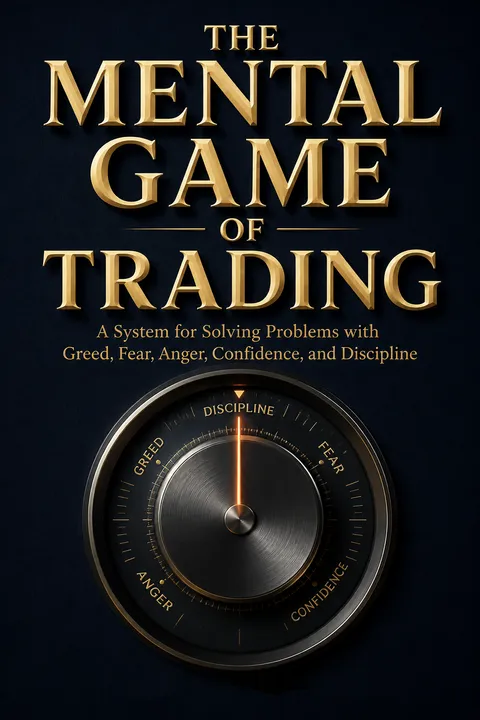

Key Takeaways
Your greed, fear, and rage aren't flaws to crush, they're signals to decode
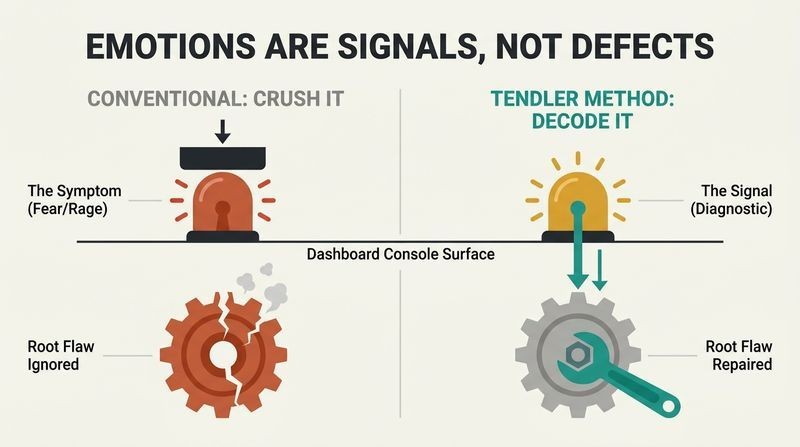
Emotions are diagnostics, not defects. Tendler's central reframe: conventional trading psychology tells you to suppress, release, or trick your emotions. He argues this is backwards. Anger after a loss or panic about missing a move are like a fever, not the disease. They point to a hidden performance flaw underneath.
The headache analogy drives it home. Imagine recurring headaches you blame on stress, until an eye exam reveals failing vision and eye strain. The headache was never the problem; it was a signal. Similarly, when you move a stop out of greed or chase price out of FOMO, the emotion is flagging a flawed belief, bias, or illusion you haven't addressed. Treat your feelings as clues a detective gathers, not enemies to silence.
This inverts the dominant mindfulness-and-control orthodoxy in trading literature, and it aligns with modern affective neuroscience. Antonio Damasio's somatic marker hypothesis showed that patients with damaged emotional processing made catastrophically poor decisions, proving emotion is integral to good judgment, not opposed to it. Tendler's framing also echoes Acceptance and Commitment Therapy, which treats emotional suppression as counterproductive. One caveat worth noting: not every emotion encodes a deep flaw. Sometimes fear simply reflects a genuinely weak strategy or real market risk. Tendler acknowledges this, which keeps the framework from becoming an over-psychologized excuse to ignore legitimate technical gaps.
Stop managing your emotions forever; aim to resolve them permanently instead
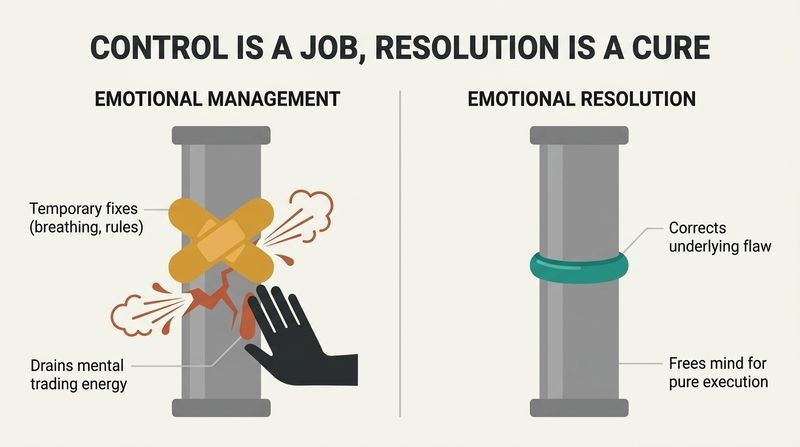
Control is a job; resolution is a cure. Tendler distinguishes managing emotions (deep breaths, quitting early, sticky-note reminders, time off) from resolving them. Management strategies are training wheels: useful short-term, but they cap your potential because you spend mental energy fighting reactions instead of trading. Resolution means correcting the underlying flaw so the trigger simply stops producing the emotion.
The friend analogy clarifies it. If a friend offends you and tension lingers for weeks, no amount of pretending fixes it. Only an honest conversation that addresses the real issue makes the resentment vanish for good, never resurfacing over that incident. That's resolution. Once you fix the flaw beneath your greed or tilt, you don't need to white-knuckle control anymore. The emotional reaction disappears, freeing your mind to focus purely on execution.
The control-versus-resolution distinction maps neatly onto the clinical difference between symptom management and addressing root causes, familiar from cognitive behavioral therapy. Tendler, a licensed therapist, essentially imports therapeutic depth into performance coaching. The promise of permanent resolution is bold and arguably oversells: cognitive biases are notoriously sticky, and even well-resolved patterns can resurface under extreme stress or fatigue. Still, the strategic value is real. By reframing the goal from endless vigilance to one-time correction, he redirects effort toward the high-leverage work most traders skip. The training-wheels metaphor is honest, conceding that management has its place during the rehab period.
Catch the emotion early, because once it peaks your thinking brain shuts off
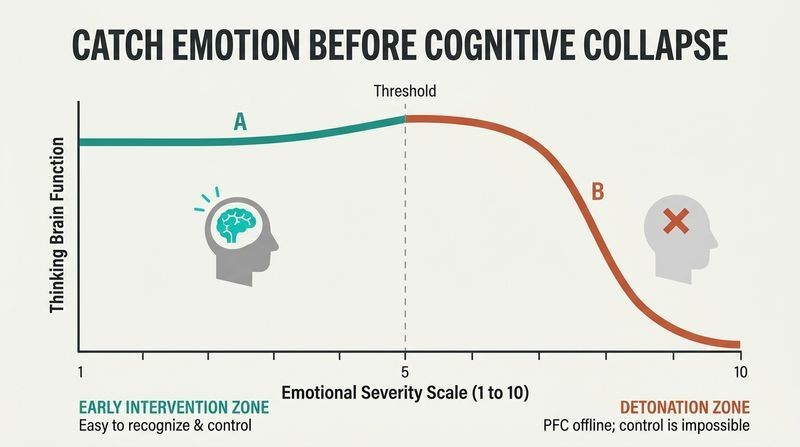
Map your pattern before it detonates. You cannot stop what you cannot see. Tendler has traders document the thoughts, physical sensations, behaviors, and decision changes that precede their mistakes, then rank them on a 1-to-10 severity scale. This builds an internal GPS that alerts you when you've taken a wrong turn, long before you drive off the cliff.
Timing is everything because of brain hierarchy. Citing the Yerkes-Dodson law, he explains performance rises with emotional arousal only to a threshold, then collapses. When emotion overruns that threshold, the brain's prefrontal cortex (responsible for thinking and emotional control) literally loses function. Trying to calm down after you're enraged is like running on a broken ankle. You must intervene while the emotion is still small, which is why early recognition is the whole game.
The neuroscience is sound: acute stress demonstrably impairs prefrontal function while strengthening amygdala-driven reactivity, as Amy Arnsten's research shows. This explains the maddening experience of knowing the right move yet being unable to execute it. Tendler's practical contribution is operationalizing this into a graded severity map, which resembles emotional granularity research by Lisa Feldman Barrett, who found that people who label emotions precisely regulate them better. One tension: high-frequency traders may lack bandwidth to map in real time. Tendler addresses this by recommending post-session reconstruction, but the approach clearly favors those with enough time between decisions to observe themselves.
Improve your worst trades, not your best; your C-game holds you back
The Inchworm moves by both ends. Tendler pictures your decision quality as a bell curve: your A-game (peak), B-game (solid), and C-game (worst). Most traders obsessively push the front end higher, chasing bigger wins. But pushing only the front widens your range, producing wild swings, blowups, and burnout. Like an inchworm, real progress requires the back foot to step forward too.
Your job is to suck less. Brian, a Canadian futures trader, was stalled, fantasizing about an island lifestyle while skipping his routines. The Inchworm reframe (just be 10% less bad, not perfect) cut his procrastination and lifted his R-factor from 1.25 to 2.25. Because emotion shuts down access to your best skills, your guaranteed baseline is your C-game. Raising that floor is the highest-leverage, most reliable improvement available to you.
This is a counterintuitive and durable insight that contradicts the popular play-to-your-strengths gospel. It mirrors how elite sports and aviation safety operate: consistency and error reduction beat occasional brilliance. Process-control thinking from manufacturing agrees, where reducing variance, not raising peak output, defines quality. The bell-curve framing also resonates with deliberate practice research, which targets specific weaknesses rather than rehearsing what you already do well. The phrase suck less is deliberately unglamorous, which is its strength. It lowers the activation energy for improvement. The honest limitation Tendler flags: backend gains feel slow and unsexy, so traders chronically neglect them despite their outsized payoff.
Greed has no flaws of its own; it's overconfidence or fear wearing a mask
Greed is just ambition gone excessive. Tendler argues there's no unique root cause for greed. Dig underneath and you find overconfidence (feeling invincible, blind to risk), lack of confidence (nothing's ever enough), anger (revenge trading), or fear (FOMO). Ambition itself isn't greedy; we don't call Michael Jordan's drive greedy. Greed is simply the point where ambition compromises your decisions.
Four traders proved it. Each arrived convinced greed was their problem. Alex's greed masked a fear of being wrong that made him undersize huge opportunities. Rodrick's was actually anger at imperfection; he once lost 58,000 dollars trying to fix a 4,000 dollar mistake. Max's traced to shaky confidence. Chris's stemmed from perfectionism. The lesson: chasing greed directly is futile. Identify which deeper emotion is driving it, then fix that.
Treating greed as a surface symptom rather than a primary drive is genuinely original in a field obsessed with the word since Gordon Gekko. Tendler's point that intent, not the action, defines greed echoes virtue ethics: Aristotle located virtue between deficiency and excess, with the right amount differing per person and context. Behavioral finance rarely makes this distinction, lumping all overtrading together. The practical risk is circularity: if greed is always really something else, the category risks dissolving into unfalsifiability. But the diagnostic discipline it enforces, refusing to accept the obvious label, is exactly the rigor that separates lasting fixes from cosmetic ones.
Fear is uncertainty in disguise, and certainty is the only real antidote
Strip fear down and you find unanswered questions. Tendler reduces fear to uncertainty: when you have certainty, fear cannot coexist. Imagine a fairy telling you the day's exact outcome; the dread would vanish instantly. Traders who absorb heavy losses without fear share one trait, certainty in their edge and their ability to adapt.
Fear shows up in five recognizable ways:
1. Risk aversion (locking winners too early)
2. Overthinking (mind looping for answers it can't find)
3. Second-guessing decisions after making them
4. Not trusting your gut
5. Predicting a negative future ('what if I blow up?')
Vishal, a UK trader, hesitated constantly until Tendler showed him his real problem was a strategy with too many unanswered questions, not a psychological fear. Trading should be 90% technical, 10% mental for him. Tightening his plan removed the doubt.
Equating fear with uncertainty is elegant and largely supported by predictive-processing neuroscience, which frames the brain as a prediction engine that experiences anxiety when its models cannot resolve ambiguity. The Vishal example is the sharpest insight here: much trading fear is misdiagnosed psychology when the true culprit is an underspecified strategy. This is a valuable corrective against over-therapizing. One nuance worth adding: tolerance of uncertainty, not its elimination, may be the healthier target. Markets are irreducibly uncertain, and chasing certainty can itself become pathological, fueling the overthinking Tendler warns against. He concedes certainty is never fully attainable, which keeps the framing honest.
Anger erupts when a hidden belief collides with market reality
Tilt is a conflict signal. Borrowed from poker, tilt means anger that wrecks your decisions. Tendler says it arises when an underlying flaw, bias, or illusion conflicts with reality: believing you're unluckier than others, that you should never make a mistake, or that you can predict price. The famous trap is the tilt of tilt, getting angry that you're angry, like throwing gasoline on a fire.
Tilt comes in flavors. Hating to lose, mistake tilt (rage at your own errors), injustice tilt (the market screwed me), revenge trading, and entitlement tilt. Tendler shows that injustice tilt often runs on rigged scorekeeping: you blame losses on bad luck but credit wins to skill, so the scales feel permanently unfair. The frequent root across types is expecting perfection, an impossible standard that guarantees emotional collapse.
The conflict-based model of anger has strong support in psychology; frustration-aggression theory and appraisal theory both locate anger in a gap between expectation and reality. Tendler's insight that traders systematically misattribute luck and skill is essentially a self-serving attribution bias, well-documented since the 1970s, applied with unusual precision to PnL. His prescription to track good luck deliberately is a clever debiasing intervention, since the bias thrives on selective memory. The perfectionism root connects to clinical work linking maladaptive perfectionism to rumination and emotional dysregulation. What elevates this beyond standard anger management is the refusal to treat anger as the problem rather than the readout of a distorted belief system.
Confidence is a feeling, not a measure of your actual skill
Confidence is an emotion, vulnerable to distortion. Tendler insists confidence and competence are different things. A novice can feel more confident than a 20-year veteran. Because confidence is fluid like any emotion, both too much and too little cause damage. Overconfidence makes you oversize and ignore risk; low confidence makes you hesitate and abandon good strategies.
The goal is stable confidence, an internal foundation anchored to something more solid than today's PnL. He frames confidence as a puzzle: rarely is the whole thing missing, just a few flawed pieces (the illusion of control, predicting outcomes, hindsight bias, the Dunning-Kruger effect where the unskilled overrate themselves and the skilled underrate themselves). David, a retired actor, stabilized his by hiring an artist to draw a cartoon of his overconfident self, using comedy instead of self-criticism to regain perspective.
Separating confidence from competence punctures one of self-help's most cherished myths, that confidence causes success. Research on the Dunning-Kruger effect, which Tendler cites accurately, shows confidence and ability often diverge sharply. The puzzle-piece metaphor is useful because it resists the all-or-nothing framing that makes confidence problems feel intractable. There is a subtle tension, though: some performance research (Bandura's self-efficacy work) does find that belief in one's ability causally improves persistence and outcomes. Tendler's reconciliation is that confidence helps navigate short-term uncertainty but does not substitute for edge. The David anecdote illustrates an underrated regulation tool, humor, which broadens cognition and counteracts the narrowing effect of negative emotion.
Convert expectations into goals; expecting perfection puts you in permanent debt
An expectation is a guarantee; a goal embraces uncertainty. Tendler's sharpest confidence insight: perfectionists keep an internal scoreboard where meeting expectations earns zero points (you only did what you were supposed to) while falling short loses points. Since perfection is unattainable over a large sample, you accumulate a massive confidence debt no win can repay. This is why hugely successful traders still feel miserable.
The fix is recalibrating the measuring stick. Aspire as high as you want, but expect only your C-game, the one thing actually guaranteed. Everything above must be earned daily and credited when achieved. He prescribes mining your trading history for unacknowledged accomplishments, spending 5 to 10 minutes daily feeding the starved confidence, because a deficit makes the next milestone feel like a feast that turns out to be a pile of sand.
The expectation-as-guarantee versus goal-as-uncertainty distinction is linguistically precise and psychologically potent. It parallels Carol Dweck's growth mindset, which Tendler explicitly recommends, where outcomes are framed as learnable rather than fixed verdicts. The confidence-debt accounting metaphor is original and memorable, capturing why achievement never satisfies the perfectionist, a phenomenon hedonic adaptation research calls the hedonic treadmill. The daily accomplishment-review practice resembles evidence-based gratitude and self-compassion interventions shown to buffer against rumination. The one caution: some elite performers credit high expectations for their drive, and Tendler agrees, insisting the goal is conversion, not lowering ambition. That nuance prevents the advice from sliding into complacency.
Solve any mental-game problem with a five-step Mental Hand History
A structured tool to find the root, not just the symptom. Named after poker's hand reviews, the Mental Hand History forces analytical traders to dissect emotional problems the way they dissect trades. The five steps:
1. Describe the problem in detail
2. Explain why it makes sense that you react this way
3. Explain why that logic is flawed
4. Devise a correction to the flawed logic
5. Explain why the correction is correct
Step 2 is where traders stumble. They want to write 'I'm just being irrational,' which is a dead end because it blames you rather than the flaw. Tendler insists mental-game problems happen for logical reasons; the cause-and-effect makes sense once you see the full picture. Most traders skip straight from step 1 to step 4, arriving at corrections that sound good but never touch the real issue.
The five-step structure is essentially a Socratic disputation method, nearly identical to the cognitive restructuring worksheets used in CBT, where clients identify automatic thoughts, examine evidence, and generate balanced replacements. Tendler's adaptation is smart for his audience: traders trust process and data, so framing emotional work as a hand review lowers resistance to introspection that might otherwise feel like soft psychobabble. The insistence on step 2, articulating why the flawed logic made sense, is the crucial methodological move, since premature jumping to solutions (step 1 to step 4) is exactly how generic advice fails. The written, iterative format also offloads working memory, which, as the book notes, shrinks under stress.
Interrupt the spiral with four moves: recognize, disrupt, inject logic, remind
The real-time correction sequence. Once a trigger fires, Tendler's protocol fights back in four steps. First, recognize the pattern using your map. Second, disrupt its momentum (a single diaphragmatic breath, writing, standing up, or talking) to create separation between reaction and response. Third, inject logic, a pre-written, rehearsed phrase tailored to your specific flaw that cuts emotion in real time, like FOMO's 'the market is a constant stream of opportunities, I won't catch them all.' Fourth, use a Strategic Reminder of the technical factors you tend to ignore when emotional.
Train the logic like an athlete trains technique. A weak or generic statement only produces a placebo that manages the symptom. The logic must come straight from your Mental Hand History and be memorized cold, so it holds under pressure. Done right, all four steps take seconds, and each repetition moves you toward resolution.
Injecting Logic is structured self-talk, a technique with solid empirical backing; a 2011 meta-analysis Tendler cites found self-talk reliably improves performance. The genius is the dual payoff: the same intervention both rescues the current moment and rewires the flaw long-term through repetition, like sharpening an axe while chopping. The diaphragmatic breath aligns with vagal-tone research on parasympathetic activation. The key caveat Tendler is admirably honest about: timing. Inject logic after the emotion crosses threshold and it fails, because the thinking brain is already offline. This makes the unglamorous mapping work from earlier the actual prerequisite, the protocol is only as good as your early-warning system.
Discipline isn't willpower you lack; it's a muscle you build where you're weakest
Discipline equals mental strength plus willpower. Mental strength is how firmly an idea is wired in your mind; willpower is the finite energy that fuels repetition. Calling yourself undisciplined, Tendler argues, is itself lazy. Everyone has discipline; the question is where and how much. Like the Inchworm, you grow it by pushing slightly harder exactly when you're weakest, even if that means logging trades for just one minute.
Six discipline leaks, each with its own fix: impatience, boredom, being overly results-oriented, distractibility, laziness, and procrastination. Laziness is reframed as strong motivation to do something else; procrastination as the false belief that 'tomorrow' is real. The crucial diagnostic question when discipline breaks: are your emotions too high, or is your energy too low? High emotion means it's not a discipline problem at all. Low energy means you're in the right chapter.
Defining willpower as finite energy invokes the ego-depletion model, which has faced serious replication challenges in recent years, so Tendler's reliance on it is the book's most scientifically contestable claim. That said, his practical advice survives regardless of the mechanism: starting absurdly small mirrors BJ Fogg's Tiny Habits and James Clear's two-minute rule, both well-validated for habit formation. Reframing laziness as competing motivation is a useful cognitive shift that removes the self-blame paralysis. The standout contribution is the diagnostic question separating emotional interference from genuine energy depletion, which prevents traders from misapplying discipline tools to what are actually unresolved fear or anger problems, the integrating insight of the whole book.
Analysis
Jared Tendler's book occupies an unusual niche: a performance-psychology system written by a licensed therapist for an audience (traders) that is data-driven, skeptical, and allergic to soft language. Its difficulty to summarize lies in its architecture. The book is not a list of tips but an integrated diagnostic system where every chapter (greed, fear, tilt, confidence, discipline) is an application of the same underlying engine: emotions are signals, signals reveal flaws, flaws get mapped and resolved through the Mental Hand History and real-time correction.
What distinguishes the work is its refusal of the genre's dominant metaphor of control. Most trading psychology preaches suppression, mindfulness, or detachment. Tendler argues these merely manage symptoms and cap potential. His resolution-versus-control distinction imports clinical depth (essentially root-cause CBT) into a field that usually settles for affirmations and breathing exercises. This is the book's real innovation and its most defensible claim.
The framework's intellectual coherence is impressive: the Inchworm Concept, the Yerkes-Dodson brain-hierarchy argument, and the expectation-versus-goal distinction all reinforce one thesis, that your guaranteed baseline (C-game) is what you should improve, because emotion strips access to everything above it. The recurring case studies (Frantz, Rodrick, Alex, Goro) function as proof-of-concept narratives showing the same engine resolving superficially different problems. The weaknesses are scientific rather than practical. The finite-willpower model rests on the contested ego-depletion literature, and the promise of permanent resolution likely overstates how durably cognitive biases can be eliminated. There is also a structural bias toward lower-frequency traders who have time to self-observe.
Yet the practical scaffolding (mapping patterns, the five-step disputation, trained self-talk) maps cleanly onto evidence-based clinical and sports-psychology methods. Stripped of trading jargon, this is a transferable system for any high-stakes performer whose own mind is the bottleneck.
Review Summary
The Mental Game of Trading receives overwhelmingly positive reviews, with readers praising its practical approach to trading psychology. Many find it valuable for managing emotions and improving decision-making in trading. The book's "inchworm" concept and focus on self-improvement are particularly appreciated. Readers note its applicability beyond trading to general life situations. Some criticize its length and repetitiveness, but most consider it a must-read for traders seeking to enhance their mental game and overall performance.
People Also Read



Glossary
Inchworm Concept
Improve worst and best togetherTendler's model picturing your decision quality as a bell curve spanning your worst (C-game) to best (A-game) performance. Like an inchworm, lasting improvement requires both ends to advance: pushing only your peak widens your range and causes blowups, so the priority is raising your floor by correcting your worst, most emotion-driven mistakes.
Mental Hand History
Five-step root-cause analysis toolA structured problem-solving worksheet, named after poker hand reviews, with five steps: describe the problem, explain why your reaction makes sense, explain why that logic is flawed, devise a correction, and confirm why the correction is right. It forces traders to find the root flaw instead of jumping straight to surface-level solutions.
Resolution
Permanently correcting the root flawTendler's end goal, contrasted with control. Resolution means fixing the underlying performance flaw so that the trigger no longer produces the emotional reaction at all, eliminating the need to manage, suppress, or work around it. Control is an endless job; resolution is a permanent cure that frees mental energy for trading.
Tilt
Anger that wrecks decisionsA term borrowed from poker (originally pinball) for anger or frustration that degrades trading decisions. Tendler treats it as a signal of conflict between a hidden flaw, bias, or illusion and reality. Subtypes include hating to lose, mistake tilt, injustice tilt, revenge trading, and entitlement tilt.
Injecting Logic
Trained corrective self-talk phraseA real-time technique using a pre-written, rehearsed statement tailored to your specific flaw, deployed the moment emotion rises to reduce it and prevent escalation. Drawn from your Mental Hand History and memorized cold, it must be applied before emotion crosses your threshold, since the thinking brain shuts down once arousal peaks.
Stable Confidence
Confidence anchored beyond resultsConfidence based on something solid and independent of short-term PnL, sitting between overconfidence and lack of confidence. It reflects your real skill rather than distortions from flaws, biases, or recent wins and losses, letting you withstand market chaos, trust intuition, and focus on execution rather than riding an emotional roller coaster.
Accumulated Emotion
Residual emotional baggage that buildsEmotion left undigested from prior sessions, days, or years that lurks beneath the surface and can be triggered with surprising intensity. It explains instant blowups and why a new trading day rarely starts from a true zero. Reducing it requires deliberate work outside trading hours, such as writing and venting.
A- to C-game Analysis
Mapping your performance rangeAn exercise that defines and separates the mental/emotional and technical characteristics of your best (A-game), solid (B-game), and worst (C-game) trading. It provides a non-monetary measuring stick for daily performance, stabilizes confidence by clarifying your guaranteed baseline, and pinpoints which weaknesses to correct.
Strategic Reminder
Technical-factor checklist under pressureThe fourth step of the real-time correction protocol: a written note of the decision-making factors, data, or common mistakes you tend to ignore when emotional. Used alongside Injecting Logic, it protects the technical side of execution while logic addresses the emotional side.
Bloated Brain
Mental fog from data overloadTendler's term for the cognitive fog, lost clarity, and disrupted sleep that result from absorbing too much information without digesting it. Like accumulated emotion, undigested data carries over day to day. The fix is taking breaks to stop consuming data and writing to clear the mind before, during, and after trading.
FAQ
What's The Mental Game of Trading about?
- Focus on Mental Aspects: The book emphasizes the psychological challenges traders face, such as fear, greed, and overconfidence, and how these emotions impact trading performance.
- Systematic Approach: Jared Tendler presents a step-by-step system to identify and correct common emotional issues that can hinder trading performance.
- Real-World Application: The methods are based on Tendler's experience with clients in trading, poker, and sports, showcasing their effectiveness in real-world scenarios.
Why should I read The Mental Game of Trading?
- Improve Execution: The book provides practical strategies to enhance trading execution by addressing psychological barriers that lead to poor decision-making.
- Long-Term Success: Understanding and correcting mental game issues can lead to consistent long-term profitability rather than relying on luck or short-term strategies.
- Comprehensive Framework: It offers a structured framework for recognizing and resolving emotional problems, valuable for both novice and experienced traders.
What are the key takeaways of The Mental Game of Trading?
- Emotions as Signals: Emotions are signals indicating underlying issues that need to be addressed, not enemies to be suppressed.
- Mapping Patterns: Traders are encouraged to map their emotional patterns to recognize triggers and responses, aiding in effective mental game management.
- Focus on Resolution: The goal is to resolve mental game issues rather than merely controlling emotions, leading to improved trading performance.
What are the best quotes from The Mental Game of Trading and what do they mean?
- “Hope isn’t a strategy; close it and move on to the next one.”: This emphasizes decisive action over emotional attachment to trades.
- “If knocked down, I will get back up, every time.”: Reflects the resilience needed in trading, highlighting perseverance and recovery from losses.
- “You can’t control variance, but you can control how you respond to it.”: Promotes a proactive mindset in dealing with market fluctuations and setbacks.
How does Jared Tendler define greed in The Mental Game of Trading?
- Excessive Desire for More: Greed is described as a selfish and excessive desire for more, which can cloud judgment and lead to poor decisions.
- Interconnected with Other Emotions: Greed often stems from flaws related to overconfidence, lack of confidence, or anger.
- Impact on Performance: It can lead to actions like moving profit targets or overleveraging, undermining strategies and costing money.
What is the "Inchworm Concept" in The Mental Game of Trading?
- Learning Process Visualization: The Inchworm Concept illustrates improvement in trading performance through a structured learning process.
- Focus on Backend Improvement: Emphasizes improving the backend of trading skills (C-game) while pushing the front end (A-game) forward.
- Continuous Growth: By addressing weaknesses, traders can expand their performance range and achieve higher success levels over time.
How can I map my emotional patterns as suggested in The Mental Game of Trading?
- Document Your Experiences: Keep a detailed log of thoughts, emotions, and behaviors during trading sessions to identify patterns and triggers.
- Organize by Severity: Rank the intensity of emotional responses on a scale from 1 to 10, distinguishing between mental/emotional and technical aspects.
- Iterative Process: Continuously update your map as you gain more insights, allowing for better recognition and management of your mental game.
What is the "Mental Hand History" method in The Mental Game of Trading?
- Structured Problem-Solving: A five-step process designed to help traders analyze their mental game issues systematically.
- Identify and Correct Flaws: Encourages traders to describe problems, understand flawed logic, and develop corrections to improve performance.
- Iterative Learning: Allows for ongoing reflection and adjustment, helping traders learn from experiences and refine their approach over time.
How does The Mental Game of Trading address the fear of mistakes?
- Mistakes as Learning Opportunities: Mistakes are a natural part of learning and should be viewed as growth opportunities rather than failures.
- Expecting Perfection: Discusses how expecting perfection can lead to fear of mistakes, hampering performance and decision-making.
- Correcting Self-Criticism: Encourages reducing self-criticism and focusing on constructive feedback to improve skills and confidence.
How can I improve my confidence as a trader according to The Mental Game of Trading?
- Recognize Accomplishments: Keep track of achievements, no matter how small, to build a positive self-image and reinforce confidence.
- Injecting Logic: Use "Injecting Logic" statements to counter negative thoughts and boost confidence, tailored to specific fears or doubts.
- Stable Confidence: Develop stable confidence based on a realistic assessment of skills rather than fluctuating results, allowing better performance under pressure.
What strategies does Jared Tendler recommend for managing fear in trading?
- Identify Triggers: Understand what specifically triggers fear and map patterns to recognize its impact on decision-making.
- Use Breathing Techniques: Diaphragmatic breathing helps calm the mind and body, reducing anxiety and regaining focus during stress.
- Focus on Process Goals: Shifting focus from results to process-oriented goals can mitigate fear, reducing the emotional weight of trades.
What role does discipline play in trading according to The Mental Game of Trading?
- Foundation for Success: Discipline is essential for executing a trading strategy consistently, helping traders stick to plans and avoid emotional decisions.
- Building Habits: Discipline is a skill that can be developed over time, focusing on building positive habits that support trading goals.
- Managing Emotions: A strong sense of discipline allows traders to manage emotions effectively, reducing the impact of fear, greed, and other challenges on performance.
About the Author

Download PDF
Download EPUB
.epub digital book format is ideal for reading ebooks on phones, tablets, and e-readers.








































