


Key Takeaways
Control access to your body and love, and demand better treatment
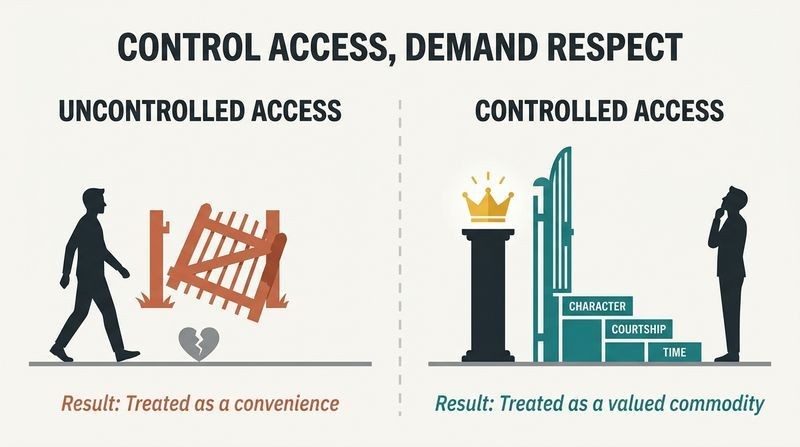
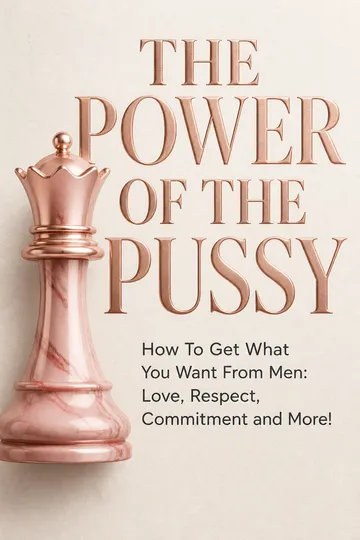
The central thesis is leverage. King argues that every woman possesses "pussy power," which she frames not as literal seduction but as the refusal to hand over sex, love, and devotion to men who haven't earned them. When a woman stops giving herself away cheaply, she becomes a valued commodity rather than a convenience.
The practical rule: make a man court you, prove his character, and demonstrate consistent good treatment before he receives your affection. King claims that in twelve years of marriage she has never been cheated on, dumped, or played, crediting this discipline. The power is universal, she insists, regardless of age, weight, or looks. The only thing that neutralizes it is being unaware it exists, or wasting it on a man who simply doesn't want you.
Stripped of its deliberately crude branding, King's thesis echoes classic scarcity and commitment theory: people value what is costly to obtain. Economists call it signaling, and evolutionary psychologists like David Buss describe "courtship as costly investment," where women screen for men willing to invest. The framing empowers, but it also reduces intimacy to transaction. Critics could note that treating love as a marketplace can breed distrust and game-playing on both sides. Still, the underlying message, that self-respect and standards shape how others treat you, is well supported by research on self-concept and relationship satisfaction.
Stay single until you love yourself, then commitment becomes your choice
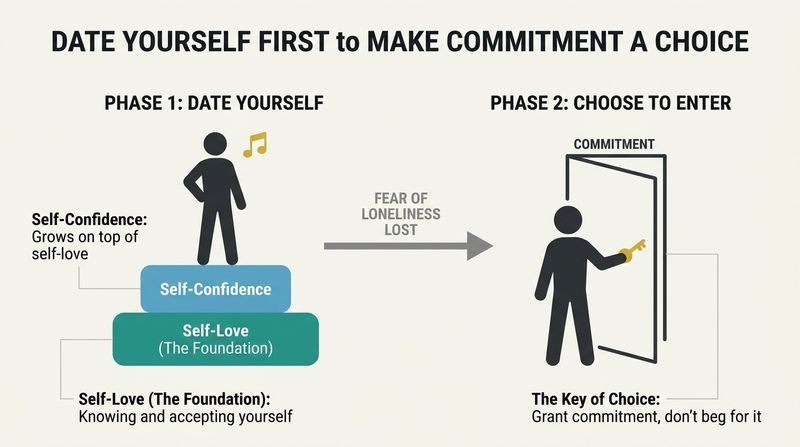
Date yourself before dating anyone. King urges women, especially the young, to spend years single by choice, discovering who they are independent of parents, peers, and boyfriends. She distinguishes self-love from self-confidence: knowing and accepting yourself is the foundation, and confidence is what grows on top of it.
Her personal catalyst came at nineteen, when she realized her longtime boyfriend never knew she loved rock music because she had hidden it out of insecurity. That suppression, not the relationship, was the real prison. She cites a claimed 60%-plus divorce rate for high school sweethearts within fifteen years, arguing people who commit too young never fully form themselves. The payoff of staying single: fear of loneliness loses its grip, and commitment becomes something you grant rather than beg for.
The advice aligns with developmental psychology. Erik Erikson placed identity formation (adolescence) before intimacy (young adulthood), arguing you cannot merge with another until you know who you are. Research on differentiation of self by Murray Bowen similarly links a strong autonomous identity to healthier partnerships. The specific 60% statistic should be treated cautiously, as it is cited without source and marriage-age divorce data varies widely. But the broader claim, that unresolved fear of being alone drives premature and unstable commitments, is echoed in attachment research on anxious partners settling for poor matches.
Men are agreeable before sex and dismissive after: time your requests
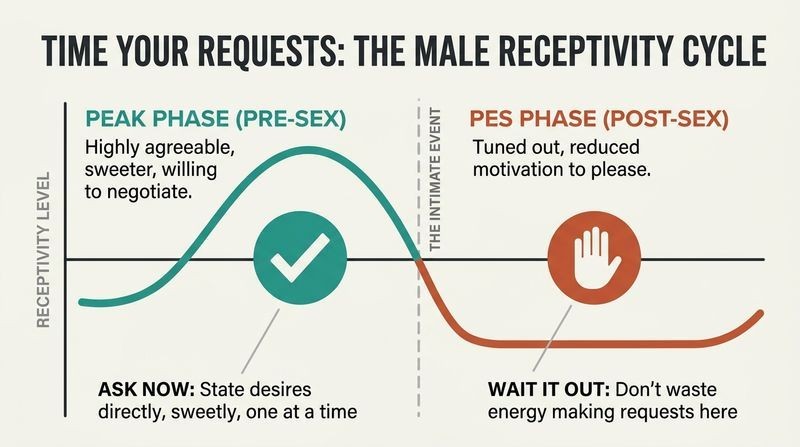
PEAK versus PES. King's signature (and bluntly named) framework claims men behave differently depending on where they sit in the sexual cycle. During PEAK, the window before sex when desire is building, men are sweeter, more romantic, and more willing to negotiate. After sex, they enter PES, a brief period of reduced motivation to please, lasting hours to days depending on appetite.
Her prescription: notice this rhythm rather than fighting it. Ask for what you want, whether help with chores, romance, or a real conversation, during PEAK, and don't waste energy making requests during PES. Pair this with "Just Say It": state your desire directly, sweetly, and one issue at a time, because men, she argues, don't read minds and tune out nagging entirely.
The physiology is roughly real: post-orgasm, men experience a refractory period accompanied by prolactin release and dopamine drop, which can dampen motivation and attention. King intuited a hormonal pattern that sexology partially confirms. The weakness is overgeneralization; individual variation is enormous, and framing sex as a tool for behavioral timing can feel manipulative to partners who value spontaneity. Yet the deeper communication insight, that direct, kind, single-topic requests outperform indirect hinting and nagging, is strongly supported by relationship research from the Gottman Institute, which finds "harsh startup" and mind-reading expectations predict conflict.
Reward good behavior with sex; never spoil an unappreciative man
Positive reinforcement, not scolding. King borrows the behaviorist principle directly: reward the behavior you want, ignore the behavior you don't. Applied to marriage, this means saving your best sexual attention for moments your partner treats you well, and withholding it (without drama) when he's being difficult. She suggests verbally linking the reward to the behavior, so the good conduct and the payoff connect in his mind.
Crucially, she warns against giving your best on demand. A man spoiled with mind-blowing sex regardless of behavior has no incentive to improve. Reserve ordinary intimacy for everyday life and save the exceptional for genuine rewards and "pussy negotiations." She stresses individualizing rewards, since praise, food, or attention motivate different men, and she limits all of this to loyal, deserving partners only.
This is operant conditioning (Skinner) applied to a marriage, and the mechanics are sound: intermittent reinforcement of specific behaviors does shape them. But the ethics are contestable. Treating a spouse like a subject to be conditioned can undermine the mutuality and trust that relationship science identifies as core to lasting bonds. There is also a gendered asymmetry embedded here, positioning sex as female currency rather than shared pleasure. A steelman: many couples already trade favors implicitly, and making the exchange conscious can reduce resentment. The healthiest version emphasizes appreciation and reciprocity, which King does insist must be mutual.
Personality, not looks, is what makes men commit for life
Beauty attracts; character keeps. King argues great looks earn desire but rarely a proposal, which explains why men fall hard for average-looking women. She surveyed men on their most valued traits and, after redirecting two who described breasts, distilled five: intelligence (broadly defined as ambition, creativity, drive, or talent), a sense of humor, kindness that isn't mistaken for weakness, honesty and faithfulness, and appreciation.
The appreciation point is her emphasis: men need to feel valued the way women need to feel cherished. Acknowledging a good man's efforts, even expected ones, makes him eager to repeat them. She frames this not as changing yourself but as sprinkling confidence-boosting habits onto your authentic personality, and she notes that letting your genuine humor and interests show filters out men who would eventually bore you anyway.
The claim tracks well with mate-selection research. Studies consistently find that for long-term partners, both sexes rank kindness, intelligence, and emotional warmth above physical attractiveness, while looks dominate short-term selection. King's informal survey is anecdotal, but it lands near findings from researchers like Buss on universal mate preferences. The appreciation insight connects to Gottman's "culture of appreciation" and the psychology of reciprocal positive regard. One caveat: her list still frames traits partly through their effect on men rather than as intrinsic goods, which slightly undercuts the authenticity message she otherwise champions.
Refuse to be the other woman: it devalues every woman's power
Integrity as collective strategy. King insists women stop sleeping with married or committed men, framing it as both self-respect and solidarity. Her economic metaphor: too much "free" access floods the market and devalues everyone's leverage. If women collectively refused, infidelity would become far harder to sustain.
She dissects why women stay in affairs: the "ego high" of feeling superior to a wife, which she compares to drug addiction, and the self-deceiving "but we're in love" story. Her test: demand he end the marriage first, and watch whether sweet talk survives the absence of easy sex. She argues men of low integrity rarely change, so a cheater won for you will likely cheat on you. Her broader plea is camaraderie: blame the cheating man, not the other woman, the way men close ranks.
The "pussy stock market" metaphor is a folk version of collective-action and game theory: individual defection undermines a shared equilibrium that would benefit all women. It resembles arguments in feminist economics about how atomized competition weakens bargaining power. The addiction framing of the ego high has real grounding; novelty, secrecy, and status-boosting can trigger dopamine-driven pursuit. The tension is that King simultaneously condemns female rivalry and prescribes withholding as leverage, which is itself competitive. Her call for women to redirect blame toward the unfaithful partner rather than the rival is psychologically healthier and echoes research on misplaced same-sex aggression.
Diagnose your relationship style: nagger, pushover, fighter, or perfectionist
Choose your battles by knowing your pattern. King offers a self-diagnostic of four sabotaging types. The nagger complains so much she gets tuned out; the fix is asking sweetly and reserving conflict for what matters. The pushover swallows her opinions until resentment festers; she must practice voicing preferences, starting small. The fighter is subtler: King argues some people get physiologically hooked on conflict, citing the adrenaline and dopamine released during arguments and intensified by make-up sex, alongside ego and attention-seeking rooted in low self-worth.
The perfectionist rejects good men over trivial flaws (a hairy back, a forgotten car door) and stays chronically single. The unifying tool is a single question before any conflict: "Is this worth it?" King suggests cutting fighting by half to reserve energy for issues that genuinely threaten your happiness.
The fighter-as-addict claim is the most novel and partly defensible: conflict does trigger sympathetic arousal, and the tension-reconciliation cycle can create a reinforcing loop resembling intermittent reinforcement, which is why volatile relationships feel addictive. Neuroscience on stress and reward supports the mechanism, though King simplifies it. The four-type taxonomy is intuitive rather than validated, but it functions well as a mirror. The strongest element is metacognitive: pausing to ask whether a battle is worth fighting is essentially a cognitive-behavioral intervention, interrupting automatic reactivity, a technique clinicians use to reduce destructive conflict escalation in couples therapy.
Name the powers men hold over you: rejection, great sex, shared children
Awareness disarms. The book's second half flips perspective, cataloging the leverage men exert. Rejection is treated as a distinct force: the pain often exceeds the value of the man, so King urges asking whether you miss him or just sting from being rejected. She reframes it as "redirection." "Mr. Good Dick" is her label for sexual chemistry that clouds judgment; she argues the thrill often comes from the chase and mind games, not the man himself, and warns against confusing lust-driven emotion for love.
The "baby daddy" holds three powers: "the dream" of the perfect family you refuse to let die, financial dependency, and the fierce maternal desire to keep children happy. King's point throughout: recognizing a hidden power is itself the escape from it.
The rejection analysis anticipates findings from social neuroscience: Naomi Eisenberger's fMRI work shows social rejection activates the same brain regions as physical pain, validating King's "internal bruise" metaphor. Her insight that we crave the rejector precisely because rejection wounds the ego maps onto reactance theory and the scarcity effect. The "Mr. Good Dick" observation, that intermittent unavailability manufactures addictive attraction, is again intermittent reinforcement. The baby-daddy framework is emotionally astute about sunk-cost thinking ("the dream") and structural entrapment (financial dependency). Her repeated thesis, that naming a psychological trap loosens its grip, aligns with how affect labeling reduces emotional reactivity in the brain.
Treat divorce as reinvention: grieve on a deadline, then celebrate freedom
Positive Perspective in five steps. King reframes divorce (or any long-term breakup) as a beginning. Her method: first, grieve fully, crying and journaling to purge the pain, but set a "deadline of despair," a calendar date after which self-pity ends and emotional discipline begins. She warns against romanticizing only the good times and recommends a "things I hate about you" list as a reality check.
Next comes a symbolic "letting go" ceremony (burning photos, selling the ring), then "purposeful thinking," the daily practice of forcibly replacing loneliness with thoughts of freedom, even when forced. Finally, celebration: new experiences, dating, and the "upgrade," deliberately choosing a partner opposite to your ex's worst traits. Her recurring refrain: happiness is the best revenge, and karma eventually visits the husband who left for a fling.
The structure is surprisingly aligned with evidence-based grief and mood research. Setting boundaries on rumination mirrors findings that unlimited dwelling deepens depression, while scheduled "worry time" is an actual CBT technique. Expressive writing (Pennebaker's research) genuinely aids emotional processing. The ritual of a letting-go ceremony reflects anthropological work on how rites of passage help people transition identities. The riskier notes are the "karma" and revenge framing, which can tether healing to the ex's fate rather than one's own growth. The "upgrade" advice, defining a new partner by contrast to old wounds, is practical but risks selecting reactively rather than for genuine compatibility.
Stop rewarding bad men with sex, and "nice guys" stop finishing last
The patriarchy runs on female enabling. King's closing argument is structural: society, shaped by men, has conditioned women to shame themselves for the same behaviors men celebrate, from casual sex to ambition. She points to double standards (twelve birth control options for women, none but condoms for men), workplace harassment she experienced as a teen, and victim-blaming in rape cases as evidence of a system that excuses male misbehavior.
Her solution is collective and behavioral: because men are motivated by sex, women hold the lever to change male conduct. If women stopped sleeping with cheaters, users, and the arrogant, and instead rewarded kind, loyal, ambitious men, male behavior would shift within generations. She insists the goal is not matriarchy but balance, and she frames rewarding good men as the practical engine of that change.
This chapter fuses pop-feminist critique with the book's leverage thesis, and the join is uneven. The structural observations (harassment, double standards, victim-blaming) draw on legitimate feminist scholarship. But the causal claim that women's sexual choices alone could reform male behavior overstates individual agency against systemic forces, and echoes a controversial "female sexual gatekeeping" model that critics argue burdens women with responsibility for men's conduct. There is tension between condemning the objectification of women and prescribing sex as a behavior-modification tool. The strongest, most defensible thread is the call to value kindness and integrity over status and swagger in mate choice.
Go to the one who loves you, not the one you love
The book's final compression. King ends on borrowed wisdom she treats as a law: pursue the man who pursues you. Her framework holds that "pussy power" only works on a man who already wants you; deployed on a man who doesn't reciprocate, it is like swimming upstream, exhausting and futile.
The practical consequence: if you are the one chasing, begging, and settling, you have surrendered your leverage entirely, and no technique will restore it. The remedy is to cut losses and redirect toward men who desire you. She frames modern dysfunction as a reversal of courtship, women hunting and pleading for commitment while men enjoy "free milk." Her prescription restores the natural order: remain confident, stay uncommitted until a man proves worthy, and let him do the pursuing.
The maxim is old folk wisdom with a kernel of relationship science: partnerships where one person is markedly more invested ("principle of least interest," coined by sociologist Willard Waller) tend toward imbalance and dissatisfaction, and the less-invested partner holds disproportionate power. King's advice to avoid being the vastly-more-invested pursuer is genuinely protective. The limitation is its rigidity; healthy relationships require mutual pursuit, and framing all pursuit as the man's job can discourage women from expressing legitimate desire. The wiser reading is not "never pursue" but "never chase someone who consistently signals disinterest," a distinction between confident interest and self-abandoning pursuit.
Analysis
Kara King's sequel is a mass-market relationship manual dressed in deliberately provocative language, aimed at women who feel burned by dating and marriage. Structurally it splits in two: powers women wield (personality, chastity, self-knowledge, behavioral conditioning) and powers men hold (rejection, sexual chemistry, shared children, patriarchal conditioning). Beneath the crude branding sits a coherent, if debatable, worldview: relationships are power exchanges, sexual access is female leverage, and women sabotage themselves by giving that leverage away and then chasing men who don't reciprocate.
What makes the book hard to summarize is the gap between its packaging and its substance. Much of the actual advice is unremarkable and defensible: know yourself before committing, communicate directly instead of hinting, value character over looks, choose your battles, don't tolerate abuse, and don't pursue people who signal disinterest. King intuitively rediscovers established principles: operant conditioning, the principle of least interest, intermittent reinforcement, expressive-writing grief work, and scarcity-driven valuation. Her PEAK/PES framework even brushes against real post-orgasmic neurochemistry.
The intellectual weaknesses are threefold. First, biological essentialism: sweeping claims about how "men" and "women" think ignore vast individual variation. Second, the transactional model of intimacy sits uneasily beside her calls for authenticity and mutual respect; conditioning a spouse and being genuinely intimate pull in different directions. Third, the closing patriarchy chapter fuses feminist critique with a female-gatekeeping thesis that arguably places the burden of male reform on women's sexual choices, a contested and self-limiting frame.
Yet the book's enduring value is psychological rather than tactical. Its through-line, that awareness of a manipulation or emotional trap is itself liberating, mirrors how affect labeling and metacognition reduce reactivity. Read charitably, it is a self-respect manifesto for women taught to accept too little, wrapped in shock-value marketing designed to be remembered rather than ignored.
Review Summary
The Power of the Pussy (Part Two) receives mixed reviews, with an overall rating of 4.05 out of 5. Some readers praise the book for its straightforward advice and empowering content, particularly for married women. They appreciate the author's honesty and consider it a valuable resource. However, critics argue that the book contains manipulative tactics, outdated views, and generalizations. Some find it demeaning and potentially damaging to relationships. Despite the polarizing opinions, many readers recommend it as an eye-opening guide for women in various relationship stages.
People Also Read



Glossary
Pussy Power
Leverage from controlling love accessKing's central concept: the influence every woman holds by controlling access to her body, love, and devotion. Framed not as literal seduction but as refusing to give oneself away to undeserving men, thereby commanding respect and detecting manipulation. King insists it works only on men who already desire you, and is neutralized when a woman becomes the pursuer or wastes it on the uninterested.
PEAK
Pre-sex window of agreeablenessStands for Pre-Ejaculation Ass Kissing. The time frame before sex, when a man's sexual desire is building, during which King claims men are sweeter, more romantic, and more willing to negotiate or grant requests. She advises women to make important asks and raise relationship issues during this window for maximum cooperation.
PES
Post-sex dip in cooperationStands for Post Ejaculation Syndrome. The period after sex, lasting hours to days depending on a man's sexual appetite, when King claims his motivation to please drops and he becomes cockier or more dismissive. She advises women to avoid making requests during PES and to withhold sexual attention when a partner behaves badly.
Just Say It
Direct sweet single-topic requestsKing's communication technique: stating what you want plainly, sweetly, and one issue at a time, ideally during PEAK, rather than hinting or nagging. Based on her claim that men do not read minds, focus on one thing at a time, and tune out complaining but respond well to clear, warm, simple requests.
Pussy Negotiations
Trading intimacy for tasksKing's term for explicitly motivating a committed partner to do things (chores, childcare, romance) in exchange for sexual reward, conducted during PEAK. She stresses securing the agreed action before sex rather than after, and frames it as a mutual, consensual exchange within a loving relationship.
Mr. Good Dick
Sexual chemistry clouding judgmentKing's label for a man whose sexual skill clouds a woman's judgment, potentially overriding her better instincts. She argues the addictive pull often comes from the chase and emotional mind games rather than the sex itself, and warns women not to confuse lust-driven excitement for love or sacrifice their standards for it.
Positive Perspective
Five-step divorce recovery methodKing's five-step framework for healing from divorce or a major breakup: scheduled grieving time, a deadline for ending self-pity, a symbolic letting-go ceremony, purposeful thinking (forcibly replacing negative thoughts with thoughts of freedom), and celebration of a new life, including the "upgrade" to a better partner.
Prince Charming Test
Screening a man via favorsA screening technique where a woman asks a man to help with a task suited to his talents (fixing something, giving a ride, escorting her somewhere). A man who genuinely likes her helps eagerly; reluctance signals he is not truly interested or is a self-centered user to avoid.
The Dream
Fantasy trapping women in relationshipsOne of three powers King says a "baby daddy" holds. It is the idealized vision of a perfect family a woman refuses to let die, keeping her attached to an inadequate partner. King argues separating this fantasy from present reality frees a woman to leave a man who will never step up.
FAQ
What's "The Power of the Pussy (Part Two)" by Kara King about?
- Empowerment for Women: The book focuses on empowering women in their relationships with men, offering advice on dating, marriage, and divorce.
- Pussy Power Concept: It introduces the concept of "pussy power," which is about using one's femininity and confidence to navigate relationships effectively.
- Practical Advice: The book provides practical tips and strategies for women to gain respect, love, and commitment from men.
- Two-Part Structure: It is divided into two parts: the first focuses on women's powers, and the second on understanding men's powers over women.
Why should I read "The Power of the Pussy (Part Two)" by Kara King?
- Empowerment and Confidence: It aims to boost women's confidence and empower them to take control of their relationships.
- Real-Life Applications: The book offers real-life advice and scenarios that many women can relate to and apply in their own lives.
- Controversial Yet Insightful: While it may be controversial, it provides insights into gender dynamics and societal expectations.
- Practical Tools: Readers gain practical tools and strategies to improve their dating and relationship experiences.
What are the key takeaways of "The Power of the Pussy (Part Two)" by Kara King?
- Understanding Dynamics: Recognize the power dynamics in relationships and how to use them to your advantage.
- Self-Discovery: Emphasizes the importance of knowing oneself and being confident in one's identity.
- Strategic Approach: Encourages a strategic approach to dating and relationships, focusing on long-term happiness.
- Empowerment Through Awareness: Awareness of both women's and men's powers can lead to more balanced and fulfilling relationships.
How does Kara King define "Pussy Power" in the book?
- Feminine Influence: "Pussy Power" is about using feminine influence and confidence to navigate relationships.
- Not Just Physical: It goes beyond physical attraction, focusing on personality, integrity, and self-respect.
- Empowerment Tool: It is a tool for empowerment, helping women to set boundaries and demand respect.
- Awareness and Practice: Being aware of this power and practicing it daily can lead to more fulfilling relationships.
What is the "PEAK" and "PES" method mentioned in the book?
- PEAK (Pre-Ejaculation Ass Kissing): This is the time when a man is most agreeable and willing to please, as he desires sexual fulfillment.
- PES (Post Ejaculation Syndrome): After sexual fulfillment, a man's motivation to please decreases, making it a less effective time to ask for favors.
- Timing is Key: Understanding these phases helps women strategically time their requests and discussions.
- Relationship Dynamics: These concepts highlight the importance of timing in relationship dynamics and communication.
What advice does Kara King give for staying single in "The Power of the Pussy (Part Two)"?
- Self-Discovery: Use the single period to get to know yourself and what you truly want in life.
- Enjoy Freedom: Embrace the freedom that comes with being single and use it to explore new opportunities.
- Overcome Fear: Address and overcome the fear of being alone, which can lead to settling for less.
- Commitment as a Choice: View commitment as a choice, not a necessity, and wait for the right person who meets your standards.
How does "The Power of the Pussy (Part Two)" address the issue of infidelity?
- Integrity and Self-Respect: Emphasizes the importance of being a woman of integrity and not engaging with married or committed men.
- Karma and Consequences: Warns of the karmic consequences of being involved in infidelity and the impact on self-worth.
- Camaraderie Among Women: Encourages women to support each other and not undermine one another by engaging in affairs.
- Empowerment Through Boundaries: Setting boundaries and respecting oneself leads to empowerment and healthier relationships.
What are the "Five P's" for married women mentioned in the book?
- PEAK and PES: Use these phases to strategically communicate and negotiate with your partner.
- Patience and Persistence: Change takes time, and persistence is key in shifting relationship dynamics.
- Positive Reinforcement: Reward good behavior with positive reinforcement to encourage desired changes.
- Pussy Negotiations: Use sexual leverage to negotiate and motivate your partner to meet your needs.
How does Kara King suggest women handle rejection in "The Power of the Pussy (Part Two)"?
- Recognition: Recognize when rejection is affecting you and understand its power over emotions.
- Don't Take It Personally: Avoid internalizing rejection as a reflection of your self-worth.
- Rejection as Redirection: View rejection as a redirection towards better opportunities and relationships.
- Reject the Rejection: Actively choose not to let rejection define or control your emotions and actions.
What role does "The Dream" play in the power dynamics with a "Baby Daddy"?
- Idealized Vision: "The Dream" refers to the idealized vision of a perfect family that many women hold.
- Emotional Hold: This dream can emotionally bind women to their child's father, even if the relationship is unhealthy.
- Reality Check: Recognizing the difference between the dream and reality can help women make informed decisions.
- Empowerment Through Awareness: Awareness of this dynamic allows women to break free from unhealthy relationships.
How does "The Power of the Pussy (Part Two)" address the concept of patriarchy?
- Male-Dominated Society: Discusses how patriarchy is a male-dominated society that affects both men and women.
- Impact on Women: Highlights the ways in which patriarchy suppresses women's power and creates societal expectations.
- Awareness and Change: Encourages awareness of patriarchal influences and advocates for change towards equality.
- Empowerment Through Unity: Stresses the importance of women supporting each other to challenge and change patriarchal norms.
What are some of the best quotes from "The Power of the Pussy (Part Two)" and what do they mean?
- "Pussy makes the world go around." This quote emphasizes the influence and power women have in relationships and society.
- "Karma is a cunt." A reminder that actions have consequences, especially when it comes to integrity and respect in relationships.
- "The single life is fun and lonely, and the married life brings happiness and boredom." Highlights the pros and cons of both single and married life, encouraging women to find balance and fulfillment.
- "Go to the one that loves you; don't go to the one you love, and you will always be happy." Suggests that being with someone who truly values and loves you leads to greater happiness and fulfillment.
About the Author
Other books by Kara King
Download PDF
Download EPUB
.epub digital book format is ideal for reading ebooks on phones, tablets, and e-readers.








































