Resumen de la trama
La sombra del Gran Hermano
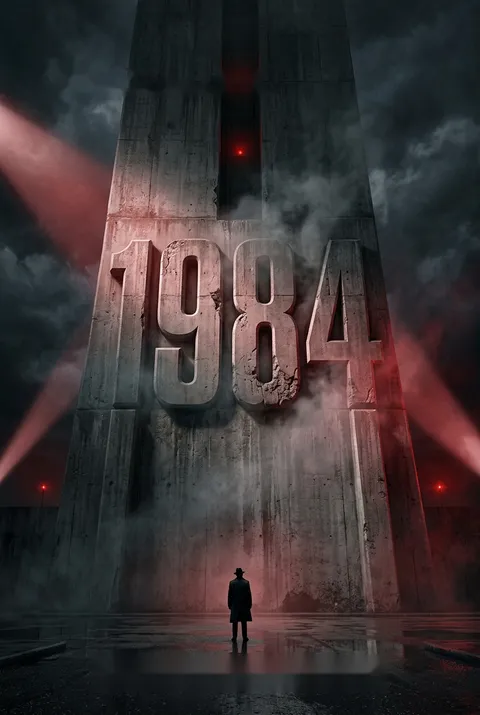
En un futuro distópico, Winston Smith vive en un estado totalitario donde el Gran Hermano vigila cada uno de sus movimientos. El Partido controla la verdad, reescribiendo la historia para ajustarla a su narrativa. Winston, un miembro de bajo rango del Partido, odia en secreto al régimen. Comienza un acto peligroso de rebeldía al llevar un diario, un crimen de pensamiento castigado con la muerte. Su vida está llena de paranoia, pues la Policía del Pensamiento podría estar observándolo en cualquier momento. A pesar del riesgo, Winston sueña con la libertad y se pregunta si otros comparten su disidencia.
Florece un amor prohibido
La vida de Winston da un giro cuando recibe una nota de Julia, una compañera del Partido, confesándole su amor. Comienzan un romance clandestino, reuniéndose en lugares secretos para evitar ser descubiertos. Su relación es un acto de rebeldía contra la prohibición del Partido sobre las lealtades y emociones personales. Julia es pragmática y rebelde, mientras que Winston es idealista, con la esperanza de una futura revolución. Juntos encuentran consuelo el uno en el otro, aunque la constante amenaza de ser descubiertos pesa sobre su felicidad.
Secretos en el desván
Winston alquila una habitación sobre la tienda de Mr. Charrington, un lugar sin telepantallas, donde él y Julia pueden ser ellos mismos. La habitación se convierte en su refugio, un pedazo del pasado donde escapan de la mirada vigilante del Partido. Hablan de su odio hacia el Partido y sueñan con unirse a la Hermandad, un grupo de resistencia del que se rumorea su existencia. Sin embargo, la seguridad de la habitación es una ilusión, pues desconocen los peligros ocultos que acechan.
La ilusión de la Hermandad
Winston y Julia se sienten atraídos por O'Brien, un miembro del Partido Interior que creen forma parte de la Hermandad. O'Brien los invita a su casa, donde confirma la existencia de la resistencia y le entrega a Winston un libro de Emmanuel Goldstein, supuesto líder de la Hermandad. El libro explica los métodos de control del Partido, pero la esperanza de Winston dura poco. Se revela la verdadera lealtad de O'Brien, y la rebelión de la pareja está a punto de enfrentar su prueba más dura.
Traición y captura
El santuario de Winston y Julia se destruye cuando son arrestados por la Policía del Pensamiento. Mr. Charrington, el tendero, resulta ser un informante. La pareja es separada, y Winston es llevado al Ministerio del Amor, donde enfrenta la cruda realidad del poder del Partido. O'Brien, antes una figura de esperanza, ahora es su interrogador, revelando la profundidad del engaño y control del Partido.
Tortura y verdad
En el Ministerio del Amor, Winston sufre torturas brutales diseñadas para quebrantar su espíritu y obligarlo a aceptar la versión de la realidad del Partido. O'Brien utiliza la manipulación psicológica y el dolor físico para hacer que Winston traicione sus creencias más profundas. La prueba definitiva llega en la Habitación 101, donde Winston se enfrenta a su peor miedo. En un momento de desesperación, traiciona a Julia, demostrando el poder del Partido para destruir las lealtades personales.
El último hombre en pie
Liberado de nuevo en la sociedad, Winston es un hombre roto. Su espíritu rebelde aplastado, pasa sus días en el Café Castaño, bebiendo ginebra y escuchando la propaganda del Partido. Se encuentra con Julia, pero su amor se ha desvanecido, reemplazado por la traición mutua. Al final, la mente de Winston sucumbe a la indoctrinación del Partido. Acepta la autoridad de el Gran Hermano, comprendiendo que el Partido ha ganado. La historia concluye con la trágica aceptación de su destino, un testimonio del control absoluto del Partido.
Personajes
Winston Smith
Winston es un hombre reflexivo e introspectivo que odia en secreto el régimen opresivo del Partido. Anhela la verdad y la libertad, pero su rebelión es finalmente aplastada por el poder abrumador del Partido. Su viaje de la esperanza a la desesperación resalta la futilidad de la resistencia en un estado totalitario.
Julia
Julia es una mujer audaz y práctica que encuentra maneras de desafiar las restricciones del Partido. Su relación con Winston es tanto un acto de amor como de desafío. A diferencia de Winston, ella se preocupa menos por la ideología y más por la libertad personal. Su traición bajo tortura subraya la capacidad del Partido para destruir los lazos personales.
O'Brien
O'Brien es un miembro de alto rango del Partido que inicialmente parece simpatizar con la causa de Winston. Sin embargo, es un maestro manipulador que usa su posición para atrapar y quebrar a los disidentes. Su papel como mentor y torturador destaca el control insidioso del Partido sobre la verdad y la lealtad.
Gran Hermano
El Gran Hermano es la cara del Partido, una figura utilizada para infundir miedo y obediencia. Aunque nunca se le ve en persona, su presencia se siente en todas partes, representando la omnipotencia del Partido y la futilidad de la resistencia.
Mr. Charrington
Al principio parece un tendero benigno, pero Mr. Charrington resulta ser miembro de la Policía del Pensamiento. Su traición a Winston y Julia ejemplifica la vigilancia y el engaño omnipresentes en la sociedad del Partido.
Emmanuel Goldstein
Goldstein es el supuesto líder de la Hermandad, una figura usada por el Partido para canalizar el odio público y justificar sus medidas opresivas. Su existencia es ambigua, sirviendo como herramienta de manipulación del Partido.
Tom Parsons
Parsons es vecino de Winston, un ferviente partidario del Partido que finalmente es traicionado por sus propios hijos. Su lealtad ciega y posterior caída ilustran el control del Partido incluso sobre sus seguidores más devotos.
Recursos narrativos
Crimen de pensamiento
El crimen de pensamiento es el acto de pensar en contra del Partido, un delito castigado que refleja el control del régimen sobre el pensamiento individual. El diario y las ideas rebeldes de Winston son centrales en el conflicto y la caída del personaje.
Telepantallas
Las telepantallas son usadas por el Partido para monitorear y controlar a la población, asegurando una vigilancia constante. Simbolizan la pérdida de privacidad y el poder invasivo del Partido en todos los aspectos de la vida.
Doble pensamiento
El doble pensamiento es la capacidad de sostener dos creencias contradictorias al mismo tiempo, un concepto usado por el Partido para manipular la realidad. Es una herramienta clave para mantener el control, forzando a los ciudadanos a aceptar las verdades cambiantes del Partido.
Análisis
"1984" es una poderosa llamada de atención sobre los peligros del poder gubernamental sin límites y la erosión de las libertades individuales. La representación de Orwell de una sociedad donde la verdad es maleable y las lealtades personales son destruidas resuena con las preocupaciones actuales sobre la vigilancia, la propaganda y el autoritarismo. La novela explora el lenguaje como herramienta de control, subrayando la importancia del pensamiento y la expresión libres. En última instancia, "1984" desafía a los lectores a mantenerse vigilantes frente a las fuerzas que buscan socavar la democracia y la autonomía personal, recordándonos el valor perdurable de la verdad y la libertad.
Resumen de reseñas
1984 es una novela distópica que invita a la reflexión y que ha dejado una huella profunda en sus lectores. Muchos la encuentran inquietantemente relevante frente a los problemas políticos y sociales actuales, y elogian sus advertencias proféticas sobre el totalitarismo, la vigilancia y la manipulación de la verdad. La forma en que el libro retrata una sociedad controlada resulta tremendamente poderosa: despierta sentimientos de miedo, desesperación y, en ocasiones, esperanza. Si bien algunos lectores la encontraron exigente o repetitiva, la gran mayoría la considera un clásico imprescindible que ofrece reflexiones profundas sobre la naturaleza humana y los peligros del poder sin límites.
También leyeron

Preguntas frecuentes
Synopsis & Basic Details
What is 1984 about?
- A Dystopian Future: The story follows Winston Smith, a low-ranking member of the ruling Party in Oceania, a totalitarian state under the omnipresent eye of Big Brother.
- Rebellion Against Control: Winston secretly rebels against the Party's oppressive rule, which controls every aspect of life, including thought, history, and language, by beginning a forbidden diary.
- Search for Connection: His quest for genuine human connection and truth leads him into a dangerous secret affair and a misguided attempt to join a rumored resistance movement, ultimately testing the limits of his defiance.
Why should I read 1984?
- Powerful Warning: It serves as a stark cautionary tale about the dangers of unchecked government power, surveillance, and the manipulation of truth, themes that remain highly relevant today.
- Exploration of Control: The novel deeply explores how a totalitarian regime can maintain absolute power by controlling information, language (Newspeak), and even individual thought (Thoughtcrime, Doublethink).
- Enduring Cultural Impact: It introduced concepts and terms like "Big Brother," "Thought Police," "Newspeak," and "Room 101" into popular culture, shaping how we discuss authoritarianism and surveillance.
What is the background of 1984?
- Post-War Context: Written in 1948, the novel reflects the anxieties of the post-World War II era, particularly the rise of totalitarian regimes like Stalin's Soviet Union and the potential for widespread government control.
- Author's Experiences: George Orwell's own experiences, including his time as a policeman in Burma and fighting in the Spanish Civil War, informed his understanding of power, propaganda, and political violence.
- Critique of Totalitarianism: The book is a direct critique of totalitarian ideologies, illustrating a world where individual freedom is extinguished, and reality is constantly rewritten to serve the state.
What are the most memorable quotes in 1984?
- "BIG BROTHER IS WATCHING YOU.": This iconic phrase, displayed on posters throughout Oceania, encapsulates the pervasive surveillance and lack of privacy that defines the Party's control.
- "WAR IS PEACE. FREEDOM IS SLAVERY. IGNORANCE IS STRENGTH.": These contradictory Party slogans, displayed on the Ministry of Truth, exemplify the concept of Doublethink and the Party's ability to force acceptance of mutually exclusive ideas.
- "Freedom is the freedom to say that two and two make four.": Winston writes this in his diary, representing his initial belief in objective truth and individual autonomy, a belief the Party systematically works to destroy.
What writing style, narrative choices, and literary techniques does Michael Dean use?
- Simplified Prose: The retelling uses clear, accessible language, focusing on direct action and dialogue to make the complex themes understandable for a wider audience.
- Third-Person Limited POV: The narrative primarily follows Winston Smith's perspective, allowing readers access to his internal thoughts, fears, and rebellious feelings, creating empathy and highlighting his isolation.
- Symbolism and Irony: The text employs symbolic elements like the telescreens, the decaying city, and the ironically named ministries (Ministry of Truth, Ministry of Love) to convey the oppressive atmosphere and the Party's deceptive nature.
Hidden Details & Subtle Connections
What are some minor details that add significant meaning?
- Decaying Environment Symbolism: The description of Victory Mansions smelling of "dust and yesterday's food" and the city streets filled with "dust and bits of paper" and bomb holes ("The nineteenth-century houses were all falling down") subtly reflects the physical and moral decay of Oceania under Party rule.
- The Smell of Parsons: Parsons is repeatedly described as smelling of "sweat," which, while seemingly minor, symbolizes his unquestioning, almost animalistic physical loyalty and tireless, unthinking effort for the Party, contrasting with Winston's intellectual dissent.
- The Old Clock in the Room: The twelve-hour clock in the room above Charrington's shop ("She smiled at the old twelve-hour clock") is a small detail that signifies a connection to the past, a time before the Party's twenty-four-hour control and the thirteen-hour clock system, making the room feel like a true sanctuary from the present.
What are some subtle foreshadowing and callbacks?
- O'Brien's Dream Callback: Winston's early dream of O'Brien saying, "We shall meet in the place where there is no dark," is a significant piece of foreshadowing, chillingly fulfilled when they meet in the brightly lit, windowless cells of the Ministry of Love ("In the Ministry of Love there were no windows").
- The Dark-Haired Girl's Look: Winston's initial fear and intense dislike of the dark-haired girl (Julia) stems from a look she gave him in the canteen ("she had looked at him in a way that filled him with black terror"), subtly foreshadowing her later significance in his life, albeit not in the way he initially feared (as a spy, though she is pragmatic about survival).
- Charrington's Transformation: Mr. Charrington's seemingly gentle, old-fashioned appearance and interest in the past ("He was a small, gentle-looking man of about sixty... He looked like a writer, or perhaps a musician") is a deliberate misdirection, making his sudden transformation into a cold, young Thought Police officer ("his hair... was now black. His body was straighter and looked bigger... a man of about thirty-five") a shocking reveal and a callback to the pervasive deceit.
What are some unexpected character connections?
- Parsons' Daughter's Betrayal: The seemingly minor interaction where Parsons proudly describes his children spying ("Do you know what my girl did last week? She was on a walk... and she saw a strange man. She... told the police about him") becomes tragically significant when his own daughter denounces him for Thoughtcrime ("My little daughter," said Parsons, sad but proud), highlighting the Party's destruction of family bonds.
- Syme's Predicted Vaporization: Winston's internal prediction that Syme will be vaporized ("One of these days... Syme will be vaporized. He is too intelligent... It is written in his face") is an unexpected connection based purely on Winston's intuition about the Party's intolerance for independent thought, which is later confirmed by Syme's disappearance ("They vaporized Syme... He did not exist").
- O'Brien's Shared "Understanding": The brief, shared look between Winston and O'Brien during the Two Minutes Hate ("at that exact moment his eyes met O'Brien's... 'I am with you,' O'Brien seemed to say to him") creates a powerful, albeit false, connection based on perceived mutual dissent, which Winston clings to despite having little basis for it.
Who are the most significant supporting characters?
- Syme: As a Newspeak expert, Syme is significant because he articulates the Party's goal of destroying language to narrow thought ("The aim of Newspeak is to narrow thought"), providing a chilling explanation of how the Party seeks to make Thoughtcrime impossible.
- Mr. Charrington: Initially appearing as a harmless link to the past and providing Winston and Julia's sanctuary, his reveal as a Thought Police member ("for the first time in his life he was looking at a member of the Thought Police") is crucial to the plot, demonstrating the Party's deep infiltration and the illusion of safety.
- Tom Parsons: Representing the ideal, unthinking Party member ("unbelievably stupid and endlessly enthusiastic... a follower with no mind of his own"), Parsons' eventual arrest, reported by his own child, highlights the Party's ultimate control over even its most loyal adherents and the breakdown of family.
Psychological, Emotional, & Relational Analysis
What are some unspoken motivations of the characters?
- Winston's Need for Truth: Beyond simply hating the Party, Winston's deepest unspoken motivation is a desperate need to find and hold onto objective truth ("Freedom is the freedom to say that two and two make four"), which drives his diary writing and his search for others who share this need.
- Julia's Pragmatic Survival: Julia's motivation is primarily personal pleasure and survival ("You wanted a good time... so you broke the rules as well as you could"), using rebellion as a means to carve out small areas of personal freedom rather than seeking ideological change or revolution.
- O'Brien's Pursuit of Pure Power: O'Brien's motivation, as he later explains, is not ideology or a better society, but the pure, absolute exercise of power for its own sake ("The Party is only interested in power... We want power, only power, pure power"), a chillingly simple and absolute goal.
What psychological complexities do the characters exhibit?
- Winston's Internal Conflict: Winston exhibits psychological complexity through his constant internal struggle between his desire for rebellion and his deep-seated fear of the Party, leading to moments of defiance followed by intense paranoia and self-doubt.
- Julia's Double Life: Julia's ability to convincingly play the role of a fervent Party loyalist while secretly engaging in forbidden acts ("I do anything they want and I always look happy about it. It's the only way to be safe") demonstrates a complex psychological adaptation for survival in a totalitarian state.
- O'Brien's Calculated Cruelty: O'Brien displays a disturbing psychological complexity in his ability to appear as a sympathetic figure ("I am with you") before revealing himself as a cold, calculating torturer who genuinely believes in the Party's methods of breaking individuals ("To make them tell you about their crimes... To punish them... No! No! Not just to hear about your crimes. Not just to punish you. Shall I tell you why we have brought you here? To make you better").
What are the major emotional turning points?
- Starting the Diary: The act of writing "DOWN WITH BIG BROTHER" in his diary is a major emotional turning point for Winston, transforming his passive dissent into an active, dangerous rebellion ("It was a decisive act to start writing... his crime was clear. Thoughtcrime, they called it").
- Julia's "I Love You" Note: Receiving Julia's note is a pivotal emotional moment, shifting Winston from despair and loneliness to hope and the possibility of shared rebellion and human connection ("life seemed better. He believed her... He wanted to see her again").
- Betrayal in Room 101: Winston's scream, "Do it to Julia! Do it to Julia! Not me! Julia!" in Room 101 is the ultimate emotional turning point, signifying the Party's success in breaking his spirit and destroying his love, replacing it with pure self-preservation and fear.
How do relationship dynamics evolve?
- Winston and Julia: From Suspicion to Love to Betrayal: Their relationship evolves dramatically from Winston's initial fear and suspicion of Julia as a spy ("He disliked her from the first moment he saw her... He even thought she might be working for the Thought Police") to passionate, rebellious love ("The next moment she was in his arms on the grass... It was a political act"), and finally to mutual betrayal and emotional emptiness after torture ("I betrayed you," she said. "I betrayed you, too," he said... "You only care about yourself.' And he had meant it").
- Winston and O'Brien: From Hope to Torment: Winston's relationship with O'Brien transforms from a distant, hopeful connection based on a perceived shared dissent ("there was sometimes an intelligence in his face that suggested - perhaps - that he might question the official Party beliefs") to a terrifying dynamic of torturer and victim, where O'Brien systematically breaks Winston's mind and spirit ("O'Brien was looking down at him. His hand was on a machine... 'To make you better'").
- Family Dynamics: From Duty to Denunciation: The traditional family unit is shown to have evolved into a tool of the Party, where the relationship between parents and children is twisted into one of surveillance and potential denunciation ("Children who would one day spy on their parents and tell the Party if they said or did anything wrong"), as tragically exemplified by Parsons' daughter.
Interpretation & Debate
Which parts of the story remain ambiguous or open-ended?
- The Existence of the Brotherhood: Despite O'Brien confirming its reality ("No, it is real"), the true nature and extent of the Brotherhood remain ambiguous; O'Brien tells Winston, "That, Winston, you will never know," leaving the reader to question if it's a genuine resistance or another Party fabrication to catch dissenters.
- The Reality of Big Brother: While O'Brien states Big Brother exists as "the face of the Party" and "will never die," his physical reality as a single, living person is never confirmed ("Nobody has ever seen Big Brother. He is a face on posters, a voice on the telescreen"), leaving his existence open to interpretation as either a real figurehead or a powerful symbol maintained by the Inner Party.
- The Future of Oceania: Although O'Brien chillingly predicts a future of eternal oppression ("imagine a boot stamping on a human face — for ever"), the story ends with Winston's personal defeat, leaving the ultimate fate of Oceania and the possibility of future resistance, perhaps from the proles, open to reader interpretation, despite the bleak outlook presented.
What are some debatable, controversial scenes or moments in 1984?
- The Nature of Winston and Julia's Love: Readers debate whether their relationship is genuine love or primarily an act of political rebellion and mutual convenience in a loveless world, especially given Julia's pragmatic approach and their eventual betrayal of each other under duress.
- The Effectiveness of the Party's Indoctrination: The extent to which Winston's final "love" for Big Brother is a true psychological transformation versus a complete mental breakdown and surrender is debatable, raising questions about the limits of psychological manipulation and the possibility of an unbroken inner core.
- The Role and Potential of the Proles: Goldstein's book suggests hope lies with the proles ("The future belonged to the proles"), but the narrative largely depicts them as apathetic and easily distracted ("The proles are not really people," Syme said), leading to debate about whether they represent a genuine potential for revolution or are simply too downtrodden to ever pose a threat.
1984 Ending Explained: How It Ends & What It Means
- Winston's Complete Submission: The novel ends with Winston Smith, broken by torture in the Ministry of Love, having fully succumbed to the Party's indoctrination, symbolized by his ability to accept "2 + 2 = 5" and his final realization, "He loved Big Brother."
- Destruction of Love and Truth: The ending signifies the Party's ultimate victory in destroying individual identity, love (shown by Winston and Julia's mutual betrayal and subsequent apathy towards each other), and the concept of objective truth, replacing them with absolute loyalty and acceptance of Party dogma.
- The Triumph of Totalitarianism: The final scene, where Winston feels tears of happiness and loves Big Brother while listening to war news, represents the tragic success of the totalitarian state in not just controlling actions, but conquering the human mind and spirit, fulfilling O'Brien's goal of making him "better" by conforming him entirely to the Party's will.
Descargar PDF
Descargar EPUB
.epub digital book format is ideal for reading ebooks on phones, tablets, and e-readers.








































