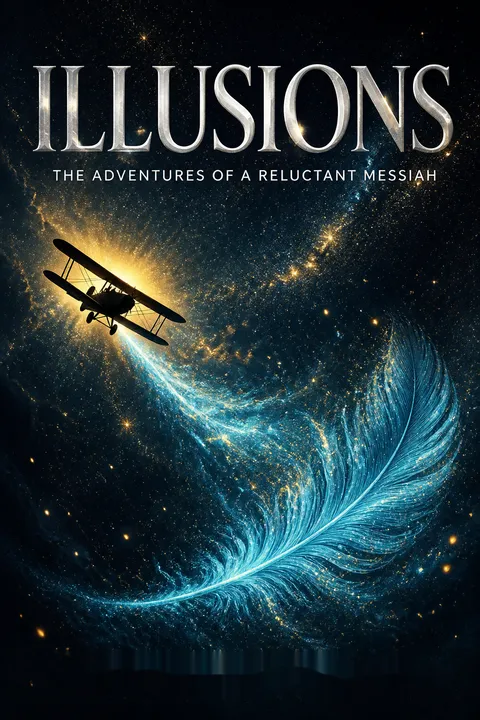

Resumen de la trama
El Mesías Reacio
En Indiana, un mecánico descubre que tiene el poder de sanar y enseñar a otros, atrayendo multitudes que lo llaman mesías. Abrumado por la atención y sin poder trabajar, se retira al campo. A pesar de su reticencia, la gente lo sigue, buscando milagros y sabiduría. Él enseña que dentro de cada persona reside el poder de elegir salud, riqueza y libertad. Sin embargo, la carga de las expectativas ajenas se vuelve insoportable, y ora por liberarse. Una voz le dice que siga su propia voluntad, lo que lo lleva a abandonar su papel de mesías y regresar a una vida más sencilla.
El Encuentro con Donald Shimoda
Richard, un piloto itinerante, conoce a Donald Shimoda, otro piloto con un aura misteriosa. Shimoda es sereno y enigmático, con un avión que parece ajeno al paso del tiempo. Mientras conversan, Richard descubre que Shimoda fue un mesías que renunció a su papel. La presencia de Shimoda es magnética, y demuestra una comprensión del mundo que intriga a Richard. Forjan un vínculo, y Richard comienza a aprender de la sabiduría poco convencional de Shimoda.
Lecciones sobre las Ilusiones
Shimoda enseña a Richard que el mundo es una ilusión, y que la verdadera libertad proviene de entender esto. A través de parábolas y demostraciones, Shimoda muestra que la realidad está moldeada por la creencia y la percepción. Richard lucha por captar estos conceptos, pero se siente fascinado por las posibilidades que presentan. Las enseñanzas de Shimoda desafían a Richard a reconsiderar su comprensión de la vida y su lugar en el mundo.
El Manual del Mesías
Shimoda presenta a Richard el "Manual del Mesías", un libro lleno de sabiduría críptica y recordatorios para quienes buscan la iluminación. El manual ofrece perspectivas sobre la naturaleza de la realidad, el poder del pensamiento y la importancia de vivir auténticamente. Richard queda cautivado por el libro, encontrándolo a la vez desconcertante y esclarecedor. Se convierte en una fuente de orientación mientras avanza en su camino junto a Shimoda.
Caminando sobre el Agua
Shimoda lleva a Richard a un estanque y demuestra la capacidad de caminar sobre el agua, explicando que la realidad es maleable y está sujeta a la creencia. Al principio, Richard es escéptico, pero con el aliento de Shimoda, logra caminar sobre el agua él mismo. Esta experiencia refuerza la idea de que las limitaciones son autoimpuestas y que todo es posible con la mentalidad adecuada. Richard comienza a ver el mundo con una nueva luz, cuestionando los límites de lo que creía posible.
El Poder de la Imaginación
Shimoda enseña a Richard sobre el poder de la imaginación, explicando que lo que uno visualiza puede convertirse en realidad. Richard practica esto imaginando una pluma azul, que luego aparece de forma inesperada. Esta lección destaca el poder creativo del pensamiento y la importancia de enfocarse en lo que realmente se desea. Richard aprende que la imaginación es una herramienta clave para moldear la experiencia del mundo.
La Lección Final
Durante un día rutinario de vuelo, Shimoda es asesinado por un hombre resentido. Richard queda devastado, luchando por entender por qué algo así le sucedió a alguien con la sabiduría y el poder de Shimoda. En su dolor, Richard reflexiona sobre las enseñanzas de Shimoda y comprende que la verdadera lección es soltar los apegos y entender la impermanencia de la vida. La muerte de Shimoda se convierte en un catalizador para la comprensión más profunda de Richard sobre las ilusiones de la realidad.
Un Sueño de Entendimiento
En un sueño, Richard vuelve a encontrarse con Shimoda, quien le asegura que la muerte no es el fin y que su conexión trasciende la existencia física. Shimoda anima a Richard a seguir aprendiendo y a compartir sus conocimientos con otros. Este sueño le brinda a Richard un cierre y un renovado sentido de propósito. Despierta con una comprensión más profunda de las lecciones aprendidas y un compromiso con vivir auténticamente.
Personajes
Richard
Richard es un piloto itinerante que conoce a Donald Shimoda y se convierte en su alumno. Inicialmente escéptico, Richard se siente atraído por la sabiduría de Shimoda y comienza a cuestionar su comprensión de la realidad. A lo largo de su viaje, Richard aprende sobre el poder de la creencia y la imaginación, encontrando finalmente un sentido más profundo de propósito y entendimiento.
Donald Shimoda
Shimoda es un ex mesías que ha elegido vivir una vida más sencilla como piloto. Posee una sabiduría profunda y la capacidad de manipular la realidad, que comparte con Richard. A pesar de su poder, Shimoda es humilde y busca enseñar a otros sobre las ilusiones del mundo. Su muerte se convierte en una lección crucial para Richard.
El Maestro
El Maestro es una figura que representa el potencial de iluminación dentro de cada persona. Enseña que los individuos tienen el poder de moldear su realidad y que la verdadera libertad proviene de entender las ilusiones del mundo. Las enseñanzas de El Maestro son centrales en la narrativa y sirven como guía para el viaje de Richard.
Recursos Narrativos
Ilusiones
El concepto de ilusiones es fundamental en la narrativa, destacando la idea de que la realidad no es fija, sino que está moldeada por las creencias y percepciones individuales. Este recurso desafía a los personajes a cuestionar su comprensión del mundo y a explorar las posibilidades de lo que puede lograrse mediante la creencia y la imaginación.
El Manual del Mesías
El manual funciona como un recurso narrativo que ofrece sabiduría críptica y orientación a quienes buscan la iluminación. Proporciona perspectivas sobre la naturaleza de la realidad y el poder del pensamiento, sirviendo como fuente de inspiración y reflexión para Richard mientras avanza en su camino con Shimoda.
Parábolas y Demostraciones
Shimoda utiliza parábolas y demostraciones para transmitir sus enseñanzas, ilustrando conceptos complejos de manera accesible y atractiva. Este recurso permite la exploración de ideas filosóficas en un contexto narrativo, brindando a Richard ejemplos prácticos de las lecciones que está aprendiendo.
Análisis
"Ilusiones: Las Aventuras de un Mesías Reacio" es una exploración filosófica sobre la naturaleza de la realidad y el poder de la creencia. A través del viaje de Richard y sus encuentros con Donald Shimoda, la narrativa invita a los lectores a cuestionar su comprensión del mundo y a considerar las posibilidades de lo que puede lograrse mediante la imaginación y la creencia. El libro enfatiza la importancia de vivir auténticamente y la idea de que la verdadera libertad proviene de entender las ilusiones de la realidad. Anima a los lectores a abrazar su potencial de iluminación y a explorar el poder creativo del pensamiento para moldear su experiencia del mundo.
Resumen de reseñas
Ilusiones recibe en su mayoría reseñas positivas, y muchos lectores consideran que es un libro capaz de cambiar vidas y de una profundidad extraordinaria. Sus seguidores elogian los mensajes espirituales, la sabiduría que transmite y su capacidad para provocar reflexión. Los críticos, en cambio, argumentan que resulta simplista y carece de verdadera sustancia. El libro explora temas como la realidad, la percepción y el crecimiento personal a través de la historia de dos pilotos, uno de ellos un mesías a regañadientes. Muchos lectores valoran sus pasajes memorables y encuentran en él una fuente de inspiración, mientras que otros lo desestiman como palabrería de la nueva era sin mayor fundamento. En definitiva, se trata de una obra polarizante que conecta profundamente con algunos y deja completamente indiferentes a otros.
También leyeron


Preguntas frecuentes
Synopsis & Basic Details
What is Illusions: The Adventures of a Reluctant Messiah about?
- Barnstormer meets Messiah: Richard, a pilot giving rides in his biplane, encounters Donald Shimoda, a former messiah who teaches him about the illusory nature of reality.
- Lessons in mastering reality: Shimoda guides Richard through experiences that challenge his perceptions and reveal the power of belief and imagination in shaping the world.
- Tragedy and transformation: The story culminates in Shimoda's death, prompting Richard to internalize the lessons he's learned and continue his journey of self-discovery.
Why should I read Illusions: The Adventures of a Reluctant Messiah?
- Philosophical exploration: The book delves into profound questions about reality, perception, and the power of the human mind, offering a unique perspective on these concepts.
- Inspirational journey: Richard's transformation from a skeptical pilot to a believer in the power of illusions is an inspiring tale of self-discovery and personal growth.
- Engaging narrative: The story combines philosophical ideas with an adventurous plot, making it both thought-provoking and entertaining.
What is the background of Illusions: The Adventures of a Reluctant Messiah?
- Midwest America setting: The story is set in the green meadow seas of midwest America, where Richard Bach flew passengers for three-dollar rides.
- Barnstorming culture: The backdrop of barnstorming, with its itinerant pilots and small-town airfields, provides a unique and nostalgic setting for the philosophical exploration.
- Post-Jonathan Seagull inspiration: The book was written after the success of Jonathan Livingston Seagull, addressing the author's desire to explore further spiritual themes.
What are the most memorable quotes in Illusions: The Adventures of a Reluctant Messiah?
- "The world is your exercise-book": This quote encapsulates the idea that life is a learning experience, and we are free to create our own reality within it. "The world is your exercise-book, the pages on which you do your sums. It is not reality, although you can express reality there if you wish."
- "Argue for your limitations, and sure enough, they're yours": This quote highlights the power of belief in shaping our capabilities and the importance of challenging self-imposed restrictions. "Argue for your limitations, and sure enough, they're yours."
- "There is no such thing as a problem without a gift for you in its hands": This quote emphasizes the potential for growth and learning in every challenge, encouraging a positive perspective on difficulties. "There is no such thing as a problem without a gift for you in its hands."
What writing style, narrative choices, and literary techniques does Richard Bach use?
- Parable-like storytelling: Bach employs simple, direct language and parable-like narratives to convey complex philosophical ideas, making them accessible to a wide audience.
- First-person perspective: The story is told from Richard's point of view, creating a personal and intimate connection with the reader as he grapples with Shimoda's teachings.
- Blending reality and fantasy: Bach blurs the lines between reality and fantasy, using elements of magical realism to illustrate the illusory nature of the world and the power of belief.
Hidden Details & Subtle Connections
What are some minor details that add significant meaning?
- The immaculate Travel Air: Shimoda's pristine airplane, untouched by dirt or wear, symbolizes his mastery over the physical world and his detachment from its limitations. "It was a 1928 or 1929 machine, and it was completely unscratched...No scratch anywhere, not a patch on the fabric, not a single streak of engine oil from the cowling."
- The nine-sixteenths wrench: The recurring appearance of the nine-sixteenths wrench, which Richard attempts to levitate, represents his struggle to grasp Shimoda's teachings and his gradual awakening to his own potential. "Ever since a cheap seven-eighths broke in my hand. I've bought the best tools a man can have . . . this one happened to be a Snap-On"
- Pan-bread as a metaphor: Richard's terrible pan-bread symbolizes his flawed understanding and the need to move beyond his limited perceptions. "this is really terrible stuff...I'd say that you believe that it's good and that therefore it does taste good to you."
What are some subtle foreshadowing and callbacks?
- The Mechanic Messiah: The opening chapter, presenting a messiah figure who quits, foreshadows Shimoda's own story and sets the stage for the exploration of the messianic role.
- Sarah's fear of heights: Sarah's initial fear of heights and subsequent transformation during her flight with Shimoda foreshadows Richard's own journey of overcoming limitations. "Grampa, I'm not afraid! I wasn't scared, honest! The house looked like a little toy and Mom waved at me and Don said I was scared just because I fell and died once and I don't have to be afraid anymore!"
- The "Savior's Manual": The Messiah's Handbook is first called the "Savior's Manual," which is a subtle foreshadowing of the book's true purpose: to remind advanced souls of their potential.
What are some unexpected character connections?
- Richard and Shimoda's past: The suggestion that Richard and Shimoda have met in past lives adds a layer of depth to their relationship, implying a shared history and purpose. "I'm going to say that we met three or four thousand years ago, give or take a day. We like the same kind of adventures, we probably hate the same sort of destroyers, learn with about as much fun, about as fast as each other."
- The vampire as a thought-form: The appearance of the vampire, created by Shimoda, reveals the power of thought and the illusory nature of reality, blurring the lines between the physical and mental realms. "Dot was a wompire from Tronsylwania...Or to be more precise, dot was a thought-form of a wompire from Tronsylwania."
- The crowd's anger: The anger of the crowd after Shimoda's radio show foreshadows the violence that ultimately leads to his death, highlighting the resistance to his unconventional ideas.
Who are the most significant supporting characters?
- Jeff Sykes: The radio show host, Jeff Sykes, acts as a catalyst for the events leading to Shimoda's death, highlighting the conflict between Shimoda's teachings and societal norms.
- The angry callers: The callers on Jeff Sykes' radio show represent the fear and resistance that Shimoda's message provokes, illustrating the challenges of sharing unconventional ideas.
- The hardware store owner: The hardware store owner, playing "Green Sleeves" on a cheap guitar, provides a moment of beauty and connection, reminding Richard of the simple joys in life.
Psychological, Emotional, & Relational Analysis
What are some unspoken motivations of the characters?
- Richard's need for connection: Richard's initial motivation for seeking out Shimoda stems from his loneliness as a barnstorming pilot, highlighting his desire for companionship and shared understanding. "Mine's a free life, but it does get lonely, sometimes. I saw the biplane there, thought about it for a few seconds, and decided it would be no harm to drop in."
- Shimoda's desire to be understood: Despite his claims of detachment, Shimoda's actions suggest a deep-seated desire to share his knowledge and be understood, even if he ultimately accepts that it may not be possible. "I wanted to say, for the love of God, if you want freedom and joy so much, can't you see it's not anywhere outside of you?"
- The crowd's search for meaning: The crowds that gather around Shimoda are driven by a desire for meaning and purpose in their lives, seeking miracles and guidance to fill a void.
What psychological complexities do the characters exhibit?
- Richard's skepticism vs. openness: Richard struggles between his rational skepticism and his growing openness to Shimoda's teachings, reflecting the internal conflict between logic and intuition.
- Shimoda's detachment vs. engagement: Shimoda presents a detached and indifferent facade, but his actions reveal a deep engagement with the world and a desire to help others, creating a complex and contradictory character.
- The crowd's hope vs. fear: The crowd's reaction to Shimoda is driven by both hope for a better world and fear of the unknown, highlighting the psychological tension between embracing change and clinging to the familiar.
What are the major emotional turning points?
- Richard's realization of Shimoda's death: The moment Richard realizes that Shimoda is truly dead is a major emotional turning point, forcing him to confront the impermanence of life and the limitations of even the most enlightened beings.
- Richard's dream of Shimoda: Richard's dream of Shimoda patching the airplane provides closure and reaffirms the lessons he has learned, offering a sense of hope and renewed purpose.
- Richard's decision to write: Richard's final decision to write about his experiences marks a turning point in his journey, signifying his commitment to sharing his knowledge and inspiring others.
How do relationship dynamics evolve?
- Skepticism to mentorship: Richard and Shimoda's relationship evolves from initial skepticism to a deep mentorship, with Richard gradually accepting Shimoda's teachings and embracing his own potential.
- Teacher to friend: The relationship between Richard and Shimoda transcends the teacher-student dynamic, evolving into a genuine friendship based on shared experiences and mutual respect.
- Crowd to individual: Shimoda's relationship with the crowds transforms from one of messianic expectation to one of individual connection, as he realizes the importance of reaching people on a personal level.
Interpretation & Debate
Which parts of the story remain ambiguous or open-ended?
- The nature of Shimoda's powers: The extent and source of Shimoda's powers remain ambiguous, leaving the reader to question whether they are divine gifts, mental projections, or simply illusions.
- The meaning of Shimoda's death: The reason for Shimoda's death is open to interpretation, with possibilities ranging from a necessary sacrifice to a random act of violence, prompting reflection on the nature of fate and free will.
- Richard's future: Richard's future as a potential messiah figure is left open-ended, suggesting that the journey of self-discovery is ongoing and that the potential for enlightenment exists within everyone.
What are some debatable, controversial scenes or moments in Illusions: The Adventures of a Reluctant Messiah?
- Shimoda's radio show appearance: Shimoda's controversial statements on the radio, particularly his dismissal of good and evil, are likely to spark debate about the nature of morality and personal responsibility.
- The vampire encounter: The scene with the vampire, a thought-form created by Shimoda, raises questions about the ethics of manipulating reality and the potential for harm in such actions.
- Shimoda's acceptance of his death: Shimoda's seemingly passive acceptance of his death may be seen as controversial, prompting debate about the role of free will and the meaning of sacrifice.
Illusions: The Adventures of a Reluctant Messiah Ending Explained: How It Ends & What It Means
- Shimoda's death as a catalyst: Shimoda's death serves as a catalyst for Richard's deeper understanding of the illusory nature of reality and the importance of letting go of attachments.
- The dream as affirmation: The dream encounter with Shimoda reaffirms the lessons Richard has learned and provides closure, suggesting that their connection transcends physical existence.
- Richard's writing as legacy: Richard's decision to write about his experiences signifies his commitment to sharing his knowledge and inspiring others, ensuring that Shimoda's teachings continue to resonate.

Descargar PDF
Descargar EPUB
.epub digital book format is ideal for reading ebooks on phones, tablets, and e-readers.








































