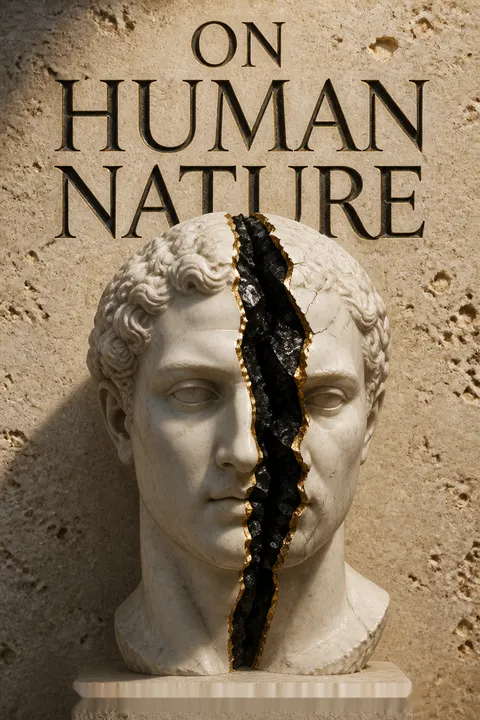
Points clés
1. La nature humaine est fondamentalement égoïste et sujette à la cruauté
L’homme est le seul animal qui inflige de la douleur à autrui sans autre but que celui de la causer.
Malfaisance inhérente. Schopenhauer soutient que l’être humain possède une capacité fondamentale à la cruauté qui le distingue des autres animaux. Contrairement à ces derniers, qui ne nuisent que pour survivre, l’homme peut infliger la souffrance simplement pour son propre plaisir psychologique.
Motivations psychologiques. La cruauté humaine découle de pulsions complexes, telles que :
- La joie maligne éprouvée face à la souffrance d’autrui (Schadenfreude)
- L’envie et la haine
- Le désir d’affirmer sa domination
- Une compensation psychologique face à ses propres insuffisances
Manifestation systémique. Cette malveillance n’est pas seulement individuelle, elle se manifeste aussi dans les structures sociales, des relations personnelles aux systèmes politiques à grande échelle qui perpétuent la souffrance.
2. Le gouvernement et l’ordre social naissent de la nécessité, non d’une bonté intrinsèque
L’État n’est qu’une institution existant pour protéger ses membres contre les attaques extérieures ou les dissensions internes.
Origine de la gouvernance. Les structures sociales ne naissent pas de l’altruisme, mais de la nécessité urgente de gérer les intérêts conflictuels inhérents à l’être humain. Les gouvernements agissent comme des mécanismes destinés à contrôler les tendances destructrices de l’humanité.
Dynamiques du pouvoir :
- La force précède le droit
- Les systèmes politiques visent fondamentalement à maîtriser la nature humaine
- Les monarchies sont plus naturelles que les systèmes démocratiques
- L’ordre social requiert une autorité concentrée
Perspective pragmatique. Schopenhauer considère les systèmes gouvernementaux comme des solutions pratiques pour gérer la complexité humaine, non comme des idéaux reflétant le potentiel humain.
3. Le caractère est inné et immuable
La conduite d’un homme, prise dans son ensemble, n’est pas gouvernée par sa raison ni par aucune résolution qu’il pourrait prendre.
Essence prédéterminée. Le caractère fondamental d’un individu est établi avant tout choix conscient, profondément enraciné dans une volonté métaphysique plutôt que dans une décision rationnelle.
Manifestations du caractère :
- La disposition morale est génétique
- La capacité intellectuelle a une influence limitée sur le caractère profond
- Les actions personnelles reflètent constamment la nature sous-jacente
- Les expériences extérieures révèlent, mais ne transforment pas, le caractère fondamental
Déterminisme psychologique. Nos actions expriment une essence interne immuable, la raison jouant davantage le rôle d’observateur que de maître de notre nature profonde.
4. Le libre arbitre est une illusion ; nos actions sont prédéterminées
Le cours entier de la vie d’un homme, dans tous ses incidents grands et petits, est aussi nécessairement prédéterminé que le cours d’une horloge.
Contrainte métaphysique. Les actions humaines ne sont pas spontanées, mais suivent une trajectoire prédéterminée, façonnée par le caractère inhérent et les circonstances extérieures.
Cadre déterministe :
- Le caractère individuel est fixe
- Les motifs engendrent des comportements prévisibles
- Le choix personnel est une illusion
- Les actions émergent d’une disposition innée
Implications philosophiques. Cette vision remet en question les notions traditionnelles de responsabilité personnelle, suggérant que notre sentiment d’agentivité est fondamentalement erroné.
5. L’instinct moral transcende la raison rationnelle
L’action morale procède d’une règle sans aucun objet.
Moralité intuitive. Le comportement éthique naît d’une conscience plus profonde, qui dépasse la compréhension intellectuelle, fonctionnant par instinct plutôt que par raisonnement calculé.
Caractéristiques de la conscience morale :
- Elle opère indépendamment de la pensée rationnelle
- Elle émerge d’une « meilleure conscience »
- Elle se manifeste comme un impératif catégorique
- Elle transcende la capacité intellectuelle individuelle
Dimension spirituelle. L’instinct moral représente une forme supérieure de compréhension, qui ne peut être pleinement expliquée par les cadres philosophiques traditionnels.
6. La sympathie et la compassion sont les plus hautes vertus morales
Lorsque vous entrez en contact avec un homme, ne tentez pas de l’apprécier objectivement selon sa valeur et sa dignité.
Perspective compatissante. La véritable excellence morale naît de la reconnaissance de la vulnérabilité humaine partagée, plutôt que du jugement des réussites ou des échecs individuels.
Principes de la compassion :
- Reconnaître la souffrance universelle
- Privilégier l’empathie à l’évaluation critique
- Comprendre les limites humaines
- Transcender les différences individuelles
Transformation éthique. La compassion incarne une approche philosophique profonde qui dissout les barrières artificielles entre les individus.
7. La capacité intellectuelle ne garantit pas l’excellence morale
Les esprits fins sont rarement de belles âmes.
Déconnexion entre intelligence et moralité. La puissance intellectuelle ne se traduit pas automatiquement par un comportement éthique ou une intelligence émotionnelle.
Complexité intellectuelle-morale :
- La capacité cognitive est distincte de la disposition morale
- Le génie n’assure pas la bonté
- Le caractère moral transcende la pensée rationnelle
- La capacité émotionnelle importe plus que la réussite intellectuelle
Compréhension holistique. La véritable excellence humaine requiert l’intégration des capacités intellectuelles et émotionnelles.
8. Le monde est une manifestation de la souffrance collective
Le monde est lui-même le Jugement dernier sur lui.
Douleur universelle. L’existence est fondamentalement caractérisée par la souffrance, les expériences individuelles reflétant des conditions métaphysiques plus larges.
Dynamique de la souffrance :
- La douleur est un aspect inhérent à la vie
- Les expériences individuelles reflètent les luttes collectives
- L’existence implique une confrontation continue avec les limites
- La conscience émerge par la reconnaissance de la souffrance universelle
Perspective philosophique. Comprendre la souffrance devient une voie vers une compréhension existentielle plus profonde.
9. L’identité individuelle existe au-delà de la manifestation physique
Vous existez dans tout ce qui est en dehors de vous autant que dans votre propre personne.
Interconnexion métaphysique. L’identité personnelle transcende les frontières physiques, reliant les individus par une essence plus profonde, non matérielle.
Principes d’identité :
- La conscience s’étend au-delà de l’expérience individuelle
- Les frontières personnelles sont illusoires
- La volonté fondamentale relie tous les êtres
- L’existence individuelle fait partie d’un cadre métaphysique plus vaste
Implications spirituelles. L’identité humaine représente un phénomène complexe et interconnecté, au-delà de la simple existence physique.
10. L’existence humaine est un voyage de découverte de soi
La vie est la manifestation du caractère, de ce que nous comprenons par ce mot.
But existentiel. La vie sert de mécanisme pour comprendre sa nature fondamentale, révélant la disposition interne à travers les expériences extérieures.
Processus de découverte de soi :
- Les expériences agissent comme des miroirs reflétant le caractère intrinsèque
- Les actions démontrent la disposition sous-jacente
- La croissance personnelle implique la reconnaissance des tendances inhérentes
- La conscience émerge par une réflexion continue sur soi
Navigation philosophique. L’existence devient une exploration profonde de l’essence individuelle.
Résumé des avis
De la nature humaine reçoit des avis partagés, avec une note moyenne de 3,98/5. Les lecteurs saluent les réflexions de Schopenhauer sur le comportement humain et la moralité, même si certains trouvent ses positions pessimistes. L'ouvrage aborde des sujets tels que la nature humaine, le gouvernement, le libre arbitre et le caractère. Beaucoup apprécient le style d'écriture de Schopenhauer et ses idées stimulantes, tandis que d'autres peinent face à la densité du contenu philosophique. Quelques lecteurs signalent des problèmes liés aux traductions. Dans l'ensemble, les lecteurs trouvent ce livre intellectuellement enrichissant, même s'ils n'adhèrent pas à l'ensemble des arguments de Schopenhauer.
FAQ
What's "On Human Nature" by Arthur Schopenhauer about?
- Essays on Human Nature: The book is a collection of essays by Arthur Schopenhauer, translated by T. Bailey Saunders, focusing on various aspects of human nature.
- Philosophical Exploration: It delves into philosophical themes such as morality, free will, character, and the nature of government.
- Schopenhauer's Perspective: The essays reflect Schopenhauer's views on the inherent nature of humans, often highlighting the darker aspects of human behavior and society.
- Ethical and Metaphysical Themes: The book combines ethical reflections with metaphysical inquiries, offering a comprehensive look at human existence.
Why should I read "On Human Nature" by Arthur Schopenhauer?
- Insightful Analysis: Schopenhauer provides a deep and often critical analysis of human nature, offering insights that are still relevant today.
- Philosophical Depth: The book is a valuable resource for those interested in philosophy, particularly in understanding the complexities of human behavior and morality.
- Timeless Themes: It addresses timeless themes such as the struggle between good and evil, the nature of free will, and the role of government.
- Influential Work: Schopenhauer's ideas have influenced many later thinkers, making this book an important read for understanding the development of philosophical thought.
What are the key takeaways of "On Human Nature" by Arthur Schopenhauer?
- Human Nature's Duality: Schopenhauer explores the dual nature of humans, capable of both great good and profound evil.
- Moral Instinct vs. Reason: He discusses the conflict between moral instincts and rational thought, suggesting that true morality lies beyond reason.
- Determinism and Free Will: The book examines the concept of free will, arguing that human actions are determined by character and circumstances.
- Role of Government: Schopenhauer critiques the role of government, suggesting it is necessary due to the inherent lack of right in human nature.
How does Schopenhauer define "Character" in "On Human Nature"?
- Innate and Unchangeable: Schopenhauer views character as innate and unchangeable, determined by one's will and not by reason or experience.
- Manifestation of Will: Character is the manifestation of an individual's will, which is consistent and reveals itself through actions.
- Moral and Intellectual Aspects: He distinguishes between moral character, which is related to one's will, and intellectual character, which is related to one's understanding.
- Reflection of Self: Life is seen as a reflection of one's character, providing an opportunity for self-understanding and growth.
What is Schopenhauer's view on "Free Will and Fatalism" in "On Human Nature"?
- Deterministic View: Schopenhauer argues that human actions are determined by character and circumstances, leaving no room for free will in the traditional sense.
- Metaphysical Freedom: He suggests that true freedom lies outside the physical world, in the metaphysical realm where one's character is a free act.
- Life as Predetermined: Life is seen as a predetermined course, much like the movement of a clock, with actions unfolding according to necessity.
- Moral Implications: This deterministic view leads to the idea that life itself is a form of judgment, where one's actions reflect their true character.
How does Schopenhauer address "Moral Instinct" in "On Human Nature"?
- Instinct vs. Reason: Schopenhauer contrasts moral instinct with reason, suggesting that true moral actions arise from instinct rather than rational deliberation.
- A Priori Nature: Moral instinct is described as a rule of action given a priori, guiding behavior without the need for conscious understanding.
- Conflict with Reason: He highlights the conflict between moral instincts and rational thought, where the latter often leads to selfishness and deceit.
- Role in Ethics: Moral instinct is seen as a fundamental aspect of ethical behavior, providing a direct connection to the better consciousness beyond reason.
What does Schopenhauer say about "Government" in "On Human Nature"?
- Necessity of Government: Schopenhauer argues that government is necessary due to the inherent lack of right in human nature, serving to protect individuals from each other.
- Critique of State: He critiques the state as a parody of the moral law, suggesting it is a crutch rather than a true solution to human problems.
- Balance of Power: The book discusses the balance between despotism and anarchy, advocating for a government that leans towards despotism to maintain order.
- Role of Law: Schopenhauer emphasizes the role of law in restraining human behavior, as moral freedom is not achievable within the physical world.
What are the best quotes from "On Human Nature" and what do they mean?
- "Man is at bottom a savage, horrible beast." This quote reflects Schopenhauer's view of the inherent cruelty and egoism in human nature.
- "Life is the manifestation of character." It suggests that life serves as a mirror for one's character, providing opportunities for self-understanding.
- "The world is itself the Last Judgment." This implies that life is a form of judgment where one's actions reveal their true nature and moral standing.
- "The will itself is independent of all knowledge." This highlights the idea that the will is a fundamental aspect of human nature, unaffected by rational thought.
How does Schopenhauer explore "Ethical Reflections" in "On Human Nature"?
- Moral Law vs. State: Schopenhauer contrasts the moral law with the state, suggesting that true morality lies beyond the reach of government and law.
- Role of Honour: He discusses the principle of honour as an abuse of human freedom, often leading to actions that are not truly virtuous.
- Innocence and Experience: The book explores the concept of innocence as a state of ignorance, with true understanding arising from experience and self-reflection.
- Critique of Modern Morality: Schopenhauer critiques modern morality as superficial, emphasizing the need for genuine moral understanding beyond societal norms.
What is Schopenhauer's perspective on "Human Nature" in "On Human Nature"?
- Inherent Egoism: Schopenhauer views human nature as inherently egoistic, driven by a will to live that often leads to conflict and suffering.
- Dual Nature: He acknowledges the dual nature of humans, capable of both good and evil, with character playing a central role in determining behavior.
- Role of Suffering: Suffering is seen as an integral part of human existence, providing opportunities for self-understanding and moral growth.
- Philosophical Inquiry: The book encourages philosophical inquiry into the nature of humanity, challenging readers to reflect on their own character and actions.
How does Schopenhauer address "Character" in "On Human Nature"?
- Fixed and Innate: Schopenhauer argues that character is fixed and innate, determined by one's will and not subject to change through experience or reason.
- Manifestation of Will: Character is the manifestation of an individual's will, revealing itself through actions and decisions.
- Moral and Intellectual Aspects: He distinguishes between moral character, related to one's will, and intellectual character, related to one's understanding.
- Self-Understanding: Life is seen as a reflection of one's character, providing opportunities for self-understanding and growth.
How does Schopenhauer's "On Human Nature" relate to modern philosophical thought?
- Influence on Existentialism: Schopenhauer's exploration of free will, determinism, and the nature of suffering has influenced existentialist thinkers like Nietzsche and Sartre.
- Critique of Rationalism: His critique of rationalism and emphasis on the will as a fundamental aspect of human nature challenges modern philosophical assumptions.
- Relevance to Ethics: The book's exploration of moral instinct and character continues to be relevant in contemporary ethical discussions.
- Philosophical Legacy: Schopenhauer's ideas have left a lasting impact on modern philosophy, encouraging ongoing inquiry into the complexities of human nature.
À propos de l'auteur
Autres livres de Arthur Schopenhauer





Télécharger le PDF
Télécharger l'EPUB
.epub digital book format is ideal for reading ebooks on phones, tablets, and e-readers.








































