
Punti chiave
1. Artistic style is driven by volition, not technical ability
The stylistic peculiarities of past epochs are, therefore, not to be explained by lack of ability, but by a differently directed volition.
Volition over skill. The traditional, materialistic view of art history often measures progress solely by technical mastery or the ability to mimic reality. Wilhelm Worringer challenges this assumption by championing the concept of "absolute artistic volition" (Kunstwollen). He argues that every culture creates exactly what it intends to create based on its unique psychological needs, rather than what its technical limitations dictate.
Redefining historical progress. Under this framework, the stylistic differences of ancient, primitive, or non-Western cultures are not failures to capture realism, but deliberate aesthetic choices. The evolution of art is a history of changing spiritual desires rather than a linear climb toward photographic accuracy. When we look at past styles, we must evaluate them based on their own internal goals rather than our modern standards of realism.
Key elements of artistic volition:
- It exists independently of the material, tool, or utilitarian purpose.
- It represents the primary, active psychological force in all creative endeavors.
- It is modified, but never created, by technical limitations or raw materials.
2. Aesthetic experience oscillates between the dual poles of empathy and abstraction
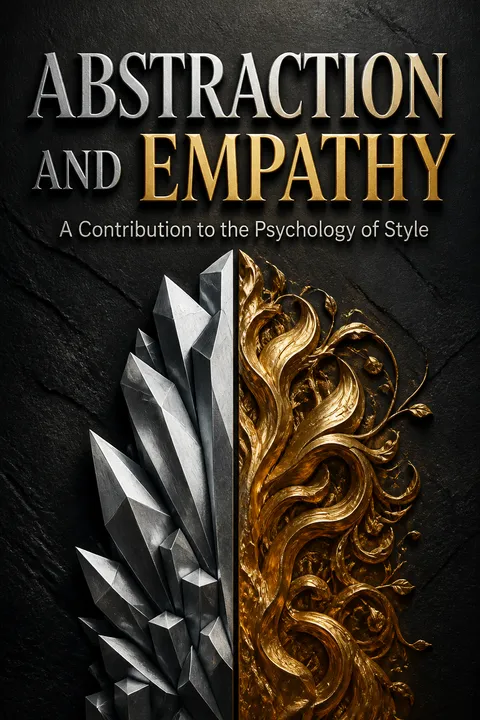
We find the need for empathy and the need for abstraction to be the two poles of human artistic experience.
The dualistic spectrum. Human artistic creation exists on a spectrum between two opposing forces: empathy and abstraction. These two impulses are mutually exclusive in their purest forms, yet the history of art is a continuous dialogue and negotiation between them. Every style represents a specific point of balance on this psychological spectrum.
Aesthetic satisfaction. While modern Western aesthetics has historically focused almost exclusively on empathy, this leaves us blind to vast eras of human creativity. True aesthetic science must recognize that both poles offer distinct paths to psychological satisfaction and beauty. One is not superior to the other; they simply answer different human needs.
Contrasting the two poles:
- Empathy finds its gratification in the organic, living, and natural.
- Abstraction seeks beauty in the life-denying, inorganic, and crystalline.
- Empathy projects the self outward, while abstraction seeks to escape the self.
3. Empathy thrives on organic harmony and a confident relationship with nature
Aesthetic enjoyment is objectified self-enjoyment.
The empathetic connection. The urge to empathy (Einfühlung) occurs when humans feel a harmonious, pantheistic connection with the natural world. In this state of confidence, we project our own vital energy, rhythm, and organic sensations into the objects we contemplate. We experience our own vitality mirrored back to us, which brings a deep sense of peace and satisfaction.
Organic beauty. This psychological state finds its ultimate expression in Classical Greek and Renaissance art, where the human form and organic rhythms dominate. The viewer feels a sense of physical liberation and ease because the artwork's lines match the natural movements of the human body. It is an art of beautiful, tranquil being that celebrates the physical world.
Characteristics of empathetic art:
- It celebrates the beauty of organic vitality and natural proportions.
- It fosters a sense of being "at home" in the physical universe.
- It relies on a happy, pantheistic relationship with the cosmos.
4. Abstraction is born from spiritual dread and a need for cosmic tranquility
the urge to abstraction is the outcome of a great inner unrest inspired in man by the phenomena of the outside world; in a religious respect it corresponds to a strongly transcendental tinge in all notions.
Cosmic anxiety. When a culture experiences the external world as chaotic, unpredictable, and threatening, it develops a profound "spiritual dread of space." Unable to find peace in the shifting flux of nature, the human spirit seeks to rescue individual objects from their terrifying relativity. This anxiety drives the creation of rigid, timeless abstractions.
The search for the absolute. Abstraction is not a primitive lack of skill, but a desperate search for tranquility and necessity. By translating the organic into geometric, crystalline, and inorganic forms, the artist purifies the object of its temporary, mortal qualities. This process gives the object an absolute, eternal value that stands outside of time.
Triggers of the abstract impulse:
- A feeling of being lost and helpless in a vast, incomprehensible universe.
- An instinctive distrust of the deceptive "veil of Maya" or sensory appearances.
- A deep-seated psychological need for stability, order, and absolute law.
5. Space and three-dimensionality are the primary enemies of the abstract impulse
Space is...the major enemy of all striving after abstraction, and hence the first thing to be suppressed in the representation.
The threat of depth. Space is the medium that connects all things, rendering them relative, temporary, and dependent on their surroundings. Because three-dimensionality and depth require the viewer to integrate multiple shifting perspectives over time, they destroy the illusion of an object's closed, permanent individuality. Space draws things into the chaotic flux of time.
The retreat to the plane. To achieve true abstraction, artists must suppress the third dimension and flatten the representation onto a two-dimensional plane. This tactile approach, famously perfected by the ancient Egyptians, preserves the clear, uninterrupted outline of the object. It rescues the object from spatial chaos and makes it easily graspable by the mind.
Techniques for suppressing space:
- Translating depth relations into flat, surface-level arrangements.
- Utilizing strict, unbroken outlines and regular geometric curves.
- Avoiding shadows, foreshortening, and perspective cues that imply depth.
6. Geometric ornament is the primitive and pure starting point of artistic expression
The style most perfect in its regularity, the style of the highest abstraction, most strict in its exclusion of life, is peculiar to the peoples at their most primitive cultural level.
The purity of geometry. Geometric ornament represents the earliest and most unadulterated expression of the human art impulse. Long before primitive cultures attempted to copy natural forms, they created highly regular, symmetrical, and rhythmic linear patterns. These patterns served as an instinctive defense against the confusion of existence.
Inverting the evolutionary model. Worringer turns the traditional art-historical narrative on its head by showing that abstraction precedes naturalism. Primitive man did not start with clumsy attempts at realism and gradually refine them; rather, he started with pure geometric abstraction because his spiritual anxiety was at its peak. The geometric line is the ultimate refuge from the caprice of organic life.
Evolution of ornamental forms:
- Pure geometric lines offer the highest possibility of psychological repose.
- Plant and animal motifs are initially constructed from abstract, regular lines.
- Naturalization occurs later, as cultures grow more comfortable with organic life.
7. Naturalism in art is distinct from the mechanical impulse to imitate
The primitive imitation impulse has prevailed at all periods, and its history is a history of manual dexterity, devoid of aesthetic significance.
Imitation vs. naturalism. A crucial distinction must be made between the mere playful impulse to copy nature and true artistic naturalism. While imitation is a mechanical skill that satisfies a basic curiosity or desire for likeness, naturalism is a profound aesthetic style. It seeks to capture the inner, organic joy of living form rather than just its outward appearance.
Aesthetic value. True naturalism does not aim for photographic accuracy or deceptive illusion; instead, it uses the natural model as a vehicle to project human vitality and rhythm. It is an act of artistic creation that speaks directly to our shared, elementary aesthetic feelings of organic harmony. It is a spiritual process, not a manual trick.
Key differences:
- Imitation is a matter of manual dexterity and has no metaphysical depth.
- Naturalism is born from a deep psychological need to experience organic beauty.
- Popular art often mimics reality, while high art seeks formal, stylistic expression.
8. Architecture and sculpture reflect the struggle to master spatial anxiety
Forcible accommodation to the framework of cubic forms is the first maxim of this monumental endeavour, once the artist has become conscious that it is a matter not of imitating reality...
Tectonic constraint. Because sculpture and architecture are inherently three-dimensional, they present a unique challenge to the abstract artistic volition. To prevent these structures from being swallowed up by the chaotic relativity of real space, artists must impose strict geometric, cubic, and tectonic constraints upon them. This process tames the wildness of three-dimensional space.
The pyramid as an absolute. The Egyptian pyramid stands as the ultimate triumph of abstraction in three dimensions. By presenting the viewer with flat, triangular planes that conceal the depth behind them, the pyramid successfully divests the cubic form of its "agonizing quality." It transforms a massive physical structure into a monument of eternal stability.
Architectural expressions of the two poles:
- Doric temples use heavy, lifeless, and abstract geometric laws.
- Ionic temples introduce organic proportions, swelling columns, and living rhythm.
- Sculptural figures are kept compact, with limbs pressed close to preserve the stone's unity.
9. Gothic art represents a unique fusion of mechanical structure and expressive empathy
Thus, on an inorganic fundament, there is heightened movement, heightened expression.
The Gothic hybrid. Gothic architecture and sculpture represent a fascinating, highly differentiated compromise between abstraction and empathy. Unlike the calm, organic harmony of Classical Greek art, Gothic art infuses rigid, inorganic, and mechanical structures with an intense, restless, and almost frantic vitality. It is a style of restless movement.
Ecstatic mechanics. In a Gothic cathedral, the laws of matter and construction are not hidden or softened; instead, they are exaggerated and driven to their absolute limits. The viewer's empathy is violently swept up into this vertical, soaring movement of forces. This creates a sense of ecstatic, breathless vertigo that lifts the soul above the physical world.
Characteristics of the Gothic style:
- It utilizes abstract, linear, and geometric frameworks (rib-vaults, pointed arches).
- It charges these inorganic lines with an uncanny, restless, and expressive pathos.
- It reflects the inner disharmony and spiritual searching of Northern European cultures.
10. Artistic styles mirror a culture's religious stance on transcendence and immanence
To transcendentalism of religion there always corresponds a transcendentalism of art, for which we lack the organ of understanding...
Art and religion. The stylistic evolution of art is intimately linked to the history of religion and human worldviews. Both are co-equal expressions of a culture's "temperature of the soul" (Weltgefühl) and its psychological relationship with the cosmos. They are different paths to the same spiritual destination.
Immanence vs. transcendence. Cultures that believe the divine is immanent in the physical world (such as Greek pantheism) naturally produce naturalistic, empathetic art that celebrates organic life. Conversely, cultures dominated by a dualistic, transcendental worldview (such as ancient Eastern religions or early Christianity) seek salvation in abstract, life-denying, and eternal forms.
The spiritual feedback loop:
- Pantheism and naturalism reflect a confident, world-revering state of mind.
- Transcendentalism and abstraction reflect a deep-seated need for redemption.
- The shift from abstract to naturalistic art mirrors a shift from instinct to rationalism.
Scarica PDF
Scarica EPUB
.epub digital book format is ideal for reading ebooks on phones, tablets, and e-readers.








































