核心要点
1. The dual nature of Japanese culture is defined by coexisting contradictions.
The Japanese are, to the highest degree, both aggressive and unaggressive, both militaristic and aesthetic, both insolent and polite, rigid and adaptable, submissive and resentful of being pushed around, loyal and treacherous, brave and timid, conservative and hospitable to new ways.
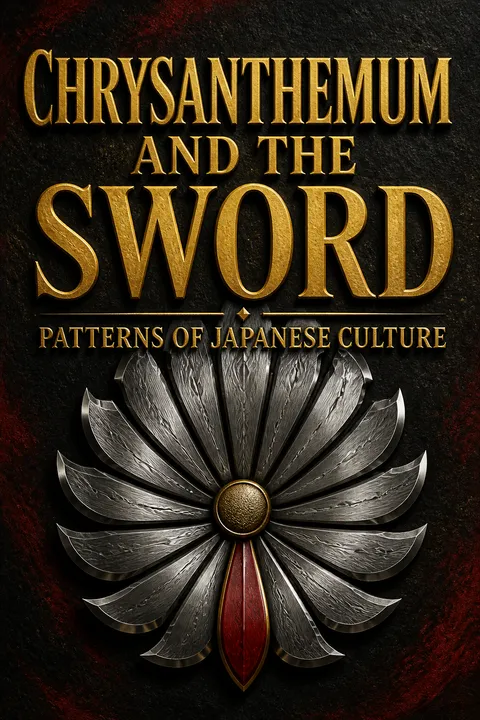
Embracing cultural contradictions. Western observers often struggle to comprehend Japan because they apply binary categories of thought to a culture that seamlessly integrates seemingly opposite behaviors. The same society that lavishes exquisite care on the cultivation of chrysanthemums also maintains a fierce, historical cult of the sword.
A systematic design. These behavioral swings are not random hypocrisies but highly patterned responses to specific situational cues. To understand this system, we must look at how these disparate traits are integrated into a cohesive worldview:
- Politeness coexists with insolence depending on social distance.
- Rigid traditionalism operates alongside an astonishing adaptability to foreign innovations.
- Extreme aestheticism balances a ruthless, militaristic discipline.
The anthropologist's lens. By examining the commonplace habits of daily life, we can map out the underlying consistency of these contradictions. What appears to be a chaotic paradox to an outsider is actually a highly organized, functional blueprint for living that provides security to its members.
2. A deep-seated faith in hierarchy shapes both domestic and international relations.
Japan's confidence in hierarchy is basic in her whole notion of man's relation to his fellow man and of man's relation to the State and it is only by describing some of their national institutions like the family, the State, religious and economic life that it is possible for us to understand their view of life.
The rule of inequality. While Americans view equality as the moral foundation of a just society, the Japanese find safety and order in knowing their "proper station." Every social interaction, from family greetings to diplomatic negotiations, is meticulously mapped to reflect the precise social distance between participants.
The respect language. This hierarchical structure is reinforced by a complex linguistic and behavioral etiquette that dictates how individuals must carry themselves. A person's station is determined by a combination of factors:
- Gender and age within the household.
- Generational standing and primogeniture.
- Class, professional status, and past interactions.
A reciprocal framework. Unlike Western authoritarianism, Japanese hierarchy is not a system of unchecked tyranny but one of mutual obligation. Superiors are bound by strict codes of responsibility toward their dependents, ensuring that those at the bottom of the pyramid accept their station because it guarantees security and order.
3. The Emperor serves as an inviolable, sacred symbol of national unity.
The Japanese prisoner of war was quite explicit that the reverence given the Imperial Household was separable from militarism and aggressive war policies.
A sacred figurehead. Throughout centuries of feudal rule, the Emperor remained a secluded, politically powerless figure while military Shoguns administered the state. Yet, this lack of secular authority only enhanced his sacred status, placing him entirely above the messy compromises of daily politics.
Unconditional spiritual loyalty. Modern Japanese statesmen capitalized on this historical isolation by centering the supreme virtue of chu—unconditional loyalty—directly upon the Emperor. This clever political arrangement achieved several key objectives:
- It unified a highly factionalized nation under a single spiritual father.
- It shielded the throne from criticism, as ministers took the blame for policy failures.
- It allowed the military to command absolute obedience in the Emperor's name.
The power of capitulation. The ultimate proof of this symbolic power occurred at the end of World War II, when a single radio broadcast from the Emperor caused millions of undefeated soldiers to lay down their arms. By framing surrender as the Emperor's active will, the nation accepted defeat without losing its core identity.
4. The concept of on represents an inescapable, lifelong burden of indebtedness.
On is in all its uses a load, an indebtedness, a burden, which one carries as best one may.
The weight of obligation. In Japan, a virtuous life does not begin with individual rights, but with a profound recognition of one's debts to the past and the present. This passive indebtedness, known as on, is a heavy psychological load that an individual incurs from superiors, parents, teachers, and the Emperor.
A dangerous gift. Because receiving on creates an uncomfortable sense of inferiority, the Japanese are extremely wary of accepting casual favors from strangers. This sensitivity explains several unique social behaviors:
- The reluctance of crowds to intervene in street accidents to avoid imposing a debt.
- The use of phrases like kino doku ("this poisonous feeling") to express gratitude.
- The deep resentment felt when someone forces an unwanted favor upon another.
The currency of relations. Unlike the Western ideal of unconditional love, Japanese relationships are structured like financial ledgers where every kindness must eventually be balanced. To ignore or forget one's on is to risk social bankruptcy and the devastating label of being a person who lacks basic human decency.
5. Gimu demands unconditional, limitless repayment of primary life debts.
One's gimu groups together two different types of obligations: repayment of one's on to parents, which is ko, and repayment of one's on to the Emperor, which is chu.
Limitless moral duties. While some debts can be paid back in equal measure, gimu represents a category of lifelong obligations that can never be fully discharged. No matter how much an individual sacrifices, they can never return even a fraction of what they owe to their parents (ko) or their country (chu).
The absolute imperative. Unlike Chinese Confucianism, which makes loyalty conditional on the ruler's benevolence, Japanese gimu is absolute and unconditional. This unyielding standard manifests in powerful ways:
- Children must obey their parents' marital and career decisions, even at the cost of personal happiness.
- Citizens must obey the law as a direct repayment of the Emperor's benevolence.
- Soldiers must gladly offer up their lives in battle to satisfy their infinite debt to the state.
A tragic nobility. This ethical framework elevates personal frustration to a form of tragic nobility, where the strong individual is defined by their ability to suppress personal desire. The suffering endured in fulfilling gimu is not viewed as a grievance, but as the ultimate proof of character.
6. Giri to the world enforces strict, mathematically equivalent social contracts.
Repaying giri is full of malaise.
Contractual social debts. In contrast to the limitless nature of gimu, giri to the world represents a class of obligations that must be repaid with precise, mathematical equivalence. These are not the warm duties owed to one's immediate bloodline, but the cold, contractual obligations owed to in-laws, distant relatives, and associates.
The ledger of life. Every gift, favor, or helpful act received from the outside world enters a mental ledger that must be balanced within a specific timeframe. This rigid system of reciprocity governs a vast array of social interactions:
- The biannual exchange of carefully calibrated seasonal gifts.
- The meticulous recording of funeral contributions to ensure exact future repayment.
- The heavy, often dreaded obligations an adopted husband owes to his father-in-law's family.
The pressure of opinion. Because giri is driven by a fear of public shame rather than an internalized sense of sin, it is often accompanied by intense anxiety and resentment. A person does not perform giri out of spontaneous love, but because failing to do so would invite public ostracism and ruin their reputation.
7. Giri to one's name requires vigilant defense of personal and professional honor.
Giri to one's name also demands acts which remove a slur or an insult; the slur darkens one's good name and should be got rid of.
The code of honor. While giri to the world is about returning kindness, giri to one's name is about defending one's reputation against any hint of failure, rejection, or insult. In the Japanese moral universe, an unavenged slight or an uncorrected error leaves the world dangerously out of balance.
Vulnerability and defense. This extreme sensitivity to criticism makes competition highly stressful, as failure is experienced as a devastating public humiliation. To minimize this vulnerability, Japanese society has developed elaborate defensive mechanisms:
- The ubiquitous use of go-betweens to negotiate marriages and business deals, preventing direct rejection.
- An etiquette that strictly avoids pointing out professional errors to a person's face.
- A tendency to turn aggression inward, resulting in deep depressions or protest suicides.
The cleansing bath. When a slur cannot be avoided, giri to one's name demands a "morning bath" of vindication to wash away the defilement. Historically, this meant a violent vendetta against the detractor; in modern times, it is more commonly expressed through self-destructive acts or an obsessive drive to prove the critic wrong.
8. Japanese morality embraces physical pleasures while subordinating them to duty.
The Japanese do not condemn self-gratification.
A non-Puritan worldview. Unlike Western cultures influenced by Christian concepts of original sin, Japan does not view the flesh and the spirit as opposing forces. Physical pleasures—such as hot baths, sleeping, eating, drinking, and sex—are regarded as naturally good and worthy of refined cultivation.
Pleasure in its place. However, these indulgences are strictly categorized as minor relaxations that must never interfere with the serious duties of life. The Japanese map their lives into distinct, non-overlapping circles of behavior:
- A husband may visit geishas or prostitutes for erotic pleasure, but this must remain entirely separate from his family obligations.
- Drinking alcohol is a highly approved relaxation, but it must be put aside the moment a serious task begins.
- Romantic love is celebrated in literature, but it is never expected to be the basis of a stable, arranged marriage.
No cosmic battle. Because they do not view the world as a battlefield between good and evil, the Japanese do not suffer from a constant sense of moral guilt regarding physical desires. They simply accept that while pleasure is sweet, duty is paramount, and the strong man is he who can walk away from temptation the moment his obligations call.
9. Self-discipline is viewed as a tool for self-mastery rather than self-sacrifice.
Only through mental training (or self-discipline; shuyo) can a man or woman gain the power to live fully and to 'get the taste' of life.
Polishing the soul. In Japan, self-discipline (shuyo) is not practiced to appease a censorious God or to punish a sinful body, but to remove the "rust" of self-doubt and hesitation. It is viewed as a highly practical training that sharpens a person's efficiency and allows them to savor life to the fullest.
The state of muga. The ultimate goal of this training is to achieve muga, a state of effortless "one-pointedness" where the self-conscious observer-self is completely eliminated. When a person achieves this level of expertness, their actions become perfectly aligned with their will:
- A fencer strikes without thinking, as if his sword moves on its own.
- A student takes an exam with absolute, unshakeable calm.
- An individual lives "as already dead," freed from the paralyzing fear of public opinion and failure.
An inner strength. By eliminating the internal censor of shame, the disciplined individual gains a profound sense of psychic freedom and power. This unique philosophy of self-mastery allows the Japanese to endure incredible physical and mental hardships, not as miserable victims of self-sacrifice, but as proud masters of their own destiny.
10. Child-rearing practices create a dualistic personality through a U-curve of freedom.
The arc of life in Japan is plotted in opposite fashion to that in the United States.
The U-curve of life. While American children face strict disciplines that are gradually relaxed as they reach independent adulthood, the Japanese life cycle is shaped like a great, shallow U-curve. Maximum freedom and indulgence are granted to infants and the elderly, while the prime of life is marked by intense social restrictions and obligations.
The paradise of babyhood. A Japanese baby is treated with extraordinary permissiveness, allowed to nurse at will, sleep with its mother, and express its emotions without fear of punishment. This early period of indulgence builds a deep reservoir of self-confidence and a memory of absolute acceptance:
- Toddlers are petted and allowed to throw tantrums against their mothers.
- Children are taught physical skills through gentle, passive placement of their limbs.
- Young children are considered to "know no shame" and are exempt from moral judgment.
The onset of shame. Around the age of six or seven, this paradise is gradually replaced by the strict demands of "knowing shame." The child is taught that their family's acceptance is conditional on their behavior, and that the outside world will ruthlessly ridicule any deviation from the code. This sharp discontinuity in upbringing creates a highly complex, dualistic adult personality—capable of both childlike spontaneity and fanatical, self-controlled devotion.
读者评价
Reviews of The Chrysanthemum and the Sword are mixed, averaging 3.85/5. Many praise it as a pioneering, insightful study of Japanese culture, noting Benedict's impressive analysis given her limitations—she never visited Japan or spoke Japanese. Critics highlight its outdated perspectives, sweeping generalizations, and reliance on secondhand sources, including Japanese-American interviewees. Several reviewers note it reveals as much about American culture as Japanese. While considered essential reading by some, others find it condescending and historically narrow, primarily reflecting Japan's 1868–1945 period rather than contemporary society.
下载 PDF
下载 EPUB
.epub digital book format is ideal for reading ebooks on phones, tablets, and e-readers.








































