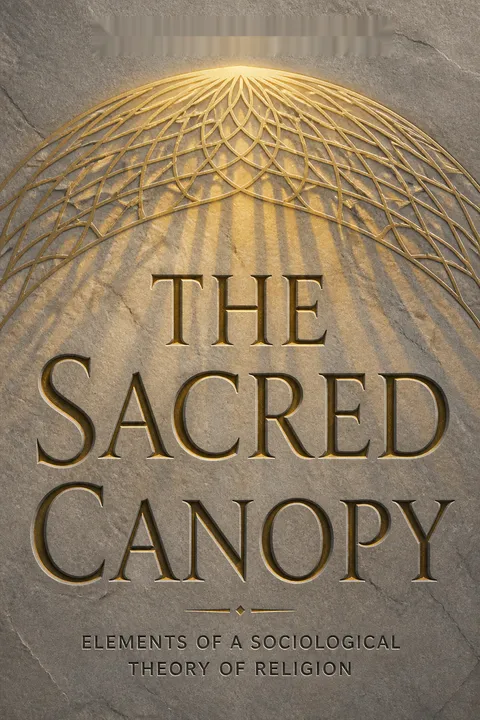

核心要点
1. 社会是人类建构,且不断反作用于其创造者
社会是一种辩证现象,它既是人类的产物,且仅仅是人类的产物,同时又不断反作用于其创造者。
人创造社会。 社会并非自然力量,而是人类活动、意识与意义建构的产物。它的存在离不开人们的行为与信念。理解这一点至关重要,因为它使个体能够认识到自己在塑造周围世界中的角色。
社会塑造人。 个人生于既存的社会结构之中,这一结构影响其身份认同、价值观和行为。社会为个体发展自我意识和生活导航提供了框架。这种影响虽非决定性,却凸显了社会力量对个体成长的深远作用。
辩证关系。 社会与个体的关系非单向。社会塑造个体,个体亦通过行动与互动塑造社会。这种持续的辩证过程创造了动态且不断演变的社会现实。正是这种不断的反馈回路构成了社会变迁与进步的本质。
2. 宗教是将整个宇宙视为人类意义的大胆尝试
宗教意味着人类自我外化的极致,是将现实注入自身意义的过程。
宗教即宇宙化。 宗教是人类试图建立神圣宇宙的事业,为宇宙赋予意义与秩序。它大胆地将人类价值与意义投射到浩瀚存在之中,提供理解我们在世界中位置的框架。
神圣与世俗。 宗教区分神圣与世俗,神圣蕴含神秘与敬畏之力,世俗则是日常生活领域。这种二分制造了非凡感,并为仪式与崇拜提供框架。神圣不仅超越人类,更与人类相关联,呈现出非人类现象所不具备的关系。
宇宙与混沌。 宗教通过建立神圣宇宙来对抗混沌威胁,为无意义提供屏障。此宇宙赋予秩序与目的,保护个体免受无序恐惧,提供驾驭生命不确定性的框架。神圣宇宙被人类视为超越自身的强大现实。
3. 宗教赋予社会制度本体论地位
宗教通过将社会制度置于神圣宇宙的参照框架中,赋予其最终有效的本体论地位,从而使其合法化。
合法化力量。 宗教在合法化社会制度中扮演关键角色,将其根植于宇宙秩序之中。由此赋予制度必然性与永恒感,使其看似神圣计划的体现,而非单纯人类建构。
小宇宙/大宇宙。 宗教合法化常见形式是小宇宙/大宇宙模式,社会制度被视为宇宙神圣结构的映射。这种和谐感强化了社会秩序的合法性。凡“此间”皆有其“彼上”对应。
宇宙地位。 宗教赋予社会制度宇宙地位,使个体在社会角色中获得正当性与意义,增强其对社会秩序的承诺与稳定性。这种宇宙地位被客观化,成为制度与角色客观现实的一部分。
4. 宗教仪式通过“使基本定义显现”强化现实
宗教仪式是“提醒”过程中的关键工具。
仪式即记忆。 宗教仪式强有力地提醒社会基本现实定义与合法性。它们“使神名与神迹显现”,强化人与神圣的联系。
行动与观念。 宗教观念根植于宗教活动,仪式与神话协同“召回”传统意义。行动与观念的辩证关系确保文化价值与信仰的延续。仪式表演紧密关联于神圣公式的重复,使神名与神迹再次显现。
恢复连续性。 仪式恢复当下与社会传统的连续性,将个体经验置于更大历史语境中。它强化归属感,提供理解世界的框架。社会本质上是一种记忆。
5. 神义论将无序体验纳入社会既定法则
以宗教合法化解释这些现象,无论理论多么复杂,均称为神义论。
苦难中的意义。 神义论是对无序现象(如苦难、邪恶、死亡)的宗教合法化,试图以既定法则解释这些体验,赋予其宇宙中的位置。
超越幸福。 神义论不必然承诺幸福,但提供意义。对处境艰难者而言,意义的需求可能与甚至超过幸福的需求。神义论主要提供的不是幸福,而是意义。
社会功能。 神义论通过将无序事件纳入集体法则,保护社会免于混乱瓦解,强化社会秩序稳定。它为贫者赋予贫穷的意义,也为富者赋予财富的意义。
6. 受虐倾向提供超越苦难与死亡的途径
在此态度中,身体或精神的痛苦成为自我否定的证明,甚至带来主观愉悦。
向他者的臣服。 受虐倾向表现为个体在他人面前自我降格为无力对象,无论是单独他人、集体,还是其所建立的法则。它涉及向被视为绝对权力与意义的他者的臣服。
臣服的陶醉。 受虐态度提供超越苦难与死亡的途径。通过自我否定,个体在自我湮灭中找到悖论式的意义,逃避孤独与无意义。任何他者施加的痛苦都是臣服已成事实及其陶醉真实的证明。
宗教受虐。 受虐态度可扩展至集体与法则,最终表现为对宇宙他者的宗教臣服。这带来终极安全感与意义,个体融入无所不在的神性海洋。“我一无所有——他即一切”因臣服对象的经验不可得性而更显深刻。
7. 异化源于个体与世界辩证关系的丧失
异化是个体与其世界的辩证关系丧失于意识的过程。
联系丧失。 异化发生于个体“遗忘”社会世界是其自身活动产物时,导致对世界与自我的疏离,辩证关系丧失。个体“忘记”此世界曾由其共同创造并持续存在。
虚假意识。 异化意识是非辩证且虚假的,它模糊了人类建构世界与自然世界的区别,导致物化,人类创造被视为非人类、无意义的实体。行动者沦为被动对象。
人类学必然性。 异化是社会生活的内在可能性,源于意识的复制与自我的客体化。它既可通过回忆被重新占有,亦可成为永久疏离状态。社会文化世界与自然世界的本质差异被掩盖。
8. 宗教的力量源于其异化人类世界的倾向
同理,正如前述,宗教也是一种重要的虚假意识形式。
异化力量。 宗教作为法则制定的代理,其力量源于异化人类世界的倾向。通过设定超越人类活动的神圣宇宙,宗教神秘化社会秩序,阻碍个体认识其建构角色。
虚假意识。 宗教常表现为虚假意识,将人类建构的世界呈现为神授或自然必然,阻止个体挑战现状,延续社会不平等。人类创造的世界被解释为非人类的产物。
神秘化。 宗教通过将制度解释为超越其历史经验存在的神圣实体,制造敬畏感,同时掩盖制度的人类起源及其变革可能。社会文化世界作为人类意义的建筑,被非人类起源的神秘覆盖。
9. 世俗化使社会文化部分领域脱离宗教统治
世俗化指社会文化部分领域脱离宗教机构与符号统治的过程。
影响撤退。 世俗化表现为宗教影响在社会文化多个领域的衰退,如政教分离、教育摆脱教会权威、艺术科学中宗教内容减少。现代西方历史中,世俗化体现为基督教会撤出其曾控制或影响的领域。
意识世俗化。 世俗化也影响个体意识,导致宗教信仰下降,转向世俗世界观。个体越来越多地以非宗教解释看待世界与自身生活。社会文化的世俗化伴随意识的世俗化。
分布不均。 世俗化在社会中分布不均,男性、年轻人、城市居民及与现代工业生产紧密相关者更为显著。不同群体受影响程度各异。
10. 新教内含世俗化的种子
新教尽可能剥离了神圣的三大古老且强大伴随物——神秘、奇迹与魔法。
世界的去魅。 新教强调个人信仰与直接通神,剥离了许多传统宗教实践元素,如圣礼、圣徒与奇迹。这种“世界去魅”为理性与世俗世界观铺平道路。新教信徒不再生活在持续被神圣力量渗透的世界中。
激进超越。 新教强调神的激进超越,划分神与人类的界限,使世界失去内在神圣性,更易被视为纯自然领域,接受科学探究。宗教意义上,世界变得极为孤寂。
世俗化前奏。 新教通过缩小神与人之间的中介渠道,无意中开启了世俗化洪流。渠道一旦切断,世界便向理性与科学探索敞开。新教成为世俗化的历史性前奏。
11. 多元化使宗教传统去垄断,形成市场局面
多元化首先是一种市场局面。
去垄断。 世俗化导致宗教传统去垄断,宗教机构失去对现实定义的独占控制,形成不同宗教团体竞争信徒的多元局面。宗教团体还需与非宗教竞争者争夺世界定义权。
市场动态。 多元局面中,宗教机构转变为营销机构,宗教传统成为消费品,引入供需动态。宗教机构成为营销代理,宗教传统成为消费商品。
理性化与官僚化。 竞争压力促使宗教机构理性化,采用官僚结构与营销策略,导致宗教产品标准化,注重满足消费者需求。多元局面因此形成一张官僚网络,与社会及彼此理性互动。
12. 世俗化与多元化引发合法性危机
本社会学理论的核心视角是,宗教应被理解为基于特定人类历史基础的人类投射。
信誉丧失。 世俗化与多元化使宗教机构传统合法性失去说服力,导致宗教在意识中的“位置”从客观真理转向主观意见。宗教传统失去作为社会整体象征的地位,社会需另觅整合象征。
神学应对。 宗教机构对危机的反应多样,涵盖适应与抵抗。适应指调整教义与实践以符合世俗价值,抵抗则坚持传统信仰以应对世俗挑战。多元局面为宗教机构提供两种理想类型选择。
神学挑战。 合法性危机对神学家构成重大挑战,需应对在世俗时代维持宗教信仰的问题。由此催生新神学流派,如新正统主义与激进神学,试图应对世俗化与多元化的挑战。
读者评价
《神圣的穹顶》是宗教社会学领域的经典著作,探讨了宗教如何构建并维系社会现实。伯杰的文字以清晰著称,尽管部分读者认为内容较为晦涩。书中涉及疏离、失范与世俗化等概念,运用社会学原理分析宗教现象。部分读者赞赏伯杰的洞见,亦有批评其无神论立场及缺乏实证案例。该书对世俗化及其对基督教影响的历史分析尤为珍贵,尽管伯杰后来对部分观点进行了修正。
其他人还在读








常见问题
What is The Sacred Canopy by Peter L. Berger about?
- Sociological theory of religion: The book develops a comprehensive sociological theory explaining religion as a humanly constructed universe of meaning, focusing on how religion functions to create and maintain a "sacred canopy" over social reality.
- Religion and world construction: Berger explores how religion legitimates social order and provides a meaningful framework for human existence amid the chaos and uncertainty of life.
- Secularization and modernity: A significant portion analyzes the process of secularization and the resulting pluralistic religious landscape in modern societies.
- Empirical approach: Berger brackets questions of religious truth, focusing instead on the empirical, sociological consequences of religion as a social phenomenon.
Why should I read The Sacred Canopy by Peter L. Berger?
- Foundational sociological insight: The book is a classic in the sociology of religion, offering a rigorous, accessible framework for understanding how religion shapes and is shaped by society.
- Relevance to modernity: Berger’s analysis of secularization and pluralism is highly relevant for understanding contemporary religious change and the crisis of traditional worldviews.
- Interdisciplinary value: The book bridges sociology, theology, and philosophy, making it valuable for students and scholars across disciplines.
- Critical perspective: Berger’s approach challenges both religious and secular assumptions, encouraging readers to critically examine the origins and functions of their own beliefs.
What are the key takeaways from The Sacred Canopy by Peter L. Berger?
- Religion as social construction: Religion is a human product that creates a meaningful, sacred order (cosmos) over the chaos of existence.
- Secularization’s impact: Modernity leads to the decline of religious plausibility structures, resulting in pluralism and a crisis of religious authority.
- Dialectical process: Society and religion are created through a dialectic of externalization, objectivation, and internalization, shaping both individuals and institutions.
- Religion’s dual role: While religion legitimates social order and provides ontological security, it can also foster alienation and false consciousness.
How does Peter L. Berger define religion in The Sacred Canopy?
- Sacred cosmos: Berger defines religion as the human enterprise of positing a sacred cosmos, a universe imbued with ultimate meaning and moral order.
- Sacred vs. profane: Religion is marked by the dichotomy between the sacred (set apart, ultimate reality) and the profane (ordinary, mundane reality), which is central to religious experience.
- Human projection: Religion is understood as a human projection, constructed and maintained through collective symbolic systems and social infrastructures.
- Legitimation of order: Religion provides the supreme legitimation for social institutions by grounding them in a reality that transcends human contingency.
What is the relationship between society and the individual in The Sacred Canopy by Peter L. Berger?
- Dialectical phenomenon: Society is both a product of human activity (externalization) and a formative force on individuals (internalization), creating a dynamic interplay.
- Three moments of society: Berger identifies externalization, objectivation, and internalization as the key processes through which society is constructed and maintained.
- Society as human product: While society is created by humans, it appears as an objective, coercive reality that shapes individual identity and behavior.
- Collective world-building: Human beings inherently build their worlds collectively, with society structuring and coordinating activities to make culture and order possible.
What are the concepts of externalization, objectivation, and internalization in The Sacred Canopy by Peter L. Berger?
- Externalization: The ongoing human activity of projecting meaning into the world, both physically and mentally, producing culture and society as human products.
- Objectivation: The process by which these human products gain an existence independent of their creators, confronting them as objective realities with coercive power.
- Internalization: The re-appropriation of these objective realities by individuals through socialization, making them part of subjective consciousness and identity.
- Dialectical process: These three moments form a dialectic that explains how society is both created by and formative of individuals, crucial for understanding religion’s social role.
How does The Sacred Canopy by Peter L. Berger explain the role of religion in legitimating social order?
- Religion as supreme legitimator: Religion historically provides the most effective legitimation for social institutions by grounding them in a sacred, ultimate reality.
- Levels of legitimation: Legitimation ranges from self-evident facticity to complex worldviews, with religion integrating and justifying all levels.
- Cosmization of social roles: Religious legitimation interprets social institutions and roles as reflections or embodiments of cosmic order, enhancing their stability and authority.
- Shield against chaos: By projecting human order into the sacred, religion offers protection against the terror of meaninglessness and social anomy.
What is the concept of "plausibility structure" in The Sacred Canopy by Peter L. Berger?
- Definition: A plausibility structure is the social and cultural framework that supports and maintains the credibility and reality of a particular worldview or religious belief system.
- Social confirmation: The strength of a plausibility structure determines how taken-for-granted and real religious definitions appear to individuals.
- Secularization’s effect: Secularization weakens plausibility structures, leading to a crisis of credibility where religious beliefs become subjective preferences.
- Community and institutions: The maintenance of religious worlds depends on communities and institutions that reinforce shared belief and legitimation.
How does The Sacred Canopy by Peter L. Berger explain secularization and its effects on religion?
- Secularization defined: Secularization is the process by which sectors of society and culture are removed from religious domination, leading to the decline of religious symbols and institutions.
- Loss of plausibility: It results in the collapse of the plausibility of traditional religious worldviews, affecting both individual consciousness and social structures.
- Pluralism and competition: Secularization leads to religious pluralism, where multiple worldviews compete in a free market of ideas.
- Transformation of religion: Religious institutions adapt by becoming more bureaucratic and market-oriented, facing challenges of legitimacy and relevance.
How does Peter L. Berger link Protestantism and the process of secularization in The Sacred Canopy?
- Disenchantment of the world: Protestantism narrows the sacred, removing mediations like sacraments and saints, and polarizes the universe between a transcendent God and a "fallen" world.
- Facilitating rationality: By abolishing sacred intermediaries, Protestantism makes the world appear "empty" and open to scientific rationality and technological control.
- Historical roots: Berger traces this process back to the Old Testament’s transcendentalization of God and the Reformation’s emphasis on individual conscience.
- Precursor to modernity: These religious shifts are seen as decisive preludes to the rise of modern secular, pluralistic societies.
What is the problem of theodicy in The Sacred Canopy by Peter L. Berger, and why is it central to religion?
- Theodicy defined: Theodicy is the religious explanation of suffering, evil, and death within the social order (nomos), legitimating anomic phenomena so society can persist.
- Making suffering meaningful: All theodicies involve a surrender of self to the ordering power of society or the divine, making suffering bearable or meaningful.
- Types of theodicies: Berger describes a continuum from irrational self-transcendence (mysticism) to rational systems (karma-samsara), with intermediate forms like messianism and dualism.
- Biblical theodicy: In monotheism, theodicy is especially acute, with Christianity offering meaning through the suffering of God incarnate in Christ.
How does The Sacred Canopy by Peter L. Berger address alienation and false consciousness in relation to religion?
- Alienation as false consciousness: Alienation occurs when individuals forget that society and its institutions are human products, perceiving them as external, inexorable realities.
- Religion’s role: Religion can mystify human institutions by attributing them sacred, supra-human origins, reinforcing alienation and false consciousness.
- Bad faith and identity: Individuals may identify completely with social roles, denying their own choices and internal conflicts, a process religion can legitimize.
- Potential for de-alienation: Despite its alienating tendencies, religion can also legitimize de-alienation by revealing institutions as human constructs, as seen in mysticism and prophetic critique.
关于作者
下载 PDF
下载 EPUB
.epub digital book format is ideal for reading ebooks on phones, tablets, and e-readers.








































