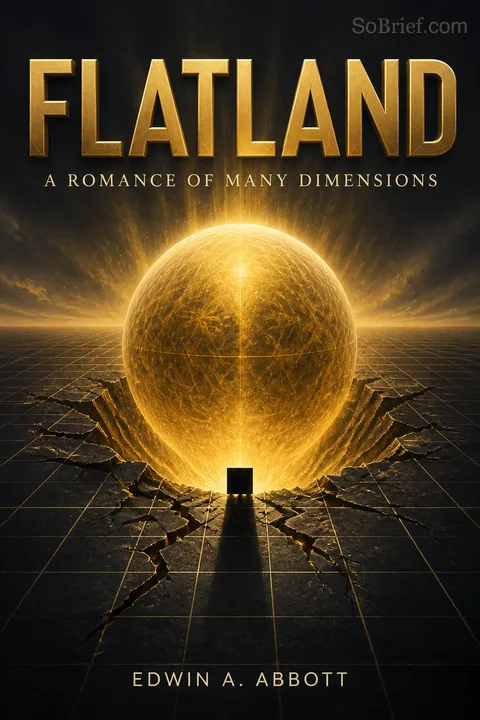
ملخص الحبكة
هندسة فلاتلاند الغريبة
فلاتلاند هو عالم فريد يعيش فيه السكان على شكل أشكال هندسية على سطح مستوٍ. يروي لنا الراوي، وهو مربع، كيف يرى هؤلاء السكان بعضهم البعض كخطوط فقط بسبب محدودية إدراكهم للأبعاد. لا يستطيع سكان فلاتلاند فهم مفهوم الارتفاع أو العمق، إذ يقتصر عالمهم على الطول والعرض فقط. هذه الحدود تشكل فهمهم للواقع، وتجعلهم غافلين عن وجود بعد ثالث.
التسلسل الاجتماعي للأشكال
في فلاتلاند، يُحدد التسلسل الاجتماعي بعدد أضلاع الشكل. تمثل المثلثات الطبقات الدنيا، بينما المربعات والخماسيات هم المهنيون من الطبقة الوسطى. أما النخبة فهم الدوائر، التي هي في الواقع مضلعات ذات عدد كبير من الأضلاع تجعلها تبدو دائرية. هذا النظام الطبقي صارم، حيث يطمح كل جيل إلى زيادة عدد أضلاعه، رمزًا للحراك الاجتماعي. ومع ذلك، يفرض هذا النظام أيضًا التماثل الصارم ويقمع الفردية.
النساء ومخاطرهن
تُصوَّر النساء في فلاتلاند كقطع خطية بسيطة، مما يجعلهن غير مرئيات وخطيرات في آن واحد بسبب حدتهن. عدم وجود زوايا لديهن يجعلهن أقل ذكاءً حسب المعايير الاجتماعية. تحكم قوانين صارمة سلوكهن لمنع إيذاء الآخرين عن طريق الخطأ، مما يبرز عدم المساواة بين الجنسين والخوف من المجهول الذي يسود مجتمع فلاتلاند.
التعرف والهوية
في عالم يظهر فيه الجميع كخطوط، يصبح التعرف تحديًا. يعتمد سكان فلاتلاند على اللمس والسمع للتعرف على بعضهم البعض، بينما تطورت الطبقات العليا لديهم حاسة بصرية متطورة للتمييز. هذا الاعتماد على الإشارات غير البصرية يبرز محدودية إدراكهم للأبعاد وأهمية التسلسل الاجتماعي في الحفاظ على الاستقرار.
ثورة الألوان
حركة لإدخال اللون كوسيلة للتمييز والمساواة تهز مجتمع فلاتلاند. في البداية، استُقبلت الثورة اللونية بحماس لجمالها وفوائدها العملية، لكنها في النهاية تهدد التسلسل الاجتماعي القائم. تقوم الدوائر الحاكمة بقمع الحركة خوفًا من فقدان سلطتهم والفوضى التي قد تجلبها المساواة الحقيقية.
رؤية لينلاند
يحلم المربع بعالم لينلاند، عالم أحادي البعد حيث يرى السكان نقاطًا فقط. لا يستطيع ملك لينلاند فهم مفهوم البعد الثاني، تمامًا كما يعاني سكان فلاتلاند مع البعد الثالث. يسلط هذا اللقاء الضوء على حدود إدراك الأبعاد وصعوبة فهم الأبعاد التي تتجاوز خبرة الفرد.
اللقاء مع الكرة
يلتقي المربع بـ الكرة القادمة من عالم الفضاء، التي تكشف له عن وجود بعد ثالث. قدرة الكرة على رؤية داخل أشكال فلاتلاند والتنقل في عالمهم كدائرة تتحدى فهم المربع للواقع. يشكل هذا اللقاء نقطة انطلاق لسعي المربع للمعرفة ورغبته في تجاوز وجوده ثنائي الأبعاد.
كشف عالم الفضاء
تأخذ الكرة المربع إلى عالم الفضاء، حيث يختبر روائع الأبعاد الثلاثة. يجد المربع صعوبة في استيعاب هذا الواقع الجديد، لكن التجربة توسع آفاقه وتشعل رغبته في استكشاف أبعاد أعلى. ترمز هذه الرحلة إلى القوة التحويلية للمعرفة وإمكانية النمو خارج الحدود المفترضة.
السعي وراء الأبعاد
مستوحى من تجاربه، يصبح المربع مهووسًا بفكرة البعد الرابع. يحاول مشاركة اكتشافاته مع الآخرين في فلاتلاند، لكن أفكاره تواجه الشك والعداء. يمثل سعي المربع للفهم الصراع ضد الجهل والسعي نحو التنوير في وجه مقاومة المجتمع.
السجن والتأمل
تؤدي محاولات المربع لنشر معرفة الأبعاد العليا إلى سجنه. معزولًا ومفهومًا بشكل خاطئ، يتأمل في تجاربه وحدود مجتمع فلاتلاند. رغم حبسه، يظل المربع متفائلًا بأن رؤاه ستلهم يومًا ما الآخرين للتشكيك في واقعهم والسعي وراء حقائق أعمق.
الشخصيات
المربع
المربع هو مهني من الطبقة الوسطى في فلاتلاند ويعمل كراوي القصة. تميّزه فضوله واستعداده للتشكيك في الأعراف الاجتماعية عن أقرانه. من خلال لقاءاته مع الكرة، يكتسب فهمًا أوسع للأبعاد ويصبح رمزًا للفضول الفكري والسعي وراء المعرفة.
الكرة
الكرة كائن ثلاثي الأبعاد يقدم لـ المربع مفهوم البعد الثالث. كمرشد، يتحدى الكرة تصورات المربع ويشجعه على التفكير خارج حدود فلاتلاند. تمثل الكرة القوة التحويلية للأفكار الجديدة وإمكانية النمو من خلال الفهم.
ملك لينلاند
ملك لينلاند شخصية يلتقي بها المربع في حلم. عدم قدرته على فهم الأبعاد التي تتجاوز عالمه يبرز حدود إدراك الأبعاد وصعوبة استيعاب المفاهيم الجديدة. يعمل الملك كمعاكس لـ المربع، مؤكدًا أهمية الانفتاح الذهني ومخاطر الركود الفكري.
الدائرة
الدوائر هي أعلى طبقة اجتماعية في فلاتلاند، تمثل قمة التسلسل الاجتماعي. تحافظ على سلطتها من خلال السيطرة الصارمة على المعرفة وقمع المعارضة. مقاومة الدوائر للتغيير وخوفها من فقدان السلطة يبرزان تحديات مواجهة الأنظمة الراسخة والنضال من أجل التقدم.
زوجة المربع
زوجة المربع هي قطعة خطية، تمثل المرأة النموذجية في فلاتلاند. تبرز تفاعلاتها مع المربع الديناميات الجندرية والقيود المفروضة على النساء في مجتمع فلاتلاند. رغم فهمها المحدود، تقدم دعمًا عاطفيًا لـ المربع، مما يوضح أهمية العلاقات الشخصية في مواجهة القيود الاجتماعية.
أدوات الحبكة
إدراك الأبعاد
مفهوم إدراك الأبعاد هو جوهر السرد، يوضح كيف يشكل فهم الأفراد للواقع حدود أبعادهم. يستخدم القصة هذه الأداة لاستكشاف موضوعات الجهل، التنوير، وإمكانية النمو من خلال توسيع الوعي.
التسلسل الاجتماعي
التسلسل الاجتماعي الصارم في فلاتلاند، المحدد بعدد أضلاع الشكل، يعمل كنوع من النقد للأنظمة الطبقية وطبيعة المكانة الاجتماعية التعسفية. تبرز هذه الأداة تحديات الحراك الاجتماعي والمقاومة للتغيير داخل الأنظمة الراسخة.
الرمزية والسخرية
يستخدم "فلاتلاند" الرمزية والسخرية لنقد الأعراف الاجتماعية والفهم العلمي في المجتمع الفيكتوري. من خلال تصوير الهيكل الطبقي الصارم وإدراك الأبعاد المحدود، تتحدى القصة القراء للتشكيك في افتراضاتهم والنظر في إمكانيات النمو خارج القيود الاجتماعية.
التحليل
"فلاتلاند" هو استكشاف عميق للأبعاد والإدراك، يستخدم عالمًا خياليًا لانتقاد حدود الفهم البشري والأعراف الاجتماعية. تتحدى القصة القراء للتشكيك في افتراضاتهم والنظر في إمكانيات النمو من خلال توسيع الوعي. من خلال تسليط الضوء على الطبيعة التعسفية لـ التسلسلات الاجتماعية والمقاومة للتغيير، يقدم "فلاتلاند" تعليقًا خالدًا على أهمية الانفتاح الذهني والسعي وراء المعرفة. تشجع الرواية القراء على تبني الفضول وتحدي الوضع الراهن، داعية في النهاية إلى مجتمع أكثر تنويرًا وعدالة.
قرأ الآخرون أيضًا

الأسئلة الشائعة
Synopsis & Basic Details
What is Flatland: A Romance of Many Dimensions about?
- A Geometric Allegory: The novel introduces readers to Flatland, a two-dimensional world inhabited by geometric shapes, where a Square, our narrator, lives a life governed by strict social hierarchy and limited dimensional perception. This world serves as a satirical mirror to Victorian society, exploring themes of class, gender, and intellectual confinement.
- Journey of Discovery: The Square's mundane existence is shattered by a series of encounters with beings from other dimensions—first a dream of Lineland (one dimension), then a visit from a Sphere from Spaceland (three dimensions). These revelations challenge his fundamental understanding of reality and ignite a quest for higher knowledge.
- The Price of Enlightenment: Inspired by his journey to Spaceland, the Square attempts to evangelize his countrymen about the existence of a third dimension. However, his efforts are met with disbelief, ridicule, and ultimately, imprisonment, highlighting the resistance to new ideas and the suppression of truth by entrenched authorities.
Why should I read Flatland: A Romance of Many Dimensions?
- Mind-Bending Conceptualization: Flatland offers a unique thought experiment, forcing readers to grapple with the limitations of their own dimensional perception by imagining life in fewer dimensions. This intellectual exercise expands understanding of space, reality, and the nature of knowledge itself, making it a foundational text for exploring dimensional theory.
- Sharp Social Satire: Beyond its mathematical premise, the book is a biting critique of Victorian England's rigid class system, gender inequality, and intellectual dogmatism. Abbott uses the geometric society of Flatland to expose the absurdities and injustices of human society, offering timeless commentary on prejudice and power dynamics.
- A Call to Open-Mindedness: The Square's journey from ignorance to enlightenment, and his subsequent persecution, serves as a powerful allegory and satire for the struggle of scientific and philosophical progress against societal inertia. It encourages readers to question established norms, embrace curiosity, and remain open to truths beyond their immediate experience.
What is the background of Flatland: A Romance of Many Dimensions?
- Victorian Social Commentary: Edwin A. Abbott, a theologian and schoolmaster, wrote Flatland in 1884, a period marked by significant scientific advancements (like the burgeoning understanding of higher dimensions in mathematics) and rigid social hierarchy in Victorian England. The book reflects contemporary debates on social reform, women's rights, and the tension between scientific inquiry and religious dogma.
- Mathematical and Philosophical Roots: The concept of multiple dimensions was a topic of fascination in 19th-century mathematics and philosophy. Abbott's work popularizes these abstract ideas, making them accessible through an imaginative narrative, while also exploring the philosophical implications of limited dimensional perception and the nature of reality.
- Critique of Dogmatism: Abbott, a progressive educator, used the allegorical setting to criticize the intellectual narrow-mindedness and resistance to change he observed in society and even within the scientific community. The Flatlanders' inability to conceive of a third dimension, and their persecution of those who do, mirrors historical instances of new ideas being suppressed.
What are the most memorable quotes in Flatland: A Romance of Many Dimensions?
- "Upward, not Northward.": This phrase, uttered by the Sphere to the Square, encapsulates the core challenge of understanding higher dimensions. It signifies a direction entirely outside the known axes of Flatland, representing a conceptual leap beyond conventional thinking and becoming the Square's mantra for enlightenment.
- "To be self-contented is to be vile and ignorant, and that to aspire is better than to be blindly and impotently happy.": Spoken by the Sphere in Pointland, this quote serves as a profound moral lesson, directly contrasting the blissful ignorance of the Point-Monarch with the value of intellectual ambition and the pursuit of knowledge, even if it leads to suffering.
- "Once a Woman, always a Woman.": This decree of Nature, as stated by the Square, highlights the extreme gender inequality in Flatland, where women are denied intellectual development and social mobility. It underscores the rigid, deterministic view of identity and potential within their society, reflecting the patriarchal attitudes Abbott satirizes.
What writing style, narrative choices, and literary techniques does Edwin A. Abbott use?
- First-Person Allegorical Narrative: The story is told from the perspective of A. Square, a middle-class Flatlander, which allows for an intimate, yet biased, exploration of his world and his subsequent revelations. This narrative choice immerses the reader in the limited perspective before gradually expanding it, mirroring the Square's own journey.
- Didactic and Satirical Tone: Abbott employs a didactic tone, particularly in the early chapters, to explain the geometric principles of Flatland, often directly addressing the "Readers in Spaceland." This is interwoven with sharp satire, using the absurdities of Flatland's society to critique real-world social, political, and religious conventions of the Victorian era.
- Analogy and Metaphor: The primary literary technique is the extensive use of analogy, comparing the Flatlanders' perception of a Sphere to a Linelander's perception of a Square, and then extending this to the human perception of a fourth dimension. This systematic use of analogy makes complex mathematical concepts accessible and serves as a powerful metaphor for intellectual and spiritual awakening.
Hidden Details & Subtle Connections
What are some minor details that add significant meaning in Flatland?
- The "Peace-cry" of Women: Women are legally required to emit a "Peace-cry" in public, a seemingly minor detail that profoundly illustrates their subjugation and the male fear of their "stinging extremity." This constant vocalization is not just a safety measure but a symbol of their enforced visibility and the suppression of their silent, potentially dangerous, nature, as described in Section 4.
- The "Neo-Therapeutic Gymnasium": This institution, where "promising children" of higher Polygons undergo risky surgical procedures to increase their sides and approximate Circles, reveals the extreme lengths to which Flatland's aristocracy goes to maintain and accelerate social mobility within their elite. It's a chilling detail of eugenics and the artificial manipulation of "natural" evolution, as detailed in Section 11.
- The Annual Consumption of Workmen: In the sole factory producing color (after its prohibition), the workmen are "annually consumed, and fresh ones introduced" to prevent the secret of color-making from spreading (Section 10). This horrific detail underscores the Circles' ruthless maintenance of power and knowledge, sacrificing countless lives to preserve their monopoly on a once-revolutionary concept.
What are some subtle foreshadowing and callbacks in Flatland?
- Grandson's Early Inquiry: The Square's youngest grandson, a Hexagon, innocently asks about the meaning of "three-to-the-third" in geometry (Section 15), which the Square dismisses. This seemingly childish question directly foreshadows the Sphere's later revelation of the third dimension and the concept of a Cube, highlighting the innate curiosity that Flatland society actively suppresses.
- The King of Lineland's Ignorance: The Square's dream of Lineland (Section 13) serves as a direct callback and parallel to his own later experience with the Sphere. The King of Lineland's inability to comprehend a second dimension, despite the Square's attempts, perfectly foreshadows the Flatlanders' (and the Square's brother's) similar resistance to the idea of a third dimension, illustrating the universal difficulty of transcending one's perceived reality.
- The Council's Millennial Resolution: The recurring resolution of the Grand Council to "destroy all such as were Isosceles... scourge and imprison any regular Triangle... cause any Square or Pentagon to be sent to the district Asylum" for professing revelations from another world (Section 18) directly foreshadows the Square's own fate. This cyclical suppression of knowledge is a grim callback to past attempts at enlightenment and the enduring power of the ruling class.
What are some unexpected character connections in Flatland?
- The Irregular Circle and the Colour Bill: The "diabolical Bill" for universal color was not from an Isosceles, but an "Irregular Circle" (Section 9), revealing a deep internal division and cunning within the highest ranks. This suggests that even the ruling class is not monolithic, and that dissent or ambition can arise from unexpected, highly intelligent sources, aiming to destabilize the very system they ostensibly lead.
- The Square's Brother, the Chief Clerk: The Square's brother, a "perfectly Symmetrical Square" and Chief Clerk of the High Council, is condemned to perpetual imprisonment for merely witnessing the Sphere's manifestation (Section 18). This connection highlights the Circles' ruthless commitment to secrecy, punishing even loyal, high-ranking officials to prevent the spread of forbidden knowledge, and showing the personal cost of proximity to truth.
- Chromatistes, the Colour Revolution Leader: Chromatistes, the individual who first discovered color and initiated the Colour Revolt (Section 8), is later revealed to be the "leader of the Sedition" (Section 10) who is brutally executed by the Circles. This connection shows how innovation, initially embraced for its aesthetic and practical benefits, can quickly become a threat to established power, leading to the destruction of its originators.
Who are the most significant supporting characters in Flatland?
- The Square's Grandson: This "most promising young Hexagon" (Section 15) is significant as the only Flatlander who shows an innate, intuitive grasp of higher dimensions, asking about "three-to-the-third." His eventual rejection of the Third Dimension, influenced by the Council's proclamation (Section 21), tragically symbolizes the crushing of intellectual curiosity by societal pressure and fear.
- Pantocyclus, the Chief Circle: As the "queller of the Colour Revolt" and the architect of the "Doctrine of our Priests" (Section 12), Pantocyclus represents the ultimate embodiment of Flatland's authoritarian and dogmatic ruling class. His cunning rhetoric and ruthless actions in suppressing dissent are pivotal in maintaining the social order and illustrate the manipulative power of the elite.
- The Square's Wife: Though depicted with the biases of her time and Flatland's society, the Square's Wife is a crucial supporting character. Her "good sense" (Section 20) and emotional support, despite her inability to comprehend the Third Dimension, highlight the personal relationships that ground the Square's life, even as his intellectual journey isolates him. Her "Peace-cry" and limited understanding also serve as a constant reminder of Flatland's restrictive gender roles.
Psychological, Emotional, & Relational Analysis
What are some unspoken motivations of the characters in Flatland?
- The Circles' Fear of Obsolescence: While publicly maintaining their divine status, the Circles' extreme measures to suppress the Colour Bill and the concept of higher dimensions (Section 10) reveal an unspoken fear that their "Sacred Art of Sight Recognition" and intellectual superiority could be rendered obsolete. Their motivation is not just power, but the preservation of their unique intellectual capital and the social advantages it confers.
- The Square's Desire for Validation: Beyond pure intellectual curiosity, the Square's fervent attempts to evangelize Flatland about the Third Dimension (Section 21) are driven by a deep, unspoken need for validation and recognition for his profound discovery. His frustration when his grandson laughs at him, and his continued efforts despite imprisonment, suggest a personal yearning to share and be believed, rather than just a detached pursuit of truth.
- The Sphere's Ambivalence Towards Enlightenment: The Sphere, while a guide, shows impatience and ultimately anger when the Square pushes for a Fourth Dimension (Section 19). His unspoken motivation might be a desire to maintain his own perceived intellectual superiority, or perhaps a fear of the chaos that unchecked dimensional exploration could unleash, mirroring the Flatland Circles' own anxieties about societal disruption.
What psychological complexities do the characters exhibit in Flatland?
- The Square's Cognitive Dissonance: The Square, despite his own enlightenment, struggles with profound cognitive dissonance, particularly regarding his wife and the lower classes. He intellectually understands the limitations of his former two-dimensional perception, yet he continues to apply his Flatland biases, calling his wife "mindless" (Section 12) and his grandson a "fool" (Section 15), revealing the deep-seated nature of prejudice even in the face of new knowledge.
- The King of Lineland's Solipsism: The King of Lineland exhibits extreme solipsism, believing his one-dimensional world is "the whole of Space" and that any external input is "from my own intestines" (Section 13). This psychological state, where self is indistinguishable from the universe, highlights the profound difficulty of empathy and understanding when one's perceptual framework is utterly limited, making him incapable of grasping external realities.
- The Circles' Calculated Hypocrisy: The Priests, or Circles, demonstrate a complex hypocrisy, publicly espousing a doctrine of "Configuration makes the man" (Section 12) to justify their social order, while privately acknowledging "right" and "wrong" in their own homes. This reveals a sophisticated psychological manipulation, where a deterministic philosophy is used to control the masses, while the elite retain a more nuanced, self-serving understanding of agency.
What are the major emotional turning points in Flatland?
- The Grandson's "Three-to-the-Third" Question: This seemingly innocuous question (Section 15) is a pivotal emotional turning point for the Square, as it plants the seed of doubt about Flatland's dimensional limits and foreshadows the profound intellectual awakening he is about to experience. It represents the first crack in his established worldview, stirring a nascent curiosity that will soon consume him.
- The Sphere's Physical Demonstration: When the Sphere physically demonstrates his ability to vanish and reappear, and to touch the Square's "inside" (Section 17), it marks a dramatic emotional shift from skepticism and fear to awe and conviction for the Square. This tangible proof transcends mere words and analogies, solidifying the reality of the Third Dimension in a way that intellectual arguments alone could not.
- The Square's Imprisonment and Brother's Disbelief: The Square's arrest and perpetual imprisonment (Section 22) is a crushing emotional blow, but the subsequent revelation that his own brother, who witnessed the Sphere, still disbelieves him, is perhaps the most painful. This moment underscores the profound isolation of the enlightened and the enduring power of ingrained prejudice, leading to the Square's "martyrdom" for truth.
How do relationship dynamics evolve in Flatland?
- From Patriarchal Control to Intellectual Isolation: The Square's relationship with his wife initially reflects the patriarchal norms of Flatland, where he dismisses her as "mindless" and controls her access to information (Section 12, 21). However, as his intellectual journey progresses, he becomes increasingly isolated in his knowledge, unable to share his profound experiences with her, transforming their dynamic into one of emotional distance despite her continued domestic presence.
- Mentor-Pupil to Antagonistic Equals: The relationship between the Square and the Sphere evolves from a clear mentor-pupil dynamic, where the Sphere patiently guides the Square through the mysteries of Spaceland (Section 16-18). However, when the Square's ambition extends to a Fourth Dimension, the Sphere becomes "moodily" dismissive and even angry (Section 19), revealing a shift to a more antagonistic dynamic where the former pupil challenges the mentor's own perceived limits.
- Familial Affection to Societal Betrayal: The Square's relationship with his grandson begins with a tender, if condescending, affection, as he attempts to nurture the boy's mathematical curiosity (Section 15). This bond is tragically broken when the grandson, fearing the Council's proclamation, rejects his grandfather's "nonsense" (Section 21), illustrating how societal fear and conformity can override familial ties and lead to intellectual betrayal.
Interpretation & Debate
Which parts of the story remain ambiguous or open-ended in Flatland?
- The Nature of the Fourth Dimension: While the Square passionately argues for the existence of a Fourth Dimension based on analogy (Section 19), the Sphere vehemently denies it, calling the idea "utterly inconceivable." The story leaves the actual existence and nature of this higher dimension ambiguous, prompting readers to ponder whether the Sphere is genuinely limited, or if he is suppressing further truth, much like the Circles in Flatland.
- The Sphere's True Intentions: The Sphere's motivation for visiting Flatland and revealing the Third Dimension is stated as a "mission" to "preach once only in a thousand years" (Section 17). However, his subsequent anger at the Square's ambition for a Fourth Dimension and his swift return to Spaceland leave his ultimate goals and the extent of his benevolence open to interpretation. Was he a true enlightener, or merely a limited being fulfilling a prescribed duty?
- The Square's Final Mental State: In his prison cell, the Square admits to moments of "mental weakness" where "Cubes and Spheres flit away into the background of scarce-possible existences" (Section 22). This raises ambiguity about the enduring certainty of his revelations. Is his faith truly unwavering, or does his imprisonment and isolation lead to a profound, existential doubt about the very truths he suffered for?
What are some debatable, controversial scenes or moments in Flatland: A Romance of Many Dimensions?
- The Treatment of Women: The depiction of women as "mindless organisms" (Section 12), devoid of reason and memory, and subject to laws that mandate their destruction for involuntary movements (Section 4), is highly controversial. While a satire of Victorian patriarchy, the extreme nature of their subjugation and the Square's own misogynistic commentary spark debate on the effectiveness and ethical implications of such a portrayal, even within an allegorical context.
- The Suppression of the Colour Revolution: The brutal suppression of the Universal Colour Bill, culminating in the massacre of "seven score thousand of the Criminal Class slain by one another's angles" (Section 10), is a shocking and controversial moment. It highlights the Circles' ruthless authoritarianism and their willingness to commit mass violence to maintain social order, prompting debate on the justifications for political control and the cost of "stability."
- The "Consumption" of Irregular Figures: The practice of "painlessly and mercifully consumed" (Section 7) Irregular offspring, or imprisoning/executing those who fail university exams, is a clear allegory for eugenics and social control. This controversial policy, presented as a necessary evil for societal stability, forces readers to confront the ethical dilemmas of defining "normalcy" and the dangers of state-sanctioned elimination of perceived "deviants."
Flatland: A Romance of Many Dimensions Ending Explained: How It Ends & What It Means
- The Square's Perpetual Imprisonment: The story concludes with the Square imprisoned for seven years, condemned for preaching the Third Dimension, with his own brother, who witnessed the Sphere, still disbelieving him (Section 22). This ending signifies the tragic fate of prophets and innovators who challenge deeply ingrained societal dogmas, illustrating that truth, even when revealed, often faces overwhelming resistance and persecution.
- The Cycle of Ignorance and Suppression: The Council's millennial resolution to suppress "revelations from another World" (Section 18) and the Sphere's own denial of a Fourth Dimension (Section 19) reveal a cyclical pattern of ignorance and suppression across dimensions. The ending suggests that each dimension, in its turn, becomes dogmatic about its own limits, trapping its inhabitants in a self-imposed intellectual prison, and that enlightenment is a continuous, often solitary, struggle.
- Hope in the Written Word: Despite his despair and the lack of converts, the Square writes his memoirs, hoping they "may find their way to the minds of humanity in Some Dimension, and may stir up a race of rebels who shall refuse to be confined to limited Dimensionality" (Section 22). This final act transforms his personal tragedy into a universal message, suggesting that while individual efforts may be suppressed, the written word can transcend barriers and inspire future generations to seek higher truths, offering a glimmer of hope for intellectual progress.








































