
Plot Summary
A Stranger in Camelot
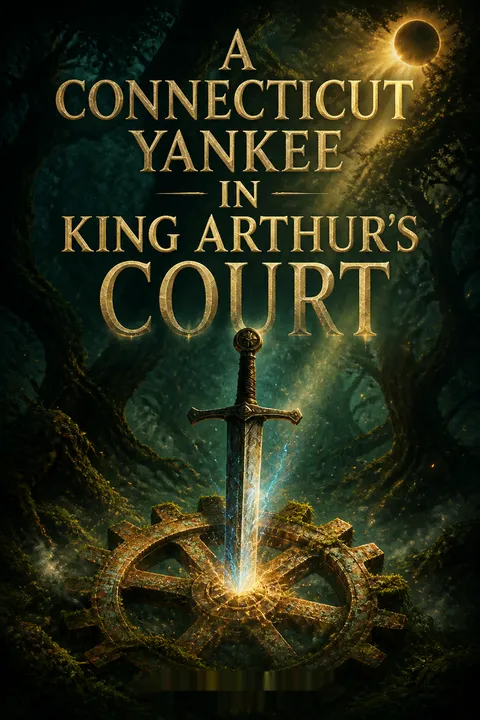
Hank Morgan, a practical, ingenious Yankee from 19th-century Connecticut, finds himself inexplicably transported to King Arthur's sixth-century England. Disoriented and skeptical, he is quickly captured and brought before the legendary court of Camelot. The world he enters is one of superstition, rigid class divisions, and medieval brutality, where the divine right of kings is unquestioned and the common people are oppressed. Hank's confusion and disbelief are matched only by the court's amazement at his strange appearance and speech. As he is sentenced to death, Hank's quick wit and knowledge of an impending solar eclipse become his only hope for survival, setting the stage for a collision between modern reason and ancient myth.
The Eclipse Gambit
Facing execution, Hank leverages his knowledge of the coming eclipse to convince the court of his supernatural powers. As the sky darkens, he "blots out the sun," astonishing the superstitious masses and saving his life. Declared a mighty magician, he is elevated to a position of power, second only to King Arthur. Hank's scientific knowledge is mistaken for magic, and he becomes "The Boss," determined to use his new authority to modernize the kingdom. The eclipse marks the beginning of his campaign to upend the old order, as he plots to introduce technology, education, and democracy to a land mired in ignorance and fear.
The Boss Ascends
Now wielding immense influence, Hank sets about transforming Arthurian England. He establishes secret schools, factories, and workshops, laying the groundwork for a technological revolution. The knights and nobles, awed by his "miracles," are gradually sidelined as Hank's inventions—telegraphs, steam engines, and even newspapers—begin to reshape society. Yet, he must tread carefully, for the Church and the aristocracy remain powerful and suspicious. Hank's vision is grand: to replace superstition with reason, privilege with equality, and monarchy with a republic. But the seeds of resistance are already sown, and the struggle between old and new intensifies.
Civilization in Secret
Hank's reforms flourish in hidden corners, as he trains a new generation of thinkers and craftsmen. He introduces Sunday schools, Protestant congregations, and a rudimentary press, all while keeping his activities concealed from the Church's watchful eyes. The mines and factories hum with innovation, and the first stirrings of a middle class appear. Yet, the common people remain shackled by inherited ideas and centuries of oppression. Hank's efforts to awaken them are met with both hope and inertia, as the weight of tradition proves difficult to lift. The dream of a free, rational society glimmers, but the forces of reaction gather in the dark.
Adventures with Sandy
Ordered by Arthur to seek adventure, Hank sets out with the earnest but talkative Sandy, who believes herself on a mission to rescue enchanted princesses. Their journey is a comic parade of misunderstandings, as Hank's skepticism clashes with Sandy's credulity. They encounter peasants, ogres (who turn out to be swineherds), and the harsh realities of medieval life—poverty, disease, and injustice. Hank's attempts to apply modern logic to ancient customs often backfire, revealing both the absurdity and the tragedy of the world he seeks to reform. Through it all, Sandy's unwavering faith in chivalry and magic stands in poignant contrast to Hank's restless pragmatism.
The Ogre's Illusion
Sandy leads Hank to a supposed ogre's castle, which he recognizes as a pigsty. To Sandy, the swineherds are fearsome monsters; to Hank, they are simply poor men. Playing along with her delusion, Hank "rescues" the princesses (the pigs) and purchases them from the swineherds, inadvertently exposing the arbitrary nature of status and perception. The episode is both farce and satire, highlighting the power of belief to shape reality. Hank's efforts to reason with Sandy are futile, and he is forced to admit that logic alone cannot dispel the enchantments of culture and tradition.
The Queen's Dungeons
Hank and Sandy's travels bring them to the castle of Morgan le Fay, Arthur's sister and a notorious sorceress. There, they witness the casual brutality of the nobility: prisoners languish in darkness for trivial offenses, and mercy is rare. Hank is appalled by the indifference to suffering and the arbitrary exercise of power. He engineers the release of many captives, but is haunted by the realization that centuries of oppression cannot be undone by a single act. The episode deepens his resolve to challenge the foundations of the old order, even as it exposes the limits of his influence.
The Tournament Disrupted
Back in Camelot, Hank is drawn into a grand tournament, the centerpiece of knightly culture. He introduces baseball as a new spectacle, pitting teams of armored kings against each other in a comic display of misplaced valor. The tournament becomes a battleground between the old and the new, as Hank's inventions and tactics confound the knights. His ultimate victory—using a lasso and revolver to defeat the greatest champions—signals the death knell of chivalry. The crowd is both awed and bewildered, and the age of magic gives way to the age of machinery.
The Valley of Holiness
News spreads of a miraculous well that has ceased to flow, plunging the Valley of Holiness into despair. Merlin, the old magician, fails to restore it with his incantations. Hank investigates and discovers a simple mechanical cause—a leak in the well's wall. He repairs it, then stages a dazzling display of fireworks and "magic" to convince the people of his supernatural power. The episode is a biting satire of religious superstition and the gullibility of the masses, as Hank's technological wizardry is mistaken for divine intervention. The Church, threatened by his influence, begins to plot against him.
The Miracle and the Machine
Hank's reputation as a miracle-worker grows, and he uses it to introduce hygiene, baths, and other modern improvements to the monks and nuns of the valley. He battles Merlin and the Church for control of the narrative, ultimately triumphing through a combination of showmanship and practical skill. Yet, the episode reveals the fragility of progress: the people's loyalty is fickle, and their faith can be easily manipulated. Hank's victory is real, but precarious, as the forces of reaction regroup and prepare to strike back.
The Republic Proclaimed
With Arthur's death, Hank seizes the moment to declare a republic, abolishing the monarchy, nobility, and established Church. He and Clarence, his loyal lieutenant, fortify themselves in Merlin's cave with a handful of faithful boys and a formidable arsenal of modern weapons. The rest of the nation, cowed by the Church's interdict and the return of superstition, turns against them. Hank's dream of a bloodless revolution collapses, and he is forced to confront the tragic limits of reason and technology in the face of fear and tradition.
The Battle of the Sand Belt
The final confrontation pits Hank and his fifty-two boys against the massed chivalry of England. Using electrified fences, dynamite, and Gatling guns, they annihilate the knights in a cataclysmic slaughter. The victory is total, but hollow: the land is devastated, and the survivors are left isolated and doomed. The dream of progress has become a nightmare, and the cost of victory is the destruction of the very society Hank sought to save.
The End of Chivalry
In the aftermath, Hank and his followers are besieged by the poisonous air of the battlefield and the relentless advance of death. Merlin, disguised as a peasant woman, casts a spell that puts Hank into a thirteen-century sleep. Clarence, his faithful friend, records the end of their struggle and the collapse of their hopes. The age of chivalry is dead, but the age of reason has not yet been born. The manuscript ends in sorrow and ambiguity, as the dream of a better world slips away.
The Interdict Falls
The Church's interdict plunges England into silence and despair. Commerce ceases, the streets are empty, and the people are paralyzed by fear. Hank returns from abroad to find his achievements undone and his allies scattered. The power of superstition proves stronger than the promise of progress, and the old order reasserts itself with a vengeance. Hank's isolation is complete, and the forces of reaction close in for the final reckoning.
The Last Stand
In Merlin's cave, Hank and his boys prepare for the inevitable assault. The knights of England, united by the Church, march against them in overwhelming numbers. The ensuing battle is a massacre, as Hank's modern weapons mow down the flower of chivalry. Yet, victory brings no peace: disease and despair claim the survivors, and Merlin's final enchantment seals Hank's fate. The dream of a new world dies with its creator, and the cycle of history resumes.
Clarence's Farewell
Clarence, Hank's loyal companion, records the last days of the Boss and his followers. As death closes in, Clarence reflects on the tragedy of their enterprise—the hope, the struggle, and the ultimate futility of their quest. The manuscript ends with a postscript by Mark Twain, blurring the line between dream and reality, and leaving the reader to ponder the meaning of progress, power, and the human heart.
Analysis
A Connecticut Yankee in King Arthur's Courtis a dazzling, unsettling meditation on the promises and perils of progress. Twain's novel is both a comic romp and a profound critique of the myths that sustain societies—whether the romance of chivalry or the gospel of technology. Through Hank Morgan's journey, Twain explores the limits of reason, the persistence of superstition, and the tragic inertia of human institutions. The book is a satire of both medieval and modern worlds, exposing the arbitrary nature of power, the cruelty of privilege, and the vulnerability of the common people. Yet, it is also a lament for the failure of reform: Hank's dream of a rational, egalitarian society is undone not by the strength of his enemies, but by the weakness of his allies and the resilience of the past. The novel's enduring lesson is that progress is neither inevitable nor secure; it must be fought for, and even then, it may be lost. Twain's vision is at once hopeful and tragic, a warning that the future is always haunted by the ghosts of history, and that the battle between reason and superstition, freedom and authority, is never truly over.
Review Summary
A Connecticut Yankee in King Arthur's Court receives mixed reviews. Many praise Twain's satirical wit and commentary on religion, monarchy, and social issues. The time-travel premise and humor are appreciated, though some find the narrative meandering. Critics note the book's relevance to modern times and its groundbreaking use of time travel in literature. However, some readers find the protagonist unlikable and the satire heavy-handed. Overall, the novel is recognized as an important work in Twain's catalog, despite its flaws.
People Also Read



Characters
Hank Morgan
Hank Morgan, the "Yankee," is a 19th-century American engineer whose practical genius and restless energy drive the novel's central conflict. Thrust into King Arthur's England, he is both a visionary and a disruptor, determined to replace superstition with reason and privilege with equality. Hank's psychological complexity lies in his blend of confidence and vulnerability: he is at once a master of technology and a stranger in a world he cannot fully comprehend. His relationships—with Arthur, Sandy, Clarence, and the common people—reveal both his compassion and his impatience. Over time, Hank's optimism is eroded by the inertia of tradition and the resilience of human folly. His ultimate failure is not just political, but existential: he cannot bridge the gulf between the world he imagines and the world that is.
King Arthur
King Arthur is the embodiment of chivalric ideals—honor, loyalty, and mercy—but also of the limitations of inherited power. Initially trusting and benevolent, he is blind to the injustices of his realm and the suffering of his people. Through his friendship with Hank, Arthur is gradually awakened to the realities of oppression and the need for reform. Yet, his transformation is incomplete; he remains bound by the codes and prejudices of his age. Arthur's psychological journey is one of tragic enlightenment, as he comes to see the flaws in the system he upholds, but is ultimately powerless to change it.
Sandy (Alisande)
Sandy is Hank's companion on his adventures—a talkative, romantic, and credulous woman whose worldview is shaped by the myths and superstitions of her time. Her unwavering belief in enchantments and chivalry provides both comic relief and a poignant counterpoint to Hank's skepticism. Sandy's loyalty and kindness are genuine, and her innocence is both endearing and limiting. She represents the persistence of tradition and the difficulty of changing hearts as well as minds.
Clarence
Clarence is Hank's devoted lieutenant and confidant, a young page who becomes the chief administrator of the Boss's reforms. Intelligent, resourceful, and eager to learn, Clarence bridges the gap between the old world and the new. His loyalty to Hank is unwavering, but his own psychology is shaped by the contradictions of his upbringing—torn between reverence for tradition and enthusiasm for progress. In the end, Clarence is the last survivor, bearing witness to the collapse of their dream and the ambiguity of their legacy.
Merlin
Merlin, the legendary wizard, is both a rival and a symbol of the old order. His "magic" is exposed as trickery and superstition by Hank's scientific prowess, and he becomes increasingly marginalized and resentful. Merlin's psychological profile is one of wounded pride and desperate clinging to relevance. His final act—casting Hank into a centuries-long sleep—represents the enduring power of myth and the resistance of the past to the encroachments of reason.
Morgan le Fay
Morgan le Fay, Arthur's sister, is a figure of both beauty and malice. Her castle is a place of arbitrary cruelty, where prisoners languish for years without hope. Morgan's psychology is shaped by power and resentment; she is both a victim and a perpetrator of the system she inhabits. Her interactions with Hank reveal the limits of compassion in a world governed by fear and hierarchy.
Sir Launcelot
Sir Launcelot is the greatest of Arthur's knights, renowned for his valor and skill. Yet, he is also a tragic figure, caught between loyalty to his king and love for the queen. Launcelot's psychology is marked by honor, pride, and a fatal inability to reconcile his ideals with the realities of the world. His eventual downfall is both personal and symbolic—the end of chivalry and the old order.
Guenever
Queen Guenever is at the center of the court's intrigues and the cause of its final unraveling. Her love for Launcelot and her ambiguous relationship with Arthur drive the narrative toward tragedy. Guenever is both a victim of circumstance and an agent of change, her psychology shaped by desire, guilt, and the constraints of her role.
Dowley
Dowley, the blacksmith, represents the emerging middle class and the possibilities of social mobility. His pride in his achievements is genuine, but his worldview is circumscribed by the prejudices and limitations of his time. Dowley's interactions with Hank reveal both the promise and the pitfalls of progress, as well as the persistence of envy and resentment.
The Common People
The peasants, artisans, and slaves of Arthurian England are the true subjects of Hank's reforming zeal. Their psychology is shaped by centuries of subjugation, superstition, and resignation. While capable of gratitude and loyalty, they are also quick to revert to fear and conformity when threatened. Their fate is the central tragedy of the novel: offered the promise of freedom, they are ultimately unable to seize it.
Plot Devices
Time Travel and Anachronism
The central device of the novel is the transplantation of a 19th-century American into the world of Arthurian legend. This allows Twain to juxtapose modern science, technology, and rationalism with medieval superstition, hierarchy, and violence. The resulting anachronisms generate both comedy and tragedy, as Hank's innovations are alternately hailed as miracles and condemned as heresy. The device exposes the contingency of progress and the fragility of civilization.
Satire and Irony
Twain employs biting satire to lampoon the pretensions of chivalry, the abuses of power, and the follies of both past and present. Irony pervades the narrative: Hank's "miracles" are simply applications of science, but are received as magic; his reforms are intended to liberate, but often reinforce new forms of control. The novel's humor is laced with bitterness, as the promise of progress is repeatedly undermined by human weakness and institutional inertia.
Foreshadowing and Dramatic Irony
From the outset, the narrative is haunted by a sense of impending doom. Hank's confidence in reason and technology is undercut by the persistence of superstition and the resilience of the old order. The Church's eventual triumph is foreshadowed by the people's reluctance to abandon inherited beliefs, and the final catastrophe is prepared by the very successes of Hank's campaign.
Framing Narrative and Manuscript
The story is presented as a manuscript discovered by a 19th-century narrator, blurring the line between reality and fantasy. This device invites the reader to question the reliability of history, the meaning of progress, and the possibility of escape from the cycles of power and violence. The postscript by Clarence and the final delirium of the Boss reinforce the ambiguity of the tale, leaving its lessons open to interpretation.
About the Author


Download PDF
Download EPUB
.epub digital book format is ideal for reading ebooks on phones, tablets, and e-readers.








































