
Plot Summary
Prologue
Beyond the Wall, three rangers of the Night's Watch track wildlings into the haunted forest. The young, arrogant knight Waymar Royce dismisses the warnings of his grizzled companions. Out of the freezing dark glide the Others, pale inhuman figures wielding swords like shards of moonlit ice.
They cut Royce down with chilling ease while the woodsman Will watches frozen from a tree. When Will finally climbs down, the slain Royce rises again, eyes burning blue, and strangles him with icy hands. The ancient enemy of legend, gone eight thousand years, has crept back into the world while the squabbling southern kingdoms remain oblivious.
The prologue performs a sly genre maneuver: it opens an epic about thrones and bloodlines with a threat none of the throne-seekers will take seriously. Royce embodies the swaggering chivalric ideal the novel will systematically dismantle, his fine armor and castle-forged sword useless against an enemy that ignores human rules. By granting readers knowledge the characters lack, Martin builds dramatic irony that shadows every later political maneuver. The Others render the coming civil war almost absurd, a quarrel over a chair while winter and death advance. It establishes the book's central tension: human ambition versus inhuman catastrophe, and the fatal price of disbelief in a world that has forgotten its own monsters.
Deserter's Death, Direwolf Pups
A captured Night's Watch deserter loses his head to Lord Eddard Stark1's greatsword while seven-year-old Bran6 watches, learning that a ruler must look into the eyes of the man he condemns. Riding home, the Starks find a slain direwolf with a stag's antler lodged in her throat, and six newborn pups beside her.
Eddard's bastard son Jon Snow3 points out that five pups match the five trueborn Stark children, with a white runt left for himself. The children claim them. Soon afterward, grim news reaches Winterfell: Jon Arryn, the King's Hand and Eddard's beloved foster father, has died, and King Robert10 is already riding north with his whole court. The dead wolf and broken stag feel like omens no one dares to name aloud.
The opening fuses ritual, family, and foreshadowing with remarkable economy. Eddard's executioner creed defines the moral spine of the book, the belief that justice must be personal and witnessed. The direwolf and the antler that killed her quietly encode the entire plot to come: the Stark wolves and the Baratheon stag entangled in mutual destruction, with orphaned children left to survive. Martin establishes the north as a place of hard truths and old gods, where omens carry weight precisely because the adults insist they do not. The arrival of king and Hand's death together yokes private grief to public summons, pulling a contented family toward a fate already coiling.
The King's Offer, A Secret Letter
King Robert10 embraces his old friend Eddard1 and asks him to serve as the new Hand of the King, sealing the bond by proposing to wed his son Joffrey17 to Eddard's eleven-year-old daughter Sansa.8 Eddard wants to refuse. That night his wife Catelyn2 receives a letter from her sister Lysa, Jon Arryn's widow, written in a private childhood cipher: it accuses the Lannisters, the queen11's family, of murdering Jon Arryn.
Fearing for Robert surrounded by Lannisters, Catelyn convinces Eddard he must go south to learn the truth. He accepts, planning to take daughters Sansa and Arya7 while leaving Catelyn and most of his sons behind. The honorable northern lord is pulled toward a court built on flattery, debt, and lies.
This is the inciting machinery of the political plot, and it turns on obligation rather than desire. Eddard accepts a role he dreads because friendship, duty, and a dead man's possible murder leave him no honorable refusal. The betrothal weaponizes love and lineage as instruments of statecraft, foreshadowing how children will become pawns. Catelyn's coded letter introduces the theme of information as power and the danger of acting on secret accusations. The chapter sets the tragic engine running: a man whose virtues are wholly suited to the north and wholly unsuited to the south agrees to govern a realm whose rules he refuses to learn.
Daenerys Sold to the Horselord
Across the narrow sea in Pentos, the exiled Viserys Targaryen14 sells his thirteen-year-old sister Daenerys4 in marriage to Khal Drogo,13 a Dothraki warlord, in exchange for an army to reclaim the Iron Throne their family lost.
Terrified and friendless, Daenerys is bathed, perfumed, and presented like a prize. The fat merchant Illyrio arranges the match, and the exiled knight Jorah Mormont18 attaches himself to the cause. At the savage wedding feast, men fight and die and couple in the open, and Daenerys receives three petrified dragon eggs from the Shadow Lands.
Drogo,13 wordless and fearsome, leads her away to consummate the marriage, yet proves unexpectedly gentle, asking rather than taking. A frightened girl begins, almost imperceptibly, to glimpse a sliver of her own power.
Daenerys enters as the most powerless figure in the book, a commodity traded between cruel men. Her storyline runs counter to the western decline, charting ascent through degradation. The dragon eggs arrive as inert curiosities, seeds of a buried inheritance. Viserys embodies entitlement without strength, mistaking bloodline for worth, a foil to the sister who will earn her authority. Drogo's surprising tenderness complicates the reader's expectation of pure brutality, introducing the possibility of agency and intimacy inside an arranged bondage. Martin uses the Dothraki to interrogate civilization and savagery, refusing to let either the Free Cities or the horde claim moral cleanliness, and seeding a mythic rebirth far from the throne everyone covets.
Bran's Fatal Fall
While the king hunts, Bran6 climbs Winterfell's towers as he always does and overhears voices through a window in an abandoned keep. Peering in, he sees Queen Cersei11 entwined with her twin brother Jaime Lannister.12 Cersei screams. Jaime, weighing the cost aloud, remarks bitterly on the things he does for love, and shoves the seven-year-old out the window.
Bran falls. He survives, broken and comatose, his legs ruined and his memory of the climb erased. His direwolf howls beneath his window day and night. The Lannisters ride south with the royal party as though nothing happened, while Catelyn2 keeps a sleepless vigil at her son's bedside, neglecting the rule of Winterfell as grief and dread tighten around her heart.
This is the point of no return for the Starks, and the moment the novel announces it will spare no one, not even a child. The crime is intimate and casual: a knight's love-driven cruelty against an innocent, the noble Lannister mask slipping to reveal monstrous pragmatism. Bran's broken body literalizes the loss of childhood freedom that recurs across the young Starks; the boy who lived in motion is stilled. The erased memory turns him into a walking accusation no one can yet hear. Cersei and Jaime's incest, glimpsed but not yet understood by the reader's surrogate, becomes the buried secret around which the entire war will eventually detonate.
The Assassin and Catelyn's Quest
As Bran6 lingers near death, a library fire lures Catelyn2 and the guards away, and a hired killer slips into the sickroom with a fine dagger to cut the boy's throat. Catelyn fights him barehanded, slicing her fingers to the bone, until Bran's direwolf tears out the assassin's throat. The blade is far too costly for a common cutthroat, proof that someone wants Bran silenced for what he saw.
Convinced the Lannisters lie behind both the fall and Jon Arryn's murder, Catelyn rides secretly to King's Landing. There her childhood friend Petyr Baelish, called Littlefinger,15 examines the dagger and names its owner: Tyrion Lannister,5 the queen11's dwarf brother, supposedly won from him in a tourney wager. Catelyn now believes she knows her enemy.
The catspaw's dagger becomes the book's most consequential object, a single piece of steel that converts suspicion into war. Catelyn's barehanded defense of her son is the maternal ferocity that defines her, and the wound she carries marks the cost of her devotion. Crucially, the chapter dramatizes how evidence is interpreted rather than known: Littlefinger supplies a name, and a grieving mother accepts it, illustrating how easily the powerful manipulate the truth through trusted intermediaries. The direwolf's intervention again binds the Starks to the uncanny. Martin plants a question that will poison everything, whether the man who named the dagger's owner can be believed at all.
Catelyn Seizes the Imp
Riding home through the mountains, Catelyn2 stops at a crossroads inn and finds Tyrion Lannister5 there by chance. Seizing the moment, she calls on the lords sworn to her father by their oaths, accuses Tyrion of sending the dagger to murder Bran,6 and takes him captive with a dozen swords at her back.
Rather than turn for Winterfell, she rides east toward the Eyrie, her sister Lysa's impregnable mountain fortress, to deliver him to judgment. Mountain clansmen ambush the party on the high road, and Tyrion, fighting for his life, begins charming the sellsword Bronn.19 Catelyn hands her prisoner to a Lysa half-mad with grief and fear, who locks the dwarf5 in a sky cell, an open-walled chamber over a lethal drop.
Catelyn's bold gamble is the spark that lights the powder, and it is born of love and miscalculation in equal measure. By invoking sworn oaths in a public room, she turns a private grievance into a feudal obligation, demonstrating how the web of fealty can be activated like a weapon. Yet her certainty rests on Littlefinger's word, exposing the danger of righteous action without proof. The journey introduces Tyrion's defining gift, surviving by wit and gold rather than strength, and Bronn as the amoral blade he buys. Lysa's unstable terror previews how grief warps judgment, a mirror to Catelyn herself, and how fear breeds cruelty in those who feel cornered.
Jon Snow Takes the Black
Sent north with his uncle Benjen, Jon Snow3 reaches Castle Black expecting noble knights and finds instead an undermanned dungheap of thieves and outcasts. The cruel master-at-arms Ser Alliser Thorne mocks him as Lord Snow3 and turns the other recruits against him, since the castle-trained Jon easily bests them all.
Heeding Tyrion5's counsel to wear his bastardy like armor, Jon stops resenting his fellows and starts protecting them, especially the fat, kindhearted coward Samwell Tarly,20 whom he persuades the others to spare. When the recruits say their vows in a weirwood grove beyond the Wall, Jon and Sam20 swear before the old gods. To Jon's fury, he is named not a ranger but personal steward to the Lord Commander, Jeor Mormont, the Old Bear.22
Jon's arc is a brutal education in humility, the inverse of Daenerys's rise through suffering. Stripped of family status, he must learn that worth is earned among men who owe him nothing. Tyrion's gift of counsel, embrace your stigma so it cannot be used against you, reorients Jon from self-pity to leadership through service. His defense of Sam dramatizes a recurring Martin theme: courage takes many forms, and protecting the weak is its own valor. The disappointment of being made a steward rather than a ranger sets up a lesson about pride and purpose. The Wall functions as the novel's moral crucible, far from the throne games yet guarding against something far worse.
The Trident and Lady's Death
Traveling south, the royal party fractures along the Trident. Arya,7 the Starks' wild younger daughter, plays at swords with a butcher's boy named Mycah when Prince Joffrey,17 drunk and cruel, attacks the boy. Arya's direwolf Nymeria bites the prince to defend her. Arya drives the wolf away to spare her from punishment, then throws Joffrey's sword in the river and flees.
Cersei11 demands a wolf's death, and since Nymeria is gone, she claims Sansa8's gentle direwolf Lady instead, forcing Eddard1 to do the killing himself. Worse, the Hound, Sandor Clegane,21 hunts down and butchers Mycah for sport. The episode poisons the sisters against each other and gives Eddard his first bitter taste of Lannister cruelty wearing the king's own authority.
A children's quarrel escalates into the killing of an innocent boy and a guiltless animal, a microcosm of how power corrupts justice. Joffrey's cowardly malice and Cersei's vindictiveness reveal the family Eddard has bound his daughter to. Lady, the most docile of the wolves, dies for a crime Nymeria committed, an early proof that fairness has no purchase here, and that the Starks' gentlest instincts make them vulnerable. The sisters' rupture, Sansa's instinct to protect the prince against Arya's wildness, dramatizes the gulf between believing in songs and seeing the world plainly. Eddard's forced execution of Lady is honor turned against itself, a foreshadowing of sacrifices to come.
Ned Hunts a Dead Man's Secret
Installed as Hand in King's Landing, Eddard1 retraces Jon Arryn's final days and learns the old man had been studying a tome of noble lineages and quietly visiting the king's bastards. Following the trail, Ned finds Robert10's baseborn children scattered through the city, including a blacksmith's apprentice named Gendry, all of them black-haired, strong, and stamped with the unmistakable Baratheon look.
Jon Arryn's dying words, that the seed is strong, begin to make terrible sense. Meanwhile the realm frays: Gregor Clegane burns the riverlands in raids, and Eddard, sitting the Iron Throne in Robert's absence, dispatches men to bring the brute to the king's justice. Ned senses a buried truth circling him like a predator he cannot yet name.
This is the patient detective movement of the novel, and its brilliance lies in mundanity: the world-shaking secret is decoded not by magic but by heredity and careful reading. Martin grounds the central conspiracy in observable fact, the iron law of inherited coloring, which makes the eventual revelation feel earned rather than contrived. Eddard's investigative honesty is also his peril, since the closer he comes to the truth the more dangerous he becomes to those who killed Jon Arryn. His judgment against Gregor Clegane shows him wielding royal justice as the north would, naming and condemning openly, a man still playing by rules his enemies abandoned long ago.
The Hand's Tourney
Robert10 throws a lavish tournament in his Hand's honor, plunging the bankrupt crown deeper into Lannister debt. Sansa,8 dazzled, falls further in love with the spectacle and with the gallant Knight of Flowers, Loras Tyrell, who tosses her a red rose. The monstrous Gregor Clegane kills a young knight by accident, then, unhorsed by Loras's cunning, beheads his own horse and tries to murder the boy, until his scarred brother Sandor, the Hound,21 stops him.
That night the Hound escorts Sansa home and confesses, in raw bitterness, how Gregor held his face in fire when they were children, and that no true knight ever made him. Beneath the songs Sansa worships, the tourney exposes a court where beauty masks brutality.
The tournament is staged chivalry as expensive lie, mirroring a crown that performs splendor while drowning in debt. Sansa's enchantment makes her the reader's stand-in for everyone who confuses appearance with virtue, and the chapter pointedly contrasts her romantic gaze with the violence erupting on the field. The Hound's confession is the book's clearest articulation of its anti-chivalric thesis: knighthood is a costume, and the truly fearsome man is the one who refuses the pretty word. His unexpected protectiveness toward Sansa introduces moral ambiguity, the brutal man who tells hard truths against the gallant prince who lies. Spectacle, the novel insists, is where power hides its rot.
Tyrion's Sky Cell Trial
Freezing in his open-walled sky cell above a fatal drop, Tyrion5 talks his brutish gaoler into carrying a message and demands a trial before Lysa Arryn's court. Cornered, he invokes his right to trial by combat, expecting to name his absent brother12 as champion. When no one will fight for him, the sellsword Bronn19 volunteers.
Against Lysa's chosen knight, the doughty Ser Vardis Egen, Bronn fights dirty and patient, dancing away until the armored man tires, then topples a heavy marble statue onto him and drives a blade through his armor. Declared innocent by the gods' verdict, Tyrion walks free. On the treacherous road down, he buys the loyalty of the mountain clans with promises of weapons and plunder, turning captivity into an army.
Tyrion's escape is a triumph of intellect over brute force, the recurring promise that wits are a weapon. The trial by combat lays bare the absurdity of justice-by-violence: guilt or innocence decided by who hires the better killer, the gods invoked to sanctify a coin transaction. Bronn's pragmatic, unchivalrous victory rhymes with the Hound's earlier creed, that the man without honor often outlasts the man with it. Tyrion's recruitment of the clans transforms his lowest moment into leverage, demonstrating his gift for converting weakness into opportunity. The sequence also exposes the Eyrie's cruelty and Lysa's instability, deepening the portrait of a realm where the powerful indulge sadism while calling it law.
Jaime's Street Ambush
Word reaches King's Landing that Catelyn2 has seized Tyrion,5 and Jaime Lannister12 takes his revenge in the night streets. With his guardsmen he ambushes Eddard1's party as they return from a brothel where Ned had gone to see Robert10's infant bastard daughter. Jaime demands his brother5's release, then orders his men to cut down Eddard's.
The loyal captain Jory Cassel and others are butchered; a spear kills Ned's horse, which falls and shatters his leg. Jaime rides off, leaving the Hand crippled and his guard slaughtered in the mud. Robert, enraged at both sides yet unwilling to lose his queen11's kin, refuses to punish Jaime and commands Ned to make peace, hardening Ned's dawning sense that his old friend has become a stranger.
The ambush escalates a private feud into bloodshed in the capital, demonstrating how the Tully capture of Tyrion ripples outward into Lannister vengeance. Jaime's arrogance and lethal skill make him the embodiment of might unconstrained by accountability. Ned's shattered leg is more than injury; it physically disables the protagonist at the moment he most needs strength, foreshadowing how the climax will find him unable to fight, forced to sit and rely on others. Robert's refusal to act crystallizes the novel's bleak realism: even kingship bends before power and convenience. The brothel errand, born of Ned's stubborn honor toward a dead friend's promise, again ties his virtue to his vulnerability.
Daenerys Rising, Viserys Crowned
Carried east across the Dothraki sea, Daenerys4 grows from frightened bride into khaleesi, pregnant with Drogo13's child. When her bullying brother Viserys14 strikes her, she strikes back and has him publicly shamed, made to walk like the lowest of the horde. At a sacred feast she devours a stallion's raw heart whole, and the crones proclaim her son the Stallion Who Mounts the World, a prophesied conqueror.
Viserys, drunk and humiliated, draws steel in the holy city and threatens Daenerys and her dragon eggs, demanding the crown he was promised. Drogo13 grants it with horrific irony, pouring a cauldron of molten gold over his head. Daenerys watches her brother die and feels nothing, certain now that a true dragon cannot be killed by fire.
This chapter inverts the sibling power dynamic that opened Daenerys's arc and completes Viserys's self-destruction. His entitlement, the belief that blood alone confers a crown, earns him a crown of literal gold, a grotesque granting of his exact demand. Daenerys's consumption of the stallion's heart is a rite of belonging and ascendancy, while the prophecy of her unborn son raises the stakes of her pregnancy to messianic dimensions. Her cold detachment at Viserys's death signals the death of the trembling girl and the birth of a sovereign. The fire imagery, and her conviction that flame cannot touch her, plants the most important seed of her transformation, paid off in the novel's final image.
The Incest Unmasked
Piecing together the lineage book and the king's uniformly black-haired bastards, Eddard1 grasps the secret that cost Jon Arryn his life: Joffrey,17 Myrcella, and Tommen are not Robert10's children at all but the incestuous offspring of Cersei11 and her twin Jaime.12 By right, Robert's death would pass the throne to his brother Stannis.
Rather than expose the queen11 at once, the honorable Ned confronts Cersei privately in the godswood, offering her the chance to flee with her children before he tells the king. Cersei coldly refuses, warning him that in the game of thrones one wins or dies, with no middle ground. Certain of his own righteousness and Robert's mercy, Ned has just handed his deadliest enemy the time she needs.
Here honor becomes a fatal flaw made explicit. Eddard's mercy, warning Cersei to protect her innocent children from Robert's wrath, is precisely the gesture a ruthless rival exploits. Cersei's epigram distills the book's political philosophy and frames the title itself: the throne is a lethal game with no consolation prize. The scene reveals the human cost beneath the conspiracy, a mother who will do anything for children conceived in a forbidden love, against a father who cannot imagine slaughtering them. Martin sets up the tragic collision between two value systems, Ned's deontological code and Cersei's survivalist pragmatism, and makes clear which one the world rewards. The midpoint revelation transforms suspicion into a death sentence.
Robert's Boar, Ned's Betrayal
Robert10 returns from the hunt gored by a boar, dying, the wine that dulled his wits poured freely by Cersei11's cousin. On his deathbed he names Eddard1 Protector of the Realm until his heir comes of age; Ned writes my rightful heir instead of Joffrey,17 unable to wound a dying friend with the truth.
To install the lawful king Stannis, Ned needs swords and pays the City Watch through Littlefinger,15 who urges him instead to crown Joffrey and rule through him. Ned refuses the dishonorable course. When he moves against Cersei11 in the throne room, the gold cloaks turn their spears on his own men at Littlefinger's signal. Littlefinger sets a blade to Ned's throat, reminding him he had warned Ned never to trust him.
The third-act turn springs the trap Cersei's warning promised. Robert's death by boar, oiled along by wine, is murder disguised as misadventure, a fitting end for a king who refused to see. Ned's deception on the will, writing my heir, is the one small lie his honor permits, and it changes nothing. The betrayal hinges on a brilliant reversal: the gold cloaks Ned bought are loyal to whoever pays, and Littlefinger out-purchased him. Ned's downfall is doubly tragic because he was explicitly warned, both by Cersei and by Littlefinger himself, and chose to trust the rules of a game his enemies do not play. Integrity, the novel insists, is no shield.
The Lannister War Machine
In the west, Lord Tywin Lannister marshals the full might of Casterly Rock. His son Jaime12 smashes the Tully levies and besieges Riverrun, Catelyn2's family seat, capturing her brother Edmure. Tyrion,5 freed and arrived with his hill clansmen, is thrust into his father's vanguard, expected to die as bait.
At the Green Fork, Tywin springs a feint against a northern army he believes is led by Robb Stark,9 and Tyrion survives a chaotic, bloody battle, only for it to prove a deception: the enemy host was a decoy, and the boy he sought was never there. Tywin wins the field but learns the wolfling has slipped his grasp. The slow slide toward war has become open conflict raging across the riverlands.
This sequence shifts the novel from intrigue to large-scale warfare and showcases Tywin as the cold master of force that Ned never was. Tyrion's placement in the vanguard reveals his father's contempt and his own grim resourcefulness, surviving carnage through luck and the loyalty he purchased. The feint at the Green Fork dramatizes generalship as misdirection, the battlefield as another arena where information defeats strength. Tywin's victory is hollow, undercut by the realization that he was outmaneuvered, setting up the Young Wolf as a genuine threat. The chapter widens the lens from individual tragedy to the machinery of war, where smallfolk burn and lords gamble armies, and even triumph leaves the larger question unanswered.
The Lie at Baelor's Sept
Held captive, Eddard1 is offered a bargain through Varys:16 confess treason publicly, name Joffrey17 the true king, and live out his days on the Wall to spare his daughter Sansa,8 who has unknowingly aided her captors by begging for mercy. To save his child, the man of honor swallows the lie and kneels before the assembled city, naming himself a traitor and Joffrey the rightful king.
Cersei11 and Sansa expect mercy to follow. But the boy king Joffrey,17 savoring his power, instead orders Ser Ilyn Payne to take Eddard's head with the Stark greatsword Ice. Sansa screams; Arya,7 hidden in the crowd, is seized and blinded by a Night's Watch recruiter named Yoren before she can witness her father die.
The climax of the southern plot is also the book's thesis driven home like a blade. Eddard sacrifices his life's defining principle, honesty, to protect his daughter, only for the sacrifice to be rendered worthless by a child's caprice. Joffrey's betrayal of his own mother's promise reveals that even the schemers cannot fully control the monster they have crowned. The execution by the Stark family sword is a final desecration. Sansa's earlier plea, born of love and naivety, makes her an unwitting instrument of the trap, deepening her tragedy. Arya's shielded eyes and rescue by Yoren launch her into the wild, transforming a sheltered girl into a fugitive overnight.
The Dead Walk, Jon's Vow
At the Wall, two of Benjen Stark's missing rangers are recovered dead and carried back, only to rise in the night as wights with burning blue eyes. One attacks Lord Commander Mormont22 in his chambers; Jon Snow3 destroys it with fire, saving the Old Bear, who rewards him with the ancestral Valyrian steel sword Longclaw.
The ancient threat the Watch was built to face is stirring, exactly as the old tales warned. Then word arrives of Eddard1's execution. Torn between his oath and his blood, Jon flees south to join his brother9's war, but his friends ride him down and recite his vows back to him. Mormont reveals his plan: the Watch will march beyond the Wall to find Benjen and confront the gathering dark. Jon stays.
Jon's plot finally converges the political and supernatural threads: the dead rise on the very night the realm convulses over a throne, dramatizing the book's central irony. The gift of Longclaw, a dead man's blade given to a bastard, symbolizes earned worth over inherited right and Mormont's faith in him. Jon's attempted desertion is the agonizing test the whole Wall arc has prepared, love of family against sworn duty, and his friends embody the brotherhood that now claims him. Mormont's decision to ride north reframes the Watch from a forgotten dumping ground into the realm's last shield. The chapter argues that true purpose lies in facing the threat others refuse to believe in.
The Young Wolf's Crown
Refusing to abandon the south, Robb Stark9 marches with the northern host and outwits the aged schemer Walder Frey at the Twins, buying passage across his bridge with marriage pledges. Splitting his army, Robb lures Jaime12's besiegers into the Whispering Wood and, with his direwolf Grey Wind at his side, captures the Kingslayer himself, breaking the siege of Riverrun.
With Eddard1 murdered, Joffrey17 on the throne, and Robert10's brothers each claiming crowns, Robb's bannermen refuse to bend the knee to any southern king. The giant lord Greatjon Umber kneels first and proclaims Robb the King in the North, and the river lords take up the cry. Catelyn2 watches her fifteen-year-old son crowned a king, wedded now to a war he cannot easily end.
Robb's emergence as a battle commander reverses the Stark fortunes through cunning rather than honor, suggesting the next generation may learn what Ned could not. The Frey bargain shows feudal alliances bought with the bodies of children, marriage as currency, while the Whispering Wood proves the boy a tactician. Capturing Jaime gives the Starks their first real leverage. The crowning is double-edged: a moment of fierce loyalty and northern pride that also fragments the realm into competing kings, ensuring the war grinds on. Catelyn's perspective frames the bittersweet truth, that her son's elevation is also his entrapment, and that vengeance has displaced any path home to grief and peace.
Fire and Blood
On the Dothraki sea, a captured Lhazareen healer named Mirri Maz Duur23 uses blood magic to save the mortally wounded Drogo,13 warning that only death can pay for life. The price is monstrous: Daenerys4's unborn son is stillborn and deformed, and Drogo returns as a breathing husk, mindless and empty, his great khalasar scattering.
Betrayed, Daenerys smothers her husband with mercy, then exacts her vengeance. She binds the maegi23 to Drogo's funeral pyre, sets her three dragon eggs in the flames, and walks into the fire herself.
When the ashes cool, Daenerys emerges naked and unburned, three newborn dragons clinging to her body. The last Targaryen has become the Mother of Dragons, and a power thought dead for centuries breathes again in the night.
The novel's final image is its boldest reversal: amid universal decline, Daenerys achieves mythic transfiguration through total loss. Mirri Maz Duur's vengeance, the healer who refuses to save the people who burned her temple, reframes Daenerys's earlier mercy as the violence it concealed, complicating any clean reading of her as savior. The deaths of husband and child empty her of everything but the blood of the dragon, and her walk into the pyre is faith, madness, and rebirth at once. The hatching pays off every fire image and dragon-egg detail seeded throughout. Where the Westerosi plots end in severed heads and hollow crowns, Daenerys ends in transformation, the only genuine new power in a dying world.
Analysis
A Game of Thrones is a deliberate demolition of fantasy's comforting certainties. Martin builds a world that looks like classic high fantasy, then strips away its guarantees: honor does not protect the honorable, the rightful heir is not safe, and the noblest man in the realm can be destroyed precisely because he is noble. Eddard Stark1's tragedy is the book's thesis. His code, that the man who passes sentence should swing the sword, leaves him incapable of the lies and ruthlessness the southern court demands. Cersei11 states the brutal logic plainly: in the game of thrones you win or you die, with no middle ground for mercy. The novel runs three braided movements. In the south, politics curdles into civil war through misread evidence, wounded pride, and the seductions of power, with Littlefinger15 and Varys16 proving that information and theater outmatch swords. In the far north, the Wall and its forgotten threat generate dramatic irony: humanity wars over a throne while extinction gathers behind it. Across the sea, Daenerys4's mythic rebirth runs counter to everyone else's decline, suggesting real transformation comes through suffering and fire rather than inheritance. Childhood is the book's recurring casualty. Bran,6 Arya,7 Sansa,8 and Jon3 each lose a sheltered world and must grow up fast or die. Their direwolves externalize the bond between innocence and savagery, nurture and nature. The lasting lesson concerns belief and self-deception. Characters perish because they trust the wrong story: that friendship endures, that law shields, that monsters are only tales. Martin rewards those who see clearly, Syrio's lesson to Arya,7 Tyrion5's counsel to Jon,3 and punishes those who cling to comforting fictions. The result is a morally complex epic where power, not virtue, decides outcomes, and where the cost of honor is measured in heads on spikes.
Review Summary
A Game of Thrones receives high praise for its complex characters, intricate plot, and rich world-building. Readers appreciate Martin's willingness to subvert fantasy tropes and create morally ambiguous characters. The multiple perspectives and political intrigue keep readers engaged, though some find the numerous storylines overwhelming. Many readers discover the book through the TV adaptation and find the novel equally compelling. While some criticize the explicit content and depiction of violence, most agree that Martin's storytelling is captivating and unpredictable.
People Also Read

Characters
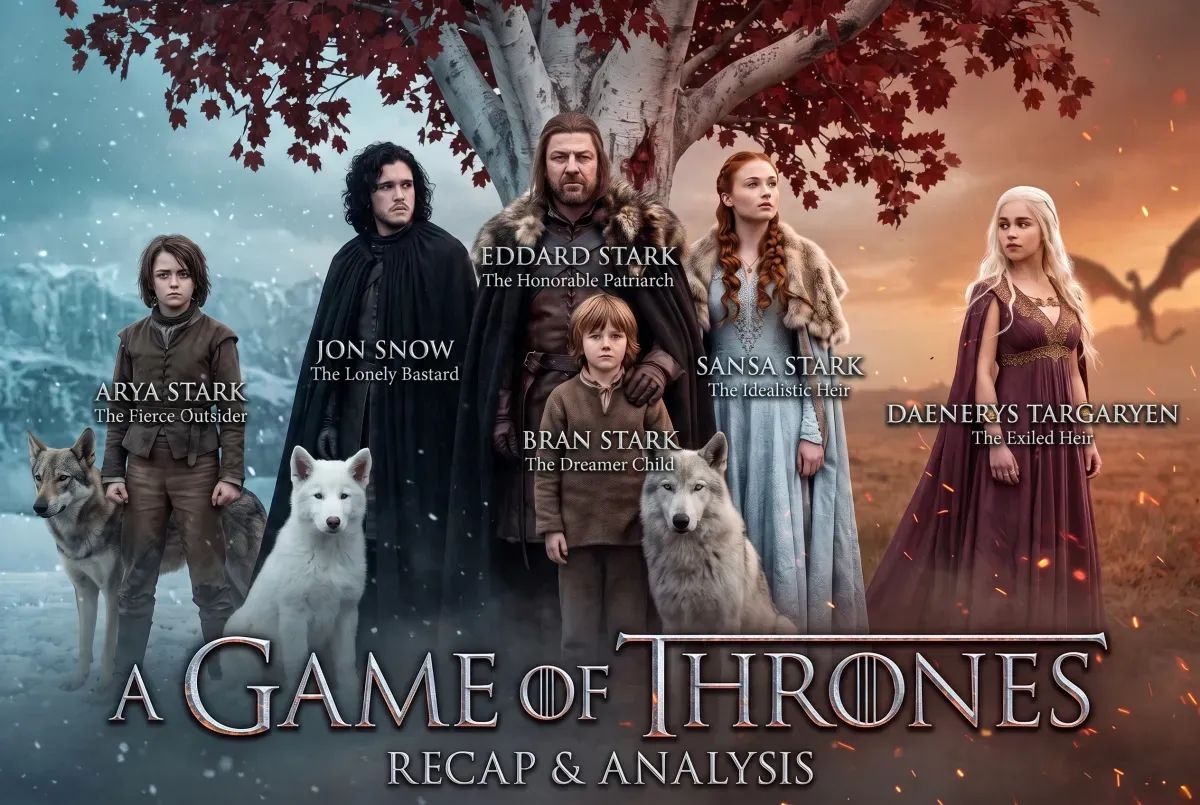
Eddard (Ned) Stark
Honorable Lord of WinterfellThe stern, honorable Lord of Winterfell and Warden of the North, raised on the creed that the man who passes sentence should swing the sword. A loving father and faithful husband haunted by old griefs, including the war that killed his sister Lyanna and the unspoken question of his bastard son3's mother. Bound to King Robert10 by a brotherhood forged in rebellion, Eddard is summoned south to serve as Hand of the King, a role he never wanted. His defining trait, an unbending sense of honor, is both his greatness and his fatal vulnerability in a court that runs on deceit. He trusts too readily in friendship, law, and the goodness of men, and measures every choice against an inner code that few around him share or even understand.
Catelyn Stark
Grieving mother turned avengerEddard1's wife, born a Tully of Riverrun and raised on the words Family, Duty, Honor. Fiercely maternal, she will risk anything for her children, and it is her bottomless dread for her broken son Bran6 that propels her into the heart of intrigue. Intelligent, proud, and capable of cold decisiveness, she reads the politics of a court better than her honest husband. Yet grief and fear sometimes override her judgment, leading her into bold, fateful gambles built on incomplete proof. Her lifelong resentment of Jon Snow3, the bastard her husband brought home, exposes the limits of her warmth. Throughout, Catelyn strains to be as hard as the north she married into while her heart pulls relentlessly toward the people she loves and fears to lose.
Jon Snow
Bastard who joins the WallEddard Stark1's bastard son, dark where his trueborn siblings are auburn, marked all his life by the surname Snow and Lady Catelyn2's coldness. Proud, gifted with sword and wit, and aching for a place to belong, he takes the black and journeys to the Wall expecting honor, finding hardship and contempt instead. His arc is a painful education in humility and brotherhood, learning from the dwarf Tyrion5 to make his bastardy his armor and from the brutal Watch that worth is earned, not granted. Loyal and quick to anger on behalf of the weak, Jon is torn between the family that never fully claimed him and the sworn brotherhood that now demands his whole life. His white direwolf Ghost is his silent shadow and truest companion.
Daenerys Targaryen
Exiled princess rebornThe last Targaryen princess, born in exile after her family lost the Iron Throne, raised on her brother14's dreams of reconquest and his casual cruelty. At thirteen she is sold into marriage to a Dothraki warlord13, beginning as a terrified, powerless girl. Hers is the most dramatic transformation in the book: as she learns to ride, to command, and to love, she discovers reserves of will and a fierce dragon's pride beneath her gentleness. She clings to a few cherished memories of a home she barely knew even as she forges a new identity among the horselords. Compassionate yet increasingly capable of ruthlessness, Daenerys grows into a leader who inspires devotion, defined above all by the blood of the dragon she insists runs in her veins.
Tyrion Lannister
Clever dwarf of Casterly RockThe dwarf son of the realm's richest lord, mocked as the Imp and despised by his own father and sister11. Denied the strength and stature his family prizes, Tyrion has armed himself with a sharp mind, a sharper tongue, and a vast appetite for books, wine, and women. He moves through the story as its wittiest observer, an outsider in his own house who feels a sly kinship with cripples, bastards, and broken things. Beneath the jokes lie real cunning and a wounded hunger for his father's respect. Pragmatic and amoral by his family's standards yet oddly compassionate, Tyrion proves that wits can be a deadlier weapon than any sword, and that being underestimated is its own quiet kind of power.
Bran Stark
Climbing boy who fallsEddard1 and Catelyn2's second son, a fearless seven-year-old who can scale the walls and towers of Winterfell better than anyone, dreaming of growing up to be a knight of the Kingsguard. Curious and warm-hearted, he is the child who sees what he was never meant to see. His recurring dream of a three-eyed crow urging him to fly hints at something ancient stirring in his blood. Bran's journey forces a boy who lived in restless motion to reckon with a transformed life, to lean on the simple giant Hodor and the captured wildling Osha, and to begin, reluctantly, to imagine a different kind of greatness than the one he believed was his destiny.
Arya Stark
Wild wolf-blooded girlThe Starks' younger daughter, all scraped knees and tangled hair, who would far rather wield a sword than a needle. Fierce, willful, and quick, Arya takes after her father1 in looks and her dead aunt Lyanna in spirit, the wolf blood running hot in her. She befriends commoners as easily as lords and bristles at every lesson in ladylike behavior. Devoted to her bastard half brother Jon3, who gives her a slender blade she names Needle, and at constant war with her prim sister Sansa8, Arya is an outsider among highborn girls. Her water-dancing lessons with the Braavosi swordsman Syrio teach her to see truly and fear less, hard-won skills a child of war will desperately need as her sheltered world shatters.
Sansa Stark
Girl betrothed to a princeThe elder Stark daughter, eleven and lovely, who has memorized every courtesy and believes life should unfold like the songs of gallant knights and beautiful queens. Gifted at needlework and dreaming of becoming queen beside her handsome prince Joffrey17, she idealizes the southern court her sister Arya7 despises. Sansa's trusting naivety is her defining trait and her tragedy: she takes beauty and high birth as guarantees of virtue. Her painful awakening, as the gulf between songs and reality widens, makes her one of the book's quietest, most affecting studies in disillusionment. Torn between loyalty to her family and longing for the prince she loves, she begins to learn that the people she trusted most can be the most dangerous, and that a sweet smile can be a weapon.
Robb Stark
Eddard's heir, the Young WolfEddard1's eldest son and heir, fourteen, with the Tully coloring and a swiftly growing gravity. Forced by his father's downfall to become a lord and battle commander almost overnight, he transforms from boy into the Young Wolf, learning to bend hard, proud men to his will. Brave, principled, and devoted to his family, he wields his direwolf Grey Wind and his father's lessons as he rides to war.
Robert Baratheon
Aging warrior kingThe king who won his throne in rebellion and has spent the years since drinking, whoring, and hunting it toward ruin. Once a peerless warrior and Eddard1's brother in all but blood, Robert is now fat, bored, and bitter, still mourning Eddard's dead sister Lyanna, whom he loved above all. Generous and genuinely fond of Ned1, he is also willfully blind to the rot in his court and marriage.
Cersei Lannister
Proud, scheming queenRobert10's beautiful, proud queen, a Lannister to the bone, who loves her children fiercely and her husband not at all. Sharp, ambitious, and dangerous when crossed, she guards secrets that could shake the realm to its foundations. Her contempt for the constraints placed on women fuels a ruthless will to power, and she plays the game of thrones to win, certain that mercy and honor are weaknesses meant to be exploited.
Jaime Lannister
Golden knight, the KingslayerCersei11's dazzling golden twin, the knight known as the Kingslayer for cutting down the mad king he was sworn to protect. Arrogant, fearless, and lethally skilled with a sword, he wears his stained reputation with a careless smile. Fiercely bound to his sister11, Jaime will act without hesitation to protect what he loves, and cares little for the judgment of lesser men or the niceties of honor.
Khal Drogo
Dothraki warlord husbandThe mighty Dothraki warlord who takes Daenerys4 to wife, a towering, undefeated horselord whose long unbroken braid proclaims he has never lost a battle. Silent and seemingly cruel at first, he proves capable of unexpected tenderness toward his young bride. Drogo lives for war, horses, and the open sky, and the slow, surprising bond that grows between him and Daenerys4 reshapes them both.
Viserys Targaryen
The beggar king brotherDaenerys4's elder brother, the self-styled rightful king who calls himself the last dragon and dreams obsessively of reclaiming the throne. Vain, cruel, and increasingly unhinged, he bullies and threatens his sister4, warning that one must never wake the dragon. His impatience and entitlement make him a danger above all to himself, a beggar prince who fatally confuses his bloodline with his worth.
Petyr Baelish (Littlefinger)
Cunning master of coinThe crown's master of coin, a smallborn man who rose through cleverness, charm, and an unmatched gift for turning chaos into profit. A childhood friend of Catelyn2's who once loved her and lost a duel for her hand, Littlefinger wears a mocking smile and an air of harmless wit over bottomless ambition. He trades in secrets and self-interest, and warns, more than once, that trusting him is a mistake.
Varys
Eunuch master of whisperersThe king10's eunuch master of whisperers, called the Spider, a soft, perfumed man who commands a web of informers and seems to know everything before it happens. A former mummer's boy turned spymaster, Varys claims to serve only the realm and its fragile peace. Slippery, theatrical, and impossible to read, he plays a deep game whose true aims stay hidden behind his powdered smiles.
Joffrey Baratheon
Cruel crown princeRobert10 and Cersei11's golden-haired heir, betrothed to Sansa8, beautiful on the surface and rotten beneath. Spoiled, cowardly, and cruel, he delights in the pain of others and chafes against any restraint. Joffrey mistakes power for greatness, and has learned from his mother11 that a king need never answer for his whims.
Ser Jorah Mormont
Exiled knight, Dany's guideAn exiled knight of Bear Island who fled the realm after selling poachers into slavery, now sworn to Viserys14 and increasingly drawn to Daenerys4. Worldly, capable, and quietly devoted, Jorah becomes her counselor and protector on the Dothraki sea. His loyalty is genuine, though his past and his true motives carry shadows he would rather keep hidden from her.
Bronn
Sellsword for hireA hard-bitten sellsword with black eyes and no illusions, who attaches himself to Tyrion5 the moment he scents profit and survival. Quick, deadly, and utterly without sentiment, Bronn fights for coin and self-interest and says so plainly. His blunt honesty about his own amorality makes him strangely trustworthy, and a very useful blade for a man who cannot win his own battles5.
Samwell Tarly
Craven turned Jon's friendA soft, fat, bookish boy disowned by his lord father and sent to the Wall, where he openly confesses his own cowardice. Gentle, clever, and kind, Sam becomes Jon Snow3's first true friend and sworn brother. Useless with a sword but sharp of mind, he embodies the idea that there are many ways to serve, and that admitting fear can take its own quiet courage.
Sandor Clegane (The Hound)
The scarred HoundPrince Joffrey17's fearsome sworn shield, his face hideously burned by his own brother in childhood. Brutal yet bitterly honest, the Hound despises knights and their false vows, and shows Sansa8 unexpected, gruff flashes of hard truth.
Jeor Mormont (The Old Bear)
Old Bear of the WatchThe gruff, shrewd Lord Commander of the Night's Watch, who sees far more than he lets on. He takes Jon3 as his personal steward, quietly grooming the bastard for greater things while the cold winds rise beyond the Wall.
Mirri Maz Duur
Vengeful godswife healerA Lhazareen godswife and healer trained in dark arts, taken captive when Drogo13's khalasar sacks her people. Wise, bitter, and dangerous, she warns that magic always demands its price in blood.
Plot Devices
The Catspaw's Dagger
Frames an innocent suspectA blade of Valyrian steel with a dragonbone hilt, carried by the hired killer sent to cut Bran6's throat as he lies comatose. Far too fine a weapon for a common cutthroat, it becomes the thread Catelyn2 pulls to find her son's would-be murderer. Littlefinger15 names its owner as Tyrion Lannister5, supposedly lost to him in a tourney wager, sending Catelyn to seize the dwarf5 and igniting open hostility between Stark and Lannister. The dagger drives the book's entire middle act, a single object that converts suspicion into war. Whether that naming is truth or convenient lie haunts every later accusation, a reminder that in this world the right piece of evidence in the wrong hands can topple kingdoms.
The Dragon Eggs
Symbol of buried powerThree petrified dragon's eggs, scaled in green-and-bronze, cream-and-gold, and black-and-scarlet, given to Daenerys4 as a wedding gift from the Shadow Lands beyond Asshai. Everyone treats them as beautiful curiosities, fortunes in cold stone, since dragons have been extinct for over a century. Daenerys cradles them, sleeps beside them, and senses a warmth that should not be there. They become the quiet promise threaded through her chapters, a sleeping inheritance waiting for the right fire. The eggs embody the novel's theme of dead powers stirring back to life, the Targaryen birthright reduced to ornament until a girl with nothing left to lose4 dares to test what the stone has been hiding all along.
The Seed Is Strong
Hereditary clue to a secretJon Arryn's dying words and a dusty book of noble lineages together form the puzzle Eddard1 must solve. The book records that whenever a Baratheon weds a Lannister, the children come out coal-black of hair, never gold. Robert10's many bastards are all black-haired and strong, yet his trueborn heirs are golden like their mother11. From this pattern Eddard deduces the truth Jon Arryn died for, a revelation that detonates the central political conflict. It is a brilliantly mundane device: no sorcery, only heredity and patient observation, the kind of truth a careful man could read in brittle pages, and the kind a queen11 would kill again and again to keep buried.
The Direwolves
Bonded familiars of the StarksSix direwolf pups, one for each Stark child including the bastard Jon3, found beside their slain mother with a stag's antler in her throat, an omen no one wants to read. Each wolf mirrors its master: Robb9's Grey Wind, Sansa8's gentle Lady, Arya7's wild Nymeria, Bran6's Summer, Rickon's Shaggydog, and Jon's silent white Ghost. The wolves guard, warn, and sometimes kill for their children, and their fates shadow the family's own. They bind the story's most sympathetic house to the natural and the uncanny, and the early loss of one wolf foreshadows the cruelty the Starks will suffer in a south where their northern instincts cannot protect them.
Winter Is Coming / The Wall
Looming existential dreadThe Stark words and the seven-hundred-foot ice Wall they guard frame the entire saga. While lords scheme over the Iron Throne, the prologue and Jon3's chapters keep reminding readers of an older, colder enemy: the Others and the wights, the long night the Night's Watch was built to hold back. The realm has dwindled the Watch to a handful of misfits and dismissed its monsters as nursery tales. This device generates the book's deepest irony, that the players of the game of thrones squabble over a chair while the true catastrophe gathers at the edge of the world, unseen and disbelieved until the dead themselves begin to walk through Castle Black.
FAQ
Synopsis & Basic Details
What is A Game of Thrones about?
- Political Intrigue & Power: The story revolves around the struggle for power among noble families in the Seven Kingdoms of Westeros, following the death of King Robert Baratheon and the ensuing chaos.
- Supernatural Threats Loom: While political machinations dominate, a supernatural threat is growing in the far north, beyond the massive ice structure known as the Wall, hinting at a larger conflict to come.
- Character-Driven Narrative: The narrative is driven by the complex lives and choices of a large cast of characters, each with their own motivations, loyalties, and flaws, as they navigate a world of treachery and war.
Why should I read A Game of Thrones?
- Complex Characters & Morality: The novel presents morally ambiguous characters, forcing readers to question their own perceptions of good and evil, and to engage with the characters' internal struggles.
- Intricate Plot & Worldbuilding: The story is rich with political intrigue, hidden agendas, and a detailed world with its own history, cultures, and mythologies, offering a deep and immersive reading experience.
- Unpredictable Narrative: The narrative subverts traditional fantasy tropes, with unexpected twists, betrayals, and character deaths, keeping readers engaged and questioning the fate of their favorite characters.
What is the background of A Game of Thrones?
- Feudal Society & Politics: The story is set in a feudal society with a complex political system, where noble houses vie for power and influence, and where alliances and betrayals are commonplace.
- Geographical Diversity: The Seven Kingdoms of Westeros are geographically diverse, ranging from the frozen north to the arid south, each with its own unique culture, customs, and history.
- Mythological & Historical Echoes: The story is infused with mythological and historical echoes, drawing on literary allusions and genre conventions to create a rich and immersive world.
What are the most memorable quotes in A Game of Thrones?
- "Winter is coming": The Stark family motto serves as a constant reminder of the harsh realities of their world and the looming threat of the supernatural, foreshadowing the darker times ahead.
- "When you play the game of thrones, you win or you die": This quote, spoken by Cersei Lannister, encapsulates the ruthless nature of the political struggle in Westeros, where power is the ultimate prize and betrayal is commonplace.
- "The things I do for love": This line, spoken by Jaime Lannister, highlights the complex and often destructive nature of love and desire, and the lengths to which characters will go to protect those they care about.
What writing style, narrative choices, and literary techniques does George R.R. Martin use?
- Multiple Points of View: The story is told from the perspectives of various characters, allowing readers to experience the events from different angles and to understand the motivations and complexities of each character.
- Foreshadowing & Symbolism: The narrative is rich with foreshadowing and symbolism, hinting at future events and adding layers of meaning to the story, encouraging readers to look for deeper connections and patterns.
- Subversion of Genre Conventions: The story subverts traditional fantasy tropes, with morally ambiguous characters, unexpected twists, and character deaths, creating a more realistic and unpredictable narrative.
Hidden Details & Subtle Connections
What are some minor details that add significant meaning?
- The Broken Antler: The shattered antler found in the direwolf's throat foreshadows the violent deaths and betrayals that will follow, and the unnatural forces at play.
- The Red Door: Daenerys's longing for the "big house with the red door" symbolizes her lost childhood and the innocence she can never reclaim, highlighting the tragedy of her past.
- The Names of Swords: The names given to swords, like "Ice" and "Lion's Tooth," reflect the history and values of their owners, and foreshadow the roles they will play in the conflicts to come.
What are some subtle foreshadowing and callbacks?
- The Weeping Wall: The description of the Wall as "weeping" foreshadows the unnatural events and the growing threat of the Others, hinting at the supernatural forces at play.
- The Red Comet: The appearance of the red comet in the sky is a subtle callback to the Targaryen sigil, foreshadowing Daenerys's rise to power and her claim to the Iron Throne.
- The Direwolf Pups: The finding of the direwolf pups, with one albino pup among them, foreshadows the unique destinies of the Stark children, and the unusual path that Jon Snow will take.
What are some unexpected character connections?
- Jon & Tyrion's Shared Bastardy: The unexpected connection between Jon Snow and Tyrion Lannister, both outcasts due to their birth status, highlights the theme of shared experiences and the complexities of identity.
- Catelyn & Littlefinger's Past: The revelation of Catelyn and Littlefinger's shared past at Riverrun adds a layer of complexity to their relationship, and foreshadows the betrayal that is to come.
- Robert & Lyanna's Shared History: The deep connection between Robert Baratheon and Lyanna Stark, revealed through their shared grief, highlights the tragic love story that underlies the political conflicts of the realm.
Who are the most significant supporting characters?
- Maester Luwin: The maester's role as a counselor and tutor to the Stark children highlights the importance of knowledge and wisdom in a world of violence and power, and his loyalty to the Starks makes him a key figure in Winterfell.
- Ser Jorah Mormont: The exiled knight's role as a mentor and protector to Daenerys highlights the theme of loyalty and the complexities of exile, and his knowledge of the Dothraki culture makes him a valuable ally.
- Petyr Baelish (Littlefinger): The master of coin's role as a manipulator and schemer highlights the treacherous nature of the political landscape, and his past connection to Catelyn adds a layer of complexity to his motivations.
Psychological, Emotional, & Relational Analysis
What are some unspoken motivations of the characters?
- Eddard's Guilt & Duty: Eddard's unspoken guilt over his sister Lyanna's death and his sense of duty to his friend Robert drive his actions, leading him to make choices that ultimately lead to his downfall.
- Cersei's Fear & Ambition: Cersei's unspoken fear of losing her power and her children drives her ruthless actions, and her ambition to control the realm fuels her manipulations and schemes.
- Viserys's Insecurity & Entitlement: Viserys's unspoken insecurity and sense of entitlement drive his desperate quest for the Iron Throne, and his inability to connect with others leads to his downfall.
What psychological complexities do the characters exhibit?
- Robert's Melancholy & Self-Destruction: Robert Baratheon's psychological complexities are revealed through his melancholy, his self-destructive tendencies, and his inability to move past the loss of Lyanna, highlighting the burden of power and the tragedy of unfulfilled desires.
- Jaime's Internal Conflict: Jaime Lannister's psychological complexities are revealed through his internal conflict between his loyalty to his family and his own sense of honor, and his struggle to reconcile his past actions with his present desires.
- Daenerys's Transformation: Daenerys Targaryen's psychological complexities are revealed through her transformation from a timid girl to a powerful leader, as she grapples with her heritage and her destiny, and learns to control her emotions and her power.
What are the major emotional turning points?
- Ned's Decision to Accept Handship: Ned's reluctant acceptance of the Handship is a major emotional turning point, driven by his sense of duty and his loyalty to Robert, but also by his fear for his family's safety.
- Catelyn's Discovery of the Dagger: Catelyn's discovery of the Valyrian steel dagger is a major emotional turning point, as it confirms her suspicions about the Lannisters and sets her on a path of vengeance and action.
- Jon's Rejection by Benjen: Jon's rejection by his uncle Benjen is a major emotional turning point, as it forces him to confront his identity as a bastard and to seek his own path in the Night's Watch.
How do relationship dynamics evolve?
- Eddard & Robert's Fading Friendship: The relationship between Eddard and Robert evolves from a close bond forged in war to a strained alliance, highlighting the corrosive effects of power and the passage of time.
- Sansa & Arya's Sisterly Conflict: The relationship between Sansa and Arya evolves from a typical sisterly rivalry to a deep-seated conflict, highlighting the different paths they take in a world of violence and betrayal.
- Daenerys & Viserys's Toxic Bond: The relationship between Daenerys and Viserys evolves from a bond of shared heritage to a toxic dynamic of control and abuse, highlighting the destructive nature of power and the importance of self-determination.
Interpretation & Debate
Which parts of the story remain ambiguous or open-ended?
- The True Nature of the Others: The true nature and motivations of the Others, the supernatural threat beyond the Wall, remain ambiguous, leaving readers to speculate about their origins and their ultimate goals.
- The Identity of Jon Snow's Mother: The identity of Jon Snow's mother remains a mystery, with hints and clues scattered throughout the narrative, leaving readers to debate the truth of his parentage.
- The Meaning of the Prophecies: The prophecies surrounding Daenerys and her dragons remain open to interpretation, leaving readers to question the nature of fate and the role of free will in the unfolding events.
What are some debatable, controversial scenes or moments in A Game of Thrones?
- The Execution of Eddard Stark: The execution of Eddard Stark is a controversial moment, as it subverts traditional fantasy tropes and highlights the brutal realities of power and the consequences of honor.
- The Sale of Daenerys to Khal Drogo: The sale of Daenerys to Khal Drogo is a controversial moment, as it raises questions about agency, consent, and the treatment of women in a patriarchal society.
- The Treatment of Jon Snow: The treatment of Jon Snow as a bastard is a controversial aspect of the story, as it highlights the social injustices and prejudices that exist in Westeros, and the challenges faced by those who are deemed "different."
A Game of Thrones Ending Explained: How It Ends & What It Means
- Ned's Execution & Its Impact: The novel ends with the shocking execution of Eddard Stark, a pivotal moment that shatters the illusion of order and justice in Westeros, and sets the stage for the war to come.
- The Rise of Robb Stark: Robb Stark's rise to power as the King in the North is a direct consequence of his father's death, highlighting the theme of legacy and the burden of leadership.
- Daenerys's Dragon Birth: Daenerys's emergence from the flames with her dragons is a symbolic ending, representing her transformation and the awakening of her Targaryen heritage, and foreshadowing her future role in the struggle for the Iron Throne.
A Song of Ice and Fire Series Series
About the Author
Download PDF
Download EPUB
.epub digital book format is ideal for reading ebooks on phones, tablets, and e-readers.








































