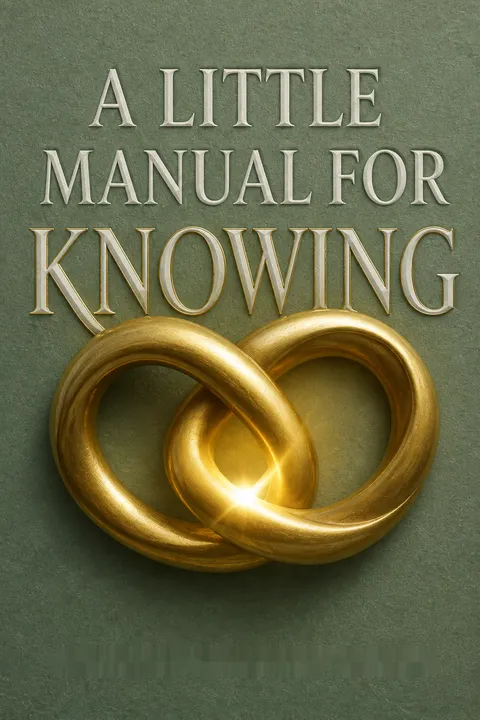

Key Takeaways
1. Knowing Begins with Love and Desire
Only when we first love do we begin to attend, to listen, to understand, to know.
Challenge assumptions. Many believe knowledge is merely collecting impersonal information, facts, or data. This "knowledge-as-information" view, however, is defective and damaging, distorting reality and hindering true knowing. It fails to explain discovery, learning, or creative insight, reducing reality to passive bits rather than a dynamic, multi-faceted gift. This manual proposes an "epistemological therapy" to reorient our understanding.
Reality as gift. Instead of impersonal data, reality is fundamentally a gift, person-like, dynamic, and full of mystery. This perspective, though seemingly theological, is deeply practical. Just as Captain Kirk discovered the Horta was a being, not a boulder, shifting our view of reality from impersonal to personal transforms our relationship with it. This "gift" nature of reality, with its inherent "oughtness" and normative features, suggests a covenantal, interpersonal core, where love is central.
Love to know. If reality is a gift rooted in love, then knowing must be a responsive gesture of love. This "loving-to-know" approach taps into desire, wonder, and self-giving, which the information-centric view ignores. It involves an "active receptivity"—a humble, pledged self-giving that welcomes the hidden real. This journey begins with noticing and wonder, a response to reality's initial overture, and requires cultivating a posture of readiness to be astounded.
2. Pledge Your Commitment to the Yet-to-Be-Known
To pledge is to say “I do” to the knowing venture.
Commitment, not curiosity. Any true knowing venture demands personal responsibility and commitment, a "pledge" to what is not yet fully known. Unlike indifferent curiosity, this commitment is a sophisticated act of choice, binding oneself in a covenant with the unknown. The "knowledge-as-information" model, which only values clear, explicit data, completely misses this crucial step, leaving individuals unprepared for the non-linear, transformative nature of discovery.
Risk and trust. Pledging to the unknown is inherently risky, requiring a fundamental trust in reality's dynamic, generous, and love-responsive nature. It's not a bargain but a wholehearted commitment, accepting the possibility of being mistaken or appearing foolish. This pledge involves:
- Giving oneself to the yet-to-be-known.
- Consenting to its being, even if different from expectations.
- Living life on its terms, developing attentiveness.
- Committing to the necessary work, time, and skill acquisition.
- Opening oneself to personal transformation without pre-defining it.
- Granting hospitable space for its truthful self-disclosure.
Troth and truth. The concept of "truth" is deeply linked to "troth"—a solemn pledge of faithfulness in relationship. This connection highlights that pledge and trust are the central nerve of knowing. Whether in college, business, art, or self-discovery, making this personal "I do" is essential. Without it, education falters, ventures lack depth, and true understanding remains elusive.
3. Cultivate Readiness and Hospitably Invite Reality
To be held in regard by another person, to see that regard reflected in a gaze or in caring words of commendation, is the communion that calls us to be fully persons.
Maturity in love. Great knowing ventures are shaped by the knower's readiness, which is essentially a matter of maturity in love. This maturation is fostered through communion with others, as we grow into our self-awareness through their loving gaze and affirming pronouncements. Healing from past hurts, curses, or betrayals is also part of this path, as distrust impedes the critical trust needed for knowing.
Embrace the Void. Humanness involves more than just coping with our situation; it includes the "Void"—the deep realization of our potential non-being or felt need. This sense of absence fuels wonder and gratitude. The healing path requires embracing this Void, admitting our need, and crying out for "new being"—the "Holy," a fourth dimension of humanness that comes graciously from beyond us. This process of moving from need to hope is a key act of inviting the real.
Presence and felt body sense. Maturation in love brings "presence"—a centered, peaceful sense of self that grants otherness to others, essential for healthy knowing. This involves our "felt body sense," which is often overlooked by the knowledge-as-information model. We don't just process data; we indwell and feel responses, relying on our "gut" for clues. Cultivating this felt body sense through any activity, from athletics to quiet reflection, enhances our capacity for creative, imaginative engagement and virtuosity in knowing.
4. Indwell Clues Subsidiarily to Achieve Insight
Anything we are focally aware of is rooted in an awareness that is not focal.
Beyond information. The "knowledge-as-information" view fails because true knowing is far more complex than collecting clear, verbalized data. It cannot explain how we move from not knowing to knowing. Instead, knowing operates through "subsidiary-focal integration" (SFI), where most of our understanding—the most important part—operates tacitly, below the surface of focal awareness.
Subsidiary-focal integration (SFI). In SFI, we don't focus on everything we know; we attend from subsidiary clues to shape a complex focal pattern. For example, when reading, we attend from the sentences (subsidiary) to grasp the meaning (focal). Subsidiaries are tacit, palpable, and rooted in our embodiment, anchoring the knower centrally. They are not subjective or private, but the working out of responsible personal commitment.
- Subsidiaries are:
- Our felt body sense (e.g., balance on a bike, feel of a hammer).
- Normative guides and frameworks (e.g., a coach's advice, theoretical models).
- The situation itself (the puzzle we want to understand).
- Integration is: An imaginative, creative synthesizing of these clues into a transformative, three-dimensional pattern that makes sense of the subsidiaries.
The shift to indwelling. Coming to know involves a dynamic struggle to shift from looking at disconnected particulars focally, to indwelling them subsidiarily as clues. This creative "scrabbling" is guided by a distant hope, a tantalizing sense of deeper meaning. Temporary focal analysis of subsidiaries (like practicing a golf swing) is crucial for growth, but it must be temporary, always returning to indwelling to achieve meaningful integration. This process, though uncomfortable and risky, is the heart of discovery and learning.
5. Insight is a Gracious, Transformative Encounter
The breakthrough insight is so lavish, profound, and superior that we easily see we could not have forced it, reasoned to it, or reached it on our own without gracious help from beyond us.
The "aha!" moment. After the struggle of indwelling, insight often arrives as an "aha!" moment—a sudden, transformative shift where puzzling particulars become transparent subsidiaries, revealing a deeper focal pattern. This epiphany is a breakthrough, a moment of discovery, artistic creation, or skill acquisition. It's not merely adding information but a qualitative leap that changes everything.
Signs of grace. The "aha!" moment is accompanied by a profound sense of:
- Happy conviction: That the integration is right and changes everything.
- Surprise and recognition: Anticipating the pattern yet finding it transformatively more than expected.
- Joy and delight: Epistemically significant responses signaling a gracious gift.
- Grace: A feeling that the insight is a gift from outside, unmerited by effort alone.
- Shift from active to passive: From knowing to being known, as reality generously breaks in.
- Contact with reality: A sense of connecting with a three-dimensionally bigger, dynamic reality.
I-You encounter. Epiphany is an "I-You" encounter, a mutual, personal giving where knower and known connect intimately. This experience reshapes our understanding of reality as dynamic, generous, and responsive to love. It also matures us in love, expanding our capacity for self-giving and fulfilling the "Holy" dimension of our humanness. This contact with reality is affirmed by "indeterminate future manifestations" (IFMs)—a sense of wonderful, yet unnamed, future possibilities that confirm the richness and inexhaustibility of the discovered truth.
6. Knowing Transforms the Knower, the Known, and Knowing Itself
Insight isn’t informational; it is transformational.
Knower transformed. Epiphany profoundly transforms the knower. It matures us in love, growing the "Holy" dimension of our humanness and making us "the I of I-You"—fully personed and ready for deeper relationship. Our felt body sense expands to incorporate new subsidiaries, integrating directions, and making sense of the world from a new outlook. This process expands our capacity, savvy, and wisdom, leading to greater confidence in knowing and inspiring others.
Reality transformed. The knowing event also transforms the known. When reality is heard and given a voice through insight, it breathes a sigh of relief, speaking truthfully and growing more fully into itself. This is "knowing for shalom"—good knowing practice fosters healing in the known, just as it does in the knower. The world itself becomes a place where such truths can exist, displaying a deeper rationality and revealing itself afresh as a gift.
Knowing transformed. Finally, epiphany transforms knowing itself. Each moment of insight refines our understanding of how knowing works, confirming that love, pledge, and relational engagement are central. It improves our epistemology, making us better at the art of knowing and more effective in all future ventures. This continuous transformation ensures that knowing is not a static accumulation but an ongoing, dynamic process of growth and deepening relationship.
7. Sustain Knowing Through the Dynamic of Dance
Each member of the dance gives, and then receives, to-and-fro, in moving relationship.
Knowing as dance. The knowing venture, from its inception to its ongoing development, can be understood as a "dance" between the knower and the known. This dynamic involves mutual overture and response, a back-and-forth, gentle, and artful unfolding of relationship. It helps us overcome the linear, one-way view of knowledge and fosters confidence in the give-and-take of discovery.
Asymmetry and rhythm. The dance is characterized by asymmetry, where partners take turns leaning in trust, giving and receiving without a tit-for-tat exchange. This dynamic keeps the relationship a gift, a series of gracious overtures and responses. The dance is also rhythmic, involving a cultivated subsidiary, felt body sense and skill. Embracing this rhythm brings peace and allows for increased output even under pressure, provided the "rules" of truth and integrity are upheld.
Relational health and artistry. The dance metaphor highlights relational health, balancing relatedness and individual particularity. In a healthy dance, each partner becomes more fully themselves, enhancing the relationship rather than being absorbed by it. This harmony, akin to psychological differentiation, allows both knower and known to thrive. Aspiring to this beautiful, artful dance, where each move is a gesture of hope and grace, makes us better knowers and fosters wisdom.
8. Know for Shalom: The Ultimate Goal is Peace and Communion
If we love in order to know, we know for shalom.
Beyond results. While the "knowledge-as-information" approach prioritizes quantifiable results, control, and power, the "loving-in-order-to-know" approach culminates in "shalom"—resolution, healing, relationship, and joy. This vision, actualized in every knowing venture, brings a profound peace that transcends the mere absence of conflict, offering creative resolution and harmony with the world.
Healing and communion. Knowing for shalom involves:
- Resolution: Insights resolve tensions, making peace among apparent contradictions and bringing harmony with the world.
- Healing: Knowing heals the knower through personal maturation and the gracious inbreaking of new being, and it heals the known by fostering its health and allowing it to be more fully itself.
- Communion: The ultimate goal is an ongoing, dynamic, joyous, and fruitful friendship with reality, not conquest or exhaustive information. This stewardly care ensures deepening understanding and mutual flourishing.
Beauty and joy. The shalom engendered by love-prompted knowing often involves beauty, as artful integrations bring aesthetic richness to the world. This beauty promises and evokes shalom, reinforcing the sense that "all will be well." Joy, often sidelined in results-driven pursuits, is an epistemic value in this approach, signaling a hospitable world where we are at home, growingly present to the patiently grown insight of love.
A smarter choice. The choice between "knowledge-as-information" (power, domination) and "loving-in-order-to-know" (communion, shalom) is a choice about effectiveness, but more fundamentally, about who we are as human persons. The latter, by engaging our whole selves, yields better knowers, truer results, and healthier fruit in the long run. It is a smarter investment strategy that aligns with a vision of reality as fundamentally about love and peace, a vision we choose to pledge our "troth" to.
Review Summary
Reviews for A Little Manual for Knowing are generally positive, averaging 3.81/5. Readers appreciate Meek's central argument that knowledge is more than information accumulation, instead framing knowing as a relational, loving venture. Her concept of "covenantal epistemology" and subsidiary-focal integration (SFI) are frequently praised as fresh and insightful. Many find the chapter-end exercises valuable. Common criticisms include unnecessarily dense or mystical language, insufficient examples, and concepts that can feel underdeveloped. Readers with philosophy backgrounds tend to engage more readily, while others find the writing style challenging to follow.
People Also Read






About the Author
Other books by Esther Lightcap Meek
Download PDF
Download EPUB
.epub digital book format is ideal for reading ebooks on phones, tablets, and e-readers.








































