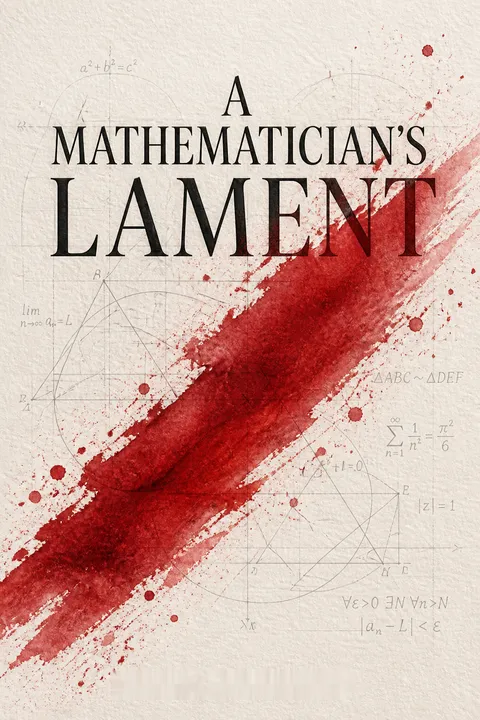

Key Takeaways
1. Mathematics is an Art, Not a Sterile Subject
The first thing to understand is that mathematics is an art.
Misunderstood art. Mathematics is fundamentally an art form, akin to music or painting, yet our culture fails to recognize it as such. While poets, painters, and musicians are celebrated for their creative expression, mathematicians are often mistakenly associated with science, seen merely as technical assistants for formulas or data processing. This widespread misconception obscures the true nature of mathematics.
Purest of arts. Mathematics is, in fact, profoundly poetic, radical, and mind-blowing, offering more freedom of expression than other arts constrained by the physical universe. Mathematicians are "makers of patterns" with ideas, preferring to think about the simplest, most imaginary things. This pursuit is driven by an aesthetic principle: simple is beautiful.
Imaginative play. At its core, mathematics is about wondering, playing, and amusing oneself with imagination. When a mathematician considers a triangle in a box, they are not thinking of physical objects, but perfect, imaginary creations. These creations, once defined, reveal their own inherent properties, compelling the mathematician to discover, not dictate, their truths.
2. Current Math Education Destroys Natural Curiosity
In fact, if I had to design a mechanism for the express purpose of destroying a child’s natural curiosity and love of pattern-making, I couldn’t possibly do as good a job as is currently being done—I simply wouldn’t have the imagination to come up with the kind of senseless, soul-crushing ideas that constitute contemporary mathematics education.
A terrible nightmare. The current system of mathematics education is likened to a nightmare where music or painting are reduced to mindless symbol manipulation or paint-by-numbers. Students are forced to memorize notation and rules without ever experiencing the art form itself, leading to boredom and a complete lack of engagement. This system is a cruel deprivation of a natural human expression.
Students are right. Politicians, schools, and educators offer various solutions, but they all miss the point. The only ones who truly understand the problem are the students themselves, who rightly declare, "Math class is stupid and boring." Their natural curiosity and love for pattern-making are systematically crushed by a curriculum devoid of meaning and creativity.
Self-perpetuating monster. This cultural problem is a self-perpetuating cycle: teachers learn pseudo-mathematics from their teachers, and students from them, creating an endless replication of misunderstanding. Those who excel at this "mindless manipulation of symbols" gain self-esteem, often discovering later they lack true mathematical talent, which is about raw creativity and aesthetic sensitivity, not following directions.
3. School Math Lacks Genuine Problems and Creative Engagement
By removing the creative process and leaving only the results of that process, you virtually guarantee that no one will have any real engagement with the subject.
No problems, only exercises. The main flaw in school mathematics is the absence of genuine problems, replaced by insipid "exercises." Students are given formulas and told to apply them repeatedly, eliminating the thrill of discovery, the joy, and even the frustration of the creative act. The question is asked and answered simultaneously, leaving nothing for the student to do.
Art of explanation. Mathematics is the art of explanation, not merely a collection of facts. The beauty lies not in the "truth" itself, but in the argument, the creative process of invention and discovery. Denying students the opportunity to pose their own problems, make conjectures, be wrong, or craft their own explanations is to deny them mathematics itself.
Lost inspiration. Presenting only the results of mathematical creation, like the triangle area formula, without the underlying creative process, is akin to describing Michelangelo's sculpture without letting one see it. It removes any chance for inspiration or real engagement. The focus on "what" without "why" reduces mathematics to an empty shell, devoid of its context and meaning.
4. The Standard Curriculum is a Rigid, Fragmented "Ladder to Nowhere"
Far from being disturbed and upset by this Orwellian state of affairs, most people have simply accepted this standard model math curriculum as being synonymous with math itself.
Orwellian rigidity. The most striking feature of the mathematics curriculum is its extreme rigidity, with the same topics taught in the same way and order across schools, cities, and states. This uniformity is mistakenly accepted as synonymous with mathematics itself, reinforcing the "ladder myth" that math is a sequential race where students are either "ahead" or "behind."
Fragmented collection. This ladder myth creates a sad race to nowhere, cheating students out of a true mathematical education. Real mathematics is organic and problem-driven, not a canned sequence of "Algebra II ideas." The curriculum, lacking historical perspective or thematic coherence, becomes a fragmented collection of topics united only by their ease of reduction to step-by-step procedures.
Unmotivated definitions. Instead of discovery, students encounter rules and unmotivated definitions, like the "negative exponent rule" presented without aesthetic rationale or the fact that it's a choice. Pointless nomenclature, such as "mixed number" versus "improper fraction," clutters classes, serving only to provide testable jargon rather than fostering genuine mathematical understanding or critical thinking.
5. High School Geometry Undermines Intuition with Artificial Proofs
All metaphor aside, geometry class is by far the most mentally and emotionally destructive component of the entire K-12 mathematics curriculum.
Insidious virus. High school geometry, despite posing as an introduction to mathematical reasoning, is a "virus" that attacks the heart of creative argument. It systematically undermines students' natural intuition about shapes and patterns through an onslaught of pointless definitions, propositions, and a rigid, artificial format for "formal geometric proof."
Tortured art. This course openly and cruelly tortures the beautiful art of mathematics. Simple, obvious observations, like vertically opposite angles being equal, are subjected to lengthy, bureaucratic, and soulless "proofs" that make students doubt their own intuition. This pedantry forces students to adopt a stilted, hieroglyphic language, rather than engaging in witty, enjoyable arguments.
Misplaced rigor. While formal proof has its place, it is not for a student's first introduction to mathematical argument. Rigor becomes crucial when intuition fails or paradoxes arise, but not as excessive preventative hygiene for the obvious. This approach creates barriers to intuition, making simple things complicated, and completely misunderstands the mathematical enterprise, which aims to remove obstacles and keep things simple.
6. True Mathematical Proof is a Beautiful, Explanatory Revelation
A proof should be an epiphany from the gods, not a coded message from the Pentagon.
Poem of reason. A mathematical argument, or proof, is a work of fiction, a poem, whose goal is to satisfy. A beautiful proof should explain clearly, deeply, and elegantly, refreshing the spirit and illuminating the mind. It is a "poem of reason" that must appease a "Two-Headed Monster" of criticism: one head demanding logical airtightness, the other seeking simple beauty and elegance.
Mystery melts away. The goal of a mathematician is to explain in the simplest, most elegant, and logically satisfying way possible, making the mystery melt away to reveal a simple, crystalline truth. This process is not about persuading others like a lawyer or testing theories like a scientist; it is a unique art form within rational science, requiring inspiration and epiphany.
Transformative power. The discovery of a proof, like the elegant L-shape explanation for the sum of odd numbers being squares, can feel like a "divine revelation." This experience of glimpsing a secret, underlying truth is what keeps mathematicians engaged. It is a transformative power, fundamentally changing one's intuition and understanding of mathematical objects.
7. Mathematical Objects are Imaginary Entities with Intrinsic Behaviors
To me the important step is not the move from rocks to symbols, it’s the transition from quantity to entity—the conception of five and seven not as amounts of something but as beings, like hamsters, which have features and behavior.
Beyond symbols. Mathematical objects, like numbers, are not merely symbols or quantities, but imaginary entities with intrinsic properties and behaviors. Just as a field biologist studies hamsters, mathematicians observe these "creatures" in their "natural habitat" (imaginary piles of rocks), focusing on what they are and do, rather than their arbitrary names or representations.
Aesthetic choices. The "rules" of arithmetic are consequences of aesthetic choices made by mathematicians to "improve" their imaginary structures. For instance, negative numbers and fractions were invented to create symmetry in operations like subtraction and division, transforming "eight take away five" into "eight plus negative five," simplifying the system to a single operation: adding.
Freedom to invent. In Mathematical Reality, there are no rules or restrictions beyond those we impose. Mathematicians are free to invent new structures, like projective geometry's "points at infinity" to eliminate parallel lines, as long as they are consistent and interesting. This freedom allows for the creation of patterns that are not only beautiful but also challenging to the mind.
8. Mathematicians Explore "Mathematical Reality" for Joy and Understanding
This is of course an imaginary place, a landscape of elegant, fanciful structures, inhabited by wonderful, imaginary creatures who engage in all sorts of fascinating and curious behaviors.
A compelling jungle. Being a mathematician is akin to being a field biologist exploring a tropical jungle, but instead of Costa Rica, it's "Mathematical Reality." This landscape is filled with strange creatures and interesting behaviors, like the pattern of consecutive odd numbers summing to squares. Mathematicians are drawn to these patterns, seeking to understand why they occur, not just that they occur.
Pure amusement. The primary motivation for mathematicians is pure enjoyment and amusement. They build and discover delightful structures, observe patterns, and craft elegant narratives to explain their behavior. This pursuit is not for practical or economic value; it is a dialogue with one's own mentality, a perfectly innocent and delightful activity of the human mind.
Transcending utility. While mathematics can have practical applications, its true value transcends mundane considerations. Just as music is not written to lead armies into battle, mathematics is not primarily for science or technology. Its worth lies in the fun, amazement, and joy it brings, offering a means of escape and a profound way to engage with the human mind.
9. The Value of Mathematics is its Intrinsic Beauty and Transformative Power
Nothing I have ever seen or done comes close to having the transformative power of math.
Mind-blowing experience. Mathematics offers a unique transformative power, capable of blowing one's mind daily. The discovery of a hidden structure, like the L-shapes within squares, provides a feeling of divine revelation, a glimpse of a secret underlying truth. This experience goes to the heart of what it means to be human.
Quintessentially human. Mathematics, as the art of abstract pattern-making, is arguably our most quintessentially human art form. Our brains are biochemical pattern-recognition machines, and mathematics is the distilled essence of this innate capability. It is a terrifyingly simple yet profound engagement with the fundamental workings of our own minds.
Beyond facts. The true value of mathematics lies not in its "truths" or facts, but in the process of discovery, explanation, and analysis. Mathematical truths are merely incidental by-products of these activities. Like painting, the art is in the doing, the experience with the ideas, not just the finished product hanging in a museum.
10. Teaching Math Requires Intellectual Honesty and Fostering Discovery
Teaching is not about information. It’s about having an honest intellectual relationship with your students.
No method needed. Effective teaching in mathematics requires no specific method, tools, or training; it simply demands the ability to be real and have an honest intellectual relationship with students. If teachers are unwilling to be real people, sharing excitement and wonder, they have no right to inflict themselves upon innocent children.
Guide, don't dictate. Teachers should guide students through engaging problems, allowing them time to make discoveries, formulate conjectures, and refine arguments. This means being flexible and open to students' curiosity, fostering an atmosphere of vibrant mathematical criticism. Specific techniques should arise naturally from this process, as they did historically.
Trust students' capacity. Students are not aliens; they respond to beauty and pattern and are naturally curious. They are capable of creative reasoning, just as they are capable of writing history papers or essays about Shakespeare. The problem is often that teachers themselves have never experienced true mathematics, having been trained in a system that lacks it.
Review Summary
A Mathematician's Lament is a passionate critique of math education, arguing that math should be taught as an art form rather than a set of rote procedures. Many readers found it eye-opening and inspiring, praising Lockhart's argument that math is creative and beautiful. Some appreciated his humor and engaging writing style. Critics felt he offered few practical solutions and was dismissive of real-world applications. Overall, the book sparked reflection on how math is taught and understood, with many wishing they had been exposed to this perspective earlier.
People Also Read
FAQ
1. What is "A Mathematician’s Lament" by Paul Lockhart about?
- Critique of Math Education: The book is a passionate critique of how mathematics is taught in schools, arguing that the current system destroys creativity and curiosity.
- Mathematics as Art: Lockhart asserts that mathematics is an imaginative and creative art form, not just a set of rules or formulas.
- Contrast with Other Arts: He draws analogies to music and painting, showing how math is stripped of its artistic essence in education.
- Call for Reform: The book advocates for a radical rethinking of math education, focusing on discovery, play, and genuine problem-solving.
2. Why should I read "A Mathematician’s Lament" by Paul Lockhart?
- Fresh Perspective: It offers a unique, insider’s view from a mathematician who became a K-12 teacher, blending expertise with classroom experience.
- Inspiration for Educators and Parents: The book is recommended for anyone involved in education, especially those frustrated with traditional math teaching.
- Rekindling Curiosity: Readers gain insight into the beauty and joy of mathematics, potentially transforming their own or their children’s relationship with the subject.
- Provocative and Eloquent: Lockhart’s writing is passionate, witty, and thought-provoking, making it engaging even for those who disliked math in school.
3. What are the key takeaways from "A Mathematician’s Lament" by Paul Lockhart?
- Math is an Art: Mathematics should be seen and taught as a creative, imaginative pursuit, not as rote memorization or mechanical procedures.
- Current Curriculum is Harmful: The standard math curriculum is rigid, uninspired, and often counterproductive, stifling genuine mathematical thinking.
- Discovery Over Drills: True mathematical understanding comes from exploring problems, making conjectures, and crafting explanations, not from repetitive exercises.
- Teachers as Artists: Effective math teaching requires teachers who appreciate and practice mathematics as an art, guiding students through exploration rather than dictation.
4. How does Paul Lockhart define mathematics in "A Mathematician’s Lament"?
- Art of Pattern-Making: Lockhart defines mathematics as the art of making patterns with ideas, akin to composing music or painting.
- Imagination and Play: He emphasizes that mathematics is about playing with imaginary objects and asking questions about them.
- Beauty and Explanation: The essence of mathematics lies in crafting beautiful explanations and arguments, not in memorizing facts.
- Freedom of Creation: Mathematicians are free to invent and explore within their own imaginative worlds, constrained only by logical consistency.
5. What are the main problems with the way mathematics is taught in schools, according to "A Mathematician’s Lament"?
- Lack of Creativity: The current system removes the creative process, reducing math to memorization and symbol manipulation.
- Absence of Real Problems: Students rarely encounter genuine mathematical problems; instead, they are given repetitive exercises with predetermined solutions.
- Overemphasis on Rigor and Notation: Formalism and jargon are introduced too early, stifling intuition and curiosity.
- Teacher Preparation: Many teachers lack a true understanding or appreciation of mathematics as an art, perpetuating a cycle of uninspired teaching.
6. How does "A Mathematician’s Lament" by Paul Lockhart compare mathematics to other art forms?
- Analogies to Music and Painting: Lockhart uses vivid analogies, imagining a world where music and painting are taught as mindless symbol manipulation, paralleling math education.
- Loss of Expression: Just as it would be absurd to teach music without playing or painting without painting, teaching math without creative exploration is equally misguided.
- Cultural Misunderstanding: Society recognizes the artistic value of music and painting but fails to see mathematics in the same light.
- Artistic Process: He argues that, like other arts, mathematics involves inspiration, experimentation, and personal expression.
7. What specific advice does Paul Lockhart give for improving math education in "A Mathematician’s Lament"?
- Focus on Problems and Play: Teachers should present students with engaging, open-ended problems and encourage playful exploration.
- Encourage Discovery: Allow students to make conjectures, struggle, and find their own explanations, rather than providing answers upfront.
- De-emphasize Rote Learning: Reduce emphasis on memorization, drills, and standardized testing in favor of creative thinking.
- Teacher Engagement: Teachers should be active mathematical thinkers themselves, sharing their excitement and curiosity with students.
8. What is the "ladder myth" in mathematics education, as discussed in "A Mathematician’s Lament"?
- Sequential Misconception: The "ladder myth" is the belief that mathematics consists of a strict sequence of subjects, each more advanced than the last.
- Race to Nowhere: This myth turns math education into a competitive race, with students worried about being "ahead" or "behind."
- Fragmented Curriculum: It leads to a fragmented, rigid curriculum lacking thematic unity or historical context.
- Art is Not a Race: Lockhart argues that real mathematics is organic and interconnected, not a linear progression of topics.
9. How does "A Mathematician’s Lament" critique the teaching of high school geometry?
- False Promise of Proof: While geometry is supposed to introduce students to mathematical reasoning, it often devolves into rigid, bureaucratic proof formats.
- Stifling Intuition: The focus on formalism and notation undermines students’ natural intuition and curiosity about shapes and patterns.
- Lack of Creativity: Students are trained to mimic proofs rather than create their own arguments or explore geometric ideas.
- Missed Opportunities: Lockhart provides examples of how genuine exploration and student-generated proofs can be far more meaningful and satisfying.
10. What does Paul Lockhart mean by "mathematics is about problems," and how should this shape teaching?
- Centrality of Problems: Mathematics is fundamentally about engaging with interesting, challenging problems, not about memorizing solutions.
- Process Over Product: The journey of exploring, conjecturing, and explaining is more important than the final answer.
- Historical Context: Many mathematical concepts arose from real problems, and teaching should reflect this context.
- Student Involvement: Students should be active participants in problem-solving, developing their own definitions, conjectures, and proofs.
11. What are some examples of mathematical beauty and creativity highlighted in "A Mathematician’s Lament"?
- Odd Numbers and Squares: Lockhart explores the pattern that the sum of consecutive odd numbers forms perfect squares, illustrating the joy of discovery and explanation.
- Shortest Path Problem: He presents the geometric problem of finding the shortest path touching a line, showcasing elegant reasoning through reflection.
- Prime Numbers: The book discusses the mystery and intrigue of prime numbers, including unsolved problems like the twin prime conjecture.
- Student Discoveries: Lockhart shares examples of student-generated proofs and insights, emphasizing the value of personal mathematical creation.
12. What are the best quotes from "A Mathematician’s Lament" by Paul Lockhart, and what do they mean?
- "Mathematics is the music of reason." – This encapsulates Lockhart’s view of math as an expressive, creative art form, akin to music.
- "Mathematics is the art of explanation." – The heart of math lies in crafting beautiful, satisfying explanations, not in memorizing facts.
- "If you deny students the opportunity to engage in this activity... you deny them mathematics itself." – Lockhart stresses that without creative engagement, students are deprived of true mathematics.
- "You don’t need to make math interesting—it’s already more interesting than we can handle!" – He argues that math’s inherent beauty and intrigue are enough, if only teaching would allow it to shine.
- "Just play! You don’t need a license to do math." – Lockhart encourages everyone to explore mathematics freely, emphasizing its accessibility and joy.
Download PDF
Download EPUB
.epub digital book format is ideal for reading ebooks on phones, tablets, and e-readers.








































