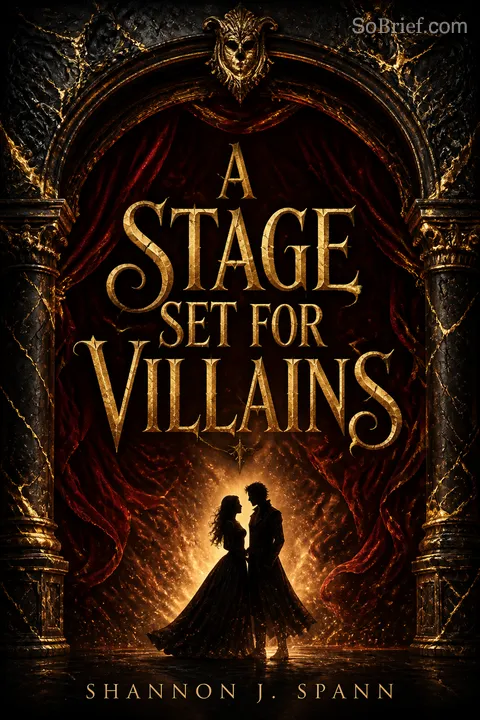
Plot Summary
Overture: Rules for Survival
Riven Hesper, eight years old, stands in line to be marked for protection against the Players—immortal, godlike actors who manipulate reality and crave adoration. Her brother Galen quizzes her on the three rules to survive an encounter: never look a Player in the eye, pay three compliments, and give a gift. But when a Player attacks the courthouse, Riven is drawn into her power, nearly abducted, and only escapes by stabbing the Player with Eleutheraen gold—poisonous to their kind. The Player's golden blood marks Riven, cursing her with a slow, mysterious decay. The trauma and the Player's whispered threat—"Come with me or you will suffer"—haunt Riven, setting the stage for a life defined by fear, anger, and the shadow of the Playhouse.
Marked by Golden Blood
The Playhouse, long absent, announces its return, and the city of Theatron is thrown into panic. Riven, now a teenager, is shunned as "cursed" by Player magic, her body wasting away. She dreams of escape through study at the Orkestrian Academy, but her brother Galen—now a council advisor—raises doubts about her health and safety, ultimately sabotaging her acceptance. Riven's anger and isolation deepen, fueled by the stigma of her curse and the memory of her father, a murdered Peacemaker. The Playhouse's return is both a threat and a strange, magnetic pull, as Riven's fate becomes entwined with the monsters she was raised to fear.
The Playhouse Returns
As the magical theater erupts from the earth, the city divides—Revelers flock to worship, while the marked flee. Riven witnesses the spectacle with dread and fascination, feeling the Playhouse's call in her bones. The director, Silenus, announces a new casting call and the Great Dionysia—a festival where mortals compete to become Players. The city's fragile peace shatters, and Riven's family is swept into political turmoil. The Playhouse's arrival is not just a performance; it is an invasion, a test of the boundaries between mortals and monsters, truth and illusion.
Cursed and Cast Out
Rejected by her family, shunned by society, and denied her future, Riven's anger becomes her armor. She is drawn to the Playhouse at night, where she is attacked by Revelers and only saved by the intervention of Silenus. Injured and desperate, she enters the Playhouse seeking healing—and perhaps a cure for her curse. Inside, she is awed by the beauty and horror of the Players' world, a palace of mirrors and stories. But she is also hunted, her mark both a shield and a target, as she stumbles into the heart of the Playhouse's deadly games.
The Great Casting Call
Mistaken for an auditionee, Riven is swept into the casting call for the Great Dionysia. She meets Jude, the enigmatic Lead Player, who recognizes her as marked and dangerous. Jude proposes a deal: if Riven survives the competition, he will help her find a cure for her curse. But the bargain is a trap—Jude needs Riven to sabotage the festival, ensuring his own survival. As Riven is forced to compete, she navigates a labyrinth of rival auditionees, manipulative Players, and the ever-present threat of exposure. The Playhouse is a cage, and every performance is a fight for her life.
Bargains with Monsters
Riven's training with Jude is fraught with tension, attraction, and betrayal. She learns the Players' secrets: Craft, the magic of performance; Reality Suspension, the art of cheating death; and Mimicry, the power to become anyone. The Players are not gods, but mortals who traded their humanity for immortality and applause. Riven's mark, once her protection, becomes a liability—she must choose whether to destroy it and embrace the Players' power, or cling to her fading humanity. As the festival approaches, Riven's anger and ambition grow, and she begins to question who the real villains are: the Players, the mortals, or herself.
Poisoned by Craft
Riven's body and mind are transformed by Craft, the Players' magic. Her curse is not a punishment, but a symptom of her true nature—she is becoming a Player herself. The more she uses Craft, the more she loses her memories, her sense of self, and her ability to distinguish truth from illusion. The Playhouse feeds on stories, and Riven is both author and character, trapped in a narrative she cannot control. Her relationships—with Jude, with her castmates, with her own past—fracture as the line between performance and reality blurs. The only way out may be through the very magic that is destroying her.
The Lead Player's Game
Jude is not just a Player, but the architect of Riven's fate. He knows her true name, her origins, and the role she was cast to play. Their relationship is a dance of love, rivalry, and mutual destruction. As the Great Dionysia begins, Riven learns the truth: she is not a victim, but a weapon planted in the North to bring down the walls between mortals and Players. Jude's loyalty is torn between protecting Riven and fulfilling his own scripted destiny. Together, they must decide whether to defy the Script—or be destroyed by it.
The Script and the Stage
The Script, a magical book held by Silenus, controls the fate of every Player, every story, every life. The Players are not free; they are characters, bound to roles written centuries ago. Breaking the Script means breaking the world—and themselves. Riven and Jude's awareness of their own fiction is both a curse and a weapon. As the Playhouse prepares for its final performance, the boundaries between actor and audience, truth and story, collapse. The only hope for freedom lies in rewriting the Script, but doing so may cost everything they have left.
Breaking the Fourth Wall
As Riven and Jude break their fourth walls, they begin to unravel—not just as characters, but as people. Their memories, bodies, and identities peel away, revealing the ancient Players beneath. The Playhouse itself begins to collapse, its illusions failing as the truth seeps in. The other Players, awakened to their own nature, must choose whether to cling to their roles or join Riven in rebellion. The cost of freedom is self-destruction, but the cost of obedience is eternal imprisonment. The stage is set for a final, catastrophic act.
The Truth of Characters
She is not the daughter of the Peacemaker, but a Player planted in the North to bridge the worlds. Her entire life has been a script, her relationships and memories crafted for a purpose. Silenus, the mortal director, is revealed as the true villain—a man who stole the power of gods and caged the Players for his own glory. The Great Dionysia is not a competition, but a ritual to maintain the Playhouse's power. Riven must decide whether to accept her role or destroy the Script, even if it means losing herself and Jude forever.
The Great Dionysia Begins
The festival erupts in spectacle and violence. Riven and Jude are forced into the arena, their battle both literal and symbolic—a fight for the right to define their own story. The audience, the council, and the world watch as the Players' illusions shatter and the truth is laid bare. Riven's plan to free the Players and return Craft to the world hinges on a single, impossible act: destroying the Script and the Playhouse itself. The cost will be high, and not everyone will survive.
The Arena of Illusions
Riven and Jude duel through layers of illusion, each trying to force the other to play their part. Their love and hatred, their shared history and mutual betrayal, fuel a performance that threatens to tear reality apart. The Playhouse expands, cracks, and collapses as the audience flees. Riven's castmates, awakened to their true selves, join her in rebellion. The only way to break the cycle is to return to the well at Eleutherae—the Players' true home—and give back what was stolen.
The Finale: Comedy or Tragedy
Riven and Jude reach the well, pursued by Silenus and the monstrous Nyxene. Jude sacrifices himself to buy time, luring Nyxene away so Riven can destroy the Script with Eleutheraen gold. In a final act of defiance, Riven forgives herself, her anger, and her role, breaking the bond between character and Player. The Playhouse burns, the Script is destroyed, and the Players are freed to return to the world as stories, not prisoners. The cycle of tragedy is broken, but at the cost of everything they once were.
The Well at Eleutherae
The Players return to the well, their true origin, and vanish into its golden light. The Playhouse is gone, but its legacy remains—stories, music, and color return to the world. The marks that once protected and divided mortals fade, and the obsession of the Revelers lifts. The world is changed, not by violence, but by the restoration of what was lost. Riven and Jude's love endures, not as a script, but as a memory, a promise to find each other in every new story.
The Price of Freedom
The world struggles to make sense of the Playhouse's disappearance. Rumors of hauntings, miracles, and new stories spread. The Players are gone, but their influence lingers in every theater, every tale, every child's song. Riven, Jude, and their castmates become legends, their faces and names shifting with each retelling. The price of freedom is uncertainty, but also possibility—the chance to write new stories, to choose new roles, to live beyond the boundaries of the Script.
Curtain Call: Stories Set Free
In a modern theater, a new play is performed—anonymously penned, but unmistakably the story of the Playhouse and its Players. Riven, Jude, and their friends watch from the audience, their faces changed but their spirits the same. The world has moved on, but the magic of story endures. The curtain falls, the applause rises, and the Players slip away into legend, ready to begin again—if not in this life, then in the next.
Analysis
A Stage Set for Villains is a dark, dazzling meditation on the power of story, the dangers of control, and the longing for freedom and belonging. In a world where gods have been replaced by immortal actors, and truth is both weapon and curse, the novel interrogates the roles we are given and the ones we choose. Riven's journey—from cursed outcast to self-aware rebel—mirrors the reader's own struggle to find meaning in a world shaped by narrative, expectation, and performance. The Playhouse is both a literal prison and a metaphor for the stories that bind us, the scripts we inherit, and the possibility of rewriting our fate. The novel's meta-narrative structure, its use of Craft as both magic and metaphor, and its exploration of identity, love, and sacrifice make it a powerful commentary on art, agency, and the human need for connection. Ultimately, A Stage Set for Villains suggests that freedom is not the absence of story, but the courage to claim authorship—to forgive, to love, and to begin again, even if only in the next life, the next role, the next telling.
Review Summary
A Stage Set for Villains receives widespread praise for its highly unique theatre-based magic system, clever structure, and atmospheric world-building. Many readers highlight the compelling dynamic between Riven and Jude, memorable twists, and the immersive integration of acting techniques into the story. Common criticisms include a slow middle section, occasionally confusing world-building and magic rules, and some readers finding Riven unlikeable. Comparisons to Caraval appear frequently. The book's standalone status and strong debut quality are repeatedly noted, with most readers eagerly anticipating the author's future work.
People Also Read

Characters
Riven Hesper
Riven is introduced as a marked outcast, haunted by a childhood encounter with a Player that left her poisoned by golden blood. Her life is defined by anger, isolation, and a desperate longing for belonging and truth. Psychoanalytically, Riven's journey is one of self-discovery and self-forgiveness—her anger both a shield and a wound. She is fiercely intelligent, stubborn, and compassionate beneath her defenses. As she learns the truth of her origins—that she is a Player planted in the North, her life scripted for a purpose—Riven must choose between obedience and rebellion, self-destruction and freedom. Her relationship with Jude is central: a dance of love, rivalry, and mutual salvation. Riven's arc is about breaking free from roles imposed by others, reclaiming agency, and redefining what it means to be real.
Jude Stepharros
Jude is the Playhouse's enigmatic star, both charming and dangerous, a master of Craft and manipulation. He is haunted by guilt, loyalty, and the burden of knowledge—aware of his own fiction, yet trapped by it. Jude's relationship with Riven is complex: he is both her captor and her protector, her rival and her soulmate. His motivations are tangled in love, ambition, and the fear of losing himself. As his fourth wall breaks, Jude deteriorates, his identity peeling away to reveal the ancient Player beneath. His ultimate sacrifice—luring Nyxene away so Riven can destroy the Script—cements his role as both villain and hero, a figure defined by choice rather than destiny. Jude's arc is about the cost of power, the pain of self-awareness, and the hope of reunion beyond the stage.
Silenus Darstellar
Silenus is the Playhouse's director, a mortal who stole the power of gods and caged the Players for his own glory. He wields the Script, controlling every story, every life, every fate. Silenus is both charismatic and monstrous, a figure of paternal affection and ruthless manipulation. His psychoanalysis reveals a deep insecurity and hunger for control—he fears irrelevance, and so binds others to his will. Silenus's relationship to Riven and Jude is that of creator and destroyer, father and executioner. His downfall comes from underestimating the power of self-awareness and the resilience of those he sought to control.
Galen Hesper
Galen is Riven's older brother, a council advisor who tries to shield her from the dangers of the Playhouse and her own curse. He is rational, loyal, and burdened by the legacy of their father, the Peacemaker. Galen's psychoanalysis centers on his inability to let go—his love for Riven is both a comfort and a chain. His death at the hands of the council's enforcer is a turning point, shattering Riven's last ties to her mortal life and fueling her rebellion. Galen represents the cost of fear and the tragedy of good intentions.
Mattia
Mattia is a formidable Player, skilled in Tragedy and the deathless arts. She is both mentor and adversary to Riven, embodying the dangers and temptations of immortality. Mattia's psychoanalysis reveals a deep weariness and longing for release—she has seen countless cycles of violence and loss. Her eventual alliance with Riven signals the possibility of change, even for those most entrenched in the Playhouse's ways.
Titus
Titus is brash, powerful, and often the loudest voice in the room. He masks his fear and vulnerability with humor and bravado. Titus's relationship with Riven is antagonistic but ultimately supportive—he is the first to join her rebellion, eager for a new story. His psychoanalysis reveals the fragility beneath the armor, the longing for meaning beyond endless performance.
Arius
Arius is skilled in Compulsion and Mimicry, a master of both healing and deception. He is the most introspective of the Players, haunted by past choices and the weight of immortality. Arius's relationship with Riven is one of cautious trust—he is the first to follow her out of the Playhouse, seeking redemption. His psychoanalysis centers on the tension between creation and destruction, the desire to mend what has been broken.
Parrish
Parrish is mischievous, unpredictable, and fascinated by the world's oddities. She is both comic relief and a reminder of the Players' capacity for cruelty. Parrish's psychoanalysis reveals a deep-seated envy and longing for connection—she hoards objects and stories to fill the void. Her alliance with Riven is driven by curiosity and the hope of something new.
Sil's Cast (Cicero, Cora, Stagehands)
The supporting cast—costume designers, stagehands, and former auditionees—are revealed as Players in disguise, each with their own history and longing for freedom. Their psychoanalysis centers on the loss of identity and the hope of reunion. Their decision to follow Riven out of the Playhouse is an act of collective rebellion, a testament to the power of shared story.
Nyxene
Nyxene is the Playhouse's monstrous guardian, a creature of shadow and punishment. She enforces the rules, destroys those who break the fourth wall, and serves as Silenus's ultimate weapon. Nyxene's psychoanalysis is that of the superego—she is the consequence of transgression, the price of awareness. Her presence is both a threat and a catalyst, driving the Players to risk everything for freedom.
Plot Devices
The Script
The Script is the central plot device—a magical book that dictates every Player's role, every story, every outcome. It is both a literal object and a metaphor for narrative control, authorial power, and the boundaries of free will. The Script's presence allows for meta-narrative commentary, breaking the fourth wall and inviting characters (and readers) to question the nature of story, identity, and agency. Its destruction is both a plot climax and a symbolic act of liberation.
Craft and Reality Suspension
Craft is the Players' magic, fueled by attention, emotion, and story. Reality Suspension allows them to cheat death, transfer life, and manipulate perception. These devices serve as metaphors for the power of art, the dangers of self-deception, and the cost of immortality. They also structure the narrative—each performance is both a literal and figurative battle for survival, with the audience's belief as the ultimate weapon.
The Fourth Wall
Breaking the fourth wall is both a narrative device and a psychological crisis. As Riven and Jude become aware of their own fiction, they gain the power to rebel—but also risk self-destruction. The fourth wall's collapse is the story's turning point, forcing characters to confront the truth of their existence and the possibility of change.
Mirrors and Mimicry
Mirrors are portals, tools of Craft, and symbols of self-examination. Mimicry allows Players to become anyone, but at the cost of memory and selfhood. These devices explore themes of authenticity, transformation, and the masks we wear. They also enable plot twists, betrayals, and moments of revelation.
The Well at Eleutherae
The well is both the Players' birthplace and the site of their liberation. It represents the source of Craft, the possibility of renewal, and the hope of returning what was stolen. The journey to the well is both literal and metaphorical—a quest for home, truth, and freedom.
Meta-Narrative Structure
The novel's structure—acts, scenes, script tags, and curtain calls—reinforces its themes of performance, authorship, and the porous boundary between fiction and life. The final "Encore" places the characters in the audience of their own story, blurring the line between reader and character, past and present, tragedy and comedy.
Download PDF
Download EPUB
.epub digital book format is ideal for reading ebooks on phones, tablets, and e-readers.








































