
Key Takeaways
1. The human brain is a triune structure composed of three evolutionary layers
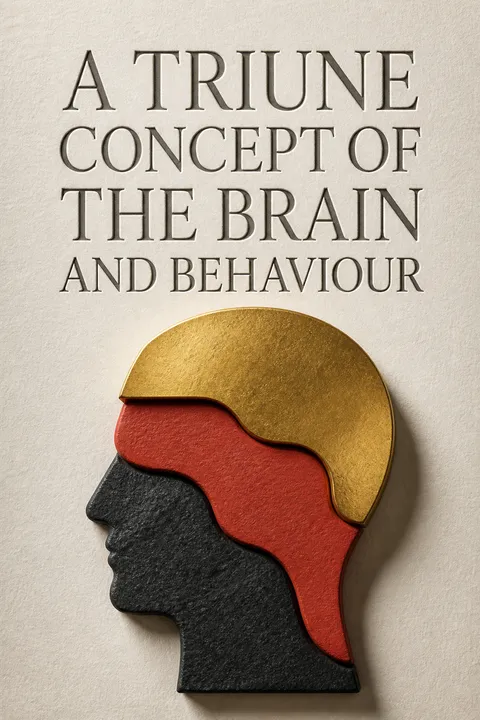
In its evolution the human brain expands along the lines of three prototypes for which I have used the terms reptilian, paleomammalian, and neomammalian.
Three brains in one. The human brain is not a single, unified entity but a hierarchical triune structure composed of three distinct evolutionary layers. Each layer possesses its own unique chemistry, structure, and subjective intelligence, yet they must all intermesh and communicate. This structural arrangement means that we carry within us the neural machinery of our evolutionary ancestors.
The evolutionary hierarchy. The three layers represent different stages of evolutionary history, stacked on top of one another:
- The reptilian brain (basal ganglia and brainstem) governs instinctual, ritualistic, and survival-based behaviors.
- The paleomammalian brain (limbic system) processes emotions, social motivations, and basic survival drives.
- The neomammalian brain (neocortex) enables abstract thought, language, logic, and reading, writing, and arithmetic.
The communication challenge. Because these three sub-brains operate like distinct biological computers, coordinating them is highly difficult. This structural and chemical divergence often leads to internal conflict, as our rational neocortex struggles to communicate with our inarticulate, emotional animal brains. Understanding this triune nature is essential for addressing the psychological tensions of modern life.
2. The reptilian brain governs instinctual, ritualistic, and precedent-bound behaviors
The reptilian brain seems to be hidebound by precedent.
Driven by precedent. The oldest part of our brain, inherited from reptiles, programs highly stereotyped, instinctual behaviors based on ancestral learning. It is deeply resistant to change, compelling us to follow established routines and proven pathways. This ancestral core prioritizes safety through rigid conformity over adaptive learning.
Instinctual survival behaviors. This ancestral core is responsible for critical survival functions that require no conscious thought:
- Establishing and defending physical territory.
- Engaging in social hierarchies and selecting leaders.
- Executing repetitive, ritualistic, and obsessive-compulsive behaviors.
- Performing species-specific courtship and mating displays.
The repetition compulsion. This neural matrix explains our deep-seated psychological urges to return to familiar frames of reference, which Freud termed the repetition-compulsion. It acts as an ancestral superego, prioritizing safety through rigid conformity over adaptive learning. When we feel a powerful urge to return to our childhood home or stick to familiar routines, we are operating under the influence of this ancient brain.
3. The limbic system processes emotions to balance self-preservation and species preservation
This brain plays an important role in elaborating emotional feelings that guide behaviour with respect to the two basic life principles of self-preservation and the preservation of the species.
The emotional border. The paleomammalian brain, or limbic system, forms a common denominator across all mammalian species, surrounding the brainstem like a border. It translates sensory inputs into rich emotional feelings that guide behavior toward survival. This system allows mammals to experience the world subjectively, moving beyond the rigid instincts of the reptile.
Functional subdivisions. The limbic system is organized into distinct functional pathways that manage different survival needs:
- The amygdala-connected pathway regulates self-preservation behaviors like feeding, fighting, and self-protection.
- The septal-connected pathway governs sociability, courtship, and species preservation.
- The mammillary-connected pathway links emotional states to memory and higher-level social planning.
The survival balance. These pathways ensure that an organism balances selfish survival needs with cooperative reproductive behaviors. Because oral and genital functions are anatomically linked in this ancient system, emotional expressions of aggression and sexuality are deeply intertwined. This close connection explains why fighting is so often a preliminary to mating in the animal kingdom.
4. Schizophysiology describes the profound functional and chemical split between emotion and reason
Nothing drives home so convincingly the functional dichotomy -or schizophysiology as I have called it -of the limbic and neocortical systems.
A divided mind. The term "schizophysiology" describes the profound functional and chemical split between the emotional limbic system and the rational neocortex. Because the limbic system lacks direct verbal communication channels, intellectual insight rarely cures deep-seated emotional disturbances. We can understand our problems intellectually while remaining entirely powerless to change how we feel.
Limbic epilepsy as a model. Irritative lesions in the limbic cortex, particularly the hippocampus, trigger localized seizures that do not spread to the neocortex. These discharges produce symptoms identical to those seen in endogenous psychoses:
- Intense feelings of terror, dread, or sudden familiarity (déjà vu).
- Distortions of time, space, and sensory perception.
- Feelings of depersonalization and paranoid delusions.
- Automatic, uncoordinated behaviors like chewing or running.
The vulnerable hippocampus. Due to its low seizure threshold and unique blood supply, the hippocampus is highly susceptible to stress, injury, and infection. Chronic emotional bombardment can destabilize this primitive cortex, leading to persistent delusional states. This vulnerability highlights the physical, neurological basis of many psychiatric disorders.
5. Human altruism evolved through a neurological shift from olfaction to vision
In the evolutionary process a concern for the welfare and the preservation of the species is based on sexuality.
From smell to sight. Primitive mammals rely heavily on olfaction, a narcissistic sense that keeps the animal focused on immediate, self-centered chemical tracks. In higher primates and humans, evolution shifted the sensory weight to vision, a futuristic and objective sense. This transition allowed us to move beyond immediate, self-centered survival toward long-term social planning.
The neural ladder. This sensory transition required a massive neurological reorganization to connect visual inputs directly to the emotional limbic system:
- The expansion of the medial thalamus and its connections to the prefrontal cortex.
- The development of visual pathways terminating in the parahippocampal cortex.
- The growth of the prefrontal neocortex, which provides foresight and planning.
The birth of altruism. By linking the cold, analytical sense of vision with the warm, subjective feelings of the limbic system, nature created the capacity for empathy. This evolutionary "visionary ladder" allows humans to project feelings onto others, transforming primitive sexual drives into genuine altruism. It is this system that enables us to build schools, hospitals, and societies.
6. Memory consolidation requires the cooperation of both arousal and limbic systems
Integrity of the limbic system in addition to a normally functioning arousal mechanism seems to be necessary for the consolidation of permanent engrams out of the short-term memory traces.
Memory and consciousness. Clinical observations reveal that memory is deeply dependent on the level of consciousness and arousal. Permanent amnesia occurs for periods of unconsciousness because the brain fails to encode sensory inputs when the reticular activating system is offline. Only a fully active and alert cortex can form permanent engrams.
The consolidation network. Creating lasting memories requires the cooperation of two distinct brain systems:
- The reticular activating system, which alerts the cortex to register incoming perceptions.
- The limbic system (specifically the hippocampus-fornix-mammillary pathway), which integrates these perceptions into meaningful personal experiences.
Types of memory failure. When these systems fail, distinct amnesic syndromes emerge. Damage to the limbic system prevents the consolidation of short-term traces into permanent engrams, while neocortical damage causes partial amnesias, destroying previously stored memories. This distinction helps clinicians identify the precise neurological source of memory disorders.
7. Electroconvulsive shock reveals a very brief window for active memory consolidation
According to memory consolidation theory, memory becomes increasingly resistant to interference with the passage of time following learning, presumably as memory is gradually transferred from temporary to permanent storage.
The consolidation window. Memory consolidation theory suggests that new memories are initially fragile and require a period of electrical activity to become permanently stored. Electroconvulsive shock (ECS) has long been used to study this window, but its effects are highly controversial. The debate centers on how long this consolidation process actually takes.
The timing of interference. Experimental studies in animals show that ECS produces different types of memory disruption depending on when it is administered:
- At intervals under 30 seconds, ECS disrupts the active electrical phase of consolidation.
- At longer intervals, ECS does not affect the memory trace itself but halts the incubation of emotional responses.
- Repetitive ECS can become aversive, creating a false appearance of memory loss.
Performance vs. memory. Many classic experiments misinterpreted the effects of ECS on performance as memory loss. Rather than erasing the memory of a shock, ECS often prevents the animal from freezing, altering its behavior without destroying the underlying memory trace. This distinction is crucial for understanding how electroconvulsive therapy affects human patients.
8. Schizophrenia is primarily a breakdown of the brain's sensory input filter
What happened to me was a breakdown of the filter, and a hodge-podge of unrelated stimuli were distracting me from things that should have held my undivided attention...
The broken filter. Schizophrenia is increasingly understood not as a voluntary withdrawal from reality, but as a failure of the brain's sensory gating mechanisms. Without an active attentional filter, the patient is overwhelmed by an uncontrollable flood of environmental stimuli. The mind is simply unable to cope with the sheer volume of incoming information.
Vulnerability to overload. This input dysfunction explains the core cognitive and behavioral symptoms of the disorder:
- An inability to concentrate due to extreme distractibility.
- A heightening of sensory vividness that becomes terrifying.
- A loss of motor spontaneity, forcing the patient to consciously plan every movement.
- A jumbling of thoughts as irrelevant associations invade consciousness.
Withdrawal as a defense. The bizarre behavioral withdrawal seen in chronic schizophrenia may be a protective strategy to reduce sensory input. Placing these patients in highly stimulating environments worsens their symptoms, while quiet, controlled settings can dramatically improve their cognitive function. This insight has profound implications for psychiatric care.
9. Hemispheric specialization dictates the cognitive side-effects of brain stimulation and surgery
Both bilateral and unilateral ECT would, therefore, usually seem to be applied to areas over or near the temporal lobes of the brain.
The temporal lobe target. Electroconvulsive therapy (ECT) and temporal lobectomy both target the temporal lobes, which contain the highly sensitive structures of the limbic system. Because the hippocampus has an exceptionally low convulsive threshold, it bears the brunt of electroshock. This local disruption explains the transient memory loss associated with these procedures.
Hemispheric specialization. The side-effects of both surgery and shock depend strictly on which hemisphere is affected:
- Interference with the dominant (usually left) hemisphere selectively impairs verbal learning.
- Interference with the non-dominant (usually right) hemisphere selectively impairs non-verbal learning.
- Bilateral interference disrupts both systems, leaving no room for compensatory learning.
Optimizing therapy. Because the therapeutic effect of ECT relies on a generalized seizure rather than local tissue disruption, changing electrode placement could minimize memory loss. Placing electrodes on the frontal lobes, away from the temporal regions, could relieve depression without damaging memory. This simple adjustment could dramatically improve patient outcomes.
10. Sleepwalking and night terrors are disorders of arousal from deep slow-wave sleep
The transitory confusional state of arousal from slow wave sleep appears to make retrieval of short-term memory impossible.
Arousal from deep sleep. Sleepwalking, bedwetting, and night terrors are not triggered by active dreaming during REM sleep. Instead, they are disorders of arousal that occur during the abrupt transition out of slow-wave (NREM) sleep. These episodes typically occur during the first cycle of sleep, when slow-wave activity is most intense.
The physiology of confusion. When awakened from deep slow-wave sleep, individuals experience a profound confusional state characterized by:
- Incomplete wakefulness with a slow-wave EEG pattern.
- Automatic behavior and a lack of responsiveness to the environment.
- Complete retrograde amnesia for the episode.
- Intense autonomic activation, particularly in night terrors.
The sentinel hypothesis. While REM sleep prepares the brain for rapid, alert scanning of the environment upon waking, slow-wave sleep is a state of deep recuperation. Arousal from slow-wave sleep leaves the cortex temporarily offline, explaining why we cannot retrieve memories or make quick decisions during these confusional awakenings. This understanding helps demystify these common sleep disorders.








































